Welcome to FMEP’s Weekly Settlement Report, covering everything you need to know about Israeli settlement activity this week.
To subscribe to this report, please click here.
July 12, 2024
- A Stunning, Expansive Time for Israel’s West Bank Annexation
- Civil Admin Seizes Patchwork of Plots as “State Land” in Order to Legalize the Evyatar Outpost
- Government Establishes Jurisdiction for New Settlement on World Heritage Site Near Bethlehem
- Settlers Takeover New Building in Hebron
- Historic Year for Land Grabs: Israel Seizes Over 3,000 Acres in the Jordan Valley as “State Land”
- Civil Admin Advances Plans to Legalize Three Outposts & Build 5k New Units Across West Bank
- Israeli Cabinet Gives Civil Admin Authority Over Antiquity Sites in Area B
- Israeli Cabinet Supports Knesset Considers Bill to Transfer West Bank Antiquities Control from Civil Admin to Domestic Body
- U.S. Issues New Round of Sanctions Against Settlers & Settler Organizations
- Israeli Court Orders 11 Families Out of Homes in Batan al-Hawa, Silwan
- Israeli Court Rules to Demolish Wadi Hilweh Info Center in Silwan
- Israeli Court Tells Settlers To Leave Khalidi Library in Old City of Jerusalem
- Israel to Advance 6,000+ Settlement Units in East Jerusalem in Coming Weeks
- Amidst Wave of Violence, Settlers Lead Progrom On Massafer Yatta Region
- Ariel Settlers Close Access Road to Palestinians
- IDF Demolishes Outposts, Clashes With Settlers
- Bonus Reads
A Stunning, Expansive Time for Israel’s West Bank Annexation
Over the past two weeks, Israel has unleashed a flurry of settlement activity that makes its annexation of the West Bank complete. Even a small sampling of those acts, detailed below along with other news, are stunning when taken together. Indeed, Israeli National Missions Minister Orti Strock called this “a miraculous time,” referring to the control her and her allies have over key government bodies and how easy it is for them to fund settlement construction. Strock is a member of the Religious Zionism party, along with Bezalel Smotrich.
Renowned Israeli human rights lawyer Michael Sfard encapsulates this time powerfully in an article entitled, “Smotrich Has Completed Israel’s Annexation of the West Bank”:
“The only thing the annexationist criminals must be saying to themselves now is: why did we wait for 57 years? It’s so easy.”
Civil Admin Seizes Patchwork of Plots as “State Land” in Order to Legalize the Evyatar Outpost
On July 8th, the Israeli government declared 16 acres (66 dunams) of land south of Nablus as Israeli “state land” in order to pave the way for the legalization of the Evyatar outpost. Palestinians who have private ownership claims to the land have 45 days in which to submit an appeal. The declaration is the result of three years of “work” by Smotrich’s Settlements Administration to examine the status of the land in order to find a way for the state to take control of the land in order to legalize the outpost. The declaration comes one week after the Israeli Security of Cabinet decided in favor of legalizing the Evyatar outpost along with four other outposts.
The Evyatar outpost was illegally built by settlers on a strategic hilltop named Mount Sabih, located just south of Nablus on land historically belonging to nearby Palestinian villages Beita, Yatma, and Qablan. It was evacuated by the Israeli government in 2021 in the context of an agreement with settlers that left all construction at the site in place, maintained an IDF presence at the site, and made clear the government’s intent to legalize settlement at the site in the future – a goal which was made more than official when it was agreed to in writing as part of the coalition agreements that formed the current Israeli government.
 To underscore the absurdity which has characterized the State’s blatant intent to legalize Evyatar even though Israeli law makes that an impossibility because parts of the land are recognized by the State as privately owned by Palestinians (which is the only reason Evyatar has yet to be legalized), the State’s new declaration of “state land” is a complete patchwork. The order does not include the land on which the central square of the outpost is built, nor does it include 11 buildings, or, very importantly, the access road leading from the main road to the outpost. The implications of this patchwork is that even though the privately owned land was not seized, Palestinians will remain unable to access the land and will, in practice, lose that land as well as land abutting the settlement as it grows, expands, and establishes control over the area with the assistance of the IDF.
Peace Now reports that this is the fifth “state land” declaration so far in 2024 bringing the total land in the West Bank taken into Israeli control this year to 5,879 acres (23,572 dunams), breaking all previous annual records combined. Israel invented the concept of “state land” in order to find means by which to confiscate land in the occupied West Bank, and to do so Israel cites Ottoman law which provided that land which has not been cultivated in consecutives years becomes the property of the sovereign. Peace Now explains:
“The declaration process is essentially a legal maneuver developed by Israel to circumvent the prohibition in international law against expropriating private property of the occupied population for the benefit of the occupying power. To “convert” private land into public land (termed “state land”) without expropriating it, Israel claims that it is not changing the land’s status but merely “declaring” it officially.
According to Israel’s interpretation of Ottoman land law, which underpins the land laws in the occupied territories, if a landowner does not cultivate their land for several years, the land is no longer theirs and becomes public property. To this end, the mapping personnel of the Civil Administration, now operating under the Settlements Administration with legal counsel under Minister Smotrich, examine aerial photographs to identify uncultivated lands and mark them as “state land.”
The declaration map for the Evyatar outpost shows that there were indeed several cultivated lands, even by Israel’s stringent interpretation. For example, the declaration creates an enclave of about 3.5 dunams in the middle of the area designated for the settlement, considered private land. In principle, Israel would argue that it is not expropriating this area and that the Palestinian landowners are still recognized as the owners. However, as in hundreds of similar cases, it is clear that they will not have access to their land and no possibility of using it when it is located in the middle of an Israeli settlement.
To enable an access road connecting the outpost to the main road without crossing private land, the map’s designers managed to “find” an 11-meter-long and 1.5-meter-wide corridor of land that they claim was uncultivated and thus considered state land. This interpretation of Ottoman law brings it to absurdity.
According to this, if a person has a plot and cultivates it intensively, but there is a small uncultivated strip on the edges, say a rock that cannot be plowed, that small part of the plot is not owned by the landowner. This interpretation is far removed from the purpose of the Ottoman law, which was to encourage the empire’s subjects to cultivate the lands to increase its tax revenues.
Regarding the access road – in any case, for modern vehicles, a road 1.5 meters wide is insufficient, and it is clear that to allow access to the settlement, the state will encroach on private Palestinian lands (requiring another legal maneuver). Thus, it can be said that this entire declaration of state land is essentially an unlawful expropriation under international law.”
Government Establishes Jurisdiction for New Settlement on World Heritage Site Near Bethlehem
On July 9th, the IDF Commander signed an order establishing the jurisdiction for a new settlement on the lands just west of Bethlehem, lands that are recognized as a World Heritage Site by UNESCO. Notably, the jurisdiction for the new settlement, called “Nahal Heletz”, does not include the land on which two illegal outposts already exist on Battir’s land. The new settlement is being planned for land that is between Bethlehem and several villages to its west (Walaja, Battir, and Husan) – meaning that construction on this land will sever the territorial continuity of Palestinian land in the Bethlehem region, and, in the words of Peace Now: “turn them [the villages] into an enclave within Israeli territory.”
There are several extraordinary facts about this land and Israel’s legal acrobatics to establish a new settlement at this location:
-
- The status of the land within the new jurisdiction is unclear, and quite possibly includes privately owned Palestinian land. The Israeli Blue Line Team (a government effort to precisely map the boundaries of state land in the West Bank) has prepared updated maps to show the boundaries of state land in the area, but has yet to release it – meaning that the status of the land is unclear. The jurisdiction appears to stretch beyond the previously understood boundaries of land that Israel seized as “state land” in the 1980s, onto land that is privately owned by Palestinians. The updated boundaries might change that fact in the eyes of the Israeli government. But,once the new Blue Line in the area is made public, Palestinians will/should be able to contest it.
- There is no access road to the area, and it is surrounded by privately owned Palestinian land. Israel will have to unilaterally expropriate privately owned Palestinian land in order to pave a road to the new settlement – – an extraordinary act which Israel has done in the past (having invented a legal basis on which to do it, a concept which considers Israeli settlers as part of the “local population” of the West Bank).
- The jurisdictional area established by this new order is too small for real development – just under 30 acres (120 dunams). Peace Now explains that “small settlements severely impact open spaces, require substantial resources for infrastructure and transportation, and contradict fundamental planning principles. The sole reason for establishing such a settlement is political: the desire to prevent a Palestinian territorial continuity in the Bethlehem area and the possibility of a viable Palestinian state.”
- The jurisdiction is a stones throw away from Palestinian houses and Area B.
Settlers Takeover New Building in Hebron
Peace Now reports that in early June 2024 settlers have taken over a building (“Beit HaTkuma”) in Hebron and established a new settlement enclave there. The house, which settlers illegally entered once before but were removed under the Bennet-Lapid government, on the main road leading from the Kiryat Arba settlement to the Tomb of the Patriarchs/Al-Ibrahimi Mosque.
Settlers claim to have purchased the house, which is a three-story building, from its Palestinians owners, and report that the Civil Administration has recently issued them a permit to begin the registration process. The timing of this permit coincides with the first days of Hillel Roth’s assumption of his role in the Defense Ministry as the civilian in charge of all land matters in the West Bank. Upon receiving the permit (allegedly), the settlers decided to enter and occupy the building although the permit does not provide for that. [map]

Historic Year for Land Grabs: Israel Seizes Over 3,000 Acres in the Jordan Valley as “State Land”
 On June 25th, the head of the IDF signed an order declaring 3,138 acres (12,700 dunams) of land in the Jordan Valley as “state land” – the largest state land seizure since the Oslo Accords were signed in 1993. This is the first declaration enacted under the authority of Hillel Roth, the new civilian deputy in the Civil Administration responsible for land policy in Area C of the West Bank. Peace Now reports that the legal opinion supporting this massive declaration of state land was crafted by lawyers in the Department of Defense and not legal advisors with the IDF.
Peace Now further reports:
“A significant part of the area that was declared as state land was previously defined as a nature reserve, and also as a “fire area”, for military use, for decades. Today’s announcement completes the Israeli takeover of this area that has been done so far through the declaration of the area as a military area and as a nature reserve – something that imposed many restrictions on the Palestinians’ ability to use their lands. The declaration creates a territorial continuity between the settlements in the Jordan Valley (Yifit and Masu’a) and the settlements at the eastern end of the mountainside (Gitit and Ma’ale Efraim).”
So far in 2024, Israel has declared 5,852 acres as “state land” a figure eclipsing any other year since the Oslo Accords were signed in 1993. The highest previous total was in 2014, and it was for 1,181 acres.
Civil Admin Advances Plans to Legalize Three Outposts & Build 5k New Units Across West Bank
On July 4th, the Israeli Civil Administration approved the advancement of plans for 5,295 settlement units, including plans which would in effect legalize three outposts under the guise of being “neighborhoods” of existing settlements. This is the first time the Civil Administration’s High Planning Council has met since it came under the authority of a civilian official, Hillel Roth, who was appointed by Bezalel Smotrich. The HPC last met in March 2024. The Associated Press has called Israel’s advancement of plans a “turbo charged settlement drive [that] threatens to further stoke tensions on the West Bank.”
The three outposts that are now on their way to legalization, once given final approval, are:
- Mahane Gadi – to be legalized as a neighborhood of the Masu’a settlement in the northern Jordan Valley. This outpost was built in 2018 on an abandoned Isareli military camp. The outpost currently functions as an educational campus and pre-military academy. Plans advanced this week are for the construction of 260 settlement units. Masu’a settlement, and its outpost satellites, were recently benefitted by the Israeli government’s massive declaration of state land that borders Masu’a.
- Givat Hanan (Susya East) – to be legalized as a neighborhood of the Susya settlement located in the South Hebron Hills.
- Kedem Arava – it appears that the Kedem Arava outpost was legalized along with Beit Hogla in February 2023 (previously unclear), located south east of Jericho. Plans advanced this week are for 316 settlement units in the Kedem Arava outpost area, but filed as if they are plans for the Beit Hogla settlement.
The settlement plans that were approved for validation (a near final step in the West Bank planning process) are:
- Beitar Illit – 298 settlement units. An additional 453 units were approved for deposit (751 settlement units total).
- Givat Zeev – 452 settlement units
- Mitzpe Yericho – 365 settlement units
- Nokdim – 290 settlement units
- Immanuel – 266 settlement units
- Elon Moreh – 186 settlement units
- Kiryat Arba – 165 settlement units
- Negohot – 158 settlement units
- Tzofim – 74 settlement units
- Ganei Modiin – 46 settlement units
- Etz Efraim – 12 settlement units. An additional 24 units were approved for deposit (36 units total)
- Eli – 24 settlement units
- Mitzad (Asfar) – 6 settlement units
The settlement plans that were approved for deposit (an earlier step in the West Bank planning process) are:
- Neria – 436 settlement units
- Modin Illit – 300 settlement units
- Gva’ot – 250 settlement units. There were over 1,000 plans for the Gva’ot settlement on the High Planning Council’s agenda, but only one plan was advanced, the rest continue to be worked on.
- Yakir – 168 settlement units. Haaretz reports that these units are slated to be built on land that is discontiguous from the built up area of the Yakir settlement, on the far side of the settlement’s access road, effectively building a new settlement. The construction of these units requires the evacuation of a military base.
- Kiryat Netafim – 136 settlement units
- Hagai – 135 settlement units
- Maale Shomron (Elamatan) – 120 settlement units
- Almon (Anatot) – 91 settlement units
- Shilo – 90 settlement units
- Pduel – 37 settlement units
- Revava – 16 settlement units
- Elkana – 8 settlement units
- Shaarei Tikva – 6 settlement units
Peace Now said in a statement:
“Netanyahu and Smotrich’s agenda became evident through the decisions of the Planning Council: approval for thousands of housing units, the establishment of three new settlements, and strategic appointments of Smotrich’s allies in key roles instead of military personnel underscore the annexation occurring in the West Bank. Our government continues to change the rules of the game in the occupied West Bank, leading to irreversible harm. While the north is neglected and citizens across the country are abandoned, with 120 hostages still in Gaza, the process of annexation and land theft continues to expand, contrary to Israeli interests. This annexationist government severely undermines the security and future of both Israelis and Palestinians, and the cost of this recklessness will be paid for generations to come. We must bring down the government before it’s too late.”
Israeli Cabinet Gives Civil Admin Authority Over Antiquity Sites in Area B
In late June, the Israeli Cabinet approved several punitive measures against the Palestinian Authority, measures which included usurping the Palestinian Authority’s singular responsibility for antiquity sites in Area B. Under the decision passed last week, the Civil Administration was granted enforcement powers over antiquity sites in Area B that are alleged to be damaged.
Emek Shaveh explains why this is incredibly significant:
“Approximately 6,000 archaeological sites have been identified in the West Bank. Almost every village or settlement contains archaeological and historical remains that require archaeological supervision to prevent damage to sites, structures, or findings. Thousands of sites are located in Areas A and B…expanding the powers of the [Civil Administration] into these areas represents another Israeli departure from the Oslo Accords. The implications of the decision for Palestinian residents are far reaching. The Staff Officer for Archaeology [in the Civil Administration], which derives its authority from the antiquities law effective in the West Bank (the Jordanian Antiquities Law of 1966), will now be empowered to perform various enforcement actions in Area B including:
- Declaration of archaeological sites, determining their boundaries.
- Issuing work stoppage orders for any development within the boundaries of a declared site or a site suspected of containing archaeological remains.
- Imposing fines for damage to an antiquity site, whether the site is declared or not.
- Demolishing structures located within a declared archaeological site or one that will be declared in the future.
- Collecting information, investigating, and requesting the arrest of suspects in antiquities theft or illegal antiquities trade.
This decision taken together with other decisions for Area B aimed at promoting annexation will dramatically reduce Palestinian space. It should be noted that the SOA consistently avoids enforcing the law when it comes to heritage site destruction by settlers (this is true in Hebron, Battir, and in other places)….
The expansion of archaeological activity into the oPt, especially as reflected in this cabinet decision, indicates the government’s intention to promote annexation by any means. It also fundamentally challenges the possibility of conducting impartial archaeological-scientific activity as long as it operates as part of an oppressive mechanism under military auspices. Israeli archaeological activity in the West Bank necessarily becomes an act of land appropriation and a deepening of Israel’s hold on the West Bank. This action violates international law and ethics, disregards the existence of the Palestinian community, and serves as a weapon for oppression.
The destruction of sites cannot and should not serve as a pretext for political action, and political action should not be disguised as archaeological activity. Blurring the distinction between heritage preservation and settlement and annexation activities turns the practice of archaeology into a weapon of oppression while undermining its professional legitimacy.”
Notably, Israel Hayom credits this Cabinet action to a settler group called “Keepers of the Eternal,” (or, “Guardians of Eternity” – an offshoot of Regavim) the leader of which called the new powers granted to the Civil Administration “dramatic.” FMEP has reported on this group repeatedly as it has increased its pressure on and work with the government to take control of West Bank antiquity sites. Dating back to June 2020, the “Guardians of Eternity” began surveying areas in the West Bank that Israel has designated as archaeological sites, looking for Palestinian construction (barred by Israel in such areas) that they could then use as a pretext to demand that Israeli authorities demolish it. The group systematically began communicating its findings to the Archaeology Unit of the Israeli Civil Administration.
Then in January 2021, the Israeli government committed funding to a settler initiative to surveil archeological sites under Palestinian control. While the objective of protecting antiquities might appear uncontroversial and apolitical, the true (and transparently self-evident) objectives behind this effort are: to support yet another pretext to surveil and police Palestinians; to establish and exploit yet another means to dispossess Palestinians of their properties; to expand/deepen Israeli control across the West Bank; and to further entrench Israeli technical, bureaucratic and legal paradigms that treat the West Bank as sovereign Israeli territory. It is the result of a campaign that has taken place over the past year in which settlers have escalated their calls for the Israeli government to seize antiquities and “heritage sites” located in Palestinian communities across the West Bank, especially in Area C, which Israel today treats as functionally (and legally) indistinguishable from sovereign Israeli territory.
Israeli Cabinet Supports Knesset Considers Bill to Transfer West Bank Antiquities Control from Civil Admin to Domestic Body
Emek Shaveh reports that the Israeli cabinet gave its support to a bill in the Knesset that would transfer authority over West Bank antiquity sites from the Defense Ministry’s Civil Administration to the domestic Israeli Antiquities Authority, bringing the cultural, heritage, and archaeological sites in the West Bank under the direct control of the Israeli government in which West Bank Palestinians have no rights.
The bill, as proposed by Likud’s Amit Halevi, explains that the move is justifiable because the West Bank antiquity sites (unbelievably) “have no historical or other connection to the Palestinian Authority.” The bill passed a preliminary vote in the Knesset on July 10th.
U.S. Issues New Round of Sanctions Against Settlers & Settler Organizations
On July 11th, the United States announced another round of sanctions targeting Israeli settlers and settler organizations it asserts are perpetrating violent crimes against Palestinians and Israeli solidarity activists in the West Bank. These sanctions expand the web or already sanctioned individuals and entities.
The individuals and entities sanctioned by the U.S. this week are:
- 1 settler organization:
- Lehava – a settler group led by Benzi Gopstein, who is already under U.S. sanctions.
- 3 individuals:
- Issachar Manne – who established the Manne’s Farm outpost.
- Reut Ben Haim – the co-head of the Tzav 9 settler group, which is already under U.S. sanctions;
- Shlomo Sari – the co-head of the Tzav 9 settler group, which is already under U.S. sanctions;
- Four illegal outposts:
- Meitarim Farm (established by Yinon Levi, who is already under U.S. sanctions);
- HaMahoch Farm (established by Neria Ben Pazi, who is already under U.S. sanctions);
- Neria’s Farm (established by Neria Ben Pazi, who is already under U.S. sanctions); and,
- Manne’s Farm, established by Issachar Manne, who came under sanctions this week, and located in the South Herbon Hills.
Notably, The Times of Israel has previously reported that in 2021 a corporation owned by the Har Hebron Regional Council signed a legally binding contract with Yinon Levi (a previously sanctioned individual) to establish Meitarim Farm. This legal connection exposes the settlement municipality to US sanctions as well.
Aaron David Miler, a former state department Middle East negotiator now a senior fellow at the Carnegie Endowment for International Peace, tells The Guardian that the expanding targets of U.S. sanctions are creeping closer towards the Israeli government, saying:
“It appears that [the U.S. State Department] not just targeted extremist settlers but … introduced a linkage to territoriality by citing illegal outposts…It doesn’t take much imagination to conclude that the next target would be [Israeli] government financing for illegal outposts. And that would be a new departure to be sure.”
Sara Yager, Washington director of Human Rights Watch, said:
“In this case we’re pleased that the Biden administration is going farther than before with the alert…Now it’s time for sanctions against the Israeli authorities that are approving and inciting. We want to see the US, UK, Canada and others focus on power behind all this in the West Bank.”
Israeli Court Orders 11 Families Out of Homes in Batan al-Hawa, Silwan
This week the Jerusalem District Court ruled on two significant cases affecting 11 Palestinian families in Silwan facing forcible eviction from their homes at the hands of the Ateret Cohanim settler organization. Both cases were found in favor of the settlers, leaving 11 families at risk of imminent mass displacement from East Jerusalem. The Palestinians plan to appeal the ruling to the Israeli Supreme Court – though it was only a month ago that the Supreme Court rejected an appeal by the Shehadeh family whose case is similar to those decided this week.
On July 9th, the Israeli court rejected the final appeal of the Gheith and Abu Nab families (4 family units totalling 22 individuals) and ordered their immediate eviction. The families were also ordered to pay the legal fees incurred by Ateret Cohanim.
On July 10th, the Israeli court rejected the final appeal of the Rajabi family (7 family units, 65 individuals), ruling that the 66-member family must vacate their longtime home by January 2025.
In both cases, Ateret Cohanim claims ownership of the buildings becuase it gained control of the historic Benvenisti Trust, which oversaw the assets of Yemenite Jews who lived in Silwan in the 19th century. In 2001 the Israeli Charitable Trust Registrar granted Ateret Cohanim permission to revive the trust and become its trustees following 63 years of dormancy. In 2002, the Israeli Custodian General transferred ownership of the land in Batan al-Hawa to the Trust (i.e., to Ateret Cohanim). Since then, Ateret Cohanim has accelerated its multi-pronged campaign to remove Palestinians from their homes, claiming that the Palestinians are illegal squatters. Silwan is just one site of Ateret Cohanim’s work to establish Jewish enclaves inside densely populated Palestinian neighborhoods of East Jerusalem, for the explicit purpose of “reclaiming” Palestinian parts of Jerusalem for Jews.
Ir Amim explains:
“These families are among some 85 Palestinian families, consisting of over 700 individuals, who face largescale displacement and settler takeovers of their homes in Batan al-Hawa. This is a result of eviction claims filed by a Jewish trust established in the 19th century, which is now controlled by the Ateret Cohanim settler group who is exploiting it to take over Palestinian homes.
While carried out under a veneer of legitimacy, the proceedings are underpinned by discriminatory laws, political motivations, and a system that is rigged against Palestinians from the outset which deprives them of equal access to justice. Moreover, theses measures are a violation of international law and could amount to a form of forcible transfer.
Rather than adjudicating these cases from a broader perspective, which includes moral, geopolitical, and humanitarian considerations, as well as international law, the Israeli judiciary is instead complicit with these moves.
These cases are part and parcel of a coordinated and systematic political campaign aimed at uprooting Palestinians and expanding Jewish settlement in the heart of Palestinian neighborhoods. While the eviction claims themselves are initiated by settlers, they are aided and abetted on all levels of the state, which carry far-reaching implications on the future of Jerusalem and the conflict as a whole.”
Israeli Court Rules to Demolish Wadi Hilweh Info Center in Silwan
On July 3rd, the Jerusalem Court of Local Affairs ruled that the Wadi Hilweh Information Center will be demolished within a year, and fined the Center over $5,000 (NIS 20,000). The Wadi Hilweh Information Center is run by prominent activist Jawad Siyam, who along with the center is a fixture in Silwan and an important interlocutor with diplomats and alternative tourism who are seeking to learn about Palestinian history in the area and current struggles to remain there while enduring state + settler harassment and displacement.
The Center was opened in 2009, at which time the Jerusalem Municipality issued a warning notice demanding the demolition of part of the building that was recently “renovated” (the roof was repaired) because the Center did not obtain an Israeli-issued building permit to do the work. The Center says that the building itself predates Israel’s control of the area in 1967. It currently stands in the shadow of the massive “City of David Visitors Center” complex that the Elad settler organization has built over the years.
Peace Now said in a statement:
“Instead of taking care of all the residents of Jerusalem, Jews and Arabs, the Jerusalem Municipality works to harm the Palestinian residents and make their lives difficult. The tourist settlement in the Palestinian neighborhoods around the Old City, which is massively supported by the government, is aiming at erasing the Palestinian presence from the public space in East Jerusalem. The pressures exerted by the municipality against the Wadi Hilweh Information Center in Silwan and the intention to demolish it, are for the political purpose of not allowing the residents to organize and make their voices heard in the public domain.”
Israeli Court Tells Settlers To Leave Khalidi Library in Old City of Jerusalem
On June 30th, the Jerusalem District Court made a group of settlers vacate ta building in the Khalidi Library complex located in the Old City of Jerusalem after they broke into the building and occupied it three days prior. The library is within eyesight of the Western/Wailing Wall plaza (Kotel Plaza), on Chain Gate Road, which leads to the Haram al-Sharif. There is an IDF checkpoint right outside of the door, reflecting what an intensely sensitive area it is in.
The settlers had forged documents claiming to have purchased the building, but upon review of the Khalidi families’ own documents which show the family has owned the building for at least 160 years, the Court ordered the settlers to leave. There is another hearing set in the coming weeks which will allow the settlers, if they choose, to make their case.
Listen to Rashid Khalidi explain the history of the Khalidi Library, the current situation and its importance, and the ongoing fears of settler takeover in a conversation with FMEP Fellow Peter Beinart on a recent episode of FMEP’s “Occupied Thoughts” podcast.
In a statement, the Khalidi family said:
“Despite this temporary success, there is an ongoing fear of settler violence and the chilling effect of the occupation. Two of the settlers involved have been identified as Eli Attal ad Erez Zaka, the former linked to previous takeovers of Palestinian properties in the old city. After today’s ruling, scores of settlers remain lingering outside the house and on the rooftops filming and occasionally bagining on the doors and windows, posing a threat of breaking and entry and further illegal actions.”
Israel to Advance 6,000+ Settlement Units in East Jerusalem in Coming Weeks
Ir Amim reports that within the next two weeks Israel is planning to advance plans for 6,700 new settlement units in East Jerusalem. Plans to be advanced include:
-
- Givat Hamatos – plans for 3,500 new units, 1,300 new hotel rooms, five synagogues, and two mikvahs (ritual baths). This plan wouldl double the number of units in the settlement and expand its size by nearly 40%;
- Gilo – two plans for a total of 1,288 new settlement units, expanding hte settlement to the south east, further choking the Palestinian neighborhood of Beit Safafa and severing neighborhoods in southern Jerusalem from the Bethlehem area;
- Ramot – plans for 800 new settlement units.
Details of the plans slated for advancement are reported here by Ir Amim, and will be reported by FMEP in more detail when they are advanced.
Amidst Wave of Violence, Settlers Lead Progrom On Massafer Yatta Region
Palestinian residents in Masafer Yatta, an area of small villages in the South Hebron Hills, have been live streaming the frequent and intensifying terror that Israeli settlers have been inflicting on them for years. The terror peaked to unimaginable levels over the last weeks when, on multiple occasions, armed settlers descended on villages in the area inflicting terror, violence, and intimidation.
Eid Suleman, a prominent activist in Umm al-Khair, told the Associated Press:
“We know what this is. They’re trying to expel us out of here. The military did the dirty job last week and now the settlers are following up.”
Some of the events that have transpired include:
On June 26th, the IDF arrived in Umm al-Khair early in the morning and proceeded to demolish a third of Umm al-Khair’s structures (11 homes), leaving 38 people (30 children) homeless).
On July 1st, armed settlers descended on Umm al-Khair, some dressed as IDF officers, and fired live ammunition toward Palestinians, deployed tear gas, and attacked people with wooden sticks. Israel soldiers and police were nearby but did not intervene.
On July 2nd, settlers were accompanied by Isreali soldiers as the entered the village of Umm al-Khair and built a tent in the center square, where 40 settlers gathered in a sort of celebration. When they eventually left, the settlers cut the water pipes supplying the village and warned of their plans to return the next day.
On July 3rd, settlers descended on the nearby village of Khalled al-Daba’a and set agricultural crops and trees on fire. The settlers then proceeded to march on the homes in the village carrying cans of gasoline and guns.
On July 4th, Palestinian residents reported that 100 settlers attacked the village of Khaled al-Daba, setting fire to fruit trees and shooting live ammunition directly towards Palestinians. Settlers proceeded to beat villages with sticks. Israeli forces arrested one Palestinian.
Settlers then moved to Mufagarah, a nearby village, where they destroyed vehicles and prevented emergency medical workers from reaching Palestinians and internationals in need. Palestinians report several Palestinians and two internationals were injured by the settlers.
On July 7th, the IDF arrested members of the Hureini family – who are all prominent activists in the area – who had called the police to report that settlers had shepherded flocks of sheep onto the Hureini’s land.
The Center for Jewish Nonviolence (which maintains a protective presence in Masafer Yatta and closely allied with the local population there) reports that “the attacks on Umm al-Khair after the demolition on Wednesday are being led by a settler named Shimon Atiya (or Atia), a leader of the nearby illegal outpost, Havat Shorashim (or “Roots Farm” in English). For months, he has been one of countless settlers acting with impunity while wreaking havoc on Palestinian communities across Area C.”
The events in Massafer Yatta bring into stark relief the intensity and persistence of settler terrorism in the West Bank, especially since October 7, 2023. AIDA (Association of International Development Agencies) has recorded 1,000 incidents of settler violence since October 7th.
The outgoing head of the Israeli Army’s Central Command, Yehuda Fuchs, used his farewell speech to criticize Israel policy makers for their failure to deter settler terrorism in the West Bank.
Ariel Settlers Close Access Road to Palestinians
The Mayor of the Ariel settlement has blockaded on the main access road leading to the nearby Palestinian village ofSalfit, boasting about his actions in an Instagram post. In addition to building a blockade of boulders and a welded gate, workers also destroyed parts of the road. The Civil Administration has attempted to remove the blockades and restore use of the road, but each time the settlers have re-constructed the blockade.
The Ariel settlement Mayor, Yair Chetboun, said in the video:
“Security is foremost upon us, upon the city. We trust the IDF, love the IDF, but if the senior levels don’t understand the importance of blockading this route – which led to attacks and enables car theft. We won’t permit such a reality. We are also operating on the political front but also on the ground.”
IDF Demolishes Outposts, Clashes With Settlers
On July 3rd, settlers clashed with Israeli authorities as they attempted to demolish the illegal outpost “Oz Zion B.” Haaretz reports that five settlers were arrested for violence against Israeli Border Police, and four were quickly released without questioning or restrictions. One settler who pepper sprayed an officer was brought to court for a hearing but later released and forbidden from going near the outpost.
The demolition of the outpost was reportedly ok’d by Prime Minister Netanyahu – going over the head of Bezalel Smotrich and the Settlement Administration, which has seized control of building enforcement in the West Bank. The outpost, according to the Shin Bet, was the source of violent terror.
Bonus Reads
- “Road to Redemption: How Israel’s War Against Hamas Turned Into a Springboard for Jewish Settlement in Gaza” (Haaretz)
- “A look at how settlements have grown in the West Bank over the years” (AP)
- “West Bank Annexation and Destabilization in the Shadow of the Israel-Hamas War” (J Street)
- “The Status of De Jure West Bank Annexation” (Israel Policy Forum)
- “Mounting International Sanctions Against Powerful Israeli Settler Group Could Be Earth-shattering” (Haaretz)
- “A warm relationship is being built between Judea, Samaria and America” (JNS)
- “Why there is no uprising in the West Bank – yet” (Mondoweiss)
- “In His Retirement Speech, Israel’s Top Officer in the West Bank Revealed the Hidden Truth” (Haaretz)
- “The Companies Making it Easy to Buy in the West Bank” (The Intercept)
Welcome to FMEP’s Weekly Settlement Report, covering everything you need to know about Israeli settlement activity this week.
To subscribe to this report, please click here.
June 23, 2023
- Smotrich Receives Near Unilateral Power Over Shortened Settlement Planning Process
- Israel To Advance Plans for 4,799 New Settlement Units, Including Retroactive Authorization of an Outpost
- Netanyahu Announces 1,000 New Units for the Eli Settlement in “Response” Palestinian Attack
- Settlers Reoccupy Evyatar Outpost As Netanyahu Reportedly Decides to “Legalize” It & Ben Gvir Encourages More Illegal Settlement Activity
- With Assistance from IDF, Settlers Establish a New Outpost Near Eli
- Settler Violently Rampage Across West Bank with Little to No Repercussion
- Eviction of Palestinian Ghaith-Sub Laban Family Scheduled
- Bonus Reads
Smotrich Receives Near Unilateral Power Over Shortened Settlement Planning Process
On Sunday, June 18th the Israeli Cabinet approved a measure that immediately expands Bezalel Smotrich’s authority over construction in existing settlements by significantly shortening the planning process and removing almost any role for Israeli politicians in that process, a lever which – for decades – has been utilized by successive Israeli governments to intervene in settlement planning usually in consideration of pressure from the international diplomatic community. Under the new procedures, political approval is only needed once at the very beginning stage of the planning process, whereas for the past three decades political approval was needed at each and every phase.
In Haaretz, Israel lawyers Ronit Levine-Schnur and Michael Saliternik explain:
“The requirement of the defense minister’s approval at each stage reflected the understanding that settlement construction, which is illegal under international law, has major legal, diplomatic and security implications. This requirement enabled government officials to halt or postpone construction in the settlements based on the changing political and security situation, and sharpened the distinction between construction within the state’s sovereign borders and construction on occupied land under Israel’s temporary military control….This week’s decision…is designed to prevent or significantly reduce not only the government’s but also the public’s and international community’s oversight of settlement construction.”
Removing the role of political figures surrenders the power of settlement planning and construction to an avowed annexationist whose agenda, at least in part, is to double the number of settlers while further entrenching Israeli domestic rule over settlers and leaving Palestinians under Israeli military rule. The Israeli Cabinet decision advances both of these goals: it differentiates settlement planning from planning for Palestinians (which remains a more complicated political-bureaucratic process in which Smotrich and Defense Minister Gallant both have power); and, as Smotrich and his allies are framing it, this procedural change “normalizes” the laws governing settlers by aligning them with Israeli domestic rule. In the words of Peace Now, “From a planning perspective, there is no difference between the Tel Aviv district and the ‘Judea and Samaria’ district, except for the initial decision by Minister Smotrich.”
The change is celebrated by settler leadership. Yisrael Gantz, head of the Benjamin Regional Council, said:
“This government resolution brings the residents of Judea and Samaria to the regular situation of the entire State of Israel,” said Gantz, using the biblical name for the West Bank region. “This step will turn construction in the settlements into something that is not newsworthy but rather, routine.”
Yossi Dagan, head Head of the Samaria Regional Council, said:
“We must stop treating residents of Judea and Samaria as second-class citizens. It’s unthinkable that only residents of Judea and Samaria need approval from the political echelon in order to build a home or a kindergarten.”
It’s worth re-sharing the latest legal analysis and commentary arguing that Israel has, even without a formal declaration, annexed the West Bank via bureaucratic transformations such as this: “A Theory of Annexation” (Berda, Meggido, & Levin-Schner, January 2023 – SSSN); “Israel is Officially Annexing the West Bank” (Sfard, June 2023 – Foreign Policy); and, “Israel’s Annexation of the West Bank Has Already Begun” (Scheindlin & Berda, June 2023 – Foreign Affairs); “This Decision by Israel Is as Dramatic as Attempts at Constitutional Change” (Levine-Schnur & Saliternik, June 2023 – Haaretz)
Peace Now further comments:
“The implication of this decision is that once Minister Smotrich decides and approves the advancement of construction plans in West Bank settlements, the plans will go directly to the planning committees in the West Bank (the Higher Planning Council), and the political and military echelon will have no authority to delay or influence the planning stages or the submitted plans. This process will allow unrestricted construction in the West Bank, disregarding security and diplomatic considerations, and perpetuating de facto annexation in the West Bank.”
The Haaretz Editorial Board writes:
“The settlers’ patience has paid off. After 27 years, they have managed to bring about a change in the way the system operates. The government decided to give a messianic settler, one who favors Israeli sovereignty over the entire Land of Israel and supports Jewish supremacy, the power to speed up construction in the settlements…Smotrich and the settlers understood very well that Netanyahu’s utter dependence on the extreme right opened a historic window of opportunity for them, and they are exploiting every moment of it to take over more and more Palestinian land to build, alter the area irreversibly and entrench one large apartheid state between the Jordan River and the Mediterranean Sea. The crisis that Israel is mired in is a golden opportunity for the settlers and their destructive project.”
Israel To Advance Plans for 4,799 New Settlement Units, Including Retroactive Authorization of an Outpost
On the same day Smotrich was awarded new power to oversee settlement construction, the Israeli High Planning Council published an agenda for its June 26th meeting outlining plans for 4,799 settlement units which will be advanced, to include plans which would have the effect of retroactively legalizing the Palgei Maim outpost as a neighborhood of the Eli settlement. The June 26th meeting will be the second time the High Planning Council convenes this year, and could bring the total number of settlement units advanced in 2023 to 12,149 – – nearly three times more than in the entire 2022 year (4,427 units). Smotrich – who now has near unilateral authority over construction planning for settlements – gloated in a statement saying that 2023 has set “a record for the rate of settlement construction [planning] in the last decade” and:
“The construction boom in Judea and Samaria and in all parts of our country continues. As we promised, today we are advancing the construction of thousands more new units in Judea and Samaria… We will continue to develop the settlements and strengthen Israel’s hold on the territory.”
Peace Now said in a statement:
“The Israeli government is advancing us at an unprecedented pace towards the annexation of the West Bank. The promotion of nearly 5,000 housing units, including the authorization of a settlement in the heart of the West Bank, joins a series of destructive decisions that the government has advanced, including yesterday’s decision granting exclusive power to Minister Smotrich for promoting settlements in the occupied territories. As the world remains silent and public attention is focused on preventing the judicial coup, the government is rushing towards an annexation coup turning Israel into an apartheid state.”
Of the total number of units on the agenda, 1,434 units are set for final approval, including:
- Carmel – 42 units, expanding construction in the settlement towards the southeast. This settlement is located in the South Hebron Hills, where Palestinians are facing ongoing displacement and forcible relocation.
- Elkana – 351 housing units. Elkana is located in the northern West Bank in an area where the Israeli separation barrier cuts deeply into the land in order to keep settlements on the Israeli side of the barrier.
- Givat Ze’ev – three plans totalling 642 units. Givat Ze’ev is located north of Jerusalem.
- Revava – 399 housing units. Revava is located west of the Ariel settlement in the heart of the northern West Bank.
Of the total, 3,306 units will be approved for deposit (an earlier stages of the planning process):
- Adora – 310 housing units. If approved, this will triple the size of the Adora settlement. Adora is located west of Hebron.
- Beitar Illit – a total of 312 units in three plans. Beitar Illit is located west of Bethlehem.
- Eli – 142 units.
- Etz Efraim – 264 units in two plans. Etz Efraim is located near the Elkana settlement in the northern West Bank in an area where the Israeli separation barrier cuts deeply into the land in order to keep settlements on the Israeli side of the barrier.
- Givat Ze’ev – 228 units. Givat Ze’ev is located north of Jerusalem.
- Halamish (also called Neve Tzuf) – 330 units, which will significantly expand the Elisha “neighborhood” of the settlement, which began as an outpost that was retroactively legalized in 2015 as a neighborhood of Halamish. If approved, this will more than double the size of the Halamish settlement. Located between Ramallah and the Ariel settlement in the northern West Bank.
- Hashmonaim – 150 units. Hashmonaim is located just over the 1967 Green Line, west of the Modin Illit settlement in the northern West Bank.
- Karnei Shomron – 104 units in two plans. Karnei Shomron is located in the northern West Bank, east of the Palestinian village of Qalqilya. Israel has openly declared its intention to continue expanding settlements in this area with the stated goal of bringing 1 million settlers to live in the area.
- Ma’ale Adumim – 340 units. Located east of Jerusalem.
- Ma’ale Amos – 152 units. If approved, this will more than double the size of the Ma’ale Amos settlement, which is located between Bethlehem and Hebron.
- Metzad (Asfar) – 78 units.
- Kiryat Arba – 120 units. Located just outside of Hebron.
- Migdalim – 184 units. Located in the extreme south of the West Bank.
- Palgei Maim outpost – 347 units located within the Palgei Maim outpost. This plan will have the effect of retroactively legalizing the outpost as a neighborhood of the Eli settlement
Netanyahu Announces 1,000 New Units for the Eli Settlement in “Response” Palestinian Attack, Bringing Outpost Legalization Total to 3 This Week
In response to the murder of four Israelis by Palestinian gunmen near the settlement of Eli on June 21st, the Israeli government announced that it is advancing plans for 1,000 new settlement units in Eli, which come in addition to the 499 units expected to be advanced by the High Planning Council at its meeting next week (see the above section). The decision was made by Prime Minister Netanyahu, Defense Minister Gallant, and Finance Minister Smotrich. The trio said in a statement:
“Our response to terror is to hit it hard and build in our land.”
According to Peace Now, the plans for 1,000 units announced by Netanyahu include three discrete schemes, inlcuding two plans to grant retroactive legalization and add hundreds of units in two outposts associated with Eli – HaYovel and Nof Harim. The third plan is for a new neighborhood in the Eli settlement consisting of 650 units. Recall that that part of what the High Planning Council is expected to advance next week is a plan to retroactively legalize and expand yet another outpost of the Eli settlement, called Palgei Maim outpost, meaning that the Eli settlement could see three of its outposts legalized soon. Peace Now comments on the totality of plans to expand the Eli settlement:
“The implication of the government’s decisions in the past week is the doubling of the number of settlers residing at Eli while legalizing and expanding three outposts located at the edge of the settlement, in close proximity to the Palestinian villages of As-Sawiya (Palegi Mayim) and Karyut (Jubal).”
National Missions Orit Strock (Religious Zionism party) celebrated the announcement, saying:
“1,000 more Jewish families in the place where Jewish lives were cut short. Every terrorist must know that this was the Zionist price tag for murdering Jews. In the place from where they try to uproot us – there we will deepen our roots. Not instead of eliminating the terrorists, not instead of the checkpoints, and not instead of drying up the terror swamp. But absolutely, as a necessary and clear Zionist step.’’
Settlers Reoccupy Evyatar Outpost As Netanyahu Reportedly Decides to “Legalize” It & Ben Gvir Encourages More Illegal Settlement Activity
Hundreds of settlers moved into the illegal Evyatar outpost on June 21st in an effort to permanently reoccupy the outpost. The massive action only escalates the demand that the government expedite the implementation of its decision (as agreed to in its coalition deals) to grant retroactive authorization to the outpost, and is now framing that demand as part of the government’s response to the murder of four Israelis by Palestinian gunmen near the Eli settlement. According to Peace Now, Israeli press reports suggest that on June 21st Prime Minister Netanyahu made a final decision to grant retroactive authorization to the outpost.
The area of the Evyatar outpost – located east of the Ariel settlement, closer to the Jordan Valley than to sovereign Israeli territory – remains a closed military zone, where Israelis and Palestinians are barred from entering. Nonetheless, the IDF appears to have deliberately decided to allow the settlers to enter the outpost area, and are now providing security for the settlers entering and leaving the area. All of this suggests that the settlers will not be removed from the site.
National Security Minister Itamar Ben Gvir traveled to the Evyatar outpost on June 23rd, congratulating the settlers and encouraging them to continue to establish new outposts and urging more violent action against Palestinians. Ben Gvir said:
“Run to the hilltops. Here, there should be a full settlement, not only here, but in all the hills around us. We should settle the Land of Israel, and at the same time, launch a military operation, take down buildings and eliminate terrorists. Not just one or two, but dozens and hundreds and if needed, thousands.”
MK Zvi Sukkot participated in the demonstration on June 21st, saying:
“We’ve returned home to Evyatar…Terrorists should know that any attack will only deepen the Jewish hold on the territory. Two years after being evacuated, the time has come for us to return forever.”
As a reminder, Evyatar is an illegal outpost (established by settlers in violation of Israeli law, in addition to international law) built on a hilltop that Palestinians have long known as Mt. Sabih, land which has historically belonged to the nearby Palestinian villages of Beita, Yatma, and Qablan. The outpost was evacuated by the Israeli government in 2021 in the context of an agreement with settlers that left all construction at the site in place, maintained an IDF presence at the site, and made clear the government’s intent to legalize settlement at the site in the future. Since then, re-establishment/legalization of Evyatar has been a regular demand of settlers and their political backers, and was agreed to in writing as part of the coalition agreements that formed the current Israeli government.
In April 2023, settlers staged another march to demand Evyatar be reestablished, with march organizers hosting a carnival-like rally at the Evyatar site. Importantly and perhaps tellingly, Haaretz reports that the April march was the first time settlers have received approval to enter the Evyatar outpost since the aforementioned 2021 agreement.
For full background on the Evyatar outpost saga, see previous FMEP reporting here.
With Assistance from IDF, Settlers Establish a New Outpost Near Eli
On evening of June 21st, a group of settlers moved five mobile homes to land near the Eli settlement but belonging to the Palestinian villages of Sinjil and Lubban ash-Sharqiya (a village settlers violently attacked the night before) in order to establish a new outpost, which they are calling “HaMor”. The Wafa news outlet reports that the IDF assisted the settlers efforts by leveling the ground with a tractor prior to their arrival with the mobile homes.
Peace Now has published pictures of this new outpost and reported:
“It appears that the outpost was established deliberately in a predetermined location, receiving support and funding from institutional sources, enabling the transportation of relatively spacious caravans, heavy equipment, and the commencement of infrastructure work.”
Peace Now further comments:
“Netanyahu’s government’s complicity in allowing and supporting settler outposts fuels an already volatile situation in the occupied Palestinian territories, intensifying violence against innocent Palestinians by extremist settlers. This flagrant disregard for justice and human rights undermines the prospects for a political resolution. The international community must vehemently condemn these actions and hold Israel accountable for its role. Moreover, the alarming rise in settler violence further exacerbates the situation. Urgent measures are imperative to prevent and punish such acts, fostering a culture of accountability and ensuring the safety and well-being of Palestinians. While the world remains silent and Israeli public attention is focused on preventing a judicial coup, the government is hastily moving towards an annexation coup, which will ultimately transform Israel into an apartheid state.”
Settler Violently Rampage Across West Bank with Little to No Repercussion
On June 20th hundreds of settlers descended on the Palestinian village of Turmus Ayya in the northern West Bank where they attacked Palestinians and their property – injuring 11 and setting fires across the town that damaged 30 houses and 60 vehicles. When the IDF came to help the settlers leave the village after residents confronted them, IDF soldiers shot indiscriminately at Palestinians resulting in one death and several serious injuries.
Another group of settlers attacked Huwara, the village where settlers committed a pogrom earlier this year. Still another group of settlers attacked the village of Al Luban Al Sharqiya located near the Eli settlement. There, settlers attacked a 12-year old boy riding his bike, leaving him seriously injured.
The Times of Israel reports that four Israelis have been arrested in connection to these attacks. B’Tselem spokesperson Roy Yellin commented that, “We didn’t expect much…The rule is impunity from justice.” Yesh Din Executive Director Ziv Stahl called the arrests a “drop in the bucket” and told AP:
“(The army) had four months after (the attack in) Hawara to study how to deal with this and stop it,” she said. “But everything happened in broad daylight. They didn’t detain anyone on the scene. They allowed the settlers to do whatever they felt like doing.”
B’Tselem said in a statement:
“Responsibility for deadly West Bank pogrom wave lies with Israel, which arms settler gangs and encourages them to attack Palestinians. Right after the deadly shooting near the settlement of Eli yesterday afternoon, settlers backed by the state began rioting across the West Bank, attacking Palestinians and their property.The rioting continues today, with one Palestinian reported killed and three others wounded by live fire in the village of Turmusaya. These events are not a single, isolated failure of the military or state, but a clear expression of Israel’s policy in the OpT. As part of this policy, Israel arms gangs of settlers and allows and even encourages them to attack Palestinians.”
Eviction of Palestinian Ghaith-Sub Laban Family Scheduled
Living under imminent risk of dispossession since June 11th, this week the Ghaith-Sub Laban family received an order from the Israeli Enforcement and Collection Authority stating that the couple will be evicted anytime between June 28th and July 13th. Ir Amim reports that Israeli authorities oftentimes state a window for carrying out forced evictions in order to “maintain an element of surprise to reduce anticipated resistance and ensure the eviction is carried out without disruption.” Ir Amim reports that the family – consisting of an elderly couple, Nora Ghaith and Mustafa Sub Laban – are presently living under extreme conditions, writing:
“Over the course of the past few weeks, the Ghaith-Sub Laban family has been subject to ongoing harassment by the police, private security guards, and settlers in the area. On numerous occasions, Israeli security forces arrived to their home demanding information and IDs of those present in the apartment, including activists, journalists, and diplomats. Beyond the looming threat of displacement, the continued uncertainty has added to their severe psychological distress.”
The Ghaith-Sub Laban family has spent more than 45 years in a legal battle against settlers (and the State) over their home in the Muslim Quarter of the Old City of Jerusalem. Nora recently told Haaretz columnist Gideon Levy when asked if she has ever considered giving up her struggle:
“I will answer with a question. If you had been born in this house, and all your brothers and sisters had been born here, grown up in it, married in it, if your mother and father had died in it, your brother had been exiled from it – would you surrender and forsake it? I want an answer. Every minute that I remain in this house is another minute of protecting my childhood memories. Every minute is to feel embraced by family members who are no longer with us. I am never alone in this house, even when I am by myself – all my family and all my memories are always with me in this house. If they come to evict us, I will not open the door. But if I feel danger to myself and to my husband, I will surrender and forsake it in order to safeguard my family. If I am evicted, I will give the house to God. This house will remain a prison until it is liberated. I will return. And if not me, then my children. One day the occupation will end, and we will return.”
This family’s story is not unique, and the broader, systemic processes behind the forcible dispossession of Palestinians in Jerusalem is also discussed. In March 2023, FMEP hosted Rafat Sub Laban and Ir Amim’s Amy Cohen on a podcast – “‘We Are Determined to Stay”: One Palestinian Family’s Story of Dispossession in Jerusalem” – to discuss the Sub Laban case and how it relates to broader State-back settler efforts to dispossess Palestinians across Jerusalem.
A large consortium of Palestinian civil society groups released a joint statement on the Sub Laban family dispossession, which reads:
“Alarmed by the imminent forcible transfer of the Ghaith-Sub Laban family from their house in the Old City of Jerusalem, which is slated to occur sometime between 28 June and 13 July 2023, the Palestinian NGOs Network (PNGO) and the Palestinian Human Rights Organisations Council (PHROC) vociferously assert that such manifestation of the ongoing Palestinian Nakba is a result of the international community’s deliberate failure and unwillingness to take effective and meaningful measures to end Israel’s illegal occupation, and settler-colonial apartheid regime…….For over 45 years, the Ghaith-Sub Laban family has endured a lengthy, exhausting, and unaffordable legal struggle, actively resisting recurring lawsuits, harassment, and efforts by Israel and settler organisations to forcibly displace them and seize their home for the purpose of expanding settlements in the eastern part of occupied Jerusalem…Indeed, the Ghaith-Sub Laban’s case is not an isolated incident but rather emblematic of a larger widespread and systematic attack against the Palestinian civilian population. The Israeli occupying authorities – mobilising its discriminatory judicial system – have consistently employed similar methods and policies to forcibly transfer dozens of Palestinian families from the Old City, Silwan, Sheikh Jarrah and other neighbourhoods of the eastern part of occupied Jerusalem.”
Bonus Reads
- “As Israel seeks West Bank expansion, a controversial outpost is revived” (Washington Post)
- “In the West Bank, UNESCO site Battir could face a water shortage from a planned Israeli settlement” (AP)
- “We’ve Found Something Settlers and Palestinians Agree On: How Ugly This Construction Is” (Haaretz)
- “Israel’s annexation drive is behind escalations in the West Bank” (The New Arab)
- “Jerusalem Permits Building U.S. Embassy on Disputed Site as Washington Mulls Location” (Haaretz)
Welcome to FMEP’s Weekly Settlement Report, covering everything you need to know about Israeli settlement activity this week.
To subscribe to this report, please click here.
December 17, 2021
- In Sheikh Jarrah, Palestinian Family Faces Immediate Displacement, While Israel Begins Work on New Settler Garden at Entrance to the Neighborhood
- Israeli Custodian General is Behind Six New Settlement Plans Across East Jerusalem
- Israel Custodian General Reveals New Details on Regulations Governing its Management of East Jerusalem Properties, Leaving More Questions
- Israel Forges Ahead with New Settlements on the Golan Heights
- Following Murder of Israeli Settler, Settlers Launch Attacks of their Own & Attempt to Establish New Outpost
- Gantz Moves to Send More Police to West Bank to Monitor Settler Violence
- Meanwhile in Israel…Political Storm Ensues Over Whether Settler Terrorism Is a Problem or Not
- Bonus Reads
In Sheikh Jarrah, Palestinian Family Faces Immediate Displacement, While Israel Begins Work on New Settler Garden at Entrance to the Neighborhood
Courtesy of an eviction order hand-delivered by settler impresario and Jerusalem city councilman Aryeh King, and his colleague Jonathan Yosef, the Palestinian Salaam family has been ordered to vacate their Sheikh Jarrah home of 70 years by December 29, 2021. King and Yosef assert they are the legal owners of the home, which is located in the Umm Haroun section of Sheikh Jarrah, having bought it from the heirs of the Jewish family that owned the property prior to 1948. Peace Now has produced a helpful timeline of the full history of the Salaam’s home.
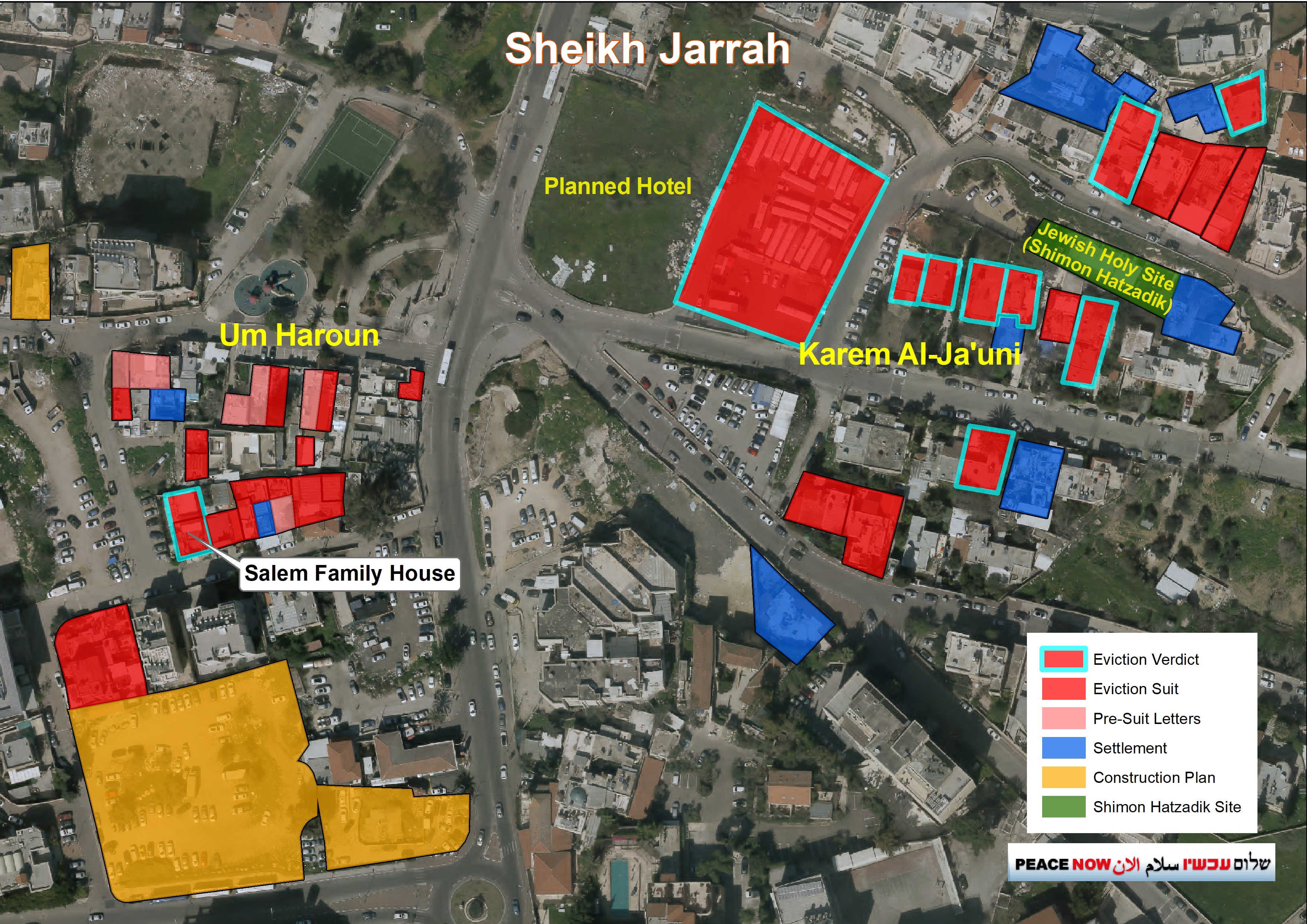 This purchase took place, without a doubt, thanks to the help of the Israeli Custodian General – the body that manages property abandoned by Jews in 1948 when their heirs are unknown – which almost certainly helped King and Yosef in identifying the property, locating the heirs and securing its sale (see Peace Now’s excellent report on the Absentee Property Law for more legal background on how this happens).
On December 15th, Ir Amim documented the scene as settlers, under the protection of Israeli police, fenced off the Salaam family’s land (where they are supposedly permitted to live until the 29th) in an attempt to prevent Palestinians, including the Salaam family, from accessing the area.
Peace Now said in response:
“This is a terrible injustice based on the cynical exploitation of a discriminatory law that allows Jews to exercise the ‘right of return; to property lost to them in 1948, at the expense of Palestinian families legally living in the property, while another Israeli law denies the same right to Palestinians. This is exactly what the Mishnah says: ‘He who says: mine is mine and yours is mine, is called evil’. The State of Israel, which took the Palestinian refugees’ properties lost to them in 1948, cannot today allow settlers to take from Palestinians Jewish properties lost in 1948 and on which they are have already received compensation. The government can stop this evacuation, and it must do so.”
The eviction of the Salaam family comes as the government of Israel is pursuing the displacement of as many as 70 Palestinian families in Sheikh Jarrah.
In parallel, the Israeli government has begun construction on a settlement installation (including a “public garden” as well as a driveway that will service an as-of-yet-unbuilt Israeli hotel in the neighborhood) at the entrance to Sheikh Jarrah, including the demolition of several Palestinian businesses. Notably, the site of this project is very close to the tomb of Shimon the Righteous, which is a religious site closely associated with the settler enclave in Sheikh Jarrah. The Jerusalem Municipality previously expropriated the land, which was privately owned by Palestinians, “for public use” — an Israeli legal tactic that permits the State to confiscate even privately owned land ostensibly to benefit the “public” (a “public” that it seems never includes Palestinians in East Jerusalem).
In October 2021, the Israeli Supreme Court rejected the appeals by the business owners to stop the demolition. This week, bulldozers leveled a plot of land owned by four Palestinian families and that was the location of two Palestinian businesses, a car wash and a parking lot. The business owners were handed an immediate eviction notice on December 14th, just one day before the bulldozers began work.
Israeli Custodian General is Behind Six New Settlement Plans Across East Jerusalem

Map by Haaretz
Haaretz reports that the Israeli Custodian General is planning six new settlement enclaves, to be located in some of the most sensitive areas of East Jerusalem. The news comes one week after the public learned of one of these plans, Givat HaShaked (see FMEP’s reporting last week), which is now understood to be part of a larger Israeli government plan to advance a slate of new settlement enclaves across East Jerusalem. As a reminder, the Israeli Custodian General is empowered by the State to act as caretaker of land that has unknown ownership.
While details on the plans are scant for the time being, Haaretz reports that the Israeli Custodian General is planning new settlements buildings that include:
1 – A new settler enclave in Sheikh Jarrah, in an area known as Um Haroun. As has been well documented, Palestinians are in a battle to stay in their longtime homes in Sheikh Jarrah while the Israeli Custodian General and Israeli settlers work hand-in-hand to displace them. Thirteen Palestinian families in Sheikh Jarrah (whose legal battle will impact dozens more) are still awaiting a Court ruling on their displacement at the hands of settlers. Haaretz reports:
“According to a custodian document, it administers 33 plots out of a total of 58 in the neighborhood. Five more plots have been expropriated by the Israel Land Authority. The city zoning plan allows for the demolition of the old structures and construction of buildings up to four-stories in their stead, or expanding them to that height. This could mean the construction of a neighborhood containing hundreds of housing units in the heart of Sheikh Jarrah. The Justice Ministry’s Land Registrar recently completed the registration of the neighborhood to its Jewish owners, so it is likely that any neighborhood built there will be for the Jewish population.”
2 – A new settler enclave near the Damascus Gate, near the Old City of Jerusalem, where approximately 10 Jewish Israeli families have already established a settlement enclave.
3 – Two new settler enclaves near Beit Safafa, one being the Givat HaShaked settlement plan which FMEP covered in greater detail last week. The second plan is not far from where the Givat HaShaked settlement would be built, and reportedly would involve a large settler compound with dozens more settlement units to be built in the sliver of land between Beit Safafa and the Talpiot Industrial Zone.
4 – A new settler enclave in Sur Baher. Reportedly, the Custodian is hoping to add more land to its holdings in Sur Baher (it currently holds 3.3 dunams and is attempting to gain 2 more dunams), meaning this plan could expand.
5 – A large new settler enclave in Beit Hanina. The Custodian is reportedly looking to build dozens of new settler units on six dunams of land (1.5 acres), to be located on a plot adjacent to the IDF Central Command base. The Custodian has also sought the cooperation of the Defense Ministry in promoting this plan.
The Justice Ministry, which houses the Custodian General, attempted to dodge these reports, telling Haaretz that it is not “advancing” any of these plans other than the one in Sheikh Jarrah, where it says it is “examining a construction project.”
Israel Custodian General Reveals New Details on Regulations Governing its Management of East Jerusalem Properties, Leaving More Questions
Under pressure from an impending court hearing, on December 11th the Israeli Custodian General submitted a document to the Court purporting to enumerate the regulations governing its management of properties in East Jerusalem. The Custodian General was facing a December 14th Court hearing on a petition filed by the Israeli NGO Ir Amim along with Palestinian residents of Sheikh Jarrah, that asserted no such regulations existed, enabling “severe misconduct and collaboration with settler groups to initiate evictions of Palestinian families in East Jerusalem, which severely infringes on the rights of Palestinians in the city.” Some 70 families in the Sheikh Jarrah neighborhood are facing homelessness because of the Custodian General’s collusion with settlers seeking their displacement from properties in which they have lived, legally, for decades.
In light of the Custodian General’s new publication (which the court viewed as resolving the complaint against the State), the Court dismissed the petition without prejudice, meaning the petitioners are permitted to file a new case on the same matter in the future.
Ir Amim filed the petition following news that the Custodian General has advanced a plan to build a new settlement – Givat HaShaked – on property it manages. As reported last week, this is an unprecedented move by the Custodian General, raising questions about whether the Custodian General is permitted to allow properties under its management to be developed. The document submitted to the Court this week by the Custodian General only raises more unanswered questions about the parameters governing the Custodian General’s ability to act as a property developer for properties that it does not own (only manages while awaiting the locating of the legal owners/heirs). Ir Amim further explains:
“The procedure includes dozens of clauses, none of which reference the possibility that the custodian may itself file plans and build residential complexes on a lot it owns. One clause refers to this indirectly, stating, ‘When initiated, or if contacted regarding urban renewal or planned improvements, the Custodian General shall examine the essence of the request and its impact on the administered property.’ Indeed, planning sources are unfamiliar with any case in which the custodian acted as a realty entrepreneur by improving the properties it holds. The subject raises another issue: the custodian is technically forbidden to sell property. Therefore, it remains unclear whether the apartments built in these various compounds will be sold on the open market, or whether they will remain the property of the custodian, who will rent them out. The Justice Ministry has not responded to clarify the matter.”
Israel Forges Ahead with New Settlements on the Golan Heights
At the recommendation and with the approval of Prime Minister Bennett, on October 14th Interior Minister Ayelet Shaked signed off on two orders establishing a settlement municipal authority in the occupied Golan Heights, a move that opens the door for an expedited planning process for existing and new settlements in the area. This includes the construction of the infamous “Trump Heights” settlement in addition to planned settlements called Givot Eden, Asif, and Matar. Last week, Prime Minister Naftali Bennett said that Israel’s plan is to double the settler population in the Golan Heights by 2030.
The special committee, which will act as a zoning board with broad planning authority, will have the combined powers of local and district planning and building committees, but will not include members who represent the public – an anomaly in the Israeli planning system.
The committee has already completed initial work by laying out the territorial borders of the “Trump Heights” settlement, which will cover 276 dunamns (about 70 acres). With its borders decided, the committee will move to expedite construction plans for residential housing, public buildings, industrial areas, roads and more.
On this massive settlement effort, the Haaretz Editorial Board writes:
“Occupied territories are occupied territories and annexation is annexation, even when it’s the Golan Heights and even when the annexation plan is called “a plan for encouraging sustainable demographic growth.”…We must tell it like it is. This is an artificial population expansion project, meant to strengthen Israel’s grip on the Golan Heights and create facts on the ground that will make it difficult for future leaders who might consider holding negotiations on the territory. To expedite matters, the Prime Minister’s Office seeks to create a “special committee” with the powers of the local and regional planning and building committees, but without the customary inclusion of public representatives. This is a national project. Like the so-called Judaization of the Galilee. Like the settlement enterprise.”
Al-Monitor provides a helpful background on the occupied Golan Heights and the creation of “Trump Heights”:
“Israel seized the Golan Heights from Syria in the 1967 Six-Day War. In 1981, Menachem Begin’s government formally annexed the territory. This unilateral move was not recognized by any country until Trump came along. In March 2019, his administration changed long-standing American policy by recognizing Israeli sovereignty over the region. A proclamation signed by Trump declared, ‘The State of Israel took control of the Golan Heights in 1967 to safeguard its security from external threats. Today, aggressive acts by Iran and terrorist groups, including Hezbollah, in southern Syria, continue to make the Golan Heights a potential launching ground for attacks on Israel. Any possible future peace agreement in the region must account for Israel’s need to protect itself from Syria and other regional threats. Based on these unique circumstances, it is therefore appropriate to recognize Israeli sovereignty over the Golan Heights.’ Three months later, the [Israeli] Cabinet convened for a special session in the Golan Heights and approved the establishment of a new settlement named for the US president. At that meeting, a huge sign decorated with Israeli and American flags was unveiled at the entrance to the new settlement. Written on it in gold letters was the name Ramat Trump.”
Following Murder of Israeli Settler,Settler Launch Attacks of their Own & Attempt to Establish New Outpost
On December 17th, a Palestinian gunmen opened fire on a settler vehicle near the dismantled settlement of Homesh, in the northern West Bank, killing one man – Yehuda Dimentman – and injuring two others. The IDF has apprehended several suspects already.
Though the Homesh settlement was evacuated by the Israeli government in 2005 – and military orders have barred Palestinians from entering the area – settlers have been allowed to establish an unauthorized outpost at the site, where the settlers also operate a yeshiva. Settlers have been openly obsessed with the desire to re-establish Homesh, hosting religious events and protests at the site, some of which have been attended by Israeli MKs and politicians. At the funeral for Dimentman, which several Israeli politicians attended, already begun calling for the government to formally reestablish the Homesh settlement.
In the hours following news of Dimentan’s death, settlers have already begun exacting revenge – with little to no interference from the IDF, though the outpouring of violence is an entirely predictable established pattern in the wake of Palestinians attacks. In the Palestinian village of Qayrut, a group of at least 15 settlers launched and especially violent attack on a Palestinian home, knocking on the door pretending to be Israeli soldiers at 4am, then proceeding to ransack the house and severely beat Mohammed Makbal – sending him to the hospital. No suspects have been apprehended, though several were caught on camera.
Within 24 hours of the attack, settlers from the Kiryat Arba settlement in Hebron moved to establish a new outpost in honor of Dimentan, called Nofei Yehuda. In this case, the IDF moved in swiftly to remove the settlers from the area. The outpost was established by members of the Nahala settler movement, of which Dimentan was a part. Nahala is behind a lot of unauthorized construction in the West Bank, and is a leading force in the battle over the Evyatar outpost.
Peace Now has written about the Nahala Movement, saying:
“The Nahala organization and the main activists of the new outposts are not the mainstream old-guard settlers (like the Amanah organization who is behind many other settlements and outposts and gets much more support from the authorities), however they are not a small fringe. This outpost is an example of a rift that is being created within the Israeli right wing. The more extreme right, which is willing to challenge the system more strongly, and the old-guard settlers who continue the mentality of working ‘with’ the government as much as possible. On the partisan level we see this rift in the creation of two different parties: Yamina, headed by Naftali Bennet, and the Jewish Zionism, headed by Betzalel Smotrich and Itamar Ben Gvir. The challenge of the new outpost puts the new shaky government, which is a coalition of parties which don’t agree about many things, to face its first big political test. The extreme right is signaling that it is planning to continue to challenge the new government, like it had done in the flags march in East Jerusalem, and in yesterday’s settlers’ marches throughout the West Bank.”
Gantz Moves to Send More Police to West Bank to Monitor Settler Violence
Defense Minister Benny Gantz and Israeli Public Security Minister Omer Bar-Leg have agreed to draft hundreds of Israeli soldiers into the (domestic) police force, so that Israeli police can then be reassigned to the West Bank partly to fill posts dedicated to policing settler violence.
Settlers, of course, are not thrilled about the new attention being paid to settler terrorism experienced by Palestinian communities across the West Bank, and which has increased over the past year. According to Israeli government data (which does not systematically track settler violence against Palestinians) the Shin Bet logged 272 “violent incidents” in the West Bank in 2020; so far in 2021, there have been 397 “violent incidents” recorded by the Shin Bet. The UN recorded even more attacks this year – 450 as of December 6 – compared to 358 in all of 2020 and 335 in 2019.B’Tselem, which recently released an excellent report on settler terrorism, documents a 28.6% increase in settler violence in 2021 over 2020. Yesh Din, which also documents settler violence while seeking justice and accountability, notes that only 5% of cases it filed from 2018-2021 (238 total cases filed, while it documented 540 total cases) have resulted in indictments. Palestinians have increasingly declined to file police reports regarding settler crimes, with so few cases actually resulting in any tangible good for the victim.
For a SMALL sample of the terrorism inflicted by settlers on Palestinians in the West Bank on a daily basis, see the following reports from the past week by WAFA news:
- “Settlers, backed by Israeli army, intensify attacks against Palestinians in Nablus area”
- “Israeli forces attack Palestinian farmers, seize tractor in Masafer Yatta area”
- “Israeli settlers leave several villagers wounded, fractured south of Nablus”
- “Settlers attack Palestinian vehicles south of Jenin”
- “Israeli settlers attack Palestinian vehicles, bloc traffic artery east of Hebron”
- “Israeli settlers rampage through Nablus-district town”
- “Israeli settlers take over water spring in northern Jordan Valley”
Meanwhile in Israel…Political Storm Ensues Over Whether Settler Terrorism Is a Problem or Not
Following months (which followed years, which followed decades) of settler terrorism against Palestinians, this week Israeli Public Security Minister Omer Bar-Lev (Labor) set off a political clash within Israel over the issue. In comments made alongside U.S. Deputy Secretary of State Victoria Nuland — and after Israeli diplomats have allegedly come to believe that the Biden Administration is “obsessed” with “settler violence” (though other reporting contradicts that claim) – Bar-Lev called settler terrorism “severe” and said that Israel is taking steps to address it.
Those comments were seen as a betrayal by many of Bar-Lev’s pro-settler coalition partners, and elicited some strong condemnations. Interior Minister Ayelet Shaked (Yamina) said Bar-Lev is “confused.” MK Bezalel Smotrich (Religious Zionism) called Bar-Lev a “bastard” and tweeted “shame on you, little man.”
The drama also drew comment from Israeli Prime Minister Naftali Bennet who, it should be recalled, relies heavily on the settler constituency and is also ideologically closely aligned with the settlers, having once served as the head of the top settler body called the Yesha Council. Bennett appeared to dismiss Bar-Lev’s comments, in effect giving official cover for an a green-light to continued and unaccountable settler terrorism, tweeting:
“The settlers in Judea and Samaria have been suffering from violence and terrorism, every day, for decades. They are the defensive wall of us all and we must strengthen them and support them, in words and deeds…There are marginal phenomena in every public, they should be dealt with by all means, but we must not generalize an entire public.”
B’Tselem’s Executive Director, Hagai El-Ad, responded to Bennett’s claim, telling Haaretz:
“There’s a propagandistic façade here that’s convenient for Israel…There’s a few bad settlers, or more, on one side, and on the other is the good state of Israel, which seeks to enforce the law. But that isn’t the truth. Both the state and the settlers want the same thing – to dispossess Palestinians of their land.”
This relationship – between the settlers and the State when it comes to dispossessing Palestinians – was spelled out in a recent B’Tselem report, “State Business: Israel’s misappropriation of land in the West Bank through settler violence.”
Bonus Reads
- “Mining Gold From East Jerusalem’s Streets” (Amira Hass for Haaretz)
- “This was the deadliest year for Palestinian children since 2014” (Khaled Quzmar for +972 Magazine)
- “Unearthing the Palestinian Neighborhood Buried Beneath a Tel Aviv Park” (Haaretz)
- “Fact Sheet: Israel’s E1 Settlement” (IMEU)
- “Opinion: Israel just showed its strategy on settlement boycotts: Gaslighting” (Gershom Gorenberg in the Washington Post)
Welcome to FMEP’s Weekly Settlement & Annexation Report. To subscribe to this report, please click here.
June 17, 2021
- The New Israeli Government: Key Figures, Items on the Agenda, & Early Indications Related to Settlements & Annexation
- Struggle Against New Outpost Sparks West Bank Protests & Israeli Army Violence
- 30 Palestinian Families in Hebron Receive Demolition Notices to Make Way for Kiryat Arba Settlement Expansion
- Settlers Continue Persistent Invasions of Sebastia Archaeological Site Near Nablus
- Bonus Reads
Comments or questions? Email Kristin McCarthy – kmccarthy@fmep.org.
The New Israeli Government: Key Figures, Items on the Agenda, & Early Indications Related to Settlements & Annexation
A new Israeli government was sworn into office on June 13, 2021. For settlement watchers – here are key facts to know.
Key figures involved in settlement and annexation policy:
- Prime Minister: Naftali Bennet (Yamina)
- Alternate Prime Minister & Foreign Affairs Minister, to rotate to Prime Minister in 2023: Yair Lapid (Yesh Atid)
- Defense Minister: Benny Gantz (Blue and White)
- The Israeli Defense Ministry oversees the Civil Administration, the oddly-named arm of the Defense Ministry responsible for administering the occupation in the West Bank. The Civil Administration has total civilian and security control over Area C including the settlements (60% of the West Bank), and security control over Area B (21% of the West Bank). Press reports suggest that Labor’s Merav Michaeli – who is now serving as the Transportation Minister – attempted to bring West Bank roads under her purview (which would be an act of de facto annexation – West Bank roads are outside of Israel’s sovereignty and not under its domestic control). That was rejected by Gantz, who will retain control of West Bank matters as Defense Minister. One settler recently paraphrased Gantz as saying: “Only I will decide on settlement construction and negotiate with the Americans on issues pertaining to Judea and Samaria.”
- Settlement Affairs Minister: Nir Orbach (Yamina)
- Construction and Housing Minister & Minister for Jerusalem Affairs: Ze’ev Elkin (New Hope)
- Justice Minister: Gideon Sa’ar (New Hope)
- Minister of the Interior: Ayelet Shaked (Yamina)
- Shaked, who previously served as Justice Minister, hard-bargained her way into a second highly consequential posting as the government representative to the Knesset’s Judicial Selection Committee. Ynet reports that the coalition has agreed to name Shaked to the post only after a representative from the Labor Party (reportedly Merav Michaeli) is seated on the panel.
- The coalition’s Security Cabinet will include: Bennett, Lapid, Gantz, Sa’ar, Shaked, Elkin, in addition to: Avigdor Liberman (Finance Minister – Yisrael Beiteinu) Merav Michaeli (Transportation Minister, Labor), Omer Barlev (Public Security Minister – Labor), Nitzan Horowitz (Health Minister – Meretz), Matan Kahana (Religious Minister – Yamina), and Yifat Shasha-Biton (Education Minister – New Hope).
The new government, headed by Nafatli Bennet, published a list of the agreements made by the new coalition – terms that were agreed by all parties as a condition of forming the new government. Those agreements include the following settlement- and annexation-related commitments:
- “Establish a budget for the unfunded students of Ariel University.”
-
-
- Reminder #1: Ariel University is located in the Ariel settlement in the West Bank. As it is not within Israeli sovereign territory, establishing the university, bringing it under domestic authorities like the Israel High Education Council, and establishing a state budget for it, are all acts of de facto annexation.
- Reminder #2: While serving previously as Minister of Education, Naftali Bennett was intimately – and inappropriately – involved in bringing Ariel University under the domestic jurisdiction of the Israeli Higher Education Council.
- Reminder #3: During the Trump Administration, the U.S. signed agreements with Ariel University, a de facto recognition of Israel’s sovereignty in the West Bank. In addition, Florida Governor Rob DeSantis (a close Trump ally and rising political powerhouse in the Trump-aligned Republican party) also signed several agreements establishing academic partnerships between schools in Florida and Ariel University
-
- “Overall plan for transportation in Judea and Samaria and the Jordan Valley.”
-
- For a deep dive into how Israel uses roads and infrastructure as means of de facto annexation and towards the forced displacement of Paelstinians, read this fantastic piece by Break the Silence: “Highway to Annexation: Israeli Road and Infrastructure Development in the West Bank”
- “Ensuring Israel’s national interests in Area C. Allocation of resources to the Ministry of Defense for enforcement in cases of construction violations and illegal takeover of land in Area C.”
- In his first speech to the Knesset after being sworn in as Prime Minister, Naftali Bennett paid particular attention to this promise, saying: “We will ensure Israel’s national interests in Area C – and we will increase standards to that end after much neglect in this area.”
- Reminder #1: This is the continuation of an ongoing campaign – led by settlers and their allies in government, including Bennett and Shaked – to entrench and expand Israel’s control over (and de facto annexation of) the entirety of Area C, which represents around 60% of the West Bank. While in the Knesset, Bennet and others were highly critical of the Netanyahu government’s alleged failure to robustly “defend” Israel’s rights/interests in Area C (e.g., preventing “illegal” Palestinian construction, preventing foreign projects that support Palestinians’ presence in the area, clearing out Palestinians, expanding settlements, consolidating state-built settlement infrastructure). Knesset has also repeatedly hosted forums to discuss the alleged “Palestinian takeover of Area C.”
- Reminder #2: In September 2020 the Netanyahu government allocated 20 million NIS ($6 million USD) for the newly created Settlement Affairs Ministry to survey and map unauthorized (by Israel) Palestinian construction in Area C (construction for which Palestinians can virtually never obtain Israeli approval, and which Israel has been aggressively demolishing). This funding further empowers a domestic Israeli body to exert extraterritorial sovereignty over Area C – in effect, treating the area as land already annexed by Israel.
- The Times of Israel reports that the coalition has also agreed to allow the High Planning Council – the body within the Defense Ministry that considers and approves all settlement construction plans – to continue to meet on a quarterly basis, as has been the practice since 2017. The body has not met since January 2021, during the waning hours of the Trump Administration.
Prior to the new government’s swearing-in ceremony, one settler leader – David Elhayani, who heads the Yesha Council (a settler umbrella group) and the Jordan Valley settlement council, and may be the only settler leader who has come out in support of the new coalition – told the Times of Israel that the new coalition had promised that there would be no freeze on settlement construction.
Struggle Against New Outpost Sparks West Bank Protests & Israeli Army Violence
 Palestinians have continued their weekly protests against the new illegal outpost – which settlers call “Evyatar,” built on on Mount Sabih, which is land belonging to the village of Beita – located south of Nablus. The Israeli army continues to violently suppress these protests, killing two young Palestinians from Beita over the past two weeks: on June 11th, the IDF shot in the chest (with a live round) and killed 16-year old Palestinian Mohammed Said Mohammad Hamayel; on June 16th, the IDF fatally shot 16-year old Ahmed Bani Shamsa in the head. Seven other protestors have also been shot and a total of five Palestinians have been killed by Israeli forces during protests related to Beita and the Evyatar outpost in the past two months.
A representative from Defense for Children International – Palestine said:
“Israeli forces frequently use live ammunition for crowd control to disperse protesters, ignoring their obligation under international law to only resort to intentional lethal force when a direct, mortal threat to life or of serious injury exists/ Systemic impunity has fostered an environment where Israeli forces know no bounds.”
As a reminder, last week Defense Minister Gantz marked this outpost for evacuation and demolition. But in the week since the military orders were issued against the outpost (during which a new Israeli government was sworn in) those orders have not been carried out. Instead of evacuating and dismantling the illegal outpost, uniformed IDF soldiers this week were pictured helping the settlers install new construction at the site.
Explaining the situation, an activist and resident of Beita, Ibrahim Dawoud, told Middle East Eye:
“On every level, the Israeli state is assisting these settlers in the takeover of our land, even though their outpost is illegal under Israel’s own laws. Within 40 days of establishing their outpost, the Israeli government has given these settlers running water, electricity, and have paved a settler-only road for them straight up the mountain…For years the soldiers have prevented [Palstinians from Beita] from accessing their land on the mountain, and it is ours. We have the papers to prove ownership, they do not. They have no right to this land. If someone from Beita even tried to erect a tent on the mountain, just a small tent, the soldiers would be there within seconds, shooting at them and kicking them off their own land. And this is not just in Beita, it’s happening all over Palestine. Israeli settlers are allowed to steal our land freely, but when we try to defend it, we are killed.”
A Facebook page updated by settlers at the outpost states explicitly that the purpose of the outpost is to prevent contiguity between the surrounding Palestinian villages while connecting the Israeli settlement of Tapuah to the Za’atara Junction and Migdalim settlement. [photo]
30 Palestinian Families in Hebron Receive Demolition Notices to Make Way for Kiryat Arba Settlement Expansion
Al-Monitor reports that 30 Palestinian families (approximately 300 people) are under threat of forced displacement from their longtime homes and agricultural land in an area called Khirbet al-Aida, near the Kiryat Arba settlement just outside of Hebron. Israel has asserted the land is “state land,” despite the fact that, according to the nearby Palestinian municipality, all of the families possess Ottoman-era land titles proving their ownership.
Samer Jaber, one of the Palestinians under threat of displacement, recently received an eviction notice after submitting a building permit application to the Israeli authorities. That application was rejected and returned with a notice that Israel has classified Jaber’s land “state land,” and ordered his family’s eviction from the site. Israeli authorities have previously demolished sheds that Jaber built on his land.
Settlers Continue Persistent Invasions of Sebastia Archaeological Site Near Nablus
WAFA reports that on June 16th, hundreds of settlers invaded the Sebastia archaeological site under the protection of the Israeli army. The site is located in the town of Sebastia, near Nablus, a town that is in Area B of the West Bank where Israel – as stipulated in Oslo – should not be operating in. The Mayor of Sebastia, Mohammed Azzem, told WAFA that a large number of Israeli soldiers shut down the town and took up positions in the streets and several rooftops near the site in order to provide security for the settlers.
Settlers have been openly agitating – with some success – for Israel to assert control over the archaeological site in Sebastia for years. In January 2021, Emek Shaveh (an Israeli NGO expert in – and focused on – archaeology) wrote about what is happening in Sebastia, saying:
“The archaeological site of Sebastia is identified with Samaria, the capital of the Kingdom of ancient Israel in 9-8 BCE. The site also features ruins from the Hellenistic, Roman and later periods. The village of Sebastia is situated within Area B while the site itself is located mainly in area C. Over the past few years, the Samaria Regional Council has been organizing tours to the site, particularly during the school holidays. Several times this year, the Civil Administration has removed a Palestinian flag from the village and the site. In the most recent incident, a flag was raised following renovation works funded by the Belgian government. In their response the regional council blamed the Palestinians for destroying a site central to Jewish history and UNESCO for supporting the Palestinians. Sebastia is on the tentative list of World Heritage sites in Palestine….the integration of ancient sites into an organized strategy designed to weaken Palestinian hold on Area C is worrying. The formalization of this approach is likely to result in a steep rise in actions over ancient sites and structures, from water cisterns found in many villages, to major sites such as Sebastia. The justification for preserving and developing ancient sites familiar to us from East Jerusalem is now being applied wholesale to hundreds of places in the West Bank to the detriment of the Palestinians living near the sites and to the multilayered heritage inherent in the ruins which will be distorted for political ends.”
As FMEP has chronicled, settlers and their allies are intent upon taking control of archaeological sites and artifacts that are currently under Palestinian control, claiming the sites are neglected and/or damaged. For example, in February 2021 settlers used a construction mishap to raise claims to the Mt. Ebal site.
In January 2021, the state of Israel committed funding to a new settler initiative to surveil archeological sites under Palestinian control. While the objective of protecting antiquities might appear uncontroversial and apolitical, the true (and transparently self-evident) objective behind this effort is to support yet another pretext to surveil and police Palestinians, and yet another means to dispossess them of their properties. It is the result of a campaign that has taken place over the past year in which settlers have escalated their calls for the Israeli government to seize antiquities located in Palestinian communities across the West Bank, especially in Area C, which Israel today treats as functionally (and legally) indistinguishable from sovereign Israeli territory. The controversy that erupted over the Mt. Ebal archaeological site in February 2021 should be understood in this context.
Previous victories for the settlers include the Israeli Civil Administration’s recent issuance of expropriation orders for two archaeological sites located on privately owned Palestinian property northwest of Ramallah. The expropriations – the first of their kind in 35 years – come amidst a new campaign by settlers lobbying the government to take control of such sites, based on the settlers’ claims that antiquities are being stolen and the sites are being mismanaged by Palestinians. The settlers’ pressure is also credited as the impetus behind the government’s clandestine raid of a Palestinian village in July 2020 to seize an ancient font. The Palestinian envoy to UNESCO, Mounir Anastas, recently called on the United Nations to pressure Israel into returning the font to the Palestinian authorities.
In June 2020, a settler group calling itself “Shomrim Al Hanetzach” (“Guardians of Eternity”) began surveying areas in the West Bank that Israel has designated as archeaological sites in order to call in Israeli authorities to demolish Palestinian construction in these areas. The group communicates its findings to the Archaeology Unit of the Israeli Civil Administration (reminder: the Civil Administration is the arm of the Israeli Defense Ministry which since 1967 has functioned as the de facto sovereign over the West Bank). The Archaeology Unit, playing its part, then delivers eviction and demolition orders against Palestinians, claiming that the structures damage antiquities in the area.
As a reminder, in 2017, Israel designated 1,000 new archaeological sites in Area C of the West Bank. The “Guardians of Eternity” group, not coincidentally, is an offshoot of the radical Regavim organization, which among other things works to push Israeli authorities to demolish Palestinian construction (on Palestinians’ own land) that lacks Israeli permits (permits that Israel virtually never grants). The group raised public alarm about the Trump Plan, alleging that hundreds of biblical sites in the West Bank are slated to become Palestinian territory.
Bonus Reads
- “Former Attorney General Discovers Settler Group Took Over His Family’s Sheikh Jarrah Home” (Haaretz)
- “Israeli settler assaults Jerusalemite activist Muna al-Kurd” (WAFA)
- “Karim Khan, new ICC chief prosecutor, to decide Israel’s fate” (Jerusalem Post)
- “How Israel’s Occupation Came Home” (NewLines // Elizabeth Tsurkov)
- “Saving Lifta: Palestinians rally against latest threat to depopulated Jerusalem village” (Middle East Eye)
- “Palestinian mom fights to stave off punitive home demolition” (AP)
- “Israel to halt nighttime ‘mapping’ of Palestinian homes” (AP)
- “Family left in shock by shooting of young Palestinian woman” (AP)
- “Roadblocks upend Palestinian family’s life in East Jerusalem’s Sheikh Jarrah” (Reuters)
Welcome to FMEP’s Weekly Settlement Report, covering everything you need to know about Israeli settlement activity this week.
To subscribe to this report, please click here.
February 28, 2020
- Fuel on the Fire: Netanyahu Advances E-1 Settlement Plans
- Making Good On Bibi’s Promise, Israel Issues Tenders for Givat Hamatos Settlement – And Plans for More
- High Planning Council Advances Plans for 1,739 Settlement Units, Including a New Industrial Zone
- Netanyahu Orders 12 Outposts Hooked Up to Israeli Infrastructure, with More to Follow
- Israel is Planning New West Bank Electricity Grid to Serve the Settlements
- Deputy Israeli AG Bemoans “Alarming Accumulation” Of Cases in Which Political Echelon Stops Outpost Evacuations
- Joint U.S.-Israeli Annexation Mapping Team Begin Work in Ariel
- Bonus Reads
Comments or questions – email Kristin McCarthy (kmccarthy@fmep.org).
Fuel on the Fire: Netanyahu Advances E-1 Settlement Plans
On February 26th, the High Planning Council of the Israeli Civil Administration deposited for public review two separate plans (for a combined total of 3,401 units) for the construction of the infamous E-1 settlement. This move sets in motion a 60-day public commenting period, after which the committee can grant final approval for construction. Long called a “doomsday” settlement by supporters of a two-state solution, construction of the E-1 settlement would sever the West Bank effectively in half, foreclosing the possibility of drawing a border between Israel and Palestine in a manner which preserves territorial contiguity between the northern and southern parts of the West Bank. It would likewise consolidate the isolation of Palestinian neighborhoods in East Jerusalem from the West Bank. In combination with the recent advancements on Givat Hamatos and new tenders for Har Homa, Prime Minister Netanyahu’s Greater Jerusalem settlement construction announcements – leading up to the third round of Israeli elections – have crossed red lines (in the eyes of the international community) that Netanyahu didn’t dare cross in the past.
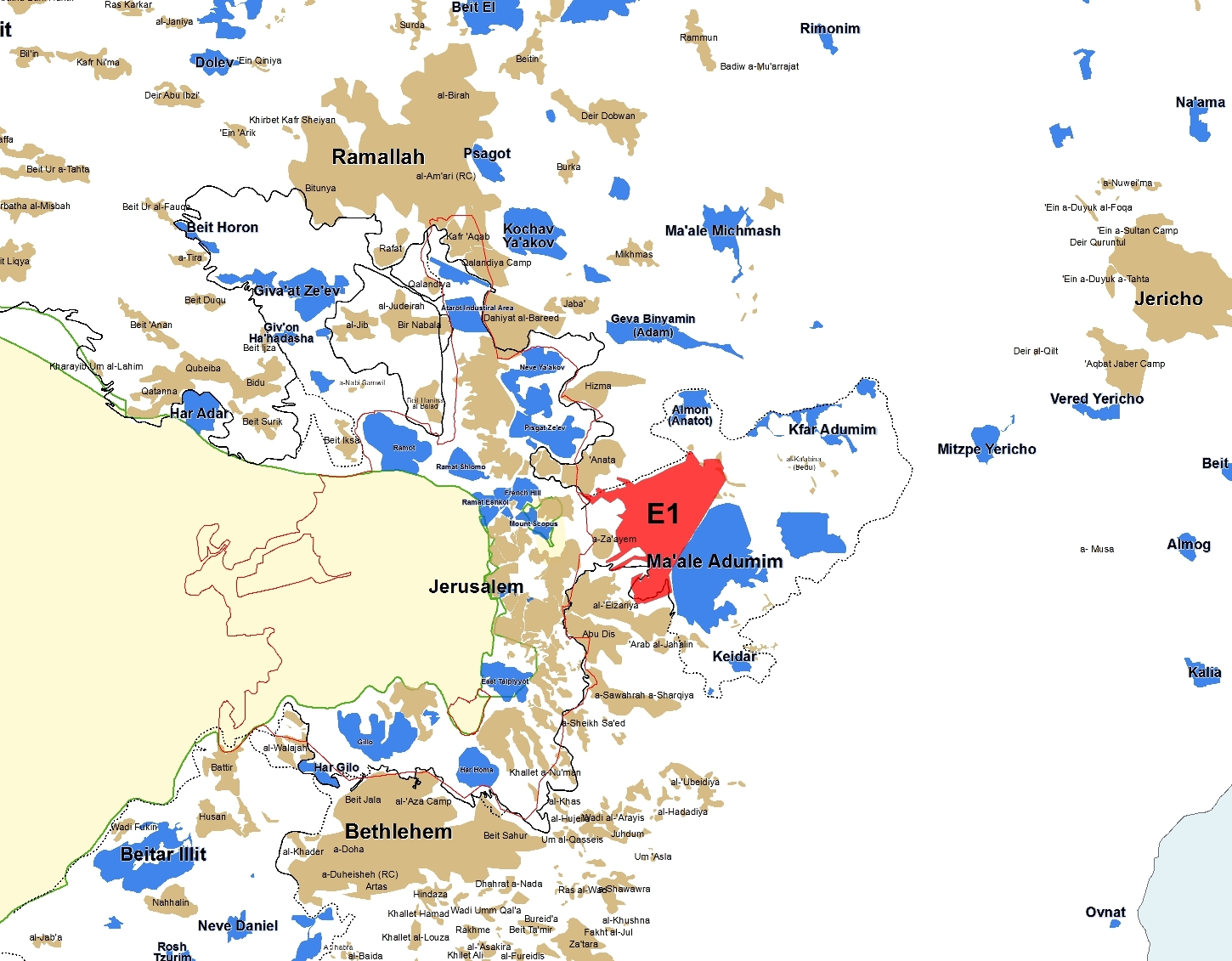
Map by Peace Now
The day before the High Planning Committee’s decision to deposit the plans, Netanyahu announced that he had lifted the freeze on E-1 that his government has imposed since 2012. Though the plans were approved for deposit in 2012, the administrative act of actually depositing the plans (which requires the plans to be published in at least three newspapers to inform the public) never occurred, largely as a result of intense international opposition to E-1. Under the recently released Trump Plan, the area where E-1 is located is slated to become part of Israel, meaning the long-held U.S. opposition to E-1 has transformed into apparent support.
Peace Now explains important context to Netanyahu’s flood of East Jerusalem settlement approvals:
“This move to promote settlement units in E1 should be understood in the context of government actions to promote settlement construction in Givat Hamatos and Har Homa to sever the Bethlehem-Jerusalem continuum, and the early promotion of a plan to turn the decommissioned Atarot Airport into a new Jerusalem settlement that would work toward severing the Ramallah-Jerusalem continuum. With E1 added to the mix, the pattern of severing the East Jerusalem and the West Bank is a clear policy direction of this government. While this announcement may be connected to the upcoming election, Netanyahu should be taken at his word and his comments should not be written off as campaign bluster. Indeed just this week he fulfilled a promise he made the week prior to publish tenders in Givat HaMatos, another area that was seen as a red line by the international community. It is likely that if moving on E1 is not met with deterring action domestically or abroad then it will further encourage settlement activity, seeing as E1 is the most recognized red line on settlement construction. The US, which has traditionally played a large role in deterring activity in E1, will likely not do so now with its current administration. Indeed, the Trump Plan envisions E1 as part of Israel, and allows for Israeli annexation pending coordination with the US and not negotiations with the Palestinians.”
Ir Amim adds:
“Although these advancements have taken place against the backdrop of the upcoming Israeli elections, they should also be seen as an alarm bell in the context of a new reality which has been created with the publication of the US Peace Plan. Carte blanche has essentially been given to Netanyahu and the Israeli government to further carry out unilateral measures in the Jerusalem area with little to no resistance. An acute exemplification of this major shift is the spate of new settlement plans (Atarot, Har Homa E, Givat Hamatos) being advanced over the Green Line in East Jerusalem, and now within the E1 area. After years of restraint due to international opposition, Israel is now set to advance construction in some of the most controversial areas in Jerusalem and along its perimeter. The realization of these plans will serve as an immense obstacle towards the future establishment of a Palestinian capital in the city and the prospect of a negotiated agreement based on a viable two-state framework.”
PLO Executive Committeewoman Hanan Ashrawi said in a statement:
“With the active participation and support of the current US administration, Israel is unilaterally and illegally annexing Palestinian territory and trampling on the Palestinian people’s most basic rights. These announcements are the practical translation of an extremist, ideologically-driven, and dangerous right-wing agenda that trounces Palestinian human rights and threatens to unravel the international order in favor of unilateralism, exceptionalism and political bullying.”
UN Special Coordinator for the Middle East Peace Process, Nikolay Mladenov, said:
“I am very concerned about Israel’s recent announcements regarding the advancement of settlement construction in Giv’at Hamatos and Har Homa, as well as the worrying plans for 3,500 units in the controversial E1 area of the occupied West Bank. All settlements are illegal under international law and remain a substantial obstacle to peace. If the E1 plan were to be implemented, it would sever the connection between northern and southern West Bank, significantly undermining the chances for establishing a viable and contiguous Palestinian state as part of a negotiated two-state solution. I urge the Israeli authorities to refrain from such unilateral actions that fuel instability and further erode the prospects for resuming Palestinian-Israeli negotiations on the basis of relevant UN resolutions, international law and bilateral agreements.”
Making Good On Bibi’s Promise, Israel Issues Tenders for Givat Hamatos Settlement – And Plans for More
As expected, on February 24th the Israeli Lands Authority published a tender for the construction of 1,077 housing units in the Givat Hamatos settlement. Haaretz reports that the tender relates to plans for “state land” and are intended to be sold as part of the the Treasury Ministry’s subsidized housing plan for young Jewish couples. Private companies will invited to bid on the project starting March 5th, with bidding set to close on June 22nd.
In addition to issuing tenders, the Jerusalem District Planning Committee met on February 27th to discuss the possibility of creating a new master plan for Givat Hamatos, in order to allow for more construction in the area. Ir Amim reports that the committee is considering a plan allowing for 6,500 residential units – which nearly doubles the total outlined in the current plan.
Ir Amim writes:
“This is the first time since the late 1990’s that Israel is constructing a new neighborhood/settlement in East Jerusalem. Furthermore, the location of Givat Hamatos means that its consturction will have dire consequences: It will serve to detach Bethlehem and the south of the West Bank from East Jerusalem while isolating the Palestinian neighborhood of Beit Safafa. For several years Netanyahu has abstained from publishing the Givat Hamatos tenders, serving as a source of frustration among rightwing parties. Netanyahu’s announcement therefore constitutes a break in the longstanding restraint. This dramatic change of policy should be seen in the context of his re-election campaign and against the backdrop of the formal release of the US Peace Plan.”
In announcing his support for the construction of the Givat Hamatos settlement last week, Netanyahu also mentioned plans to build 1,000 new homes for Palestinian residents of Beit Safafa – an East Jerusalem neighborhood which will be completely encircled by Israeli construction if/when the Givat Hamatos and Har Homa West settlement plans are implemented. According to Haaretz, the plan was/is to build 1,000 units on “Arab-owned” land — and that plan, in fact, is frozen.
In reaction to the tender for construction of the Givat Hamatos settlement, European Union High Representative Josep Borrell said in a statement:
“The Israeli authorities have announced an imminent decision regarding settlement construction in the Givat Hamatos and Har Homa neighbourhoods in East Jerusalem. Such steps would be deeply detrimental to a two-state-solution. As set out clearly on numerous occasions by the European Union, including in Council conclusions, such steps would cut the geographic and territorial contiguity between Jerusalem and Bethlehem, isolate Palestinian communities living in these areas, and threaten the viability of a two-state solution, with Jerusalem as capital of both states. Settlements are illegal under international law. The EU will not recognise any changes to the pre-1967 borders, including with regard to Jerusalem, other than those agreed by the parties. We call on Israel to reconsider these plans.”
High Planning Council Advances Plans for 1,739 Settlement Units, Including a New Industrial Zone
On February 27th, the High Planning Council – a body within the Israeli Civil Administration responsible for regulating all construction in the West Bank – approved the advancement of plans for 1,739 settlement units in the West Bank. These advancements come on the heels of the publication of tenders to build the E-1 settlement , the initiation of plans to massively expand the Har Homa settlement, and the recommitment of Israel to build a new massive new settlement in East Jerusalem, at the site of the disused Atarot airport. All of these plans deal with construction on the edges of Jerusalem and serve collectively to sever the connection between Palestinian neighborhoods of East Jerusalem and the West Bank (consolidating Israel’s uncontested sovereignty over “Greater Jerusalem”).
Of the total, 703 units received final approval, including:
- Plans to grant retroactive legalization to 620 units in the Eli settlement, a move which had been frozen by the High Court of Justice for the past 5 years while the Court considered a petition filed by Palestinians (with the assistance of Yesh Din and Bimkom) claiming to own the land. Last week, the High Court ruled against the Pallestinian petition and removed the injunction against the plans. The Eli settlement is located south of Nablus and southeast of the Ariel settlement in the central West Bank
- 48 units in the Har Bracha settlement, located just south of Nablus
- 35 units in the Givat Ze’ev settlement, located south west of Ramallah (north of Jerusalem).
Of the total, 1,036 units were approved for deposit for public review, including:
- A new industrial zone – called “Shaar Hashomron” – to be located south of the Palestinian village of Qalqilya (a town which is literally surrounded on three sides by the Israeli separation barrier – which in this area is, indeed, a massive wall). Peace Now reports: “[the new industrial zone is] close to Green Line, east of Salfit and South of Qalqilya, near the planned Nahal Rabah cemetery. In the area of Nahal Rabah, there existed a firing zone for years that prevented the use of the land. The land’s designation as a firing zone was lifted a few years ago, and the government’s Blue Line team set new boundaries for the state lands that comprised this area, all in preparation for a plan to build a new industrial zone. Industrial zones are a type of settlement in of themselves, and the planned cemetery is likely to be the first component toward establishing the new industrial zone. The plan for this new industrial park is separate from the 1,739 housing units advanced in the HPC announcement.”
- A winery in the Kiryat Arba settlement, located on the border of Hebron.
- 534 units in the Shvut Rachel settlement, located near the Shilo settlement in the central West Bank. Shvut Rachel only recently became an authorized settlement area when Israel extended the jurisdiction of the Shiloh settlement to include it as a “neighborhood” (along with three other outposts).
- Two plans for a total of 156 units in the Tzofim settlement, located just north of the Palestinian village of Qalqilya, a town completely encircled by Israel’s seperation barrier (except for a single road connecting it to the rest of the West Bank) – in the northern West Bank.
- 110 units in the Alon Shvut settlement, located south west of Bethlehem.
- 106 units in the Ma’aleh Shomron settlement, located east of the Palestinian village of Qalqilya.
- 105 units in Kfar Eldad (formally a part of the Nokdim settlement), located south of Bethlehem.
- 24 units in the Karnei Shomron settlement, located in the northern West Bank east of the Palestinian village of Qalqilya. Israel is planning to continue expanding Karnei Shomron with the stated goal of bringing 1 million settlers to live in the area surrounding the settlement.
The Times of Israel notes that this is the second time the High Planning Council has convened in as many months, marking an uptick in the frequency of such meetings, which until now have taken place quarterly (4x/year) since the Trump Administration came into power.
Peace Now said in a statement:
“The caretaker government, without a public and moral mandate, sets facts on the ground for a small and extreme minority, against the will of the majority. In the battle over the settler right-wing vote, Bennett and Netanyahu are dragging Israel to invest in thousands of harmful and unnecessary settlement units. This is how a cynical and irresponsible leadership that is willing to abandon the Israeli interest for its political survival behaves.”
Netanyahu Orders 12 Outposts Hooked Up to Israeli Infrastructure, with More to Follow
On February 23rd, Prime Minister Netanyahu announced that he had ordered 12 unauthorized outposts to be connected to Israeli infrastructure, and that his government was working to formally legalize over 100 outposts. Connecting outposts to Israeli water, sewer, power, garbage collection, and other municipal services entrenches the permanence of these outposts and furthers the de facto annexation of Palestinian land. It also copiously rewarding settlers for breaking Israeli law (by illegally building outposts), incentivizing further lawbreaking by Israel’s most radical and ideological settlers. 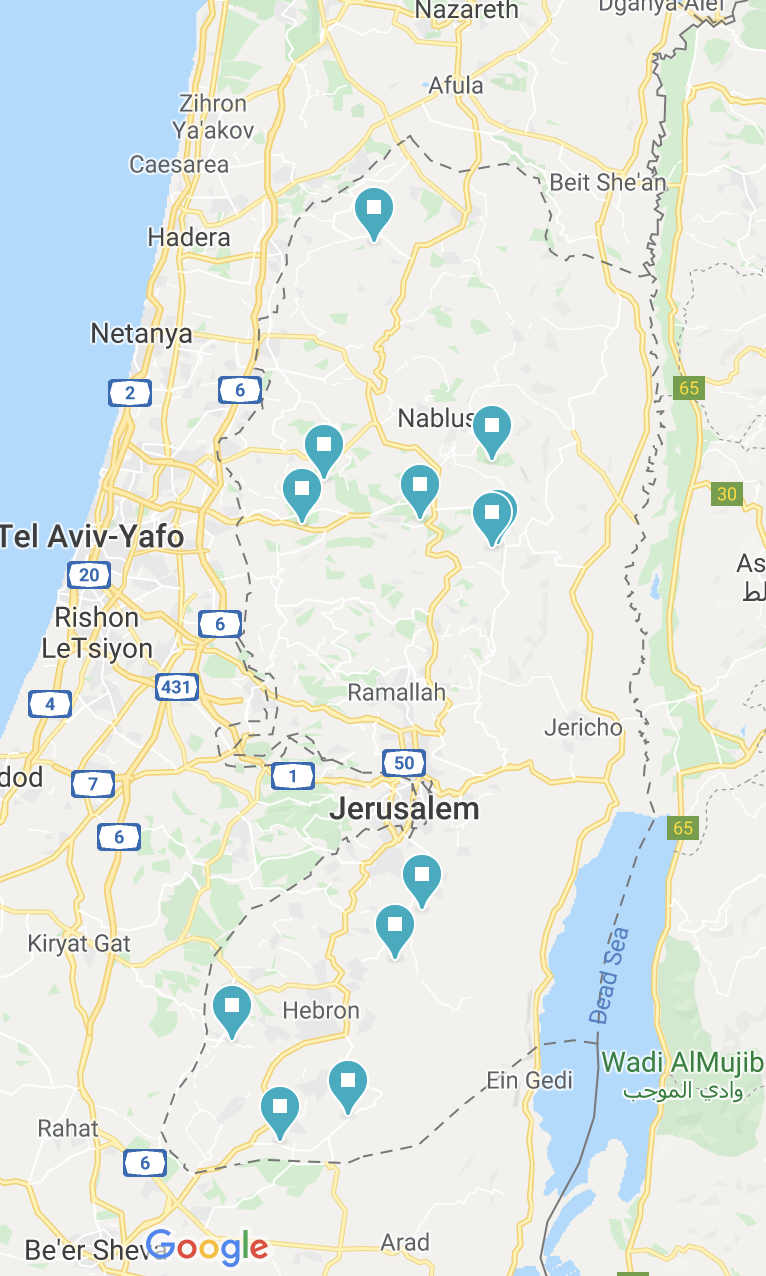
According to a letter from Netanyahu’s office, the 12 unauthorized outposts that will be connected to Israeli infrastructure were all built with “government encouragement” (though not formal approval or permits). In a perversion of the very notion of the “rule of law,” this unofficial encouragement for illegal actions is now treated by Israel as a valid legal basis for granting those outposts authorization.
The outposts slated for connection to Israeli municipal services are:
- The Nofei Nehemia outpost, located east of the Ariel settlement in the heart of the West Bank.
- The Havot Yair (Yair Farm) outpost, located west of Nablus.
- An outpost called “Hill 851”, located south east of Nablus in the central West Bank.
- The Maoz Zvi outpost, located in the northern West Bank.
- The Shaharit outpost, located in a string of settlements stretching from Israel proper to the Ariel settlement in the central West Bank, and going on to the Jordan Valley.
- The Pnei Kedem Farm outpost, located halfway between Bethlehem and Hebron in the southern West Bank.
- The Tekoa D outpost, located southeast of Bethlehem.
- The Negohot Farm outpost, located west of Hebron.
- The Avigayil outpost, located in the South Hebron Hills near the village of Susya.
- The Asa’el outpost, located east of the Palestinian village of Susiya in the southern tip of the West Bank.
- The Esh Kodesh outpost, located east of the Ariel and Shilo settlements, in a string of settlements stretching to the Jordan Valley.
- Ahiya, located in the Shilo Valley in the central West Bank.
David Elhayani, head of the umbrella settlement body called the Yesha Council, cheered Netanyahu’s announcement, saying:
“This is an important step for the benefit of young communities that have been suffering from electricity problems for years, and will now be able to receive electricity, just like any other citizen in the country.”
Since the passage of the Regulation Law in February 2017 and the invention of the “market regulation” principle by the Israeli Attorney General, the Netanyahu government has undertaken an energetic effort to grant retroactive legalization to outposts for which the Israeli government has not yet found a means to grant retroactive approval (though it has tried). The obstacle in all of these cases has been the fact that the outposts were built on privately owned Palestinian land. Following passage of the Regulation Law, Netanyahu immediately formed a committee tasked with finding a way to suspend the property rights of Palestinians; that committee produced the Zandberg Report in May 2018 — a report that, indeed, offers several justifications for the government to expropriate privately owned Palestinian land (one of the Report’s recommendations is to connect the outposts to Israeli municipal services). Following the publication of the Zandberg report, Netanyahu formed another committee tasked with implementing the report’s recommendations, by preparing individualized plans for each outpost to gain retroactive legalization. That taskforce, headed by notorious settler Pinchas Wallerstein. helped secure Cabinet approval for another bill to grant authorization to 66 outposts. All but two of the outposts named by Netanyahu this week (Hill 851 & Negohot) were part of a December 2018 bill to regulate 66 outposts – a fact that has drawn the wrath of settler leaders who bemoan Netanyahu’s delayed implementation.
FMEP tracks all events related to Israeli annexation and the drive to authorize outposts in its regularly updated Annexation Policy Tables.
Israel is Planning New West Bank Electricity Grid to Serve the Settlements
Haaretz reports that the Israeli government is close to approving a Master Plan for a new electricity grid in the West Bank, which will service Israel’s settlements. It may also serve Palestinian villages but only if — and it is a big if — the Palestinian Authority agrees to jointly implement the project. The plan is in the hands of Israel’s National Infrastructure, Energy and Water Ministry, which seeks to “provide a blueprint for the electricity market in the West Bank through 2040 and to develop infrastructure for Israeli settlements as well as for the Palestinians residing there.” However, the Israel-conceived plan calls upon the the Palestinian Authority to take responsibility over the Palestinian side of the equation, and the PA has refused to play that role and has condemned the plan.
In a statement, the Palestinian Authority’s Energy Authority said that the plan is designed:
“to establish Israeli sovereignty in the West Bank and to support the brutal presence of the settlements on our land.”
Settler leaders concurred with the PA’s assessment. Gush Etzion Regional Council chairman Shlomo Ne’eman told Haaretz:
“All moves point to sovereignty, and when we build infrastructure, there is also a basic understanding that the State of Israel is the sovereign. We are pleased that more and more government ministries have realized that this sovereignty is the reality.”
The plan, as reported by Haaretz, would see the Israeli Electric Company build a vast network of power lines across the West Bank. Israel will build six substations in Area C of the West Bank to distribute the high voltage power to settlements. Palestinians, if they are willing, are called upone to build eight substations in order to distribute power to Palestinian homes. The project is expected to cost between $870 million to $1.2 billion. The integration of settlements into Israel’s domestic planning schemes and the construction of massive infrastructure in the West Bank to service the settlements are significant advancements in Israel’s ongoing, de facto annexation of land in the West Bank.
Deputy Israeli AG Bemoans “Alarming Accumulation” Of Cases in Which Political Echelon Stops Outpost Evacuations
Haaretz reports that the Israeli Civil Administration planned to evacuate the unauthorized Mitzpe Yehuda outpost, located east of Jerusalem, in September 2019, but was directed to cancel the evacuation by one of Netanyahu’s personal aids in the Defense Ministry – Avi Roeh. The political interference was revealed in a High Court case filed by Palestinians claiming to own the land upon which the outpost was illegally constructed. The Palestinians are seeking to have the outpost immediately evacuated. Settlers claim to have purchased the land, and even submitted an application to have the outpost retroactively legalized by the government.
At the time of the scandal, Deputy Attorney General Erez Kaminitz wrote to Ronen Peretz, acting director of the Prime Minister’s Office, criticizing Roeh’s role in the Mitzpe Yehuda case, as well as the recurrence of political interference on behalf of the outposts. Citing several cases in which such interference occurred (Sde Ephraim, Givat Assaf, and Havat Negohot), Kaminitz wrote:
“This is a very alarming accumulation of cases that raises the specter of the emergence of a highly problematic trend that undermines the rule of law. It’s important to make clear that, as a rule, the political echelon is not authorized to intervene in decisions related to law enforcement.
Joint U.S.-Israeli Annexation Mapping Team Begin Work in Ariel
On February 24th, members of the U.S.-Israeli team tasked with mapping Israel’s annexation of West Bank land under the Trump Plan met for the first time to “explore the terrain.” At a vista near the Ariel settlement, Netanyahu underscored the significance of the project:
“The joint mapping process of the Israeli team and the American team is underway here in Ariel. This is a major mission. The area has an 800-km. perimeter. There is serious work, but we will work as quickly as possible to get it done…[the mapping process will] allow for the application of Israeli law [sovereignty] on these areas and later American recognition as well…[once complete] sovereignty can happen immediately.”
U.S. Ambassador David Friedman said:
“In Israel rain is a blessing, and I hope that our efforts should be blessed as much as the rain is coming down right now,” Friedman declared before the meeting started, the US Embassy in Jerusalem said in a statement. “We have our team here, and we’re going to get to work right away. We hope to complete it as soon as possible, and complete it the right way for the State of Israel.”
Ariel Mayor Eli Shaviro – one of the few settler leaders who publicly supports the Trump Plan – praised the mapping team, saying:
“The sovereignty ship is under way. As I have said in the past, I believe that the prime minister will advance the ‘Deal of the Century’ with President Trump and US officials. believe that the application of Israeli law in the Jordan Valley and in the communities of Judea and Samaria is closer than ever.”
Shaviro recently resigned from the settler Yesha Council over the group’s disavowal of the Trump Plan.
Bonus Reads + Resources
- “An Alternative Guide to City of David Archeological Park” (Emek Shaveh)
- “The Trump plan threatens the status quo at al-Haram al-Sharif” (Al Jazeera)
- “50 ex-European leaders and FMs condemn Trump plan, cite apartheid similarities” (The Times of Israel)
- “Planned Western Wall Train Will Threaten Historic Jerusalem Spring, Report Says” (Haaretz)
- “The Israelis fighting to keep the Jordan Valley Palestinian” (Al-Monitor)
Welcome to FMEP’s Weekly Settlement Report, covering everything you need to know about Israeli settlement activity this week.
To subscribe to this report, please click here.
November 8, 2018
- Jerusalem Municipality Gives Final Approval to Two East Jerusalem Settlement Schemes Pushing Towards Beit Hanina
- Claiming Ignorance, State Tells the Court it Will Demolish New Jordan Valley Outpost
- Government Officials Lay Cornerstone of “New Migron” Settlement
- Israel Seizes Palestinian Land to Build New Road to Settlement
- Bennett Violated Govt Rules to Get a Legal Opinion Supporting the De Facto Annexation of Ariel University
- In Reversal, Israeli Ministers Embrace Bill to Allow Knesset to Overrule High Court on Any Issue (Not Just on Deporting Asylum Seekers)
- Settlers Group Alleges Palestinians are Undertaking a European-Backed Scheme to “Take Over” Area C of West Bank
- UN Report Details Israel’s De Facto Annexation of West Bank Land
- Four Alleged Security Incidents Near Settlements
- Bonus Reads
Comments, questions, or suggestions? Email Kristin McCarthy at kmccarthy@fmep.org.
Jerusalem Municipality Gives Final Approval to Two East Jerusalem Settlement Schemes Pushing Towards Beit Hanina
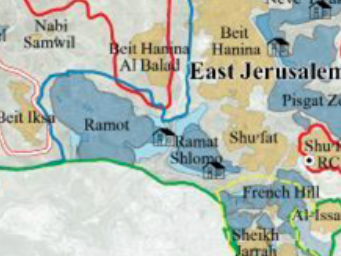 On November 6th, Jerusalem planning authorities granted approval to two settlement projects totalling 652 units in strategic areas that will increase the encroachment of settlements on the Palestinian East Jerusalem neighborhood of Beit Hanina – where the Israeli government is also advancing the first-ever government-backed settlement enclave inside of the neighborhood. This week the Committee approved:
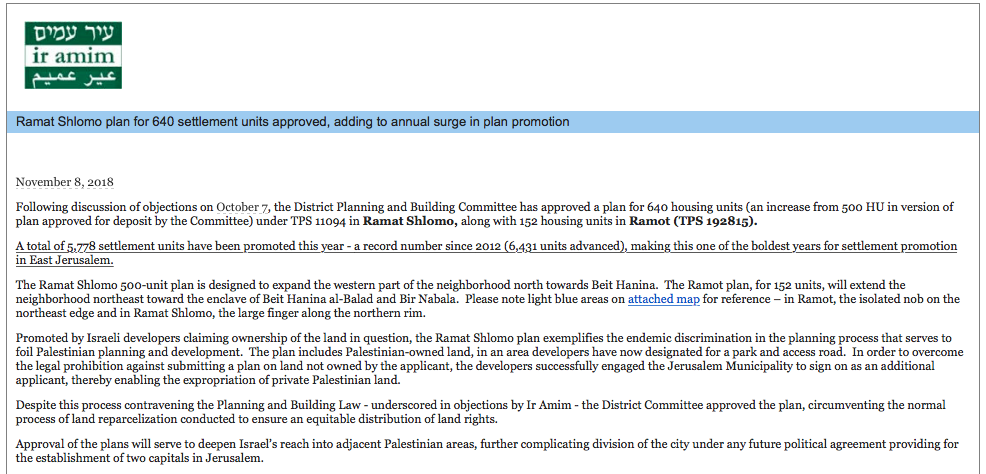
- A plan for 152 new units in the Ramot settlement in northern Jerusalem, extending the settlement’s footprint towards the Palestinian neighborhood of Beit Hanina.
- A plan for 640-units in the Ramat Shlomo settlement, to be built partially on Palestinian land, also extending the settlement north towards an existing settlement enclave inside of the Palestinian Beit Hanina neighborhood.
In granting final approval for the Ramat Shlomo plan, the Jerusalem District Planning and Building Committee decided to increase the number of approved units, from the proposed 500 to 640. And significantly, the Committee rejected serious complaints about expropriating privately owned Palestinian land for settlement purposes.
The Israel anti-settlement watchdog NGO Ir Amim filed one such complaint against the plan, explaining:
“Promoted by Israeli developers claiming ownership of the land in question, the Ramat Shlomo plan exemplifies the endemic discrimination in the planning process that serves to foil Palestinian planning and development. The plan includes Palestinian-owned land, in an area developers have now designated for a park and access road. In order to overcome the legal prohibition against submitting a plan on land not owned by the applicant, the developers successfully engaged the Jerusalem Municipality to sign on as an additional applicant, thereby enabling the expropriation of private Palestinian land.”
Ir Amim researcher Aviv Tartarsky told Haaretz this week:
“It’s very disappointing that the district committee relied on formalistic reasons to approve a step that violates the property rights of Palestinian landowners through and through. These aren’t extremist settlers in outposts somewhere out on hilltops in Samaria [the northern West Bank] but state institutions that are working in Israel’s capital city. This decision is additional proof that Israeli control in East Jerusalem means a regime based on serious discrimination.”
The new approvals add to an ever-growing tidal wave of settlement activity in East Jerusalem affecting the viability of the two-state solution, while tightening the screws on the local Palestinian population.
Claiming Ignorance, State Tells the Court it Will Demolish New Jordan Valley Outpost
Israeli government lawyers told the High Court of Justice that the State of Israel does not know who built an illegal outpost on a disused military base in the Jordan Valley, which settlers have named “Camp Gadi”, and announced that the Civil Administration will demolish it. If the Civil Administration moves to demolishes the outpost, it will require evicting several settler families who are squatting there, and shutting down a pre-military school that the families have been promoting.
The head of the Jordan Valley Regional Council, David Lahiani, seemed to contradict the government’s claim to innocence when he said that he has been in touch with the Civil Administration about legalizing the outpost. If Lahiani has been in touch with the Civil Administration, then questions arise about at what point the Israeli government learned about the outpost and who is behind it. Lahiani’s statement also contradicts (or at least raises questions about) a prior statement from the Jordan Valley Regional Council which denied involvement in establishing the outpost. Further calling into question the role of the Jordan Valley Regional Council, Lahiani was in a picture taken at the outpost which was uploaded to Facebook on October 24th.
Government Officials Lay Cornerstone of “New Migron” Settlement
A cornerstone laying ceremony marked the start of construction on the “New Migron” settlement, to be for the settlers who were removed from the illegal Migron outpost. Several government officials were on hand to lay the cornerstone of the new settlement, plans for which were approved in 2017, near the Kochav Yaakov settlement north of Jerusalem.
In 2011, the Israeli High Court ruled that the Migron outpost must be evacuated because it was built on privately owned Palestinian land. Most of the illegal outpost’s residents were evacuated and most buildings were demolished in Migron in 2012. Determined to demonstrate its support for settlers in the face of this court-compelled evacuation, the government promised to establish two new settlements: “New Migron” (located close to Kochav Yaakov settlement) as well as the approval of a plan for 184 housing units east of the Adam settlement (aka Geva Binyamin). All said, the two new settlements and temporary housing for the evicted settlers cost Israeli taxpayers millions of dollars – sending settlers a clear message that for them, law-breaking pays off.
At the ceremony this week, Jerusalem Affairs Minister Ze’ev Elkin said:
“During such events, it is customary to rejoice, but as someone who accompanied Migron from the moment of the evacuation to the present day, this is not a happy event. We would be happy if we had another legal system that made a logical decision, and I long for the days when the justice system will do justice. The settlement will grow and expand this way from time immemorial. The evacuation attempts will only lead to the strengthening and expansion of settlement.”
Housing Minister Yoav Galant, also at the ceremony, said:
“laying the cornerstone means that the territories of Yehudah and Shomron are not negotiable. It is not a subject for sale. We are laying a cornerstone for Migron and we will build it. I will see to it that the Israeli government does so by the end of the year.”
Knesset Speaker Yuli Edelstein, also in attendance, said:
“I did not come here to convince anyone about our rights in the land of Israel, I came here with mixed feelings of happiness from laying the cornerstone, alongside the great sadness of the difficult evacuation five years ago. We are here, first and foremost, thanks to the families of Migron that did not give up.”
Israel Seizes Palestinian Land to Build New Road to Settlement
According to Maan News, Israeli forces seized 38 acres (155 dunams) of Palestinian land in order to pave a road to the Beit Aryeh settlement, located northwest of Ramallah. Members of the al-Lubban al-Gharbi village council claim that the land is privately owned by Palestinians from the village and called on village residents to find documents proving land ownership in anticipation of an appeal against the construction.
So far this year, the Beit Aryeh settlement has been the beneficiary of two significant settlement advancements totalling 563 new units:
- On August 23, 2018 the Israeli Housing Ministry published a tender for 52 new settlement units in Beit Aryeh.
- On August 11, 2018 the government published a tender for 511 new settlement units in Beit Aryeh.
Bennett Violated Govt Rules to Get a Legal Opinion Supporting the De Facto Annexation of Ariel University
According to a new Haaretz report, Education Minister Naftali Bennett violated Israeli guidelines by using a private law firm to support his Knesset bill bringing settlement colleges and universities under the authority of the Israeli Higher Education Council. Prior to the Knesset’s passage of Bennet’s bill in February 2018, the Higher Education Council only included schools located inside of sovereign Israeli territory. The new law is tantamount to de facto annexation of settlement schools, and members of the Israeli Higher Education Council remain vocally opposed to the move.
The use of a private law firm is seen as an attempt to bypass the Education Ministry’s own apolitical (for now) legal advisors, and is a breach of the guidelines set years ago for every ministry by the Israeli Attorney General. The guidelines stipulate that in cases where private opinions are sought, the legal advisors for the ministry must supervise the process.
Bennet reportedly used an opinion paper issued by the Herzog Fox & Neeman firm stating the inclusion of Ariel University in the domestic Higher Education Council would not violate existing grant terms between universities in sovereign Israel and the European Union (which does not do business in the occupied territories). The opinion was then presented to members of the Higher Education Council to assuage fears that implementing the new law would result in losing international funding. The opinion said that the potential for funding cuts is “nearly non-existent.”
An anonymous senior official with the Higher Education Council told Haaretz:
“You cannot base official policy on an opinion paid for by an interested party. That’s not serious.”
Ariel University has not yet been admitted to the Council, despite the passage of the law in February 2018 and despite Minister Bennett’s repeated threats to end state relations with the Council if it did not immediately grant membership to the school. Israeli President Reuven Rivlin issued a rebuke to Bennett’s threats, saying:
“It’s possible to love Ariel without mocking academia.”
In Reversal, Israeli Ministers Embrace Bill to Allow Knesset to Overrule High Court on Any Issue (Not Just on Deporting Asylum Seekers)
At a meeting on November 4th, ministers in the governing Israeli coalition reportedly decided to abandon a bill that would empower the Knesset to reinstate its plan to deport African asylum seekers after it was struck down by the High Court, in favor of a much more far-reaching bill granting the Knesset the ability to reinstate any law the High Court strikes down. The passage of that bill would likely impact the fate of not only African asylum seekers but settlement-related legislation that has already been passed – most notably,the settlement Regulation Law – and other undemocratic measures that might follow. This news follows an exact opposite announcement two weeks ago, when Justice Minister Ayelet Shaked embraced the single-issue version of the bill, while promising to make the unlimited version a sticking point in any future coalition agreement.
Notably, the leaders of the current governing coalition decided to make this move at a meeting that was not attended by Kulanu Party leader Moshe Kahlon, who has until now blocked the coalition from advancing the unlimited version bill.
Israeli Attorney General Mandelblit vehemently opposes the bill. Mandelblit said:
“One must vigorously oppose this bill, which harms the constitutional regime of the State of Israel as a Jewish and democratic state. Removing all restrictions on undermining the human rights of a specific group, as is proposed now, has far-reaching implications for constitutional law and the democratic regime in Israel, and I strongly oppose it.”
Settlers Group Alleges Palestinians are Undertaking a European-Backed Scheme to “Take Over” Area C of West Bank
The radical settler organization Regavim – which devotes its efforts to systematically mapping out and expelling Palestinians from strategic areas in Jerusalem, the West Bank, and the Negev – presented a new report to the Knesset this week claiming that the Palestinian Authority (PA) is using European funding to take over land in Area C of the West Bank. The report alleges that the PA uses European money to pave roads, build on strategic military and diplomatic locations, and “steal” water resources, at the expense of Israel.
Regavim warns:
“If the government does not come to its senses and does something now, the Palestinian plan will create irrevocable changes and facts on the ground.”
Adding irony to Regavim’s current efforts to stop “illegal” Palestinian activity in the West Bank, in August 2018 the Israeli daily newspaper Yedioth Ahronoth published a comprehensive investigation into Regavim’s leaders. The group’s stated mission is “to ensure responsible, legal, accountable & environmentally friendly use of Israel’s national lands and the return of the rule of law to all areas and aspects of the land and its preservation.” The investigation revealed, however, that the organization’s efforts to identify and stop illegal construction are merely a tool to dispossess Palestinians of their land.
The Investigation found, in fact, that Regavim and its leaders have a demonstrable disregard for the Israeli planning and building laws that they purport to be dedicated to enforcing, evidenced most plainly by the fact that 15 Regavim officers are living in structures built on privately owned Palestinian land, some with demolition orders issued against them. These include the building where Yehuda Eliyahu, the current executive director of Regavim, lives.
UN Report Details Israel’s De Facto Annexation of West Bank Land
The United Nations Special Rapporteur on Situation of Human Rights in Palestinian Territories, Michael Lynk, issued a new report to the UN General Assembly – half of which is devoted to documenting the Israeli government’s annexation of Palestinian land in East Jerusalem and de facto annexation of land in the occupied West Bank.
The report concludes in part:
“These statements of political intent, together with Israel’s colonizing acts on the ground, its legislative activity, and its refusal to adhere to its solemn obligations under international law or to follow the direction of the international community with respect to its 51-year-old occupation, have established the probative evidence that Israel has effectively annexed a significant part of the West Bank and is treating this territory as its own. While Israel has not yet declared formal sovereignty over any parts of the West Bank, the Special Rapporteur submits that the strict prohibition against annexation in international law applies not only to a formal declaration, but also to those acts of territorial appropriation by Israel that have been a cumulative part of its efforts to stake a future claim of formal sovereignty over the occupied Palestinian territory.”
Four Alleged Security incidents Near Settlements
In the past three days, Israeli authorities have reported four security incidents near settlements:
On November 7th, the IDF reported that unknown assailants shot at a bus and lightly injured two Israelis near the settlement of Beit El, located deep inside the West Bank near Ramallah.
On November 6th, three Palestinian men were arrested near the Mevo Dotan settlement, south of Jenin, one of whom was allegedly carrying a gun.
Earlier on November 6th, a Palestinian woman was shot and arrested near the Kfar Adumim settlement, between Jerusalem and Jericho,after allegedly attacking Israeli border policemen with a pair of scissors.
On November 5th, a Palestinian man was shot and arrested after allegedly attempting to stab Israeli settlers and an Israeli IDF officer near the Kiryat Arba settlement, in Hebron.
Bonus Reads
- Khan al-Ahmar and Israel’s Creeping Annexation of the West Bank” (Newsweek)
- “Everyone Knows Settlers Cut Down Palestinian Olive Trees. But Israel Doesn’t Care” (Haaretz)
- “Settler leaders warned Rabin not to ‘cross redlines’ before assassination” (Times of Israel)
- “Hard Questions, Tough Answers: Why the Israeli mainstream turned right” (Americans for Peace Now)
- “An Interview with MK Sharen Haskel” (Fathom Journal)
- “Israeli justice minister opposes letting government jurists act as ‘gatekeepers’” (Haaretz)
Welcome to FMEP’s Weekly Settlement Report, covering everything you need to know about Israeli settlement activity this week.
To subscribe to this report, please click here.
August 17, 2018
- U.S. Ambassador: There is “No Reason” to Evacuate Settlements from West Bank
- Israel Publishes Tenders for 603 new units in East Jerusalem Settlement of Ramat Shlomo
- Massive Jerusalem Development Deal for 20,000 New Apartments – Including Settlement Expansion Projects
- Israel Triples Size of New Settlement Industrial Zone In Hebron
- Knesset Sends Funds to New Settler Council in Hebron, Despite High Court Injunction
- Knesset Approves Past Due Payment for the Construction of Amichai Settlement & “Temporary” Outpost
- Delay in Opening of new Jerusalem “Park” That Confiscates Palestinian Spring
- Israel Evicts Palestinians from Bethlehem Home Despite Court Order
- Bonus Reads
Comments, questions, or suggestions? Email Kristin McCarthy at kmccarthy@fmep.org.
U.S. Ambassador: There is “No Reason” to Evacuate Settlements from West Bank
According to MK Yehuda Glick (Likud), U.S. Ambassador to Israel David Friedman – who is one of three lead authors of the supposedly forthcoming U.S. peace plan – told a group of settler leaders that he does not see any reason why settlements would need to be evacuated from the West Bank in a peace deal with the Palestinians. MK Glick said Friedman was “very explicit” about that point during the meeting, which was held at the U.S. Embassy in Jerusalem. Notably, the position attributed to Friedman is consistent with positions he has taken in the past, both in speaking and writing.
 The Embassy declined to comment on the headline-making statement or the meeting itself. Without an American statement, settler leaders are the only source for what transpired in the meeting. According to MK Glick, the small group of settler leaders pushed Ambassador Friedman to endorse an “economic peace plan” as a substitute for a political solution to the conflict. Glick said that an economic proposal would “make redundant the discourse of concessions” (under previous U.S. proposals, Israeli concessions would have included the evacuation of far flung settlements in the West Bank).
Along those lines, the group presented Ambassador Friedman with a plan for a new industrial zone and medical center in the southern West Bank that, according to Glick and Har Hevron Regional Council Chairman Yochai Damari, would employ and serve thousands of Palestinians. The plan was presented by Glick, Damari, and Palestinian businessman Muhammad Nasser, who also attended the meeting. According to Glick, the U.S. Ambassador was supportive of the plan and offered U.S. assistance once the initiative was up and running.
[UPDATED 9/28/18: More details on the joint Israeli-Palestinian industrial zone in the Har Hebron region was later fleshed out by Ynet in a report here. The plan calls for an industrial zone and commercial center to be built near the Tene-Omarim settlement. Israeli Finance Minister Moshe Kahlon briefed the details of the plan to U.S. Treasury Secretary Steven Mnuchin and Jason Greenblatt, U.S. Special Representative for International Negotiations. The U.S. is expected to present the plan to the World Economy Forum during its annual meeting in January 2019]
Israel Publishes Tenders for 603 new units in East Jerusalem Settlement of Ramat Shlomo

Map by Ir Amim
On August 15th, the Israel Land Authority published construction tenders for 603 new settlement units in the Ramat Shlomo settlement in East Jerusalem. The 603 units are part of a larger plan for 1,500 units in Ramat Shlomo (tenders for almost all of which have been published now) that was announced by Israel in 2010, during the visit of then-Vice President Joe Biden. The timing of that announcement, and the inflammatory nature of settlement approvals in East Jerusalem (which the Obama Administration pressured Israel to halt), sparked outrage and prompted Biden to issue harsh criticism of Israel while on the ground. The incident earned the 2010 Ramat Shlomo plan the nickname the “Biden Plan.”
Anti-settlement watchdog Ir Amim comments that the Ramat Shlomo tenders are a part of the Israeli endeavor to:
“expand the Israeli neighborhoods/settlements in such a way as to consume the remaining space between them and nearby Palestinian neighborhoods ( a critical geo-political link between Jerusalem and Ramallah) so as to inhibit their development and further complicate any future division of the city.”
There has been a significant uptick in East Jerusalem settlement advancements since President Trump assumed office in January 2017, reflecting the sea change in U.S. policy towards settlements (evidenced again this week by Ambassador Friedman’s remarks, detailed above). As Ir Amim details, Israel’s unrestrained advancement of settlement construction in East Jerusalem has been coupled with legislative schemes to change the borders of Jerusalem (annexing far flung settlements into Jerusalem and cutting Palestinian neighborhoods out of Jerusalem) in order to engineer a Jewish Israeli majority in Jerusalem.
Massive Jerusalem Development Deal for 20,000 New Apartments – Including Settlement Expansion Projects
On August 15th, the Jerusalem Municipality signed a $380 million deal with the Israel Land Authority to finance a plethora of projects across the city, including 20,000 new apartment units. While much of this development will be in West Jerusalem, some will reportedly be in the East Jerusalem settlements of Pisgat Ze’ev, French Hill, and Atarot. The Jerusalem City Council is expected to give final approval to the plan next week.
Israel Triples Size of New Settlement Industrial Zone In Hebron
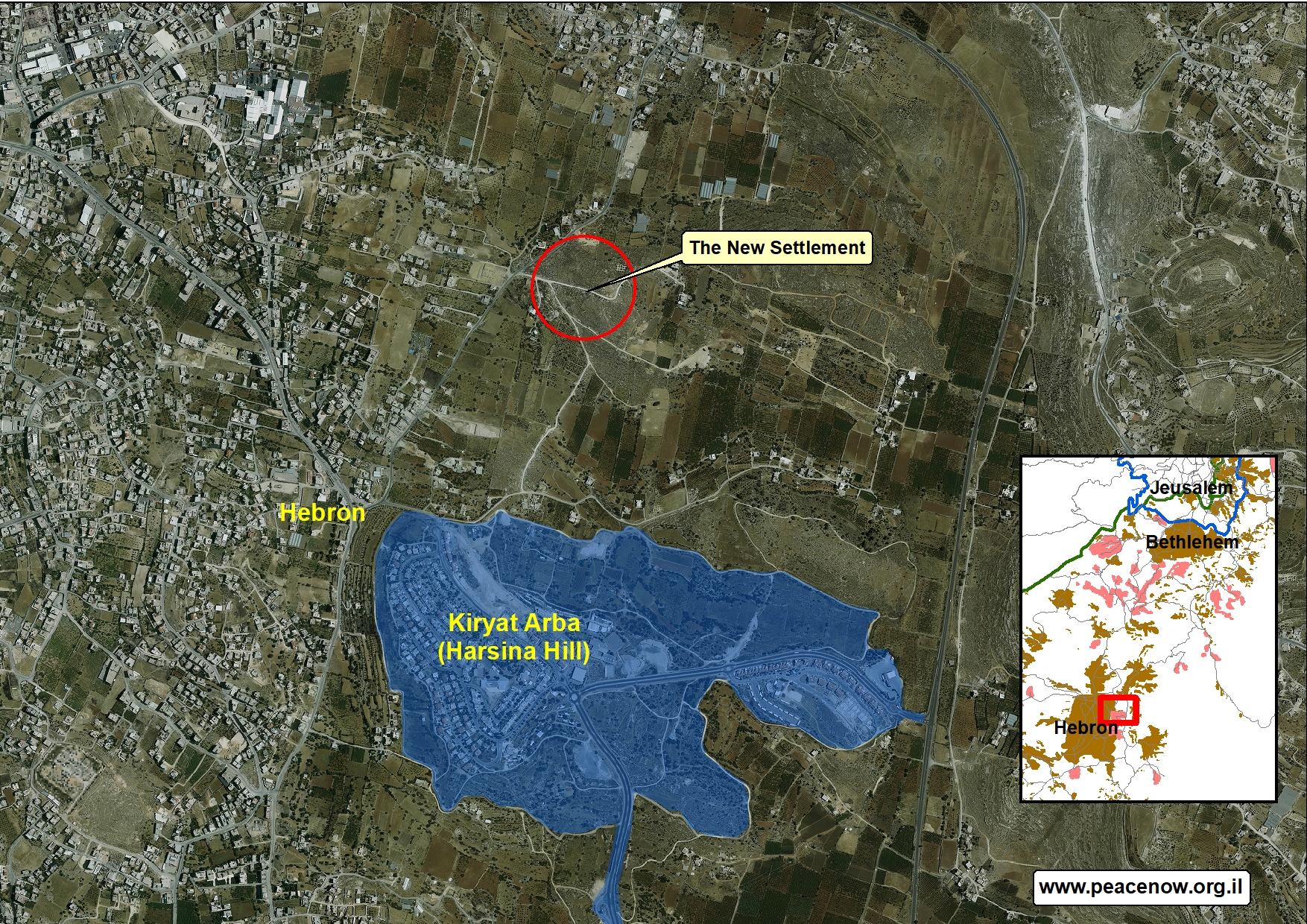
Map by Peace Now
According to The Jerusalem Post, on August 12th the Israeli government approved a plan that will triple the size of an industrial zone in the Kiryat Arba settlement in Hebron, approving 10 million shekels for the project. FMEP reported on the initial plans to build the Kiryat Arba industrial zone in March 2018, noting that the industrial zone is technically within the borders of the settlement but well outside of the developed lines of the settlement and beyond the fence that surrounds it – making it, in effect, a new Israeli settlement in Hebron. Now, the new settlement is set to significantly expand in one of the most volatile areas in the West Bank.
Knesset Sends Funds to New Settler Council in Hebron, Despite High Court Injunction
On August 12th, the Knesset Finance Committee approved 2 million shekels (about $550,000 USD) to fund the new local settler committee in Hebron. The Finance Committee requested that the money be disbursed to the Hebron settler committee “in accordance with an agreement in the past with MK Bezalel Smotrich,” (Habayit Hayehudi)…after the necessary professional and legal checks.”
The creation (via military order) of a new autonomous committee to represent and service a cluster of settlers living in enclaves in Hebron’s city center is being challenged by the Hebron Municipality. In response to the Palestinian petition, the High Court of Justice put a freeze on the plan, effective July 4, 2018, and gave the Israeli government 120 days to explain the legality of the plan. The petition argued that the military order creating the new body was intentionally vague in defining its legal and geographical jurisdiction, and pointed out that the new committee would be able to override decisions by the Hebron Municipality thereby stripping Palestinians of autonomy and representation in matters that directly affect them.
It is unclear from reporting if the Knesset Finance Committee’s decision to fund the new committee is related to the High Court’s ongoing consideration of the case. However, what is clear is that the Knesset is not concerned about undermining the High Court of Justice’s power over West Bank issues — indeed, the Knesset is actively pursuing that end with the recent passage of a new law stripping the Court of jurisdiction over land disputes and transferring it to a domestic Israeli Court, and with ongoing consideration of a bill that would allow the Knesset to reinstate laws that the High Court strikes down.
Knesset Approves Past Due Payment for the Construction of Amichai Settlement & “Temporary” Outpost
On August 12th, the Knesset Finance Committee approved the transfer of $9.5 million to pay contractors for their ongoing work on the first new settlement built with government approval in 25 years, Amichai, and a new “temporary” outpost for settlers whose homes were built on privately owned Palestinian land in the Netiv Ha’avot outpost and were recently demolished. Amichai is the new settlement approved as a pay-off to the settlers who were evacuated from the illegal Amona outpost. Construction on Amichai has begun, but has been interrupted several times due to lack of government cash, a problem ostensibly solved by this week’s cash transfer.
With respect to the new outpost for the Netiv Ha’avot outpost settlers, in February 2017 the Israeli government approved an unusual plan to place 15 mobile homes — connected to Israeli water, power, sewage, roads, and other infrastructure — at a site located near, but not within, the borders of the Alon Shvut settlement, in effect creating a new outpost for settlers evacuated from another outpost. When the High Planning Council initially approved the advancement of this plan in October 2017, it noted that “the plan is improper, but we will have to approve it as a temporary solution.” At the time, the Council ordered the government to go about expanding the borders of the Alon Shvut settlement to include the land. Under the approved plan, the new homes will be allowed to stay in that location for three years. However, based on past practice, it can be expected that within that time, or at the end of those three years, the site will “regulated” by Israel to become a permanent area of Israeli settlement.
In both cases – the Amichai plan and the Netiv Ha’avot plan – the Israeli government massively “compensating” citizens for the inconvenience of having been caught brazenly breaking Israeli law (i.e., for building without permits on privately owned Palestinian land). The two cases highlight the way in which the Israeli government not only encourages illegal settlement building, but generously incentivizes and rewards its. At this point, in addition to two new settlements, approximately 20 million shekels ($5.4 million) has been paid to the Amona evacuees and 15 million shekels ($4 million) to the Netiv Ha’avot evacuees.
Delay in Opening of new Jerusalem “Park” That Confiscates Palestinian Spring
A dispute between Israeli government agencies has led to a delay in the opening of a new Jerusalem tourist site – a park established for the express purpose of taking control over the Ein Al-Hanya spring, which was historically part of the al-Walajah Palestinian village. Originally slated to open April 1st, the delay centers around a battle over who will fund the operations of the site. For now, the site is closed and the grounds are not being maintained.
Regardless of the dispute, Israel has implemented policies that prevent Palestinians from accessing the spring and surrounding lands, including illegally moving a police checkpoint to further choke off al-Walajah from Jerusalem. As detailed in Haaretz, the plan for the park includes three pools filled by the spring – two for Israelis and tourists, and one for al-Walajah residents to water their crops and flocks. However, that third pool for Palestinians has not been built, and the water “merely spills into the nearby wadi.” The other pools, like the park, are currently empty and fenced off.
Israel Evicts Palestinians from Bethlehem Home Despite Court Order
Haaretz reports that settlers have forcibly evicted a Palestinian family from their home near Bethlehem, in defiance of an Israeli court order. The Palestinian Samara family reports that settlers tricked them into leaving the property, after which settlers locked them out, forcibly evicted them and their belongings, and then used a bulldozer to demolish their home. The family has filed an appeal to the High Court of Justice.
The Samara family – which since the early 1980s lived in 3 small units within a larger apartment building – has been targeted for eviction by settlers since 2012, when ownership of the building was transferred to an American organization controlled by Irving Moskowitz, a major funder of Jewish settlement in East Jerusalem. In 2016, the Gush Etzion Regional Council was given jurisdiction over the compound to move in Jewish Israeli settlers. Since that time, the building has been taken over by settlers, except for 2 units in which the Samara family lived as protected tenants (the third was welded shut), based on an Israeli court ruling under which the building’s owner promised not to restrict access to the building for four members of the Samara family (no other family members or visitors were allowed access). Regarding the arrangement, the judge wrote:
“This arrangement will remain in force unless a different judicial order is issued after a legal proceeding instituted by one of the parties.”
As Haaretz notes, there does not appear to be a different or new judicial order that would change the 2016 agreement.
In 2017, the Samaras reported that a new settler family had moved into the compound and began harassing the family members who remained – prompting them to file a complaint on July 26, 2018 with the Israeli police in the Beitar Illit settlement. Two weeks later on August 6th, the family was forcibly evicted and their units were demolished.
Despite the Samara’s harassment complaint and a real-time call to the police while the eviction was taking place, Israeli police took no action to prevent settlers from evicting the Samaras, reportedly stealing their cellphones, and bulldozing the properties. The Beitar Illit police station even refuse to allow the Samara family to enter the station and file a complaint until a lawyer for the family got involved many hours later.
Following intervention by UNRWA, the family was allowed to return to search the site for their ID cards and other important belongings. Now homeless, the Samara are taking their case to Israel’s the High Court of Justice.
Bonus Reads
- “A Palestinian Bedouin Village Braces for Forcible Transfer as Israel Seeks to Split the West Bank in Half” (The Intercept)
- “Between Garbage and Sewage: Israel’s Future Plans for Khan al-Ahmar” (+972 Mag)
- “Their Parents Settled the West Bank for Ideology, They’re Staying for the Vibes” (The Times of Israel)
Welcome to FMEP’s Weekly Settlement Report, covering everything you need to know about Israeli settlement activity this week.
To receive this report via email, please click here.
July 12, 2018
- Continuing New Legal Strategy, Israel Argues “Market Regulation” Principle In Bid to Legalize Outpost
- Cabinet to Consider New Bill to Legalize 70 Outposts
- Cabinet to Consider Three Bills that Advance Annexation of Area C Settlements
- New Proof that the Israeli Government is Driving Unauthorized Settlement Activity
- High Court Freezes Plan for Settlement Committee in Hebron; IDF Seizes Private Land Near Kiryat Arba
- High Court Allows the Israel Land Authority to Remain Under the Influence of the Jewish National Fund
- New Bill Would Allow Settlers to Build on National Park Grounds in East Jerusalem
- Civil Administration Strike Will Delay Settlement Construction
- Amichai Settlement’s Makeshift Sewage Pit is Contaminating Nearby Palestinian Fields
- Israeli President Cautions Against Shaked’s Bill to Politicize Key Legal Appointments
- United Nations Envoy: Israel is Moving Towards Formal Annexation
- Bonus Reads
Comments, questions, or suggestions? Email Kristin McCarthy at kmccarthy@fmep.org.
Continuing New Legal Strategy, Israel Argues “Market Regulation” Principle In Bid to Legalize Outpost
On July 3rd the Israeli State Prosecutor’s Office told the Jerusalem District Court that it has the right to retroactively legalize the Mitzpe Kramim outpost based on the “market regulation” principle. This is the recently-invented legal principle according to which the government can seize privately owned Palestinian land to give to settlers if settlers can demonstrate (to the satisfaction of an Israeli government that is doing everything possible to help them) that they built on the land “in good faith,” based on government assurances, and if the rightful landowners are offered compensation. This is just the second time the government has used the “market regulation” principle to defend the seizure of privately owned Palestinian land in court, the first being in November 2017 when the State informed the High Court of Justice that it intended to expropriate private land near the Ofra settlement. Neither court ruled on either case.

Map by Haaretz
The government’s deployment of the “market regulation” principle in the Mitzpe Kramim case completely reverses the position the government has taken for the last 7 years on this specific outpost case. Since 2011, the Israeli government admitted that the land was privately owned, that it had been mistakenly given to the World Zionist Organization in the 1980s (the Mitzpe Kramim outpost was built without Israeli authorization in 1999), and that the situation should be corrected. In its argument on July 3, 2018, the government is expressing its newfound power to seize the land, asserting that the settlers built there “in good faith” and should not be punished for the government’s mistake, under the powers of the “market regulation.”
Peace Now said:
“The state’s announcement to the District Court is a new low in the moral and political deterioration led by the Netanyahu government. As the body that has assumed responsibility for the Occupied Territories for the last 51 years, the state should have protected the property rights of Palestinians, who have no civil rights nor the ability to defend their own land. The fact that the state failed to protect their land cannot be an excuse to steal the land and grant it to the settlers.”
As Peace Now also notes, in order to satisfy the 1967 Government Property Order (which is the law underlying the “market regulation” principle) all of the land owners must be invited to participate in the court case. However, the settlers who filed the petition regarding Mitzpe Kramim failed to include all of the registered land owners, meaning there is a long course of legal action ahead before the case. Should the Court decide the case in the settlers’ favor, it would set a potentially far-reaching precedent for implementing and upholding the “market regulation” principle.
Israeli Attorney General Avichai Mandelblit originally argued for the “market regulation” principle in late 2016 as an alternative legal basis to the Regulation Law, which he believes to be “a sweeping and injurious arrangement that does not meet the test of proportionality.” That law, passed by the Knesset in February 2017, is now in serious legal jeopardy. While the Israeli government continues to staunchly defend the broader legal basis for expropriating privately owned Palestinian land established under the “Regulation law,” its increased use of the “market regulation” principle makes clear that come what may, the Israeli government has the intention to do whatever it takes to “legally” seize Palestinian private land in order to legalize outposts (offering a stark illustration of the difference between “rule of law” and “rule by law.”)
For extensive reporting on and analysis of the “market regulation” principle and the “Regulation Law,” see FMEP’s tables documenting Israeli annexation policies.
Cabinet to Consider New Bill to Legalize 70 Outposts
MKs Bezalel Smotrich (Habayit Hayehudi) and Yoav Kisch (Likud) have submitted a bill for consideration by the Israeli Cabinet that seeks to retroactively legalize 70 unauthorized outposts across the West Bank. The Ministerial Committee for Legislation (a group of Cabinet members that decides whether or not to lend government backing to Knesset legislation before it is introduced) could vote on the July 15th, during its last weekly meeting before the Knesset recesses for its summer break. According to a Defense Ministry spokesperson, 50 of the 70 outposts can become part of existing official settlements — meaning that if passed into law, the bill would (a) significantly expand the borders/footprint of some 50 existing settlements (to include the outposts and land separately the outposts from the new parent settlement), and (b) create as many as 20 new settlements.
In addition, the bill would direct the government to treat the 70 unauthorized outposts as if they were legal settlements, which would include providing municipal services like water and electricity infrastructure at the expense of the relevant regional council (funded by Israeli tax-payers). The bill would also stop the potential of enforcement of the government’s own laws against the specified 70 outposts (reminder: the Israeli government rarely enforces building laws against Israeli settlers, actively funds outposts despite their illegality, and continues to invent new ways to legalize them). According to the bill, enforcement of building laws against the unauthorized outposts could only happen at the direction of the Defense Minister or the Prime Minister, with the backing of the Cabinet.
FMEP has repeatedly covered news regarding the government’s efforts to legalize outposts built on privately owned Palestinian land. The passage of the settlement “Regulation Law” gave the government new, sweeping authority to legalize outposts which it had been unable to address under existing Israeli law (because of the fact that they were built on privately owned Palestinian land, in effect turning these into cases of incontestable theft of private property. The 2005 Sasson Report admitted that there was no possible way to legalize outposts built on privately owned Palestinian land, and concluded that all such outposts should be evacuated). With the new law in place permitting Israel to launder this land theft, the Cabinet created a Defense Ministry task force – and appointed veteran settler leader Pinchas Wallerstein as its head – empowered to examine the individual legal situation of each outpost and devise plans to retroactively legalize as many outposts as possible. In January 2018, a leaked recording revealed that the task force had been working for six months to prescribe courses of action for the outposts. Despite this, settlers and Knesset members have complained that the task force has done nothing and has not been funded, using these as talking points in their push for the new Smotrich bill.
Developments related to these efforts are tracked in FMEP’s annexation policy tables.
Cabinet to Consider Three Bills that Advance Annexation of Area C Settlements
In addition to the outpost legalization bill (covered above), the Israeli Ministerial Committee on Legislation is slated at its next weekly meeting on July 15th to discuss three bills that seek to advance Israeli de facto annexation of Area C, after refraining from discussing them last week. Those bills are:
- A bill to recognize settlements in the South Hebron Hills as well as the Kiryat Arba settlement (which is, in effect, part of Hebron) as part of the Negev regional economy. Economically, the change would enable these settlements to benefit from government grants and programs for the Negev; politically, and far more importantly, the change would erase the Green Line, legally treating these settlements as part of sovereign Israeli territory (the Negev is an area located inside sovereign Israel).
- A bill to change a 1953 Jordanian law in order to allow Israelis to directly purchase property in the West Bank. Under the current law, private, non-Arab individuals cannot purchase land in the West Bank. In 1971, the law was amended to add a loophole allowing companies registered to operate in the West Bank (like the World Zionist Organization and the Jewish National Fund) to purchase property, and often do so only to give it to Israeli settlers. This additional change would open the door for private purchases across the West Bank by settlers and their backers, including in the heart of Palestinian cities. Notably, Israeli security officials have in the past objected to changing this law, based on their recognition of the fact that settlers implanting themselves wherever they want in the West Bank – including in acts intended to be deliberately provocative – will be a security nightmare for the IDF and will enable settlers and their financial patrons to further hijack the national security agenda of the state of Israel.
- A bill to rescind the 2005 Disengagement Law in order to allow four settlements in the northern West Bank to be rebuilt. The settlements – Sa-Nur, Homesh, Kadim and Ganim – were evacuated following the passage of the Disengagement Law. Notably, the head of the Samaria Regional Council, Yossi Dagan, is one of the settlers that was evacuated from Sa-Nur in 2005 and has championed the bill, which was submitted for Cabinet consideration by Bezalel Smotrich (Habayit Hayehudi).
New Proof that the Israeli Government is Driving Unauthorized Settlement Activity
The Israeli State Comptroller published a report that exposes how Israel government bodies have colluded with the Binyamin Regional Council (one of the main governing bodies over West Bank settlements) to bankroll the construction and ongoing support of unauthorized outposts, even as the Israeli Civil Administration acts to try to stop the illegal construction the government is funding.
The report reads:
“The [Binyamin Regional] council has been the driving force in the construction of unauthorized communities [outposts] and has financed them…In so doing, the council has dictated a negative standard of behavior, that has allowed for illegal construction in the Judea and Samaria and has even advanced such activity…Government offices were involved in financing the planning and construction of the unauthorized outposts.”
In one of several examples of how the collusion has worked, the Comptroller explained that the Esh Kodesh outpost – which is actually located outside of the Binyamin Regional Council’s jurisdiction – was built in 2000 without government permission. In 2014, the Interior Ministry financed the renovation of roads in the outpost. Meanwhile, the Civil Administration issued demolition orders against structures in the outpost in 2003, 2012, and 2013.
Sensing opportunity to promote their new bill to retroactively authorize outposts (see above), MKs Yoav Kisch (Likud) and MK Bezalel Smotrich (Bayit Yehudi) argued that the Comptroller’s report, by proving the the state has participated in building outposts, underlines the necessity of authorizing those outposts for the sake of the settlers who moved to the outposts at the encouragement of the state.
Adding to the Comptroller’s report (and echoing several of its key points), a freedom of information act filed by Peace Now revealed that the Binyamin Regional Council has been concealing massive and illegal annual contributions to the Amana organization, which leads wide scale illegal settlement construction. Amana received NIS 37 million over three years from the Council, which is 57% of the funds doled out to non-governmental groups over that period. The Comptroller’s report criticized the Council’s support for private organizations, which violates Israeli law restricting regional councils to supporting apolitical, public groups. The report said “the council serves as a conduit for transferring funds from the state to a private association.”
Peace Now writes:
“this data now reveals the depth of this robbing of public funds to finance political campaigns and illegal activity. It is time for the Interior Ministry to put an end to this abuse of Israelis’ taxpayer money and to demand that the authorities in the West Bank cease this illegal funding and give the money back.”
High Court Freezes Plan for Settlement Committee in Hebron; IDF Seizes Private Land Near Kiryat Arba
The Israel High Court has ordered a temporary freeze on a military order creating a new, autonomous settler committee to represent and service a cluster of Israeli settlement enclaves in Hebron’s city center, a plan announced by Defense Minister Avigdor Liberman in August 2017. The military order, if allowed to be implemented, would transfer responsibility for the settlers’ municipal services (roads, sewage, electricity, etc.) from the Hebron Municipality to the new settler committee, a plan which contradicts the 1997 Hebron Protocol.
The High Court gave the Israeli government 120 days to explain the legality of the plan, which was challenged on multiple fronts by the Hebron Municipality. The petition argued that the military order was intentionally vague in defining the legal and geographical jurisdiction of the proposed settler body, and pointed out that the new committee would be able to override decisions by the Hebron Municipality thereby stripping Palestinians of autonomy and representation in matters that directly affect them.
While the Court considers the matter, events on the ground continue to underscore the volatility of the situation in Hebron. Elor Azaria, the Israeli soldier who was caught on camera executing an incapacitated Palestinian on the streets of Hebron, victoriously returned to the city on July 3rd after serving only 9 months in jail. The festivities welcoming Azaria were planned by a group that included the extremist settler and politician, Baruch Marzel. Only two days after the Azaria lovefest, Marzel pitched a two-person tent on the sidewalk next to a Palestinian home in the Tel Rumeida neighborhood in the Old City of Hebron. According to the Palestinian news outlet Ma’an, Marzel was involved in attacks on Palestinians in Tel Rumeida the same day, in an incident that resulted in the arrest of one Palestinian. Israeli police removed Marzel’s encampment from the street.
Also in Hebron, Palestinian media reports that Israeli forces have confiscated a plot of privately owned Palestinian land near the Kiryat Arba settlement and the Ibrahimi Mosque/Cave of the Patriarchs. A Hebron activist reports that the Israeli Army set up a new camp across the street from the seized land about one month ago, and is now moving the camp to the new site with the intention of declaring it a “closed military zone” to prevent Palestinians from entering the area.
High Court Allows the Israel Land Authority to Remain Under the Influence of the Jewish National Fund
The High Court of Justice dismissed a petition filed by Adalah which alleged that the Jewish National Fund’s representation on the Israel Land Authority council infringes on the rights of Palestinian to equality and dignity. Under Israeli law, 6 of the 14 members on the Land Authority council are to be appointed by the Jewish National Fund, an organization the petitioners say (with good cause) “openly discriminates against non-Jews and sees itself as an entity that serves only one population.” The Israel Land Authority is responsible for deciding how (and to whom) to allocate or sell land in Israel, including the land owned by the Jewish National Fund (13% of all land in Israel).
Following the High Court’s dismissal of the petition, the Haaretz Editorial Board wrote:
“In a properly run country, people who declare that they’re committed to acting in a discriminatory way are immediately disqualified from a public role. One can only imagine what Israelis’ response would be if in a country where Jews were a minority, half of a group’s members stated their intention to discriminate against Jews.”
New Bill Would Allow Settlers to Build on National Park Grounds in East Jerusalem
The radical settler group Elad is lobbying for a bill that will allow the group to build settlement units on the grounds of one specific national park located in the East Jerusalem neighborhood of Silwan, where Elad is engaged in a variety of activities to displace Palestinians and replace them with Israeli settlers (as FMEP has reported on extensively). On July 10th, the bill was approved by the Knesset’s Interior and Environment Committee, despite objections submitted to the committee by the Justice Ministry and the Attorney General. The bill was sent to the Knesset plenum for its first of three votes.
The bill will allow Elad to build more homes for Israeli settlers on the grounds of the City of David national park, which is located immediately south of the Temple Mount, adjacent to the southern wall of the Old City of Jerusalem. Since 2001, Elad has managed the park grounds on behalf of the Israel Nature and Parks Authority, a scheme which gives the settler group authority over (but no legal responsibility towards) thousands of Palestinian homes and hundreds of settler homes – a demographic balance Elad is working hard to flip.
Ir Amim’s researcher Aviv Tatarsky told Haaretz:
“This isn’t the first time a monkey is being made of the law and common sense to advance the agenda of the Elad settlers. But even this law can’t change the fact that Silwan, like East Jerusalem, is entirely a Palestinian city. Israeli attempts to deny that simple truth impair the basic rights of 350,000 people in East Jerusalem. The residents of the Israeli city also pay a price for it.”
For more information on the role on national parks around Jerusalem in advancing the Israeli settlement agenda in Palestinian neighborhoods, see Ir Amim’s reporting here, and a key survey and analysis of national parks in Jerusalem/East Jerusalem by Bimkom here.
Civil Administration Strike Will Delay Settlement Construction
A recently released list of Civil Administration functions that will be brought to a halt during the impending union strike includes the High Planning Council’s work to advance settlement construction plans, though a Civil Administration spokesperson said that construction can be expected to climb next quarter.
Hananel Dorani, Chairman of the Yesha Council, the umbrella group representing settlements,wrote a letter to Prime Minister Netanyahu, Defense Minister Lieberman, and Finance Minister Kahlon. Dorani, highlighting the green light from the political echelon to promote settlements, criticized the Civil Administration while pushing for a resolution:
“Especially now, at a time when political approval was given to promote construction, it’s not only commonplace that the Civil Administration doesn’t meet the task properly, but the workers’ strike will exacerbate the situation and create a bottleneck that’ll be difficult to free from for years. Civil Administration employees’ demand to add additional positions and their requests to improve salary conditions so they can fill existing positions hasn’t been answered for a long time, leading to renewed sanctions. As is well known, this is not the first time Civil Administration employees have initiated sanctions, but this hasn’t yet been dealt with…this organization is routinely substandard, and for a long time important headquarters work wasn’t promoted, plans approved by the political echelon are halted and piled up on the table in the Civil Administration, budgets earmarked for infrastructure projects (transportation, cellular, etc.) aren’t realized, no work permits are issued, and more…We ask that you get involved with all relevant parties and act immediately and personally to restore the Civil Administration to full functioning.”
Samaria Regional Council chairman Yossi Dagan complained:
“As if it is not enough that every house in Judea and Samaria (West Bank) needs four different permits from the political echelon, now the residents have also become hostages in a conflict between Civil Administration employees and the Finance Ministry.”
The Civil Administration will also suspend the following operations: the flow of commercial goods between the West Bank (both settlements and Palestinian areas) and sovereign Israel; changes to the land and population registries, issuance of import licenses and business permits; and, significantly, all actions – including demolitions – against illegal construction, which might delay the demolition of the Khan al-Ahmar bedouin community.
Amichai Settlement’s Makeshift Sewage Pit is Contaminating Nearby Palestinian Fields
Raw sewage from the Amichai settlement (the first new government-backed settlement in 20 years, established in the Shiloh Valley as pay-off to the evacuees of the illegal Amona outpost) has been flowing into the agricultural lands of the nearby Palestinian village Turmus Ayya.
The settlers dug a temporary sewage site (a pit in the ground that is now overflowing) only a few meters from Palestinian farm lands. Settlers have been living in mobile homes on the site of the settlement (which has not been built yet) for less than four months, and Palestinians say the the sewage began overflowing two months ago. A permanent sewage site for the settlement has not yet been built, in part because the settlement plans were approved at a “dizzying speed,” as Haaretz explains it.
Israeli President Cautions Against Shaked’s Bill to Politicize Key Legal Appointments
At a swearing in ceremony for new judges, Israeli President Reuven Rivlin took the opportunity to pointedly criticize a bill promoted by Justice Minister Ayelet Shaked which would, by design, politicize the appointment of ministerial legal advisors (a bill FMEP reported on here).
Rivlin said:
“we need independent legal advisors whose commitment to the law and being gatekeepers flows in their veins and constitutes the essence of their professional ethic. I understand elected officials. I too served in one or two roles before I reached this house, and I didn’t always agree with the legal advisor’s position. However, I believe we must be careful not to weaken one of the important pillars of the executive branch in Israeli democracy. We all want a legal advisor who’ll serve all elected officials from anywhere in the political spectrum in exactly the same way. Faithfully, devotedly, professionally, committed to government policy and primarily responsibility to uphold the law.”
United Nations Envoy: Israel is Moving Towards Formal Annexation
Ahead of the United Nations Human Rights Council’s meeting on the Israeli-Palestinian conflict, legal expert Michael Lynk told press that:
“After years of creeping Israeli de facto annexation of the large swathes of the West Bank through settlement expansion, the creation of closed military zones and other measures, Israel appears to be getting closer to enacting legislation that will formally annex parts of the West Bank. This would amount to a profound violation of international law, and the impact of ongoing settlement expansion on human rights must not be ignored.”
The statement was later posted on the Human Rights Council’s website.
Bonus Reads
- “US administration silent on Israel’s occupation policy” (Al Monitor)
- “A Tango of Violence: Building Outposts on Palestinian Land” (Haaretz)
- “The Maps of Israeli Settlements that Shocked Barack Obama” (The New Yorker)
- “Israel slams ‘immoral’ Irish bill banning trade with settlements” (Times of Israel)
- “The demolition of Khan al-Ahmar is more than just a war crime” (+972 Mag)
Welcome to FMEP’s Weekly Settlement Report, covering everything you need to know about Israeli settlement activity this week.
To receive this report via email, please click here.
May 25, 2018
- Israeli Government to Advance 3,900 Settlement Units Next Week
- Finance Ministry Announces Bargain Construction in Beit El & Ma’ale Adumim Settlements
- Defense Ministry Supports Expropriation of Private Palestinian Land for Settlements
- High Court Supports Destruction of Khan al-Ahmar [A War Crime], Clearing the Way for E-1 Settlement
- Palestinians Ask the ICC to Open Investigation into the Israeli Settlement Regime
- Bonus Reads
Comments, questions, or suggestions? Email Kristin McCarthy at kmccarthy@fmep.org.
Israeli Government to Advance 3,900 Settlement Units Next Week
Israeli Defense Minister Avigdor Lieberman (Yisrael Beiteinu) announced that the High Planning Council (the body in the Defense Ministry’s which oversees all construction in the occupied West Bank) is expected to advance plans for 3,900 settlement units next week. Of that total, 2,500 units will reportedly receive final approval for construction and 1,400 will be advanced through the planning process. Peace Now estimates that 52% of the units will be located in isolated settlements.
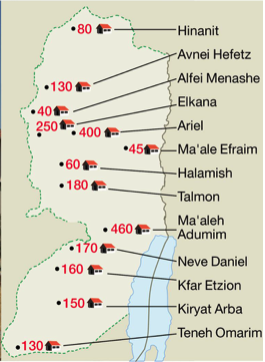
Map by Haaretz
Lieberman – whom The Times of Israel and Haaretz note has repeatedly inflated settlement approval numbers in the past – said the specific plans set to advance will include:
- 400 units in the Ariel settlement (where a medical school financed by Sheldon Adelson was recently brought under Israeli domestic jurisdiction, in a case of de facto annexation. And where a future stop on the recently approved settler-only light rail is slated to be built.);
- 460 units in the Ma’aleh Adumim settlement;
- 250 units for an assisted living center in the Elkana settlement (where the settler-only light rail will also have a stop);
- 180 units in the the Talmon settlement;
- 170 units in the Neve Daniel settlement;
- 160 units in the Kfar Etzion settlement;
- 150 units in the Kiryat Arba settlement (where construction preparations for a new industrial zone – which in reality is a new settlement in Hebron – recently began);
- 130 units in the Avnei Hefetz settlement;
- 130 units in the Tene Omarim settlement;
- 80 units in the Hinanit settlement;
- 60 units in the Halamish settlement (where settlers have built a strategic outpost, with the protection of the IDF, in order to further restrict Palestinian access to the area);
- 45 units in the Ma’ale Efraim settlement;
- 40 units in the Avnei Hafetz settlement;
- 45 units in unspecified settlements.
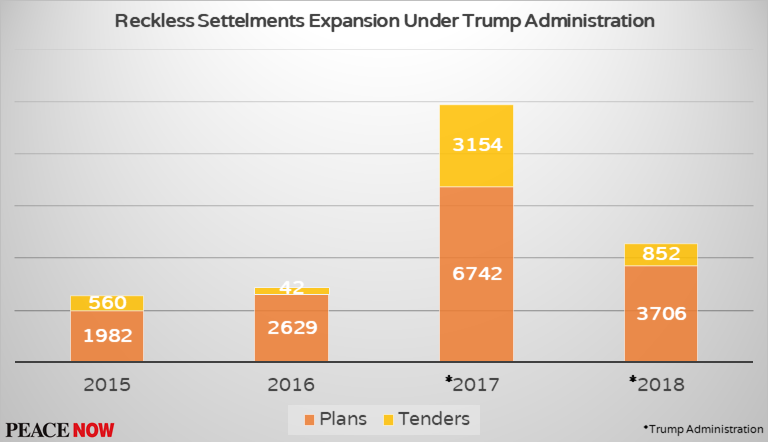
This will be the third meeting of the High Planning Council in 2018, in accordance with a reported agreement between Israel and the United States to consolidate and coordinate the number of times settlement plans are announced. The first regularly scheduled meeting of the year was in January, when 1,122 new settlement units were advanced, of which 352 received final approval for construction. The Council met again, unexpectedly in February, which Lieberman tried to minimize by calling it “less significant” because the majority of the projects approved were non-residential. In fact, the projects were extremely significant. All of the plans expanded the footprint of settlements located deep inside the West Bank – including plans for a race track and hotel in the Jordan Valley. One “unusual” plan even created a new outpost to house settlers evacuated from a different outpost (the Netiv Ha’avot outpost case that FMEP has covered in exhaustive detail).
The anti-settlement watchdog group Peace Now writes:
“In the year and a half since President Trump took office some 14,454 units in the West Bank has been approved (in plans and tenders, including today’s announcement not including East Jerusalem), which is more than three times the amount that was approved in the year and half before his inauguration (4,476 units)…The Netanyahu government is clearly continuing to take advantage of the carte blanche the Trump Administration has given it in order to destroy the chances for peace. It is well-known that for a two-state solution to be feasible Israel will have to withdraw from most of the West Bank, yet the government keeps raising the political cost of this redeployment and the evictions it will entail. By adding housing to settlements, the government shows total disregard for the two-state solution.”
In reaction to Lieberman’s announcement, PLO Executive Committee member Hanan Ahrawi said:
“Such egregious policies affirm the imperative need for the International Criminal Court to open an immediate criminal investigation into Israel’s flagrant violations of international law and conventions,” she said in a statement….Israel’s declared intention to build thousands of illegal settler units in the occupied West Bank discloses the real nature of Israeli colonialism, expansionism and lawlessness…Undoubtedly, Israel is deliberately working to enhance its extremist Jewish settler population and to superimpose ‘Greater Israel’ on all of historic Palestine…It is evident that the recent provocative and unlawful moves adopted by the United States, Guatemala and Paraguay have emboldened Israel to move forward with enhancing its illegal settlement enterprise, thereby finalizing the total annexation of the occupied West Bank.”
Saeb Erekat, a top diplomat for the Palestinian Authority released a video response, in which he highlighted the PA’s recent referral to the International Criminal Court (ICC) to investigate Israeli settlement crimes (see FMEP’s coverage on the ICC referral, below). Erekat said in part:
“This is a flagrant violation and an eye opener to the judicial council of the ICC that an official judicial investigation must be opened immediately. This cannot go on. Israel cannot continue business as usual with this impunity and immunity that they think they have.”
Nadil Abu Rudeina, a spokesman for PA President Mahmoud Abbas, said:
“The continuation of the settlement policy, statements by American officials supporting settlements and incitement by Israeli ministers have ended the two-state solution and ended the American role in the region.”
Finance Ministry Announces Bargain Construction in Beit El & Ma’ale Adumim Settlements
In addition to the approvals expected from the High Planning Council this week, the Israeli Finance Ministry has announced that a 300-unit project in the Beit El settlement and 44-unit project in the Ma’ale Adumim settlement have been marketed as part of the “Buyer’s Price” program. Under this program, the government sells land to construction companies at low prices, and those companies commit to offering future settlement units at below market prices. With the plan being marketed in Beit El, the government is accepting bids on the project from construction companies which commit to pricing the apartments 20% below market value – in effect creating a powerful financial subsidy that incentivizes Israelis to move into settlements.
The Beit El project involves 5 buildings with a total of 296 units. According to Ynet:
“the program’s goal is to transform Beit El’s southeast agricultural area into a residential neighborhood as well as unification and re-division of the lands, which will be allocated to building houses, public offices, commercial areas, routes, and a public open space.”
FMEP has covered the progress of this Beit El project repeatedly over the past year, particularly because the push around Beit El projects typifies the Netanyahu-Trump era of settlement growth. Beit El settlers have lobbied for the project for over 5 years, ever since the settlers were evacuated from an outpost of Beit El (called “Ulpana”) in 2012. When the outpost was evacuated, Prime Minister Netanyahu promised to build replacement settlement units in Beit El. Buoyed by the apparent green-light from the Trump administration, over the summer of 2017 settler leaders repeatedly and publicly shamed Netanyahu for failing to fulfill that promise, and in response Netanyahu very publicly and repeatedly promised that the settlement units will be built expeditiously. After being ignored by the High Council during its September meeting, the plan for 296 units was then approved for marketing in October 2017. Now, this week, the government has acted on that approval to market the plan, moving ever closer to the start of construction. As the Ynet report notes, if/when the 300 units are built, this will be the first new, government-sanctioned construction in the Beit El settlement in 10 years.
Also in Beit El, the settler-aligned media outlet Arutz Sheva reports that the IDF plans to build a new “razor wire” fence to separate the settlement from the Palestinian Jalazone refugee camp, located across the street (where it has been since before Beit El’s establishment). At the time of this writing, there has been no additional reporting on where the fence will be placed, and if it relates to plans to build a wall between Beit El and the Jalazone refugee camp. To better understand the severe implications of the Beit El settlement on the lives of Palestinian in Jalazone, see B’Tselem’s updated, expanded, and now pictorial project: “Life under the shadow of the Beit El Settlement.”
As a reminder, U.S. Ambassador to Israel David Friedman is closely associated with the Beit El settlement, having donated to and fundraised for it prior to his appointment as ambassador (including in his capacity as the President of the American Friends of Beit El, reportedly from 2011 until he became ambassador).
The Beit El settlement was established in 1977, on land previously seized by Israel for military purposes. A second military seizure in 1979 enabled Beit El to expand. This method of establishing and expanding settlements has been repeatedly challenged in Israeli courts. The Israeli group Yesh Din led one such petition against Beit El, seeking to have the second seizure annulled; that petition was dismissed earlier this year. Yesh Din writes:
“The State understood that it was impossible to legally defend the land theft that has been ongoing in Beit El for 40 years on land that was seized for arbitrary reasons, but it refrained, once again, from defending the rights of the weakest population, simply because they are Palestinians. Despite this, we at Yesh Din will continue to fight against the dispossession of Palestinians and the infringement of their rights.”
Defense Ministry Supports Expropriation of Private Palestinian Land for Settlements
On May 24th, the Israeli Defense Ministry released a legal opinion endorsing the government’s plan to expropriate privately owned Palestinian land in the Ofra settlement in order to retroactively legalize illegal settlement structures built there. The opinion adopts the “market regulation” principle as a legal basis for Israel to expropriate privately owned Palestinian land in cases of settlements in which decades-old structures were built and/or purchased by Israelis “in good faith” (believing the Israeli government to be the rightful owner of the land). The legal opinion also calls for the Palestinian owners to be “fully compensated, if not more than that,” and recommends that the principle should not apply to cases of unauthorized outposts. The Ofra situation is a test case for the “market regulation” principle, which has not yet been used (or tested in court) to justify expropriating Palestinian land for Israeli settlements.
Defense Ministry legal advisor Itai Ofir called on Attorney General Avichai Mandleblit to adopt the legal opinion as a government policy, which stands a good chance of happening (Mandleblit already endorsed the Ofra expropriation on that basis). In fact, the Attorney General invented the “market regulation” principle in the first place, as an alternative to the legal argument made in the Regulation Law (which he opposed). The “market regulation” principle was also recommended in the recently released “Zandberg Report,” as one of the tools that the Israeli government should use to carry out massive land expropriations, retroactive legalizations, and continued and intensified settlement growth.
FMEP has chronologically documented the development and adoption of the “market regulation” principle in the Annexation Policies tables.
High Court Supports Destruction of Khan al-Ahmar [A War Crime], Clearing the Way for E-1 Settlement
On May 24th, the High Court of Justice upheld a government plan to destroy the Palestinian Bedouin community of Khan al-Ahmar and forcibly relocate its residents out of the Ma’ale Adumim/E-1 settlement area east of Jerusalem – which Israel is expected to carry out soon. The Court reasoned that the community’s structures were built on State Land without the proper permits, even though Israel deliberately makes such permits nearly impossible to obtain. Clearing Khan al-Ahmar from the its current site (where it has been for 60+ years) is widely interpreted to be a step towards building the “doomsday” E-1 settlement which, if built, will complete a ring of Israeli settlements around East Jerusalem, destroying the territorial contiguity between Palestinians living there and the West Bank, and preventing any possibility of a viable, contiguous Palestinian state with its capital in East Jerusalem.

Map by Ir Amim
Israel has faced intense criticism for its plan to forcibly relocate Khan al-Ahmar, a plan many, including B’Tselem, call a war crime. A group of 76 U.S. Members of Congress recently sent a letter to Netanyahu beseeching him to abandon the plan, as well as the plan to demolish the Palestinian community of Susya, in the South Hebron Hills.
Peace Now says:
“The State of Israel must implement a policy of moral values, justice, equality and human rights for the Jahalin people. It is not in the Israeli interest to forcibly move them from their homes. We must stop the abuse that has been going on for decades, and allow them to live according to their way of life, to make a living and to educate their children in a way that is no different from that of the Jews living in their neighborhoods.”
The Jahalin Bedouin built the Khan al-Ahmar community in the area east of Jerusalem in the 1950s, after they were expelled from their lands in the Negev by the Israeli military. A total of 18 Bedouin tribes live in the vicinity of Ma’ale Adumim/E-1, totaling approximately 3,000 people, who have already endured numerous demolitions this year alone. The Ma’ale Adumim settlement was built in 1975 on land near where the Khan al-Ahmar community already existed; the plan for the E-1 settlement was approved in 1999.
Palestinians Ask the ICC to Open Investigation into the Israeli Settlement Regime
The Palestinian Authority has officially asked the International Criminal Court (ICC) to open an investigation into the Israeli government’s illegal settlement activity. The text of the referral can be found here. Citing “sufficient compelling evidence” and an “alarming intensification of Israeli crimes,” Palestinian Minister of Foreign Affairs Riad Malki asked the ICC to immediately open an investigation into war crimes and crimes against humanity that have been committed against Palestinians in the West Bank, East Jerusalem, and Gaza. The referral requests that the investigation include:
“those who plan, prepare and implement policies linked to the settlements regime as well as those who enable it, whether through financial, military, or logistical support or otherwise aid and abet or encourage the commission of crimes connected to that regime.”
The referral lists specific, ongoing crimes that are “among the most widely documented in contemporary history,” for the ICC to investigate. The PA’s allegations mainly relate to settlement activity (much of which is documented on a weekly basis in FMEP’s Settlement Reports) including: the unlawful appropriation and destruction of private and public properties, including land, houses and buildings, as well as natural resources; the forcible transfer of Palestinians; the unlawful transfer of the Israeli Occupying Power’s population into Occupied Palestinian Territory; the “persecution, including the grave, widespread and systematic denial or violation of basic human rights on discriminatory grounds against Palestinians, including those resulting in or intended to achieve the deportation of forcible transfer, directly or indirectly, of the Palestinian population, the re-population of ‘cleansed’ territories with Israeli settlers and the unlawful appropriation of Palestinian land and properties”; and “the establishment of a system of apartheid based in particular on the adoption of discriminatory laws, policies and practices as well as the commission of inhumane acts intended to establish an institutionalized regime of separation and advancement of Israeli settlements accompanied by the systematic oppression and domination by Israeli settlers over Palestinians.”
After the PA submitted its referral, Israeli Foreign Minister Avigdor Lieberman argued that the “ICC lacks jurisdiction over the Israeli-Palestinian issue, since Israel is not a member of the Court and because the Palestinian Authority is not a state.” While Israel is not a member of the ICC, the State of Palestine acceded to the ICC in December 2014, and its membership took force in April 2015. In January 2015, the ICC’s Office of the Prosecutor opened a preliminary inquiry to “ascertain whether the criteria for opening an investigation are met.” The preliminary inquiry is listed as “ongoing” on the ICC website. Following by the referral for an investigation submitted this week, ICC Chief Prosecutor Mrs. Fatou Bensouda released a statement saying:
“Since 16 January 2015, the situation in Palestine has been subject to a preliminary examination in order to ascertain whether the criteria for opening an investigation are met. This preliminary examination has seen important progress and will continue to follow its normal course, strictly guided by the requirements of the Rome Statute.”
The press release also notes that this is the eighth referral on the matter to date (previously, the situation in Palestine was referred to the ICC for investigation by Uganda, the Democratic Republic of the Congo, the Central African Republic, Mali, the Comoros Islands, and the Gabonese Republic).
Bonus Reads
- “Minister Ariel initiates museum of settlement” (Arutz Sheva)
- “Cherry Plantation Burned in Settlement a Hay Torched in Southern West Bank” (Haaretz)
- “Sheikh Jarrah: A Tale of Eviction and Resettlement” (Al Jazeera)
“In new film, Tel Aviv leftist picks up and moves to a West Bank settlement” (Times of Israel)
Welcome to FMEP’s Weekly Settlement Report, covering everything you need to know about Israeli settlement activity this week.
To receive this report via email, please click here.
March 9, 2018
- New Settlement in Hebron
- Palestinians Protest Rumored Plan to Unite & Expand Settlements Near Qalqilya
- High Court Reviewing Government Practice of Paying Off Settler Law-breakers
- Israel’s New West Bank Commander Promises to Defend the Settlements
- Documents Reveal: Government Funds Are Going to Unauthorized Outposts
- Israel Admits Theft of Spring was Carried out Illegally, Promises Court to Steal it Properly
- EU Report Shows Major Acceleration in Settlement Planning
- Settlement-Related AIPAC Conference Happenings
- Bonus Reads
Comments, questions, or suggestions? Email Kristin McCarthy at kmccarthy@fmep.org.
New Settlement in Hebron
Signaling the start of construction on what is effectively a new settlement in Hebron, settlers have moved four caravans onto a site located around a kilometer from the border fence of the radical Kiryat Arba settlement, on a site designated to become a new industrial zone for the settlement. The Civil Administration (a branch of the Israeli Army which is the sovereign ruling power in the occupied West Bank), told the press that the new industrial zone is being built on land seized decades ago by Israel as “state land,” according to a plan approved in “accordance with procedures.”
Map by Peace Now
The anti-settlement watchdog organization Peace Now disputes the Civil Administration assessment of the project. Peace Now notes that the project takes advantage of a plan for the Kiryat Arba settlement that was approved 30 years ago (in 1988), but never executed — and that present day realities are much different than they were 30 years ago. Peace Now notes, too, that the project is located well outside of the developed lines of the settlement and beyond the fence that surrounds it – making it, in effect, a new Israeli settlement in Hebron.
Peace Now said:
“This is Prime Minister Netanyahu’s gift to U.S. President Trump on the day of their meeting. For years, Israeli governments have refrained from establishing new settlements, especially in as sensitive a place as Hebron, but in recent months the Netanyahu government has permitted settlement activity without restraint and has taken steps that undermine the chances of a two-state solution. The new settlement near Hebron is liable to cause significant harm to the lives of dozens of Palestinian families who live nearby who are expected to suffer new security arrangements that will restrict their freedom of movement and harm the daily fabric of their lives.”
OCHA recently published a timely new report titled, “The Humanitarian Impact of Israeli Settlements in Hebron City.” The Kiryat Arba settlers and their security arrangements in the city are important contributing factors to the combined humanitarian toll settlements take on Palestinian residents of Hebron, whose entire lives – including freedom of movement, ability to engage in commerce, and access to education – are acutely strangled by the presence of Israeli settlers.
Palestinians Protest Rumored Plan to Unite & Expand Settlements Near Qalqilya
Since FMEP’s initial report on February 2018, scant further details have emerged regarding Israel’s rumored plan to unite four settlements near Qalqilya into a super settlement, thereby significantly expanding the collective footprint and population of those settlements. Nonetheless, Palestinian fears are growing about the plan’s implementation, which the governor of Qalqilya Rafi Rawajba recently called “state terror.”

Map by WINEP
Qalqilya residents have long held weekly protests against Israeli settlement expansion and the separation wall (while in some areas the separation barrier is composed of fencing, the city of Qalqilya is surrounded on all sides by a high cement wall, with only a narrow opening left for access into the rest of the West Bank). This past week, the Israeli army violently dispersed the protests, reportedly using rubber coated bullets, tear gas, and stun grenades.
The plan to unite and expand Qalqilya-area settlements should be understood alongside the July 2017 political battle that ultimately killed the implementation of a plan to build new homes and infrastructure for Palestinians in Qalqilya, which in addition to being surrounded by the Israeli separation wall is also the West Bank’s most densely populated city. The plan – which was formulated and defended by Israeli Defense Minister Avigdor Liberman, would have granted Israeli permission to the Palestinian Authority to double the size of Qalqilya by building on land in Area C (the 60% of the West Bank where the Palestinian Authority is not allowed to operate).
High Court Reviewing Government Practice of Paying Off Settler Law-breakers
The High Court of Justice temporarily blocked the Israeli government from offering monetary compensation to residents of illegal settlement outposts whose homes are demolished by the government of Israel. Such homes were built illegally according to Israeli law, and oftentimes on privately owned Palestinian land. The ruling ordered the government to submit a defense of the practice by March 12th.
The High Court’s ruling is in response to a petition filed by Israeli lawyer Shachar Ben Meir that specifically challenges the legality of Israel’s decisions to pay-off settlers evicted from the outposts of Amona and Ofra, as well as a recently approved pay-off for Netiv Ha’avot outpost settlers. None of those pay-offs have actually been transferred to date, and the ruling this week freezes the government’s ability to do so.
Ben Meir told the Times of Israel:
“The state cannot compensate building offenders for their homes being demolished when they built without a permit on land that wasn’t theirs. And if it decides to do so, it must be according to rules that are equal to everyone.”
It is worth noting that when it comes to “illegal” Palestinian construction in East Jerusalem – that is, construction on land owned by Palestinians but for which Israel has not (and generally will not) approve plans for building — Israel not only doesn’t compensate them financially for their loss, but it charges them for the cost of the demolition unless they demolish their own home first (called a self-demolition).
Israel’s New West Bank Commander Promises to Defend the Settlements
In a transfer of power ceremony this week, Major General Nadav Padan was sworn in as the new head of the Israeli Defense Force Central Command, becoming the highest ranking Israeli official in charge of all Israeli affairs in the West Bank. In his speech, Padan committed to “enabling a [high] quality of life for both Israelis and Palestinians while maintaining the rule of law and the spirit of the IDF.”
The outgoing commander also gave a speech at the ceremony, in which he embraced and praised the the settler population as a whole, while admonishing settlers leaders, saying:
“Regrettably, there is still a small handful of settlers challenging authorities as well as law and order. I urge you to continue to act and denounce this group”
Maj. Gen. Padan takes over the West Bank after serving previously as, among other things, the top general leading Israel’s incursion into Gaza during the summer of 2014, known in Israel as “Operation Protective Edge.” That assault lasted 50 days, during which Israel lost 66 soldiers and four civilians, while according to the United Nations, 2,131 Palestinians were killed, of which 1,473 were civilians, 501 were children, and 257 were women.
Documents Reveal: Government Funds Are Going to Unauthorized Outposts
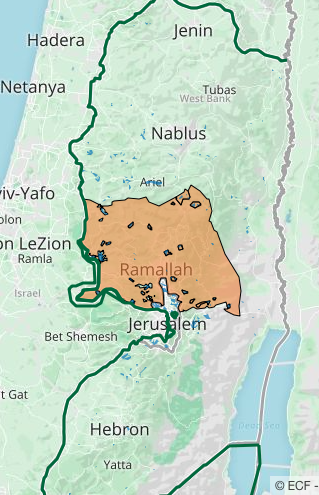
Map by the Economic Cooperation Foundation (ECF)
In response to a freedom of information request filed by Peace Now, the Israeli government released a trove of documents revealing that the Binyamin Regional Council – which receives government funding – has been funding infrastructure in far-flung outposts built without authorization and therefore considered illegal according to Israeli law (all settlement activity – whether or not it is permissible under Israeli law – is illegal under international law). The Binyamin Regional Council is the largest settler regional council and acts as a governing body officially representing 42 settlements (and unofficially many illegal outposts), covering a large area starting just north of Jerusalem and reaching almost to Nablus.
The government data shows that the Council spent $1.9 million over a three-year period to finance 24 projects in illegal outposts, including access roads, youth clubs, temporary homes, and two preschools. All of the projects lack permits (issuance of permits would be impossible, since the outposts themselves are unauthorized).
Avi Roeh, the elected head Binyamin Regional Council, defended the projects – telling Haaretz:
“every community located on state land, and this is true for these places such as Kida, Adi Ad, Esh Kodesh, etc., we intend on legalizing them. It is taking its time and in the meantime there are children and families there”
Peace Now Settlement Watch Director Shabtay Bendet responded:
“The Mateh Binyamin Regional Council is supposed to be the one to enforce the law and act according to it. Not only does it not enforce [the law], it funds and promotes illegal projects with our public funds. No police investigation has been opened on the matter. We call on the legal authorities to open an investigation.”
Israel Admits Theft of Spring was Carried out Illegally, Promises Court to Steal it Properly
This week Israeli government admitted to the Jerusalem District Court that permits were issued illegally to relocate a military checkpoint near the city of al-Walajah in order to prevent Palestinians from accessing a historic natural spring (See FMEP’s Feb. 22nd Settlement Report for more details on the scandal surrounding construction of the new checkpoint). Though admitting that the permits were granted illegally, the government suggested it was merely a bureaucratic glitch that would be fixed in short order, and asked the High Court to allow construction of the checkpoint to continue while it corrects the problem (that is, gets the permits to steal the spring issued properly). The Court ordered the State to explain the steps it will take to rectify the matter (that is, to get the proper permits in order) and will rule on the petition against the spring at some date in the future.
Ghaith Nasser, the lawyer representing al-Walajah residents in the case, told Haaretz:
“I think that what happened in this case is a scandal. They want the court to give legal validity to an outrage whose entire management from beginning to end is stained by blatant illegality…When the court is asked to approve such a thing despite all the faults, the role of the court is to champion the principle of the rule of law and explain that this isn’t how it’s done.”
Notably, FMEP reported last week that Justice Minister Ayelet Shaked has recently installed a settler-aligned judge to the Jerusalem District Court, which is hearing this case. The judge, Haya Zandberg, previously headed a government committee tasked with retroactively legalizing outposts and in two cases “adopted a creative pro-settler legal position that contradicted the views of both the Justice Ministry and the Israel Defense Forces’ legal adviser in the West Bank” according to Haaretz.
EU Report Shows Major Acceleration in Settlement Planning
The European Union recently published its regular report on Israeli settlement activity in the second half of 2017. That report documents a “three- to four-fold increase in advancement of housing units through plans and the issuance of tenders compared to 2016.”

Graph by the EU
All told, if the plans advanced during the latter half of 2017 materialize on the ground, housing will be created for potentially 23,000 additional settlers in the West Bank and East Jerusalem.
The report specifically highlights the creation of a new settlement in Hebron, the first since 2002, and the construction of large-scale road projects that are proposed to connect Israeli settlements more seamless to Israel.
The report is part of the European Union’s efforts to monitor and inform its member states about Israeli settlement growth, and to assist its member states in differentiating between economic dealings with Israel and Israeli settlements, consistent with international law and EU policy.
Settlement-Related AIPAC Conference Happenings
For the blissfully unaware, the annual AIPAC conference was held this week in Washington, D.C. It drew big-name U.S. administration officials, members of Congress, and Israeli lawmakers and leaders including Prime Minister Netanyahu. And those big names made some big headlines.
A few events/happenings pertinent to settlement observers include:
- Prominent settler leader Yossi Dagan (head of the Yesha Council, a settler umbrella group) wrote a letter to AIPAC decrying AIPAC’s assertion that Israel supports a two-state solution. Dagan asserts that Israel does not support such a solution. Dagan’s anger was quickly echoed by scads of Israeli lawmakers, including Likud MKs and members of the right-wing Israel Land Caucus. The Times of Israel has a great summary of the event and the new dynamics, titled “As AIPAC is out-hawked by Trump, settlers reevaluate ties to the pro-Israel lobby.”
- On the sidelines of AIPAC, the Israeli Ministry of Strategic Affairs joined with the Yesha Council to host an event to “combat the delegitimization of Israel through the embrace of Judea & Samaria.” The event was attended by Education Minister Naftali Bennett, Justice Minister Ayelet Shaked, Israeli Consul General in New York Dani Dayon, and Energy Minister Yuval Steinitz who said: “Israel cannot survive without its settlements.” J Street had a sharp response to the event, saying “This Israeli government thinks the way to combat delegitimization is to embrace settlements. Embrace. Settlements. This is patently absurd.”
- U.S. Ambassador and settlement financer David Friedman took to the stage on the last day of the conference to attack J Street and its motto, “pro-Israel, pro-peace.” He argued that such a motto suggests that some people are both pro-Israel and anti-peace, and that “It is no less than blasphemous to suggest that any Jew or any Christian is against peace and that’s just not a matter of religious belief.” Implied in his remark, it seems, is that only Muslims are capable of being anti-peace. His full remarks are available here.
- Senate Minority Leader Chuck Schumer told the AIPAC crowd that “it’s sure not the settlements that are the blockage to peace,” after blasting Hamas for what happened after Israel pulled out from Gaza settlements. He went on to say, among many things, that there is no peace because Palestinians do not believe in the Torah.
Bonus Reads
- “What would the [“SOFTENED”] Israel Anti-Boycott Act Actually Do?” (FMEP) **U.S. settlement policy is impacted by this bill. Analysis written by FMEP’s Lara Friedman
- “In West Bank reality, annexation is a pipedream” (Times of Israel)
- “East Jerusalem Palestinians confront Israeli diggers over damaged to homes” (Middle East Eye)