Welcome to FMEP’s Weekly Settlement Report, covering everything you need to know about Israeli settlement activity this week.
To subscribe to this report, please click here.
October 22, 2021
- Israel to Advance Plans for Nearly 3,000 Settlement Units & 1,300 Palestinian Homes in Area C
- Israeli Supreme Court to Hold Hearing on Batan al-Hawa, Silwan Dispossession Cases Next Week; AG Declines Intervention
- Israel Begins Construction on New Settlement in Downtown Hebron
- Israel Advances “Silicon Wadi” Project in East Jerusalem
- Recap: Israel Advances Settlement Plans Across Greater Jerusalem Area
- Recap: Court Pushes for Palestinians to “Compromise” with Settlers in Sheikh Jarrah
- New Report: State-Backed Settler “Tourism” Projects in East Jerusalem
- Bonus Reads
Israel to Advance Plans for Nearly 3,000 Settlement Units & 1,300 Palestinian Homes in Area C
The Israeli Civil Administration’s High Planning Council will convene next week — for the first time since Bennett and Biden took over leadership in Israel and the U.S., respectively — to advance the construction of 2,862 new settlement units (of which 1,231 will be eligible to receive final approval). These plans include the retroactive legalization of two unauthorized outposts (Mitzpe Danny and Haroeh Haivri), which should be properly understood as the creation of two new settlements.
Peace Now data
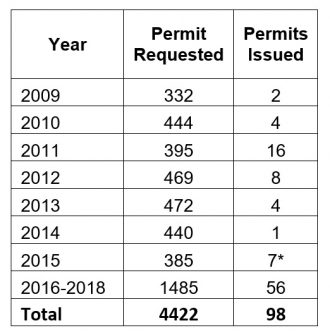
In addition, reports suggest that Israel will also advance plans for 1,303 Palestinian homes in Area C – about half of which, importantly, are already built. A majority of these units have been awaiting Israeli approval for many, many years. If approved, the permits under consideration next week for Palestinians will be the first of any significant quantity issued by Israel since, at least, 2009 (data from before this period has not been released by the Israeli government). Between 2009 and 2018, Israel issued a total of 98 building permits to Palestinians according to data released by the Israeli government in response to a freedom of information request submitted by Bimkom.
As a reminder, Area C is the 60% of the West Bank over which Israel enjoys absolute authority. For years Israel has systematically denied Palestinians the right to build on land in Area C that even Israel recognizes is privately owned by them, At the same time, it has continuously promoted the expansion of settlements and unauthorized outposts, while systematically demolishing Palestinian private construction. In terms of numbers: between 2016 to 2018, Israel issued only 21 building permits to Palestinians in Area C, while issuing 2,147 demolition orders against Palestinians during.
Commenting on the Planning Council agenda’s Peace Now observed:
“The approval of a handful of plans for the Palestinians is only a fig leaf intended to try to reduce criticism of the government. For years, Israel has pursued a policy of blatant discrimination that does not allow almost any construction for Palestinians in Area C, while in the settlements it encourages and promotes the construction of thousands of housing units each year for Israelis. The approval of a few hundred housing units for Palestinians can not cover up discrimination and does not change the fact that Israel maintains an illegal regime of occupation and discrimination in the territories.”
It is worth noting that many of the settlement units and Palestinian permits on next week’s agenda were expected to have been advanced earlier this year, in August 2021, but the High Planning Council never convened to do so.
Below are lists of settlement plans expected to be given final approval and plans expected to be advanced next week (italicized plans represent those which appear to have been added to the slate of plans that were expected to be advanced in August 2021).
Settlement plans expected to be granted final approval include:
- 629 units, including the retroactive legalization of 61 units, in the Eli settlement – located south of Nablus and southeast of the Ariel settlement in the central West Bank. Though the Eli settlement previously received Israeli government approval, a “Master Plan” – which officially zones land for distinct purposes (residential, commercial, public) – has never been issued for Eli, meaning all construction there is illegal under Israeli law;
- 286 units in the Har Bracha settlement, located south of Nablus. If implemented, these new units will double the size of Har Bracha;
- 224 units in the Talmon settlement, located west of Ramallah;
- 146 units in the Kfar Etzion settlement, located between Bethlehem and Hebron and on the Israeli side of the planned route of the barrier (which is not yet built in this area);
- 110 units in the Alon Shvut settlement, located just north of the Kfar Etzion settlement and between Bethlehem and Hebron;
- 82 units in the Karnei Shomron settlement, located in the northern West Bank, east of the Palestinian village of Qalqilya. Israel has openly declared its intention to continue expanding settlements in this area with the stated goal of bringing 1 million settlers to live in the area.;
- 52 units in the Beit El settlement, located in the heart of the northern West Bank [as a reminder, former US Ambassador to Israel David Friedman has deep ties to the Beit El settlement]; Construction on 350 new units in Beit El began earlier this year;
- 42 units in the Givat Zeev settlement, located south of Ramallah in an area that is on the Israeli side of the barrier;
- 24 units in the Haroeh Haivri outpost, a plan that will effectively grant retroactive legalization to this outpost. The Haroeh Haivri outpost is located just east of Jerusalem, within eyesight of the Khan al-Ahmar community, which Israel is threatening to demolish (forcibly relocating the Palestinian bedouin community that has lived there since the 1950s) — ostensibly because the structures in Khan al Ahmar were built without necessary Israeli approvals. The Haroah Haivri outpost was also built without the necessary Israeli approvals, but instead of demolishing the construction, Israel is moving to retroactively legalize it — demonstrating once again that, when it comes to administering the occupation, Israel prefers “rule by law” – where law is turned into a tool to elevate the rights/interests of one party over another, over the democratic rule of law.;
- 14 units in the Ma’aleh Mikhmash settlement, a plan that will effectively grant retroactive legalization to one of Ma’aleh Mikhmash’s outposts – – Mitzpe Danny;
- 10 units in the Barkan settlement, located about half way between the Ariel settlement and the cluster of settlements slated to be united into a “super settlement” area (Oranit, Elkana, Shiva Tikva, and others);
- 5 units in the Shima’a settlement, located in the southern tip of the West Bank;
- 7 units in the Peduel settlement, located in the northern West Bank and part of a string of settlements and unauthorized outposts – most notably Ariel – extending from the Green Line into the very heart of the West Bank and on towards the Jordan Valley.
Settlement plans expected to be approved for deposit (an earlier stage in the planning process) include:
- 399 units in the Revava settlement, located just east of the Barkan settlement and west of the Ariel settlement, in a string of settlements and unauthorized outposts – most notably Ariel – extending from the Green Line into the very heart of the West Bank and on towards the Jordan Valley.
- 380 units in the Kedumim settlement, located just east of Nablus. Israeli MK Bezalel Smotrich lives in the Kedumim settlement on a section of land in the settlement that has been found to be privately owned by Palestinians.;
- 100 units in the Elon Moreh settlement, located east of Nablus (for background on the significance of the Elon Moreh settlement, please see here);
- 100 units in the Sansana settlement, located on the southern tip of the West Bank on the Israeli side of the separation barrier;
- 73 units in the Givat Zeev settlement, which is also expected to receive final approval for 42 units. Givat Zeev is located south of Ramallah in an area that is on the Israeli side of the barrier;
- 68 units in the Tene settlement, located on the southern tip of the West Bank;
- 45 units in the Vered Yericho settlement, located just west of the Palestinian city of Jericho in the Jordan Valley;
- 27 units in the Karnei Shomron settlement, which is also expected to receive final approval for 82 units. Karnei Shomron is located in the northern West Bank, east of the Palestinian village of Qalqilya. Israel has openly declared its intention to continue expanding settlements in this area with the stated goal of bringing 1 million settlers to live in the area.;
- 18 units in the Alon Shvut settlement, which is also expected to receive final approval for 110 units. Alon Shvut is located just north of the Kfar Etzion settlement and between Bethlehem and Hebron;
- 10 units in the Tal Menashe settlement, located located on the tip of the northern West Bank, inside the “seam zone” between the 1967 Green Line and the Israel separation barrier, which was constructed along a route designed to keep as many settlements and as much adjacent land as possible on the Israeli side of the wall/fence.
- 7 units in the Hermesh settlement, located in the northern West Bank;
- 4 units in the Efrat settlement, located south of Bethlehem, inside a settlement block that cuts deep into the West Bank. Efrat’s location and the route of the barrier wall around it, have literally severed the route of Highway 60 south of Bethlehem, cutting off Bethlehem and Jerusalem from the southern West Bank. The economic, political, and social impacts of the closure of Highway 60 at the Efrat settlement (there is literally a wall built across the highway) have been severe for the Palestinian population.
Peace Now reports that the Planning Council will also consider advancing the following plans for Palestinian homes:
- 270 houses in the Bir al-Bash village, located south of Jenin in the northern West Bank;
- 270 houses in the Al-Ma’asara village, located south of Bethlehem;
- 233 houses in the the Almasqufa village, located near Tulkarem in the northern West Bank;
- 200 houses in the Dkeika village in the South Hebron Hills;
- 170 houses in the Khirbet Abdallah Younas village, located in the Jenin area;
- 160 houses in the Abba a-Sharqiya village, also located south of Jenin in the northern West Bank;
Israeli Supreme Court to Hold Hearing on Batan al-Hawa, Silwan Dispossession Cases Next Week; AG Declines Intervention
On October 25th, the Israeli Supreme Court is scheduled to hold an important hearing on the case of the Palestinian Duweik family which is under threat of being dispossessed of their longtime home in the Batan al-Hawa section of the Silwan neighborhood in East Jerusalem by the Ateret Cohanim settler organization.
In advance of that hearing – and after repeated extensions on a Court-ordered deadline – the Israeli Attorney General finally submitted his position on the case to the Court. The document submitted by the Attorney General was only 1 page, and simply stated that the case does not merit intervention either on the specific case of the Duweik family or regarding the wider legal principle at stake, which threatens an additional 85 families living under threat of eviction in Batan al-Hawa.
Ir Amim writes:
“Among the 85 families facing eviction, the Duweik family case is the first to reach the Supreme Court level, and its outcome will inevitably set a precedent, significantly impacting the rest of the cases in the neighborhood…As in the eviction cases in Sheikh Jarrah, the Attorney General and by extension, the government, was given a rare opportunity to take a moral stand by providing a legal opinion and policy position to help prevent the mass displacement of these families. Yet, at this point, the Attorney General’s response appears to imply that he has declined to intervene. Now, the decision concerning the fate of these families seems to lie solely in the hands of the Supreme Court. The rights of Palestinians to housing and shelter and the right to family and community life are fundamental and must be upheld. The same discriminatory legal system, which led to the confiscation of these families’ original homes in 1948, is now being exploited 73 years later to displace them for a second time from their current homes in which they have lived for decades. The Supreme Court has the power to make a principled and just decision to uphold the rights of these families to remain safely in their homes, free from the constant threat of being forcibly uprooted and driven from their homes and communities.”
Peace Now said in response to the AG’s decision to not intervene:
“The Attorney General’s response actually says that for the Israeli government, there is no problem to kick hundreds of residents out from their homes, on the basis of a discriminatory law, in favor of a settlement. The government was given an opportunity here to try to prevent moral injustice and political folly, but instead of taking a stand, it chose to remain on the sidelines, as if Silwan’s story, like that of Sheikh Jarrah, was a legal matter and not a political one.”
In July 2021, Peace Now assembled a coalition of Israeli lawyers to submit an amicus brief to the Court regarding the Duweik case. Peace Now summarizes:
“The brief addresses an approach that has emerged in international jurisprudence on human rights law which puts an emphasis on group vulnerability of occupants facing eviction and institutional, systemic discrimination against them. Where these are present, in certain circumstances, the occupants’ rights, stemming from the human right to housing and specifically, to live in their home and their family’s home – trump the right of the original owner or their substitute to regain possession of the property.
The brief reaches the conclusion that in the Duweik case, the occupants’ property rights and their right to housing supersede the right of the settlers acting on behalf of the pre-1948 original owners to receive possession of the property, based on the following:
1 – The fact that Palestinian residents of East Jerusalem are underprivileged, vulnerable and subjected to discrimination in every aspect of life, and particularly the fact that Israeli law on the restitution of property that changed hands due to wars, openly and deliberately discriminates against them;
2 – The fact that the family entered the property in good faith and/or in accordance with the law applicable at the time, and has developed a legitimate expectation to continue residing in it permanently and without interruption;
3 – The imbalance between the devastating harm the family would suffer and the minor damage the Benvenisti charitable endowment (represented by the settlers), which claims ownership of the property, would sustain, which clearly tips the scales in favor of the family.
In other words, according to the brief, even if the court finds the settlers do, in fact, have ownership, they are not necessarily entitled to remedy in the form of the families’ eviction from their homes, but rather to compensation from the state.”
Israel Begins Construction on New Settlement in Downtown Hebron
Peace Now reports that construction has begun on 31 new settlement units at the site of an old bus station previously repurposed as an IDF base, located in the heart of the Old City of Hebron on the infamous Shuhada street. This is a new settler enclave in the city and is, in effect, a new urban settlement, disconnected from already existing settlements in the city. It will be the first new settlement construction approved in downtown Hebron – where Palestinians already live under apartheid conditions – since 2002.
Peace Now said in a statement:
“The government is acting like an annexation government, not as a change government. Since the 1980s, no government has dared to build a new settlement in the heart of the largest Palestinian city in the West Bank, with the exception of one building built under the auspices of the second intifada in 2001. The Defense Minister has to stop construction, even if the plan was approved by the previous government. The settlement in Hebron is the ugly face of Israeli control of the territories. The moral and political price of having a settlement in Hebron is unbearable.”
As a reminder: in October 2017, the Israeli Civil Administration approved a building permit for the 31 units, on the condition that the Palestinian municipality of Hebron and others would have the opportunity to file objections to the plan. Soon after, two appeals were filed with the Defense Ministry: one by the Palestinian municipality of Hebron and one by the Israeli settlement watchdog Peace Now. The legal objections were based on the legally questionable process by which Israel made land in downtown Hebron available for settlement construction. Located in the Israeli-controlled H-2 area of Hebron (where 500 Israeli settlers live amongst 40,000 Palestinians), Israel seized the land in the 1980s from the Hebron Municipality, for military purposes. In 2007, the Civil Administration’s Legal Advisor issued an opinion stating that once Israel is done using the land for military purposes, it must be returned to the Hebron Municipality, which has protected tenancy rights to the land. Nonetheless, in 2015, the Israeli Civil Administration, with the consent of the Minister of Defense, quietly authorized the Housing Ministry to plan the area for Israeli settlement use, paving the way for that same ministry to subsequently present the plan for the 31 units.
In October 2018, with the legal challenges still pending, the Israeli Cabinet voted to expedite the planning of the new settlement and allocated approximately $6.1 million (NIS 22 million) for the project, which will require Israel to significantly renovate the bus station/military base in order to build the 31 new settlement housing units, as well as a kindergarten, and “public areas” for the new settler residents. Peace Now explains:
“The approval of the building permit in the heart of Hebron is an extraordinary move not only because it is a new settlement in Hebron for the first time since 2001, but because it indicates a significant change in Israeli legal interpretation of what is allowed and forbidden in occupied territory. The area in question was owned by Jews before 1948, and it was leased by the Jordanian government in protected tenancy to the Hebron municipality for the purpose of establishing the central bus station. Since 1967, the Israeli authorities managed the land and continued the lease to the Hebron municipality, until in the 1980s when the area was seized for military purposes, the bus station was closed and a military base was established there. A legal opinion of the Judea and Samaria Attorney General on the issue in 2007 emphatically stated that by law the municipality’s protected lease must not be revoked.”
Israel Advances “Silicon Wadi” Project in East Jerusalem
On October 13th, the Jerusalem Local Planning Committee met to initiate the planning process for the “Silicon Wadi” project, which was initiated by the Jerusalem Municipality and outlines plans to build a large industrial zone for hi-tech, commercial, and hospitality businesses in the heart of East Jerusalem’s Wadi Joz neighborhood. The project requires the demolition of some 200 Palestinian-owned businesses that currently operate in the area; dozens of demolition notices for which were issued in November 2020.
Ir Amim writes:
“Beyond the devastating impact of widespread demolitions of existing businesses and structures, the plan also raises concerns that the Israeli authorities will exploit the planning procedures to locate alleged Palestinian absentee properties and transfer lands into the hands of the State. It should also be noted that while Israel focuses on bolstering employment and economic activity in East Jerusalem, it simultaneously continues to suppress residential development in Palestinian neighborhoods. As with nearly all outline plans advanced in East Jerusalem in recent years, the Wadi Joz business park plan only allocates a marginal amount for residential use, which hardly meets the acute housing needs of the Palestinian population. Rather than undertaking measures to rectify the housing crisis, these plans only exacerbate the current situation and perpetuate the residential planning stranglehold, which ultimately serves to push Palestinians out of the city.”
Recap: Israel Advances Settlement Plans Across Greater Jerusalem Area
Over the past two weeks, the government of Israel has advanced four highly controversial and politically consequential settlement plans in the Greater Jerusalem area:
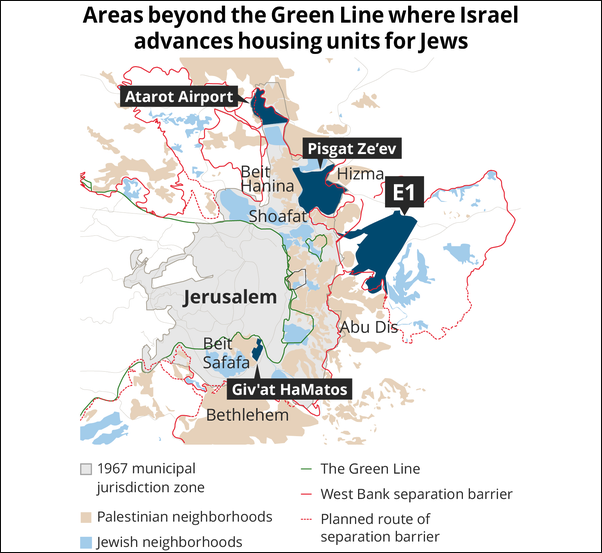
- The Givat Hamatos Settlement: On October 13th, the Jerusalem Local Planning Committee approved the expropriation of lands designated for public use in the Givat Hamatos area for the construction of roads, public buildings and the development of open space for the planned new settlement/neighborhood. For more on the Givat Hamatos settlement plan, please see here.
Map by Haaretz
- The E-1 Settlement: The Israel Civil Administration moved forward with advancing plans for the construction of the E-1 settlement, setting a date for a third hearing to discuss public objections to the plan (now set for November 8th). The first hearing was held on October 4th, but Palestinians were denied the ability to participate in that hearing (which was held virtually, making it inaccessible to the many Palestinians affected by the plan who do not have internet access). As a result, the Court scheduled this 3rd hearing (to allow the participation of Palestinians). The second hearing was held on October 18th; at that hearing three objections were presented (one by the Palestinian village of Anata, a second by the Palestinian village of Al-Azariya, and a third joint submission filed by Ir Amim and Peace Now). Ir Amim reports that there was no substantive discussion of these objections, with the Civil Administration panel offering no questions or comments on them. For more on the E-1 settlement plan, please see Terrestrial Jeruaslem’s excellent and thorough reporting.
- The Atarot Settlement: The Jerusalem District Planning Committee formally signaled that it will proceed with a hearing on the Atarot settlement plan – scheduled for December 6th – to build a huge new settlement on the site of the former Qalandiya airport (located at the northern tip of East Jerusalem). In its current form, the plan provides for up to 9,000 residential units for ultra-Orthodox Jews (assuming, conservatively, an average family size of 6, this means housing for 54,000 people), as well as synagogues, ritual baths (mikvehs), commercial properties, offices and work spaces, a hotel, and a water reservoir. If built, the Atarot settlement will effectively be a small Israeli city surrounded by Palestinian East Jerusalem neighborhoods on three sides and Ramallah to its north. Geopolitically, it will have a similar impact to E-1 in terms of dismembering the West Bank and cutting it off from Jerusalem. For more on the Atarot settlement plan, please see here.
- The Pisgat Ze’ev Settlement: The Israeli government advanced plans for 470 new settlement units in Pisgat Ze’ev, the largest settlement located in East Jerusalem.

Recap: Court Pushes for Palestinians to “Compromise” with Settlers in Sheikh Jarrah
The Israeli Supreme Court has set November 2nd as the deadline for Palestinian families living at risk of forced displacement in Shiekh Jarrah to decide wether or not to accept a Court-authored deal which would help them – at least temporarily – avoid eviction from their homes, in part by requiring them to recognize settler ownership over the properties.
Under the terms of the Court’s deal, which it is pressuring both parties to accept, the following would take place:
- The settler group Nahalat Shimon will be recognized as the owners of the site.
- The Palestinians will be recognized as protected tenants and be required to pay an nominal annual rental fee to the attorney of the settlers (in effect recognizing the settlers as the owners) but
- The Palestinians will be able to continue pursuing legal challenges to the underlying ownership of the land
- The Palestinians are permitted to renovate the properties without interference
- Settlers will be able to instigate eviction proceedings against Palestinians if they are in violation of the Court’s compromise agreement or in violation of Israel’s tenancy laws.
Terrestrial Jerusalem writes:
“The most problematic element of the settlement relates to the settlers’ ability to institute evictions even if the residents are not in violation of the agreement or of the tenancy laws. The settlers will be entitled to institute such proceedings in the event that the ownership rights are conclusively awarded to them, or after 15 years, the earlier of the two. This can be done if the settlers either wish to personally use the property or to demolish and rebuild. Under these circumstances, the settlers will need to offer the residents alternative equivalent quarters. Palestinian residents might hope settlers reject the deal to avoid having to make an ‘excruciatingly painful decision.’”
According to Terrestrial Jerusalem, the Court has signaled that further negotiations are acceptable, but that if either party rejects the agreement a decision on the eviction cases will be handed down swiftly.
New Report: State-Backed Settler “Tourism” Projects in East Jerusalem
In a new report entitled, “The Valley of Hinnom: Trees and Flowerbeds in the Political Struggle over East Jerusalem,” the Israeli NGO Emek Shaveh surveys the multitude of recent “tourism” projects jointly undertaken by the Elad settler organization and the Israeli government in the Ben Hinnom Valley — a strategic area between East and West Jerusalem (stretching past the 1967 Green Line), and located within the area designated by Israel as the Jerusalem “Walls National Park”.
Emek Shaveh writes:
“The nature of the tourism-settlement activity in the Valley of Hinnom conducted jointly by Elad and government authorities is familiar to us from the City of David/Silwan. The series of joint ventures such as the café, the Center for Ancient Agriculture and the cable car in effect hand over large expanses of land to the settlers of the Elad Foundation under the guise of tourism. Although unlike Silwan, the valley is sparsely populated, the activity there must be viewed as an integral part of the struggle for the Old City Basin of Jerusalem and as a means to clear this highly strategic area from the presence of Palestinians.”
In conclusion, we wish to emphasize the following points:
1 – Development in East Jerusalem is almost always driven by political objectives. Recent developments in the Valley of Hinnom are part of the grand plan to change the character and the landscape of the Old City Basin and ought to be considered an integral component of the settlement enterprise in the Palestinian neighborhoods surrounding the Old City.
2 – Halting the destructive development schemes in the areas surrounding the Old City is vital in order to preserve Jerusalem as a multicultural historic city and is indirectly essential for safeguarding the status quo at the holy places.
3 – The Palestinian protests against the expansion of the settlers’ grip over the open spaces such as the Hinnom Valley is part of the struggle by the residents of Silwan and the surrounding neighborhoods to preserve the character of their neighborhoods. In our view, one ought to view the various activities by the settlers and the authorities in the Historic Basin such as the expulsion of residents from their homes, taking over land and the shaping of a historic narrative as part of the same general bid to cement their control over the Historic Basin.”
Bonus Reads
- “[PODCAST] The Occupation & the Biden Administration” (FMEP ft. Danny Seidemann and Yehuda Shaul with Lara Friedman and Khaled Elgindy)
- “How offshore accounts turned the British Virgin Islands into an east Jerusalem landlord” (JTA)
- “Beita residents reach lands for first time since settler takeover” (Al Jazeera)
- “After Years of Neighborly Relations, Settlers Try to Foil Recognition of Palestinian Hamlet” (Haaretz)
- “Palestinian protests turn deadly as Israel considers the future of a new settlement” (NPR)
- “These Palestinian Families Face Eviction From Their East Jerusalem Homes” (Haaretz)
- “When Settler Becomes Native” (Jewish Currents)
Welcome to FMEP’s Weekly Settlement Report, covering everything you need to know about Israeli settlement activity this week.
To subscribe to this report, please click here.
August 13, 2021
- The First Bennett/Biden Settlement Wave, Part 1: Israel Set to Advance 2,259 Settlement Units
- The First Bennett/Biden Settlement Wave, Part 2: Israel Announces Intention to Issue 863 Building Permits for Palestinians in Area C
- The First Bennett/Biden Settlement Wave, Part 3: Observations on Settlement Policy Coordination Between Governments
- Jerusalem District Court Orders 16 Homes to Be Demolished While Delaying – for 6 months – Demolition of Others in Silwan
- Israel Begins Work on Settler-Back Project at the Ibrahimi Mosque/Tomb of the Patriarchs
- Atarot Settlement Plan to Be Discussed on December 6th
- Bonus Reads
Questions/comments? Email kmccarthy@fmep.org
The First Bennett/Biden Settlement Wave, Part 1: Israel Set to Advance 2,259 Settlement Units
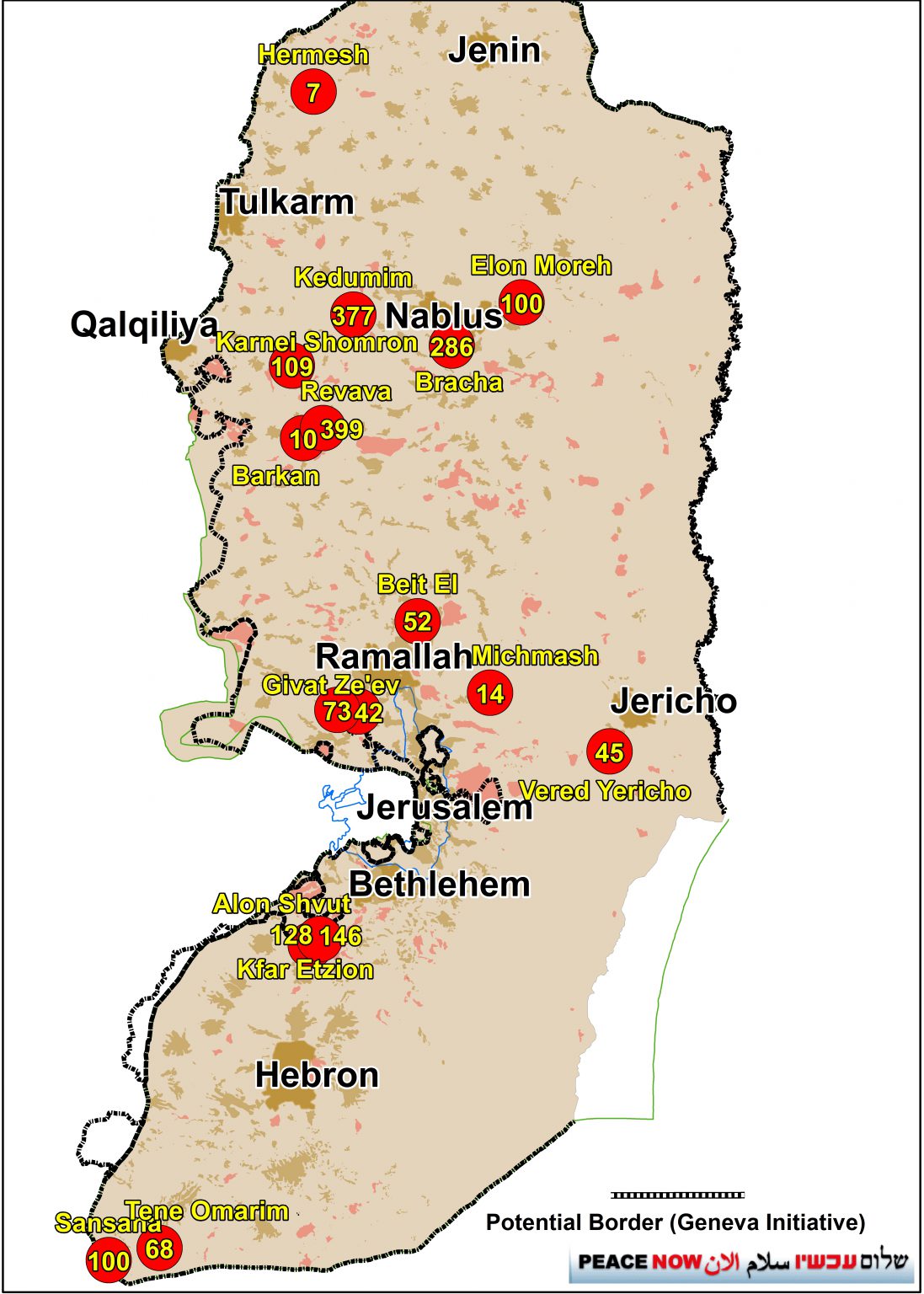 On August 12th, Israeli Defense Minister Benny Gantz announced that the High Planning Council will convene on August 18th to advance 2,259 new settlement units, as part of projects across the West Bank. Of these, 908 units are slated to receive final approval, including many units in areas beyond Israel’s security barrier. This will be the first time that the High Planning Council (HPC) has convened in 10 months, and it will be the first time a large number of settlement units has been advanced since Biden entered the White House. As a reminder, the HPC is a body within the Israeli Civil Administration (which is a part of the Israeli Ministry of Defense) that has authority over construction planning and approvals for both settlers and Palestinians in the West Bank (the HPC does not have authority with respect to settlement construction in East Jerusalem; since Israel annexed the area in 1967, Israeli domestic Israeli planning authorities are in charge there).
The plans expected to receive final approval include:
- 286 units in the Har Bracha settlement, located south of Nablus. If implemented, these new units will double the size of Har Bracha;
- 146 units in the Kfar Etzion settlement, located between Bethlehem and Hebron and on the Israeli side of the planned route of the barrier (which is not yet built in this area);
- 110 units in the Alon Shvut settlement, located just north of the Kfar Etzion settlement and between Bethlehem and Hebron;
- 82 units in the Karnei Shomron settlement, located in the northern West Bank, east of the Palestinian village of Qalqilya. Israel has openly declared its intention to continue expanding settlements in this area with the stated goal of bringing 1 million settlers to live in the area.;
- 52 units in the Beit El settlement, located in the heart of the northern West Bank [as a reminder, former US Ambassador to Israel David Friedman has deep ties to the Beit El settlement]; Construction on 350 new units in Beit El began earlier this year;
- 42 units in the Givat Zeev settlement, located south of Ramallah in an area that. is on the Israeli side of the barrier;
- 14 units in the Ma’aleh Mikhmash settlement, located east of Ramallah;
- 10 units in the Barkan settlement, located about half way between the Ariel settlement and the cluster of settlements slated to be united into a “super settlement” area (Oranit, Elkana, Shiva Tikva, and others).;
Peace Now said:
“The approval of thousands of housing units in the settlements harms the Israeli interest and the chances of reaching peace. It seems that the approval of a handful of plans for the Palestinians is only intended to try to reduce criticism of the government and to please the US administration ahead of Prime Minister Bennett’s expected visit to Washington in the coming weeks. For years, Israel has pursued a policy of blatant discrimination that does not allow almost any construction for Palestinians in Area C, while in the settlements it encourages and promotes the construction of thousands of housing units each year for Israelis. The approval of a few hundred housing units for Palestinians can not cover up discrimination and does not change the fact that Israel maintains an illegal regime of occupation and discrimination in the territories.”
The First Bennett/Biden Settlement Wave, Part 2: Israel Announces Intention to Issue 863 Building Permits for Palestinians in Area C
In announcing plans to advance over 2,000 new settlement units, Defense Minister Gantz also announced his intention to issue permits for 863 houses – some of which will be issued for existing structures – for Palestinians living in Area C. Haaretz reports that the permits are being advanced in order to buy the consent of the few members of the Israeli governing coalition that oppose settlement construction, and as “calculated risk” with respect to the Biden administration.
As a reminder, Area C is the 60% of the West Bank where Israel enjoys absolute authority and has systematically denied Palestinian building rights, while promoting the expansion of settlements and unauthorized outposts. If issued, these permits for Palestinians will be the first issued by Israel in years, and the first of any significant size. Only 21 building permits were issued to Palestinians between 2016 to 2018, while 2,147 demolition orders were issued in the same period.
Commenting on the announcement of the planned permits (which, given past experience, there is no reason to assume will ever be issued) Peace Now said:
“It is a very small expansion of the Palestinian villages and a drop in the ocean in terms of real Palestinian development needs.”
Peace Now reports that these permits, if they are ever issued, might be for:
- 270 houses in the Bir al-Bash village, located south of Jenin in the northern West Bank;
- 233 houses in the the Almasqufa village, located near Tulkarem in the norhtern West Bank;
- 160 houses in the Abba a-Sharqiya village, also located south of Jenin in the northern West Bank;
- 150 houses in the Al-Ma’asara village, located south of Bethlehem; and,
- 50 houses in the Khirbet Zakariya, also located south of Bethlehem.
The First Bennett/Biden Settlement Wave, Part 3: Observations on Settlement Policy Coordination Between Governments
In reporting over the past week, Axios journalist Barak Ravid has documented the efforts by the Israeli and U.S. governments to square conflicting positions with regards to settlement growth.
On the U.S. side, the Biden Administration has appeared to take pains to make room in its official discourse to begrudgingly tolerate settlement construction. While the U.S. has criticized the new batch of settlement advancements, until this week the U.S. had reportedly identified three actions it has asked Israel to refrain from, notably not including settlement expansion. Those three actions are: the demolition of Palestinian homes, the eviction of Palestinians from their homes, and the establishment of new outposts in the West Bank. The U.S. is also reportedly asking Israel to take positive steps to stabilize the Palestinian Authority, which is suffering from economic shortfalls and crashing levels of popular support.
For it’s part, Israeli press suggests that the Bennett government reduced the number of upcoming settlement advancements in order to appease the Biden Administration. The Israelis wanted to advance 3,623 plans, but announced a total of 2,259 (a 39% cut according to Jerusalem Post). Axios also reports that the Israeli government is assertively framing its settlement policy as one of restraint, prioritizing settlement projects that address the supposed “natural growth” needs of existing settlements.
“Natural growth” has been used many times in the past by the Israeli government as an argument for why settlements must be allowed to expand. FMEP’s Lara Friedman has debunked this argument many times in the past, explaining:
“While ‘natural growth’ has no formal definition, it has generally been used in the settler context to mean population growth due to births, as contrasted to growth due to immigration from Israel or other places. But in numerical terms (according to Israeli official statistics), taking into account deaths and people migrating out of settlements, births inside the settlements account for approximately 60% of the annual population growth in settlements, while around 40% is immigration from inside Israel or abroad. So clearly population growth in settlements is not simply a matter of births. Perhaps this is why some excuse-makers have expanded ‘natural growth’ to include other ways that families can grow, from non-settler spouses to aged non-settler relatives moving in.
“Regardless of what definition people want to use, the fact is that ‘natural growth’ is not a legitimate argument against a complete freeze in settlement construction. Yes, settlers, like people everywhere, indeed have the right to have babies, and yes, their children indeed have the right to grow up and have families and homes of their own. But nowhere in the world – not in New York, or Paris, or Tel Aviv – do people have an inalienable right to live exactly where they want – in the size home they want, in the neighborhood they want – irrespective of real estate market factors, or any political, economic, zoning, or other considerations that may come into play (including in this case, considerations about actual land ownership). Inside Israel, just like in other countries, people regularly face difficult decisions about where to live, given that major cities like Tel Aviv and Jerusalem are crowded and little affordable housing is available.
“Settlers have the right to have babies and to take in their parents or grandparents. When settler children grow up they have the right to start families and have homes of their own. But the settlers must do what people everywhere must do: reconcile their needs as best as possible to the housing market, which is affected not only by demand but by a myriad of other variables – including, in this case, the fact that settlers have knowingly and voluntarily chosen to make their lives on land that is the subject of a political dispute of global proportions.”
Axios quotes an Israeli government official saying:
“The Biden administration knows we are going to build. We know they don’t like it, and both sides don’t want to reach a confrontation around this issue.”
An Israeli government source summarized the dance going on between the respective governments by saying:
“[The U.S.] will express opposition to this move, but everyone wants this impossible coalition in Israel to hold out… It was clear for Bennett he would not have been able to advance this move after his meeting with [U.S. President Joe] Biden at the end of the month, so as not to damage their relations, and that’s why he had to announce it as early as he did.
Jerusalem District Court Orders 16 Homes to Be Demolished While Delaying – for 6 months – Demolition of Others in Silwan
On August 12th, a Jerusalem Court granted a six-month freeze on demolition orders affecting dozens of Palestinian homes in the al-Bustan section in the Silwan neighborhood of East Jerusalem. At the same time, the Court cleared the way for the immediate demolition of 16 Palestinian homes in the same area.
A lawyer representing the Palestinians involved in these demolition cases said his clients intend to file for permits for the structures, which were built on land that Palestinians assert they own. Israel argues that the land is public land.
Israel Begins Work on Settler-Back Project at the Ibrahimi Mosque/Tomb of the Patriarchs
This week, an Israeli crew began construction on a new elevator leading to the Ibrahimi Mosque/Tomb of the Patriarchs in Hebron, arguably one of the most sensitive religious sites outside of Jerusalem. The project to install accessible infrastructure at the site has been backed and pushed by settlers for over two decades and provides a means by which the State of Israel has increased its control over the site. The project is roundly opposed by Palestinians along with archaeologists and other experts. The Israeli archeology group Emek Shaveh explains its opposition:
“We claim that while the plan is couched in terms of concern for the disabled and elderly worshippers, in actual fact it is unilaterally advancing changes to a site mired in deep political controversy…The size and characteristics of the structure demonstrate that at issue is not simply a lift for persons with disabilities, but a significant change to the compound. The lift will constitute a change in the status quo and a strengthening of the settlers’ control of the holy site. Ignoring the fact that the site falls under the auspices of the Hebron Municipality is evidence that Israel is further reneging on its commitments to agreements signed in the past with Palestinians.”
Atarot Settlement Plan to Be Discussed on December 6th
As expected, the Jerusalem District Planning and Building Committee has set a date – December 6th – for the advancement of the Atarot settlement plan. This plan would allow for the construction of 9,000 settlement units, to be built on the site of the former Qalandiya airport (located at the northern tip of East Jerusalem).
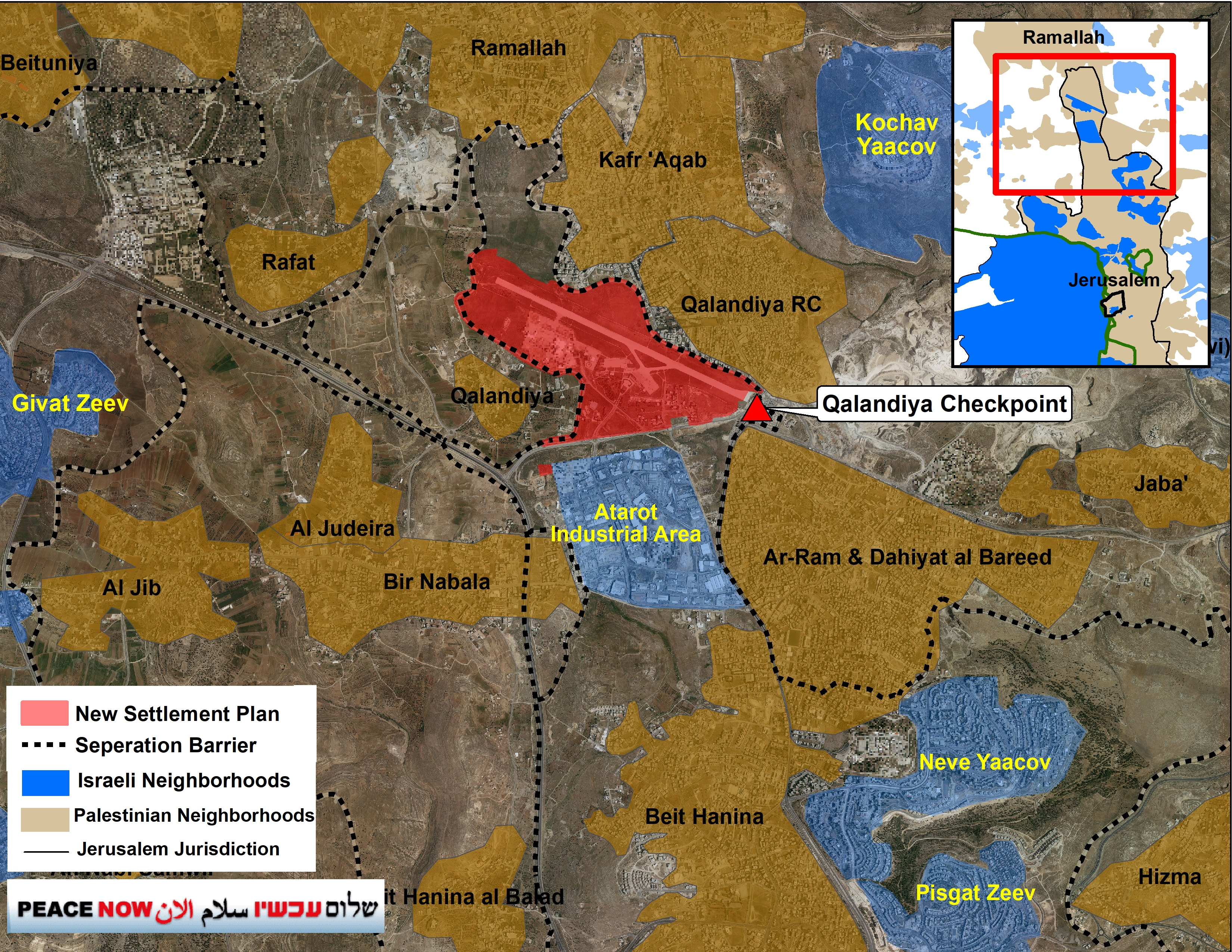 The Atarot settlement plan dates back to 2007. It was pursued by the Israeli government in 2012 but shelved under pressure from the Obama administration. The plan came back into consideration in April 2017 (a few months following the inauguration of President Trump) when it was rumored to be included on Netanyahu’s master blueprint of settlements for which he was seeking U.S. approval. In February 2020, following the publication of the Trump Plan – which designated the area that would be used for the settlement as a “special tourist zone” for Palestinians – the Atarot settlement plan was formally introduced. In January 2021 then-Prime Minister Netanyahu dangled the advancement of the plan as an incentive for parties to join his flagging coalition in order to remain in power.
In its current form, the plan provides for up to 9,000 residential units for ultra-Orthodox Jews (assuming, conservatively, an average family size of 6, this means housing for 54,000 people), as well as synagogues, ritual baths (mikvehs), commercial properties, offices and work spaces, a hotel, and a water reservoir. If built, the Atarot settlement will effectively be a small Israeli city surrounded by Palestinian East Jerusalem neighborhoods on three sides and Ramallah to its north.
There are currently 15 Palestinian families living in buildings on the land slated for the settlement, part of which is privately owned by Palestinians. Other land in the area has been declared “state land” by Israel or belongs to the Jewish National Fund. To solve the problem of Palestinian land owners, the Israeli government will need to evict the Palestinians living there and demolish their homes — a step that will be facilitated by the fact that all of the homes lack Israeli-issued building permits (which are essentially impossible for Palestinians to receive). The private Palestinian landowners will then be subjected to a non-consensual process of “reparcelization,” in which Israel will unilaterally reparcel and then redistribute the land amongst its owners on the basis of the value of the land (as determined by Israel) and the percentage of their ownership claim.
The Atarot airport site is an important commodity and, during past negotiations, it was promised to the Palestinians for their state’s future international gateway. Israeli development of the site as a settlement would — by design — not only deprive a future Palestinian state of the only airport in a Palestinian area, but also dismember Palestinian neighborhoods in the northern part of the Jerusalem, and sever East Jerusalem from a Palestinian state on this northern flank of the city (acting like E-1 on Jerusalem’s northeast flank, and like Givat Hamatos on Jerusalem’s southern flank).
Bonus Reads
- “Case Study: How a Settler Law-Breaker Became the #2 Official in Israel’s Ministry of the Interior” (FMEP // Lara Friedman w/ Dror Etkes)
- “Senior Israeli Official’s Appointment Approved Despite Demolition Order for His Settlement Home” (Haaretz)
- “In Sheikh Jarrah, anonymous actors and an absent state have created a powder keg” (The Times of Israel)
- “The Fight for Palestine’s Sheikh Jarrah Isn’t Over” (Jacobin)
- “ICC Mulls Probing Israel Over Razing Palestinian Homes in Jordan Valley” (Haaretz)
- “81 Palestinian homes demolished by Israel in East Jerusalem in 2021” (Middle East Monitor)
- “Jewish claim of land ownership in occupied East Jerusalem neighborhood displaces five Palestinian families” (WAFA)
Welcome to FMEP’s Weekly Settlement & Annexation Report. To subscribe to this report, please click here.
June 3 ,2021
- Critical Updates from Silwan & Sheikh Jarrah
- Tender Published for Givat Hamatos Groundwork, Even as Petition is Pending
- Final Approval Given to Har Homa E Settlement
- Expansion of the Beit El Settlement Begins
- High Court Bans Settlers from Farming Palestinian Land…But Continues to Deny Palestinians Access
- Resources on Israel’s New Prime Minister Naftali Bennet
- New Report on Settler Violence Against Palestinians in Area B
- Bonus Reads
Comments or questions? Email Kristin McCarthy – kmccarthy@fmep.org.
Critical Updates from Silwan & Sheikh Jarrah
In the weeks since FMEP’s last Settlement & Annexation Report was published (apologies for the gap) there have been several key developments in the cases of forced displacement of families from their longtime homes in Sheikh Jarrah and Silwan, including new scrutiny of the legal basis on which Israeli settlers claim to own the land and the homes from which they wish to expel Palestinians. It must be recalled that the Israeli Court has for the time being decided to postpone these expulsions – a decision clearly influenced by the fact that Palestinians are currently mobilized and the international community is closely engaged.
At this point, the most pressing eviction cases in Silwan and Sheikh Jarrah are awaiting the opinion of the Israeli Attorney General. That position is currently held by Avichai Mandelblit (though this might change under the new governing coalition). The Attorney General’s opinion will carry a tremendous amount of weight in deciding not only the fate of the families facing imminent displacement, but scores of other Palestinian families whose homes are being similarly targeted by settlers. Mandelblit, it is worth recalling, has among other things actively worked to craft legal mechanisms to launder illegal settler construction in the West Bank.
For additional background on the historic and legal context of these cases, see the new, excellent and thorough analysis by the Israeli NGO Terrestrial Jerusalem (PDF available here). To understand why these cases are not a simple real-estate dispute – and why it is improper to call them eviction cases – please see this analysis by Ir Amim’s Amy Cohen and Yudtih Oppenheimer. For updates on settlement-related developments in Silwan and Sheikh Jarrah, see below.
In Silwan
- On June 1st, the Jerusalem Affairs Ministry issued an order to freeze the construction of a “Yeminite heritage center” in the home of an evicted Palestinian family in the Batan al-Hawa section of Silwan.
- The order was issued in light of a newly launched investigation into the means by which Ateret Cohanim came to manage the “Benvenisti Land Trust,” an historic trust that Ateret Cohanim revived in order to claim ownership of swathes of land in Silwan, and then to initiate eviction proceedings against Palestinians living there. The investigation will have major consequences, not only for the fate of the planned heritage center (to commemorate a small Yemenite Jewish community that lived in the area before 1948), but also for the many eviction cases Ateret Cohanim is pursuing on the basis of its management of the land owned by Benvenisti Trust.
- Haaretz explains the background on why the investigation is being launched: “…in September 2020, the religious trusts registry began investigating the Benvenisti Trust in response to a petition filed in court by the Ir Amim organization. Ir Amim charged that the trust was a shell organization run by Ateret Cohanim for its own purposes, and that these purposes deviated from the founding goals of the trust, which was established in the late 19th century. Around six months ago, Ir Amim also petitioned the court against the planned heritage center, arguing that it was unreasonable for one government agency to be investigating the trust while another government agency was pouring money into it. Moreover, the organization said, it is improper for the state to finance a heritage center on private property that essentially serves Ateret Cohanim’s needs.”
- For background on Ateret Cohanim’s plans to build a heritage center, see FMEP’s August 2018 report.
- On May 26th, the Jerusalem District Court delayed the forced displacement of seven Palestinian families from their longtime homes in the Batan al-Hawa section of Silwan, awaiting a decision by the Israeli Supreme Court on two related cases.
- All three cases challenge the underlying legal status of the land and the buildings on the land – which the settler organization Ateret Cohanim claims to own via the resuscitation of the Benvenisti land trust.
- The two related cases are awaiting the submission of an opinion by the Israeli Attorney General, and that opinion will be applied to all three cases (and likely any additional cases brought on the same grounds). The Supreme Court ordered the Israeli Attorney General to submit his opinion on one of the cases – the Duweik family case – by May 31st. On June 1st, the Court granted the Attorney General a 30-day extension of that deadline.
- The Ateret Cohanim settler organization has led a campaign to forcibly displace some 100 Palestinian families from the Batan al-Hawa area of Silwan, claiming the land is rightfully owned by the Benvenisti Trust, over which Ateret Cohanim members have controlling power.
- Solidarity protests in Silwan have been violently suppressed by the Israeli authorities.
- Qutaiba Odeh, a resident of Silwan whose house is threatened with a demolition order, told Middle East Eye during a protest: “The Israeli settler groups behind the eviction cases in Sheikh Jarrah are the same ones coming after these houses in Silwan. It’s the same shared struggle, against the same occupation. We said save Sheikh Jarrah yesterday, we say save Silwan today.”
In Sheikh Jarrah
- Families continue to face the threat of displacement, the next court hearing has been delayed until August 2021, as the Court waits for the Attorney General to offer his opinion on the case, separate from the Silwan cases.
- An investigative report by Uri Blau revealed that a New York-based lawyer, Seymour Braun, is financially connected to settler efforts to displace Palestinians in Sheikh Jarrah. At the same time, the identities of those behind these eviction proceedings remains largely unknown, as they have been concealed by settlers and their backers.
- The neighborhood of Sheikh Jarrah remains under Israeli-imposed closure, actively (and violently) enforced by Israeli police.
- Ir Amim writes on the closure: “The closure of the neighborhood is seen as an intentional brazen move by the Israeli authorities to suppress Palestinian mobilization and deprive the residents of Sheikh Jarrah of the freedom of expression and the right to protest against their forced displacement. The Palestinian families at risk of eviction are now essentially living inside a cordoned-off, military-like zone. They are subject to ongoing arbitrary harassment and aggressive police measures, marked by forced entry into homes and the use of stun grenades, skunk water, and rubber-tipped bullets against neighborhood residents. With the closure’s intensification, police often force residents to stay in their homes and hostilely remove those sitting outside as is common practice in the neighborhood. Yesterday, a 15-year-old girl was severely wounded inside the confines of her own home when a soldier wantonly fired rubber-tipped bullets into the family’s house.”
- Journalists are reportedly being barred access to the area. Last week, to Palestinian journalists reporting from Sheikh Jarrah were arrested by Israeli authorities; reportedly after 5 days in jail “ the judge at Jerusalem’s Central Court released them on bail of 4,000 shekels ($1,230) each and ordered them to be under house arrest for a month, forbidding them from communicating with each other for 15 days.”
Tender Published for Givat Hamatos Groundwork, Even as Petition is Pending
Ir Amim reports that a private company has gone ahead and published a tender for the construction of roads, electrical infrastructure, and sewage systems at the Givat Hamatos settlement site. The tender is set to close June 6th.
The Israeli High Court has not yet dealt with a petition filed by Ir Amim alleging that the planned construction of government-subsidized housing at Givat Hamatos has discriminatory eligibility guidelines. A hearing was scheduled on May 27th, but was delayed at the request of the State. The hearing has been rescheduled for October 20th, and Ir Amim secured the Court’s condition that applications for Givat Hamatos housing will not be accepted in the intervening period.
Ir Amim writes:
“Publication of the tender is yet another indication that advancement of this new settlement/neighborhood on Givat Hamatos continues to move forward at a heightened pace. In the coming months, wide-scale road construction and infrastructure works are expected to already begin. It is estimated that the building of housing units could commence within two years, even before completion of the infrastructure works…Although advancement of these plans is continuing at full throttle, it is still possible for the government to suspend construction as a result of concerted pressure and opposition. Legal provisions within the tender as well as within Israeli contract law grant the Israeli government the right to rescind contracts should it be within its interest. There is likewise legal precedent for such measures.”
Final Approval Given to Har Homa E Settlement
On May 20th, a notice was published announcing the final approval of a plan to build the Har Homa E settlement in East Jerusalem. This comes on the heels of the conditional final approval granted to the project earlier in May (conditioned on a few minor changes that have since been made). Now that the plan has been published, construction on Har Homa E can begin. Ir Amim notes:
“Since the Har Homa E plan is designated for privately owned land, the planning process does not entail a tendering stage and in principle, the landowners can begin to apply for building permits. However, it is worthwhile noting that the District Committee conditioned the procurement of building permits on the start of expansion of the access road to Har Homa E. Since the road’s expansion is a municipal project, the timing of the work’s commencement is unknown. In addition, construction of new sewerage infrastructure to serve the new neighborhood/settlement is necessary since the location does not border an existing built-up area. The timetable for such construction is likewise unknown.”
Reminder: Although the Har Homa E plan is framed as merely an expansion of the Har Homa settlement in East Jerusalem, it is more properly understood as a brand new settlement. The plan calls for 540 new settlement units to be built in the area between the Har Homa settlement and the site of the planned Givat Hamatos settlement (tenders for which were issued in January 2021) — an area where the new construction will be non-contiguous with the built-up area of the existing settlement of Har Homa. Meaning that the new construction is a significant step towards completing a ring of Israeli settlements on Jerusalem’s southern edge and towards the encirclement of the Palestinian neighborhood of Beit Safafa.
Expansion of the Beit El Settlement Begins
On June 1st, the Beit El settlement hosted a ceremony to celebrate the start of construction of 350 new settlement units (housing for approximately 1,750 new settlers, assuming a family size of 5). The ceremony was attended by Health Minister Yuli Edelstein (Likud), Public Security Minister Amir Ohana (Likud), Education Minister Yoav Gallant (Likud), Regional Cooperation Minister Ofir Akunis (Likud), and Knesset Speaker Yariv Levin (Likud), in addition to more members of the Knesset.
These units were granted final approval in October 2020, during the Trump Administration. As a reminder, former US Ambassador to Israel David Friedman has deep ties to the Beit El settlement.
In a 2018 report, B’Tselem assessed the severe impact the Beit El settlement has on the 14,000 Palestinians who live in the nearby Jalazun refugee camp.
High Court Bans Settlers from Farming Palestinian Land…But Continues to Deny Palestinians Access
Following a 13-year legal battle, the Israeli High Court issued an order to evict settlers from 42-acres of land they had been illegally cultivating for in the Shiloh Valley, located in the northern West Bank. Over the course of those 13 years, settlers had established a profitable olive grove and vineyard. With the ruling, the settlers have been ordered to remove all of the olive trees and the vineyard by October 2021.
Yet, despite recognizing the settlers’ actions on the land as illegal, the High Court refused to recognize Palestinians as the rightful owners of the land. Instead, the Court said that it is not in a position to determine ownership because the land was never formally registered. As a reminder, at the start of the occupation Israel closed the land registry in the West Bank to Palestinians. This has meant that Palestinians who were not able to formally register their land before the 1967 War (Jordan was in the process of carrying out such a registration process when the war took place), there is no longer any path to do so. For more, see B’Tselem’s landmark report “Land Grab”, p.52)
Resources on Israel’s New Prime Minister Naftali Bennet
With it now looking all but certain that there will soon be a new Israeli government in place, led by Yamina’s Naftali Bennet, several media outlets have taken a deep dive into Bennet’s past. Longtime Settlement Report readers are likely familiar with Bennet’s intense devotion to annexation and the settlements, but these resources are a well-timed refresher.
- “Quick Facts: Naftali Bennett” (IMEU)
- “Israel’s likely new government, explained” (+972 Magazine)
- “Who is Naftali Bennett, Israel’s potential prime minister?” (Al Jazeera)
- “Who is Naftali Bennett, the man who could be Israel’s next prime minister?” (The Times of Israel)
- “What to know about Naftali Bennett, the Israeli politician who could succeed Benjamin Netanyahu” (Washington Post)
New Report on Settler Violence Against Palestinians in Area B
A new report by Yesh Din documents and analyzes the crimes committed by settlers in Palestinian communities located in Area B, from 2017 to 2020. In so doing, Yesh Din documents the lawlessness of settlers (who feel safe enough to enter built-up Palestinian areas to attack property and people), the cumulative deleterious effect these attacks have on Palestinian rights and wellbeing, and the abject failure of Israeli authorities to protect Palestinians and to hold Israeli settlers accountable to even Isareli for violations of the law (Israeli law).
Yesh Din writes:
“In recent years, violence perpetrated in Palestinian spaces – village streets, schools, public buildings and even homes – has proliferated. Secluded homes and structures, and those located near settlements, unauthorized outposts or access roads, have become standing, preferred, targets…Attacks on Palestinians and their property take a physical, financial, social and psychological toll on Palestinians, especially when they are widespread. Settlers have a clear advantage over the Palestinians: They are citizens of the country that holds the West Bank under military occupation. They have the protection of the Israeli police and military. Palestinians, on the other hand, are abandoned by the law enforcement system that is tasked with keeping them safe and protecting them from harm. This state of affairs, where one national group dominates another and oppresses it by denying rights, practicing legal segregation and employing different legal systems for each group, is part of Israel’s apartheid regime. This regime’s objective is to entrench and cement Israeli colonization of the West Bank.”
Bonus Reads
- “Questions and Answers: Israel’s De Facto Annexation of Palestinian Territory” (Al-Haq)
- “An Israeli Winery Guide, With Undertones of Occupation” (Haaretz)
- “Irish parliament denounces Israeli West Bank policies as ‘de facto annexation’” (The Times of Israel)
- ”Mapping Israeli occupation” (Al Jazeera)
Welcome to FMEP’s Weekly Settlement & Annexation Report. To subscribe to this report, please click here.
October 16, 2020
- No Annexation, No Problem – Israel Advances Nearly 5,000 New Settlement Plans, Including New Settlement South of Jerusalem
- Plan for 570 Units in East Jerusalem Settlement Approved for Deposit
- Israel Approves Construction of Elevator at Tomb of the Patriarchs
- Israel Delivers Confiscation Notices to Palestinians Living in the Heart of Hebron
- Palestinians Report Newly Established Outposts & Land Confiscations
- Targeting Palestinians Construction in Area C: State Devotes $6 million to Mapping Program
- In First, Palestinian Authority Courts to Hear Lawsuits Against Settlers
- NF, Elad Face International Heat Over Sumarin Family Eviction Case – Will it Matter?
- Report: U.S. Will Not Back De Jure Annexation Until 2024 [Friedman Says 2021 in Play]
- Bonus Reads
Comments/questions? Contact Kristin McCarthy (kmccarthy@fmep.org)
No Annexation, No Problem – Israel Advances Nearly 5,000 New Settlement Plans, Including New Settlement South of Jerusalem
During meetings held October 14th and 15th, the Israeli High Planning Council advanced plans for a total of 4,948 new settlement units. Of that total, plans for 2,688 units were granted final approval and plans for 2,260 units were approved to be deposited for public review (a late stage in the planning process). The latter approvals include a plan to build a new settlement, “Har Gilo West,” just beyond Jerusalem’s southern border. In addition, the Council granted retroactive approval to 340 existing illegally-built settlement units in the unauthorized outposts of Peni Kedem and Tapuach West, paving the establishment of two new official West Bank settlements (through post-facto legalization of the illegal outposts).
These were the first meetings of the High Planning Council since February 2020, at which time settlement planning was put on pause in favor of attempting to implement annexation plans as designed by Trump’s “Deal of the Century.” Under annexation, authority over the settlement planning/approval process could have been shifted from the Israeli Civil Administration (the branch of the Israeli Defense Ministry, in charge of the administration of affairs in the West Bank, – i.e., Israel’s occupation) into Israel domestic planning mechanism. Such a shift has long been a goal of settlers and their political allies.
In addition to advancing construction of new residential settlement units, the High Planning Council also advanced plans for the construction of new settlement projects that support tourism, further entrench the permanency of settlements, and that continue the exploitation of West Bank land and resources.
Record-Setting Settlement Activity in 2020
With the huge advancement of settlement plans this week, the Israeli government has advanced plans for 12,159 settlement units so far in 2020. With over two months to go, the settlement watchdog group Peace Now reports that this is already the highest total number settlement advancements in any year since Peace Now began tracking totals in 2012. Peace Now also reports that it is possible that the High Planning Council will convene one more time before the year ends.
Har Gilo West Approved for Deposit w/ Plan to Seal Off Al-Walajah
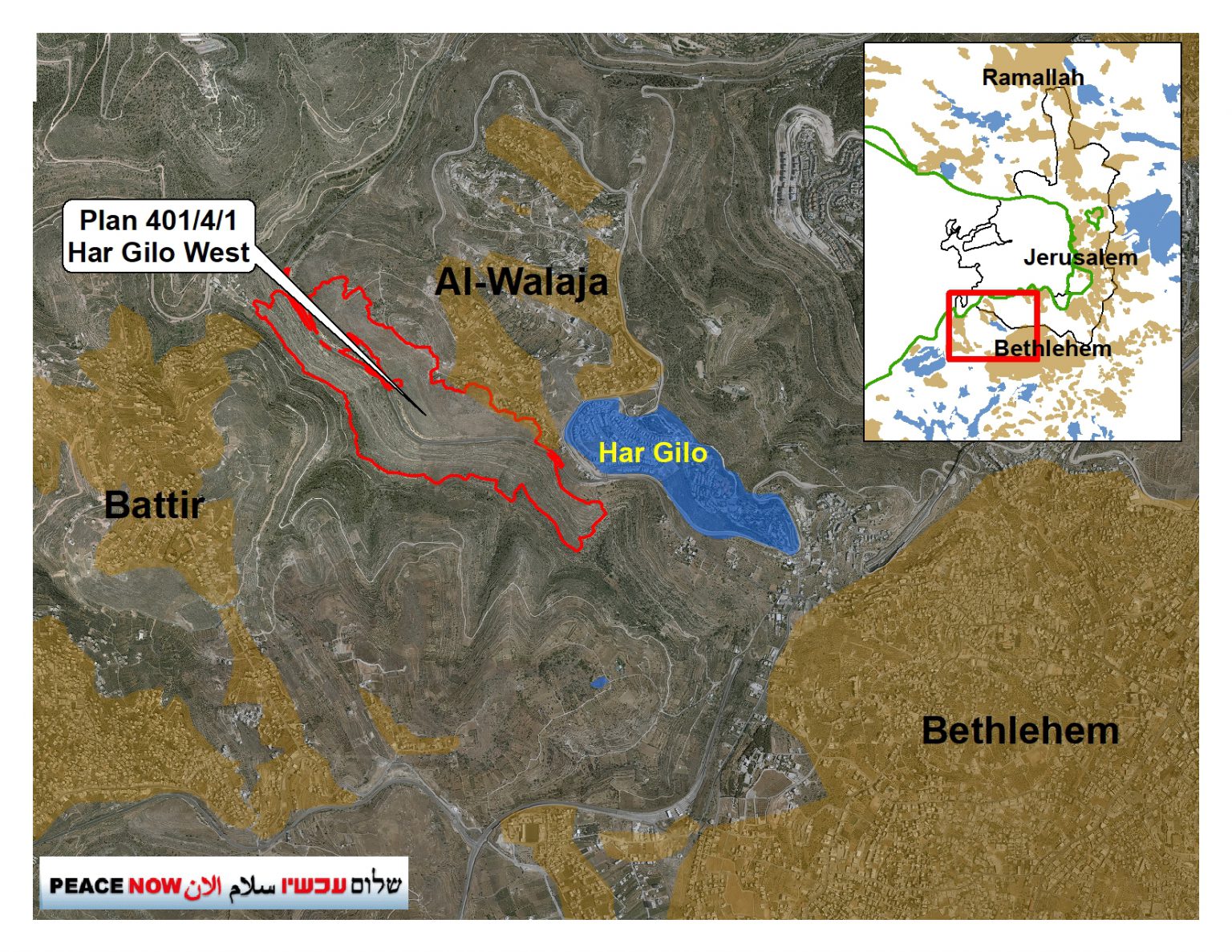 The High Planning Council approved for public deposit a plan to build 560 units at the Har Gilo West settlement site, located just south of Jerusalem. The Council is treating this plan as merely an expansion of the existing Har Gilo settlement, but in actuality it represents the construction of a new settlement on Jerusalem’s southern border, as the two areas of construction (Har Gilo and Har Gilo West) would not be contiguous. The plan for 560 units in Har Gilo West is part of a larger plan to construct around 952 units in the new settlement, extending the its borders right up to the Jerusalem municipal boundary, with dire consequences for the long-beleaguered Palestinian village of Al-Walajah.
The discussion on October 14th further revealed that, in order to build Har Gilo West, Israel plans to extend the separation barrier in that area to completely encircle al-Walajah, which is surrounded on three sides by the separation wall already. The new section of the barrier would be a 7-meters high concrete slab along the western edge of the built-up area of Al-Walajah. That would leave Al-Walajah completely encircled by the separation barrier and Israeli construction beyond it.
Ir Amim explains:
“In the past decade a series of Israeli moves have taken over more and more of Al-Walaja land and gradually isolating it. These are now culminating with the intention to construct the new settlement on the land reserves on the western side of Al-Walaja and to extend the separation barrier so as to complete the encircling of the village. As Al-Walaja will turn into an isolated enclave which lacks an outline plan its residents will be especially vulnerable to increasing home demolitions and other Israeli sanctions. Since the village will separate the new settlement from the existing Har Gilo we are likely to see increasing Israeli actions against Al-Walaja and its residents which will put their future existence at risk.”
Peace Now writes:
“The current plan of 952 housing units to be advanced will create a brand new neighborhood that will be larger than the existing settlement, and will exploit the land cut off by the West Bank barrier to further break up the western Bethlehem metropolitan area, including the land connecting al-Walaja and the town of Battir, as well as Battir and Bethlehem. This land also constitutes some of the only uninhabited fertile land reserves for Bethlehem, which currently is cut off by the West Bank barrier to its immediate north and west.“
FMEP has repeatedly documented various Israeli efforts to seal off al-Walajah from Jerusalem. Residents of al-Walajah have fought the growing encroachment by the nearby Etzion settlement bloc and the Israeli government’s attempt to de facto annex the bloc as part of “Greater Jerusalem.” Ir Amim explains several prongs of this effort, including a particularly unbelievable section of Israel’s separation barrier planned to almost completely encircle the village, to turn its valuable agricultural land into an urban park for Jerusalem, and construction of a highway that will connect the Etzion settlement bloc to Jerusalem with Israeli-only bypass roads.
Two Outposts Advance Towards Retroactive Legalization
The High Planning Council approved for deposit two plans that would, if implemented, have the effect of retroactively legalizing two outposts – bestowing upon those outposts legitimacy in the eyes of Israeli law and, in effect, establishing two new, official settlements. Those plans are:
- Pnei Kedem: A plan to grant retroactive legalization to 120 units in the Pnei Kedem farm outpost by recognizing the outpost as a “neighborhood” of the Metzad/Asfar settlement. This is despite the fact that the two areas of construction are non-contiguous. Pnei Kedem is located halfway between Bethlehem and Hebron in the southern West Bank. Settlers were particularly gleeful about this plan being advanced
- Tapuach West: A plan to grant retroactive legalization to 133 units in the Tapuach West outpost, located south of Bethlehem.
Not Just Residential Units – Council Advances Settler Tourism & Infrastructure Projects
The High Planning Council also advanced plans for the construction of new settlement projects that support tourism, further entrench the permanency of settlements, and that continue the exploitation of West Bank land and resources.
The Council granted final approval to:
- A plan for new shops and an educational site (to include an agricultural farm) in the Kochav Yaakov settlement – located between Jerusalem and Ramallah; and,
- A plan to grant retroactive authorization to a motor park and 120 hotel rooms in the Petza’el settlement, located in the Jordan Valley. As FMEP has covered in the past, this state-of-the-at racetrack and hotel complex is being built partially on land that the Israeli army previously declared a closed firing zone, a designation which resulted in the forcible displacement of Palestinians who lived there. The land remains under this designation today. Rather than halting the construction of this complex, the Israeli authorities instead created a Master Plan for the area in order to enable even more construction in the area.
Plans the Council granted final approval for public deposit include:
- A plan for an industrial zone near the Mishor Adumim settlement; and,
- A plan to build a new commercial area and 50 hotel rooms in the Maale Adumim settlement;
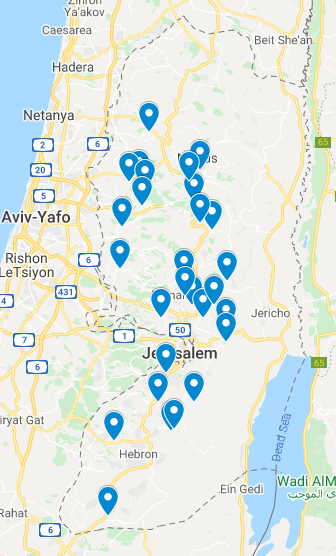
Map by Ben White (@benabyad)
Included in the total number of units receiving final approval and/or retroactive legalization (3,028 units) are (in descending order of number of units): [map]
- 382 units in the Beit El settlement, located in the heart of the northern West Bank. This includes retroactive legalization for 36 units which had been previously built without authorization and the construction of 346 units in highrise buildings with 9 or 10 floors (building up, not out in Beit El) [as a reminder, US Ambassador to Israel David Friedman has deep ties to the Beit El settlement];
- 357 units in the Geva Benyamin (Adam) settlement, located just north east of Jerusalem, just beyond the separation barrier. Israel has been steadily building the Adam settlement in a manner meant to unite the settlement more seamlessly with East Jerusalem settlements and infrastructure, erasing the Green Line;
- 354 units in the Nili settlement, located in the northern West Bank;
- 213 units in the Shiloh settlement, including the retroactive legalization of 21 units built without required approvals. The Shiloh settlement is located in the central West Bank;
- 211 units in the radical and violent Yitzhar settlement, including some retroactive authorizations (exact number not specified) as well as approval for public buildings. Yitzhar, located just south of Nablus, is associated with the Hilltop Youth movement – and a string of illegal outposts in the area associated with repeated attacks on Palestinians and their property;
- 205 units in the Nokdim settlement (actually approved for the Kfar Eldad settlement, which is officially within the jurisdiction of Nokdim), located south of Bethlehem;
- 200 units in the Metzad settlement (also known as Asfar), including the retroactive legalization of an unspecified number of existing units built without necessary approvals;
- 160 units in the Kochav Yaacov settlement, located east of Ramallah;
- 140 units in Kerem Reim settlement – located north west of Ramallah. Peace Now has repeatedly challenged the illegal construction of the Kerem Reim outpost, which the Israeli government retroactively legalized by declaring it a neighborhood of the Talmon settlement even though the areas are non-contiguous. Though a court rejected one Peace Now petition, there is an ongoing case against the Amana settler organization which Peace Now alleges engaged in illegal activities to build the outpost;
- 132 units in Kfar Adumim settlement – located east of Jerusalem and less than one mile from the Khan al-Ahmar bedouin community which the state of Israel is seeking to demolish;
- 106 units in the Ma’ale Shomron settlement, located east of the Palestinian village of Qalqilya;
- 84 new units in the Shima settlement, including retroactive legalization of 14 existing units;
- 74 units in the Yakir settlement – located in the northern West Bank and part of a string of settlements and unauthorized outposts – most notably Ariel – extending from the Green Line deep into the West Bank;
- 64 units in the Telem settlement – located west of Hebron;
- Retroactive legalization of 18 units in the Psagot settlement – located east of Ramallah, and home to the Psagot Winery;
- Retroactive legalization of 2 units in the “Givon Hadasha” settlement;
Plans which were approved for deposit for public review include (in descending order of number of units):
- 629 units in the Eli settlement, including the retroactive legalization of 61 units – located south of Nablus and southeast of the Ariel settlement in the central West Bank. Though the Eli settlement previously received Israeli government approval, a “Master Plan” – which officially zones land for distinct purposes (residential, commercial, public) – has never been issued for Eli, meaning all construction there is illegal under Israeli law;
- 560 units in the Har Gilo settlement located just south of Jerusalem (covered in detail above);
- 286 units in the Har Bracha settlement – located just south of Nablus. If implemented, these new units will double the size of Har Bracha;
- 179 units in the Einav settlement – located northwest of Nablus;
- 148 units in the Rimonim settlement – located between Ramallah and Jericho in the Jordan Valley;
- A plan to grant retroactive legalization to 133 units in the Tapuach West outpost, thereby granting approval to the outpost itself (discussed above);
- A plan to grant retroactive legalization to 120 units in the Pnei Kedem outpost by recognizing the outpost as a “neighborhood” of the Metzad/Asfar settlement although the two areas of construction are non-contiguous. Pnei Kedem is located between Bethlehem and Hebron in the southern West Bank;
- 82 units in the Karnei Shomron settlement – located in the northern West Bank east of the Palestinian village of Qalqilya. Israel is planning to continue expanding Karnei Shomron with the stated goal of bringing 1 million settlers to live in the area surrounding the settlement.;
- 75 units in the Shimaa settlement, including the legalization of 14 units previously built without authorization;
- 52 units received retroactive legalization in the Kfar Adumim settlement;
- 35 units in the Efrat settlement – located south of Bethlehem. As a reminder, Efrat is located inside a settlement block that cuts deep into the West Bank. Efrat’s location and the route of the barrier wall around it, have literally severed the route of Highway 60 south of Bethlehem, cutting off Bethlehem and Jerusalem from the southern West Bank. The economic, political, and social impacts of the closure of Highway 60 at the Efrat settlement (there is literally a wall built across the highway) have been severe for the Palestinian population;
- 14 units (in one building) in the Maale Mikmash settlement – located east of Ramallah;
- 10 units in the Barkan settlement – located about half way between the Ariel settlement and the cluster of settlements slated to be united into a “super settlement” area (Oranit, Elkana, Shiva Tikva, and others).
- 7 units in the Peduel settlement – located in the northern West Bank and part of a string of settlements and unauthorized outposts – most notably Ariel – extending from the Green Line into the very heart of the West Bank and on towards the Jordan Valley; and,
The High Planning Council met only after settlers, who represent a key ally of the embattled Prime Minister, pressured Netanyahu to allow it. Settlers have spent months decrying what they understood to be a freeze on settlement constructed inflicted upon them by Netanyahu. Gush Etzion Regional Council Head Shlomo Ne’eman said:
“Sometimes we take our prime minister to task, which we feel is justified as a result of our disappointment in postponing the application of sovereignty over our country. But now something tangible is happening – we are building and developing our communities, and of course, the highlight of today is the full registration in the Land Authority of the young community of Pnei Kedem, 20 years since it was established.”
Samaria Regional Council head Yossi Dagan said:
“This is a happy day for Samaria. [New construction] in Har Bracha, Yitzhar, Einav and Tapuach is another step on the way to a million residents in this beautiful region of the country…While we’re very content with today’s developments, I call on the Prime Minister not to stop here. We’re overfilled with joy, but it is a drop in the ocean with sovereignty falling off the agenda. The expectation now is that construction and strengthening of the settlement movement will increase tenfold.”
Peace Now responded to the approvals in a statement saying:
“While Israel reels from its second lockdown and economic distress, Netanyahu is promoting construction in isolated settlements that Israel will have to evacuate. Instead of taking advantage of the agreements with the Gulf states and promoting peace with the Palestinians, he is distorting Israel’s priorities and catering to a fringe minority for these settlement unit approvals that will continue to harm future prospects for peace. We call on the Defense Minister and the Alternative Prime Minister Benny Gantz to veto these plans. Far from a ‘settlement freeze,’ the right has been complaining about, the expected settlement approvals announcement next week prove that the settlement enterprise under Netanyahu is moving ahead at full steam toward solidifying the de facto annexation of the West Bank. The move also will be the first major demonstration of Defense Minister Benny Gantz’s bowing to the ‘Greater Israel’ settlement agenda that would in reality bring about a permanent undemocratic one-state reality. By doing so, Israel will be signaling to the world its bi-partisan support for the end to the concept of a two-state solution and a Palestinian state – the paradigm that until now has largely shielded Israel from formal pressure over its 53-year occupation. The settlement enterprise is not in Israel’s national or security interest, and is a strategic mistake at the international level.”
Palestinian Prime Minister Mohammed Shtayyeh denounced the approvals, saying:
“Every settler unit constitutes a plan to annex our land.”
Palestinian Authority spokesman Nabil Abu Rudeineh said in a statement:
“We warn against this Israeli policy that will lead the region to the brink of the abyss, and we call on the international community to intervene immediately and urgently to pressure the Netanyahu government to stop this settlement madness that totally eliminates any real opportunity to achieve a just and comprehensive peace to end the occupation and establish the independent Palestinian state with East Jerusalem as its capital on the 1967 borders.”
UN High Representative Josep Borrell said in a statement:
“In recent days, Israel has announced a significant expansion of settlements in the occupied West Bank, in areas in and around Jerusalem. These plans, which foresee the construction of close to 5.000 housing units, jeopardise the viability and territorial contiguity of a future Palestinian State as the outcome of a negotiated two-state solution, in line with the internationally agreed parameters. Settlements are illegal under international law. As stated consistently, the EU will not recognise any changes to the pre-1967 borders, including with regard to Jerusalem, other than those agreed by the parties. Settlement activity threatens current efforts to rebuild trust, to resume civil and security cooperation between Palestinians and Israelis and to prepare the ground for an eventual resumption of meaningful and direct negotiations. The Government of Israel should reverse these decisions and halt all continued settlement expansion, including in East Jerusalem and sensitive areas such as Har Homa, Givat Hamatos and E1. The period from March to August 2020 also saw a spike in demolitions or confiscations of Palestinian-owned structures in the West Bank in spite of the COVID-19 pandemic. The EU reiterates its call on Israel to halt all such demolitions, including of EU-funded structures, in particular in light of the humanitarian impact of the current pandemic. Against the background of normalization of relations between Israel, UAE and Bahrain, Israelis and Palestinians should seize this opportunity and take urgent steps to build confidence and restore cooperation along the line of previous agreements and in full respect of international law.”
A spokesperson for UN Secretary-General Antonio Guterres issued a statement flagging concern over the advancements, saying:
“We are concerned about the reports of Israel’s settlement advancements in the occupied West Bank and will continue to follow developments closely, as the Israeli High Planning Committee finalizes its meetings tomorrow. The Secretary-General has consistently reiterated that all settlements are illegal under international law and remain a substantial obstacle to peace. We urge the Israeli authorities to refrain from such unilateral actions that fuel instability and further erode the prospects for resuming Palestinian-Israeli negotiations on the basis of relevant UN resolutions, international law and bilateral agreements.”
Plan for 570 Units in East Jerusalem Settlement Approved for Deposit
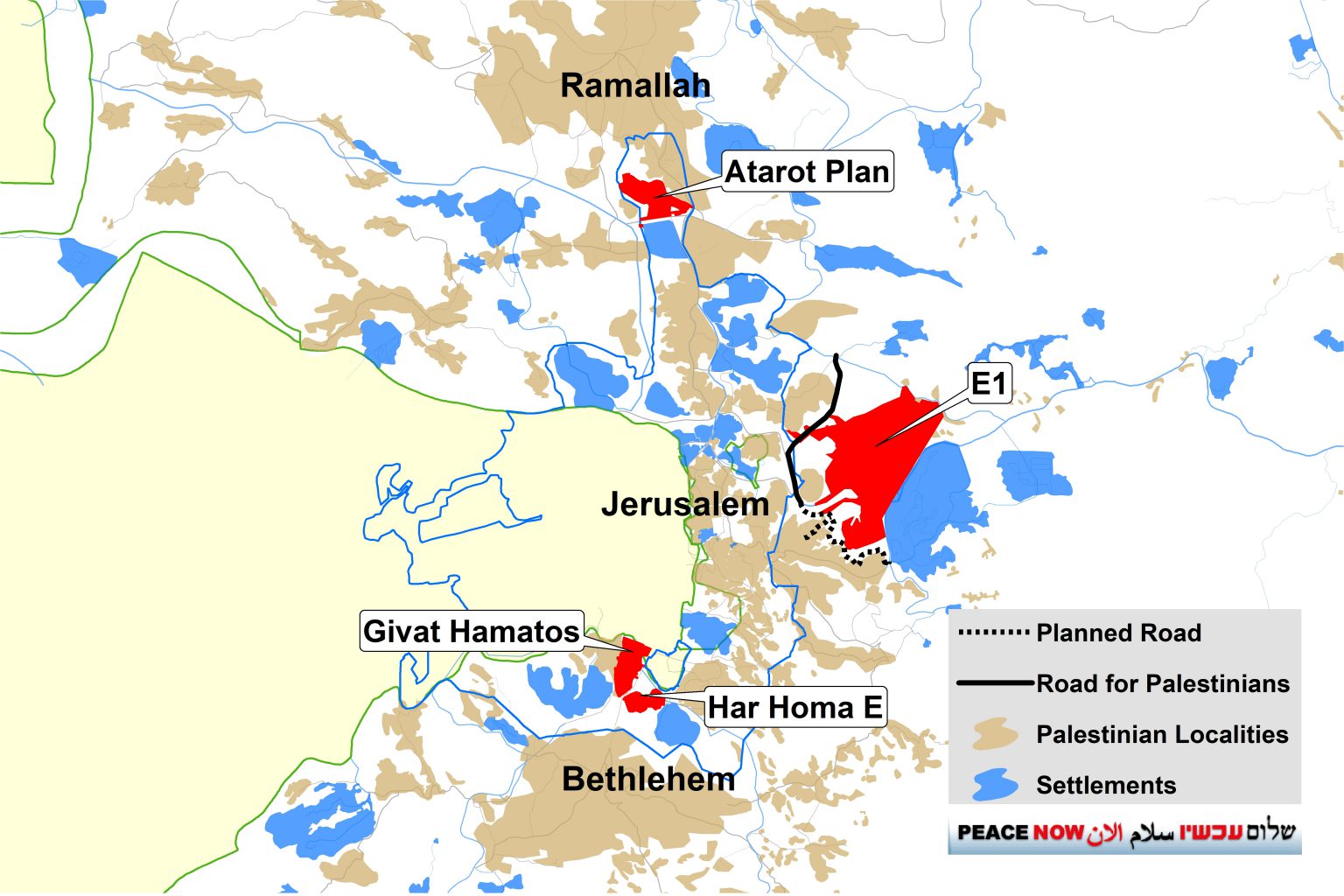 Ir Amim reports that on September 22nd, the Jerusalem District Committee approved for deposit for public review a detailed plan providing for the construction of 570 units in the Har Homa E settlement, located in East Jerusalem. Taken together with the pending construction of the nearby Har Gilo West settlement (discussed in the section above), the Palestinian village of al-Walajah stands to be completely encircled by Israeli settlements.
If implemented, this plan will extend the Har Homa settlement westward, in the direction of the site of the as-of-yet-unbuilt Givat Hamatos settlement. Ir Amim explains:
“If realized, Har Homa E together with construction in Givat Hamatos will connect Har Homa to Gilo creating a contiguous Israeli settlement area that will disconnect East Jerusalem from Bethlehem and the south of the West Bank.”
Ir Amim also reminds us that the Jerusalem District Committee previously approved a Master Plan for a total of 2,200 units in Har Homa E. The plan for 570 units approved for deposit in late September represents the first detailed plan under this Master Plan allows for. Plans to build the remaining units permitted under the Master Plan are not yet being advanced.
Israel Approves Construction of Elevator at Tomb of the Patriarchs
Emek Shaveh reports that on September 29th the Civil Administration granted final approval to a plan to build accessible infrastructure, including an elevator, at the Ibrahimi Mosque/Tomb of the Patriarch in Hebron — a plan which requires Israel to seize land from the Islamic Waqf. As of this writing, Emek Shaveh is considering whether to challenge that approval.
Regarding the significance of the plan, Emek Shaveh said:
“One need not be an archaeologist or architect to review the council’s plan and understand that it is destructive in a manner which is unprecedented. We are convinced that the plan, as approved, would never have been promoted had it not been driven by political motives.”
Emek Shaveh has previously provided critical context as to why this plan is not really, or not fully, being advanced out of humanitarian concerns, explaining:
“Israel’s decision to seize responsibility for the site from the Hebron municipality and the Palestinians sends a clear political message that Israel is reneging on agreements that were signed with the Palestinians in Hebron. Beyond the precedent that will enable the settlers in the future to demand additional changes at the Tomb of the Patriarchs/Ibrahimi Mosque, this is also a precedent that could play out at other sites under the responsibility of the Islamic Waqf. Experience has shown us that what begins in Hebron percolates into other places including Jerusalem. It begins with a seemingly rational demand to benefit the disabled or the general public and evolves into a new status quo. The expected change in Hebron has not escaped the attention of members of the Temple movement and they will know how to present their demands to the government. If Israel can repudiate agreements with the Palestinians in Hebron and expropriate land from the Waqf, it would seem that accepting what appears to be the far more modest demands by the Temple movement to pray or to walk about the Temple Mount complex freely is not so far-fetched. In the reality of Hebron and East Jerusalem, a change involving only several meters at a historic or holy place is not free of political considerations and often it is part of long-term strategy. While it is necessary to tend to the needs and interests of persons with disabilities, the extremists who presume to speak on their behalf must be prevented from forging Israeli policy, even if it is only a matter of a lift and an access path.”
Read Emek Shaveh’s full analysis here: “Humanitarianism Hebron Style.”
Israel Delivers Confiscation Notices to Palestinians Living in the Heart of Hebron
The Palestinian media outlet WAFA news reports that several Palestinians living in the Tel Rumeida section of downtown Hebron were handed confiscation notices from the Israeli authorities, informing them that the State of Israel had confiscated 17 plots of land, including land privately owned by Palestinians.
Tel Rumeida is a part of Hebron located directly in the city center, considered H2 by the Hebron Accords giving Israel full control of security in that area. B’Tselem estimates that there are around 700 settlers living in enclaves amongst approximately 34,000 Palestinians in H2. The Israeli army heavily protects those settlers, and has implemented an apartheid system of segregated movement and checkpoints, most notably in the area of Shuhada Street.
Palestinians Report Newly Established Outposts & Land Confiscations
The Palestinian news outlet WAFA reports that settlers have installed three new outposts over the past month – one near Nablus and a second near Hebron, and a third in the Jordan Valley.
Near Nablus, Palestinians report that the settlers installed mobile homes and a small farm in an attempt to establish a permanent presence on a new plot of land. The settlers are reportedly in the process of connecting the new outpost to the Elon Moreh settlement via roads and water supply. Ghassan Daghlas, who monitors Israeli settlements on behalf of the PLO, told WAFA that the specific area has seen even wider road construction recently, which he sees as an effort to create more seamless contiguity between settlements in the Nablus area and the Jordan Valley. The construction comes at the direct expense of the Palestinian village of Beit Dajani, which has historically owned the land where the outpost and roads are being built.
Near Hebron, WAFA reports that an Israeli settler erected a tent with and Israeli flag on privately owned Palestinian land near the Birin village.
In the Jordan Valley, WAFA reports that settlers set up a caravan on land on which they began planting trees about three months ago. The settlers also reportedly dug a well at the site.
On October 15th, Israel reportedly announced its intention to confiscate large tracts of land (11,000 dunums) adjacent to the Jordan Valley settlements of Rotem, Maskiyot, and Mesovah. This confiscation, according to Palestinian settlement watcher Qasem Awwad, was presented by the Israeli authorities as a move to add land to natural reserve areas, but seems clearly to be linked to efforts to expand settlements and their control over land in the area.
Targeting Palestinians Construction in Area C: State Devotes $6 million to Mapping Program
Despite COVID and the suspension of Israeli’s unilateral annexation of vast tracts of land in the West Bank, the Israeli government — at the urging of settlers and their allies — is continuing its push to consolidate its control over all aspects of life in Area C (the over 60% of the West Bank that is under full Israeli control).
OCHA has documented an acceleration in the Civil Administration’s demolition of Palestinian structures in the West Bank over the summer, documenting the demolition of 389 Palestinian-owned structures in Area C of the West Bank. As a result of those demolitions, 442 Palestinians were made homeless. OCHA further reported that In just the month of August, 205 Palestinians lost their homes, the highest single month total since January 2017. In addition, Israel continues to issue more demolition notices, including against Palestinians living in a cave near Jenin, and against a newly constructed school for bedouin children located east of Ramallah.
To further this effort, on September 10th the Israeli government allocated $6 million USD (20 million NIS) for the newly created Settlement Affairs Ministry to survey and map unauthorized Palestinian construction in Area C of the West Bank, which Israel and its settlers have been aggressively demolishing in an effort to rid the area of Palestinians. Haaretz reports that this is the first time that the state budget has included funds specifically for a land survey in the West Bank. The state also allocated an additional $2.8 million (9.5 million NIS) to an existing grant program specifically for settlement municipalities to cash in on. As a reminder, virtually all Palestinian construction in Area C of the West Bank is unauthorized, because Israel almost universally refuses to give Palestinians permission to build in Area C even on land that Israel recognizes as owned by Palestinians.
The Settlement Affairs Ministry is a new creation of the current coalition government, and is headed by Tzachi Hanegbi (Likud). The funding for the Settlement Affairs Ministry to conduct a survey of unauthorized Palestinian construction in Area C further empowers a domestic Israeli body to exert extraterritorial sovereignty over Area C – in effect, treating the area as land already de facto annexed by Israel. While technically the occupied territories are administered by the Israeli Civil Administration (a body within the Defense Ministry), Israel has spent decades bringing the administration of the territories (specifically the settlements and Area C) ever more directly under direct Israeli sovereignty (de facto annexation).
In the lead up to the allocation of funds for this new survey of Palestinians life in Area C, the Knesset hosted two committee discussions the political outlook of which was clearly indicated in the stated subject of the meetings: “the Palestinian takeover of Area C.” Consistent with this framing (which is predicated on the idea that Area C belongs to Israel), and pushed by outside groups, many members of the Knesset have criticized the Israeli government’s allegedly lackadaisical approach to preserving State interests in Area C (i.e., clearing out Palestinians, expanding settlements, consolidating state infrastructure). Reportedly, Foreign Affairs Minister Gabi Ashkenazi (Blue & White) sent a letter to the committee specifically addressing the Knesset’s outrage over European humanitarian assistance projects for Palestinians in Area C. In the letter, Ashkenazi not only celebrated the reduction of European projects over the past year, but validated settlers’ insinuations regarding the nefarious nature of European assistance for Palestinians, saying that any European activity in the West Bank lacking Israeli permission is “an attempt to define a border.” Ashkenazi also said that Israel will not compensate European donors for confiscated equipment or the demolition of European-funded projects that lack Israeli permission (like in the case of schools built with European funding, and solar panels donated to bedouin communities lacking power).
At one Knesset hearing, MK Bezalel Smotrich (Yamina) suggested that a solution could be to empower the settlements with the ability to demolish Palestinian construction they believe to be unauthorized. Smotrich’s partymate Ayelet Shaked (former Justice Minister) suggested that the government should appoint a project manager tasked with preventing a Palestinian takeover of Area C.
As noted above, Israel has long denied Palestinians the ability to build in Area C. To fully understand what is happening, it is worth reviewing B’Tselem’s excellent explainer:
“Israel’s planning and building policy in the West Bank is aimed at preventing Palestinian development and dispossessing Palestinians of their land. This is masked by use of the same professional and legal terms applied to development in settlements and in Israel proper, such as “planning and building laws”, “urban building plans (UBPs)”, “planning proceedings” and “illegal construction”. However, while the planning and building laws benefit Jewish communities by regulating development and balancing different needs, they serve the exact opposite purpose when applied to Palestinian communities in the West Bank. There, Israel exploits the law to prevent development, thwart planning and carry out demolitions. This is part of a broader political agenda to maximize the use of West Bank resources for Israeli needs, while minimizing the land reserves available to Palestinians….
In the West Bank, the potential for urban, agricultural and economic development remains in Area C. Israel uses its control over the area to quash Palestinian planning and building. In about 60% of Area C – 36% of the West Bank – Israel has blocked Palestinian development by designating large swathes of land as state land, survey land, firing zones, nature reserves and national parks; by allocating land to settlements and their regional councils; or by introducing prohibitions to the area now trapped between the Separation Barrier and the Green Line (the boundary between Israel’s sovereign territory and the West Bank).
Even in the remaining 40% of Area C, Israel restricts Palestinian construction by seldom approving requests for building permits, whether for housing, for agricultural or public uses, or for laying infrastructure. The Civil Administration (CA) – the branch of the Israeli military designated to handle civil matters in Area C – refuses to prepare outline plans for the vast majority of Palestinian communities there. As of November 2017, the Civil Administration had drafted and approved plans for only 16 of the 180 communities which lie in their entirety in Area C. The plans cover a total of 17,673 dunams (1 dunam = 1,000 square meters), less than 1% of Area C, most of which are already built-up. The plans were drawn up without consulting the communities and do not meet international planning standards. Their boundaries run close to the built-up areas of the villages, leaving out land for farming, grazing flocks and future development. Since 2011, seeing that the Civil Administration did not draft plans as it is obliged to do, dozens of Palestinian communities – with the help of Palestinian and international organizations and in coordination with the PA – drafted their own plans. Some of the plans covered communities or villages located in full in Area C and others covered places only partly in Area C. As of September 2018, 102 plans had been submitted to the Civil Administration’s planning bodies, but by the end of 2018, a mere five plans – covering an area of about 1,00 dunams (or about 0.03% of Area C) – had received approval.
The odds of a Palestinian receiving a building permit in Area C – even on privately owned land – are slim to none. Given the futility of the effort, many Palestinians forgo requesting a permit altogether. Without any possibility of receiving a permit and building legally, the needs of a growing population leave Palestinians no choice but to develop their communities and build homes without permits. This, in turn, forces them to live under the constant threat of seeing their homes and businesses demolished.
The impact of this Israeli policy extends beyond Area C, to the hundreds of Palestinians communities located entirely or partially in Areas A and B, as the land reserves for many of these communities lie in Area C and are subject to Israeli restrictions there.
The demand for land for development has grown considerably since the 1995 division of the West Bank: The Palestinian population has nearly doubled, and the land reserves in Areas A and B have been nearly exhausted. Due to the housing shortage, much land still available in these areas is used for residential construction, even if it is more suited for other uses, such as agriculture.
Without land for construction, local Palestinian authorities cannot supply public services that require new structures, such as medical clinics and schools, nor can they plan open spaces for recreation within communities. Realizing the economic potential of Area C – in branches such as agriculture, quarrying for minerals and stone for construction, industry, tourism and community development – is essential to the development of the entire West Bank, including creating jobs and reducing poverty. Area C is also vital for regional planning, including laying infrastructure and connecting Palestinian communities throughout the West Bank.
In contrast to the restrictive planning for Palestinian communities, Israeli settlements – all of which are located in Area C – are allocated vast tracts of land, drawn up detailed plans, connected to advanced infrastructure, and the authorities turn a blind eye to illegal construction in them. Detailed, modern plans have been drawn up for the settlements, including public areas, green zones and, often, spacious residential areas. They enjoy a massive amount of land, including farmland that can serve for future development.
Israel’s policy in Area C is based on the assumption that the area is primarily meant to serve Israeli needs, and on the ambition to annex large parts of it to the sovereign territory of Israel. To that end, Israel works to strengthen its hold on Area C, to further exploit the area’s resources and achieve a permanent situation in which Israeli settlements thrive and Palestinian presence is negligible. In doing so, Israel has de facto annexed Area C and created circumstances that will leverage its influence over the final status of the area.”
In First, Palestinian Authority Courts to Hear Lawsuits Against Settlers
For the first time since the Palestinian Authority was established in 1994, it will allow Palestinians to bring lawsuits against Isareli settlers in Palestinian courts. The Palestinian Authority’s Justice Minister Mohammed al-Shalaldeh announced that the PA had formed a national team to handle these cases, and the team was already working to collect evidence and file suits against settlers who have committed crimes against Palestinians in Hebron and in the village of Burin, located just south of Nablus.
Until this point, no Israeli citizen has been tried in a Palestinian court. Under the Oslo Accords (which established the Palestinian Authority), the Palestinian Authority holds no jurisdication over Israeli citizens – including Israeli citizens living in the West Bank. In May 2020, PA President Mahmoud Abbas announced that the PA considers all accords and agreements with Israel to be void following Israel’s announcement that it intends to annex large parts of the West Bank in accordance with the Trump Plan. Shalaldeh said that the announcement this week flows directly from Abbas’s decision to free the PA from the Oslo Accords’ provisions.
Explaining how these cases might work, Shalaldeh said:
“The Israeli side will be notified as an occupying power to appear before the Palestinian court…If the [Israeli] side refuses the jurisdiction of the Palestinian courts, formal procedures will be followed and in absentia rulings will be issued, in accordance with Palestinian laws.”
JNF, Elad Face International Heat Over Sumreen Family Eviction Case – Will it Matter?
Over the past month, international audiences have directed heightened scrutiny towards the radical settler group Elad and the Jewish National Fund (JNF) for the role both organizations have played in spearheading the effort to evict the Palestinian Sumreen family from their home in the Silwan neighborhood of East Jerusalem. Due to the new attention, the JNF is reportedly reconsidering whether or not to carry out the eviction of the Sumreens – an eviction which the organization has pursued since 1991.

Map by Haaretz
JNF donors – along with activists, religious leaders, members of Congress, and Israel prize winners – reportedly began to express concern and outrage over the JNF’s role in the Sumreen case following the September 2020 ruling by Jerusalem Magistrate’s Court against the Sumreen’s claim to the home. In response to the criticism, the JNF (via actions by the Board of its subsidiary organization, Himnuta, which was created to take the lead for JNF in litigating aggressive settlement takeover cases like this) has acted to freeze the eviction process internally, and was scheduled to consider a proposal for freezing the formal legal proceedings against the Sumreens this past week. Himnuta’s decision and deliberations caused conflict with Elad, which had the Jerusalem Magistrate’s Court intervene to postpone Himnuta’s Board meeting to discuss the proposal. Elad argues that Himnuta transferred all legal authority over the Sumreen case to their organization, and cannot now interfere in the proceedings. The meeting was subsequently postponed at the request of the Court.
Elad is also coming under new international scrutiny following the revelation that Roman Abramovitch – a Russian oligarch and naturalized Israeli citizen who also is one of the owners of the renowned Chelsea football club – is Elad’s single largest donor, having anonymously donated over $100 million to the settler group over the past 13 years. The BBC produced an investigative feature report on Abramovitch’s connection to Elad, pointing out that over the past 15 years more than half of Elad’s funding has come from offshore companies in the Caribbean, which are now known to be owned or controlled by Abramovitch. The BBC feature connects Elad to the settlers’ struggle to evict the Sumreen family, and the larger effort to replace Palestinians in Silwan with Jewish Israelis.
Peace Now writes:
“The news about Abramovich’s involvement highlights the injustice Palestinians face at the hands of these settlement groups. Impoverished families are up against the financial weight of a Russian oligarch. NGOs trying to protect these families are delegitimized and their work dismissed for receiving funding from democratic European aid agencies while settler groups rake in vast sums of non-transparent money from offshore Caribbean shell companies. And the JNF is profiting off of all of this. We can’t force Abramovich to stop his funding or the JNF to stop abetting Elad in its settling campaign, but we can make them worry about their reputation. Peace Now has been conducting a campaign inside Israel to call Abramovich out for his devious funding.”
Regarding the revelations of Elad’s funding source, Emek Shaveh writes:
“…the Elad Foundation, through a combined strategy of sponsoring excavations, developing tourism and settling in Palestinian homes, succeeded in recreating Silwan as the Jewish neighbourhood of Ir David (City of David) and one of the most popular tourist destinations in the country. The exploitation of archaeological tourism by the Elad Foundation has become a number one strategy for entrenching Israeli sovereignty over historic Jerusalem. “
The Sumreen family home is located in the middle of what today has been designed by Israel “the City of David National Park.” The area is managed by the radical Elad settler organization, which for years has also been pursuing the eviction of Palestinians from the homes in Silwan. For nearly three decades, the Sumreen family has been forced to battle for legal ownership of their home, after the state of Israel, prompted repeatedly by the JNF, declared the Sumreen’s home to be “absentee” property. After that designation – which was not communicated to the Sumreen family – Israeli law permitted the state to take over the rights to the building. The state then sold the rights to the home to the JNF in 1991. The JNF has pursued the eviction of the Sumreen family ever since. Israeli courts ruled in favor of the Sumreen family’s ownership claims to the home for years, until a September 2019 ruling by the Jerusalem Magistrate’s Court granted ownership of the family’s home to the JNF, a decision the family immediately appealed to the Jerusalem District Court.
A full history of the saga involving the Sumreen family – which is similar to dozens of other Palestinian homes in Silwan that were declared Absentee Property in the 1990s – can be found on the Peace Now website here.
Report: U.S. Will Not Back De Jure Annexation Until 2024 [But Friedman Says 2021 Is in Play]
A series of reports in mid-September suggested that, as part of its commitment to the U.A.E. in exchange for normalization with Israel, the U.S. promised to withhold its recognition of Israeli annexation until January 2024, at the earliest.
The 2024 timeline harkens back to a concept in Trump’s “Deal of the Century” which gave (oh so generously) the Palestinians a four year window to enter into negotiations with Israel on the basis of the Trump Plan’s conceptual map.
Following these reports regarding a 2024 timeline for the U.S. greenlighting Israeli annexation, U.S. Ambassador David Friedman (who has been a champion of annexation) told Israel’s Army Radio that annexation can happen next year. Friedman, pushing back on U.A.E. press leaks seeking to promote the notion that the Abraham Accords stopped annexation, said:
“We said in our statement that sovereignty will be postponed, and this does not mean that it has been abolished, but rather that it has stopped. It has been suspended for a year, maybe more, but it has not been cancelled.”
Bonus
- “Tourism in the Service of Occupation” (Al-Shabaka)
- “The Status Quo on the Temple Mount/Haram Al Sharif: Dodging a Bullet (For Now)” (Terrestrial Jerusalem)
- “How Evangelicals Working in Settlements Bypassed Israel’s COVID-19 Entry Ban” (Haaretz)
- “ The March of Folly in the Settlements Continues” (Haaretz)
- “Israeli Students in State-funded Scholarship Program Guard Illegal West Bank Outposts” (Haaretz)
Welcome to FMEP’s Weekly Settlement Report, covering everything you need to know about Israeli settlement activity this week.
To subscribe to this report, please click here.
August 9, 2019
- Summary: Another Week, Another Round of Major Settlement Approvals
- Israeli Annexation via Settlement Construction Unleashed, Part 1: Three Outposts are “Legalized”
- Israeli Annexation via Settlement Construction Unleashed, Part 2: Final Approval for 648 New Settlement Units
- Israeli Annexation via Settlement Construction Unleashed, Part 3: Plans Advanced for 1,466 New Settlement Units (With More to Come)
- Israeli Annexation via Settlement Construction Unleashed, Part 4: Reactions
- Following Murder of Settler Youth, Netanyahu Doubles Down on Commitment to Settlements
- Latin Patriarchate Files Suit Claiming New Proof of Fraud Behind Settler Takeover of Old City Hotel Properties
- Education Minister Strips Key Committee Membership from Professor Who Objected to Authorization of Settlement Medical School
- Bimkom Report: Israel’s “No Construction Zone” Adjacent to the Separation Barrier Has Little To Do With Security
- Ir Amim: Israel’s Crackdown in Issawiya Advances Settlement Project in East Jerusalem
- Terrestrial Jerusalem In-Depth Report: The Silwan Tunnel Project
- Bonus Reads
Questions or comments? Contact Kristin McCarthy at kmccarthy@fmep.org.
Summary: Another Week, Another Round of Major Settlement Approvals
During its quarterly convening on August 5th and 6th, the Israeli Defense Ministry’s High Planning Council advanced plans for a total of 2,304 new settlement units. This includes:
- the approval of plans legalizing 190 units that have the effect of retroactively legalizing 3 unauthorized outposts;
- final approval for the construction of 648 settlement units; and
- interim approval (i.e., a step toward final approval) for the construction of 1,466 new settlement units
These approvals comes on the heels of the Israeli Security Cabinet’s decision to issue 6,000 building permits for settlement units last week (details of which are still unpublished). The past week of massive settlement advancements is a clearer-than-ever indication that Israel (with very public backing from top U.S. officials) is not holding back its illegal settlement activities and its ongoing annexation of the West Bank, particularly in Area C.
Details of this week’s approvals are broken down below.
Israeli Annexation via Settlement Construction Unleashed, Part 1: Three Outposts are “Legalized”
Plans advanced August 5-6 by the Israeli Defense Ministry’s High Planning Council In its decisions taken August 5th and 6th include at least 190 units in three illegal outposts — which have the effect of retroactively legalizing those three outposts. The outposts that gained retroactive approval this week are:
- Haroah Haivri – The council approved a plan for an educational institute and accompanying housing for students and staff. Most extraordinarily, Haroah Haivri, located just east of Jerusalem, is within eyesight of the Khan al-Ahmar community, which Israel is planning to demolish (forcibly relocating the Palestinian bedouin community that has lived there since the 1950s) — ostensibly because the structures in Khan al Ahmar were built without necessary Israeli approvals. The Haroah Haivri outpost was also built without the necessary Israeli approvals, but instead of demolishing the construction, Israel has retroactively legalized it — demonstrating once again that, when it comes to administering the occupation, Israel prefers “rule by law” – where law is turned into a tool to elevate the rights/interests of one party over another, over the democratic rule of law.
- Ibei Hanachal – The Council approved 96 units in this outpost, located southeast of Bethlehem, turning it into a “neighborhood” of the Maale Amos settlement. In reality, the outpost is not contiguous with the built-up area of the Maale Amos settlement, meaning that the implementation of this plan will, in effect, create a distinct new settlement (for coverage of this plan, see here) .
- Givat Salit – The Council approved 94 units in this outpost, located in the northern Jordan Valley, as part of turning it into a “neighborhood” of the nearby Mechola settlement.
The legalization of these three outposts only adds to the success of Israel’s ongoing and increasingly successful effort to retroactively legalize all illegal settler construction in the West Bank (that is, construction undertaken illegally under Israel law; all settlement construction is illegal under international law). The lengths to which Israel has gone to in order to achieve that goal include inventing new legal grounds — some outlined by the government’s “Zandberg report” and another – the “market regulation principle” identified by the Isareli Attorney General — that in effect allow Israel to suspend the rule of law and erase private property rights of Palestinians. For the past 2.5 years, FMEP has documented this campaign in detail in its Annexation Policies Tables – regularly updated and available online.
Israeli Annexation via Settlement Construction Unleashed, Part 2: Final Approval for 648 New Settlement Units
The actions taken this week by the High Planning Council include issuing final approval for 648 settlement units – mostly new construction but also some approval of existing construction that had been undertaken without approval (all of this is in addition to the 190 units in outposts legalized retroactively). Details of these approvals for new settlement construction are as follows:
-
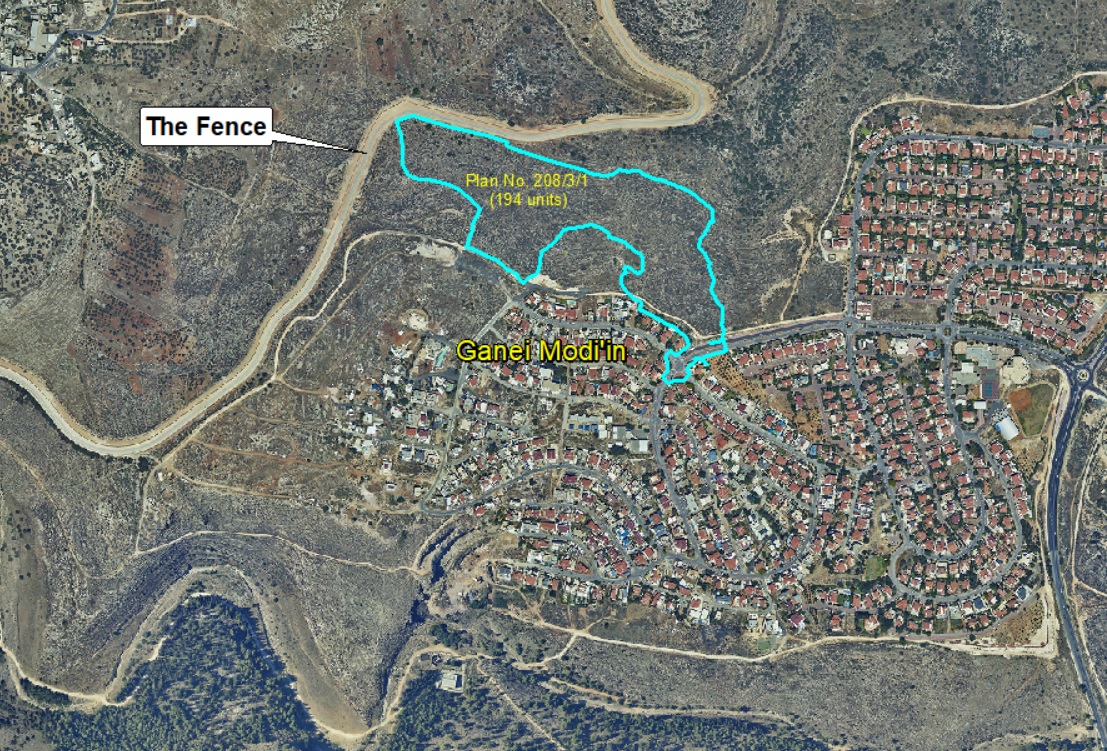
Map by Peace Now
194 units in the Ganei Modlin settlement, located in the northern “seam line zone” in the West Bank but on the Israeli side of the security barrier (by design of the Israeli government). The plan for 194 new units will bring the settlement’s built-up area directly up to the separation barrier, a particularly notable plan given Israel’s recent demolition of 70 Palestinian homes in the West Bank, based on the argument that the construction within a 200-250 foot Israeli-imposed “no construction zone” on either side of the barrier poses an unacceptable security risk to Israel. Israel rejected an offer by Palestinians to privately finance the construction of new and higher wall near the buildings; developers behind the Ganei Modlin project also offered to finance the construction of high wall near the construction, an offer the courts saw fit to accept – resolving the matter in the eyes of the High Planning Council, which approved the plan.
- 96 units in the Kiryat Netafim settlement, located in the northern West Bank and part of a string of settlements and unauthorized outposts – most notably Ariel – extending from the Green Line into the very heart of the West Bank and on towards the Jordan Valley.
- 76 units in the Beit Hagai settlement, located just south of Hebron,
- 66 units in the Efrat settlement, located south of Bethlehem. Efrat had already received final permission for 1,000 new settlement units at the most recent High Planning Council meeting, in April 2019. As a reminder, Efrat is located inside a settlement enclave that cuts deep into the West Bank. Efrat’s location and the route of the barrier wall around it, have literally severed the route of Highway 60 south of Bethlehem, cutting off Bethlehem and Jerusalem from the southern West Bank. The economic, political, and social impacts of the closure of Highway 60 at the Efrat settlement (there is literally a wall built across the highway) have been severe for the Palestinian population.
- 61 units attached to an educational institute in the Gva’ot settlement, located south of Bethlehem. The Gva’ot (Gevaot) settlement was established as an outpost of mobile homes, and later benefited from Israel’s unilateral, mass expropriation of Palestinian land in 2014 (which Israeli officials explictly said was done in response to a Palestinian terror attack). At the time, Peace Now reported that the move constituted the largest single expropriation of Palestinian land by the Israeli state in over 30 years.
- 51 units in Shvut Rachel, which only recently became an authorized settlement area when Israel extended the jurisdiction of the Shiloh settlement to include it as a “neighborhood” (along with three other outposts). The plans approved this week will retroactive legalize existing units and permit the construction of a few news one.
- 29 units in the Otniel settlement, located in the South Hebron Hills area. The plans serve to retroactively legalize existing units.
- 27 units in the Maskiyot settlement, located in the northern Jordan Valley. These units are part of a plan allowing the construction of a “bed and breakfast” with 27 additional rooms (and calling to mind Amnesty International’s recent report on the role tourism plays in supporting the occupation).
- 19 units in the Peduel settlement, located in the northern West Bank and part of a string of settlements and unauthorized outposts – most notably Ariel – extending from the Green Line into the very heart of the West Bank and on towards the Jordan Valley.
- 18 units and a park in the Ma’ale Adumim settlement.
- 11 units in the Einav settlement, located northwest of Nablus.
In addition, the Council gave retroactive approval for a controversial archeological site in the Shiloh settlement, located in the center of the northern West Bank. The Israeli government has devoted a significant amount of money and political energy towards building the tourist site, which is now drawing upwards of 60,000 evangelical tourists each year. For background on the site, see this Emek Shaveh report from 2014 and this brief from 2017, when the government approved the commercialization of the site. For analysis on how the site fits into a bigger pattern of Israeli efforts to normalize the settlements through tourism, see this report by Amnesty International.
Israeli Annexation via Settlement Construction Unleashed, Part 3: Plans Advanced for 1,466 New Settlement Units (With More to Come)
Actions taken August 5-6 by the Israeli Defense Ministry’s High Planning Council include advancing plans that, when they eventually receive final approval, will allow for the construction of 1,466 settlement units (details of the various steps of the planning/approval process are laid out by Peace Now here). Specifically, the Higher Planning Council this week approved the following plans for deposit for public review:
- 382 units in the Beit El settlement, located north of Ramallah. The plans include the retroactive legalization of 36 units; the remaining 346 are new units. As a reminder, Beit El is the settlement closely associated with U.S. Ambassador to Israel David Friedman, who among other things was the President of the “Friends of Beit El” organization, which raised money on its behalf.
- 354 in the Nili settlement, located in the northern West Bank;
- 200 units in the Asfar settlement, located northeast of Hebron. If approved, this plan will triple the size of the Asfar settlement.
- 168 units in the Talmon settlement, located north west of Ramallah. In December 2018, FMEP reported on a deadly encounter between neighboring Palestinians and settlers from Talmon and/or the many unauthorized outposts associated with it. The settlers had been attempting to takeover another hilltop on the outskirts of the Palestinian village of al-Mazra’ah al-Qibliyah. When Palestinians staged an attempt to stop the settlers from entering the area, a scuffle ensued and Israeli soldiers shot and killed two Palestinians.
- 132 units in the Kfar Adumim settlement, located east of Jerusalem and less than one mile from the Khan al-Ahmar bedouin community which the state of Israel is seeking to demolish.
- 84 units in the Shima settlement, located in the southern tip of the West Bank.
- 74 units in the Yakir settlement, located in the northern West Bank and part of a string of settlements and unauthorized outposts – most notably Ariel – extending from the Green Line deep into the West Bank.
- 48 units in the Bracha settlement, located south of Nablus.
- A recreational area in the Kochav Yaakov settlement, located just south of Ramallah.
In addition to the plans approved and advanced detailed above, the High Planning Council delayed consideration of two additional plans, which are:
- A plan that would effectively legalize another outpost, known as Brosh. Similar to the Haroah Haivri plan, discussed above, the plans relating to Brosh serve to retroactively legalize an existing educational institute. Approval of the plan was delayed because the Council had not resolved objections that were filed against the plan, including an objection filed by Peace Now.
A plan for 207 settlement units in the Bracha settlement, located near Nablus (these plans are in addition to the plans for 48 units approved to be deposited for public review, covered above). Though plan was on the Council’s schedule, it could not be approved because the Council first needs to approve the extension of Har Bracha’s existing settlement jurisdiction to include the area units are to be built. Since the plan calls for the construction of units outside of the existing area of jurisdiction, the plan could not be approved.
Israeli Annexation via Settlement Construction Unleashed, Part 4: Reactions
Following this week’s advancement of plans for 2,304 settlement units, settlement watchers and key members and bodies of the international community issued sharp criticism and sounded the annexation alarm bells. In contrast, there was glaring – and very, very, very predictable – silence came from the U.S. administration. A few notable reactions are included below.
Peace Now said in a statement:
“The approval of settlement plans is part of a disastrous government policy designed to prevent the possibility of peace and a two-state solution, and to annex part or all of the West Bank. The linkage of thousands of housing permits for settlers and a negligible number of housing units for Palestinians cannot hide the government’s discrimination policy. As a result, we see for example an approval of the illegal outpost (Haroeh Haivri) built for Israelis adjacent to the Palestinian bedouin village of Khan Al-Ahmar, for which the government refuses to approve any construction permits and instead seeks to transfer. Or we see, the approval of the construction of a new settlement neighborhood adjacent to the separation barrier after demolishing 72 housing units built adjacent to the separation barrier in Wadi Hummus, despite offering to fund security measures.”
The European Union issued a statement which reads:
“The EU expects the Israeli authorities to fully meet their obligations as an occupying power under International Humanitarian Law, and to cease the policy of settlement construction and expansion, of designating land for exclusive Israeli use, and of denying Palestinian development.”
United Nations Special Coordinator for the Middle East Peace Process Nickolay Mladenov said in a statement:
“The expansion of settlements has no legal effect and constitutes a flagrant violation of international law. By advancing the effective annexation of the West Bank, it undermines the chances for establishing a Palestinian state based on relevant UN resolutions, as part of a negotiated two-state solution.”
British Foreign Secretary Dominic Raab urged Israel to stop what he called:
“the effective annexation of the West Bank.”
Leilani Farha, the United Nations Special Rapporteur for the right to housing, and Michael Lynk, the United Nations Special Rapporteur for human rights in the Palestinian territory occupied since 1967, said in a statement:
“These settlement housing units are clearly meant to solidify the Israeli claim of sovereignty over the West Bank. Building civilian settlements in occupied territory is illegal, as is the annexation of territory. The international community has spoken out against the Israeli settlements, but it has not imposed effective consequences for the country’s defiance of international law. Israel’s actions indicate it plans to remain permanently and advance a claim of sovereignty. The Israeli Prime Minister made this clear when he said recently that: ‘No settlement and no settlers will ever be uprooted.’ Should we not take him at his word that Israel has no intention of complying with international law? Criticism without consequences is hollow. The international community has a wide menu of commonly-used countermeasures to push recalcitrant states into compliance with their international duties. If the international community is serious about its support for Palestinian self-determination and its opposition to Israeli settlements then, surely, the time has come for meaningful action.”
Israeli settlers, on the other hand, we filled with glee. Gush Etzion Regional Council Head Shlomo Ne’eman said in a statement:
“Thank God today we received approval from the Higher Planning Council for new housing units in Gush Etzion. Congratulations to all of our residents on the 200 units in Metzad, which is historic in that it will triple the size of the community. Congratulations on the final approvals for the Sadna institution, which works towards integration and is located in Gevaot, and will enable permanent construction of tens of units. Another major breakthrough is the final approval for Ibei Hanachal, which essentially fully legalizes the community and includes the construction of 96 permanent homes. These are major accomplishments for southeastern Gush Etzion, for the Jewish communities in the Judean Desert, and of course for all of Judea and Samaria. This is an opportunity for me to thank Prime Minister Netanyahu on this impressive accomplishment. Let’s hope that the trend of development and construction in Judea and Samaria continues full speed ahead.”
Following Murder of Settler Youth, Netanyahu Doubles Down on Commitment to Settlements
Following the murder of a 19-year old Israeli settler, Prime Minister Netanyahu vowed once again that he will promote settlement construction in all areas of the West Bank. Speaking at a ceremony marking the establishment of a new neighborhood of 650 units in the settlement of Beit El (which just saw plans for 382 new units advance, see above) Bibi said:
“We promised to build hundreds of housing units. Today we are doing it, both because we promised and because our mission is to establish the nation of Israel in our country. We know that the Land of Israel is bought in agony. Today another one of our sons fell. He was from a family that has already made a heavy sacrifice for the Land of Israel. These vicious terrorists: They come to uproot, we come to plant. They come to destroy, we come to build. Our hands will reach out and we will deepen our roots in our homeland – in all parts of it.”
Bibi’s words — which suggest an intention to continue/expand settlement construction across the entirely of the West Bank — did not satisfy many of his challengers on the Israeli right (against whom he is squaring off against in the upcoming election). Ayelet Shaked – who is leading a union of right wing parties – called directly for annexation. She said:
“We have to apply sovereignty to Judea and Samaria. Gush Etzion is in consensus and there is no reason not to apply sovereignty there.”
Knesset Speaker Yuli Edelstein (Likud) said:
“our response to the murder has to be [to] apply sovereignty on the settlements, starting with Gush Etzion.”
And the Sovereignty Movement – is an offshoot of the Women in Green organization, and has been working to formalize its expanding influence over Israeli politicians and public discourse by pushing for the establishment of a Knesset committee devoted to the cause of Israeli annexation of the West Bank – issued a statement saying:
“It is either us or them! This is a 52-year-old struggle that must be resolved. Sovereignty will bring resolution and will erase the hope of pushing us out of here through terror attacks. The resolution must be clear and unambiguous – we have returned to the heritage of our fathers, we will bring another million Jews here, we will build dozens of communities. The Arabs are invited to live under our sovereignty as individuals and enjoy a prosperous life as residents.”
Latin Patriarchate Files Suit Claiming New Proof of Fraud Behind Settler Takeover of Old City Hotel Properties
On August 5th, the Greek Orthodox Patriarchate in Jerusalem filed a request to reopen the underlying case in Jerusalem District Court which awarded the radical settler group Ateret Cohanim the ownership rights to three historic church properties in the Old City of Jerusalem. The Patriarchate’s appeal is based on new evidence of fraud committed by the Jerusalem settler organization Ateret Cohanim – with the aid of church officials – during the sale of the properties. The original Jerusalem District Court ruling acknowledged that there were problems in the transaction, but found that the church failed to prove its allegations of bribery and corruption.
The allegations of fraud rely on the testimony of Ted Bloomfield, a man who managed the Petra Hotel in the 1990s. Bloomfield reportedly told the Greek Patriarchate that Ateret Cohanim paid him to help persuade the Palestinian protected tenants to sell their rights. The lawsuit says these actions are “extraordinary in their severity” and include fraud, forgery of legal documents, and bribery – including alleged attempted sexual bribery. The church’s complaint also alleges that the settler group obstructed justice in deliberately concealing documents during legal proceedings.
Haaaretz recently published a moving video testimony of one Palestinian man, Abu-Walid Dajani, whose family has run the New Imperial Hotel, one of the targeted properties, since 1949. Dajani is now facing eviction.
Education Minister Strips Key Committee Membership from Professor Who Objected to Authorization of Settlement Medical School
The Haaretz Editorial Board penned a sharp criticism of newly appointed (and interim) Israeli Education Minister Rafi Peretz, who recently removed Professor Yossi Shain from the Planning & Budgeting Committee of the Higher Education Council. Shain was one of the members of the key professional committee – which essentially serves as the gatekeeper for schools hoping to join the ranks of accredited Isareli education institutions – who objected to the rushed and politicized process by which, in contravention to the Council’s normal practice, a medical school located in the settlement of Ariel received approval from the Higher Education Council.
The Editorial Board writes:
“The ‘revenge’ taken by Peretz against someone acting according to his professional judgment is a worrisome sign. The message conveyed by the education minister’s bureau is crystal clear: In education and academia, loyalty to the occupation and annexation project has become a decisive criterion.”
Bimkom Report: Israel’s “No Construction Zone” Adjacent to the Separation Barrier Has Little To Do With Security
In a new report, the Israeli NGO Bimkom sheds light on the very problematic regulation that was the legal pretext behind Israel’s recent demolition of 70 Palestinian homes in Wadi Hummos – i.e., the argument that the construction was located too close to Israel’s separation barrier.
Bimkom explains that in 2011, the Israeli military issued a “no construction order” to prevent construction close to the separation barrier, ostensibly on the basis of security considerations. The zone defined by the order ranges from ranges from 30 meters to 700 meters in different areas (on both sides of the barrier). Given that much of the barrier passes through the West Bank (meaning the land on both sides is Palestinian land), the cumulative impact on the Palestinians is significant. According to Bimkon, the total area affected by the no-construction order is approximately 195,000 dunams [48,185 acres/195km2] of land, belonging to 115 Palestinian villages.
While the order also (theoretically) impacts 15,000 dunams of land in areas where there are settlements located close to the barrier, the perimeter of the zone and enforcement against construction within it follows a predictable logic in favor of the settlements.
Bimkom writes:
“Similar to the barrier route, the no-construction order is determined such that its impact on settlement construction is minimal, but its impact on Palestinian villages is enormous. The negative impact of the physical barrier on hundreds of thousands of Palestinians is intensified expanded to hundreds of meters in which Palestinian construction is prevented. The potential for Palestinian development in Area C is already very limited, and the no-construction zone only serves to exacerbate the situation. In summary, it can be seen that the security considerations which are supposedly behind the construction ban are often questionable, and this also applies to Wadi al-Hummus. The obvious conclusion is that the security considerations according to which buildings in Areas A and B were demolished are a smoke-screen for political considerations whose purpose is to reduce the Palestinian population in the seam zone, especially in the Jerusalem region, or even to punish them for unrest in the area, according to army reports. The threat of demolition still hangs over Wadi al-Hummus, as there are a large number of other buildings that have received demolition orders and the court is scheduled to discuss their case in the coming months.”
Also, as detailed above, the inconsistency of Israeli policy when it comes to enforcing the “no-construction zone” was on display this week, as Israel approved the construction of 194 units in the Ganei Modlin settlement, right up to the barrier (discussed above). Whereas Israel rejected an offer by Palestinians in Wadi Hummos to privately finance the construction of new and higher wall near their buildings (and went ahead and demolished them), Israel authorities accepted an offer by developers behind the Ganei Modlin project to finance the construction of high wall near the construction, allowing expansion of a settlement to move ahead.
Ir Amim: Israel’s Crackdown in Issawiya Advances Settlement Project in East Jerusalem
In +972 Mag, Ir Amim researcher Aviv Tartarsky published a superb analysis of the ongoing campaign of daily harassment and intimidation Israeli authorities have unleashed against Palestinians living in the Issawiya neighborhood of East Jerusalem. Tatarsky writes:
“The campaign against Issawiya signals a new stage in Israel’s oppressive policies in East Jerusalem, and is part of the overall change in Israeli policy toward the Palestinians with the backing of the Trump administration. In the past, Israel primarily focused on settlement construction in the eastern part of the city. By building so-called ‘facts on the ground,’ the government intended to make it as difficult as possible to draw a border along the Green Line and create two capitals in Jerusalem. Today that focus has dangerously shifted to breaking apart Palestinian Jerusalem. Israel is pouring hundreds of millions of shekels into projects that will take over large parts of the the Old City and its surrounding neighborhoods, while fragmenting Palestinian territory and jeopardizing the Palestinian population. Neighborhoods such as Silwan, A-Tur and Sheikh Jarrah have seen an intensification of home demolitions and evictions on the one hand, while on the other the municipality has built promenades, heritage centers, and other tourist attractions for the Jewish settlers living inside Palestinian neighborhoods. Meanwhile, Israel is aiming to redraw the city’s municipal borders so as to push 120,000 Palestinians — more than a third of the city’s Palestinian population — out of the city. According to legislation advanced last year by Jerusalem Affairs Minister Ze’ev Elkin, neighborhoods such as Kufr Aqab, Ras Hamis and the Shuafat refugee camp — already separated from the rest of the city by the separation wall — will be drawn out of the municipal boundaries. Issawiya, then, portends what Israel has in store for the remaining Palestinian neighborhoods of Jerusalem: continual violence that has no aim other than oppressing and making life miserable for all who live there.”
Terrestrial Jerusalem In-Depth Report: The Silwan Tunnel Project
Terrestrial Jerusalem produced an essential in-depth report on Israeli and U.S. policy towards Silwan, offering important context and shedding new light on the significance of Ambassador Friedman and Jason Greenblatt’s political stunt alongside Elad in the tunnels underneath the neighborhood.
Danny Seidemann writes in the report’s introduction:
“The event was not merely dramatic. The choreography illuminated at one critical moment and in one critical space two apparently disparate dimensions of the Israel-Palestine conflict, and their current dynamics: the territorial skirmishing and the battle over narrative in Jerusalem. More than anywhere else, the settlement in Silwan embodies the significant changes taking place in the Old City of Jerusalem and its immediate environs. The opening tunnel was, superficially, a minor routine event that disclosed developments that are anything but routine. As such, it requires an in-depth analysis that takes a hard look at the event, its background and its consequences. In our three sectioned report, we will begin by examining the background and significance of the settlement in Silwan. In Part II, we will examine the tunnel, its archeological, historical and ideological significance and the context in which it was excavated. Part III will deal with the nature of the shift in US policy regarding Silwan, its sources and its ramifications.”
Bonus Reads
- “Goodbye withdrawal, hello sovereignty: The triumph of the settlers” (Times of Israel)
- “Peace Cast: Housing Rather than Ideology” (Americans for Peace Now)
- “How Ayelet Shaked, a secular woman, came to dominate the right-wing religious camp in Israel” (JTA)
- “India’s Settler-Colonial Project in Kashmir Takes a Disturbing Turn” (Washington Post)
Welcome to FMEP’s Weekly Settlement Report, covering everything you need to know about Israeli settlement activity this week.
To subscribe to this report, please click here.
March 15, 2019
- State Submits Defense of Mitzpe Kramim Outpost Legalization to High Court, Peace Now Petitions to Join the Case
- Civil Administration Employees Go on Strike, Delaying Approval of 4,500 New Settlement Units
- 47% of Palestinian Land Expropriated by Israel for “Security Needs” Has Been Given to the Settlements
- Transportation Ministry Denies Involvement in Jerusalem Cable Car Project, Calls it a “Tourist Cable Car”
- State Department Formalizes Occupation Denial as Official U.S. Policy; Israeli Politicians Immediately Plan for Annexation
- For the First Time, AIPAC National Policy Conference to Host Settler Leader
- Wind Power & Israel’s Occupation of the Golan Heights
- Bonus Reads
Questions/comments? Email kmccarthy@fmep.org
State Submits Defense of Mitzpe Kramim Outpost Legalization to High Court, Peace Now Petitions to Join the Case
On March 10th, the state of Israel submitted a written argument to the High Court of Justice in defense of its plan to expropriate land that it acknowledges is privately owned by Palestinians in order to retroactively legalize the Mitzpe Kramim outpost.
The state’s argument was previously accepted by the Jerusalem District Court in an August 2018 ruling, which paved the way for the High Court to resume its consideration of a petition against the Mitzpe Kramim outpost, submitted by the registered Palestinian landowners in 2011.
In both cases the state’s argument relies on the “market regulation” principle, which the Israeli Attorney General invented as a legal basis for retroactively legalizing settlements and outposts built on land that even Israel recognizes as undeniably owned by Palestinians.
According to the “market regulation” principle, in cases where all relevant parties – in this case, the government, the World Zionist Organization, and the settlers – acted “in good faith” in the course of events that lead to the establishment of the unauthorized outpost on privately owned Palestinian land, the ownership of that land can legally be given over to the settlers. It is notable that the Palestinians are not considered relevant parties in this analysis (even when they and human rights groups alerted Israeli authorities in real time of the illegal building taking place – challenging the very idea of “good faith” mistakes).
The state’s March 10th argument also attempts to explain why the landmark 1979 Elon Moreh ruling, which explicitly prohibits Israel from building settlements on land expropriated for military purposes, should not apply to the Mitzpe Kramim case, given that the outpost was allegedly built in “good faith” based on the settlers’ belief that the land in question was part of a military seizure order from the 1970s (this belief was incorrect – the land was/is recorded in the Israeli Land Registry as privately owned by Palestinians from the village of Deir Jarir).
Also on March 10th, Peace Now filed an application to join the Mitzpe Kramim High Court case as a “friend of the court,” citing the organization’s professional expertise on the subject matter. In the application, Peace Now explained the potential devastating ramifications of the “market regulation” principle, and challenged the notion that “good faith” can be attributed to the Israeli parties involved in illegally building the Mitzpe Kramim outpost. Peace Now’s main points on the case are:
- The broad implications of the ruling – Peace Now has submitted to the court a list of 132 settlements and outposts where nearly 7,000 housing units have been built on private Palestinian land, stretching over 10,000 dunams. This is in addition to thousands of dunams or even tens of thousands of dunams taken from their owners by settlements for infrastructure, agriculture, and so on. The ruling is likely to serve as a precedent for the massive land grabs that the state has carried out over the years in the settlements.
- Land Management by the Custodian of Government and Abandoned Property in Judea and Samaria – A description of a series of failures in the General Director’s actions led to the many “errors” in the allocation of land that is not owned by the state. Some of the failures were presented in official government reports and by the state comptroller, which attest to historic failures and oversights that have not been corrected to this day.
- Land management by the Settlement Division, not done in “good faith” – Extensive information on the activities of the Settlement Division on land allocated to it (and land not allocated to it) and in many cases of allocations granted without authorization.
- The nature of the “market” for which the “market regulation” is applied – In fact, there is no “market” or “normal trading life” in transactions of the kind that the state manages in the territories. There is no ongoing trade, certainly not in “state lands” allocated by the state to settlers and transactions between the state and the World Zionist Organization (the umbrella organization that includes the Settlement Division). Moreover, there is no possibility – even theoretically – of the opposite situation: seizing privately owned land for Jews and transferring it “by mistake” to Palestinians. Nor is there a governmental body in the area that expropriates private land from Jews. Only one side is consistently discriminated against, as evidenced in the data according to which 99.76% of the allocated state land in the West Bank was given to the Israeli population, and while less than a quarter of a percent was allocated to Palestinians since 1967.
FMEP’s Annexation Policy Tables track the ongoing legislative, political, and legal transformations happening in the Israeli government to justify the expropriation of Palestinian land for settlements. As a reminder, the “market regulation” principle was promoted by Israeli Attorney General Avichai Mandelblit, who offered it as an alternative to the legal basis provided in the “Regulation Law” to legalize unauthorized outposts and settlement construction.
Civil Administration Employees Go on Strike, Delaying Approval of 4,500 New Settlement Units
The Times of Israel’s settlement correspondent Jacob Magid reports that employees of the Israeli Civil Administration – the Israeli legal body that runs the West Bank, operating under the Ministry of Defense – will resume a strike for improved compensation and working conditions. Employees of the Civil Administration went on strike in July 2018 over the same set of issues.
The strike, if it happens, may delay the next meeting of the Civil Administration’s High Planning Committee (the body which regulates all planning and building in the West Bank), scheduled for next week. The committee is expected to advance 4,500 new settlement units.
47% of Palestinian Land Expropriated by Israel for “Security Needs” Has Been Given to the Settlements

Graph by Kerem Navot
A new report by Kerem Navot has revealed the extent to which military seizure orders have been used to expropriate privately owned Palestinian land in the West Bank not for military or security purposes, but to advance the settlements.
The report – entitled, “Seize the Moral Low Ground: Land Seizures for ‘Security Needs’ in the West Bank” – provides detailed data on how land taken by Israel via military seizure orders is currently being used. Important and illustrative data points include:
- Under international law Israel, as the occupying power, may seize private Palestinian land for military purposes, but such seizures must be temporary in nature (the land must be returned to its owners when it is no longer being used for the purposes for which it was seized) and the owners must be compensated for the period of the seizure.
- From 1967-2014 Israel issued 1,150 military seizure orders, taking nearly 25,000 acres (just over 100,000 dunams).
- 67% of land seized by military order is privately owned by Palestinians.
- 47% of the total land seized by Israel by military orders is currently used to serve the needs of the settler population.
The new report also provides a fascinating explanation of how Israeli courts have at times held that the establishment of a civilian settlement on land seized for security needs is a valid use of that land, holding that settlements promote Israeli security. This was the case in a 1980 ruling on the Beit El settlement, which held that the civilian settlement of Beit El, constructed on land seized for military purposes, should be viewed as a security asset. Regarding this concept, the judge wrote:
“Israel, a small country within the long narrow confines of the Green Line, is surrounded, very regretfully, by countries that do not hide their hostility toward it. It is doubtful whether this situation, into which I will not go into detail, has any parallel in the history of humankind. … It is therefore reasonable to assume that in this unique situation, which requires supreme alertness to precede any possible calamity if, where, and when it may flare up, it is necessary to make use of exceptional solutions as well. … One of these solutions — and the topic of the discussion before us — is the creation of a Jewish civilian presence at particularly sensitive points. … I am aware of the fact that we are referring to a civilian population. … Against this backdrop, I accept Major General Orly’s claim that a civilian presence at these sensitive points is the necessary solution.”
This legal argument appears to directly contradict the landmark Elon Moreh settlement ruling in 1979, in which the courts barred the state from using privately owned Palestinian land that had been seized for security needs in order to build civilian settlements.
The report is available online here.
Transportation Ministry Denies Involvement in Jerusalem Cable Car Project, Calls it a “Tourist Cable Car”
The Israeli Transportation Ministry has publicly confirmed that it is not involved in the development of the Jerusalem cable car project, contradicting the Israeli Tourism Ministry, which has pitched the project as a transportation solution for traffic congestion around the Old City.

Map by Terrestrial Jerusalem
In response to an inquiry from the Israeli NGO Emek Shaveh – a prominent critic of the cable car’s settler-linked agenda and damaging impact on Jerusalem’s archeological integrity – an official at the Transportation Ministry said, “We have no information on the cable car project. This is a tourist project not a transport one.” That fact was confirmed by The Times of Israel, which received the following response to their own inquiry: “This is a tourist cable car, and therefore the Ministry of Transportation is not involved in the project.”
The non-involvement of the Transportation Ministry only compounds the secrecy and unusual circumstances surrounding Tourism Minister Yair Levin’s promotion of the cable car project. In addition to circumventing the normal planning process for such large-scale, landscape-altering construction projects in and around the Old City, the Jerusalem Development Authority (JDA) – the quasi-governmental body that is leading efforts to implement the plan – continues to refuse requests to release the “economic feasibility report” outlining critical details about the cable car plan. The JDA said that the publication of the report would “disrupt the project’s progress” and “harm” the tender process.
Emek Shaveh filed a petition with the Jerusalem District Court to compel the release of the economic feasibility report, only to be told by the court that the respondents to the petition (the JDA and the Tourism Ministry) do not have to respond to the petition until the Fall, well after the April 2nd date for public comment.
In a statement issued in March 2019, Emek Shaveh wrote:
“The fact that the developers of the cable car project are concealing such important information from the planning committees casts a dark shadow over the project. It is no secret that the project was presented in the National Infrastructure Committee, because it obviously would not have passed in the planning committees. Even in a governmental committee that is their own playing field, the project’s developers have to scheme in order to get it approved. The cable car initiative is a destructive plan that clashes with the unique character of Jerusalem as an historic and holy city for three religions. Spurred by the political interest of strengthening the settler organization “Elad,” the Israeli government is willing to compromise the Old City walls, the skyline of the Historic Basin and its antiquities – and dares to call it tourism. We, at Emek Shaveh, together with a coalition of organizations and people, will do everything we can to object to and stop this plan, which will harm World Heritage assets that were entrusted to the State of Israel.”
Emek Shaveh attorney Eitay Mack said:
“The public has access neither to a transport plan nor to an economic plan. This is a populist project, which hasn’t been thought through and risks becoming a white elephant.”
As FMEP has previously covered, the Jerusalem cable car project is an initiative of the Elad settler organization (which is building a massive tourism center – the Kedem Center, which will be a stop along the cable car’s route – in the Silwan neighborhood). The cable car project is intended to further entrench settler activities and tourism sites inside Silwan, while simultaneously delegitimizing, dispossessing, and erasing the Palestinian presence there.
State Department Formalizes Occupation Denial as Official U.S. Policy; Israeli Politicians Immediately Plan for Annexation
Under the close guidance of U.S. Ambassador David Friedman, the U.S. Department of State’s annual report on human rights covering events in 2018 does not recognize the West Bank and Gaza as occupied territory. The 2018 report also marks U.S. recognition of the Golan Heights as “Israeli-controlled” rather than “Israeli-occupied,” as previous administrations had addressed the Syrian territory.
Following the report’s release, and widespread press coverage of the language change, Education Minister Naftali Bennett and Justice Minister Ayelet Shaked (who are campaigning for the next Knesset as the co-leaders of The New Right party) announced that they will be introducing a bill to annex Area C of the West Bank. Making the connection to the U.S. policy shift clear, Bennett said:
“Now that the United States no longer sees Judea and Samaria as an occupied territory, there is no reason to wait [on annexing Area C] any longer. Half a million Israelis have to stop being second-class citizens. In Ariel, Ma’aleh Adumim and Ofra Jewish citizens discriminated against because they chose to settle the land. I would like to thank President Trump for the tremendous change in the administration’s position, it is a correct step in the right direction.”
Shaked added:
“It is time to apply sovereignty in Area C. The declaration of the United States obliges the State of Israel to make bold and courageous decisions that will help Israel’s security and full equality of rights for all its citizens.”
Ambassador Friedman has spent his two-year tenure pushing for and implementing pro-settlement policy changes, which is in line with his belief that Israeli settlements in the West Bank are not illegal and that occupation is a matter of allegations and opinions. Reflecting Ambassador Friedman’s talking points, a State Department official told Haaretz:
“We retitled the human rights report to refer to the commonly used geographic names of the area the report covers.”
The 2017 State Department report laid the groundwork for the wholesale elimination of occupation from the State Department lexicon this year. It was the 2017 report – issued in 2018 by Acting Secretary of State John Sullivan – that altered the titles of the two sections covering Israel and the Palestinians, from “Israel” and “The Occupied Territories” to “Israel and the Golan Heights” and “West Bank and Gaza.” The 2017 report did acknowledge Israel’s occupation of the West Bank and East Jerusalem in 1967, though reference to and criticism of the occupation was severely neutered compared to previous reports (including the 2016 report issued by the newly inaugurated Trump Administration under Secretary of State Rex Tillerson).
Hanan Ashrawi, member of the Executive Committee of the Palestine Liberation Organization (PLO), said in a statement:
“After the release of the so-called Human Rights Report by the US State Department, it is now abundantly clear that the Trump administration is gearing all branches of the government to whitewash the Israeli occupation and its pervasive violations of human rights. The ‘report’ also decontextualizes the reality by omitting the inescapable fact of Israeli occupation of Palestine, reflecting this administration’s infatuation with an alternative yet fallacious version of reality and legality…The intention of this publication is clear. It is to exonerate Israel from its indisputable human rights violations, while deliberately attempting to depict the racist policies and attitudes of the Israeli government as benign despite the fact that they deny the Palestinian people’s humanity, nationality, and narrative. In its zealous pursuit to justify and mainstream the right-wing agenda in Israel, the Trump administration has made a mockery of the Human Rights ‘Report’ and reaffirmed its complicity in the promotion and support of human rights violations against the Palestinian people.”
Debra Shushan, Director of Policy & Government Relations at American for Peace Now, told FMEP in reaction:
“Denying occupation doesn’t change the reality of occupation. As for the Golan Heights, US acceptance of Israeli annexation there is a gateway drug to recognizing annexation of West Bank. If the administration, with support from some Congressional Republicans, is willing to recognize the violation of international law with regard to Syrian territory annexed by Israel, why not recognize annexation of other territories Israel occupied in 1967? Naftali Bennett and Ayelet Shaked are taking the State Department report as a US decision that ‘US no longer sees Judea and Samaria as occupied territory’ and pledge to introduce legislation to annex Area C in first week of next Knesset session. If Netanyahu retains the prime ministership he’s likely to agree to anything to get a right-wing coalition to support immunity for him so he can stay out of jail. This report, and the broader Trump/Friedman policy of which it is part, could have huge consequences.”
Also commenting from the U.S., Eugene Kontorovich – head of the international law department at the Kohelet Policy Forum, a right-wing pro-settlement organization, who has long argued that Israel is not occupying Palestinian territory – said:
“This year’s report for the first time does not use the inaccurate legal description ‘occupation’ to refer to Israel’s presence in the West Bank or Golan…This is a massive change in how America relates to the conflict. It is coming to understand that while Israel and the Palestinians have a dispute, international law does not provide the answers to that dispute. The report also for the first time expresses skepticism at the claims and submissions of anti-Israel groups, whose poorly documented allegations had previously been accepted as gospel.”
As a reminder, Kontorovich self-identifies as a key figure in the drafting of “anti-BDS” (but actually, anti-free speech/pro-settlement) laws in the United States. Kontorovich has also testified multiple times to U.S. Congress, including in support of moving the U.S. Embassy to Jerusalem; in support of Congress legislating U.S. foreign policy, including with regard to Jerusalem; on the impact of the BDS movement, and in support of U.S. recognition of Israel’s sovereignty over the Golan Heights, a push which gained even more momentum in Congress this week when Senator Lindsey Graham visited the Golan Heights alongside Netanyahu and Amb. Friedman.
Senator Ted Cruz (R-TX) also commented on the significance of the Human Rights Report’s language. A spokesman for the Senator told Jewish Insider:
“Sen. Cruz believes that it is in the United States’ national security interests to recognize Israel’s sovereignty over the Golan Heights. Anything that moves in that direction is a welcome step, but we must do more. He will continue advancing his legislation, introduced with Sen. Cotton and Rep. Gallagher in the House, to establish that it is the policy of the United States to recognize Israel’s sovereignty. Any policy short of full recognition is a policy that falls short of securing American national security interests.”
For the First Time, AIPAC National Policy Conference to Host Settler Leader
The American-Israel Public Affairs Committee (AIPAC) will host settler leader Oded Revivi at the upcoming AIPAC national policy conference in Washington, D.C. Revivi will speak on a panel entitled, “The Future of Judea and Samaria.” Revivi is the former head of the Yesha Council, an umbrella group that represents all settlements in the West Bank; he currently serves as Mayor of the Efrat settlement and the foreign envoy of the Yesha Council. In September 2018, Revivi proudly boasted about his role in illegally establishing a new outpost on privately owned Palestinian land.
With respect to his invitation, Revivi told the Jerusalem Post:
“AIPAC has finally realized that they cannot ignore half-a-million people living in Judea and Samaria, who are becoming more and more attractive to the audience of AIPAC.”
AIPAC denies that Revivi’s official role in the conference marks a change in policy; AIPAC publicly supports the two state solution – a position which produced an awkward public fight between settlers leaders – who do not support a two state solution – and AIPAC last year. An AIPAC spokesman said:
“At every policy conference, we have scores of speakers from across the political spectrum — including those with diverse views on settlements — and this year is no different..we do not take a position on settlements.”
At the 2018 AIPAC policy conference, several prominent Israeli politicians held pro-settlement, pro-annexationist discussions on the margins of the AIPAC conference – but were not part of the official program. Mondoweiss notes that there are growing ties between AIPAC and the Yesha Council, and that AIPAC delegations (including Congressional delegations) regularly meet with Revivi while in Israel and the West Bank.
Wind Power & Israel’s Occupation of the Golan Heights
The Israeli NGO Who Profits has released a new report entitled, “Greenwashing the Golan: The Israeli Wind Energy Industry in the Occupied Syrian Golan.” The report details Israeli commercial wind farms currently under development in the Golan and their role in exploiting Syrian land, strengthening illegal settlements and normalizing the Israeli occupation. The report also exposes the involvement of private international and Israeli corporations, including the involvement of the U.S.-based multinational General Electric and the Israeli publicly traded companies Enlight Renewable Energy, Minrav Group and Energix Renewable Energies.
Bonus Reads
- “BBC Global Questions – Trump’s ‘Deal of the Century’” (YouTube/BBC)
- “VIDEO: Sabbagh Family Faces Imminent Eviction in Sheikh Jarrah” (YouTube/Ir Amim)
- “70% of Israeli Jews Find Israeli Control Over the Palestinians as Immoral” (Jerusalem Post)
Welcome to FMEP’s Weekly Settlement Report, covering everything you need to know about Israeli settlement activity this week.
To subscribe to this report, please click here.
November 8, 2018
- Jerusalem Municipality Gives Final Approval to Two East Jerusalem Settlement Schemes Pushing Towards Beit Hanina
- Claiming Ignorance, State Tells the Court it Will Demolish New Jordan Valley Outpost
- Government Officials Lay Cornerstone of “New Migron” Settlement
- Israel Seizes Palestinian Land to Build New Road to Settlement
- Bennett Violated Govt Rules to Get a Legal Opinion Supporting the De Facto Annexation of Ariel University
- In Reversal, Israeli Ministers Embrace Bill to Allow Knesset to Overrule High Court on Any Issue (Not Just on Deporting Asylum Seekers)
- Settlers Group Alleges Palestinians are Undertaking a European-Backed Scheme to “Take Over” Area C of West Bank
- UN Report Details Israel’s De Facto Annexation of West Bank Land
- Four Alleged Security Incidents Near Settlements
- Bonus Reads
Comments, questions, or suggestions? Email Kristin McCarthy at kmccarthy@fmep.org.
Jerusalem Municipality Gives Final Approval to Two East Jerusalem Settlement Schemes Pushing Towards Beit Hanina
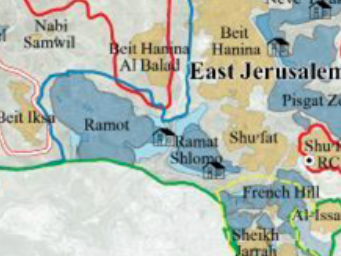 On November 6th, Jerusalem planning authorities granted approval to two settlement projects totalling 652 units in strategic areas that will increase the encroachment of settlements on the Palestinian East Jerusalem neighborhood of Beit Hanina – where the Israeli government is also advancing the first-ever government-backed settlement enclave inside of the neighborhood. This week the Committee approved:
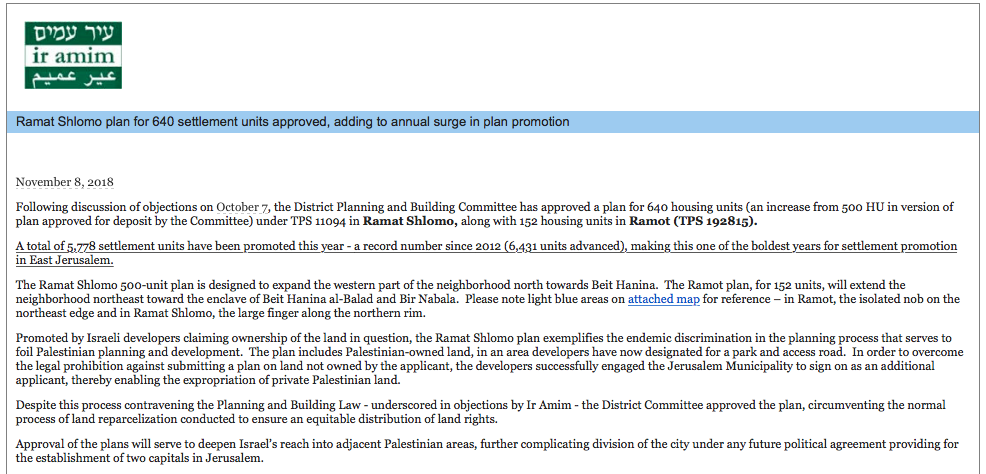
- A plan for 152 new units in the Ramot settlement in northern Jerusalem, extending the settlement’s footprint towards the Palestinian neighborhood of Beit Hanina.
- A plan for 640-units in the Ramat Shlomo settlement, to be built partially on Palestinian land, also extending the settlement north towards an existing settlement enclave inside of the Palestinian Beit Hanina neighborhood.
In granting final approval for the Ramat Shlomo plan, the Jerusalem District Planning and Building Committee decided to increase the number of approved units, from the proposed 500 to 640. And significantly, the Committee rejected serious complaints about expropriating privately owned Palestinian land for settlement purposes.
The Israel anti-settlement watchdog NGO Ir Amim filed one such complaint against the plan, explaining:
“Promoted by Israeli developers claiming ownership of the land in question, the Ramat Shlomo plan exemplifies the endemic discrimination in the planning process that serves to foil Palestinian planning and development. The plan includes Palestinian-owned land, in an area developers have now designated for a park and access road. In order to overcome the legal prohibition against submitting a plan on land not owned by the applicant, the developers successfully engaged the Jerusalem Municipality to sign on as an additional applicant, thereby enabling the expropriation of private Palestinian land.”
Ir Amim researcher Aviv Tartarsky told Haaretz this week:
“It’s very disappointing that the district committee relied on formalistic reasons to approve a step that violates the property rights of Palestinian landowners through and through. These aren’t extremist settlers in outposts somewhere out on hilltops in Samaria [the northern West Bank] but state institutions that are working in Israel’s capital city. This decision is additional proof that Israeli control in East Jerusalem means a regime based on serious discrimination.”
The new approvals add to an ever-growing tidal wave of settlement activity in East Jerusalem affecting the viability of the two-state solution, while tightening the screws on the local Palestinian population.
Claiming Ignorance, State Tells the Court it Will Demolish New Jordan Valley Outpost
Israeli government lawyers told the High Court of Justice that the State of Israel does not know who built an illegal outpost on a disused military base in the Jordan Valley, which settlers have named “Camp Gadi”, and announced that the Civil Administration will demolish it. If the Civil Administration moves to demolishes the outpost, it will require evicting several settler families who are squatting there, and shutting down a pre-military school that the families have been promoting.
The head of the Jordan Valley Regional Council, David Lahiani, seemed to contradict the government’s claim to innocence when he said that he has been in touch with the Civil Administration about legalizing the outpost. If Lahiani has been in touch with the Civil Administration, then questions arise about at what point the Israeli government learned about the outpost and who is behind it. Lahiani’s statement also contradicts (or at least raises questions about) a prior statement from the Jordan Valley Regional Council which denied involvement in establishing the outpost. Further calling into question the role of the Jordan Valley Regional Council, Lahiani was in a picture taken at the outpost which was uploaded to Facebook on October 24th.
Government Officials Lay Cornerstone of “New Migron” Settlement
A cornerstone laying ceremony marked the start of construction on the “New Migron” settlement, to be for the settlers who were removed from the illegal Migron outpost. Several government officials were on hand to lay the cornerstone of the new settlement, plans for which were approved in 2017, near the Kochav Yaakov settlement north of Jerusalem.
In 2011, the Israeli High Court ruled that the Migron outpost must be evacuated because it was built on privately owned Palestinian land. Most of the illegal outpost’s residents were evacuated and most buildings were demolished in Migron in 2012. Determined to demonstrate its support for settlers in the face of this court-compelled evacuation, the government promised to establish two new settlements: “New Migron” (located close to Kochav Yaakov settlement) as well as the approval of a plan for 184 housing units east of the Adam settlement (aka Geva Binyamin). All said, the two new settlements and temporary housing for the evicted settlers cost Israeli taxpayers millions of dollars – sending settlers a clear message that for them, law-breaking pays off.
At the ceremony this week, Jerusalem Affairs Minister Ze’ev Elkin said:
“During such events, it is customary to rejoice, but as someone who accompanied Migron from the moment of the evacuation to the present day, this is not a happy event. We would be happy if we had another legal system that made a logical decision, and I long for the days when the justice system will do justice. The settlement will grow and expand this way from time immemorial. The evacuation attempts will only lead to the strengthening and expansion of settlement.”
Housing Minister Yoav Galant, also at the ceremony, said:
“laying the cornerstone means that the territories of Yehudah and Shomron are not negotiable. It is not a subject for sale. We are laying a cornerstone for Migron and we will build it. I will see to it that the Israeli government does so by the end of the year.”
Knesset Speaker Yuli Edelstein, also in attendance, said:
“I did not come here to convince anyone about our rights in the land of Israel, I came here with mixed feelings of happiness from laying the cornerstone, alongside the great sadness of the difficult evacuation five years ago. We are here, first and foremost, thanks to the families of Migron that did not give up.”
Israel Seizes Palestinian Land to Build New Road to Settlement
According to Maan News, Israeli forces seized 38 acres (155 dunams) of Palestinian land in order to pave a road to the Beit Aryeh settlement, located northwest of Ramallah. Members of the al-Lubban al-Gharbi village council claim that the land is privately owned by Palestinians from the village and called on village residents to find documents proving land ownership in anticipation of an appeal against the construction.
So far this year, the Beit Aryeh settlement has been the beneficiary of two significant settlement advancements totalling 563 new units:
- On August 23, 2018 the Israeli Housing Ministry published a tender for 52 new settlement units in Beit Aryeh.
- On August 11, 2018 the government published a tender for 511 new settlement units in Beit Aryeh.
Bennett Violated Govt Rules to Get a Legal Opinion Supporting the De Facto Annexation of Ariel University
According to a new Haaretz report, Education Minister Naftali Bennett violated Israeli guidelines by using a private law firm to support his Knesset bill bringing settlement colleges and universities under the authority of the Israeli Higher Education Council. Prior to the Knesset’s passage of Bennet’s bill in February 2018, the Higher Education Council only included schools located inside of sovereign Israeli territory. The new law is tantamount to de facto annexation of settlement schools, and members of the Israeli Higher Education Council remain vocally opposed to the move.
The use of a private law firm is seen as an attempt to bypass the Education Ministry’s own apolitical (for now) legal advisors, and is a breach of the guidelines set years ago for every ministry by the Israeli Attorney General. The guidelines stipulate that in cases where private opinions are sought, the legal advisors for the ministry must supervise the process.
Bennet reportedly used an opinion paper issued by the Herzog Fox & Neeman firm stating the inclusion of Ariel University in the domestic Higher Education Council would not violate existing grant terms between universities in sovereign Israel and the European Union (which does not do business in the occupied territories). The opinion was then presented to members of the Higher Education Council to assuage fears that implementing the new law would result in losing international funding. The opinion said that the potential for funding cuts is “nearly non-existent.”
An anonymous senior official with the Higher Education Council told Haaretz:
“You cannot base official policy on an opinion paid for by an interested party. That’s not serious.”
Ariel University has not yet been admitted to the Council, despite the passage of the law in February 2018 and despite Minister Bennett’s repeated threats to end state relations with the Council if it did not immediately grant membership to the school. Israeli President Reuven Rivlin issued a rebuke to Bennett’s threats, saying:
“It’s possible to love Ariel without mocking academia.”
In Reversal, Israeli Ministers Embrace Bill to Allow Knesset to Overrule High Court on Any Issue (Not Just on Deporting Asylum Seekers)
At a meeting on November 4th, ministers in the governing Israeli coalition reportedly decided to abandon a bill that would empower the Knesset to reinstate its plan to deport African asylum seekers after it was struck down by the High Court, in favor of a much more far-reaching bill granting the Knesset the ability to reinstate any law the High Court strikes down. The passage of that bill would likely impact the fate of not only African asylum seekers but settlement-related legislation that has already been passed – most notably,the settlement Regulation Law – and other undemocratic measures that might follow. This news follows an exact opposite announcement two weeks ago, when Justice Minister Ayelet Shaked embraced the single-issue version of the bill, while promising to make the unlimited version a sticking point in any future coalition agreement.
Notably, the leaders of the current governing coalition decided to make this move at a meeting that was not attended by Kulanu Party leader Moshe Kahlon, who has until now blocked the coalition from advancing the unlimited version bill.
Israeli Attorney General Mandelblit vehemently opposes the bill. Mandelblit said:
“One must vigorously oppose this bill, which harms the constitutional regime of the State of Israel as a Jewish and democratic state. Removing all restrictions on undermining the human rights of a specific group, as is proposed now, has far-reaching implications for constitutional law and the democratic regime in Israel, and I strongly oppose it.”
Settlers Group Alleges Palestinians are Undertaking a European-Backed Scheme to “Take Over” Area C of West Bank
The radical settler organization Regavim – which devotes its efforts to systematically mapping out and expelling Palestinians from strategic areas in Jerusalem, the West Bank, and the Negev – presented a new report to the Knesset this week claiming that the Palestinian Authority (PA) is using European funding to take over land in Area C of the West Bank. The report alleges that the PA uses European money to pave roads, build on strategic military and diplomatic locations, and “steal” water resources, at the expense of Israel.
Regavim warns:
“If the government does not come to its senses and does something now, the Palestinian plan will create irrevocable changes and facts on the ground.”
Adding irony to Regavim’s current efforts to stop “illegal” Palestinian activity in the West Bank, in August 2018 the Israeli daily newspaper Yedioth Ahronoth published a comprehensive investigation into Regavim’s leaders. The group’s stated mission is “to ensure responsible, legal, accountable & environmentally friendly use of Israel’s national lands and the return of the rule of law to all areas and aspects of the land and its preservation.” The investigation revealed, however, that the organization’s efforts to identify and stop illegal construction are merely a tool to dispossess Palestinians of their land.
The Investigation found, in fact, that Regavim and its leaders have a demonstrable disregard for the Israeli planning and building laws that they purport to be dedicated to enforcing, evidenced most plainly by the fact that 15 Regavim officers are living in structures built on privately owned Palestinian land, some with demolition orders issued against them. These include the building where Yehuda Eliyahu, the current executive director of Regavim, lives.
UN Report Details Israel’s De Facto Annexation of West Bank Land
The United Nations Special Rapporteur on Situation of Human Rights in Palestinian Territories, Michael Lynk, issued a new report to the UN General Assembly – half of which is devoted to documenting the Israeli government’s annexation of Palestinian land in East Jerusalem and de facto annexation of land in the occupied West Bank.
The report concludes in part:
“These statements of political intent, together with Israel’s colonizing acts on the ground, its legislative activity, and its refusal to adhere to its solemn obligations under international law or to follow the direction of the international community with respect to its 51-year-old occupation, have established the probative evidence that Israel has effectively annexed a significant part of the West Bank and is treating this territory as its own. While Israel has not yet declared formal sovereignty over any parts of the West Bank, the Special Rapporteur submits that the strict prohibition against annexation in international law applies not only to a formal declaration, but also to those acts of territorial appropriation by Israel that have been a cumulative part of its efforts to stake a future claim of formal sovereignty over the occupied Palestinian territory.”
Four Alleged Security incidents Near Settlements
In the past three days, Israeli authorities have reported four security incidents near settlements:
On November 7th, the IDF reported that unknown assailants shot at a bus and lightly injured two Israelis near the settlement of Beit El, located deep inside the West Bank near Ramallah.
On November 6th, three Palestinian men were arrested near the Mevo Dotan settlement, south of Jenin, one of whom was allegedly carrying a gun.
Earlier on November 6th, a Palestinian woman was shot and arrested near the Kfar Adumim settlement, between Jerusalem and Jericho,after allegedly attacking Israeli border policemen with a pair of scissors.
On November 5th, a Palestinian man was shot and arrested after allegedly attempting to stab Israeli settlers and an Israeli IDF officer near the Kiryat Arba settlement, in Hebron.
Bonus Reads
- Khan al-Ahmar and Israel’s Creeping Annexation of the West Bank” (Newsweek)
- “Everyone Knows Settlers Cut Down Palestinian Olive Trees. But Israel Doesn’t Care” (Haaretz)
- “Settler leaders warned Rabin not to ‘cross redlines’ before assassination” (Times of Israel)
- “Hard Questions, Tough Answers: Why the Israeli mainstream turned right” (Americans for Peace Now)
- “An Interview with MK Sharen Haskel” (Fathom Journal)
- “Israeli justice minister opposes letting government jurists act as ‘gatekeepers’” (Haaretz)
***NOTE: This week the Israeli government unleashed a massive wave of approvals to advance plans for settlement construction — in excess of 2,000 units — in highly sensitive and strategically significant areas deep inside the West Bank and in East Jerusalem. More approvals/advancements are expected in the coming weeks. See below for detailed coverage of the individual plans, keeping in mind both the significance of each approval on its own, and as part of the overarching Israeli government agenda clearly intending to both prevent any possibility of a Palestinian state and to further the march toward formal annexation of the West Bank. Also keep in mind, importantly, that there has been zero public push back from the Trump Administration against this surge, which comes on the heels of Ambassador Friedman’s statement last week that Israel will never be required to remove any settlements.***
August 24, 2018
- Settlement Wave, Part 1: High Planning Council Advances Plans for 1,004 Settlement Units (96% Located Deep in the West Bank)
- Settlement Wave, Part 2: Housing Ministry Published Tenders for 420 Settlement Units
- Settlement Wave, Part 3: Jerusalem District Committee Advances Plans for 603 Settlement Units in East Jerusalem
- Settlement Wave, Part 4: More Settlement Construction Coming Soon
- U.S. Stands by Israeli “Intentions” on Settlements
- State Tells High Court: We Can Annex the West Bank – International Law Be Damned
- This Week in Ariel: Settlers Celebrate 40 Years, A Construction Boom, A Medical School, & An Evangelical “Leadership Camp”
- Amana (the Official Settler Movement) Moves Its HQ to Sheikh Jarrah
- Settlement Gains in East Jerusalem Result in Palestinians Self-Demolitioning Their Homes
- Bonus Reads
Comments, questions, or suggestions? Email Kristin McCarthy at kmccarthy@fmep.org. To subscribe to this report, please click here.
Settlement Wave, Part 1: High Planning Council Advances Plans for 1,004 Settlement Units (96% Located Deep in the West Bank)
On August 22nd, the Israeli Defense Ministry’s High Planning Council (the body in the Israeli Defense Ministry responsible for regulating all construction in the West Bank) advanced plans for 1,004 new settlement units, 96% of which are located deep inside of the West Bank. Of the total, 620 units were approved for deposit for public review and 382 units were given final approval for construction.
As reported by Israeli settlement watchdog Peace Now, the plans approved for deposit for public review (totalling 620 units) are:
- 370 units in the Adam settlement (aka Geva Benyamin). This project was urged on by Defense Minister Liberman following a stabbing attack in the settlement, which resulted in one death and injuries to three others. The 370 units are part of a larger plan for 1,000+ units that will, if built, connect the Adam settlement to two large settlements in East Jerusalem (Neve Ya’akov and Pisgat Ze’ev) that are on the Israeli side of the separation barrier (the route of the barrier juts far beyond the 1967 Green Line to include Pisgat Ze’ev and Neve Ya’akov on the Israeli side while the Adam settlement is on the West Bank side). If the larger plan is implemented, the Adam settlement will have built up areas on both sides of the separation barrier, which could (in all likelihood) present Israel an opportunity to re-route the barrier around Adam — which would de facto annex even more West Bank land to Israel and further choke off Palestinian East Jerusalem from the West Bank to its north. [Note: FMEP’s Lara Friedman and Peace Now’s Hagit Ofran published an op-ed in Haaretz in 2008 warning of this plan – you can read that background here].
- 85 units in Karnei Shomron settlement. Israel has repeatedly confiscated as “state land” located between Karnei Shomron and the Palestinian village of Qalqilya (which is literally surrounded on three sides by the separation barrier). In November 2017, Israel began clearing landmines from that “state land” in order to prepare for settlement construction. At the time, Deputy Defense Minister Eli Ben-Dahan said that the new construction in the Karnei Shomron area will bring “a million Jews [to] live in Judea and Samaria in the future.”
- 84 units in the Kiryat Netafim settlement, located about half way between the Ariel settlement and the cluster of settlements close to the 1967 Green Line that are slated to be united into a “super settlement” area (Oranit, Elkana, Shiva Tikva, and others). The expansion of Kiryat Netafim will go towards creating a contiguous corridor of Israeli settlements stretching from sovereign Israeli territory, though the super settlement, to Ariel. As FMEP has repeatedly said, the Ariel settlement is located in the heart of the northern West Bank, reaching literally to the midpoint between the Green Line and the Jordan border. The future of Ariel has long been one of the greatest challenges to any possible peace agreement, since any plan to attach Ariel to Israel (with a finger of land running through settlements like Kiryat Netafim) will cut the northern West Bank into pieces.
- 52 units in the Beit El settlement. This is the second major approval for new units in Beit El in 2018, with a third plan for 300 more units coming soon, according to Israel Hayom. The construction boom is being hailed by the settler-aligned Arutz Sheva outlet, which wrote that the plans will increase the size of Beit El by 65%. If any of the units are constructed it will be first new, government-sanctioned construction in Beit El in over 10 years. U.S. Ambassador to Israel David Friedman is closely associated with the Beit El settlement, having donated to and fundraised for it prior to his appointment as ambassador (including in his capacity as the President of the American Friends of Beit El, reportedly from 2011 until he became ambassador).
- 29 units in the Otinel settlement, located south of Hebron. MK Yehuda Glick (Likud) lives in Otinel.
Plans that gained final approval, meaning no additional formal approvals are required to move ahead with construction (totalling 382 units) are:
- 168 units in the Tzofim settlement, located on the Israeli side of the separation barrier, but jutting towards the Karnei Shomron settlement, which also received advancements this week. See the section on Karnei Shomron, above, for context and news regarding this area of settlements.
- 108 units in the Nofim settlement, located on the Israeli side of the separation barrier but jutting towards the Karnei Shomron settlement, which also received advancements this week. See the section on Karnei Shomron, above, for context and news regarding this area of settlements.
- 56 units in the Barkan settlement, located near the Kiryat Netafim settlement. Both Barkan and Netafim are located about half way between the Ariel settlement and the cluster of settlements slated to be united into a “super settlement” area (Oranit, Elkana, Shiva Tikva, and others). See the section on Kiryat Netafim, above. for context and news regarding this area of settlements.
- 44 units in Ma’ale Adumim, the mega settlement just east of Jerusalem.
- 6 units in the Avnei Hefetz settlement, located southeast of the Palestinian city of Tulkarem.
Notably, Netanyahu intervened to remove two items from the High Planning Council’s agenda, both of which would have led to the retroactive legalization of illegal outposts. Those plans are:
- A plan to retroactively legalize the Ibei Hanahel outpost, which is a non-contiguous “neighborhood” of the Ma’ale Amos settlement, located deep in the southern West Bank. The plan would have allowed the outpost to be demolished and then rebuilt legally with residential units, transforming the outpost into a new, fully authorized settlement.
- A plan to build an education center in the Nofei Prat South outpost, which is a non-contiguous“neighborhood” of the Kfar Adumim settlement, located northeast of Jerusalem. The land on which the project would be built is located just 1.5 km away from the Khan Al-Ahmar Bedouin community – the same one that the Israeli government plans to forcibly evacuate in order to cleanse the area of Palestinians and expand settlements. The outpost was established by the Haroeh Ha’ivri (“the Hebrew Shepherd”) nonprofit association, which is funded by the Israeli Education Ministry.
In response to Netanyahu’s directive to remove these two items from the agenda, the heads of the Knesset’s “Land of Israel Lobby,” Bezalel Smotrich (Jewish Home) and Yoav Kisch (Likud), said that the Prime Minister should “ act with greater rigor to promote settlement, rather than doing the opposite.”
Settler leaders were also unsatisfied with the High Planning Council’s overall numbers. Yossi Dagan, head of the Samaria Regional Council (a municipal body for settlements in the northern West Bank), said:
“We are happy about every new house in Samaria, but we have to tell the truth. Hundreds of housing units are not enough for an area that constitutes 12% of the State of Israel…We expect the government to step in the gas, stop worrying about what they will say overseas, and develop this beautiful region.”
Settlement Wave, Part 2: Housing Ministry Published Tenders for 420 Settlement Units
On August 23rd, one day after the Defense Ministry’s High Planning Council advanced a huge tranche of settlement plans (detailed above), the Israeli Housing Ministry published tenders for a total of 425 settlement units (under plans previously approved by the High Planning Council).
Those tenders include:
- 211 units in the Ma’ale Efraim settlement, located in the Jordan Valley.
- 54 units in the Givat Ze’ev settlement, located north of Jerusalem.
- 52 units in the Beit Aryeh settlement, which comes in addition to the the publication of tenders for 511 units in the settlement last week.
- 42 units in the Ariel settlement. See reporting below for extensive coverage of the many reasons settlers in Ariel are celebrating this week.
Settlement Wave, Part 3: Jerusalem District Committee Advances Plans for 603 Settlement Units in East Jerusalem
In addition to the tranche of settlement plans advanced by the Defense Ministry’s High Planning Council and the tenders published by the Housing Ministry (detailed above), the Jerusalem District Committee deposited for public review (one of the final steps before approval) plans for a total of 608 new settlement units in East Jerusalem, with 345 units slated for the Gilo settlement and 263 units in the Ramot settlement.
On the plan for the Gilo settlement, Ir Amim explains:
“The Gilo plan is being promoted in tandem with development of the new Green Line branch of the Light Rail (construction of which was launched in May), which will be built adjacent to the settlement expansion. This sequencing of events once again exemplifies a pattern of the state investing billions of shekels in transportation infrastructures to allow for extensive construction beyond the Green Line.”
As Ir Amim notes, this week’s advancements come on the heels of Israel’s August 15th decision to publish tenders for 603 units in Ramat Shlomo, and its June 2018 advancement of plans for 1,064 settlement units in the Pisgat Ze’ev settlement — bringing Israel’s two-month total of settlement advancements in East Jerusalem to 2,275 units.
As a reminder, approvals/advancement of settlement plans is not the only ongoing threat to Palestinians in East Jerusalem. Settlers and settler-run organizations continue their campaign to take over sensitive areas in East Jerusalem neighborhoods neighborhood – like Silwan and Sheikh Jarrah – and to create more settler run tourist sites – like the Jerusalem cable car, the Kedem Center, the Abu-Tor footbridge, the Yemenite “heritage center,” and more – to erase the visibility of Palestinians in Jerusalem. Meanwhile, pending legislation in the Knesset seeks to gerrymander the borders of Jerusalem to create a Jewish majority by annexing settlements and cutting out Palestinian neighborhoods from the borders of the city. Sounding the alarm on all of these trends, Ir Amim writes:
“It is vital that the traditional calculus of settlement building be readjusted to a) treat these coordinated efforts to consolidate control of the Old City and surrounding Palestinian neighborhoods with the same urgency afforded to settlement building throughout the whole of East Jerusalem; b) ensure a holistic response that regards private settlement inside the Old City Basin and touristic settlement not as individual phenomena but as multiple elements of a unified and politically lethal strategy.”
Settlement Wave, Part 4: More Settlement Construction Coming Soon
In addition to the plans for 1,004 units that were advanced this week by the High Planning Council, the 425 tenders published by the Housing Ministry, and the 608 units advanced in East Jerusalem (all detailed above), this week saw reports that additional plans are expected to advance soon. Those are:
- Ir Amim reports that on September 2nd, the Jerusalem District Committee is expected to discuss a plan to build a six-story building in Sheikh Jarrah, a neighborhood in which at least 75 families face eviction by radical settlers, with the backing of the Israeli government and courts. For detailed reporting on the building, plans for which were deposited for public review in May 2018, see FMEP reporting here.
- Peace Now reports that tenders are expected to be issued (having already been marketed) for more units in the Adam (Geva Binyamin) settlement. If true, this will be another step towards uniting Adam to the East Jerusalem settlements – the details of which are covered above.
- Peace Now also notes that a plan for 300 units in Beit El is expected to be advanced. This comes in addition to the 52 tenders issued for Beit El this week.
- The Times of Israel reports that plans for hundreds of additional settlement units will soon be marketed for construction by the Defense Ministry. These plans received final approval before this week’s High Planning Council meeting. A Civil Administration official hinted that the plans will be marketed for the Alfei Menashe and Ma’ale Efraim settlements. [NOTE: This reporting was before the subsequent publication of tenders for 211 units in Ma’ale Efraim, covered above.]
U.S. Stands By Israeli “Intentions” on Settlements
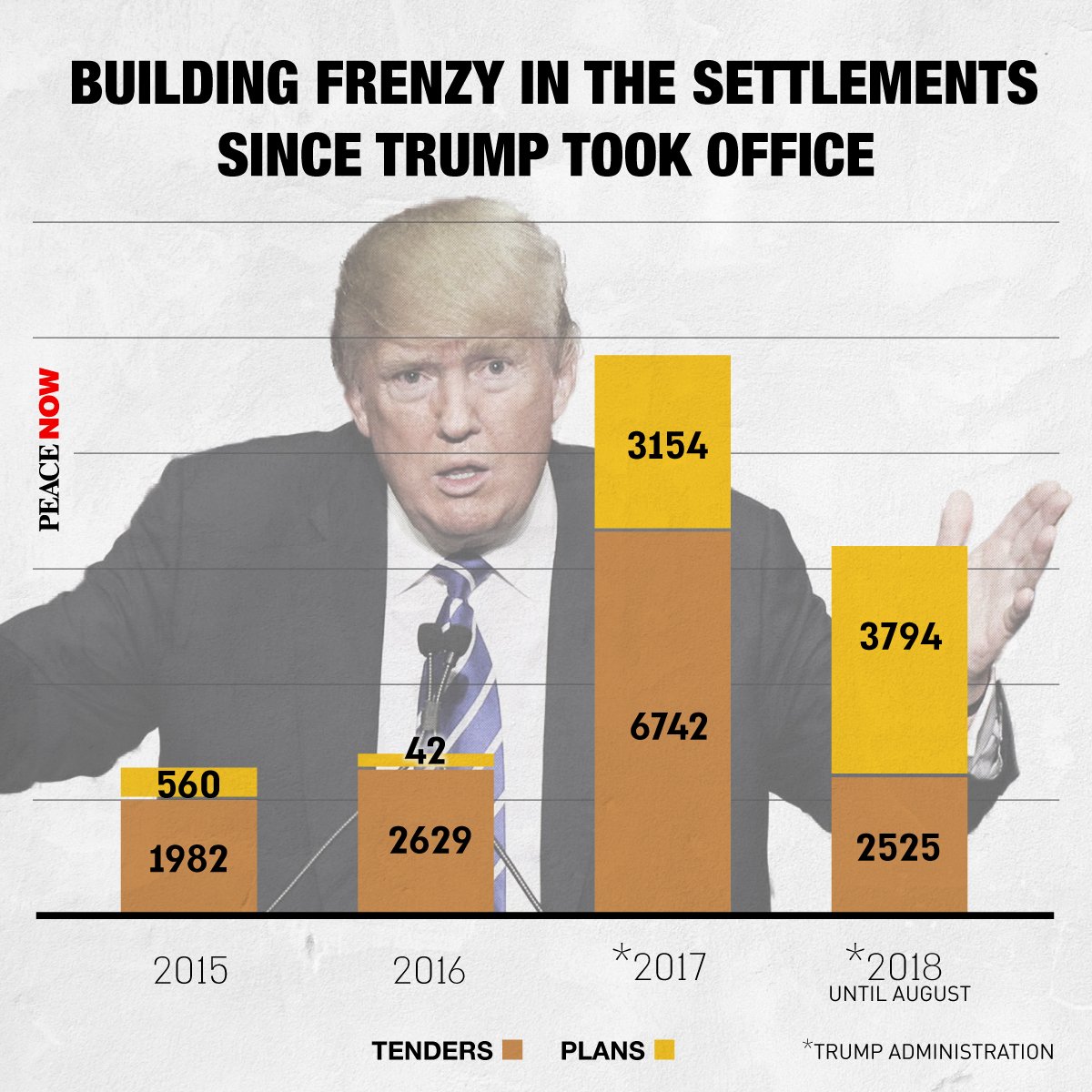
Image by Peace Now
When asked for comment on the various major settlement announcements, the U.S. State Department said that the Trump Administration believes the Israeli government has clearly demonstrated an intent to “adopt a policy regarding settlement activity that takes the president’s concerns into consideration” – a statement that suggests unequivocally that the Trump Administration has given a green light for massive settlement expansion across the length and breadth of the West Bank and East Jerusalem.
Notably, on the same day that the bulk of the settlement announcements were made, President Trump’s National Security Advisor, Ambassador John Bolton, was on the ground in Jerusalem. Not only did he offer no comment or criticism of the settlement announcements, he very publicly joined Israeli politicians and settlers leaders for dinner in East Jerusalem, dining in the “City of David National Park,” the archeological/touristic/residential site in the Palestinian neighborhood of Silwan that is run by the radical Elad settler organization. As FMEP has repeatedly covered, the Elad settler organization is spearheading a government-aided campaign to evict Palestinians from their homes in Silwan, replace them with Jewish Israeli settlers, and transform the neighborhood into a Biblical tourist site emphasizing exclusively the area’s Jewish history.
The head of the Peace Now Settlement Watch program, Shabtay Bendet, told Al-Monitor:
“The situation on the ground is changing rapidly…Restraints on construction in the settlements have been lifted. The Americans don’t care…”
State Tells High Court: We Can Annex the West Bank, International Law Be Damned
On August 7th, the state’s private attorney Harel Arnon submitted a second brief [Hebrew] to the High Court of Justice in defense of the settlement “Regulation Law.” In it he argues that the Knesset is not bound by international law and has the right to apply its own laws outside of its borders and annex land, if it wishes.
Arnon argues:
“The mere application of a certain Israeli norm [law] to an anonymous place outside the state does not necessarily make that anonymous place part of Israel. The Knesset is not restricted from legislating extra-territorially anywhere in the world, including in the region, the Knesset can legislate in Judea and Samaria.”
The brief also argues:
“The Knesset is permitted to impose the powers of the military commander of the West Bank region as it sees fit. The Knesset is permitted to define the authorities of the military commander as it sees fit. The authority of the government of Israel to annex any territory or to enter into international conventions derives from its authority as determined by the Knesset…[and] the Knesset is allowed to ignore the directives of international law in any field it desires.”
Lawyers representing Adalah responded:
“the Israeli government’s extremist response has no parallel anywhere in the world. It stands in gross violation of international law and of the United Nations Charter which obligates member states to refrain from threatening or using force against the territorial integrity of other states – including occupied territories. The Israeli government’s extremist position is, in fact, a declaration of its intention to proceed with its annexation of the West Bank.”
Harel was ordered to submit a second defense of the bill in response to a petition filed by Adalah and Al-Mezan on behalf of seventeen local Palestinian authorities. The petition argues that the Regulation Law violates international law and that the Knesset cannot enact laws over the West Bank where the majority of the population is Palestinians (who are not Israeli citizens and cannot vote).
The High Court of Justice is widely expected to strike down the “Regulation Law,” but has yet to make a ruling. Just last week, Arnon made the case that the recently passed Nation-State Law, which makes “Jewish settlement,” a “constitutional value,” can help him defend the settlement law before the High Court.
For ongoing tracking of the Regulation Law and other annexation trends in Israel, see FMEP’s Annexation Policy Tables.
This Week in Ariel: Settlers Celebrate 40 Years, A Construction Boom, A Medical School, & An Evangelical “Leadership Camp”
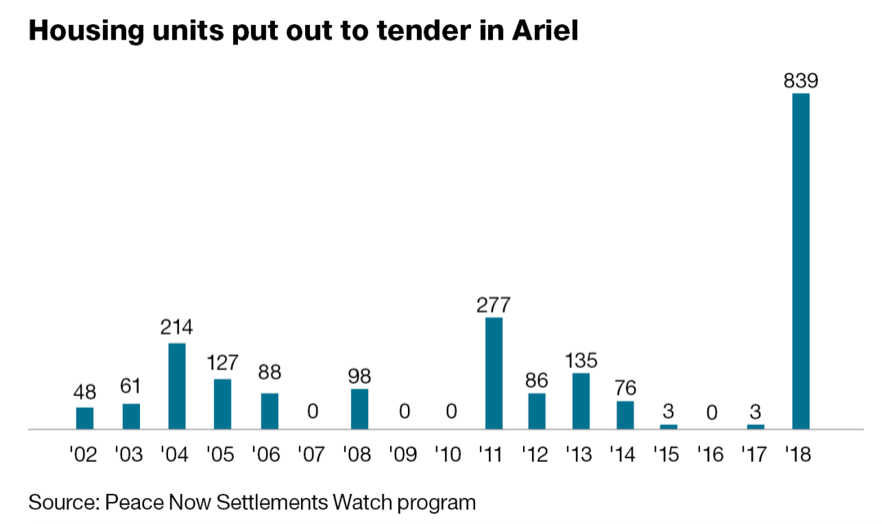 Haaretz published a lengthy report this week on the history of the the Ariel settlement – which is celebrating its 40th anniversary this month – and the dramatic spike in construction in the settlement in 2018. Even before tenders were issued for 42 new units this week (see above), plans for 839 units had already been approved during the first eight months of 2018, compared to tenders for fewer than 5 units each of the past three years. One of the original settlers of Ariel said:
“During the Obama years, everything here was frozen. But thanks to Donald Trump, we’re starting to see the light at the end of the tunnel.”
Not only has Ariel seen a massive surge in construction advancements this year, but the settlement broke ground on a new medical school heavily financed by U.S. casino magnate, and Trump backer, Sheldon Adelson (who this week gave $25 million to the GOP to help it keep the Senate, and in May gave the GOP $30 million to help it keep the House). Many settler leaders and Israeli officials, as well as Adelson and his wife Miriam, were in Ariel this weekend to attend a dedication ceremony for the medical school, despite ongoing controversy around its accreditation under domestic Israeli law. Prime Minister Netanyahu was notably absent from (and reportedly was not invited to) the ceremony, fueling rumors regarding the growing disaffection between him and Adelson.
According to another recent report in Haaretz, Ariel university is illegally dumping construction debris on land that Israel acknowledges is not “state land.” The dump site is outside of the so-called “Blue Line” which the Israeli government uses to demarcate the land that it considers “state land.” Since the dump site is not within the Blue Line, it is likely on land that even the government of Israel recognizes as being privately owned by Palestinians. Anti-settlement watchdog and founder of Kerem Navot, Dror Etkes, commented:
“It’s not surprising that Ariel University, which is the only university in the world built and existing by military order, has adopted the standards accepted in the West Bank involving the takeover of private Palestinian land.”
According to a third Haaretz report, the Israeli Education Ministry has signed a contract to sponsor 3,000-4,000 Israeli high school students of Ethiopian descent to take part in a leadership training program located in Ariel. The program, called “JH Israel,” was founded by American evangelical mega-church pastors Bruce and Heather Johnston, the latter of whom also runs the U.S. Israel Education Association, a pro-Israel, pro-settlement, non-profit group which works with the Family Research Council to lead Congressional delegations to Israel. The JH Israel website says its mission is to help Jewish Israeli students who are “disconnected from the roots of their faith” to establish “a deeper connection to God by embracing their biblical and cultural heritage.” The website also says that Ariel is “at the forefront of biblical prophecy unfolding in modern Israel.”
As FMEP has repeatedly documented, Ariel is located in the heart of the northern West Bank, reaching literally to the midpoint between the Green Line and the Jordan border. The future of Ariel has long been one of the greatest challenges to any possible peace agreement, since any plan to connect Ariel to Israel will cut the northern West Bank into pieces.
Peace Now Settlement Watch Director Shabtay Bendet spoke to Haaretz about the future of the Ariel settlement and the (other) significant repercussions of opening the new medical school. Bendet said:
“Most places in Israel don’t get recognized as cities unless they have 20,000 to 30,000 residents. Ariel became a city when it had just 11,000 residents. Why was this so significant? Because maybe you can uproot a settlement, but you don’t uproot a city. The same holds true for the university. Why was it so important for him to get it accredited? Because when a place has a university, that means it’s established — no pulling it out of the ground….By creating a buffer between the northern and southern parts of the West Bank it makes any future Palestinian state unviable. But besides that, it is also causing damage in the present because its continued expansion impinges on the ability of the surrounding Palestinian villages to develop and grow.”
Amana (the Official Settler Movement) Moves Its HQ to Sheikh Jarrah
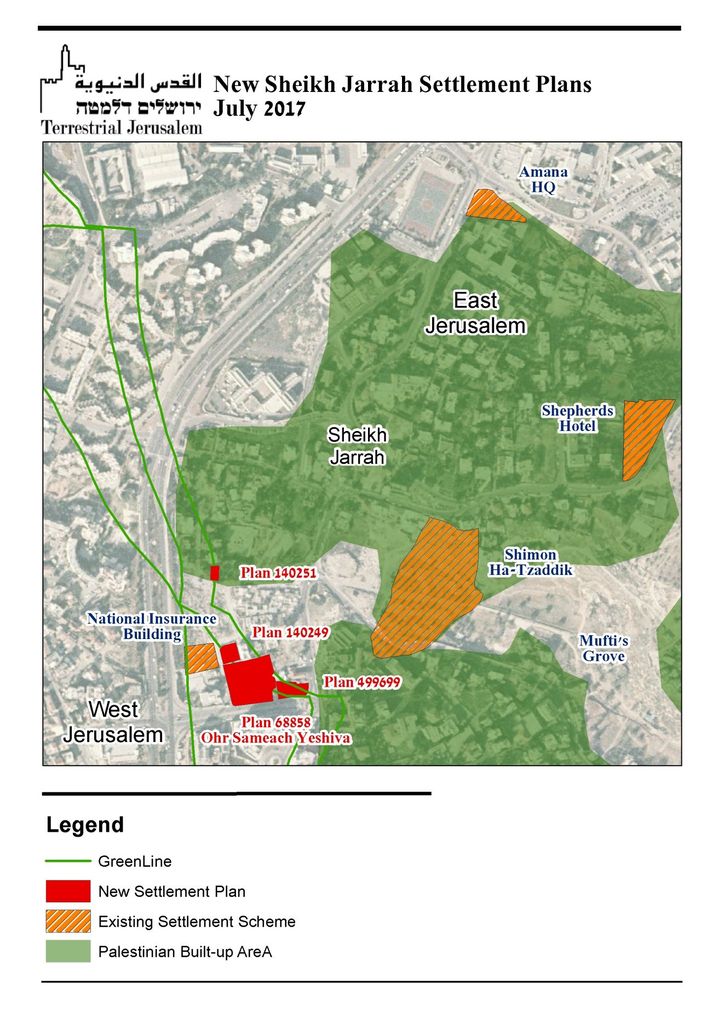 The Ynet news outlet reports that the Amana settler organization – the official body of the settlement movement, operating since the 1970s – has moved into its new headquarters in the heart of the Sheikh Jarrah neighborhood of East Jerusalem, where settlers are continuing to wage a displacement campaign against Palestinian residents. Though Amana has owned the plot of land since 1992, various legal challenges and incredibly sensitive geopolitical considerations have slowed construction of the building, called the “Amana House” (see a detailed history here).
Regarding the strategic implications of the location, Ynet reports:
“Amana says the new headquarters will help bolster the territorial contiguity of Jewish settlements in east Jerusalem.”
Agriculture and Rural Development Minister Uri Ariel (Bayit Yehudi) who previously served as the CEO of Amana, commented that the organization’s relocation:
“constitutes a significant reinforcement to the (Jewish) settlement in east Jerusalem and the bolstering of the Jewish territorial contiguity in the area.”
Several settlement plans are currently proceeding in Sheikh Jarrah, underscoring the strategic location and goals of settler activity in Sheikh Jarrah. As covered previously in this report, Israel is expected to advance a plan for a 6-story office building for settlers, located at the entrance to the neighborhood. Across the street from that building, a highly consequential plan for a new religious school (the Glassman yeshiva) was approved for deposit for public review in July 2017. The goal is clear: to unite the enclaves of settlers living inside of the Palestinian neighborhood by creating a contiguous area of settlement that connects to West Jerusalem, thereby cementing an immovable Jewish Israeli presence in a key Palestinian neighborhood – closing off the possibility of evacuation under a future peace deal.
Settlement Gains in East Jerusalem Result in Palestinians Self-Demolishing Their Homes
OCHA reports that two Palestinian homes in the East Jerusalem neighborhood of Beit Hanina were self-demolished after the Israeli Supreme Court ruled in favor of settlers’ ownership claims. OCHA writes:
“In recent decades, Israeli settler organizations, with the support of the Israeli authorities, have taken control of properties within Palestinian neighbourhoods in East Jerusalem, and some 180 Palestinian families are currently facing eviction cases, filed mainly by settler organizations.”
Bonus Reads
- “How Israeli Right-wing Thinkers Envision the Annexation of the West Bank” (Haaretz)
- “Let’s Admit It: The Settlers Have Won and We Have Lost” (Haaretz)
Welcome to FMEP’s Weekly Settlement Report, covering everything you need to know about Israeli settlement activity this week.
To receive this report via email, please click here.
May 25, 2018
- Israeli Government to Advance 3,900 Settlement Units Next Week
- Finance Ministry Announces Bargain Construction in Beit El & Ma’ale Adumim Settlements
- Defense Ministry Supports Expropriation of Private Palestinian Land for Settlements
- High Court Supports Destruction of Khan al-Ahmar [A War Crime], Clearing the Way for E-1 Settlement
- Palestinians Ask the ICC to Open Investigation into the Israeli Settlement Regime
- Bonus Reads
Comments, questions, or suggestions? Email Kristin McCarthy at kmccarthy@fmep.org.
Israeli Government to Advance 3,900 Settlement Units Next Week
Israeli Defense Minister Avigdor Lieberman (Yisrael Beiteinu) announced that the High Planning Council (the body in the Defense Ministry’s which oversees all construction in the occupied West Bank) is expected to advance plans for 3,900 settlement units next week. Of that total, 2,500 units will reportedly receive final approval for construction and 1,400 will be advanced through the planning process. Peace Now estimates that 52% of the units will be located in isolated settlements.
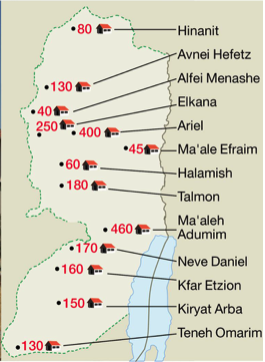
Map by Haaretz
Lieberman – whom The Times of Israel and Haaretz note has repeatedly inflated settlement approval numbers in the past – said the specific plans set to advance will include:
- 400 units in the Ariel settlement (where a medical school financed by Sheldon Adelson was recently brought under Israeli domestic jurisdiction, in a case of de facto annexation. And where a future stop on the recently approved settler-only light rail is slated to be built.);
- 460 units in the Ma’aleh Adumim settlement;
- 250 units for an assisted living center in the Elkana settlement (where the settler-only light rail will also have a stop);
- 180 units in the the Talmon settlement;
- 170 units in the Neve Daniel settlement;
- 160 units in the Kfar Etzion settlement;
- 150 units in the Kiryat Arba settlement (where construction preparations for a new industrial zone – which in reality is a new settlement in Hebron – recently began);
- 130 units in the Avnei Hefetz settlement;
- 130 units in the Tene Omarim settlement;
- 80 units in the Hinanit settlement;
- 60 units in the Halamish settlement (where settlers have built a strategic outpost, with the protection of the IDF, in order to further restrict Palestinian access to the area);
- 45 units in the Ma’ale Efraim settlement;
- 40 units in the Avnei Hafetz settlement;
- 45 units in unspecified settlements.
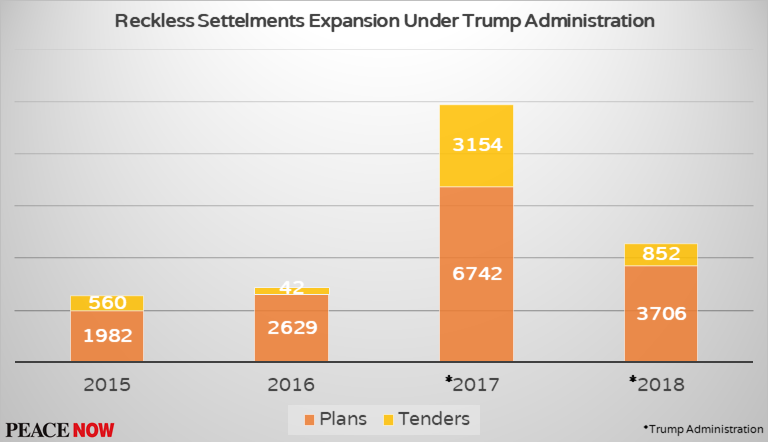
This will be the third meeting of the High Planning Council in 2018, in accordance with a reported agreement between Israel and the United States to consolidate and coordinate the number of times settlement plans are announced. The first regularly scheduled meeting of the year was in January, when 1,122 new settlement units were advanced, of which 352 received final approval for construction. The Council met again, unexpectedly in February, which Lieberman tried to minimize by calling it “less significant” because the majority of the projects approved were non-residential. In fact, the projects were extremely significant. All of the plans expanded the footprint of settlements located deep inside the West Bank – including plans for a race track and hotel in the Jordan Valley. One “unusual” plan even created a new outpost to house settlers evacuated from a different outpost (the Netiv Ha’avot outpost case that FMEP has covered in exhaustive detail).
The anti-settlement watchdog group Peace Now writes:
“In the year and a half since President Trump took office some 14,454 units in the West Bank has been approved (in plans and tenders, including today’s announcement not including East Jerusalem), which is more than three times the amount that was approved in the year and half before his inauguration (4,476 units)…The Netanyahu government is clearly continuing to take advantage of the carte blanche the Trump Administration has given it in order to destroy the chances for peace. It is well-known that for a two-state solution to be feasible Israel will have to withdraw from most of the West Bank, yet the government keeps raising the political cost of this redeployment and the evictions it will entail. By adding housing to settlements, the government shows total disregard for the two-state solution.”
In reaction to Lieberman’s announcement, PLO Executive Committee member Hanan Ahrawi said:
“Such egregious policies affirm the imperative need for the International Criminal Court to open an immediate criminal investigation into Israel’s flagrant violations of international law and conventions,” she said in a statement….Israel’s declared intention to build thousands of illegal settler units in the occupied West Bank discloses the real nature of Israeli colonialism, expansionism and lawlessness…Undoubtedly, Israel is deliberately working to enhance its extremist Jewish settler population and to superimpose ‘Greater Israel’ on all of historic Palestine…It is evident that the recent provocative and unlawful moves adopted by the United States, Guatemala and Paraguay have emboldened Israel to move forward with enhancing its illegal settlement enterprise, thereby finalizing the total annexation of the occupied West Bank.”
Saeb Erekat, a top diplomat for the Palestinian Authority released a video response, in which he highlighted the PA’s recent referral to the International Criminal Court (ICC) to investigate Israeli settlement crimes (see FMEP’s coverage on the ICC referral, below). Erekat said in part:
“This is a flagrant violation and an eye opener to the judicial council of the ICC that an official judicial investigation must be opened immediately. This cannot go on. Israel cannot continue business as usual with this impunity and immunity that they think they have.”
Nadil Abu Rudeina, a spokesman for PA President Mahmoud Abbas, said:
“The continuation of the settlement policy, statements by American officials supporting settlements and incitement by Israeli ministers have ended the two-state solution and ended the American role in the region.”
Finance Ministry Announces Bargain Construction in Beit El & Ma’ale Adumim Settlements
In addition to the approvals expected from the High Planning Council this week, the Israeli Finance Ministry has announced that a 300-unit project in the Beit El settlement and 44-unit project in the Ma’ale Adumim settlement have been marketed as part of the “Buyer’s Price” program. Under this program, the government sells land to construction companies at low prices, and those companies commit to offering future settlement units at below market prices. With the plan being marketed in Beit El, the government is accepting bids on the project from construction companies which commit to pricing the apartments 20% below market value – in effect creating a powerful financial subsidy that incentivizes Israelis to move into settlements.
The Beit El project involves 5 buildings with a total of 296 units. According to Ynet:
“the program’s goal is to transform Beit El’s southeast agricultural area into a residential neighborhood as well as unification and re-division of the lands, which will be allocated to building houses, public offices, commercial areas, routes, and a public open space.”
FMEP has covered the progress of this Beit El project repeatedly over the past year, particularly because the push around Beit El projects typifies the Netanyahu-Trump era of settlement growth. Beit El settlers have lobbied for the project for over 5 years, ever since the settlers were evacuated from an outpost of Beit El (called “Ulpana”) in 2012. When the outpost was evacuated, Prime Minister Netanyahu promised to build replacement settlement units in Beit El. Buoyed by the apparent green-light from the Trump administration, over the summer of 2017 settler leaders repeatedly and publicly shamed Netanyahu for failing to fulfill that promise, and in response Netanyahu very publicly and repeatedly promised that the settlement units will be built expeditiously. After being ignored by the High Council during its September meeting, the plan for 296 units was then approved for marketing in October 2017. Now, this week, the government has acted on that approval to market the plan, moving ever closer to the start of construction. As the Ynet report notes, if/when the 300 units are built, this will be the first new, government-sanctioned construction in the Beit El settlement in 10 years.
Also in Beit El, the settler-aligned media outlet Arutz Sheva reports that the IDF plans to build a new “razor wire” fence to separate the settlement from the Palestinian Jalazone refugee camp, located across the street (where it has been since before Beit El’s establishment). At the time of this writing, there has been no additional reporting on where the fence will be placed, and if it relates to plans to build a wall between Beit El and the Jalazone refugee camp. To better understand the severe implications of the Beit El settlement on the lives of Palestinian in Jalazone, see B’Tselem’s updated, expanded, and now pictorial project: “Life under the shadow of the Beit El Settlement.”
As a reminder, U.S. Ambassador to Israel David Friedman is closely associated with the Beit El settlement, having donated to and fundraised for it prior to his appointment as ambassador (including in his capacity as the President of the American Friends of Beit El, reportedly from 2011 until he became ambassador).
The Beit El settlement was established in 1977, on land previously seized by Israel for military purposes. A second military seizure in 1979 enabled Beit El to expand. This method of establishing and expanding settlements has been repeatedly challenged in Israeli courts. The Israeli group Yesh Din led one such petition against Beit El, seeking to have the second seizure annulled; that petition was dismissed earlier this year. Yesh Din writes:
“The State understood that it was impossible to legally defend the land theft that has been ongoing in Beit El for 40 years on land that was seized for arbitrary reasons, but it refrained, once again, from defending the rights of the weakest population, simply because they are Palestinians. Despite this, we at Yesh Din will continue to fight against the dispossession of Palestinians and the infringement of their rights.”
Defense Ministry Supports Expropriation of Private Palestinian Land for Settlements
On May 24th, the Israeli Defense Ministry released a legal opinion endorsing the government’s plan to expropriate privately owned Palestinian land in the Ofra settlement in order to retroactively legalize illegal settlement structures built there. The opinion adopts the “market regulation” principle as a legal basis for Israel to expropriate privately owned Palestinian land in cases of settlements in which decades-old structures were built and/or purchased by Israelis “in good faith” (believing the Israeli government to be the rightful owner of the land). The legal opinion also calls for the Palestinian owners to be “fully compensated, if not more than that,” and recommends that the principle should not apply to cases of unauthorized outposts. The Ofra situation is a test case for the “market regulation” principle, which has not yet been used (or tested in court) to justify expropriating Palestinian land for Israeli settlements.
Defense Ministry legal advisor Itai Ofir called on Attorney General Avichai Mandleblit to adopt the legal opinion as a government policy, which stands a good chance of happening (Mandleblit already endorsed the Ofra expropriation on that basis). In fact, the Attorney General invented the “market regulation” principle in the first place, as an alternative to the legal argument made in the Regulation Law (which he opposed). The “market regulation” principle was also recommended in the recently released “Zandberg Report,” as one of the tools that the Israeli government should use to carry out massive land expropriations, retroactive legalizations, and continued and intensified settlement growth.
FMEP has chronologically documented the development and adoption of the “market regulation” principle in the Annexation Policies tables.
High Court Supports Destruction of Khan al-Ahmar [A War Crime], Clearing the Way for E-1 Settlement
On May 24th, the High Court of Justice upheld a government plan to destroy the Palestinian Bedouin community of Khan al-Ahmar and forcibly relocate its residents out of the Ma’ale Adumim/E-1 settlement area east of Jerusalem – which Israel is expected to carry out soon. The Court reasoned that the community’s structures were built on State Land without the proper permits, even though Israel deliberately makes such permits nearly impossible to obtain. Clearing Khan al-Ahmar from the its current site (where it has been for 60+ years) is widely interpreted to be a step towards building the “doomsday” E-1 settlement which, if built, will complete a ring of Israeli settlements around East Jerusalem, destroying the territorial contiguity between Palestinians living there and the West Bank, and preventing any possibility of a viable, contiguous Palestinian state with its capital in East Jerusalem.

Map by Ir Amim
Israel has faced intense criticism for its plan to forcibly relocate Khan al-Ahmar, a plan many, including B’Tselem, call a war crime. A group of 76 U.S. Members of Congress recently sent a letter to Netanyahu beseeching him to abandon the plan, as well as the plan to demolish the Palestinian community of Susya, in the South Hebron Hills.
Peace Now says:
“The State of Israel must implement a policy of moral values, justice, equality and human rights for the Jahalin people. It is not in the Israeli interest to forcibly move them from their homes. We must stop the abuse that has been going on for decades, and allow them to live according to their way of life, to make a living and to educate their children in a way that is no different from that of the Jews living in their neighborhoods.”
The Jahalin Bedouin built the Khan al-Ahmar community in the area east of Jerusalem in the 1950s, after they were expelled from their lands in the Negev by the Israeli military. A total of 18 Bedouin tribes live in the vicinity of Ma’ale Adumim/E-1, totaling approximately 3,000 people, who have already endured numerous demolitions this year alone. The Ma’ale Adumim settlement was built in 1975 on land near where the Khan al-Ahmar community already existed; the plan for the E-1 settlement was approved in 1999.
Palestinians Ask the ICC to Open Investigation into the Israeli Settlement Regime
The Palestinian Authority has officially asked the International Criminal Court (ICC) to open an investigation into the Israeli government’s illegal settlement activity. The text of the referral can be found here. Citing “sufficient compelling evidence” and an “alarming intensification of Israeli crimes,” Palestinian Minister of Foreign Affairs Riad Malki asked the ICC to immediately open an investigation into war crimes and crimes against humanity that have been committed against Palestinians in the West Bank, East Jerusalem, and Gaza. The referral requests that the investigation include:
“those who plan, prepare and implement policies linked to the settlements regime as well as those who enable it, whether through financial, military, or logistical support or otherwise aid and abet or encourage the commission of crimes connected to that regime.”
The referral lists specific, ongoing crimes that are “among the most widely documented in contemporary history,” for the ICC to investigate. The PA’s allegations mainly relate to settlement activity (much of which is documented on a weekly basis in FMEP’s Settlement Reports) including: the unlawful appropriation and destruction of private and public properties, including land, houses and buildings, as well as natural resources; the forcible transfer of Palestinians; the unlawful transfer of the Israeli Occupying Power’s population into Occupied Palestinian Territory; the “persecution, including the grave, widespread and systematic denial or violation of basic human rights on discriminatory grounds against Palestinians, including those resulting in or intended to achieve the deportation of forcible transfer, directly or indirectly, of the Palestinian population, the re-population of ‘cleansed’ territories with Israeli settlers and the unlawful appropriation of Palestinian land and properties”; and “the establishment of a system of apartheid based in particular on the adoption of discriminatory laws, policies and practices as well as the commission of inhumane acts intended to establish an institutionalized regime of separation and advancement of Israeli settlements accompanied by the systematic oppression and domination by Israeli settlers over Palestinians.”
After the PA submitted its referral, Israeli Foreign Minister Avigdor Lieberman argued that the “ICC lacks jurisdiction over the Israeli-Palestinian issue, since Israel is not a member of the Court and because the Palestinian Authority is not a state.” While Israel is not a member of the ICC, the State of Palestine acceded to the ICC in December 2014, and its membership took force in April 2015. In January 2015, the ICC’s Office of the Prosecutor opened a preliminary inquiry to “ascertain whether the criteria for opening an investigation are met.” The preliminary inquiry is listed as “ongoing” on the ICC website. Following by the referral for an investigation submitted this week, ICC Chief Prosecutor Mrs. Fatou Bensouda released a statement saying:
“Since 16 January 2015, the situation in Palestine has been subject to a preliminary examination in order to ascertain whether the criteria for opening an investigation are met. This preliminary examination has seen important progress and will continue to follow its normal course, strictly guided by the requirements of the Rome Statute.”
The press release also notes that this is the eighth referral on the matter to date (previously, the situation in Palestine was referred to the ICC for investigation by Uganda, the Democratic Republic of the Congo, the Central African Republic, Mali, the Comoros Islands, and the Gabonese Republic).
Bonus Reads
- “Minister Ariel initiates museum of settlement” (Arutz Sheva)
- “Cherry Plantation Burned in Settlement a Hay Torched in Southern West Bank” (Haaretz)
- “Sheikh Jarrah: A Tale of Eviction and Resettlement” (Al Jazeera)
“In new film, Tel Aviv leftist picks up and moves to a West Bank settlement” (Times of Israel)
Welcome to FMEP’s Weekly Settlement Report, covering everything you need to know about Israeli settlement activity this week.
To receive this report via email, please click here.
March 15, 2018
- Settler Put in Charge of Office Dedicated to Seizing Palestinian Property in East Jerusalem
- 7 Months After Illegally Breaking In/Occupying Hebron Property, High Court Orders IDF to Evacuate Settlers
- Israel Moves to Confiscate More Palestinian Land Near Nablus
- B’Tselem Report: “Life Under the Shadow of the Beit El Settlement”
- “Settlements Are A War Crime”: UN High Commissioner Weighs in on 2017 Settlement Activities
- Bonus Reads
Comments, questions, or suggestions? Email Kristin McCarthy at kmccarthy@fmep.org.
Settler Put in Charge of Office Dedicated to Seizing Palestinian Property in East Jerusalem
A recent Haaretz report revealed that, more than a year ago, the Israeli Justice Ministry transferred authority over East Jerusalem absentee property cases to a division within the Justice Ministry headed by radical Israeli settler leader Hananel Gurfinkel. According to the report, over the course of the time Gurfinkel has been responsible for the East Jerusalem portfolio, the Justice Ministry has significantly increased its cooperation with nonprofit settler organizations to evict Palestinians and transfer the property to Israeli Jews – particularly in the Silwan and Sheikh Jarrah neighborhoods. The responsibility was transferred from the “Unit for the Location and Restitution of Unclaimed Property” in the Administrator General’s Office, to the economic unit, which Gurfinkel has lead for many years.
Gurfinkel lives in the Nof Zion settlement enclave, located in the Jabal al-Mukaber neighborhood of East Jerusalem (Nof Zion is set to triple in size, btw), and has a history of leading efforts to evict Palestinians from East Jerusalem and to replace them with Israeli Jews. Back in 2016, while serving in the Administrator General’s office he reportedly founded ”Building Jerusalem,” a nonprofit organization dedicated to combating the “Arab conquest” of Jerusalem. In that time he has also been elected to the central committee of the right-wing Habayit Hayehudi political party.
With Gurfinkel in charge of the Administrator General’s East Jerusalem property cases, the office has drawn much criticism, particularly around its decision to hire attorney Moshe Segal to represent the government in property disputes against Palestinians. Segal was reportedly hired without going through a competitive bidding process, as required for government contracts. Even more alarming, Segal provides legal representation to two of the most aggressive settler groups active in East Jerusalem – Elad and Ateret Cohanim – which regularly petition the Administrator General to evict Palestinians and award property rights to Israeli Jews. Segal representation of these clients appears to pose a blatant conflict of interest.
After initially – and bizarrely – denying that Segal works for the government, the Justice Ministry defended Segal’s hiring and dismissed the idea that there might be a conflict of interest, saying “the administrator general and attorney Segal do not represent opposing positions” (suggesting with remarkable honestly, that it is the official view of the Ministry that the positions of the settler organizations and the government are indistinguishable). The Justice Ministry further defended its operations, saying in part:
“The handling of assets managed by the administrator general division were transferred to the economic unit … as part of a structural change and based on the giving of additional tasks to the Unit for the Location and Restitution of Unclaimed Property…The administrator general division manages the property of private owners all over the country and is obligated to act for their benefit, including handling suits against trespassers. The division has no separate policy concerning management of property located in one region or another.”
The Haaretz Editorial Board issued a blistering response to their paper’s breaking news, saying that assigning such authorities to Gurfinkel is “crooked, improper, and possibly illegal.”
7 Months After Illegally Breaking In/Occupying Hebron Property, High Court Orders IDF to Evacuate Settlers
On March 12, the Israeli High Court of Justice finally issued a ruling to evict nearly 100 Israeli settlers who have been squatting in a disputed property in Hebron, after having broken into the building nearly seven months ago. Since first ordering them to leave the site in October 2017, the High Court has repeatedly agreed to delay the evacuation, pending various appeals. Since then, the settlers have repeatedly petitioned the Court for delays and comprises, all of which the High Court has rejected.
Peace Now told The Times of Israel that the government should “show zero tolerance for any further attempts to postpone the evacuation” and that hopefully “this time the invaders will honor the court and evacuate without violence and without unnecessary dramas.”
The property, which the settlers have named “Beit Machpelah” (Palestinians call it the “Abu Rajab House”) sits across the street from the historic religious site known as the Tomb of the Patriarch to Jews and the Ibrahimi Mosque to Muslims. Palestinians claim it is owned by the Abu Rajab family, while settlers claim the property was legally purchased. When the settlers broke into the property, the Israeli army protected their presence there (allowing them to freely enter and exit the property) and declared the area a closed military zone to keep Palestinians away from the settlers. The army also failed to protect Palestinians from the settlers, some of whom are violent, squatting there. In a recently published report, the United Nations High Commissioner for Human Rights addresses the case of the disputed property (page 4 and 6), documenting several incidents of settler-violence resulting in hospitalization and slamming the IDF for not intervening, and in once case arresting Palestinians who were the victims of the settlers’ stone-throwing.
Israel Moves to Confiscate More Palestinian Land Near Nablus
According to a report by Al Jazeera, the Israeli army entered the Palestinian town of Burin in an effort to inform its leaders that Israel intends to confiscate a parcel of land in the city that is currently the site of a local secondary school. IDF soldiers reportedly said that the land is being confiscated for “security reasons.” According to Yahia Kadous, who is the head of Burin, Israel has already seized much of the land around the school, and the latest decision is a continuation of Israel’s incremental annexation of land on the village’s periphery.

Map by WINEP
Burin is a Palestinian town just south of Nablus, near the notoriously violent Israeli settlement of Yitzhar. Settlers, mainly from Yitzhar, have launched a string of attacks on the Burin and other surrounding villages over the past year. The Israeli NGO Yesh Din has documented 20 incidents of settlers throwing stones at Burin residents and houses over the past six months alone. As is often the case across the West Bank, the IDF stands idly by as settlers attack, and in some cases the IDF enters Burin to disperse counter-protests – deploying tear gas canisters and stun grenades. In early March, a Yesh Din video showed Israeli soldiers invading Burin and firing a tear gas canister at a Palestinian couple and their infant who were fleeing their home as the soldiers approached.
In response to the constant violence and the IDF’s abdication of responsibility, Yesh Din has launched a campaign seeking to compel the IDF to do more to stop the attacks on Burin. Yesh Din unveiled the campaign, writing:
“The residents of Burin and surrounding villages are thus repeatedly impacted not only by the violence of settlers, but also by the violence of the Israeli security forces, whose task it is to provide protection for the Palestinians. This reality must and can be prevented. Yesh Din has launched a public campaign calling for an immediate end to settler harassment in the Yitzhar area including settler trespass into the village and fields of Burin. The campaign calls upon the Head of the Central Command in the Israeli army to fulfil his duty to protect Palestinians and prevent offences from being committed against them by Israeli civilians. We demand that the Israeli authorities investigate and bring the Israeli perpetrators to justice.”
B’Tselem Report: “Life Under the Shadow of the Beit El Settlement”
In a new publication, B’Tselem documents the detrimental impact that the Beit El settlement has had on 14,000 Palestinians living in the nearby al-Jalazun refugee camp. As a reminder, U.S. Ambassador David Friedman served as President of American Friends of Beit El, and on his watch the organization raised major funding to support the settlement.
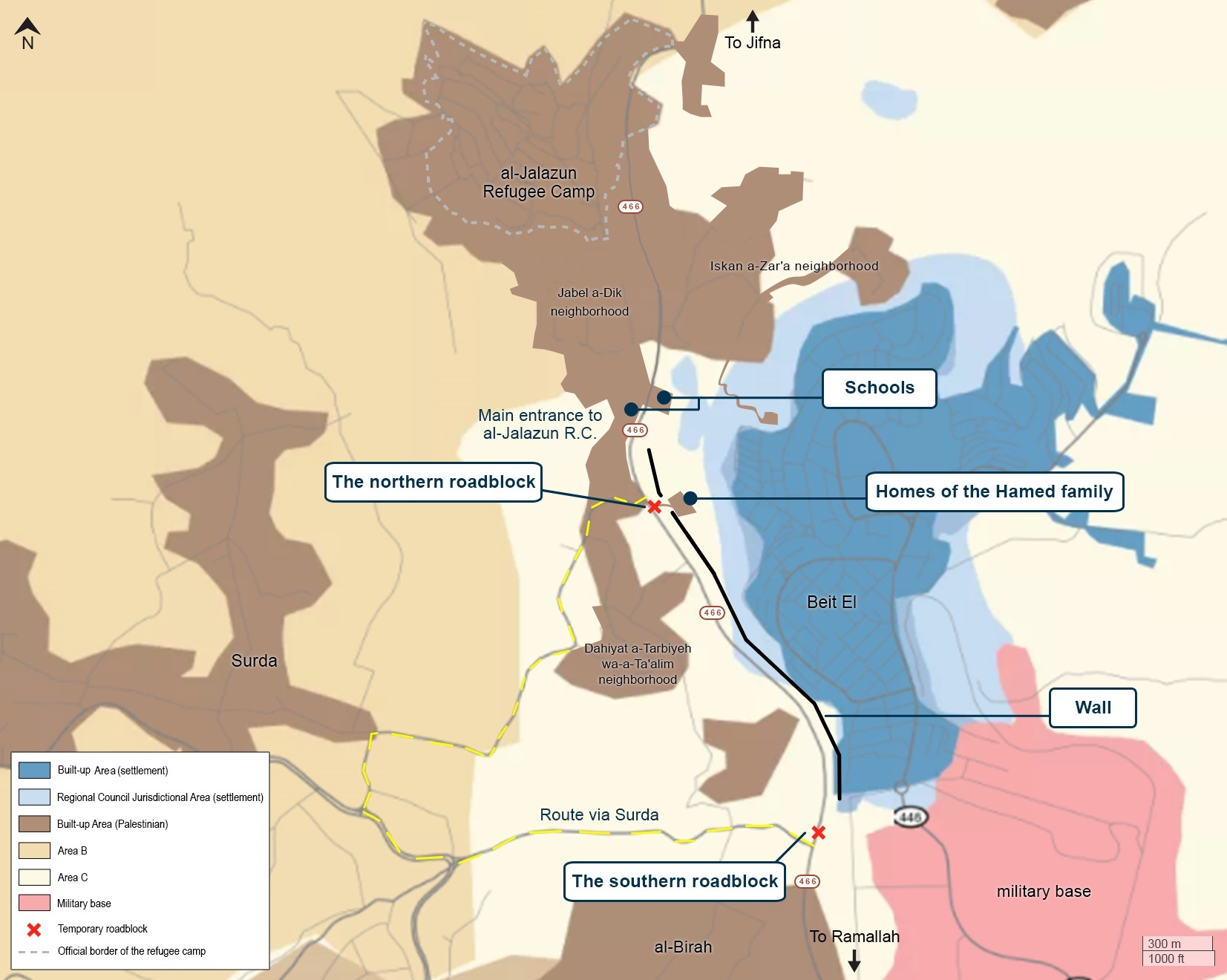
Map by B’Tselem
The Israeli army frequently denies al-Jalazun residents the right to use roads near Beit El, which severely restricts their ability to commute to jobs or seek medical treatment, or to simply go about their lives unmolested. Additionally, the Beit El settlement successfully lobbied the Israeli government to build a massive separation wall between the settlement and the refugee camp, a wall which has cut-off one Palestinian family from the camp.
B’Tselem compiled numerous testimonies from residents of al-Jalazun refugee camp that shed light on how such severe infringements on freedom of movement have impacted their daily lives. On resident, Muhammad Safi, said:
“Life here has become unbearable. If it happened once a year, or even once a month, I might have been able to live with it, but for months it happened here every day and it was unbearable. The humiliation, the anxiety, the fear I and other taxi drivers working this route feel all the time can make a person sick. I’m thinking about looking for other work, but there aren’t too many alternatives. I pray to God to make it better for us.”
“Settlements Are A War Crime”: UN High Commissioner Weighs in on 2017 Settlement Activities
The United Nations High Commissioner for Human Rights recently submitted the annual report tracking the expansion of Israel settlements, documenting activities from November 2016 through October 2017. The report covers a lot of ground — documenting and condemning Israeli activities in Area C of the West Bank, legislative initiatives concerning Jerusalem, discriminatory planning and zoning practices, home demolitions and evictions, the role of Israeli security forces, an increase in settler violence, and instances of collective punishment. It also reiterates that all Israeli settlements in occupied territories are a war crime under the Fourth Geneva Convention.
In a key section describing how many of these policies create what the report calls a “coercive environment” that amounts to a population transfer, the report says:
“Forcible transfer does not necessarily require the use of physical force by authorities; it may be triggered by specific factors that give individuals or communities no choice but to leave, amounting to what is known as a ‘coercive environment’. Any transfer without the genuine and fully informed consent of those affected is considered forcible. Genuine consent to a transfer cannot, however, be presumed in an environment marked by the use or threat of physical force, coercion, fear of violence, or duress (A/HRC/34/38, para. 28; A/HRC/34/39 para. 41). Human rights, such as the rights to freedom of movement, privacy and family life, in addition to economic, social and cultural rights (A/HRC/16/71, para. 24), are usually violated within the context of forcible transfer.”
Bonus Reads
- “Do Israeli Settlers Have Any Power in America?” (The Forward)
- “Israeli Settlers Hold Country Hostage to their Ideology”(Al-Monitor)
- “West Bank demolitions and displacement continue at similar pace to 2017” (OCHA)