Welcome to FMEP’s Weekly Settlement Report, covering everything you need to know about Israeli settlement activity this week.
To subscribe to this report, please click here.
January 4, 2019
- Israel Advances Plans for 2,191 New Settlement Units – Including Establishing 2 New Settlements & Laying Groundwork for 2 New Settlement Industrial Zones
- Based on New Legal Tools to Take Palestinian Land, Israel Announces Intention to Build A New Settlement (“Givat Eitam/E-2”) Near Bethlehem
- Following High Profile Political Support, Settlers Violently Resist Evacuation from Amona Outpost Site
- Knesset Speaker & Leaders Call for Annexation of Hebron
- Regavim Petitions Jerusalem District Court to Stop the EU-Backed “Arab Takeover” of Area C
- Knesset Lawyer Criticizes Bill to Give Palestinian Land to the World Zionist Organization
- Sheldon Adelson’s Medical School in Ariel Settlement May Not Open
- Bonus Reads
Questions/comments? Email kmccarthy@fmep.org
Israel Advances Plans for 2,191 New Settlement Units – Including Establishing 2 New Settlements & Laying Groundwork for 2 New Settlement Industrial Zones

Map on Twitter by @JacobMagid
During its final meetings of 2018 (held on December 26th and 27th), the Israeli Civil Administration High Planning Council advanced plans for a total of 2,191 new settlement units. Peace Now reports that 87% of the settlement plans advanced are located deep inside of the West Bank, far beyond any of the negotiated parameters for a border between Israel and a future Palestinian state.
The flood of settlement approvals includes plans that will effectively create two new settlements (by legalizing the unauthorized outposts of Ibei Hanachal and Gva’ot, detailed below) and establish two new settlement industrial zones (one near the Beitar Illit settlement and one near the Avnei Hefetz settlement). Another plan, for an educational campus and a gas station, will serve to connect the unauthorized outpost of Mitzpeh Danny to a nearby settlement (Ma’aleh Mikhmash) – paving the way towards the eventual legalization of that outpost, creating yet another new settlement.
Of that total, plans for 1,159 units were given final approval for construction – meaning building permits can be issued immediately. These include
- 220 new units in the Givat Ze’ev settlement;
- 180 new units in the Neveh Daniel settlement;
- 135 new units in the Tene settlement;
- 120 new units in the Karmei Tzur settlement;
- 129 new units in the Avnei Hefetz settlement (where plans to build a new, noncontiguous industrial zone nearby were also advanced – see below);
- 61 new units in the Tzofim settlement;
- 42 new units in the Alfei Menashe settlement;
- 55 new units in the Tomer settlement;
- 18 new units in the Adora settlement;
- 16 new units in the Metzad settlement;
- 1 new units in the Shilo settlement; and,
- 62 new units in the Ma’aleh Mikhmash settlement;
-

Map by Peace Now
A plan to build an educational campus and a gas station between the Malakeh Mikhmash settlement and the unauthorized outpost of Mitzpeh Danny. Peace Now writes, “Although this is not a residential program, these buildings also qualify as the establishment of a new settlement complex in the West Bank. The plan covers 140 dunams and will create a permanent presence of hundreds of Israeli students and teachers…During the discussion it was noted that the Mateh Binyamin Regional Council is preparing a plan to regulate the outpost.”
- A plan to build a cemetary on an area of “state land” south of the Palestinian city of Qalqilya. The area used to be a closed firing zone, but that military designation was rescinded years back, and the site has since been the subject of settlement planning. Peace Now writes, “The planned cemetery is likely to be the first component on the road to the establishment of an industrial zone, which is also a type of settlement.”
Settlement plans that were advanced through earlier stages of the planning process include:
-
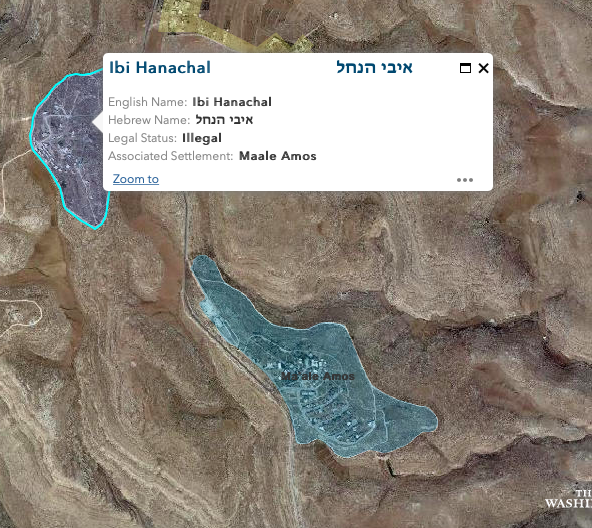
Map by WINEP
A plan for 98 units in the unauthorized Ibei Hanachal outpost, which will turn the outpost as a “neighborhood” of the Maale Amos settlement. In reality, the outpost is not contiguous with the built-up area of the Maale Amos settlement, meaning that the implementation of this plan will, in effect, create a distinct new settlement.
- A plan for 61 new units in the unauthorized Gva’ot outpost, an outpost originally built in 1999 by the settlers as a “neighborhood” of the Alon Shvut settlement. The settlers built a yeshiva there, but abandoned it not long after. The new settlement plan is for a public building, likely an educational institute with housing.
- 82 new units in th Ofra settlement. FMEP reported on this plan in the Dec 14th edition of the Settlement Report, in conjunction with the litany of punitive settlement plans advanced by Israel in response to terror attacks. The area where the new units are slated to be built is land that was allegedly purchased by the settlers from its original Palestinian owners.
- Plans for two new settlement industrial zones, one near the Beitar Illit settlement and one near the Avnei Hefetz settlement. The latter industrial zone, called Bustani Hefetz, will cover a large area of land (some 730 dunams) and will not be not contiguous with any other settlement. Peace Now writes, “an industrial zone of this scope, which is cut off from any other settlement, in all actuality constitutes a new settlement.”
- 121 new units in the Yitzhar settlement, where the IDF has been trying to rein in the violence perpetrated by the “Hilltop Youth” settlers, who are based in Yitzhar.
- 152 new units in the Shavei Shomron settlement.
- 212 new units in the Har Bracha settlement.
- 94 new units in the Beit Haggai settlement.
- A plan to legalize 75 existing settlement units in the Shvut Rachel settlement, which Israel considers a “neighborhood” of the Shiloh settlement.
- 100 new units in the Halamish settlement.
Peace Now released a statement saying:
“In 2018, the government advanced thousands of housing units, including most which can be found in isolated settlements deep inside the West Bank that Israel will eventually have to evacuate. Those who build these places have no intention of achieving peace and a two-state solution. The latest announcement, which as an aside was cynically passed on Christmas while most Western governments are on holiday, shows that Netanyahu is willing to sacrifice Israeli interests in favor of an election gift to the settlers in an attempt to attract a few more votes from his right-wing flank.”
Top Palestinian negotiator, Saeb Erekat, released a statement saying:
“While the world is celebrating Christmas with its spirit of peace and joy, the Grinch ‘occupation’ decided to steal the Christmas spirit from the people of Palestine. As part of his early election campaign, the Israeli Prime Minister Benjamin Netanyahu has as well stolen more Palestinian land and resources for the benefit of Israel’s illegal colonial settlement expansion. Such illegal actions are a deliberate campaign to destroy the two-state solution and to prevent the establishment of an independent and sovereign State of Palestine with East Jerusalem as its capital.”
Tamar Zandberg, head of the Meretz Party, slammed the new announcements, and previous decisions taken by the government to retroactively legalize 60 outposts. Zandberg said:
“The Israeli government has become a settlement government. (MKs Bezalel) Smotrich, Moti Yogev, (Justice Minister) Shaked and (Education Minister) Bennett are its landlords. They exploit the (Palestinian) attacks to build more settlements. But the truth needs to be said. To achieve security we need to evacuate settlements, not build more and more…”The 60 new settlements are the real threat to Israel’s security and to IDF soldiers. The pogroms they are waging in Palestinian villages. The stone-throwing, the shooting and the uprooting of the trees. This is the danger to our moral image and our security! They eight seats of Habayit Hayehudi party dictate eight million lives.”
Based on New Legal Tools to Take Palestinian Land, Israel Announces Intention to Build A New Settlement (“Givat Eitam/E-2”) Near Bethlehem
On December 26th, the Israeli Civil Administration announced that it will draft plans to build as many as 2,500 new settlement units at the Givat Eitam outpost site, creating a new settlement on a strategic hilltop that will cut off Bethlehem from the southern West Bank, completing the near encirclement of Bethlehem by Israeli settlements.
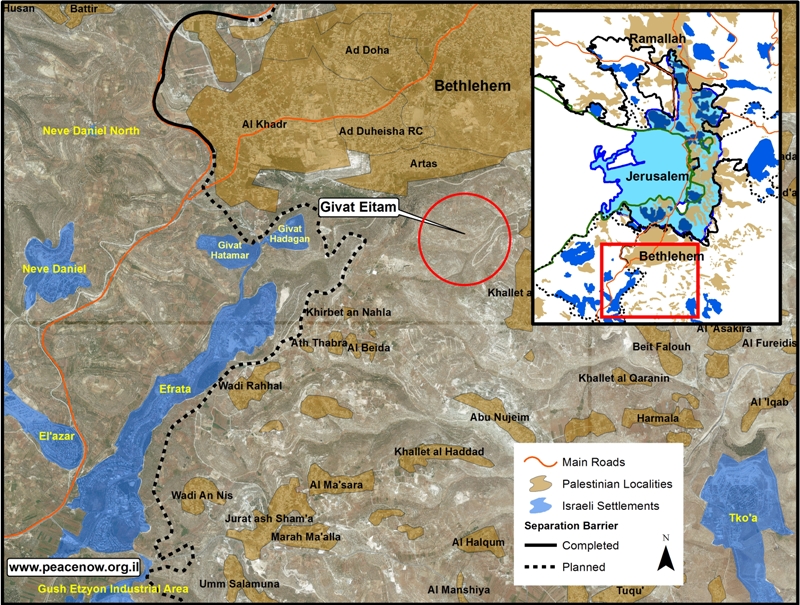
Map by Peace Now
For years, settlers have lobbied for construction at the site, but those efforts have been stymied by the lack of a legal access road to the outpost, which is surrounded by land that even Israel recognizes is privately owned by Palestinians. Until recently, Israel has balked at seizing private land from Palestinians for the exclusive benefit of the settlements. But now, several new legal opinions have allowed Israel to violate the private property rights of Palestinians for the sole purpose of legalizing settlements and settlement infrastructure. Those legal opinions include the “market regulation” principle, the opinion(s) regarding the Haresha outpost case, and the Regulation Law. It is unclear which legal argument will be applied to the Givat Eitam/E-2 case.
The Givat Eitam outpost has been nicknamed “E-2” by settlement watchers for for its resemblance, in terms of dire geopolitical implications, to the infamous E-1 settlement plan. Located east of the separation barrier on a strategic hilltop overlooking the Palestinian city of Bethlehem to its north, Givat Eitam/E-2 is located within the municipal borders of the Efrat settlement but is not contiguous with Efrat’s built-up area, making Givat Eitam/E-2 effectively a new settlement that, according to Peace Now, will:
“block Bethlehem from the south, and prevent any development in the only direction that has not yet been blocked by settlements (the city is already blocked from the North by the East Jerusalem settlements of Gilo and Har Homa, and from the West by the Gush Etzion Settlements) or bypass roads (that were paved principally for Israeli settlers). The planned building in area E2 would likely finalize the cutting off of Bethlehem city from the southern West Bank, delivering a crushing blow to the Two States solution.”
In September 2018 FMEP reported that the local council of the Efrat settlement encouraged the start of (unauthorized) construction of an outpost at the Givat Eitam/E-2 site (presuming that any such illegal construction would be retroactively legalized by the government) in response to a Palestinian terror attack in the Efrat settlement. Since then, the Civil Administration has allowed the settlers to build and maintain an agricultural farm there.
FMEP tracks all developments related to Israeli legislative, cabinet, and judicial action that promotes the retroactive legalization of outposts built on privately owned Palestinian land as part of its documentation of creeping annexation – available here.
Following High Profile Political Support, Settlers Violently Resist Evacuation from Amona Outpost Site
On January 3rd, 23 Israeli police officers were injured by Israeli settlers and their supporters who violently resisted the court-ordered evacuation from illegal encampments erected on privately owned Palestinian land as part of an effort to re-establish the Amona outpost. Approximately 300 settlers showed up at the Amona site (which is currently a closed military zone) overnight to resist the removal of settlers and two caravans from the hilltop, which was ordered by the Jerusalem District Court. The settlers and their supporters burned approximately 300 tires at the entrance to the outpost, poured oil on the access roads, and threw rocks and boulders at the Israeli police. Seven suspects were arrested and quickly released.
The evacuation of the outpost was reportedly carried out in defiance of a direct order from Prime Minister Netanyahu. According to the Haaretz report, Netanyahu gave orders to the Israeli military secretary, Col. Avi Bluth, to stop the evacuation. Col. Bluth did not relay the message in time, and the evacuation was carried out. Now, Netanyahu has ordered a disciplinary hearing to investigate the actions of Col. Bluth, which is scheduled for January 4th.
The violent evacuation of settlers from the Amona hilltop follows a week of high profile support for their efforts. Israeli Cultural Minister Miri Regev attended a ceremony near the recently re-established (yet unauthorized) Amona outpost to express her support for authorizing construction on the hilltop – which, according to the Israeli High Court of Justice, is privately owned Palestinian land. Regev could not go to the actual Amona site, because the area is a closed military zone where no one (settlers, politicians, and even the Palestinians who own the land) is permitted to enter. Regev and the settlers claim that the hilltop land has been legally purchased by the settlers, but that claim has not been investigated, much less verified. Casting doubt on the settlers’ claims, Haaretz notes:
“The lot in question is jointly owned by several different Palestinians, which means every single one of them would have to consent to the purchase for it to be legal. It’s not clear which, if any, of these Palestinians signed the sale document. In the end, the land was designated military land, is zoned for agriculture and has no building permits.The Binyamin Regional Council didn’t await the administration’s decision before moving two prefab homes into Amona and providing basic infrastructure such as water tankers.”
Israeli Attorney General Avichai Mandleblit slammed the settlers for trespassing and illegally moving caravans onto the site. Mandelblit criticized MK Bezalel Smotrich and the heads of regional settlement councils who went to the site to express support, saying:
“Breaking the law with the support of public figures, like placing caravans on privately-owned lands, can’t be a source of pride.”
A Haaretz report recently revealed Bezalel Smotrich was a founding member of a non-governmental group called Ofek Lehityashvut, which directly financed the illegal reestablishment of the Amona outpost last month by purchasing the two caravans that settlers moved onto the hilltop. The Haaretz report goes on to reveal that the Benyamin Regional Council has purposefully tailored various calls for proposals so that Ofek Kehityashvut would be the only group qualified to receive financing for that project. As a result of that manipulation, Ofek Kehityashvut has received substantial amounts of funding from the Benyamin REgional Council, which is an Israeli-taxpayer funded entity.
Knesset Speaker & Leaders Call for Annexation of Hebron
The speaker of the Israeli Knesset, Yuli Edelstein (Likud), called for Israel to apply its sovereignty over the city of Hebron – which would constitute an act of de facto annexation. Edelstein released a statement announcing his intention to go on a tour of Hebron – where some 500-800 settlers live under Israeli military protection amongst 200,000+ Palestinians – with the far-right, pro-annexationist group Im Tirzu. In the statement he wrote:
“In my view, it’s delusional that some Knesset members dare to undermine the Jewish people’s right to dwell in the city of our forefathers,” Edelstein said in a press statement issued prior to the conference. “We’re developing Hebron, investing in it and inculcating its importance in future generations. We are saying clearly – sovereignty in Hebron first.”
Speaker Edelstein also participated in a conference highlighting Israel’s historic connection to the city of Hebron. Organized by the Knesset Land of Israel Lobby, the event culminated in the signing of a document that reads:
“We, the undersigned, hereby express deep solidarity with the roots of the Jewish people in Hebron and the support of the Jewish community in Hebron that has clung to the city despite all the difficulties. We declare an unambiguous commitment to the continued existence, security and prosperity of Hebron as the city of both our forefathers and children.”
The event was co-organized by MK Bezalel Smotrich (Jewish Home) who said:
“Hebron is a litmus test. What is happening in Hebron shows our Jewish pulse….[those who call for settlers to leave Hebron] understand very well that if Hebron grows and develops, the entire settlement enterprise will grow and develop, so they invest in harming Hebron. But they will continue to shout and complain while we will continue to build, reach the people and connect with our roots.”
Regavim Petitions Jerusalem District Court to Stop the EU-Backed “Arab Takeover” of Area C
Following the Knesset’s passage of a bill in July 2018 that brought many West Bank legal matters under Israel’s domestic jurisdiction (an act of de facto annexation), the Jerusalem District Court is set to hear its first case concerning land disputes in the occupied territory. The bill was sponsored by Israeli Justice Minister Ayelet Shaked, whose three-fold rationale for the bill explicitly states that its purpose is to help settlers take more Palestinian land and shut-down Palestinian challenges to such thefts — by bringing matters to the Jerusalem Court instead of the High Court of Justice, which Shaked believes is too concerned with Palestinian rights and international law. The bill is part of the legislative body’s broader effort to erase all remaining distinctions (legal, judicial, economic, and otherwise) between sovereign Israel and the occupied territories, distinctions which allowed Israel to preserve the guise of respect for rule of law, and good intentions, for the last 50 years.
Looking to cash in the bill’s explicit purpose, the radical settler group Regavim initiated the petition asking the court to intervene to stop the “illegal Arab takeover” of land in the West Bank. Regavim’s petition claims that Palestinians are cultivating “state land” near the Mezad settlement. The petition also blames the European Union for its financial backing for the agricultural projects on the land. (Note: Regavim, like most settler media outlets, uses the word “Arab” to describe Palestinians, a vocabulary choice meant to erase any recognition of Palestinian identity).
A coordinator for Regavim told the Arutz Sheva outlet:
“The intervention of the European Union in what is happening in Area C is a brazen and aggressive intervention. We see extensive involvement on their part in lawbreaking and invading state land throughout Judea and Samaria. Their symbols are everywhere, and the State of Israel must respond to this blatant intervention on the diplomatic level as well.”
Shlomo Ne’eman, head of the Gush Etzion Regional Council said:
“The direct involvement of the European Union in financing Arab squatters in the territories and state lands has already become a plague on the state. We congratulate Justice Minister Ayelet Shaked on the obvious step that has led to great logic and justice in reducing the burden on the Supreme Court and in uniform enforcement against the land grabs by hostile elements…the Arabs understand that the real battle is on the ground. Foreign countries with their money are trying to shape a false consciousness and finally change the map of the state, but nothing can change history and our natural belonging on our national land.”
FMEP tracks the application of domestic Israeli law over the occupied West Bank (the de facto annexation of the West Bank) on its Annexation Policy Tables, which are regularly updated.
Knesset Lawyer Criticizes Bill to Give Palestinian Land to the World Zionist Organization
The legal advisors to the Knesset Constitution, Law and Justice Committee criticized a bill that would transfer vast tracts of land in Area C of the West Bank to the Settlement Division of the World Zionist Organization (WZO), a quasi-private state-funded entity that works to establish and expand settlements in the West Bank. Despite pressure to pass the bill, the legal advisors called on the committee to reexamine the text over concerns that it would also give the WZO authority over Palestinian communities in Area C. The experts wrote in a legal opinion for the committee:
“The proposed definitions of ‘rural settlement’ and ‘land’ do not include references to the character and nature of the settlement, and it seems that land that is government or abandoned property intended for Palestinian rural settlement will also be included in the boundaries of the proposed arrangement, and will be transferred to the management of the Settlement Division. Is the intention of the bill that the Settlement Division will also manage the Palestinian rural settlement in the area?”
As FMEP has previously reported, the bill was proposed by MK Bezalel Smotrich (Habayit Hayehudi) to accelerate the transfer of almost all of the land in Area C to the control of the World Zionist Organization. The land transfer is, in fact, taking place at the bureaucratic level, but Smotrich and the Israeli Cabinet (which endorsed the bill) are increasingly frustrated by the slow pace of the transfer (and perhaps also the limited scope of land slated to be handed over). Israeli Attorney General Avichai Mandelblit expressed his opposition to the bill, saying it is unnecessary given that ministry staffs are already working to transfer more land to the WZO through an administrative process.
In June 2018, when the Knesset gave preliminary approval to the bill, Peace Now responded:
“the government is scandalously planning to give the biggest land thieves responsibility for managing the land distribution, which will continue to be done under the cover of darkness if the bill passes into law.”
For more information on this bill, read a comprehensive background briefing by Peace Now.
Sheldon Adelson’s Medical School in Ariel Settlement May Not Open
The state-of-the-art medical school planned to be built in the Ariel settlement is now in danger of not opening, after a letter from the Israeli Justice Ministry warned that the school’s approval is in jeopardy. The Justice Ministry discovered an undisclosed conflict of interest that voids an important vote in favor of approving the school by the planning and budgeting subcommittee of the Higher Education Council. A member of the subcommittee, Dr. Rivka Wadmany-Shauman, allegedly met with the heads of Ariel University ahead of the vote, and made her approval of the new medical school conditional on being promoted to the rank of professor. Israel Hayom reports the Ariel University has already shelved plans to inaugurate the new school for its first semester in the Fall of 2019.
As FMEP has previously reported, Ariel University became an accredited Israeli university in 2012, following significant controversy and opposition, including from Israeli academics. It has since been the focus of additional controversy, linked to what is a clear Israeli government-backed agenda of exploiting academia to normalize and annex settlements. In 2018, the settlement broke ground on the new medical school, with significant financial backing from U.S. casino magnate and settlement financier, Sheldon Adelson. In February 2018, in an act of deliberate de facto annexation, the Israeli Knesset passed a law that extends the jurisdiction of the Israeli Council on Higher Education over universities in the settlements (beyond Israel’s self-declared borders), ensuring that the Ariel settlement medical school (and its graduates) are entitled to all the same rights, privileges, and certifications as schools and students in sovereign Israel.
As a reminder, Ariel is located in the heart of the northern West Bank, reaching literally to the midpoint between the Green Line and the Jordan border. The future of Ariel has long been one of the greatest challenges to any possible peace agreement, since any plan to attach Ariel to Israel will cut the northern West Bank into pieces.
Bonus Reads
- “Israeli settlements threaten to engulf West Bank communities” (Al-Monitor)
- “Israeli settlement activity appears to surge in Trump era” (AP)
- “It Pays Off to be an Israel Settler, Whether Trespasser or Landowner” (Haaretz+)
- “In the West Bank, the Israeli army works for the settlers” (Haaretz)
- “Netanyahu’s pro-settler allies force annexation into campaign agenda” (Al-Monitor)
Welcome to FMEP’s Weekly Settlement Report, covering everything you need to know about Israeli settlement activity this week.
To subscribe to this report, please click here.
December 21, 2018
- Israel Nears Final Move to Carry Out Massive Land Theft to “Regulate” Illegal Outposts
- Ministers Back a Bill to Legalize 66 Outposts
- In New Legal Opinion, Israeli AG Outlines Strategy for Legalizing Outposts
- New Outpost #1 : Settlers & Government Officials Illegally Re-Build Amona Outpost
- New Outpost #2: Settlers Build Outpost Overlooking Hebron
- More Details on the Plan to Dig a Tunnel Road to the Haresha Outpost
- High Court Criticizes State Over Illegal Road on Palestinian Land
- New Report Documents Israel’s “Severe and Regular” Violation of International Law in Hebron
- High-Rise Settlement Housing Promoted As a Means to Achieve 2020 Settler Vision & As a Solution to Israel’s Affordable Housing Shortage
- Fourth Quarter Decline in 2018 Settlement Construction Starts Doesn’t Tell the Whole Story
- Bonus Reads
Questions/comments? Email kmccarthy@fmep.org
Israel Nears Final Move to Carry Out Massive Land Theft to “Regulate” Illegal Outposts
As has become routine, Israeli settlers and their allies in government are exploiting the recent deaths of three Israelis (two soldiers and a baby) at the hands of Palestinian attackers as an opportunity to accelerate settlement-related activities. This includes advancing new legislation and accelerating/expanding the application of new legal tools designed to entrench and expand the permanence of some of the most radical Israeli settlers living in isolated outposts across the West Bank.
If implemented, the plans and legislation detailed below (and in last week’s settlement report) will expropriate huge amounts of land that even Israel recognizes as privately owned by Palestinians, in order to retroactively legalize Israeli outposts scattered across the West Bank. Such a move will complete what has been a gradual but steady formal suspension of even the pretense of maintaining the rule of law with regard to Israeli settlers’ or the Israeli government’s’ actions in the West Bank (which comes on top of Israel’s official and open contempt for international law). As Haaretz columnist Zvi Bar’el writes:
“The legal criminality that the government invented in honor of the settlers… is an unbridled attack on the rule of law, the undermining of Palestinian landowners’ right to appeal at the High Court, and the destruction of the planning and building system. And mainly, it turns terror into a real estate perk for lawbreaking extortionists.”
Americans for Peace Now said:
“In reaction to murderous terrorist attacks targeting West Bank Jewish settlers and Israeli soldiers, the government of Israel has come under pressure from the settlers to exact retribution against Palestinians. Two of the measures adopted are bound to open the floodgates for the legalization of existing settlement-outposts and the establishment of new ones.”
Ministers Back a Bill to Legalize 66 Outposts
On December 16th, the Israeli Cabinet voted unanimously to give government backing to a bill (called “Regulation Law 2” or the “Young Settlement Bill”) that directs the government to treat 66 illegal outposts built on privately owned Palestinian land as legal settlements, while giving the government 2 years to find a way to retroactively legalize those outposts.
The bill, proposed by MK Bezalel Smotrich (Habayit Hayehudi) and MK Yoav Kisch (Likud), also freezes any/all legal proceedings against the outposts and requires the government to connect the outposts to state infrastructure including water, electricity, provide garbage removal, and also approve budgets for them. The law also allows the finance minister to guarantee mortgages for settlers seeking to buy units in these outposts, even before the legal status of the land is resolved (a remarkable state-directed violation of normal practices in the mortgage industry). With government backing, the bill will now be introduced in the Knesset, where it must pass three readings before becoming law.
Though this bill has been ready for months, the Cabinet decided to advance the bill now in response to recent Palestinian terror attacks. MK Smotrich said: “This is the definitive answer to the murderous terrorism of the Arabs.” This sentiment was echoed widely across the settler movement.
The Cabinet voted to support the bill despite strong opposition from the Israeli Attorney General’s office. Deputy AG Ran Nizri told the Cabinet ahead of the vote that the bill has “significant legal problems,” represents a sweeping violation of the property rights of Palestinians in the West Bank, and will likely face a drawn out Court battle that might result in the High Court of Justice overturning the law. Notwithstanding these seemingly principled arguments opposing this tactic for legalizing outposts, it should be recalled that the Attorney General’s office has proposed what it believes is a more defensible means means to accomplish the same ends – called the Market Regulation principle (discussed below).
The Jerusalem Post speculates that passage of the “Regulation Law 2” in the Knesset may not be automatic, in light of past instances where international condemnation of such moves to legalize outposts led to hold-ups. The Times of Israel points out that the Trump Administration has failed to express any criticism about the new bill, which is unsurprising given Trump Administration officials’ statements and actions embracing and normalizing the settlements.
Israeli Justice Minister Shaked praised the bill, saying:
“[the bill is a] clear statement that will legalize young settlements [outposts] in Judea and Samaria. In the last three years, we changed the conversation from one of evacuation to one of legalization. There is no reason for the residents of Judea and Samaria to always have to live under the sword of evacuation.”
Peace Now said:
“Another populist and unconstitutional initiative is approved by the settler government, and only in such a state can an ‘illegal settlement’ be classified as a ‘young settlement.’ The settlers’ violence against Palestinian passerby that we witnessed during the weekend is a direct result of the government’s policy and of such bills that actually telling the settlers that they are above the law and whatever violation of the law the make, the government will legalize it.”
The bill is a follow-up to the first Regulation Law, which was passed by the Knesset in February 2017 but has since then been frozen by the High Court of Justice while it considers the law’s constitutionality. One month after passage of the Regulation Law, the Israeli Cabinet passed a resolution to enact the law expeditiously, at which point the cabinet created a committee – now headed by settler leader Pinchas Wallerstein – to build a list of outposts which the government can retroactively legalize and to complete the bureaucratic work required to do so. Wallerstein – who has a long history of ignoring Israeli law but is now responsible for massaging it to suit his needs – has been vocal about what the government can do immediately, telling the Knesset in October 2018 that there are at least 20 outposts which can be “easily” legalized as neighborhoods of existing settlements, and 50 more outposts that can be legalized but require more complex solutions.
The outposts slated to be legalized are scattered across the West Bank, many of which FMEP has reported on regularly, including: Haresha (the center of recent legal maneuvers aimed at legalizing an access road built on privately owned Palestinian land); Givat Assaf (where two Israeli soldiers were killed on December 13th); Havat Gilad (another outpost which gained political support following a Palestinian terror attack); Yitzhar South, Yitzhar East (satellites of the radical and violent Yitzhar settlement near Nablus; Ma’ale Rehavam (which was built on privately owned Palestinian land that the WZO illegally allotted to the settlers); Mitzpe Kramim (where once again the WZO gave settlers land owned by Palestinians. A court recently ruled the WZO acted in “good faith” in the transaction despite evidence to the contrary); Netiv Ha’avot (FMEP extensively covered the saga of Netiv Ha’avot); and, Adei Ad (a violent outpost that has been approved to be added to the jurisdiction of the new Amichai settlement in the Shilo Valley).
FMEP tracks all developments related to Israeli legislative, cabinet, and judicial action that promotes the retroactive legalization of outposts built on privately owned Palestinian land as part of its documentation of creeping annexation – available here.
In New Legal Opinion, Israeli AG Outlines Strategy for Legalizing Outposts
On December 13th, Israeli Attorney General Avichai Mandleblit issued a new legal opinion outlining how the government can implement the “market regulation” principle (which he invented) as a new legal basis for retroactively legalizing outposts and settlement structures built on privately owned Palestinian land. According to this principle – which contradicts any notion of rule of law or the sanctity of private property rights – settlement structures and outposts built illegally on private Palestinian land, can be legalized, if the settlers acted “in good faith” when they took over and built on the land. His opinion and subsequent arguments to the Israeli High Court of Justice (below) confirm that in the view of the Israel’s top law official, Israel has the right to expropriate privately owned Palestinian land in the occupied West Bank and give it to Israeli settlers; the only disagreement he has with the Knesset is over the method of doing so.
Peace Now has a comprehensive breakdown of the new legal opinion, including the specific criteria outlining which outposts can qualify under the new scheme. AG Mandelblit estimates that 2,000 illegal settlement structures qualify for retroactive legalization using this principle,
The Israeli government has already used the “market regulation principle” in court twice, both in defending against lawsuits filed by Palestinians (first in response to petitions by Palestinian landowners against structures on their land near the Ofra settlement, second in response to petitions filed by Palestinian landowners against the Mitzpe Kramim outpost). This week’s move by the Attorney General allows the government to proactively initiate proceedings to retroactively legalize unauthorized outposts and settlement structures.
Reportedly, the Attorney General prepared this legal opinion a while back, but was stopped from publishing it by Prime Minister Netanyahu, who was concerned about the international and diplomatic repercussions. It seems likely that the recent string of Palestinian terror attacks prompted Netanyahu to give the AG the green light to go ahead, along with advancing a number of other punitive settlement plans.
Shortly after approving the implementation of the “market regulation principle,” Mandleblit called on the High Court of Justice to overturn the Regulation Law, which the Court has been considering for more than a year. In a letter to the High Court Justices, Mandleblit argued that implementing the “market regulation principle” is “a more proportionate and balanced measure than the arrangement prescribed in the Regulation Law,” providing a more narrow legal basis by which Israel can strip Palestinian landowners of their rights (estimating that 2,000 structures can be legalized under the “market regulation principle,” compared to an estimated 4,000 under the Regulation Law). Of course, this argument overlooks the severe violation of Palestinian rights, the rule of law, and international law inherent in Israel’s decision to in effect erase Palestinian private property rights in the occupied territory to benefit the settlers.
Peace Now said:
“The attorney general is crossing yet another red line by laying the foundations for an institutionalized theft mechanism that will expropriate land from Palestinians and allocate it to settlers who stole it.This is part of a larger move led by AG Mandelblit to reduce the rights of Palestinians in the occupied territories and to expand the privileges of the settlers, thereby bringing us closer to an apartheid reality.”
FMEP tracks all developments related to Israeli legislative, cabinet, and judicial action that promotes the retroactive legalization of outposts built on privately owned Palestinian land as part of its documentation of creeping annexation – available here.
New Outpost #1 : Settlers & Government Officials Illegally Re-Build Amona Outpost
In recent days, dozens of Israeli settlers moved two mobile homes placed on the hilltop where the illegal Amona outpost once stood, claiming to have purchased the land from its Palestinian owners. Prominent settler leaders and MK Bezalel Smotrich (Habayit Hayehudi) visited the site to celebrate the resurrection of the infamous outpost, an endeavor which was directly supported and facilitated by the Binyamin Regional Council (a settlement regional authority which draws its budget from Israeli taxpayer funds).
Settlers have reportedly submitted documents to the Israeli Civil Administration which they claim prove the land has been legally purchased (a claim which, even if true, does not justify the settlers’ illegal invasion of and construction in an area designated by Israel as a closed military zone). The Civil Administration – which is the sovereign power over the West Bank and responsible for enforcing the law there – has confirmed that it is aware of the new outpost and has received documents from the settlers, but has not yet reviewed the documents.
Yesh Din, an Israeli NGO representing the Palestinian landowners, immediately filed a petition to have the illegal structures removed. Yesh Din also filed a criminal complaint against the Israeli government officials who were involved with invading the hilltop. As of this writing they have not received a response on either front. Peace Now has also stated it will pursue legal action against the settlers.
Yesh Din explains key context in the Amona outpost saga:
“After the evacuation [of the Amona outpost] in 2017, the Israeli army declared the area a closed military zone, prohibiting entry of Israelis and Palestinians to the area where the outpost had been located. The closure, however, was not enforced for Israelis, who freely entered, while Palestinians – including the legal landowners – were forbidden to enter and cultivate the very land for which they had struggled for years. In addition to the audacity of blatantly defying the High Court of Justice ruling and trampling on the rights of the landowners, the placing of the new structures this weekend violates the closure order and constitutes a further infringement of the law as the establishment of a new settlement in Amona was never authorized – certainly no permits or outline plans exist. But in the ‘land of the settlers,’ the concept of rule of law has long since lost any meaning. Any Israeli can decide to build a settlement on a hill, merely because they feel like it. The buildings then remain regardless of their illegality, Israeli authorities not daring to challenge their imposing presence.”
Benyamin Regional Council Chairman Yisrael Gantz said in a statement:
“After two years of this place being uninhabited, we are fortunate to resume Israeli life here. The plots upon which we erected the structures were legally purchased. Yesterday, I promised to establish a new settlement in Binyamin in response to the deadly attacks and today we are carrying it out.”
Yossi Dagan, head of the Samaria Regional Council said at the event:
“In these dark days, when terrorist attacks are so numerous and the honor of the people of Israel is harmed, we must get fired up and today’s ascent to Amona is an appropriate Zionist response.”
Peace Now said in a statement:
“There is no limit to the cynicism of the hilltop criminals who exploit the events of recent days to trample the law and ignite disturbances, all with public funds. These pyromaniacs are backed by Knesset members and local politicians… It is difficult to understand how an order has not yet been issued to evacuate them, and we ask whether the IDF and the police would have allowed this if they were Palestinians. This disgrace should be addressed today.”
Re-establishing the Amona outpost would hand a complete and total victory to the settlers who were forcibly evacuated from the site in 2017 – proving that not only does settler law-breaking go unpunished, but it is handsomely rewarded by the Israeli government, and that establishing illegal outposts is an effective route to establishing new settlements. Since being evacuated, the Amona outpost settlers have (so far) been “compensated” by the government with financial compensation and two new settlements:
- The first new government-backed settlement in 25 years, Amichai. The Israeli Civil Administration High Planning Council subsequently approved a plan to triple the size of the Amichai settlement to include the Adei Ad outpost and the lands between the two; and,
- The Shvut Rachel East settlement. This is an outpost that was granted authorization as a “neighborhood” of the Shilo settlement, but is properly understood as a new settlement unto itself. Teh Amona outpost settlers were first offered the Shvut Rachel East hilltop as a relocation site, but rejected it in favor of the nearby Amichai hilltop. Despite rejection, Shvut Rachel East received authorization anyways.
New Outpost #2: Settlers Build Outpost Overlooking Hebron
In recent days, a group of settlers have moved back into the site of an evacuated outpost near the city of Hebron, just north of the Kiryat Arba settlement, which settlers are calling Givat Mevaser. At a celebration of the decision by settlers to reestablish the outpost, the chairman of the Kiryat Arba settlement local council, Eliyahu Libman, said:
“We made a decision in light of the harsh news endured by the people of Israel last week to permanently move families into Givat Mevaser.”
The IDF was present at the celebratory event to protect the settlers, but an official at the Defense Ministry admitted that the settlers did not coordinate their actions with authorities. The site was previously approved to be developed into a settlement industrial zone, and according to a spokesperson for the new outpost, settlers are in the process of changing the building plan in order to get authorization for residential housing. Nonetheless, the settlers are at present violating Israeli law by taking up residence at the site.
More Details on the Plan to Dig a Tunnel Road to the Haresha Outpost
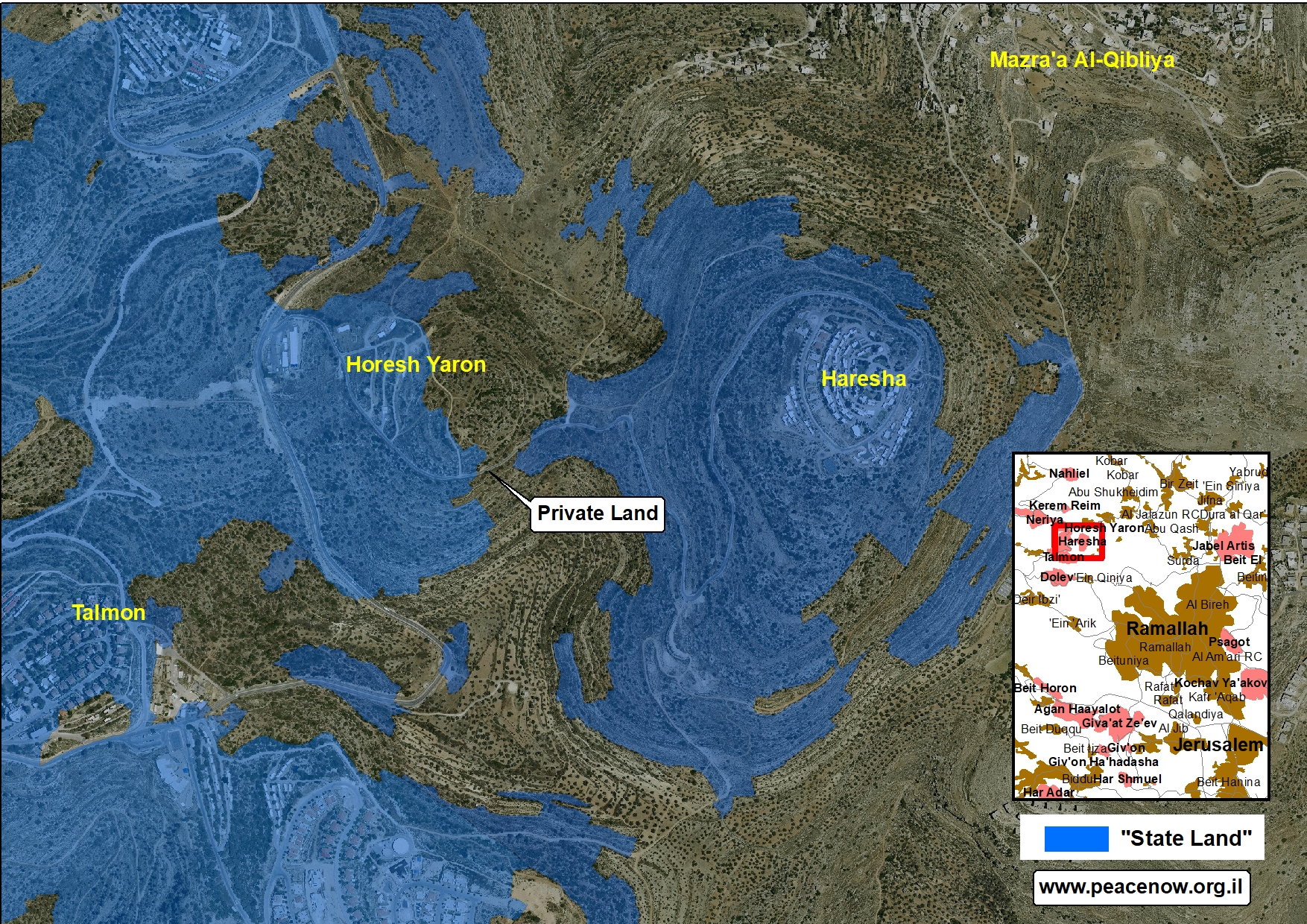 Kerem Navot has published a Justice Ministry opinion that provides further details on the government’s plan – approved on December 6th – to retroactively legalize the Haresha outpost by building a tunnel road underneath privately owned Palestinian land (an olive grove). The Justice Ministry document explains that while the Israeli government in principle has the right to permanently expropriate the land from its Palestinian owners, such an action would likely be challenged in the High Court of Justice, where it might be overturned. The Justice Ministry suggests instead that the government should “temporarily” expropriate the land while a tunnel is dug and road paved beneath the olive grove – with the plan being, ostensibly, to return the land to its Palestinian owners after construction is complete.
Kerem Navot comments:
“now, in order to legalize the outpost, shady legal advisers (of the type to whom Justice Minister Ayelet Shaked is drawn) write documents in which they lay down their doubts on whether to expropriate the grove ‘permanently,’ which will be cheaper and faster (but it is likely to be rejected by the High Court of Justice), or to ‘temporarily’ expropriate it solely for the construction of a tunnel through the ‘excavation and cover-up’ method.”
As a reminder, in November 2017 the Attorney General gave the Israeli government a green light to permanently expropriate the privately owned land based on a legal argument that holds Israeli settlers to be part of the “local population” of the West Bank, and therefore eligible to be the sole beneficiaries of state land expropriated for “public use.”
High Court Criticizes State Over Illegal Road on Palestinian Land
At a December 18th hearing, the High Court of Justice gave the government of Israel 60 days to explain why it should not be required to demolish a road and several buildings that were built on land that the state has admitted it believes is privately owned by Palestinians. The case is before the court on a petition by Palestinians who claim that a 200-meter (650-foot) stretch of the road is built on their land.
The Court also slammed the State for allowing the construction of the road and buildings to be completed after a stop-work order was issued against the construction, a stop-work order the State assured the Court would be implemented. At the December 18th hearing, an attorney from the State Prosecutor’s Office told the Court that the road in question was a dirt road, and argued that the state had not sanctioned or had a hand in its construction.
New Report Documents Israel’s “Severe and Regular” Violation of International Law in Hebron
Haaretz shares details from a leaked report written by the Temporary International Presence in Hebron (TIPH), which documents the totality of Israel’s policies in Hebron, serve to aid and protect settler and which collectively impose severe human rights violations and restrictions on Palestinians.
The report accuses Israel of being in “severe and regular breach” of international law, highlighting the many ways in which the human rights of Palestinians are systematically trampled on – specifically as it relates to radical settlers, their increasing activities in Hebron’s Old City, and the role of nearby settlements.
The Temporary International Presence in Hebron (TIPH) was first established in 1997 as part of the Oslo Accords’ Hebron Protocol, which allowed the partial redeployment of Israeli military forces to the part of the city that remained under its control. Israel must renew the TIPH’s mandate every six months; some fear that the next renewal has been jeopardized by the leaked report’s publication.
High-Rise Settlement Housing Promoted As a Means to Achieve 2020 Settler Vision & As a Solution to Israel’s Affordable Housing Shortage
Haaretz reports that the Yesha Council – the umbrella group representing all settlements in the West Bank – has adopted a strategic goal to advance “high quality, high density” settlement schemes in order to reach their goal of having 1 million settlers living in the West Bank by 2020. The basic idea is to build high-rise apartment complexes in settlements close to major highways in the West Bank and aggressively market them to Israelis who are seeking cheap rent and a fast commute, two key complaints of Israelis living and working in sovereign Israeli territory.
The strategy marks a shift in how settlements have typically been marketed to the Israeli public; once sold as an answer for young Israeli families looking for a single family unit with land, housing in settlements is now being marketed as the answer for young professionals looking for affordability, convenience and accessibility. The Yesha Council has coupled the new strategy with pressure on the government (and a promise to potential purchasers) to expedite West Bank infrastructure projects that will ease traffic, including bypass roads and detours around Palestinian towns.
In a February 2018 article, the Chairman of the Yesha Council wrote:
“Looking ahead, the patterns of thinking and action in the settlement movement need to be changed in two main areas: high-rise construction and doing away with admission committees. The available land for building is not plentiful. Until now, we’ve been used to rural communities with a one-family home on a half-dunam plot, but the goal from now on should be to build as many housing units as possible on that same land. High-density construction — building up or in a terraced fashion, depending on topography — will change the balance in the area and also require a new approach to infrastructure development to suit the number of residents in the future.” [Note: the Haaretz article explains that “admission committees” are a function of settlements which have standards for who is permitted to live there, mostly in ultra-orthodox and ideological settlements]
Fourth Quarter Decline in 2018 Settlement Construction Starts Doesn’t Tell the Whole Story
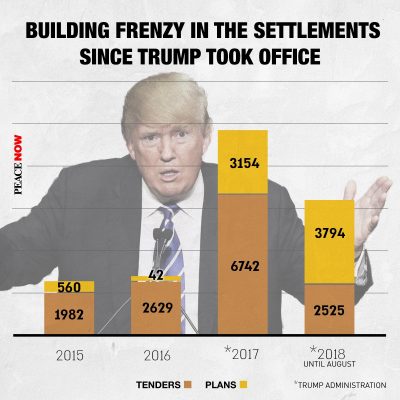
by Peace Now
The Israeli Central Bureau of Statistics (CBS) released new data showing a 52% decrease in the number of settlement construction starts in the third quarter of 2018 compared to the second quarter of 2018. News about a “decline,” relative to the last quarter, obscures the clear and alarming settlement surge currently taking place. As Peace Now has reported, by August 2018 the total number of settlement tenders and plans that have been advanced (6,319) is more than double the total amount in 2016 (3,189).
In addition, it is important to bear in mind that the number of construction starts do not begin to depict or reveal the level of settlement activity happening in the West Bank. Israel’s settlement enterprise is not solely a matter of residential housing plans, but also the unceasing expansion of infrastructure and security measures that exclusively benefit Israeli settlers, the normalization and development of settlement industrial zones, and illegal settlement activity (outposts, which are now regularly legalized ex post facto) that does not register in numbers tracking the settlement planning process.
Bonus Reads
- “Israel Has Weaponized the Settlements” (Haaretz Editorial)
- December 2018 public opinion poll – Palestinian Center for Policy and Survey Research
Welcome to FMEP’s Weekly Settlement Report, covering everything you need to know about Israeli settlement activity this week.
To subscribe to this report, please click here.
December 14, 2018
- Israel Seizes on Palestinian Attacks as Pretense to Advance Settlement on Multiple Fronts
- The WZO Used Non-Existent Land Plots as “Collateral” for Loans to Build Illegal Outposts
- Israeli AG Freezes New Grants Program for Illegal Outposts
- At the Opening of New West Bank Highway Interchange for Settlers, Netanyahu Celebrates Erasing the Green Line
- Hanukkah Event Draws Political Support for Settlers’ Bid to Take Over Site in the Old City’s Muslim Quarter
- Huge Holes Open on Streets of Silwan…Above Settler Excavations
- Israel’s Top Court Slams State Rail Company for Moving Debris to Private Palestinian Land as Part of Plan to Build a Settlement Park
- Bonus Reads
Questions/comments? Email kmccarthy@fmep.org
Israel Seizes on Palestinian Attacks as Pretense to Advance Settlement on Multiple Fronts
Seizing on a series of deadly Palestinian attacks this week as his pretext, Prime Minister Netanyahu announced he will:
- retroactively legalize thousands of settlement structures and outposts;
- initiate a plan to build 82 new units in the Ofra settlement;
- build two new settlement industrial zones (one near the Avnei Hefetz settlement and one near the Beitar Illit settlement); and,
- implement a range of policies that collectively punish Palestinians in the West Bank.
In addition, the Israeli Ministerial Committee on Legislation (a committee within the Israeli cabinet that decides whether to give government-backing to Knesset legislative proposals) will consider supporting a bill written by MK Bezalel Smotrich (Habayit Hayehudi) which would allow the government to provide municipal services, like water and electricity, to some illegal outposts. The bill assumes the series of outposts will be retroactively legalized, an assumption based on the work to achieve that end spearheaded by settler leader Pinchas Wallerstein (who has his own history of ignoring the law).
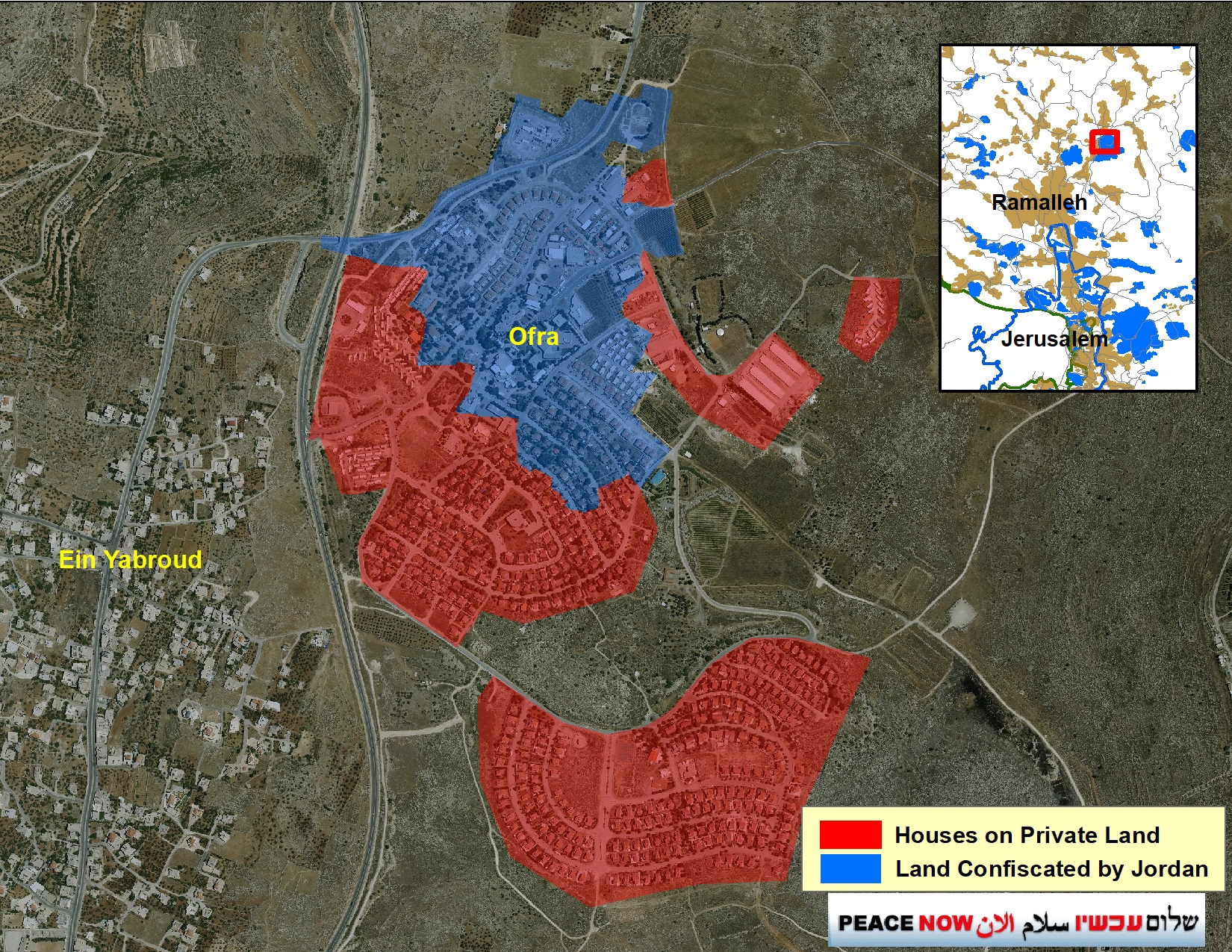 Many other senior Israeli officials joined Netanyahu in advocating for the immediate legalization of every unauthorized (i.e., illegal under Israeli law) structure in the Ofra settlement. The Ofra settlement – located northeast of Ramallah – was first established by settlers on land that had been expropriated in 1966 by the Jordanian government in order to build a military base (which was never built, as Israel took control of the West Bank in 1967). The Israeli government used this pretext to expropriate the land in 1977 in order to recognize the Ofra settlement, which had been established in the area illegally (i.e., without government approval, but with its tacit cooperation) two years prior. However, the majority of the Ofra settlement was not built on the land expropriated by the Israel in 1977, but instead on land that is registered to Palestinian owners from the nearby village of Ein Yabroud. In light of the legal status of the land, no Israeli government has yet been able to find a way to fix the legal status of these homes (not for lack of trying) – meaning that the majority of the structures in Ofra were built without permits, making them illegal under Israeli law.
Peace Now elaborates:
“Most of the houses built in Ofra (approximately 413 out of 625) were built on an area of 550 dunams of privately owned Palestinian land. In addition, hundreds of dunams of Palestinian private land were seized for roads in Ofra, as well as infrastructure and agricultural lands for the settlers. The only way to regulate the theft of these lands would be to expropriate them from the Palestinian landowners for the benefit of the settlers, in complete contradiction to the positions of previous Israeli governments and legal advisors, and contrary to binding rulings of the High Court. Although the current legal advisor (Avichai Mandelblit) allowed land expropriation in some places for settlement purposes (for example, in Haresha), in the regulation of massive land theft such as in Ofra the Israeli government would be crossing a new red line.”
Justice Minister Ayelet Shaked said that she already has a draft resolution and a legal opinion supporting retroactive legalization of Ofra. Shaked further threatened:
“Facing the price tag of Abu Mazen [Palestinian President Mahmoud Abbas], we pose our own price tag. Every terror attack will strengthen the settlement establishment instead of weakening it, and every potential attacker will know in advance that he will be considered responsible for strengthening settlements.”
Speaker of the Knesset Yuli-Yoel Edelstein vowed to push a plan through the Knesset to regulate Ofra, saying:
“The immediate answer to such an incident is to finally regulate Ofra, one of the oldest and most beloved communities. The 20th Knesset has been good and the Government has been positive towards the settlement enterprise. There have been important achievements and laws, but it’s not enough… I pledge to support the plan that will be formulated and advance it myself in the Knesset. This is our duty towards millions of citizens. The fate of Ofra must be the same as the fate of Petah Tikva.”
Yisrael Gantz, the new chairman of the Binyamin Regional Council, called for the:
“immediate approval of thousands of housing units… in order to deepen our roots here.”
The WZO Used Non-Existent Land Plots as “Collateral” for Loans to Build Illegal Outposts
The Israeli NGO Kerem Navot discovered more proof that the World Zionist Organization’s Settlement Division is directly financing the construction of illegal outposts with public funds — by providing loans to settlers based on non-existent assets, including fictitious plots of land in the West Bank. This reporting builds on previous revelations about the WZO’s complicity in illegal settlement construction on privately owned Palestinian land in the West Bank, including in the cases of the Mitzpe Kramim outpost and the Ma’aleh Rahavam outpost. Nonetheless, the Israeli government is rapidly advancing plans to hand over even more West Bank land to the WZO for settlement expansion.
On its latest findings, Kerem Navot founder Dror Etkes told Haaretz:
“This story exposes again the Settlement Division’s swindling ways and dirty dealings. [Like in the case of MK Bezelal Smotrich] who received a mortgage in the Kedumim settlement for a plot that doesn’t exist. It’s obvious from that and from the other cases that this is only the tip of the iceberg of a much broader practice.”
As a reminder, the WZO’s Settlement Division was created by the Israeli government in 1968 and is funded entirely by Israeli taxpayers. Its mandate is to manage West Bank land expropriated by Israel, in order to facilitate the settlement of Israeli Jews in the occupied territories. To make this possible, the Israeli government has allocated approximately 60% of all “state land” in the West Bank to the WZO’s Settlement Division [over the past 50 years Israel has declared huge areas of the West Bank to be “state land,” including more than 40% of Area C, where most of the settlements are located]. In addition, settlement and human rights watchdogs have repeatedly documented how the WZO’s Settlement Division has worked to take over additional land, including privately owned Palestinian land, in order to build more settlements.
Israeli AG Freezes New Grants Program for Illegal Outposts
Israeli Attorney General Avichai Mandelblit has reportedly frozen the implementation of a resolution, passed by the Israeli cabinet last week, designating three outposts as “national priority areas” for development. The resolution would direct enormous amounts of state resources to the outposts for construction.
Mandelblit wrote a letter slamming Housing Minister Yoav Gallant for bypassing the Attorney General in approving the resolution. According to Haaretz, Mandelblit had previously told the Housing Minister that the inclusion of settlements in the list of national priority areas needs to be thoroughly reviewed before the resolution was passed. Ignoring Mandelblit, Gallant advanced the resolution without a thorough review and without the permission of the government’s top legal official.
At the Opening of New West Bank Highway Interchange for Settlers, Netanyahu Celebrates Erasing the Green Line
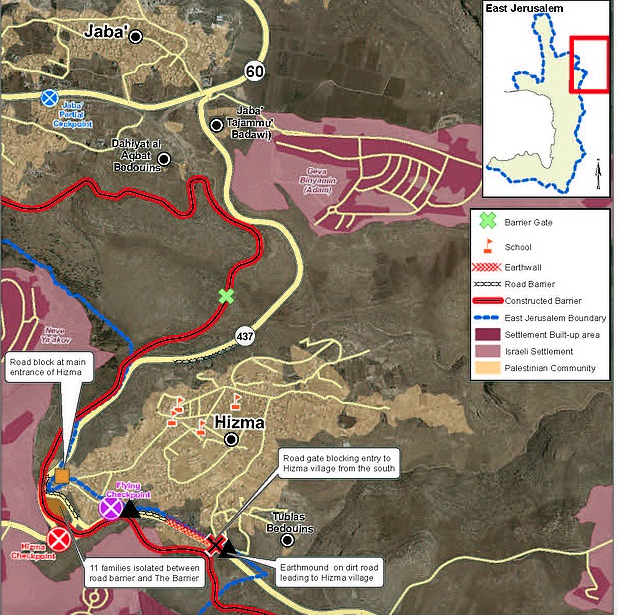
Map by OCHA
Israeli Prime Minister Benjamin Netanyahu attended a ceremony marking the opening of a newly renovated traffic interchange on Highway 60 (the main north-south highway in the West Bank). Located near the Adam/Geva Benyamin settlement and the Palestinian village of Hizma, the new interchange is meant to ease traffic congestion for settlers travelling to Jerusalem from the northern West Bank. More importantly, it advances the seamless integration of infrastructure serving Israeli settlements and sovereign Israeli territory – a key effort by settlers and their government allies to effectively erase the Green Line.
At the event, Netanyahu said:
“We are not stopping here. We will yet complete the paving of bypass roads, the widening of lanes and the improvement of infrastructures. There is a combined transportation-security aspect here. We are making yet another great link. While we are joining the country geographically, we are also joining the present to the future. Today and in this place we are doing something else, we are also joining the present to the past. Our ancestors walked here and took in this view of these valleys and these hills. The greatest dramas in the history of our people and of humanity took place here in this place; therefore, we are also joining our past to our future and this is a very great privilege.”
Minister Katz, who was also in attendance, said:
“We’re promoting a strategic plan on a very wide range with light rail routes at high-risk areas and traffic lights to make Judea and Samaria part of the Israeli norm of a developed and connected country…After we completed these two projects (Adam Interchange and Givat Assaf Traffic Light) we’ll work to enable this connection with a road with better conditions. This is part of the large and complementary projects to allow traffic to flow here.”
In September 2018, the United Nations Office for the Coordination of Humanitarian Affairs (OCHAS) released a report looking at the impact of Israeli roads on the the village of Hizma, as a case study of the effects road closures have on Palestinian rights. OCHA wrote:
“Hizma is a Palestinian village of over 7,000 residents in Jerusalem governorate. The bulk of its built-up area is in Area B but small parts of the village lie in Area C or within the municipal boundaries of Jerusalem, although it is separated from the rest of the city by the Barrier. Between 28 January and the end of March 2018, the three access roads into the village were either totally or partially closed to Palestinian traffic. The Israeli army hung posters on village shops stating that the army ‘will continue its work so long as you [residents] continue to be disruptive’. Other posters showed broken windshields. Following communications with the Israeli military, the head of the village council reported that the posters justified the closures as a response to stone throwing by Palestinian youths at vehicles with Israeli number plates. In 2017 and the first two months of 2018, OCHA recorded 11 incidents of Palestinians throwing stones at Israeli vehicles near Hizma that resulted in Israeli injuries or damage to vehicles.
The closures disrupted access by Hizma’s residents to services and livelihoods. Traffic between the north and south of the West Bank that passed through the village was diverted, undermining the commercial life of the village. Service providers, including a third of the teachers in village schools who commute on a daily basis, faced delays reaching the village. Over 50 shops/businesses that are the main source of income for 150 households were affected by the diversion of Palestinian traffic away from the village. Family life was also affected by the unpredictable nature of the closures.”
Hanukkah Event Draws Political Support for Settlers’ Bid to Take Over Site in the Old City’s Muslim Quarter
The Israeli archeological group Emek Shaveh reports that the Ateret Cohanim settler organization hosted a Hanukkah celebration – drawing the participation of the incoming Mayor of Jerusalem Moshe Lion, Minister of Jerusalem Affairs Ze’ev Elk, and the son of the Israeli Prime Minister, Yair Netanyahu – at the “Little Western Wall.” The site (which Israelis call the “Kotel Ha’Katan”) is a section of the retaining wall of the Temple Mount/Haram al-Sharif located within the Old City’s Muslim Quarter. It is viewed by some religious Jews as the closest point to the Holy of Holies at which Jews are permitted to pray. For historical background on the site and Ateret Cohanim’s role and goals related to it, see this 2016 report by Haaretz’s Nir Hasson.

Emek Shaveh writes:
“The recent Hanukkah ceremonies demonstrate an increase in political support for Ateret Cohanim and, no less important, the growing importance of the Little Western Wall, a politically and religiously charged place, attesting to a growing consensus among the Israeli Right regarding strengthening Jewish presence in areas immediately adjacent to the Temple Mount/Haram al-Sharif.”
Ateret Cohanim is a radical settler organization working to increase the presence of Israeli Jews living inside Palestinian neighborhoods of Jerusalem – including in the Old City, where the group recently succeeded in purchasing a Palestinian house in the Muslim Quarter (a property sale that continues to stoke controversy within the Palestinian community). Ateret Cohanim, along with their compatriots in the Elad settler group, also leads efforts to take over land and evict Palestinians from their homes in the Silwan neighborhood. Ateret Cohanim’s recent efforts in Silwan include using the guise of a Yemenite cultural center to build a new settlement in Silwan with government financing, and winning a High Court ruling that permits them to continue their campaign to evict 700 Palestinians from their homes.
Huge Holes Open on Streets of Silwan…Above Settler Excavations
 The Israeli archeological group Emek Shaveh reports that holes have begun appearing in the ground of Silwan, along the route of an underground excavation run by the Israeli Antiquities Authorities and funded by the Elad settler group. Elad has invested heavily in archeological excavations in Silwan in a campaign to co-opt the ancient history of Jerusalem to strengthen the Jewish hold on and presence in Palestinian neighborhoods in East Jerusalem. Emek Shaveh writes:
“There’s rarely a dull moment in Silwan. Last weekend, after the rain came, large holes opened up in the ground. This is not normal. And no amount of cement poured into the holes will make it so. Perhaps the reason for this odd occurrence can be found in the fact that Israel Antiquities Authority is excavating a tunnel along an ancient Roman road which runs right underneath the places where the holes opened up. There are 15 houses along the route of the tunnel. In some of them cracks have shown up. Others have shown signs of sinking into the ground. A few months ago we asked the Antiquities Authority to examine the homes and were assured the engineer would look into it. We’re still waiting for answers.”
The new holes are just the latest in a long series of above-ground damage related to excavations which the Israel Antiquities Authority (IAA) started in 2013. The IAA began the excavations without notifying Palestinian residents of the project. Palestinians began complaining about the work when cracks began appearing in their homes, threatening their structural integrity, and forcing many to leave their homes.
Emek Shaveh has repeatedly asked the IAA to investigate the issues caused by the excavations, but has not received an answer to date. Emek Shaveh also shared footage of Israelis haphazardly attempting to fill in the new holes with concrete.
Israel’s Top Court Slams State Rail Company for Moving Debris to Private Palestinian Land as Part of Plan to Build a Settlement Park
The Israeli High Court of Justice sharply criticized Israel Railways, the state rail company, for moving debris on to privately owned Palestinian land in the West Bank, as part of a plan to use the debris to develop a new park in the nearby Nili settlement. The debris comes from tunnelling a path for the Tel Aviv to Jerusalem rail line, meaning the debris was transported from sovereign Israeli territory into the West Bank, where it was deposited on Palestinian land.
Back in 2011, the Court chastised Israel Railways for its actions and ordered the debris to be removed. Seven years later, the Palestinian land is still a dumpsite while the Israeli government and Israeli Railways bicker over who is responsible for clearing the refuse. This week the Court rebuked the company and hinted that it would soon issue a ruling against it.
Bonus Reads
- “Q&A with Naftali Bennett” (The Forward)
- “A Plan for Perpetual Conflict” (Carnegie Endowment)
- “The New Capital of Israel” (Haaretz)
- “Annexation Legislation is Imminent, and Dangerous” (Commanders for Israeli Security)
- “Forged Jerusalem Home Sale Gets Jordan’s Attention” (Al-Monitor)
Welcome to FMEP’s Weekly Settlement Report, covering everything you need to know about Israeli settlement activity this week.
To subscribe to this report, please click here.
December 7, 2018
- Looming Mass Eviction in Silwan, Part 1: High Court Rules that Settler Organization Can Pursue Eviction of 700 Palestinians in Batan Al-Hawa Section of Silwan
- Looming Mass Eviction in Silwan, Part 2: Elad Settler Org Wins Eviction Case Against Palestinians in Wadi Hilweh Section of Silwan
- Israel to Fast-Track Two Settlement Plans in Sheikh Jarrah
- Justice Ministry Finalizes Legal Opinion to Retroactively Legalize the Haresha Outpost
- Three Illegal Outposts (& Ariel) Are Now “National Priority Areas” Eligible for Government Subsidies
- High Court Rules the Jewish National Fund is the Legal Owner of Land South of Bethlehem
- Israel Seizes Jordan Valley Land Owned by the Catholic Church
- Israeli Civil Administration Report Criticizing Yitzhar Settler Violence Leads to Renewed Calls to Annex the West Bank
- After IDF Killed Two Palestinians, Civil Administration Grants Settlers Victory in Struggle Over Hilltop
- The New Mayor of Jerusalem, Moshe Lion, On Settlements
- Al-Shabaka Policy Paper: “The EU & Jerusalem”
- Breaking the Silence Report – “Occupying Hebron: 2011-2017”
- U.S. Chatter on Economic Coexistence Initiatives (Which Normalize Settlements/Occupation) Provokes Strong Palestinian Response
- Bonus Reads
Questions/comments? Email kmccarthy@fmep.org
Looming Mass Eviction in Silwan, Part 1: High Court Rules that Settler Organization Can Pursue Eviction of 700 Palestinians in Batan Al-Hawa Section of Silwan
On November 22nd, the Israeli High Court of Justice ruled that the settler organization Ateret Cohanim can continue to pursue the eviction of 700 Palestinians from their homes in the Batan al-Hawa section of the Silwan neighborhood in East Jerusalem. This would be the largest displacement of Palestinians from East Jerusalem since 1967.
The High Court’s ruling did not decide the central issues in the case, which call into question Ateret Cohanim’s ownership of the land through its control of an historic Yemenite land trust (the Benvenisti Trust). The High Court reserved those issues for the Jerusalem Magistrate’s Court to decide as part of its consideration of individual eviction cases.
In its ruling, the High Court criticized of the government’s involvement in the case, specifically calling out the role the government played in transferring ownership of the land to Ateret Cohanim without properly informing the Palestinian residents. The High Court ruling said:
“We can’t continue without expressing surprise at the state’s assumption that a decision so significant to the lives of hundreds of people – ‘liberating’ the property on which they have lived for many years [and transferring it] to other hands – isn’t the kind of thing that ought to be publicized through reasonable means. Even the precise identity of the property’s residents wasn’t known, and that’s the interpretation kindest to the state…Evicting people who have lived on this land for decades – some of them without even knowing that the land belongs to others – creates a human problem. Especially when it’s done without compensation or any other solution. It seems the state would do better to consider providing a solution, in appropriate cases, for those evicted from their homes. Property rights are important, but it’s also important to defend people’s homes.”
B’Tselem commented:
“The judgment proves, yet again, that the Israeli High Court gives its seal of approval to almost any infringement of Palestinians’ rights by the Israeli authorities.”
Ateret Cohanim has waged a years-long eviction campaign against Palestinians living in Silwan, on property the settler NGO claims to own, based on its control of the historic Benvenisti Trust, which oversaw the assets of Yemenite Jews who lived in the neighborhood in the 19th century. Palestinians have challenged the legitimacy of the Benvinisti Trust’s claims to the currently existing buildings, saying that the trust only covered the old buildings (none of which remain standing) and not the land. Despite ongoing legal challenges, in October 2018 the Jerusalem Magistrate’s Court ruled in Ateret Cohanim’s favor in one of the cases connected to the Benvenisti Trust’s claim to the buildings there – resulting in the eviction of the last remaining Palestinian tenants (the Abu Sneina family) from a building in area of Silwan known as Batan al-Hawa.
The ruling this week does not give a final decision to the underlying questions of ownership, but it allows Ateret Cohanim to proceed – from a strengthened position – in its legal efforts to evict Palestinians from their homes.
Looming Mass Eviction in Silwan, Part 2: Elad Settler Org Wins Eviction Case Against Palestinians in Wadi Hilweh Section of Silwan
 On December 5, 2018 the Jerusalem Magistrate’s Court upheld the eviction of a Palestinian family – the Siyams – family their home in the Wadi Hilweh section of Silwan, in East Jerusalem, just 820 feet from the southern wall of Al-Aqsa Mosque. Like Ateret Cohanim (see above), the Elad settler organization has been waging a years-long legal battle to take control homes in Silwan, including a 20-year battle to take control of the Siyam family home, which Elad insists legally purchased it.
The Court ruling this week was the first ruling in the settlers’ favor. The Siyam family announced plans to petition the ruling to the Jerusalem District Court.
In response to the ruling, Peace Now said:
“This case is an example of how the settlers manage to take control of Palestinian property in East Jerusalem by combining manipulations, money, forgery and significant aid from the Israeli authorities. It is not a regular case between equal sides, but a story of David and Goliath, and the settlers are the Goliath. There is a settlers organization with almost unlimited financial resources and enormous political power against an ordinary Palestinian family that has been forced into court for more than 20 years, to invest tremendous resources in legal defense and to deal with various and varied purchase claims. This way the settlers are causing great damage to Israel when they harm the delicate fabric of life in Jerusalem and the possibility of compromise in Jerusalem and a two-state solution.”
Israel to Fast-Track Two Settlement Plans in Sheikh Jarrah
Ir Amim reports that the Jerusalem District Planning and Building Committee will meet on December 23rd to fast-track the approval of two plans for a total of 13 new settlement units in the Sheikh Jarrah neighborhood of East Jerusalem. The plans put approximately 5 Palestinian families at imminent risk of eviction.
On December 23, the Committee will discuss public objections to plans for the two settler building (one for 10 units and one for 3 units), which if approved, will result in the eviction of 5 Palestinian families.
Ir Amim further explains:
“The two plans in Sheikh Jarrah are being pushed by city councilperson and settler leader Arieh King, a close ally of Jerusalem’s just inaugurated mayor, Moshe Leon. King has recently joined the new mayor at several public events and is said to be eyeing a deputy mayor position in the new administration.”
+972 Magazine has an excellent piece on the resumption of evictions and settlement takeovers in Sheikh Jarrah, which have been stalled since 2009, in part due to international pressure. A prominent figure in the Sheikh Jarrah resistance movement, Saleh Diab, said:
“Ever since Trump said last year that Jerusalem belongs to the Jews, we have been feeling the change. The settlers are working quickly to evict us before the American administration changes…How will we go back to the days of protests? The police today are like the police in [apartheid] South Africa. Israelis who stood alongside us were fired from their jobs because of their views…Like in Khan al-Ahmar, they are trying to expel an entire community and turn us into refugees for a second time.”
PLO Spokeswoman Hanan Ashrawi released a statement saying:
“Since the beginning of the year, Israel has accelerated and intensified its efforts to entrench its colonial military occupation, especially in and around occupied Jerusalem…Israel’s extremist, racist government coalition headed by Prime Minister Benjamin Netanyahu is deliberately and systematically working to complete the total annexation and isolation of Jerusalem from its Palestinian environs and surrounding areas, as well as the distortion of the occupied city’s demographic, historical and cultural character…These measures pose a strategic threat to Palestinian human and national rights, especially through the imposition of new and ‘permanent’ realities on the ground that deliberately undermine the achievement of Palestinian statehood…At a time when the rights-based international system is under threat, the reality and future of Jerusalem is a litmus test for the world and the integrity of its legal and political system. It is our hope that the global community and people of conscience will rise to the challenge and defend the universality and indivisibility of human rights. The world must not fail Jerusalem.”
Justice Ministry Finalizes Legal Opinion to Retroactively Legalize the Haresha Outpost
On December 6, 2018, Israel Justice Minister Ayelet Shaked announced a new legal opinion that permits the Israeli government to proceed with its plan to retroactively legalize the Haresha outpost by building an access road through privately owned Palestinian land. According to the new opinion, the Israeli government is permitted to “temporarily seize” the privately owned land to build a tunnel underneath it leading to the outpost, though it leaves open the possibility for the government to permanently expropriate the land in the future. The lack of an access road has until now prevented the Israeli government from retroactively legalizing the entire Haresha outpost; once the access road is deemed legal, the government is expected to act quickly to legalize it and pursue plans to build more settlement units there.
Israeli Attorney General Avichai Mandelblit – who signed off on the new Justice Ministry opinion – in November 2017 released a different legal argument in favor of permanently expropriating the land to legalize the access road, arguing that settlers are part of the “local population” of the West Bank and are therefore eligible to be the sole beneficiaries of land seized for “public use” (the access road is not open to Palestinian traffic). The opinion released this week, which cites Mandelblit’s previous opinion, finds yet another way to accomplish the same goal, by temporarily seizing the land to build a permanent tunnel for the settlers underneath it.
Justice Minister Ayelet Shaked said:
“From the beginning of my current term I have set a goal of normalizing the lives of the residents of Judea and Samaria and normalizing as many communities as possible. We have gone from a discourse of eviction to a discourse of normalization. These actions are in addition to the strengthening of the communities by other means, such as the transfer of authority in matters of Judea and Samaria from the Supreme Court to the Administrative Affairs Court in Jerusalem, as well as the equalization of legislation for Judea and Samaria…I will continue to work for the normalization of additional communities in Judea and Samaria. I thank Attorney General Avichai Mandelblit, Deputy Attorney General (Erez) Kaminitz and the Legal Advisor for the Judea and Samaria Area for their important activity on the issue.”
Peace Now told the Times of Israel:
“This move is a mockery of justice. Since the Regulation Law is tied up in court, the Ministry of Justice is yet again using every crooked justification it can concoct to expropriate private Palestinian land in order to dissect the West Bank with settlements until they have achieved their one-state apartheid agenda.”
Dror Etkes, founder of the anti-settlement watchdog group Kerem Navot, wrote:
“the outpost of Haresha, comprised of about 100 illegal structures, is of course not the story here. The story that the settlers are striving to resolve, with Mandelblit’s help, involves hundreds (yes hundreds!) of roads that have been illegally paved for decades around settlements and outposts, on land that even Israel recognizes as privately-owned. Now, with a little creativity and a lot of nerve, a legal mechanism has been invented to enable settlers to retroactively authorize the road system, without which the national land grab enterprise championed by Israel in the West Bank, can’t function.”
Three Illegal Outposts (& Ariel) Are Now “National Priority Areas” Eligible for Government Subsidies
On November 26th, Israeli Housing Minister Yoav Gallant announced that three illegal outposts – Kerem Reim, new Migron, and Shvut Rachel – will be considered “national priority” areas for development, marking the first time that illegal outposts are eligible for significant government subsidies to encourage growth.
In order to include the outposts, the Israeli Housing Ministry wrote and adopted a new criteria to make “neighborhoods located far from a ‘parent town’ that do not rely on the infrastructure of said town” eligible for priority status. For the purposes of the government subsidies plan, Kerem Reim is considered a “neighborhood” of the Talmon settlement, New Migron is considered a “neighborhood” of the Kochav Yochav settlement, and Shvut Rachel is considered a “neighborhood” of the Shilo settlement.
Though the Israeli government has rewritten its laws to consider these “children” outposts as “neighborhoods” of existing, government-approved settlements, they are, in fact, independent settlements. This fact is underscored by the Housing Ministry’s new criteria which admits that the outposts do not share the same infrastructure systems as the settlements of which they are considered a part (and, indeed, rewards that fact).
The Ariel settlement was also re-designated as a national priority area (having been previously selected and then later removed from the list), among a total of 583 communities from both sides of the Green Line. The selected communities, settlements, and outposts will benefit from massive government subsidies, including at least 50% of infrastructure costs for the construction of new housing. Israelis seeking to purchase a home in the selected communities will receive government loans and forms of assistance.
Haaretz reports Housing Minister Yoav Gallant remarked:
“it is a social and national duty to prevent negative migration from distant towns and to enable them to thrive and prosper.”
The Jerusalem Post quotes Gallant as saying that the decision to include the outposts:
“is a clear statement by the government that it will continue to develop and strengthen the settlements.”
High Court Rules the Jewish National Fund is the Legal Owner of Land South of Bethlehem
On November 28, 2018 the Israeli High Court of Justice ruled that the Jewish National Fund is the legal owner of 130 acres of land south of Bethlehem, ending a 22-year legal battle over ownership claims. Palestinians from a nearby village challenged the validity of the sale of the land to the Jewish National Fund when the organization moved to register its ownership of the land with the Israeli Civil Administration in 1996.
This week, the Court held that the Jewish National Fund (via its subsidiary company, Himnuta) had legally purchased the land in 1944 from its original Palestinian owners. The ruling will allow the settlers to move forward with plans for building more settlement units on the land, which is already home to one settlement, Rosh Tzurim, and to the headquarters of the Gush Etzion Regional Council.
The head of the Gush Etzion Regional Council, Shlomo Ne’eman, celebrated the ruling, saying:
“the task of expanding the lands of Gush Etzion is a national mission. The Supreme Court’s ruling gives us optimism that the court’s position will benefit the Jews and Jewish land in Judea and Samaria and will not automatically rule in favor of the thieving claims of the Arab intruders.”
Israel Seizes Jordan Valley Land Owned by the Catholic Church
On November 27, 2018, the Israeli Civil Administration announced that it is seizing 66 acres of land in the northern Jordan Valley that is owned by the Catholic Church. The Civil Administration said the land was needed for “military purposes.”
The Latin Patriarchate of Jerusalem responded to the seizure in a statement, saying:
“The Patriarchate is looking into the aspects of this decision in order to address it in the appropriate manner, have it contested and to stop further damage.”
Israeli Civil Administration Report Criticizing Yitzhar Settler Violence Leads to Renewed Calls to Annex the West Bank
An Israeli news outlet, Kan 11 news, revealed the existence of a new Civil Administration report that criticizes the Yitzhar settlement. According to Kan 11, the report states that Yitzhar is a source of violence that “undermines governance and the rule of law.”
In addition to documenting the violence perpetrated by Yitzhar residents against Palestinians living nearby, the report also documents incidents of Yitzhar settlers attacking Israeli forces. The report calls on the IDF Commander Maj. Nadav Padan to punish the Yitzhars settlers by scuttling plans to build a new kindergarten and by ceasing to guard dangerous roads around the settlement and its many outposts.
In response, Yossi Dagan (head of the Samaria Regional Council, a settlement municipal body) called for the author of the report to be fired, saying:
“Officials in the Civil Administration are torpedoing the approval of security elements which could have prevented terrorist attacks in threatened settlements such as Itamar, and in the Barkan industrial zone before the attack, as well as narratives of the Palestinian Authority and radical left-wing organizations.This is an example of the evil in the civil administration. I call on the head of the Civil Administration to remove the clerk … who acts like a politician and not as is required. This report is malicious and false. The Yitzhar leadership is leading the community in a good and positive direction, and this report has nothing but lies. This is the total loss of control of the Civil Administration. While murderers with the blood of Israelis on their hands, the Civil Administration refrains from punishing the sources of terror out of statements that this is collective punishment, and now they want to create collective punishment for the Jews. The head of the Civil Administration and the deputy defense minister should call this clerk for a hearing before his dismissal.”
In response to the report’s recommendations, MK Bezalel Smotrich (HaBayit HaYehudi) called for the entire Civil Administration to be disbanded. Smotrich announced that he will seek government backing for a bill to achieve that end during the next meeting of the Israeli Cabinet, scheduled for December 9th. Under the bill, Israeli settlers in the West Bank will come under the full sovereignty of domestic Israeli institutions, while Palestinians will be ruled by “Regional Liaison administrations.” The bill would effectively annex the entire West Bank to Israel.
Smotrich said:
“The Civil Administration must be shut down now. This document reflects a political agenda that is hostile to the settlement enterprise and to the local residents, [an agenda] which unfortunately is expanding in this unnecessary body…This is the same Civil Administration that for years has pushed for a policy of separation between Arabs involved in terrorism and the rest of the Arab population. Now it suddenly remembers to use collective punishment against Jewish residents…for years now, the residents of Judea and Samaria, who are equal citizens who serve in the army and in the reserve and who pay taxes, are not entitled to equal rights and receive inferior service from the Civil Administration instead of receiving optimal service from government ministries like all citizens of Israel. The time has come to fix that.”
After IDF Killed Two Palestinians, Civil Administration Grants Settlers Victory in Struggle Over Hilltop
On November 29th, Haaretz reported the tragic story of two Palestinians who were shot and killed by Israeli forces while protesting attempts by Israeli settlers to take over a hilltop belonging to the Palestinian village al-Mazra’ah al-Qibliyah, just north of Ramallah. Following a clash on October 26th, in which the IDF opened fire on Palestinian protesters – killing the two men – the IDF issued a military order closing the hilltop – known as Khirbet Na’alan – to Palestinians on Fridays. As Haaretz notes, the military order was a victory for the settlers, who have been aggressively trying to take over the hilltop since July 2018.
The residents of al-Mazra’ah al-Qibliyah have fought against the increasing encroachment of the Talmon settlement and its seven illegal satellite outposts, which collectively surround the village. Having seen several outposts take over their land illegally and under the protection of the IDF, Palestinians began actively trying to prevent the takeover of the Khirbet Na’alan hilltop. The settlers waged their own campaign to harass and intimidate the village, often entering the village at night to paint hateful messages and damage Palestinian property. Each Friday, the settlers would go pray at the site.
In response to petitions filed by Palestinians, the Israeli Civil Administration issued an order barring the settlers from accessing the hilltop. On the same day the villagers found out about the order, they watched 10 settlers from the Kerem Reim outpost (which was recently selected as a “national priority area” to encourage growth, see above) approach the hilltop with heavy IDF protection. It was on this day that the IDF opened fire on a group of Palestinians protesting the incursion, killing two and wounding many others.
Video of the bloody incidents shows the IDF opening fire at an incredibly close distance, and at least 10 Palestinians falling down amidst gunfire.
The New Mayor of Jerusalem, Moshe Lion, On Settlements
In a thorough analysis of the recent Jerusalem Municipal elections, Terrestrial Jerusalem’s Danny Seidemann shared key insights into what may be in store for settlement activity under Jerusalem’s new mayor, Moshe Lion. Seidemann writes:
“Lion emerged from the ranks of the less ideological elements in the Likud. However, support for East Jerusalem settlements and settlers is so deeply ingrained even in this segment of the party as to be second nature. Lion never mentioned the Palestinians of East Jerusalem in his campaign, and actively cooperated with Aryeh King, who represents the right-wing fringe of the East Jerusalem settlers. Consequently, it is highly likely that Lion will continue to do the bidding of the settlers in East Jerusalem, and to neglect the Palestinian sector. Nothing in his world view or the way he understands his political interests suggests otherwise.”
Al-Shabaka Policy Paper: “The EU & Jerusalem”
Al-Shabaka analyst Yara Hawari published a new paper exploring options for European Union member states to push back on U.S. policy and Israel’s annexation of Palestinian land. Hawari writes:
“The US embassy move has accelerated and legitimized a process of de-Palestinianization of Jerusalem that began over seven decades ago. In the absence of concrete pressure, Israel will continue to violate the fundamental rights of the Palestinian people in Jerusalem and the rest of historic Palestine, with the full support and encouragement of the Donald Trump administration as well as its far-right allies within Europe and in Latin America. Despite the inaction described above and the global political shift to the right, there remains potential for the EU to pressure Israel and pursue Palestinian human rights. This is due to strong European popular support for Palestinian rights and sovereignty that has allowed grassroots solidarity networks to grow, as well as the fact that the EU is premised on international law and human rights…”
Breaking the Silence Report – “Occupying Hebron: 2011-2017”
Breaking the Silence released a new compilation of testimonies from Israeli soldiers who served in the Hebron area. Breaking the Silence writes:
“The Israeli settlement in the heart of the city of Hebron marked its 50th anniversary this year. Its story is a microcosm of the occupation: contempt and disregard for the rule of law, daily violence, deprivation of Palestinian residents’ basic rights, and a military system that preserves all of the above. This booklet of testimonies intends to offer the public a glimpse of the reality in Hebron from our perspective as soldiers deployed there. These testimonies were given by soldiers who served in the city from 2011-2017. They reveal the violence and discrimination that have become an inextricable part of life in Hebron, and their impact on the lives of Palestinian residents.”
The online portal for the report also has an interactive map, where users can see where each incident took place against the backdrop of Hebron’s closed streets, religious sites, and settlement enclaves.
U.S. Chatter on Economic Coexistence Initiatives (Which Normalize Settlements/Occupation) Provokes Strong Palestinian Response
Top U.S. negotiators have continued hinting about a major economic element to the yet-to-be-unveiled “deal of the century.” As FMEP has documented to this point, Ambassador David Friedman has met with Israeli and Palestinian businessmen in a bid to promote joint projects in the Occupied Territories in a way that normalizes Israeli settlements and annexation bids.
On November 28th, Ambassador Friedman was interviewed by the Christian Broadcast Network. Part of the transcript of the interview reads:
Question: “One of the aspects of the peace plan seems to be a relationship between Palestinian businessmen and Israeli businessmen. Some would say you crossed a red line when you crossed the green line into Ariel officially. What was the importance of that meeting?”
Friedman: “On a practical level, I met with, I don’t know, maybe 8 or 10 Palestinian business leaders and, to a person, they all said to me, ‘let’s do business, let’s get going. We want to work with Jews; we want to work with Israelis.’… I try to look at everything from a lens of what is best for the United States. That’s my job. I represent the United States. But look, we are a nation under God; we’re built on Judeo-Christian values. Much as I try I cannot help but see the majesty of God’s work and all the miracles that happen in this incredible country.”
U.S. Special Representative for International Negotiations, Jason Greenblatt, wrote an op-ed also emphasizing, among of myriad of accusations against the Palestinian Authority, that the U.S. is hoping to jump-start economic development, separate from its “plan” to resolve core issues. The article reads:
“While waiting for a possible political solution, it is high time to build the Palestinian economy and provide Palestinians with the opportunities they deserve…We know that the Palestinians are not interested in mere economic peace. The Trump Administration continues to strive for a peace agreement, but the Palestinians need economic help now – with or without a peace agreement. The technology sector in the West Bank and Gaza has great potential and can be developed without treading into the politically contentious core issues of the conflict…I continue to meet with ordinary Palestinians and what is striking is that, although they complain about the Trump Administration’s policies, they remain focused on their economy…Palestinians are a proud people and want to create and earn on their own. They believe, as I do, that Palestinians should be allowed to improve their economy without worrying about whether they will give up on their national cause…Let’s be real – 136,000 Palestinians commute to work with Israelis every day because the opportunity is there. Anti-normalisation is a failed policy that only hurts the Palestinians. Let’s allow Palestinians to thrive in the way they are educated, capable of and deserve. We won’t tire of trying to resolve the political conflict (and certainly Palestinians won’t either), but we must focus on helping the Palestinian economy where we can, before it is too late.”
Palestinians reacted strongly to Greenblatt’s screed. Saeb Erekat, chief Palestinian negotiator, wrote in response:
“…economic desperation is seen by the Trump administration as an opportunity to force Palestinians to normalise Israel’s occupation, to legitimise its settlements and its whole system of oppression. The administration has been trying to divide Palestinians by claiming that the Palestinian leadership is preventing economic growth. However, there is a consensus among our people that the primary responsibility for our grave financial situation is the Israeli occupation.”
Hani Masri, a Palestinian political analyst, said:
“Trump thinks that what the Palestinian leadership has rejected can be passed through the people, but the majority of Palestinians will not positively absorb or accept what Greenblatt is promoting. There are economic interests between the Palestinians and Israelis, however the political issue is a different subject and can’t come at the expense of the legitimate rights of the Palestinians.”
Elsewhere, at an event hosted by the Brookings Institute, former peace negotiator Dennis Ross promoted draft legislation in the U.S. Congress that would invest heavily in joint economic projects in the West Bank which normalize the settlements. The Jewish Insider summarizes:
“[Dennis] Ross praised current draft legislation in Congress that would give upwards of $150 million to joint Israeli and Palestinian projects: [Ross:] ‘Cutting $10 million for projects that are joint projects between Israelis and Palestinians, the rationale for that is hard to grasp. If there is one thing that we should be doing [it is] demonstrating that when Israelis and Palestinians cooperate there’s a payoff for it. And that ought to be elementary. That ought to be just a given. Anything you’re doing should be to designed to elevate the payoffs of practical tangible cooperation.’”
Finally, the Friends of Beit El organization (previously headed by now-Ambassador David Friedman) hosted a star-studded fundraiser in New York to raise funds for and awareness of the Beit El settlement. It was attended by two Members of Congress and the speaker of the Israeli Knesset Yuli Edelstein, who told the crowd:
“Independence, sovereignty, will eventually come to Judea and Samaria and many more houses with be built in order to reach the number we all dream — a million Jews in Judea and Samaria.”
Notably, the mention of Rep. Nancy Pelosi, the newly elected Speaker of the House, elicited boos from the crowd.
Bonus Reads
- “Annexation – at what cost?” (Times of Israel)
- “Leftists on tour in Hebron confirmed in view that settlers ‘have already won’” (Times of Israel)
- “Shaked touts ‘confederation’ of Jordan WEst Bank, and Gaza” (Times of Israel)
- “Inside the Evangelical Money Flowing Into the West Bank” (Haaretz)
Welcome to FMEP’s Weekly Settlement Report, covering everything you need to know about Israeli settlement activity this week.
To subscribe to this report, please click here.
October 18, 2018
- Full Speed Ahead on “Legalizing” Illegal Outposts
- Israeli Cabinet Approves $6.1 Million in Funding for New Settlement in Hebron
- Ambassador Friedman Stand With Settlers (Literally) in Ariel
- Closure of U.S. Consulate Stokes Annexation Hopes/Fears
- B’Tselem Head to UN Security Council: Israel’s Settlement Policies Have Created Bantustans in West Bank
- If Not Now: 5 Ways American Jews Are Supporting Occupation
- Arab League Issues Report Slamming “Accelerating” Settlement Growth and “Apartheid” Policies
- Bonus Read
Comments, questions, or suggestions? Email Kristin McCarthy at kmccarthy@fmep.org.
Full Speed Ahead on “Legalizing” Illegal Outposts
Two outpost-related developments this week underscore the Israeli governments seriousness about moving ahead with its plans to suspend even the pretense of respect for the rule of law for the sake of settlements.
First, the Knesset’s Internal Affairs Committee is calling for the Israeli Civil Administration and Prime Minister Netanyahu to act by the end of the year to retroactively legalize 20 settlement outposts built on without Israeli government authorization on privately owned Palestinian land, with 50 more outposts to follow. Speaking to the Knesset Committee on October 15th, Pinchas Wallerstein, the longtime settler leader whom the government appointed to lead its ongoing effort to move ahead with legalization of the outposts, argued that the Civil Administration can “easily” authorize 15-20 outposts by including them as neighborhoods of existing settlements, and that an additional 50 outposts can be legalized but will require more complicated solutions. It is worth recalling here that in the years before the took this new job, Wallerstein: was prosecuted for knowingly violating Israeli law by illegally building a sewage plant near the Ofra settlement on private Palestinian land; admitted to issuing forged building permits for settlement construction without the authority to do so; and admitted to lying to government authorities to expedite the construction of the (since evacuated) building the Amona outpost. The Civil Administration’s High Planning Council – the arm of the Israeli Defense Ministry which is the sovereign power in the West Bank (and therefore responsible for regulating construction there) – is expected to meet one more time this year to advance and approve settlement construction plans.
As FMEP has tracked, the effort to legalize 70 outposts built on privately owned Palestinian land started in earnest following the passage of the Regulation Law in February 2017. That law gave the Israeli government new, sweeping authority to legalize outposts the status of which it has been unable to otherwise address under existing Israeli law (which, consistent with a basic tenet of rule of law, did not permit the State, in effect, to condone one set of individuals engaging in the outright theft of private property belonging to another set of individuals). Notably, the 2005 Sasson Report concluded that there was no possible way to legalize outposts built on privately owned Palestinian land, and concluded that all such outposts should be evacuated. However, based on new authorities granted to the government under the Regulation Law, the Israeli government has moved ahead with legalization efforts, despite the fact that the Regulation Law was subsequently frozen while the High Court weighs its constitutionality (and remains frozen at this time). These efforts include establishing in May 2017 a special committee (known as the Zandberg Committee, named for its chairwoman, Haya Zandberg, who was since named a Jerusalem district court judge), which in May 2018 issued recommendations for how Israel could retroactively legalize all outposts within three years; and they included appointing Pinchas Wallerstein to take charge of the subsequent legalization push (despite pushback from the Justice Ministry).
In July 2018, MKs Bezalel Smotrich (Habayit Hayehudi) and Yoav Kisch (Likud) sought to speed up the implementation of the Zandberg Report’s recommendations by submitting a bill for consideration by the Israeli Cabinet, aiming to directly legalize the 70 unauthorized outposts across the West Bank. The Cabinet has not yet called that bill up for consideration.
In this week’s second outpost-related development, Justice Minister Ayelet Shaked has received approval to appoint a Justice Ministry representative to the coordination team which supervises and directs the work of the outpost legalization committee described above. Taking orders from and reporting to Shaked, the new Justice Ministry representative to the coordination team will ensure that Shaked’s influence shapes the committee’s work. FMEP has repeatedly documented the many ways Shaked has inserted herself into government matters involving settlements and outposts – all in order to ensure the Israeli government acts to protect settlers, ensure their continued permanence in the West Bank, and prepare the way for the ultimate annexation of Area C. The totality of Shaked’s efforts are documented, on an ongoing basis, in FMEP’s Annexation Policy Tables.
To be clear: if implemented, the retroactive legalization of outposts built on privately owned Palestinian land will dismantle even the pretense of Israeli respect for the rule of law in West Bank, in effect rewarding Israelis for breaking the law. It will do so not for the sake of Israeli security or the interests of the Israeli population as a whole, but rather for the sole benefit of settlers. If implemented, the recommendations will “legalize” the outright theft of land recognized by Israel as privately owned by Palestinians and will lay the groundwork for continued, additional expropriation of privately-owned land for settlement-related construction.
Developments related to these efforts are tracked in FMEP’s annexation policy tables.
Israeli Cabinet Approves $6.1 Million in Funding for New Settlement in Hebron
On October 14th, the Israeli Cabinet voted to expedite the establishment of a new settlement in the heart of downtown Hebron and pay the bill – totalling $6.1 million (22 million shekels) – from several ministries – for its construction. FMEP reported on the plan for 31 settlement units on Shuhada Street in last week’s Settlement Report, including two legal challenges filed by Peace Now and the (Palestinian) Municipality of Hebron. If implemented, this will be the first new government-backed settlement in downtown Hebron since 2002.

Map by Haaretz
The new settlement will require significant renovations to transform a military base into a new settlement, to include 31 residential units, a kindergarten, and “public areas.” The Defense Ministry will contribute about $770,000 (2.8 million shekels), and the Science, Technology and Space Ministry, the Environmental Protection Ministry and the Ministries of Social Equality, Justice, and Education are also committed to subsidizing the project.
MK Ayman Odeh (Joint List) slammed the Cabinet’s decision, saying:
“Twenty-two million shekels to expand the occupation. Straight from government ministries near your home. The divisive and inciting right-wing government is continuing to inflame the region and then shouts that there is no partner. For the benefit of a handful of extremist settlers, the government is trampling its citizens.”
Ambassador Friedman Stand With Settlers (Literally) in Ariel
While making a very strong political statement with his attendance at a private business conference in the Ariel settlement, U.S. Ambassador David Friedman continued to publicly champion settlement industrial zones as meaningful “coexistence” and “peace” projects that advance U.S. peace efforts. Following the event, Ambassador Friedman tweeted:
“At the invitation of the Judea and Samaria Chamber of Commerce, I met in Ariel with Palestinian & Israeli business leaders ready, willing & able to advance joint opportunity & peaceful coexistence. People want peace & we are ready to help! Is the Palestinian leadership listening?”
A U.S. Embassy spokesperson released a statement on the Ambassador’s support for business “coexistence” programs, saying:
“In support of the President’s peace plan, U.S. Ambassador Friedman is working to promote peaceful coexistence and stronger people to people connections between Israelis and Palestinians because people that work together and do business together are more likely to form bonds of friendship and live together in peace. The ambassador was encouraged by the enthusiasm and commitment of the Israeli and Palestinian business leaders he met with yesterday to work together to create more economic opportunity and peaceful coexistence within the region.”
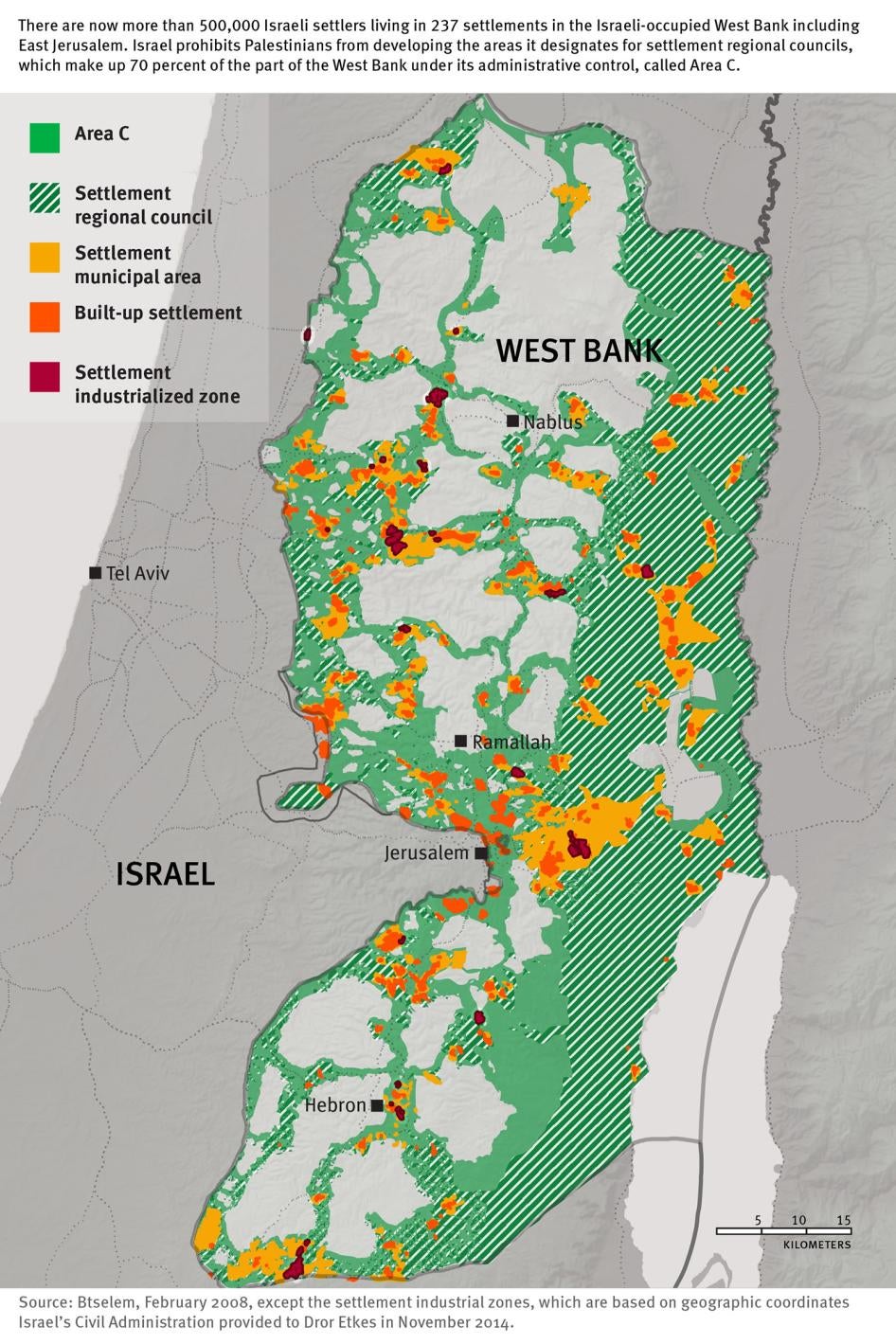
Map by Human Rights Watc
In last week’s settlement report, FMEP linked to several resources acknowledging and explaining the perversity of labeling Israel’s economic exploitation of occupied territory (including the local workforce, land, and other natural resources) “coexistence” or suggesting that it brings to the Palestinians benefits they should welcome. Adding to that, a new piece in The New York Times quoted a spokesman for the Palestinian Authority explaining the Orwellian reality of settlement industrial zones:
“Somebody occupies your country, steals your land, steals your water, steals your resources, then says: ‘I’ll make a good deal for you if you come work for me. I’ll create jobs for you. We are not occupiers. We are employers.’ This is ridiculous. The colonial settlements are illegal in every sense of the word.”
The media also widely reported this week that Friedman’s participation in the event at Ariel was the first time a U.S. ambassador had traveled to an Israeli settlement in his/her official capacity – despite the fact that Friedman has previously visited settlements since taking up official duties. Regardless, Friedman’s very public act of traveling to and speaking at Ariel should put to rest any remaining speculation about whether the U.S. had changed its policy refraining from official travel there.
Americans for Peace Now reacted to the events of the week, saying:
“Friedman’s idea of Israeli-Palestinian peaceful coexistence is what he found under Israeli military occupation, in a settlement that is one of the largest obstacles to Israeli-Palestinian peace.”
J Street released a statement saying:
“By making an official public appearance at an event in an Israeli West Bank settlement, Ambassador Friedman once again crossed a major, longstanding red line of bipartisan US policy. The Trump administration continues to send a clear message of support for the settlement movement and the agenda of the Israeli right. Indeed, the ambassador, himself a longtime benefactor of the settlement movement, has actively worked to erode the distinction between Israel and the occupied territory it controls beyond the Green Line. With unprecedented actions like these, the Trump administration is driving home the point that they have no real interest in promoting a two-state solution to resolve the Israeli-Palestinian conflict — now or in the future.”
Closure of U.S. Consulate Stokes Annexation Hopes/Fears
On October 18th, the U.S. State Department announced that it is closing the U.S. Consulate in Jerusalem and folding its functions into a new “Palestinian Affairs Unit” within the U.S. Embassy. For decades, the U.S. Consulate General in Jerusalem – one of the only fully independent Consulates the U.S. maintains anywhere in the world, reporting directly to Washington, rather than operating under the authority of an embassy – has functioned as the de facto U.S. embassy to the Palestinians. As such, its existence carried important symbolism for Palestinian national aspirations, signaling that the U.S. viewed Palestinian affairs and its relations with Palestinians and their leaders not merely as a subset of issues between Israel, but as a matter of importance to the U.S. in its own right, and as a separate bilateral relationship.
The downgrading of U.S. relations with the Palestinians implied by this shift in operations – the implications of which are well understood both by Palestinians and the Israeli right – has inspired celebration from Israel’s pro-annexationist leaders, and stoked despair amongst Palestinians.
Commenting on the move, FMEP President Lara Friedman tweeted:
“Added to recent closure of PLO mission in Washington, it cements new reality of US w/ NO direct, bilateral relationship with Palestinians – any/all relations will now be wholly-owned subsidiary of US-Israel ties…completing the roll-back of relations to pre-Madrid era.”
Saeb Erekat released a statement saying:
“The Trump Administration is making clear that it is working together with the Israeli Government to impose Greater Israel rather than the two-state solution on the 1967 border. The US administration has fully endorsed the Israeli narrative, including on Jerusalem, Refugees and Settlements.”
Former Israeli Ambassador to the U.S. and current Deputy Minister for Diplomacy, MK Michael Oren tweeted:
“A great day for Israel, Jerusalem, and the United States. SoS Pompeo’s announcement closing the U.S. consulate in Jerusalem and transferring its responsibilities to the embassy ends the last vestige of American support for the city’s division. Israel is deeply grateful.”
Peace Now tweeted:
“The downgrading of the unofficial US embassy for Palestinians in Jerusalem coincides this week with the US Ambassador to Israel’s decision to cross the red line on visiting settlements when he visited Ariel. The writing is on the wall.”
Americans for Peace Now released a statement saying:
“Downgrading the US diplomatic mission to the Palestinians to a subsidiary of the US embassy to Israel signals that American policy toward the Israeli-Palestinian conflict has changed dramatically. It puts a giant question mark over the assumption of a future Palestinian state. It is yet another gesture in a series of humiliating measures toward the Palestinians and their leadership by the Trump administration. More than anything, this measure signals an acceptance, if not outright embrace, of Israel’s accelerating process of annexing the West Bank, a declared goal of the most extreme right-wing elements in Israel’s governing coalition. The fact that this ‘merger’ (more accurately, a hostile takeover) will be led by US Ambassador to Israel David Friedman makes this development even more alarming. David Friedman has openly and publicly attacked the two-state solution. He is an avid supporter and past financier of Jewish settlements in the West Bank and has been openly contemptuous of the Palestinian leadership, availing himself of any opportunity to demean it. Disastrously, Friedman has emerged as the architect of the Trump administration’s calamitous policy toward the Israeli-Palestinian conflict and no one within the administration is willing or able to stop him from ramming through his agenda.”
B’Tselem Head to UN Security Council: Israel’s Settlement Policies Have Created Bantustans in West Bank
Addressing the United Nations Security Council on October 18, 2018, B’Tselem President Hagai El-Ad said:
“…All this is often referred to as “the status quo.” Yet there is nothing static about this reality. It is a calculated and deliberate process of slowly splitting up an entire people, fragmenting their land, and disrupting their lives: separating Gaza from the West Bank, breaking up the West Bank into small enclaves, and walling off East Jerusalem from the rest of the West Bank. Eventually, what remains are isolated bits, the easier to oppress: a family slated for “eviction” in the East Jerusalem neighborhood of Silwan; a community such as ‘Urif, south of Nablus, trying against all odds to hold on to its land and farm it in the face of Israel’s long arm of unchecked settler violence; or Area A of the West Bank, conveniently said to be “under full Palestinian control,” but in fact essentially large Bantustans, slowly but surely being hemmed in by ever more new or expanding Israeli settlements. None of this is random. All of it is policy-driven. Two of the latest and most conspicuous examples are Israel’s conduct in the recent protests in Gaza, and its plans for Khan al-Ahmar, a Palestinian shepherding community. Some 200 people live in Khan al-Ahmar, just a few kilometers east of Jerusalem, in an area where Israel has long endeavored to minimize Palestinian presence and expand settlements.”
If Not Now: 5 Ways American Jews Are Supporting Occupation
The American Jewish group If Not Now published a new report entitled, “Beyond Talk: Five Ways the American Jewish Establishment Supports the Occupation.” Settlements factor in heavily in the critique.
A few of If Not Now’s findings:
- Between 2009 and 2013, 50 American 501(c)(3) non-profit organizations gave over $220 million in tax-deductible donations to settlements and other extreme right-wing organizations, according to an investigation of American and American Jewish organizations’ IRS tax forms conducted by Israel’s Haaretz newspaper.
- Jewish Federations in cities around the country allow donors to funnel money through donor-advised funds to pro-Occupation organizations that fund extreme right-wing settlers. At the same time, they prevent donors from using these funds to support groups that have expressed support for Palestinian rights, such as the National Lawyers Guild, Jewish Voice for Peace, and IfNotNow.
- In addition to lobbying for Israel, the majority of Jewish institutions lobby against any and all criticism of Israel’s Occupation. Of all American Jewish organizations with large national memberships, only Americans for Peace Now, Jewish Voice for Peace, J Street, and the New Israel Fund supported the U.S. administration’s abstention in the December 2016 United Nations Security Council Resolution recognizing Israel’s settlements as illegal under international law. The mixture of condemnation and silence from every other national American Jewish organization demonstrates an investment in a status quo that benefits settlement expansion over Palestinian rights.
The entire report (with extensive citations for the above facts) is available online here.
Arab League Issues Report Slams “Accelerating” Settlement Growth and “Apartheid” Policies
On October 14th, the Arab League issued a report condemning Israeli settlement construction, which the group cites as happening at “an accelerating pace amid U.S. acceptance and encouragement and absence of international accountability.” The report continues, “Israel systematically allocates lands for Jews as part of a policy that can only be described as apartheid.”
Bonus Read
- “Settlers Accused of Targeting Palestinian Olive Trees As Harvest Kicks Off” (Times of Israel)
Welcome to FMEP’s Weekly Settlement Report, covering everything you need to know about Israeli settlement activity this week.
To subscribe to this report, please click here.
September 28, 2018
- Following Murder of Ari Fuld, Settlers Start Building “Givat Eitam/E-2” Settlement
- Undermining Any Claim of “Good Faith,” Reports Shows Israel & WZO Knew Land Was Stolen Before Giving to Settlers
- Palestinians Demand $360 Million in Back Taxes on Businesses Operating in Israeli Settlements
- UNSC & UNGA Round-Up: Notable Activities & Statements Related to Settlements
Comments, questions, or suggestions? Email Kristin McCarthy at kmccarthy@fmep.org.
Following Murder of Ari Fuld, Settlers Start Building “Givat Eitam/E-2” Settlement
In response to the terrorist attack that resulted in the death of Israeli-American settler Ari Fuld, the local council of the Efrat settlement (where Fuld resided) has directed the start of (unauthorized) construction at the highly consequential “Givat Eitam” settlement site (nicknamed by settlement watchers “E-2” for its resemblance, in terms of dire geopolitical implications, to the infamous E-1 settlement plan). Located east of the separation barrier on a strategic hilltop overlooking the Palestinian city of Bethlehem to its north, Givat Eitam/E-2 is located within the municipal borders of the Efrat settlement but is not contiguous with its built-up area, making Givat Eitam/E-2 effectively a new settlement that, according to Peace Now, will:
“block Bethlehem from the south, and prevent any development in the only direction that has not yet been blocked by settlements (the city is already blocked from the North by the East Jerusalem settlements of Gilo and Har Homa, and from the West by the Gush Etzion Settlements) or bypass roads (that were paved principally for Israeli settlers). The planned building in area E2 would likely finalize the cutting off of Bethlehem city from the southern West Bank, delivering a crushing blow to the Two States solution.”
A small group of settlers are currently living in makeshift shelters at the site, under the protection of the Israeli army. The Israeli Civil Administration – which is responsible for enforcing planning and building laws in the occupied territory – has acknowledged the unauthorized construction at the Givat Eitam/E-2 site but has not announced any intention to remove the settlers or their illegal structures.
The head of the Efrat Local Council, Oded Revivi, took credit for the establishment of the outpost and acknowledging a long effort to build at the site, saying:
“Less than 24 hours after the murder of our friend Ari Fuld, the Efrat local council is offering a suitable Zionist response and building a new point of settlement in the Land of Israel – Givat Eitam – a strategic hill that connects the center of Gush Etzion to the eastern part. After many attempts and a lot of work, and a great deal of pressure from all sides, we’re on our way there. The residents of Efrat are with us, behind us, in cars, accompanying us. We will arrive in just a few moments and will be able to recite the blessing: “Blessed be He who establishes the border of the widow.”
Settlers have tried to build, legally and illegally, on the hilltop for over a decade. In 2004, Israel declared the area as “state land” and put it under the municipal jurisdiction of the Efrat settlement. Palestinians challenged the declaration, providing deeds to the land, but the High Court of Justice rejected the majority of the petitioner’s arguments and sent the case back to the appeals court to reconsider its previous ruling against the Palestinians. Since then, Israel and the settlers have acted unilaterally on the assumption that the area is theirs to build on. Settlers built an illegal outpost on the exact hilltop in 2011 and again in 2013; both times the Civil Administration removed the outposts after some time. In 2014, the settlers were allowed to build an access road to the Givat Eitam/E-2 site. In 2015, the Civil Administration – apparently accepting the settlers’ argument that the land belongs to Israel – destroyed Palestinian wheat crops that were planted there.
The new outpost of Efrat serves to magnify the territorial issues presented by the Efrat settlement, which is located inside a settlement enclave that cuts deep into the West Bank. Efrat’s location and the route of the barrier wall around it, have literally severed the route of Highway 60 south of Bethlehem, cutting off Bethlehem and Jerusalem from the southern West Bank. The economic, political, and social impacts of the closure of Highway 60 at the Efrat settlement (there is literally a wall built across the highway) have been severe for the Palestinian population. The concentrated settlement growth in Efrat (Efrat saw more construction starts in 2016 than any other settlement and has financed illegal construction projects to expand its borders) exacerbates all of these problems and further entrenches what settlement expert Lara Friedman calls “the trend of ‘canonization’ of the West Bank.”
Undermining Any Claim of “Good Faith,” Reports Shows Israel & WZO Knew Land Was Stolen Before Giving to Settlers
A new Haaretz report challenges the legal basis for the recent and monumental Jerusalem District Court ruling which held that the Mitzpe Kramim outpost can be retroactively legalized because the State, the World Zionist Organization, and the settlers all acted “in good faith” in the course of events that lead to the establishment of the unauthorized outpost on privately owned Palestinian land. Legal and bank documents seen by Haaretz show that the World Zionist Organization (WZO) transferred ownership rights to settlers two months after the State was informed that the land belongs to Palestinians. The sequence of events fundamentally calls into question the Jerusalem District Court’s holding that the State and WZO acted “in good faith.”
In early 2011, Palestinians filed petitions with the High Court of Justice asserting ownership of the land in question. The State responded to the Court regarding the petition, claiming that it mistakenly thought the land was under State control when it was granted to the WZO (an admission that the land should not be under WZO control). On February 6, 2011 the High Court of Justice ordered a temporary injunction against construction on the land until the ownership issues were resolved. Despite the legal proceedings and the State’s acknowledgement that the land should not be in the hands of the WZO, newly revealed documents show that the WZO transferred land rights to Israeli settlers in a series of transactions in the months after the Court order (from March to July 2011). In bank documents submitted in August 2011 (six months after the Court ruling) the WZO attested to to the settlers’ ownership of the land, paving the way for the bank to issue mortgages to the settlers, despite the unresolved ownership issues about which the WZO was aware.
Dror Etkes, the founder of the NGO Kerem Navot, who discovered the bank documents, said:
“So this is what ‘good faith’ looks like in Mitzpeh Kramim: the Settlement Division, the settlers, Amana, and the banks, worked together in a cold and calculated manner during the first few months after the petition was submitted – when there couldn’t have been the slightest doubt that construction was being illegally conducted on privately owned land – to present decisive facts before the High Court of Justice and prevent their eviction.”
The case regarding Mitzpe Kramim is now before the High Court of Justice, which will issue a final ruling about the future of the outpost, and potentially render a final verdict regarding the “good faith” of the State and WZO, and the rights of the Palestinian landowners.
Palestinians Demand $360 Million in Back Taxes on Businesses Operating in Israeli Settlements
First reported by i24 News, in a new report the Palestinian Authority documents what it estimates to be $360 million in “fiscal leakages” – monies have been denied to the PA by Israeli control over Area C, and which the PA is seeking to recoup. The PA reportedly planned to present the findings to international donors at a meeting on the sidelines of this week’s UN General Assembly meeting in New York.
The PA report asserts that since 2000 (at which time Israel ceased informing the PA about commercial activity in Area C), Israel has collected an estimated $1.7 million each month from about 2,000 businesses operating in settlements in the occupied territories. The PA argues that according to the 1994 Paris Protocol (which the report extensively cites), all these funds should be transferred to the PA by Israel, and that going forward Israel should transfer the monthly sum to the PA.
UNSC & UNGA Round-Up: Notable Activities & Statements Related to Settlements
On September 27, 2018 Palestinian Authority President Mahmoud Abbas addressed the United Nations General Assembly. Abbas twice stated that the Trump administration’s policy vis a vis settlement construction is a verdict on the final status issue of land, Abbas said:
“I renew my call to President Trump to rescind his decisions and decrees regarding Jerusalem, refugees and settlements, which contravene international law and UN resolutions, as well as the understandings among us, in order to salvage the prospects for peace and to achieve stability and security for the future generations in our region….We awaited his peace initiative with utmost patience, but were shocked by decisions and actions he undertook that completely contradict the role and commitment of the United States towards the peace process. In November 2017, his administration issued a decision to close the PLO office in Washington, DC. He then announced his recognition of Jerusalem as the capital of Israel and transferred his country’s embassy from Tel Aviv to Jerusalem, and boasts that he has removed the issues of Jerusalem, refugees, settlements and security off the negotiation table. All such decisions threaten the Palestinian national cause and constitute an assault on international law and relevant United Nations resolutions. The US administration went even further in its assault by cutting assistance to the Palestinian National Authority, UNRWA and Palestinian hospitals in occupied East Jerusalem.”
On September 27th, 2018 Israeli Prime Minister Benjamin Netanyahu also addressed the United Nations General Assembly. Netanyahu’s speech did not address settlements.
On September 27th, U.S. Special Representative for International Negotiations Jason Greenblatt, gave a speech defending U.S. funding cuts to Palestinians and humanitarian projects. As part of that speech Greenblatt noted that the U.S. decision was motivated in part by the Palestinian Authority’s refusal to cooperate with Israeli businesses, which might be pointing towards industrial zone projects inside Israeli settlements – an “economic peace” scheme the U.S. administration recently promised to support. Greenblatt said in his speech that PA leaders:
“refuse opportunities to build the economy due to an anti-normalization prejudice towards doing business with Israelis. (…) The United States will not use the hard-earned tax dollars of its citizens to subsidize anti-normalization”.
At a September 26th press conference during UNGA that the U.S. preferences a two-state solution, President Trump articulated support for a two-state solution. Commenting on Trump’s statement, Husam Zomlot – until recently the PLO Ambassador to the U.S. – said:
“[Trump’s] statements contradict his actions. His policy is destroying any chance for peace.”
J Street has the following reaction:
“If President Trump truly supports a two-state solution, then he should reverse the many actions by his administration that have made it much harder to achieve. He should stop claiming that he has taken the issue of Jerusalem “off the table,” and stop the cruel and destructive cuts in humanitarian aid and assistance to the Palestinian people. He should instruct the US ambassador to Israel to stop condoning Israeli settlement expansion in the West Bank. President Trump and his administration should be judged by actions, not words, and their actions have made clear: they have no interest in promoting genuine peace between Israelis and Palestinians. Until those destructive actions change, the idea that they are formulating a credible ‘peace plan’ is absurd.”
Also on September 26th, President of the Palestinian Authority, Mahmoud Abbas, held a meeting to gather support for an alternative model for negotiations – a model that replaces U.S. leadership in the process with a multilateral approach. The meeting was attended by foreign ministers of Turkey, Ireland, and Japan, UK Minister for the Middle East Alistair Burt, and diplomats from Germany, Norway, Spain, Morocco, Egypt, Ethiopia, and Indonesia, among others. UN Special Coordinator for the Middle East Peace Process Nickolay Mladenov and Under-Secretary-General for Political Affairs Rosemary DiCarlo also attended the event.
On September 20, 2018, the UN Special Coordinator for Middle East Peace Nickolay Mladenov provided an update on the implementation of UN Res 2334 to the United Nations Security Council (UNSC), chaired by U.S. Ambassador to the UN Nikki Haley. Mladenov began his update saying:
“No steps have been taken during the reporting period to ‘cease all settlement activity in the occupied Palestinian territory, including East Jerusalem’, as required by the resolution.”
Mladenov’s report goes on to document the number of settlement units approved for construction. He concludes with broad observations about the context and consequences of Israeli settlement activity, starting with:
“The expansion of Israeli settlements is illegal under international law and continues to erode the viability of a two-state solution. Particularly alarming are legal and administrative steps which could consolidate and expand settlement activity deep in the West Bank, further undermining the contiguity of a future Palestinian state.”
Welcome to FMEP’s Weekly Settlement Report, covering everything you need to know about Israeli settlement activity this week.
To subscribe to this report, please click here.
September 14, 2018
- Khan al-Ahmar Verdict Is A Greenlight for East Jerusalem Settlement Schemes
- New Outpost Established in the Jordan Valley
- U.S. Ambassador: We Have Never Challenged an Israeli Settlement Plan
- Dismantling the Notion that Israel & the WZO Acted “In Good Faith” in Recent Outpost Case
- Aryeh King on the New East Jerusalem Settlement: Beit Hanina Will Begin to “Judaize”
- New Polling: Palestinians View Two-State Solution as Linked to Settlement Expansion
- Bonus Reads
Comments, questions, or suggestions? Email Kristin McCarthy at kmccarthy@fmep.org. To subscribe to this report, please click here.
Khan al-Ahmar Verdict Is A Greenlight for East Jerusalem Settlement Schemes
Last week, the Israeli High Court lifted an order preventing the Israeli government from forcibly removing residents from the Khan al-Ahmar Bedouin community and demolishing the village in the E-1 area, east of Jerusalem. Looking at the implications of the ruling, Jerusalem expert Danny Seidemann, founder of the Terrestrial Jerusalem, warns:
“the verdict gives a green light for the removal of Khan al-Ahmar, and provides a basis for removal of other Palestinian villages located on West Banks lands coveted by settlers and their allies…next in line are other Bedouin communities in that area, including Jabel Al Baba, as well as Susiya (in the southern Hebron hills), and Palestinian communities in areas targeted by the settlers in East Jerusalem (like Sheikh Jarrah and Batan al Hawa in Silwan – for recent developments see here).”
Seidemann further notes:
“the evacuation of Khan El Ahmar is not only about the tragic fate of the residents themselves…As we [Terrestrial Jerusalem] underlined several times in the past, the stubbornness, not to say the obsession, of the government of Israel with Khan Al Ahmar is mostly due to its location close to E1, within what is viewed by Israeli authorities as the ‘Maale Adumim bloc,’ extending deep into the West Bank to include the settlement of Kfar Adumim. The Court’s green light for the displacement of Khan al-Ahmar, alongside the start of the national electoral campaign, raises the risk that Prime Minister Netanyahu – always looking for a way to score points with the right and far-right – will decide to pursue push ahead with E-1 (the other grand scheme available in East Jerusalem is Givat Hamatos; the risk that he will move on that scheme is also serious).”
Palestinians recently took the Khan al-Ahmar case to the International Criminal Court (ICC), filing an addendum to a petition that was submitted to the ICC against Israeli settlements in May 2018.
When asked about the Khan al-Ahmar case, U.S. State Department spokesperson Heather Nauert acknowledged that the U.S.has been tracking the case but deferred to Israeli judicial proceedings on the matter, saying that the U.S. understanding is that “all appeals have been exhausted” and parroting the Israeli government talking point arguing that, “Israel is offering land [to the Bedouin], which includes access to water, electric, infrastructure, schools, and necessary things of that sort to the incoming residents.” This talking point glosses over the patent illegality – under international law – of forcibly transferring the Bedouin. It also glosses over the actual details of the very problematic “offer” Israel is making to the Bedouin – i.e., a location adjacent to a garbage dump or a wastewater facility.
New Outpost Established in the Jordan Valley
Ma’an News reports that settlers have set up a new unauthorized outpost on Palestinian land in the Jordan Valley, between the Palestinian village of Tubas and the Israeli settlement of Shadmot Mechola. Previously a single tent established at the site in May 2018, settlers significantly expanded the outpost, raised Israeli flags over the new dwellings, and primed the site for permanent residences.
According to reports, the outpost prevents Palestinians residents from Tubas, an agricultural center, from accessing their privately owned land – land that Palestinians have long used to herd sheep.
As FMEP has previously reported, Israel has effectively annexed 85% of land in the Jordan Valley, through ongoing settlement building and the declaration of “closed military zones” on vast swaths of farmland. A recent report by B’Tselem documents how Israeli settlers were allowed to establish two new outposts in the Jordan Valley in 2017. Israel has also undertaken alarming efforts to evict Palestinians from their land in the Jordan Valley, particularly Palestinian communities that have the misfortune of being located near to an Israeli settlement. Simultaneously, Israel has approved new settlement plans in the Jordan Valley and has advanced plans to retroactively legalize outposts in the Jordan Valley.
U.S. Ambassador: We Have Never Challenged an Israeli Settlement Plan
In a new interview, U.S. Ambassador to Israel David Friedman said that Israel “shouldn’t have to ask permission from the U.S.” to expand settlements in the West Bank and confirmed what settlement watchers have long believed: that the Trump Administration never challenged an Israeli construction plan in the West Bank. The full interview was published in the Israeli daily newspaper Israel Hayom, which is owned by U.S. settlement financier, Netanyahu supporter and Trump backer Sheldon Adelson.
Friedman also explained, for the first time publicly, the process by which Israel consults with the U.S. before advancing settlement plans. According to Friedman, prior to announcing settlement advancements, the Netanyahu government presents the plans to the U.S., which then offers commentary on the plans. Friedman said:
“We don’t tell Israel what to do and what not to do. It’s a sovereign country and they have to make those decisions. But we do have an open relationship and a good faith relationship, we talk about these plans and we do so from the perspective that the president expressed early on in his presidency – that settlements are not an obstacle to peace but if unrestrained settlement expansion continues, mathematically speaking, there will be much greater limits on territory that could be given to Palestinians. We never tell them, ‘You must pull this out.’ If we have an issue with something we say, ‘Do you really need to go this far? Can you build closer in to the existing property lines?’”
Since Trump took office almost two years ago, only a single report has surfaced suggesting Trump Administration intervened to stop an Israeli plan related to settlements. In that case, the U.S. reportedly took a position opposing [at that specific time] legislation seeking to annex settlements. The bill was tabled by the Netanyahu government, with Netanyahu citing White House concerns when explaining to his coalition partners his decision to table the bill. At the time, the White House responded, “It’s fair to say that the U.S. is discouraging actions that it believes will unduly distract the principals from focusing on the advancement of peace negotiations. The Jerusalem expansion bill was considered by the administration to be one of those actions.”
Dismantling the Notion that Israel & the WZO Acted “In Good Faith” in Recent Outpost Case
Hagit Ofran, the Director of Peace Now’s Settlement Watch program, wrote a blistering takedown of the Jerusalem District Court’s ruling that held that the State of Israel and the World Zionist Organization acted “in good faith” when giving privately owned Palestinian land to settlers, who built the Mitzpe Kramim outpost on the land in question. That ruling, as FMEP previously explained, is a monumental new legal precedent that – if allowed to stand – will open the door for retroactive “legalization” of many more outposts, effectively green-lighting a new series of land grabs – now extending to land that even Israel recognizes is privately owned by Palestinian – for the sake of settlements.
Ofran writes:
“One can believe that the outpost settlers really thought that the land was not privately owned by Palestinians. But it is difficult to attribute ‘total innocence and honesty’ to anyone who builds without permits in an illegal outpost. Had the settlers bothered to ask for a permit, the Civil Administration would have immediately discovered that this was private land, and they would have been saved from stealing. (It is reasonable to assume that the government would not have approved the establishment of the outpost because at least until the establishment of the Netanyahu governments, the official policy was that no new settlements would be established.). But the court did not rule on the good faith of the settlers. The discussion dealt with the good faith of those who gave them the land, i.e. the state and the Settlement Division.”
Aryeh King on the New East Jerusalem Settlement: Beit Hanina Will Begin to “Judaize”
As FMEP reported last week, the Jerusalem Planning and Building Committee has approved plans for a new settlement in the Beit Hanina neighborhood of East Jerusalem. New reporting by Al-Monitor provides more evidence of the ideologically driven strategy at play:
“[Rabbi Aryeh] King, a [Jerusalem] city council member and activist who has been buying up Palestinian land for Jews, pledged that Arab Beit Hanina ‘would begin to Judaize, and hopefully soon become a neighborhood with a firm Jewish majority as befits the capital of the Jewish people.’ Indeed, implementation of the plan would turn Beit Hanina into one of the largest Jewish settlements in Palestinian neighborhoods.”
Renowned Israeli journalist Akiva Eldar also connects the Beit Hanina settlement plan to the recently-passed Nation-State Law, writing:
“The decision, announced with little fanfare, lays the foundation stone for the recently adopted nationality law, which anchors the Jewish nature of the State of Israel. For instance, it encourages Jewish-only communities and codifies the ‘national value’ of Jewish settlement in the homeland of the Jewish people. After all, what is more of a national value than Jewish settlement in Jerusalem, the city enshrined by the controversial legislation as the capital of Israel?”
New Polling: Palestinians View Two-State Solution as Linked to Settlement Expansion
New polling and analysis from the Palestine Center for Policy and Survey Research (PSR) finds that amongst Palestinians:
“In the past few years, 55 to 65 percent of Palestinians have said that they believe that settlement construction has expanded so much that the two-state solution is no longer practical or feasible. On average, three-quarters of those who reach this conclusion shift to opposing the two-state solution, while a similar percentage of those who think the two-state solution remains feasible remain in favor of it. In other words, support for the two-state solution is strongly linked to perceptions of feasibility, and settlements are making it seem unfeasible.”
The full results of PSR’s latest poll can be found here.
Bonus Reads
- “Do Palestinians Still Support the Two-State Solution? Why Israeli Settlements Are the Greatest Obstacle to Peace” (Foreign Affairs)
- “For Israel, Khan al-Ahmar residents lack ‘good faith’ displayed by settlers” (+972 Mag)
- “How Oslo Accords Contributed to Israeli Occupation” (Ynet)
- “Israelis Can’t Escape Apartheid” (Haaretz)
- “25 Years On, Some Israeli Right-Wingers Ready to Declare Oslo Accords Dead” (The Times of Israel)
- “This BDS Movement Just Loves Israeli Settlers” (Haaretz)
Welcome to FMEP’s Weekly Settlement Report, covering everything you need to know about Israeli settlement activity this week.
To subscribe to this report, please click here.
August 31, 2018
- Setting a New Legal Precedent, Court Accepts “Market Regulation” Principle As Basis for Legalizing Outpost
- Shaked & Regavim Take Credit for Precedent-Setting Outpost Legalization Victory
- Another New Outpost – Continuing the Trend of Unannounced, Unopposed, & Highly Consequential Settlement Expansion
- Special U.S. Regulations Protect Israel’s Settlement Enterprise from Quality Aerial Documentation
- Bonus Reads
Comments, questions, or suggestions? Email Kristin McCarthy at kmccarthy@fmep.org. To subscribe to this report, please click here.
Setting a New Legal Precedent, Court Accepts “Market Regulation” Principle As Basis for Legalizing Outpost
Jerusalem District Court Ruling
On August 18th, Jerusalem District Court Judge Arnon Darel ruled in favor of retroactively legalizing the Mitzpe Kramim outpost, holding that privately owned Palestinian land can (and should) be expropriated for the settlements in instances where Israeli settlers built “in good faith” and with government support – a rationale called the “market regulation” principle. According to the ruling, the Court held that the parties responsible for the outpost – the Israeli government, the World Zionist Organization, and the settlers – all acted in “good faith.” Specifically, the Court held that the State acted in “good faith” even though it was negligent in its responsibility to protect the rights of Palestinians and correctly record/manage the status of land in the West Bank; and, that the settlers acted in “good faith,” even though they built the outpost without government authorization, without building permits, and without a master plan.
This is the first time an Israeli court has accepted the “market regulation” principle as a valid basis for legalizing outposts, setting a monumental new precedent according to which outposts that the government had previously been unable to legalize (because they were built on land recognized by Israel as privately owned by Palestinians) to petition for authorization. With this judgment, the public got a first glimpse of the incredibly broad interpretation of “good faith” that the Jerusalem District Court (now the court of first jurisdiction for land disputes in the West Bank) is inclined to apply on behalf of law-breaking settlers.
Peace Now released a statement saying:
“The court today chose to ‘align’ with the project of annexation and dispossession of the Israeli government led by the Netanyahu and the Jewish Home. It is absurd to attribute ‘good faith’ to the settlers of an illegal outpost whose homes were built illegally and without permits on private Palestinians land, because of a ‘mistake’ made by the authorities in allocating the land. The Israeli Authorities should protect the properties of the people under their control, and failing to do so cannot be used as an excuse to take the land from the Palestinian owners. Let us hope that the Supreme Court will erase this shame.”
Background on the Mitzpe Kramim Case
 The outpost at the center of the case – Mitzpe Kramim – was built in 1999 without government authorization on land near the Kochav Hashachar settlement, located deep inside the West Bank, closer to the Jordan River than sovereign Israeli territory. In the 1970s, land in the area was taken by the State of Israel by military order; subsequently, the land on which the outpost was built was allocated to the World Zionist Organization (WZO), apparently based on the (mistaken) assumption that the land in question was part of that military seizure. The WZO then gave the land to settlers, even issuing a certificate of ownership in their names. However, the land in question was not included in the military seizure of the 1970s, but was/is In fact recorded in the Land Registry as privately owned by Palestinians from the village of Deir Jarir. This fact should, under Israeli law, invalidate the government’s allocation of the land to the WZO, and the WZO’s grant of the land to the settlers.
In 2011, the registered Palestinian landowners filed a petition with the High Court of Justice to have the Mitzpe Kramim outpost removed from their land, only to see the settlers file their own petition in 2013 with the Jerusalem District Court (which froze the High Court’s consideration of the Palestinians’ petition), seeking to be registered as the rightful landowners. In their petition, the settlers – who are represented by Harel Arnon, the same lawyer hired to represent the Israeli government in its defense of the “Regulation Law” – argued that they are innocent victims of a mistake by the government, and as such should not be forced to bear the consequences of having built their homes on someone else’s land. Originally the Israeli government, admitting that the Civil Administration had made a mistake in mapping the area, argued that the settlers should be removed. In July 2018, the State completely reversed its stance, submitting a new argument to the Court citing the “market regulation” principle in defense of expropriating the land for the settlers.
In its ruling this week, the Jerusalem District Court gave legal validity to the newly invented “market regulation” basis for taking Palestinian land that had previously been impossible for the State to legally expropriate.
What’s Next?
Now that the Jerusalem District Court has ruled in favor of the settlers’ claim, the High Court of Justice is set to take up the original petition filed by the Palestinian landowners to have the outpost removed. Part of the High Court’s deliberations will now have to grapple with the new jurisprudence established by the Jerusalem District Court on the “market regulation” principle.
Regardless of whether or not the High Court allows the Jerusalem District Court’s ruling to stand, that ruling has already energized pro-settlement, pro-annexation Israeli policymakers and influencers, who (unsurprisingly) have lauded the ruling and urged more outpost legalization cases forward. The ruling also legitimizes the longstanding arrangement between Israel and the settlers: the government turns a blind eye to illegal settlement activity (including rebuffing efforts by settlement watchdogs to force it to take action, and when forced by the courts to take action, drags its feet to allow illegal activities to become more deeply entrenched), only to go to any lengths to authorize the illegal actions post-facto. This modus operandi allows Israel to circumvent the limitations of Israeli law, bureaucracy and international criticism, all of which would otherwise restrain (to some extent) unfettered settlement construction and land theft in the West Bank.
FMEP tracks the ongoing legislative, political, and legal transformations happening in the Israeli government to justify the expropriation of Palestinian land for the settlements in its Annexation Policy Tables. As a reminder, the “market regulation” principle was promoted by Israeli Attorney General Avichai Mandelblit, who offered it as an alternative to the legal basis provided in the “Regulation Law” to legalize unauthorized outposts and settlement construction.
Shaked & Regavim Take Credit for Precedent-Setting Outpost Legalization Victory
Celebrating the Jerusalem District Court’s ruling on the Mitzpe Kramim outpost case (covered above), Justice Minister Ayelet Shaked (Likud) said:
“The District Court today clearly stated that whoever settled [the land] with the state’s approval and in good faith, would not be evacuated. The injustice done in the evacuations of the Amona and Netiv Ha’avot [outposts] should not be repeated. The court should not be a party to the political debate between the Right and Left. That should be left to the ballot box. Through joint and intensive work, we have brought about a policy change in the state’s responses to the High Court of Justice. Now we are seeing a change in the district court.” [emphasis added]
Indeed, Justice Minister Shaked has led a years-long effort to re-make the judicial branch, injecting pro-settlement policies and figures into key positions within the Court system, with the explicit goal of protecting all Israeli settlements and outposts from any legal accountability for illegal actions. Part of that effort was her decision in 2015 to hire a private lawyer, Amir Fisher (who also represents the settler group Regavim), to essentially write the State’s responses to petitions before the High Court that deal with settlements.
As noted in the section above, the state of Israel reversed its own position vis a vis the future of Mitzpe Kramim in its 2018 submission to the Court, a reversal that happened after Fisher and Shaked were firmly in control of the State’s handling of outpost legalization cases. What’s more, Shaked installed a pro-settlement judge on the Jerusalem District Court (which issued the precedent-setting ruling this week), and then promoted legislation that strips the High Court of Justice of its primary jurisdiction over certain West Bank legal petitions (including Palestinian petitions relating to land disputes, travel permits, and building permits) and gave that jurisdiction to the Jerusalem District Court. Shaked is currently promoting another bill which would allowed the Knesset to reinstate any law struck down by the High Court of Justice. The Ministerial Committee on Legislation, of which Shaked and Education Minister Naftali Bennett are members, voted to give government backing to the bill in May 2018. The totality of Shaked’s efforts are documented, on an ongoing basis, in FMEP’s Annexation Policy Tables.
Shaked’s fellow travelers at Regavim released a statement following the Jerusalem District court ruling, emphasizing the far-reaching implications:
“This is a product of a long legal battle, run by the settlements and settling bodies. They asked to legalize outposts that were established by the State of Israel. This blessed decision is a historic one. We call upon the attorney general to apply the principles of this decision to all other outposts in Judea and Samaria that need regularization.”
The fruits of Shaked and Regavim’s work was applauded by many others in the government, including Education Minister Naftali Bennett (Jewish Home), who said the ruling was a:
“victory for decency and common sense, another step toward legalizing the settlements in Judea and Samaria and turning them into an integral part of the State of Israel.”
Culture Minister Miri Regev (Likud) said she was:
“happy that common sense and justice prevailed over cold formalism..[the ruling sends] a clear-cut message to the Palestinians and their collaborators from far-left organizations, that you don’t destroy and evacuate communities in the Land of Israel.”
Agriculture Minister Uri Ariel (Jewish Home) said:
“This is a blessed month of settlement, and after the decision of the Housing Cabinet to establish three new towns [in the Negev], comes the court’s decision regarding Mitzpeh Kramim. Such significant decisions strengthen and expand the settlement of the Land of Israel.”
Knesset speaker Yuli Edenstein (Likud) said:
“The determination and strong spirit of the people of Mitzpeh Kramim proved themselves. I welcome this just, requisite ruling from the District Court in Jerusalem. We will continue to strengthen settlement in Israel!”
Another New Outpost – Continuing the Trend of Unannounced, Unopposed, & Highly Consequential Settlement Expansion
Haaretz reports that settlers have built a strategic new outpost deep inside the West Bank near the settlement of Eli, in a bid to eventually annex privately owned Palestinian land that falls between Eli and pockets of “state land” in the area. The new outpost was built without Israeli permits on the outer edge of newly declared “state land,” some of which had been used as farmland by Palestinians. Haaretz notes a trend:
“Around the West Bank, settlers have been setting up farms near the outer edge of state-owned land, as in the case near Eli, in an effort to expand existing settlements. Even though they have been established without permission, no legal action has been taken against them.”
The Israeli Civil Administration – responsible for enforcing building laws in the occupied territory – told Haaretz that it is unaware of the new outpost. The Head of the Binyamin Regional Council (an Israeli municipal body responsible for settlements in the northern West Bank – recently proven to be bankrolling new outposts), Avi Roeh, denied that the Council was involved with the new outpost.
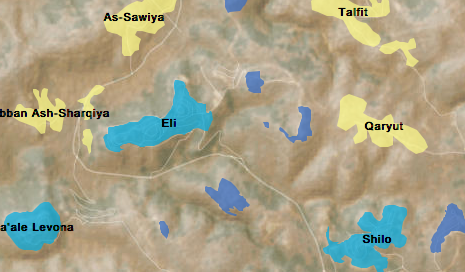
Map by WINEP
The new outpost is the fifth illegal satellite of the Eli settlement, stretching the band of Israeli settlements further and further east towards the Jordan Valley. Eli is located between the Ariel and Shilo settlements (both of which have seen tremendous growth and government support over the past two years – Ariel with its new medical school and Shilo with the promotion of the new Amichai settlement to its immediate east), in an area where settlers are working to connect settlements and outposts into a contiguous band of settlement stretching from sovereign Israeli territory all the way to the Jordan Valley.
As evidenced this week in the Israeli court system, the government – which consistently turns a blind eye to illegal outpost construction – is willing to go to great lengths to retroactively legalize outposts, even when the cost to Israeli taxpayers is enormous and even when doing so contradicts any notion of justice under the law.
Special U.S. Regulations Protect Israel’s Settlement Enterprise from Quality Aerial Documentation
Al-Shabaka published a new report this week detailing a little-known U.S. law that restricts companies from producing high quality satellite imagery of the West Bank. Al-Shabaka explains the significance of that limitation on U.S. companies like Google:
“Although the legislation was implemented under the pretense of protecting Israel’s national security, it is better characterized as an act of censorship. By deliberately blurring aerial images of Palestine-Israel, the [The Kyl-Bingaman Amendment (KBA) to the US National Defense Authorization Act] hinders the work of archaeologists, environmentalists, geographers, and humanitarians. It poses serious obstacles, not only for the preservation of cultural heritage, but also for holding Israel to account for land grabs, home demolitions, and settlement activity….While the legislation only applies to US companies, their hegemony in the commercial market for satellite imagery has elevated the legislation to de facto institutionalization on a global scale, affecting the access of researchers worldwide.”
The report can be accessed here.
Bonus Reads
- “The West Bank Model is a Failure” (The New York Times)
- “Israeli Taxpayers Bear Financial Burden of Evicting Illegal West Bank Outposts, And Sometimes, Making them Legal” (Haaretz)
***NOTE: This week the Israeli government unleashed a massive wave of approvals to advance plans for settlement construction — in excess of 2,000 units — in highly sensitive and strategically significant areas deep inside the West Bank and in East Jerusalem. More approvals/advancements are expected in the coming weeks. See below for detailed coverage of the individual plans, keeping in mind both the significance of each approval on its own, and as part of the overarching Israeli government agenda clearly intending to both prevent any possibility of a Palestinian state and to further the march toward formal annexation of the West Bank. Also keep in mind, importantly, that there has been zero public push back from the Trump Administration against this surge, which comes on the heels of Ambassador Friedman’s statement last week that Israel will never be required to remove any settlements.***
August 24, 2018
- Settlement Wave, Part 1: High Planning Council Advances Plans for 1,004 Settlement Units (96% Located Deep in the West Bank)
- Settlement Wave, Part 2: Housing Ministry Published Tenders for 420 Settlement Units
- Settlement Wave, Part 3: Jerusalem District Committee Advances Plans for 603 Settlement Units in East Jerusalem
- Settlement Wave, Part 4: More Settlement Construction Coming Soon
- U.S. Stands by Israeli “Intentions” on Settlements
- State Tells High Court: We Can Annex the West Bank – International Law Be Damned
- This Week in Ariel: Settlers Celebrate 40 Years, A Construction Boom, A Medical School, & An Evangelical “Leadership Camp”
- Amana (the Official Settler Movement) Moves Its HQ to Sheikh Jarrah
- Settlement Gains in East Jerusalem Result in Palestinians Self-Demolitioning Their Homes
- Bonus Reads
Comments, questions, or suggestions? Email Kristin McCarthy at kmccarthy@fmep.org. To subscribe to this report, please click here.
Settlement Wave, Part 1: High Planning Council Advances Plans for 1,004 Settlement Units (96% Located Deep in the West Bank)
On August 22nd, the Israeli Defense Ministry’s High Planning Council (the body in the Israeli Defense Ministry responsible for regulating all construction in the West Bank) advanced plans for 1,004 new settlement units, 96% of which are located deep inside of the West Bank. Of the total, 620 units were approved for deposit for public review and 382 units were given final approval for construction.
As reported by Israeli settlement watchdog Peace Now, the plans approved for deposit for public review (totalling 620 units) are:
- 370 units in the Adam settlement (aka Geva Benyamin). This project was urged on by Defense Minister Liberman following a stabbing attack in the settlement, which resulted in one death and injuries to three others. The 370 units are part of a larger plan for 1,000+ units that will, if built, connect the Adam settlement to two large settlements in East Jerusalem (Neve Ya’akov and Pisgat Ze’ev) that are on the Israeli side of the separation barrier (the route of the barrier juts far beyond the 1967 Green Line to include Pisgat Ze’ev and Neve Ya’akov on the Israeli side while the Adam settlement is on the West Bank side). If the larger plan is implemented, the Adam settlement will have built up areas on both sides of the separation barrier, which could (in all likelihood) present Israel an opportunity to re-route the barrier around Adam — which would de facto annex even more West Bank land to Israel and further choke off Palestinian East Jerusalem from the West Bank to its north. [Note: FMEP’s Lara Friedman and Peace Now’s Hagit Ofran published an op-ed in Haaretz in 2008 warning of this plan – you can read that background here].
- 85 units in Karnei Shomron settlement. Israel has repeatedly confiscated as “state land” located between Karnei Shomron and the Palestinian village of Qalqilya (which is literally surrounded on three sides by the separation barrier). In November 2017, Israel began clearing landmines from that “state land” in order to prepare for settlement construction. At the time, Deputy Defense Minister Eli Ben-Dahan said that the new construction in the Karnei Shomron area will bring “a million Jews [to] live in Judea and Samaria in the future.”
- 84 units in the Kiryat Netafim settlement, located about half way between the Ariel settlement and the cluster of settlements close to the 1967 Green Line that are slated to be united into a “super settlement” area (Oranit, Elkana, Shiva Tikva, and others). The expansion of Kiryat Netafim will go towards creating a contiguous corridor of Israeli settlements stretching from sovereign Israeli territory, though the super settlement, to Ariel. As FMEP has repeatedly said, the Ariel settlement is located in the heart of the northern West Bank, reaching literally to the midpoint between the Green Line and the Jordan border. The future of Ariel has long been one of the greatest challenges to any possible peace agreement, since any plan to attach Ariel to Israel (with a finger of land running through settlements like Kiryat Netafim) will cut the northern West Bank into pieces.
- 52 units in the Beit El settlement. This is the second major approval for new units in Beit El in 2018, with a third plan for 300 more units coming soon, according to Israel Hayom. The construction boom is being hailed by the settler-aligned Arutz Sheva outlet, which wrote that the plans will increase the size of Beit El by 65%. If any of the units are constructed it will be first new, government-sanctioned construction in Beit El in over 10 years. U.S. Ambassador to Israel David Friedman is closely associated with the Beit El settlement, having donated to and fundraised for it prior to his appointment as ambassador (including in his capacity as the President of the American Friends of Beit El, reportedly from 2011 until he became ambassador).
- 29 units in the Otinel settlement, located south of Hebron. MK Yehuda Glick (Likud) lives in Otinel.
Plans that gained final approval, meaning no additional formal approvals are required to move ahead with construction (totalling 382 units) are:
- 168 units in the Tzofim settlement, located on the Israeli side of the separation barrier, but jutting towards the Karnei Shomron settlement, which also received advancements this week. See the section on Karnei Shomron, above, for context and news regarding this area of settlements.
- 108 units in the Nofim settlement, located on the Israeli side of the separation barrier but jutting towards the Karnei Shomron settlement, which also received advancements this week. See the section on Karnei Shomron, above, for context and news regarding this area of settlements.
- 56 units in the Barkan settlement, located near the Kiryat Netafim settlement. Both Barkan and Netafim are located about half way between the Ariel settlement and the cluster of settlements slated to be united into a “super settlement” area (Oranit, Elkana, Shiva Tikva, and others). See the section on Kiryat Netafim, above. for context and news regarding this area of settlements.
- 44 units in Ma’ale Adumim, the mega settlement just east of Jerusalem.
- 6 units in the Avnei Hefetz settlement, located southeast of the Palestinian city of Tulkarem.
Notably, Netanyahu intervened to remove two items from the High Planning Council’s agenda, both of which would have led to the retroactive legalization of illegal outposts. Those plans are:
- A plan to retroactively legalize the Ibei Hanahel outpost, which is a non-contiguous “neighborhood” of the Ma’ale Amos settlement, located deep in the southern West Bank. The plan would have allowed the outpost to be demolished and then rebuilt legally with residential units, transforming the outpost into a new, fully authorized settlement.
- A plan to build an education center in the Nofei Prat South outpost, which is a non-contiguous“neighborhood” of the Kfar Adumim settlement, located northeast of Jerusalem. The land on which the project would be built is located just 1.5 km away from the Khan Al-Ahmar Bedouin community – the same one that the Israeli government plans to forcibly evacuate in order to cleanse the area of Palestinians and expand settlements. The outpost was established by the Haroeh Ha’ivri (“the Hebrew Shepherd”) nonprofit association, which is funded by the Israeli Education Ministry.
In response to Netanyahu’s directive to remove these two items from the agenda, the heads of the Knesset’s “Land of Israel Lobby,” Bezalel Smotrich (Jewish Home) and Yoav Kisch (Likud), said that the Prime Minister should “ act with greater rigor to promote settlement, rather than doing the opposite.”
Settler leaders were also unsatisfied with the High Planning Council’s overall numbers. Yossi Dagan, head of the Samaria Regional Council (a municipal body for settlements in the northern West Bank), said:
“We are happy about every new house in Samaria, but we have to tell the truth. Hundreds of housing units are not enough for an area that constitutes 12% of the State of Israel…We expect the government to step in the gas, stop worrying about what they will say overseas, and develop this beautiful region.”
Settlement Wave, Part 2: Housing Ministry Published Tenders for 420 Settlement Units
On August 23rd, one day after the Defense Ministry’s High Planning Council advanced a huge tranche of settlement plans (detailed above), the Israeli Housing Ministry published tenders for a total of 425 settlement units (under plans previously approved by the High Planning Council).
Those tenders include:
- 211 units in the Ma’ale Efraim settlement, located in the Jordan Valley.
- 54 units in the Givat Ze’ev settlement, located north of Jerusalem.
- 52 units in the Beit Aryeh settlement, which comes in addition to the the publication of tenders for 511 units in the settlement last week.
- 42 units in the Ariel settlement. See reporting below for extensive coverage of the many reasons settlers in Ariel are celebrating this week.
Settlement Wave, Part 3: Jerusalem District Committee Advances Plans for 603 Settlement Units in East Jerusalem
In addition to the tranche of settlement plans advanced by the Defense Ministry’s High Planning Council and the tenders published by the Housing Ministry (detailed above), the Jerusalem District Committee deposited for public review (one of the final steps before approval) plans for a total of 608 new settlement units in East Jerusalem, with 345 units slated for the Gilo settlement and 263 units in the Ramot settlement.
On the plan for the Gilo settlement, Ir Amim explains:
“The Gilo plan is being promoted in tandem with development of the new Green Line branch of the Light Rail (construction of which was launched in May), which will be built adjacent to the settlement expansion. This sequencing of events once again exemplifies a pattern of the state investing billions of shekels in transportation infrastructures to allow for extensive construction beyond the Green Line.”
As Ir Amim notes, this week’s advancements come on the heels of Israel’s August 15th decision to publish tenders for 603 units in Ramat Shlomo, and its June 2018 advancement of plans for 1,064 settlement units in the Pisgat Ze’ev settlement — bringing Israel’s two-month total of settlement advancements in East Jerusalem to 2,275 units.
As a reminder, approvals/advancement of settlement plans is not the only ongoing threat to Palestinians in East Jerusalem. Settlers and settler-run organizations continue their campaign to take over sensitive areas in East Jerusalem neighborhoods neighborhood – like Silwan and Sheikh Jarrah – and to create more settler run tourist sites – like the Jerusalem cable car, the Kedem Center, the Abu-Tor footbridge, the Yemenite “heritage center,” and more – to erase the visibility of Palestinians in Jerusalem. Meanwhile, pending legislation in the Knesset seeks to gerrymander the borders of Jerusalem to create a Jewish majority by annexing settlements and cutting out Palestinian neighborhoods from the borders of the city. Sounding the alarm on all of these trends, Ir Amim writes:
“It is vital that the traditional calculus of settlement building be readjusted to a) treat these coordinated efforts to consolidate control of the Old City and surrounding Palestinian neighborhoods with the same urgency afforded to settlement building throughout the whole of East Jerusalem; b) ensure a holistic response that regards private settlement inside the Old City Basin and touristic settlement not as individual phenomena but as multiple elements of a unified and politically lethal strategy.”
Settlement Wave, Part 4: More Settlement Construction Coming Soon
In addition to the plans for 1,004 units that were advanced this week by the High Planning Council, the 425 tenders published by the Housing Ministry, and the 608 units advanced in East Jerusalem (all detailed above), this week saw reports that additional plans are expected to advance soon. Those are:
- Ir Amim reports that on September 2nd, the Jerusalem District Committee is expected to discuss a plan to build a six-story building in Sheikh Jarrah, a neighborhood in which at least 75 families face eviction by radical settlers, with the backing of the Israeli government and courts. For detailed reporting on the building, plans for which were deposited for public review in May 2018, see FMEP reporting here.
- Peace Now reports that tenders are expected to be issued (having already been marketed) for more units in the Adam (Geva Binyamin) settlement. If true, this will be another step towards uniting Adam to the East Jerusalem settlements – the details of which are covered above.
- Peace Now also notes that a plan for 300 units in Beit El is expected to be advanced. This comes in addition to the 52 tenders issued for Beit El this week.
- The Times of Israel reports that plans for hundreds of additional settlement units will soon be marketed for construction by the Defense Ministry. These plans received final approval before this week’s High Planning Council meeting. A Civil Administration official hinted that the plans will be marketed for the Alfei Menashe and Ma’ale Efraim settlements. [NOTE: This reporting was before the subsequent publication of tenders for 211 units in Ma’ale Efraim, covered above.]
U.S. Stands By Israeli “Intentions” on Settlements
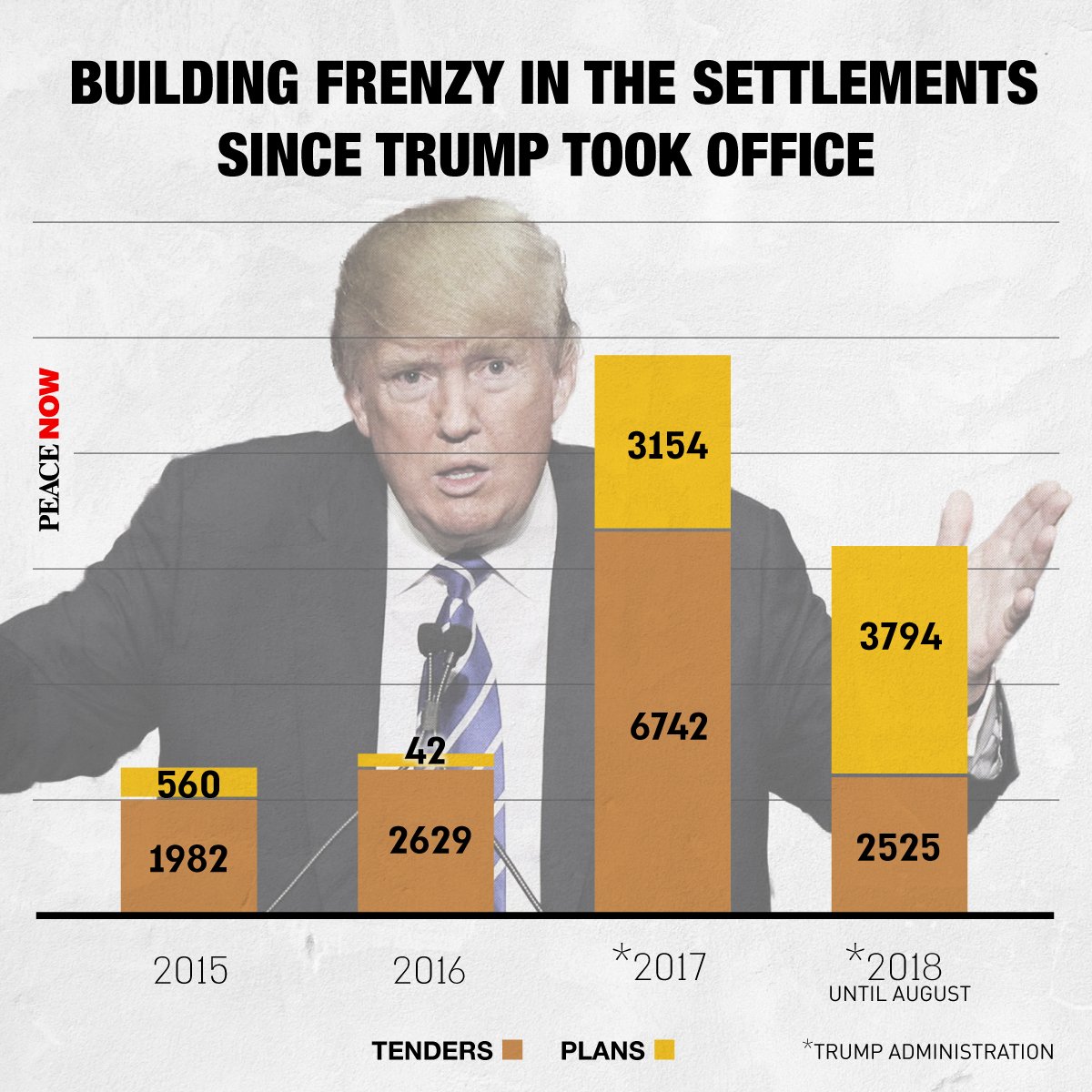
Image by Peace Now
When asked for comment on the various major settlement announcements, the U.S. State Department said that the Trump Administration believes the Israeli government has clearly demonstrated an intent to “adopt a policy regarding settlement activity that takes the president’s concerns into consideration” – a statement that suggests unequivocally that the Trump Administration has given a green light for massive settlement expansion across the length and breadth of the West Bank and East Jerusalem.
Notably, on the same day that the bulk of the settlement announcements were made, President Trump’s National Security Advisor, Ambassador John Bolton, was on the ground in Jerusalem. Not only did he offer no comment or criticism of the settlement announcements, he very publicly joined Israeli politicians and settlers leaders for dinner in East Jerusalem, dining in the “City of David National Park,” the archeological/touristic/residential site in the Palestinian neighborhood of Silwan that is run by the radical Elad settler organization. As FMEP has repeatedly covered, the Elad settler organization is spearheading a government-aided campaign to evict Palestinians from their homes in Silwan, replace them with Jewish Israeli settlers, and transform the neighborhood into a Biblical tourist site emphasizing exclusively the area’s Jewish history.
The head of the Peace Now Settlement Watch program, Shabtay Bendet, told Al-Monitor:
“The situation on the ground is changing rapidly…Restraints on construction in the settlements have been lifted. The Americans don’t care…”
State Tells High Court: We Can Annex the West Bank, International Law Be Damned
On August 7th, the state’s private attorney Harel Arnon submitted a second brief [Hebrew] to the High Court of Justice in defense of the settlement “Regulation Law.” In it he argues that the Knesset is not bound by international law and has the right to apply its own laws outside of its borders and annex land, if it wishes.
Arnon argues:
“The mere application of a certain Israeli norm [law] to an anonymous place outside the state does not necessarily make that anonymous place part of Israel. The Knesset is not restricted from legislating extra-territorially anywhere in the world, including in the region, the Knesset can legislate in Judea and Samaria.”
The brief also argues:
“The Knesset is permitted to impose the powers of the military commander of the West Bank region as it sees fit. The Knesset is permitted to define the authorities of the military commander as it sees fit. The authority of the government of Israel to annex any territory or to enter into international conventions derives from its authority as determined by the Knesset…[and] the Knesset is allowed to ignore the directives of international law in any field it desires.”
Lawyers representing Adalah responded:
“the Israeli government’s extremist response has no parallel anywhere in the world. It stands in gross violation of international law and of the United Nations Charter which obligates member states to refrain from threatening or using force against the territorial integrity of other states – including occupied territories. The Israeli government’s extremist position is, in fact, a declaration of its intention to proceed with its annexation of the West Bank.”
Harel was ordered to submit a second defense of the bill in response to a petition filed by Adalah and Al-Mezan on behalf of seventeen local Palestinian authorities. The petition argues that the Regulation Law violates international law and that the Knesset cannot enact laws over the West Bank where the majority of the population is Palestinians (who are not Israeli citizens and cannot vote).
The High Court of Justice is widely expected to strike down the “Regulation Law,” but has yet to make a ruling. Just last week, Arnon made the case that the recently passed Nation-State Law, which makes “Jewish settlement,” a “constitutional value,” can help him defend the settlement law before the High Court.
For ongoing tracking of the Regulation Law and other annexation trends in Israel, see FMEP’s Annexation Policy Tables.
This Week in Ariel: Settlers Celebrate 40 Years, A Construction Boom, A Medical School, & An Evangelical “Leadership Camp”
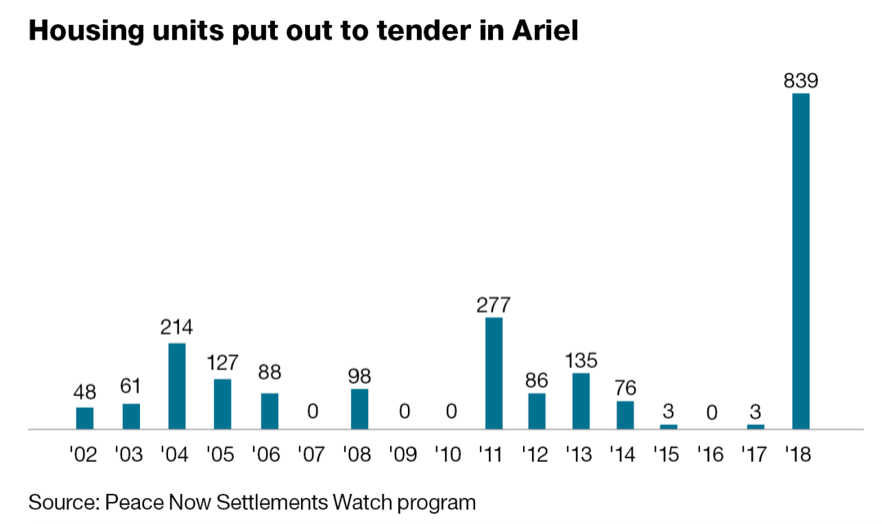 Haaretz published a lengthy report this week on the history of the the Ariel settlement – which is celebrating its 40th anniversary this month – and the dramatic spike in construction in the settlement in 2018. Even before tenders were issued for 42 new units this week (see above), plans for 839 units had already been approved during the first eight months of 2018, compared to tenders for fewer than 5 units each of the past three years. One of the original settlers of Ariel said:
“During the Obama years, everything here was frozen. But thanks to Donald Trump, we’re starting to see the light at the end of the tunnel.”
Not only has Ariel seen a massive surge in construction advancements this year, but the settlement broke ground on a new medical school heavily financed by U.S. casino magnate, and Trump backer, Sheldon Adelson (who this week gave $25 million to the GOP to help it keep the Senate, and in May gave the GOP $30 million to help it keep the House). Many settler leaders and Israeli officials, as well as Adelson and his wife Miriam, were in Ariel this weekend to attend a dedication ceremony for the medical school, despite ongoing controversy around its accreditation under domestic Israeli law. Prime Minister Netanyahu was notably absent from (and reportedly was not invited to) the ceremony, fueling rumors regarding the growing disaffection between him and Adelson.
According to another recent report in Haaretz, Ariel university is illegally dumping construction debris on land that Israel acknowledges is not “state land.” The dump site is outside of the so-called “Blue Line” which the Israeli government uses to demarcate the land that it considers “state land.” Since the dump site is not within the Blue Line, it is likely on land that even the government of Israel recognizes as being privately owned by Palestinians. Anti-settlement watchdog and founder of Kerem Navot, Dror Etkes, commented:
“It’s not surprising that Ariel University, which is the only university in the world built and existing by military order, has adopted the standards accepted in the West Bank involving the takeover of private Palestinian land.”
According to a third Haaretz report, the Israeli Education Ministry has signed a contract to sponsor 3,000-4,000 Israeli high school students of Ethiopian descent to take part in a leadership training program located in Ariel. The program, called “JH Israel,” was founded by American evangelical mega-church pastors Bruce and Heather Johnston, the latter of whom also runs the U.S. Israel Education Association, a pro-Israel, pro-settlement, non-profit group which works with the Family Research Council to lead Congressional delegations to Israel. The JH Israel website says its mission is to help Jewish Israeli students who are “disconnected from the roots of their faith” to establish “a deeper connection to God by embracing their biblical and cultural heritage.” The website also says that Ariel is “at the forefront of biblical prophecy unfolding in modern Israel.”
As FMEP has repeatedly documented, Ariel is located in the heart of the northern West Bank, reaching literally to the midpoint between the Green Line and the Jordan border. The future of Ariel has long been one of the greatest challenges to any possible peace agreement, since any plan to connect Ariel to Israel will cut the northern West Bank into pieces.
Peace Now Settlement Watch Director Shabtay Bendet spoke to Haaretz about the future of the Ariel settlement and the (other) significant repercussions of opening the new medical school. Bendet said:
“Most places in Israel don’t get recognized as cities unless they have 20,000 to 30,000 residents. Ariel became a city when it had just 11,000 residents. Why was this so significant? Because maybe you can uproot a settlement, but you don’t uproot a city. The same holds true for the university. Why was it so important for him to get it accredited? Because when a place has a university, that means it’s established — no pulling it out of the ground….By creating a buffer between the northern and southern parts of the West Bank it makes any future Palestinian state unviable. But besides that, it is also causing damage in the present because its continued expansion impinges on the ability of the surrounding Palestinian villages to develop and grow.”
Amana (the Official Settler Movement) Moves Its HQ to Sheikh Jarrah
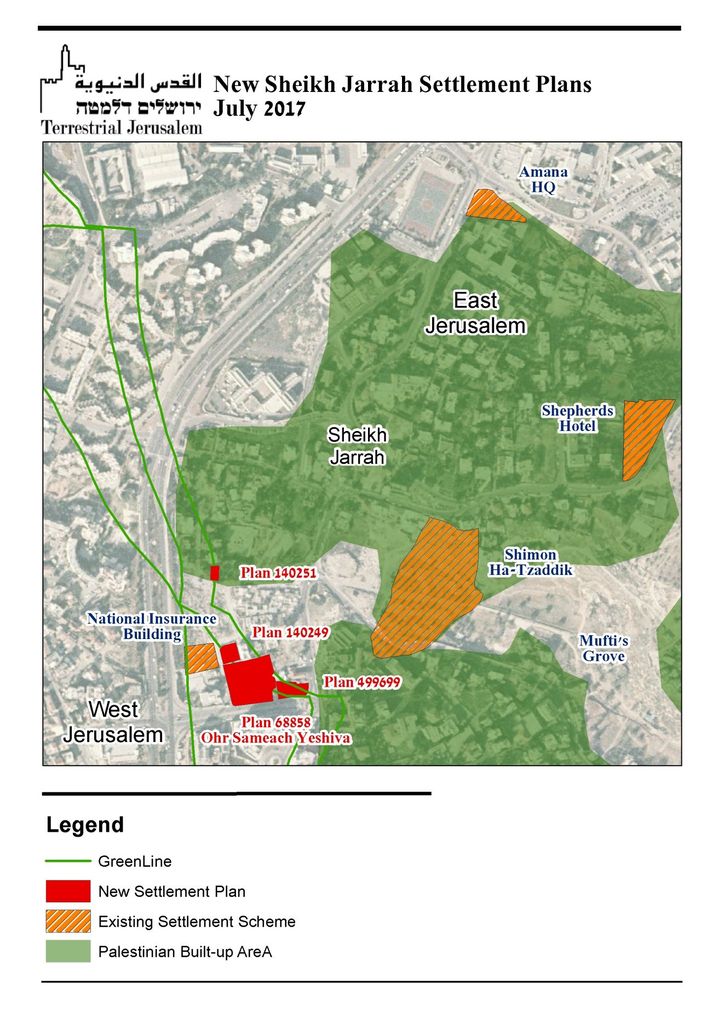 The Ynet news outlet reports that the Amana settler organization – the official body of the settlement movement, operating since the 1970s – has moved into its new headquarters in the heart of the Sheikh Jarrah neighborhood of East Jerusalem, where settlers are continuing to wage a displacement campaign against Palestinian residents. Though Amana has owned the plot of land since 1992, various legal challenges and incredibly sensitive geopolitical considerations have slowed construction of the building, called the “Amana House” (see a detailed history here).
Regarding the strategic implications of the location, Ynet reports:
“Amana says the new headquarters will help bolster the territorial contiguity of Jewish settlements in east Jerusalem.”
Agriculture and Rural Development Minister Uri Ariel (Bayit Yehudi) who previously served as the CEO of Amana, commented that the organization’s relocation:
“constitutes a significant reinforcement to the (Jewish) settlement in east Jerusalem and the bolstering of the Jewish territorial contiguity in the area.”
Several settlement plans are currently proceeding in Sheikh Jarrah, underscoring the strategic location and goals of settler activity in Sheikh Jarrah. As covered previously in this report, Israel is expected to advance a plan for a 6-story office building for settlers, located at the entrance to the neighborhood. Across the street from that building, a highly consequential plan for a new religious school (the Glassman yeshiva) was approved for deposit for public review in July 2017. The goal is clear: to unite the enclaves of settlers living inside of the Palestinian neighborhood by creating a contiguous area of settlement that connects to West Jerusalem, thereby cementing an immovable Jewish Israeli presence in a key Palestinian neighborhood – closing off the possibility of evacuation under a future peace deal.
Settlement Gains in East Jerusalem Result in Palestinians Self-Demolishing Their Homes
OCHA reports that two Palestinian homes in the East Jerusalem neighborhood of Beit Hanina were self-demolished after the Israeli Supreme Court ruled in favor of settlers’ ownership claims. OCHA writes:
“In recent decades, Israeli settler organizations, with the support of the Israeli authorities, have taken control of properties within Palestinian neighbourhoods in East Jerusalem, and some 180 Palestinian families are currently facing eviction cases, filed mainly by settler organizations.”
Bonus Reads
- “How Israeli Right-wing Thinkers Envision the Annexation of the West Bank” (Haaretz)
- “Let’s Admit It: The Settlers Have Won and We Have Lost” (Haaretz)
Welcome to FMEP’s Weekly Settlement Report, covering everything you need to know about Israeli settlement activity this week.
To receive this report via email, please click here.
August 9, 2018
- Israel Plans to Use “Nation-State Law” to Defend Settlement “Regulation Law”
- Israel Moves to Approve a New Settlement…By Expanding An Existing One (An Old Trick)
- Israeli Govt is Funding a Settler School Squatting in a Palestinian Home
- Transferring Israeli Trash to the West Bank
- Settler Regional Council Funds Activities Aimed at Undermining Israeli Law
- Bonus Read
Comments, questions, or suggestions? Email Kristin McCarthy at kmccarthy@fmep.org.
Israel Plans to Use “Nation-State Law” to Defend Settlement “Regulation Law”
The Israel State’s private attorney tasked with defending the settlement “Regulation Law,” Harel Arnon, told reporters that the recent passage of the Nation-State law (declaring Israel the nation-state of the Jewish people alone) will strengthen his efforts to keeping the Regulation Law on the books (an effort which is widely expected to fail). The settlement “Regulation Law” was passed by the Knesset in February 2017, as a means to allow Israel to expropriate privately owned Palestinian land for the exclusive use/benefit of settlers. The High Court of Justice is currently weighing petitions against the settlement “Regulation Law,” which has been frozen since August 2017.
Arnon said:
“The nation-state law certainly impacts the Regulation Law. There is no question. If until now, the argument in defense of the Regulation Law was that it seeks to balance the individual rights of Israeli residents (in the West Bank) with those of the Arab residents… what the nation-state law does is raise the status of Jewish settlement to one of constitutional value.”
The Nation-State law was passed by the Knesset on July 19th, and has since sparked condemnation and protest for the way it demotes the standing of minority communities in Israel. The law says “the state views the development of Jewish settlement as a national value and will act to encourage and promote its establishment and consolidation.” Nothing in the text suggests a distinction between “Jewish settlement” within Israel’s sovereign borders, and settlement in the occupied territories.
Yossi Alpher – former senior Mossad official and IDF intelligence officer) predicted as much in his weekly explainer for Americans for Peace Now. Deconstructing recent quotes by Prime Minister Netanyahu (“Without the Nation State law it would be impossible to ensure Israel’s future as a Jewish state for the coming generations”) and Tourism Minister Yariv Levin (“The hysterics of the political left prove that this is an excellent law. Once the composition of the [High Court] judges is changed, we can get what we wanted”), Alpher deduced:
“…the ultra-nationalist right, currently Israel’s political mainstream, intends to continue absorbing the land of the West Bank into Israel. Simultaneously it seeks, in one form or another, to disenfranchise more than three million Palestinians living there lest they become Israeli citizens and tilt the demographic balance away from ‘Jewish’ and (with a combined population including 45 percent Arabs but still excluding Gaza) toward ‘bi-national’. A Jewish nation state in which only Jews determine the country’s constitutional nature is the perfect ‘legal’ legislative vehicle for taking the necessary apartheid-like measures to make this happen.”
Israel Moves to Approve a New Settlement…By Expanding An Existing One (An Old Trick)
On August 8th, the Israeli Civil Administration announced that it is planning to retroactively legalize the Adei Ad outpost by massively expanding the borders of the (brand new) Amichai settlement to turn Adei Ad into a (non-contiguous) neighborhood of Amichai. In effect, this is a stealth operation by Israel to turn the Adei Ad outpost into an entirely new official, legal settlement.
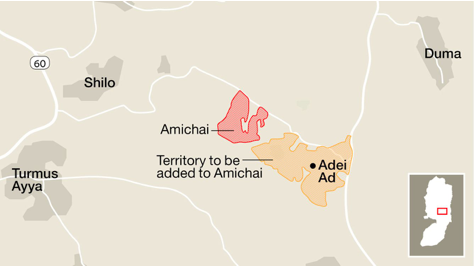
Map by Haaretz
The massive expansion of the Amichai settlement and the transformation of Adei Ad into a brand new settlement, if implemented, will be a significant step towards creating an uninterrupted corridor of settlements connecting sovereign Israel to the Ariel settlement, through the isolated Shiloh Valley settlements, all the way to the Jordan Valley. In so doing, It will completely bisect the northern part of the West Bank.
The plan takes into account a Civil Administration “Blue Line” survey in 2017, which found that the strip of land between the Amichai settlement and the Adei Ad outpost is privately owned Palestinian land. It seems that the Civil Administration is opting (for now) not to use its newly endowed tools for expropriating privately owned land for the use of settlements, and is instead moving forward with a plan that will effectively leave Adei Ad – ostensibly now a neighborhood of Amichai – physically disconnected from its new parent settlement. The strip of Palestinian land in between the two will almost certainly become inaccessible to its Palestinian owners, as is much of the Palestinian land near Adei Ad, a notoriously radical and violent outpost. It is highly likely that at a later date the land will be expropriated.
The Civil Administration unveiled the new plan in a letter addressed to Israeli NGO Yesh Din, in response to a 2014 petition against the Adei Ad outpost filed by the group on behalf of Palestinian landowners. The Civil Administration’s letter claimed the 2017 “Blue Line” land survey determined that Adei Ad is built on “state land” and is therefore eligible for retroactive legalization (despite having been built there entirely illegally). Yesh Din and its clients have formally appealed the findings of that survey, contending that Adei Ad is partially on private land.
After the Amichai borders are expanded to give cover for the legalization of Adei Ad, the Israeli Civil Administration is set to transfer administrative responsibilities over the expanded settlement (including the Adei Ad “neighborhood”) to the Binyamin Regional Council – the municipal body responsible for administering services and enforcing building laws in settlements within its jurisdiction (though it rarely moves to enforce laws against the illegal settler construction). As Haaretz notes:
“Except in the rarest cases, the council does not enforce the law against illegal construction in its jurisdiction…As a result of the transfer of administrative powers to municipal authorities at Amichai, the settlers will be able to build new structures illegally without effective enforcement.”
Yesh Din’s attorney, Shlomi Zecharia, told Haaretz:
“The inhabitants of the villages near the outpost have become hostages to the policy that abundantly rewards prizes and gifts to ideological criminals. Cutting off farmlands by means of a false [expansion of] jurisdiction is extreme, disproportionate and needless, and in fact is intended to perpetuate restrictions on and infringement of Palestinian property, this time under the official auspices of the government.”
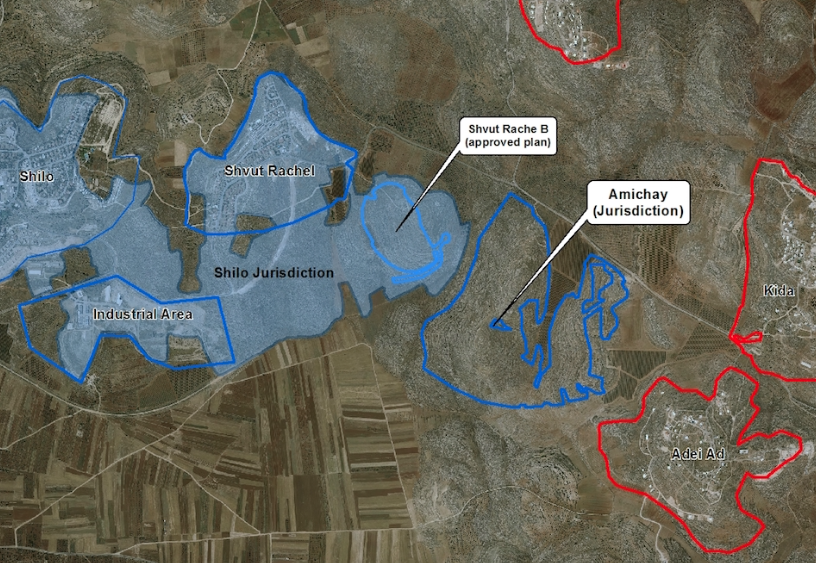
Map by Peace Now
Additionally worth noting, the Amichai expansion/Adei Ad legalization plan will represent yet another reward to settler law-breakers who evacuated from the unauthorized Amona outpost. Previously, the pay-off to settlers included the approval and construction of the Amichai settlement, which was the first new settlement to be built with government authorization in 25 years. It included, too, the approval of Shvut Rachel East, an outpost which – just like Adei Ad – became a non-contiguous “neighborhood” of an existing settlement (Shilo). The Amona pay-off package can now count a third settlement, Adei Ad. As FMEP documented at the time, the Trump Administration reportedly accepted the Amichai plan as an exception to its settlement policy which, at that time, was described in the media as President Trump asking Netanayahu “hold back on settlements for a little bit.”
Yesh Din comments on the Adei Ad scheme:
“Viewed in a broader context, this retroactive authorization is a major step towards fulfillment of Israel’s plan to annex Area C: retroactively authorizing unauthorized outposts at any price so as to ‘normalize’ them and render them permanent settlements; and creating continuous settler presence across the West Bank, from west to east, in order to facilitate the annexation, while dispossessing Palestinians of land that is their source of livelihood and in blatant disregard of international law and of the rights of Palestinian residents.”
Israeli Govt is Funding a Settler School Squatting in a Palestinian Home
The Times of Israel has a detailed report on a government-funded religious school that for years has been operating illegally in a privately owned Palestinian home near the Ofra settlement, in the center of the West Bank. The Mishpatei Eretz Institute, which is operating the school, receives around USD $55,000 annually from the Israeli Culture Ministry, and has received a total of USD $214,039 from government bodies over the past three years alone.
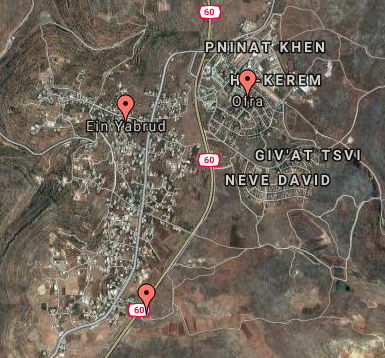
Map by Google, markers by The Times of Israel
In the mid 1990s the home was physically cut off from the Palestinian village to which it belongs when Israel paved Route 60, the major north-south highway in the West Bank. In 2003, Israeli settlers broke into the home while its owners, the Shehadeh family, were on a day trip to Ramallah. After invading the home, settlers produced forged documents claiming that the Al-Watan settler organization purchased the building, and then spent years trying to prove that the purchase was legitimate in order to have the building registered with the Civil Administration. The Shehadeh family also spent years trying to force the IDF to evict the squatters, but nothing was ever done. In the meantime, Al-Watan donated the building – even without having legally established ownership of it – to the Mishpatei Eretz Institute, which then began operating a religious school in the building with government funding.
In 2013, the Jerusalem District Court ruled against Al-Watan’s claim to the building (slamming the organization and its officers for engaging in rampant fraudulent activity), deciding that the documents had been forged and recognizing the original Palestinian owners’ rights. Ten days after the ruling, the IDF Central Command issued a military order seizing the plot of land the home sits on, claiming “security purposes.” The IDF also built a fence around the area. The military order seizing the land will remain in force until 2019.
When contacted about the story, the IDF acknowledged the 2013 Court ruling but did not offer an explanation for any of its actions dating to either before or after the court ruling. A lawyer representing the Palestinian owners told The Times of Israel that the family will soon petition the High Court of Justice to have the settlers, and their school, evicted.
The anti-settlement watchdog Kerem Navot told reporters:
“We see here another example that reveals the corrupt system that Israel maintains in the West Bank. Rather than enforce the law, and evict and punish the settlers who invaded the property, the IDF issued a corrupt military order based on security needs that de facto enables them to stay there. On top of that, we now discover that the government is generously funding criminal bodies like the Mishpatei Eretz Institute.”
Transferring Israeli Trash to the West Bank
Haaretz reports that the Israeli government is close to finalizing a new plan to transfer waste from Jerusalem to the West Bank. Under the scheme, Israel will build a waste treatment facility east of the Ma’ale Adumim settlement to handle waste from Jerusalem. The facility will recycle or burn as much of the waste as possible, and then transfer the resulting ash and any remaining waste back into Israel.
Since the West Bank is under a military occupation, environmental regulation standards are considerably lower than in sovereign Israeli territory, making the West Bank an ideal spot for Israel to dump/treat its waste on the cheap, a practice extensively documented in a 2017 report by B’Tselem. The report asserts:
“Waste treatment in the West Bank is simply one more facet of the exploitative policy Israel has practiced consistently for fifty years now, using Palestinian space and people to further its own interests. As part of this policy, Israel treats the West Bank – and particularly Area C, where it retained full control under the Oslo Accords – as an area meant to serve its needs exclusively, as if it were its sovereign territory.”
Echoing the B’Tselem report, MK Mossi Raz (Meretz) notes that the plan, though sold as an environmentally friendly solution, is part of Israel’s de facto annexation of the West Bank, saying:
“Although at first glance it looks as though the ministry wants to protect the environment, the government plans clearly demonstrate that the goal is to prepare the ground for annexation. The building of infrastructure in the occupied territories by the state, without cooperation from the PA, deepends Israeli control in the territories, and thereby in effect is bringing us even closer to the day when the Israeli government will annex the territories.”
The Israeli Defense Ministry is slowing down the implementation of the plan, which has broad support across other government ministries, for technical reasons — mainly having to do with a dispute about how the facility will be staffed.
Settler Regional Council Funds Activities Aimed at Undermining Israeli Law
In 2017 the Gush Etzion Regional Council contributed hundreds of thousands of shekels to illegal settlement and outpost construction in its jurisdiction, and heavily invested in projects connected to defending the unauthorized Netiv Ha’avot outpost against demolition. Data obtained by the Movement for Freedom of Information and analyzed by Peace Now show that the Gush Etzion Regional Council, which is supposed to be enforcing Israeli laws in areas under its jurisdiction, instead invested hundreds of thousands of shekels trying to help the illegal Netiv Ha’avot outpost skirt the law. The Council’s 2017 projects connected to Netiv Ha’avot included:
- The construction of a new, unauthorized observation tower (a memorial site) in the outpost. Construction of the tower moved forward after the High Court of Justice ruled that 17 buildings in Netiv Ha’avot were built partially on Palestinian land and must be demolished.
- A public campaign to save buildings in the Netiv Ha’avot outpost from demolition, including a payment to the radical Regavim settler organization in connection to the campaign (which is working to selectively enforce building laws against Palestinians in the West Bank). By the end of 2017, the council spent NIS 164,688 on the campaign – which, as Peace Now notes, became an even more active effort in 2018.
- Building a new (at that point unauthorized) outpost for those settlers facing evacuation from buildings in the Netiv Ha’avot outpost. The Council was able to recoup some of those expenses when the government later approved an NIS 60 million package to provide compensation for the settlers who were evacuated as well as funds for the Council.
In addition to the Netiv Ha’avot outpost expenditures, and other unauthorized settlement projects, the Gush Etzion Regional Council spent NIS 1,755 on an ATV tour for MK Yehuda Glick to conduct a “survey on the application of sovereignty over (i.e., annexation of) Gush Etzion.”
Peace Now says:
“It is time for official authorities that are obligated to act according to the law to stop funding illegal activities, attacking the High Court and evading enforcement of the law, especially when using public funds. The Interior Ministry must put an end to this sinister exploitation of the public coffers, and must get our taxpayers’ money back.”
Bonus Read
- “Fact and Fiction About the Amendment of the Israeli Supreme Court’s Jurisdiction Over West Bank Cases” (Lawfare Blog)