Welcome to FMEP’s Weekly Settlement Report, covering everything you need to know about Israeli settlement activity this week.
To subscribe to this report, please click here.
February 8, 2019
- Another Challenge to Israel’s Plan to Retroactively Legalize Adei Ad Outpost
- New Eviction Proceedings Against Two Palestinian Families in the Muslim Quarter of the Old City
- Higher Education Council Reverses Approval of Adelson-Backed Medical School in Ariel University
- Activists Ask High Court to Revoke Status of West Bank Nature Reserve Run By Settlers
- Settlers Threaten to Blacklist Palestinians Who Work with Human Rights Organizations
- Prominent Israeli Politicians Pledge To End Two-State Solution
- 40 Ambassadors to the United Nations Visit Settler-Run Tourist Site in Occupied East Jerusalem
- Settler Org Credits Trump for Growth in West Bank Settler Population & Death of Two-State Solution
- New B’Tselem Report Slams High Court for Role in Dispossessing Palestinians, Validating Occupation
- Video Compilation of Likud Candidates Touting Role of Tourism in Expanding Settlements
- EU Settlement Report Details “Unprecedented” Level of Settlement Advancements 2018
- Bonus Reads
Questions/comments? Email kmccarthy@fmep.org
Another Challenge to Israel’s Plan to Retroactively Legalize Adei Ad Outpost
On January 31st, Yesh Din filed a petition with the High Court of Justice to reverse an expansion of “state land” boundaries in the Shiloh Valley that seized privately owned Palestinian land in order to retroactively legalize the notoriously (and recently) violent Adei Ad outpost.
In 2014, Palestinian landowners, in cooperation with Yesh Din, first petitioned the Court to evacuate the unauthorized Adei Ad outpost which was built on their land in contravention of both international and Israeli law. Instead of enforcing the law, the Israeli Civil Administration announced that it would “reexamine” the boundaries of state land in the area, an examination which found that Adei Ad was, according to the new Israeli mapping of the area, built on state land. To make the findings of the reexamination official, the Civil Administration used an entirely new procedure (a “declaration amendment”) to expand the boundaries of a previous state land declaration. In so doing, the Civil Administration found a way to avoid issuing a new state land declaration, which can be challenged in a court by Palestinians and legal groups like Yesh Din. For “declaration amendments,” landowners can only seek recourse through the Civil Administration. Objections filed to the expansion of state land in this case were all dismissed.
The new Yesh Din petition filed on January 31st challenges the secretive and unjust process by which the Civil Administration expanded the scope of state land to include the Adei Ad outpost. The petition reads:
“[…] Not only does the procedural structure for objection to the declaration, as stated in the procedure, substantially diminish the rights of the petitioners and other objectors who seek to receive their day in court before an independent and impartial judiciary (which is offered without exception to their neighbors, indicative of institutional discrimination), but even in substantive terms, the decision of the first respondent [the head of the Civil Administration] was carried out in violation of the law, in contrast to judicial decisions, in a manner entirely lacking transparency and conveying the arbitrariness that ultimately results from irrelevant considerations — the desire to legalize the outpost of Adei Ad at all costs.”
The new petition seeks to stop the implementation of the next step in the Civil Administration’s process to retroactively legalize Adei Ad, a plan that was announced in August 2018. Under the scheme, Adei Ad will be retroactively legalized by defining it as a “neighborhood” of the Amichai settlement – the first new government-backed settlement in 25 years, approved as payoff to the settlers who were evacuated from the unauthorized Amona outpost – located nearby.
In 2013, Yesh Din published a lengthy report about the Adei Ad outpost – how it was established and how the settlers who live there use violence to take over more and more land from nearby Palestinians.
Kerem Navot recently wrote:
“The outpost of Adei Ad has the hard-earned dubious reputation as one of the wildest and most violent outposts in the West Bank. Since its establishment in the late 1990s, settlers have initiated numerous violent incidents, all based on one simple rationale: take control of as much land as possible. As a reward for 20 years of wreaking havoc, the state is currently authorizing the outpost and has recently deemed it a ‘neighborhood.’ Guess whose: a ‘neighborhood’ of the settlement of Amichai that was established less than two years ago after the state granted “compensation” estimated at 300 million shekels, to the group of land thieves who were evicted from the outpost of Amona.”
New Eviction Proceedings Against Two Palestinian Families in the Muslim Quarter of the Old City
Ir Amim reports that settlers are behind two new eviction proceedings against Palestinians in the Muslim Quarter of the Old City of Jerusalem.
In the first case, the Abu Asab family received a notice that they must vacate their home in the Muslim Quarter by February 12th. The family has been renting the house since the 1960s, when the Old City was under the authority of the Jordanian government, which managed leases for vacant properties. In 2014, a settler-run trust – the Maisel Trust – petitioned to annul the family’s protected tenancy rights, arguing that those rights had been lost when the original tenants allegedly “abandoned” the property (the current residents are second generation relatives of the original renters). The Court ruled in the settlers’ favor in, and a subsequent appeal against the ruling was rejected.
In the second case, just 100 meters away from the Abu Asab family home, the Ghaith-Sub Laban family was warned that another settler-managed trust – the Gengel Trust – filed a new request for their eviction, arguing that the original tenants had abandoned the home and therefore forfeited their protected tenancy rights. The new eviction proceedings were initiated despite a 2016 Supreme Court ruling that held that Nora Gaith and husband Mustafa Sub Laban are legally allowed to remain in the apartment for 10 years), at which time their protected tenancy will be (prematurely) terminated and their children’s status as protected tenants annulled.
Ir Amim notes that there are a total of eight Palestinian families at imminent risk of eviction in the Muslim Quarter of the Old City, all in close proximity to the cases detailed above.
Higher Education Council Reverses Approval of Adelson-Backed Medical School in Ariel University
On February 7th, the Planning & Budgeting subcommittee of Israel’s Higher Education Council voted 3-2 against the approval of a medical school in Ariel University, reversing the subcommittee’s previous vote to approve the medical school in July 2018.
The Israeli Attorney General’s office ordered the second vote after it was revealed that one of the members of the subcommittee should not have been able to vote in July 2018, due to a major conflict of interest (Ariel University had promised the individual a promotion in the event the school was approved).
Since receiving the approval in July 2018, Ariel University has taken significant steps towards opening the medical school this fall, despite multiple unfolding controversies surrounding the process by which the school was approved. In addition to addition to the controversy surrounding the July 2018 vote, Israeli Education Minister Naftali Bennett is accused of violating government rules to secure a legal opinion in favor bringing the school under Israeli domestic laws (an act of de facto annexation). Bennett is also accused of inappropriately intervening to expedite the approval of the school.
In response to the vote Israeli Education Minister Naftali Bennett, said:
“I do not intend to give up. I will fight the university cartel until we establish the Faculty of Medicine at Ariel University.”
Following the vote, the settler Yesha Council (an umbrella group which lobbies on behalf of the settlements) issued a statement saying:
“We expect the Israeli government to handle the matter and renew the permit in the coming year.”
As FMEP has previously reported, Ariel University became an accredited Israeli university in 2012, following significant controversy and opposition, including from Israeli academics. It has since been the focus of additional controversy, linked to what is a clear Israeli government-backed agenda of exploiting academia to normalize and annex settlements. In 2018, the settlement broke ground on the new medical school, with significant financial backing from U.S. casino magnate, settlement financier, and Trump backer Sheldon Adelson. In February 2018, in an act of deliberate de facto annexation, the Israeli Knesset passed a law that extends the jurisdiction of the Israeli Council on Higher Education over universities in the settlements (beyond Israel’s recognized sovereign borders), ensuring that the Ariel settlement medical school (and its graduates) would be entitled to all the same rights, privileges, and certifications as schools and students in sovereign Israel.
As a reminder, Ariel is located in the heart of the northern West Bank, reaching literally to the midpoint between the Green Line and the Jordan border. The future of Ariel has long been one of the greatest challenges to any possible peace agreement, since any plan to attach Ariel to Israel will cut the northern West Bank into pieces.
Activists Ask High Court to Revoke Status of West Bank Nature Reserve Run By Settlers
A group of Israeli human rights activists have petitioned the Israeli High Court to revoke the special status of the Umm Zuka nature reserve and firing zone in the West Bank, saying the Israel’s designation of the land as a protected area has only served as a pretext to remove Palestinians and allow settlers to take over.
The petition goes on to explain that Israeli settlers have built an unauthorized outpost on the land that is slated to be added to the existing nature reserve, and have essentially turned the wilderness area into a private settler park where Palestinians are not allowed to enter. Despite complaints, the Israeli Civil Administration has not removed the unauthorized outpost – which consists of several structures connected to the water, sewage, and electricity of a nearby army base. The Civil Administration spokesperson told Haaretz that it is undertaken unspecified “enforcement proceedings” against the unauthorized outpost.
Eitay Mack, a lawyer who filed the petition on behalf of the group, told Haaretz:
“the reserve and the firing zone have effectively become a private settler farm that receives personal security service from Israel Defense Forces soldiers and bars entry to the farm’s enormous territory on the basis of ethnicity, nationality, religion and political opinions.”
Settlers Threaten to Blacklist Palestinians Who Work with Human Rights Organizations
Settlers have taken to posting signs in Palestinian villages warning that Palestinians who cooperate with human rights organizations will be prohibited from working in of Israeli settlements. The posters threaten:
“Do you wish to keep working in the settlements? Do you want to provide a living for your families from the Jews? Whoever cooperates with any one of these individuals and organizations (Ta’ayush and Rabbis for Human Rights) will never be allowed to enter the settlements for work. Be warned!”
+972 Magazine reports that the settlers behind the posters have also distributed leaflets to business owners inside of the settlements which list names of Palestinians alleged to work with (or have family members who work with) human rights groups – ostensibly encouraging Israeli business owners to fire them.
An Israeli activist working with the Tayyush organization (which is named on the posters as a group Palestinians cannot work with) explained:
“These flyers are yet another reminder that we [Israeli human rights groups] are a target of far-right groups, which get their marching orders from the Israeli government. The goal is clear: to expel Palestinians from their Area C of the West Bank and minimize their ability to defend themselves.”
Observers have noted the similarity between these flyers and signs posted by the Ku Klux Klan in the US years back targeting Black Americans.
Prominent Israeli Politicians Pledge To End Two-State Solution
In the context of Israel’s current election campaign, dozens of Israeli politicians have signed a pledge to the “Nahalah Movement” which reads:
“I hereby commit to be loyal to the land of Israel, not to cede one inch of our inheritance from our forefathers. I hereby commit to act to realize the settlement plan for the settlement of 2 million Jews in Judea and Samaria in accordance with Prime Minister Yitzhak Shamir’s plan, as well as to encourage and lead the redemption of all the lands throughout Judea and Samaria. I commit to act to cancel the declaration of two states for two peoples and replace it with the stately declaration: The land of Israel: One country for one people.”
Among the most prominent signatories are Knesset Speaker Yuli Edelstein (Likud), Transportation Minister Yisrael Katz (Likud), Justice Minister Ayelet Shaked (New Right) Education Minister Naftali Bennett (New Right), Tourism Minister Yariv Levin, Environmental Protection and Jerusalem Affairs Minister Zeev Elkin, Public Security Minister Gilad Erdan, Culture Minister Miri Regev, Regional Cooperation Minister Tzachi Hanegbi, Communication Minister Ayoub Kara, Immigration and Absorption Minister Yoav Galant, Social Equality Minister Gila Gamliel.
The petition was introduced and signed as the climax of the Nahalah Movement’s two-week-long protest outside of Prime Minister Netanyahu’s residence in Jerusalem. The activists were protesting what they portray as Netanyahu’s policy of severely restricting settlement construction. The Nahalah movement calls for unconstrained settlement construction and the establishment of new settlements. The Nahalah Movement released a statement saying:
“The signing of the petition opposite the Prime Minister’s Residence at the height of the Likud primary election campaign and at the height of the efforts to compile the [Knesset] lists in the right-wing and center bloc and in particular ahead of the coming election campaigns constitutes an ideological and ethical loyalty test for the various contenders.”
The settlement agenda promoted by former Prime Minister Yitzhak Shamir – the one mentioned in the Nahalah pledge – was one of unrestrained growth and absolute opposition to compromise with the Palestinians and/or Arab governments in the region. Notably, Shamir’s promotion of the settlement enterprise was strongly opposed by then-U.S. President George W. Bush, who threatened to cut U.S. aid to Israel if settlement construction did not stop.
40 Ambassadors to the United Nations Visit Settler-Run Tourist Site in Occupied East Jerusalem
A group of 40 Ambassadors to the United Nations visited a tourist site run by the radical Elad settler organization in the East Jerusalem neighborhood of Silwan. The delegation was led by Israel’s own Ambassador to the UN, Danny Danon, who appeared on video saying:
“We arrive today with nearly 40 UN Ambassadors to the City of David, Ir David, to show them the real truth about Israel….when the Ambassadors come here and they see for themselves the history of the Jewish people they understand why you cannot disconnect the Jewish people from our eternal capital Jerusalem.”
In the same clip, the President of Elad (aka the “City of David Foundation”) said:
“Why are they here? Far away from the halls of the United Nations building, here they will travel with us through the field and actually lift up the archaeological evidence and see the facts in front of their eyes. This is not a matter of fantasy and not only a matter of faith. Here we have facts that prove the connection of the Jewish people to Jerusalem.”
As a reminder, the explicit ambition of the Elad settler organization is to increase Jewish hegemony across all of Jerusalem at the explicit and intended expense of the Palestinian East Jerusalemites. In Silwan in particular, Elad has undertaken a multi-faceted campaign to evict Palestinians and increase the number of Jewish settlers living there.
Intending to give a backhanded compliment to the visiting delegation, Eugene Kontorovich – who heads the international law department at the Kohelet Policy Forum, a right-wing pro-settlement organization – tweeted that the UN Ambassadors must not agree with U.N. Resolution 2334, which calls on the international community to differentiate between Israel and areas occupied by Israel in their dealings in the region. Kontorovich also told Jewish Insider:
“The Security Council resolution calls on countries to ‘differentiate’ between Israel and territories that came under its control in 1967. The resolution is of course not binding, and by going on in official state visit across the green line in the company of Israeli government officials, these UN ambassadors show that they are fully aware what a dead letter the resolution is.”
As a reminder, Kontorovich self-identifies as a key figure in the drafting of “anti-BDS” (but actually, anti-free speech/pro-settlement) laws in the United States. At the core of these laws is the conflation of Israeli settlements with Israeli proper, based on Kontorovich’s argument that Israel is not occupying Palestinian territory. Kontorovich has also testified multiple times to U.S. Congress, including in support of moving the U.S. Embassy to Jerusalem; in support of Congress legislating U.S. foreign policy, including with regard to Jerusalem; on the impact of the BDS movement, and in support of U.S. recognition of Israel’s sovereignty over the Golan Heights.
Settler Org Credits Trump for Growth in West Bank Settler Population & Death of Two-State Solution
A settler-run organization has released an analysis of Israeli government data citing the Trump Administration as a key driver of a “surge” in the growth rate of the Israeli settler population in 2018, and predicted a larger surge to come. The group claims the settler population in the West Bank grew by 3.3% last year (449,508 – excluding East Jerusalem – as of January 2019), compared to a 1.9% increase in Israel’s overall population.
The director of the group, Baruch Gordon, told the Associated Press:
“Since the change of the U.S. administration, the atmosphere for construction permits has become much easier. They’re being given with greater ease. I think possibly the next report and certainly in the ones after that, I think we’ll start to see a huge surge in the numbers here….Those who continue to talk about a two-state solution, in my mind it’s just a sign that they’re removed from the reality and the facts on the ground.”
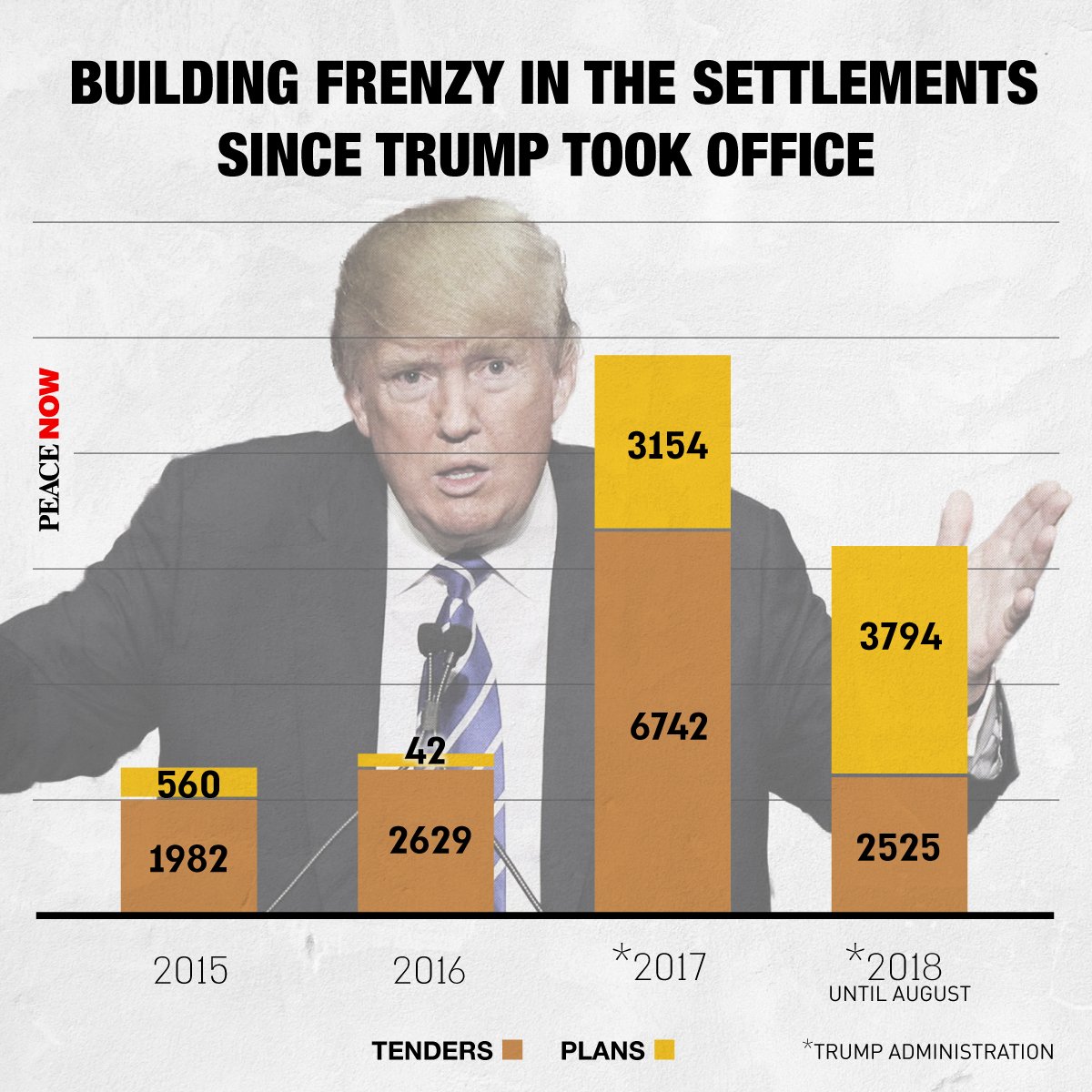
Image by Peace Now
When another settler organization – the Council of Jewish Communities in Judea and Samaria – published near identical data points in January 2019 (literally last month), the overwhelming response of the settler community was to blame former U.S. President Barack Obama for a slowdown in the population growth from the 2017 rate, which was at 3.4%. However, if Gordon is correct in his prediction of a settler surge to come, that surge will indeed by blamed on or credited to – depending on the source – U.S. President Donald Trump.
Peace Now has documented the sharp in increase in settlement advancements in 2018, which will eventually result in an increase in the population of settlers (by as many as 60,000 settlers) once those new units are built and sold.
Nabil Abu Rudeineh, spokesman for Palestinian President Mahmoud Abbas, told the AP:
“The American support for settlements through silence is doomed to failure because there is no peace and stability without an agreement with the Palestinian people and its legitimate leadership.”
New B’Tselem Report Slams High Court for Role in Dispossessing Palestinians, Validating Occupation
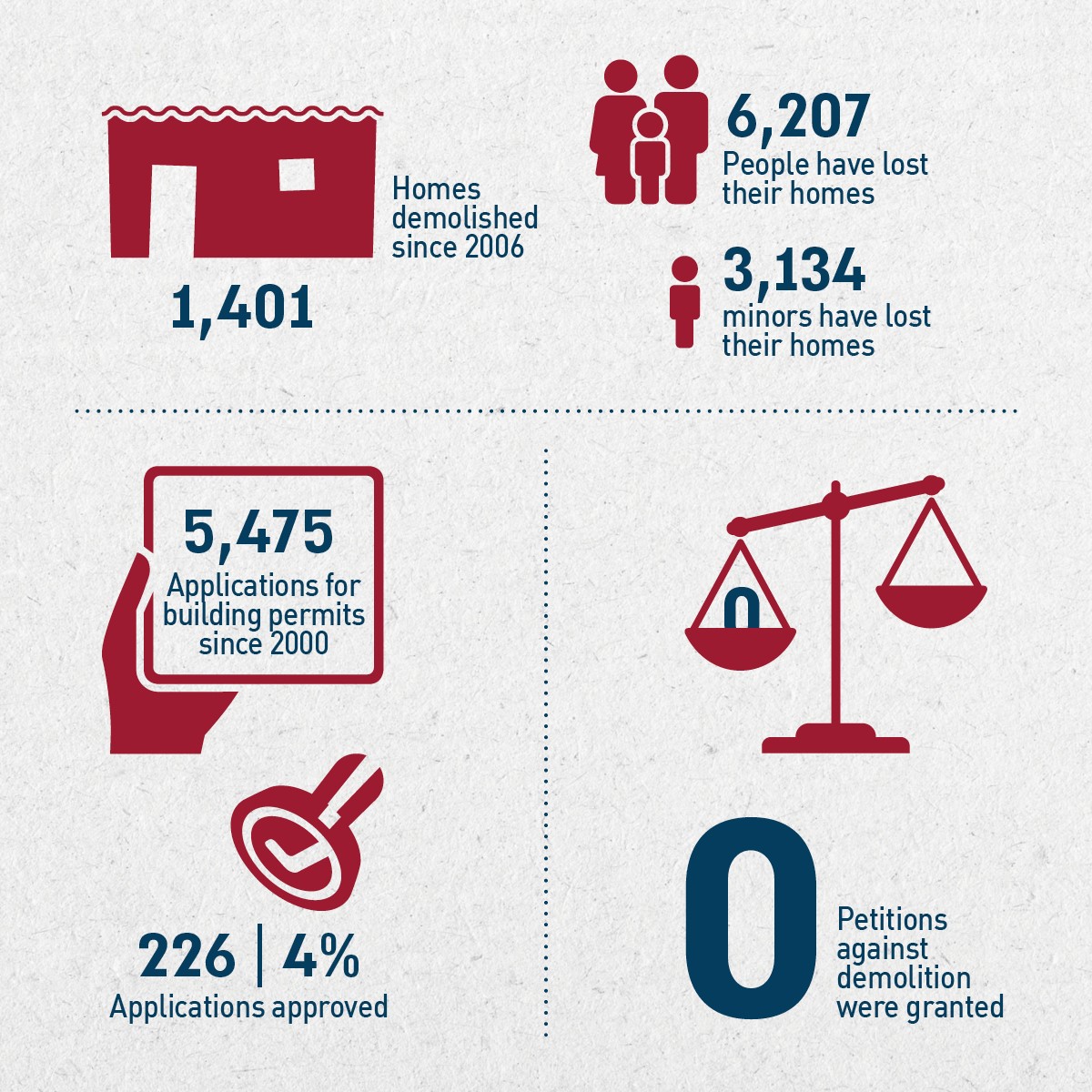
Image by B’Tselem
B’Tselem published an important new report entitled “Fake Justice: The Responsibility Israel’s High Court Justices Bear for the Demolition of Palestinian Homes and the Dispossession of Palestinians.” The report examines the role the highest court in Israel (and the only practicable avenue by which Palestinians can challenge Israeli policies and settler actions) has played in perpetuating the severe injustices inflicted upon Palestinians by the Israeli occupation and providing a guise of legality to for the Israeli policies behind them. Looking at its actions over the years as a whole, the report concludes that the court’s support of Israeli planning policy in the West Bank is tantamount to support for “forcible transfer” — a war crime.
The report’s executive summary explains:
“On the declarative level, Israeli authorities consider the demolition of Palestinian homes in the West Bank as no more than a matter of illegal construction, as if Israel does not have long-term goals in the West Bank and as if the matter does not have far-reaching implications for the human rights of hundreds of thousands of individuals, including their ability to subsist, make a living and manage their own routine. The Supreme Court has fully embraced this point of view. In hundreds of rulings and decisions handed down over the years on the demolition of Palestinian homes in the West Bank, the justices have regarded Israeli planning policy as lawful and legitimate, nearly always focusing only on the technical issue of whether the petitioners had building permits. Time and time again, the justices have ignored the intent underlying the Israeli policy and the fact that, in practice, this policy imposes a virtually blanket prohibition on Palestinian construction. They have also ignored the policy’s consequences for Palestinians: the barest – sometimes positively appalling – living conditions, being compelled to build homes without permits, and absolute uncertainty as to the future.”
The report is available to read and download here.
Video Compilation of Likud Candidates Touting Role of Tourism in Expanding Settlements
The Israeli archaeological group Emek Shaveh produced a video compilation of prominent Likud candidates touting their role in driving settlement tourism projects – in statements made in anticipation of the Likud primary elections (which were held on February 5th). Snippets in the video include:
- Former Mayor of Jerusalem Nir Barakat bragging about his work on behalf of settlement projects run by Elad in the Silwan neighborhood;
- Transportation Minister Yaariv Levin bragging on Facebook about the huge investments his ministry made into developing a settlement tourism industry, including doubling the amount of tourism to the West Bank in two years, funding two hotels in the Kiryat Arba settlement, and starting a grants program for tourist projects in settlements;
- Jerusalem Affairs Minister Zeev Elkin celebrating the opening of a “visitors center” in a settlement near the central West Bank city of Nablus.
Emek Shaveh writes:
“What was previously termed ‘hidden settlement’ has quietly transformed amid the Likud primaries into open policy. The extent of the Israeli government’s investments in the tourist settlement is now being exposed.”
There has been a growing awareness of – and opposition to – Israel’s overt investment in settlement tourism as means to expand and entrench Israeli settlements, most acutely in East Jerusalem. In February 2018, a leaked report by the European Union said explicitly that Israeli archaeological and tourism projects in East Jerusalem are “a political tool to modify the historical narrative and to support, legitimacy and expand settlements.”
Emek Shaveh issued a statement elaborating on leaked EU report, saying:
“Archaeological tourism projects are favored by the settlers as a means of winning the hearts of minds of the Israeli, Jewish and evangelical publics. The EU now recognizes how archaeological sites in East Jerusalem are being used as a political tool to ‘modify the historical narrative and to support, legitimise and expand settlements’. The City of David in Silwan, the new cable car project, the national parks in Palestinian neighborhoods compliment evictions and house demolitions in marginalising and disenfranchising the East Jerusalem Palestinian public. The difference between ‘cultural projects’ such as the national parks or the City of David and house demolitions is that in addition to the physical displacement, the former also expropriate the narrative, dispossessing the Palestinians from their historical and cultural contexts. When it comes to Jerusalem, narrative is not an abstract issue because in Jerusalem history and questions of present-day sovereignty are intertwined. And when it will come to determining the final status of the city, the question of who ‘owns’ the history of the city will be crucial.”
EU Settlement Report Details “Unprecedented” Level of Settlement Advancements 2018
On February 4th, the European Union issued its bi-annual report (pdf) documenting and analyzing trends in Israeli settlement activity from July through December 2018. It also provides a big picture summary of settlement activity in recent years, which found that there was a three-to-four-fold increase in settlement advancements in 2017/2018 (the era of U.S. President Donald Trump) compared to 2015/2016 (under Barack Obama).
The full report is available as a pdf here.
Bonus Reads
- “As West Bank Violence Surges, Israel is Silent on Attacks by Jews” (New York Times)
- “Digging Up Controversy” (US News)
- “US Blocks UN Statement on Israel Ending Hebron Monitors Mention” (Ynet)
- “CAF rejects tender for Jerusalem’s Railway as it Traverses ‘67 Borders” (Maan News)
Welcome to FMEP’s Weekly Settlement Report, covering everything you need to know about Israeli settlement activity this week.
To subscribe to this report, please click here.
January 11, 2019
- Israel Opens “Apartheid Road” – Divided Road Eases Settlers’ Access to Jerusalem, Routes Palestinians Around the City, Significant Step Towards Advancing E-1 Settlement Construction
- Israeli Businessman Opens Huge Mall in East Jerusalem Settlement Industrial Zone
- In Parting Gift to Settlers, Housing Minister Greenlights Construction of New Settlement Units for Outpost Evacuees
- Settlers Blame Obama for Slowed Israeli Population Growth in the West Bank
- Israeli Justice Minister Stands with Families of Suspects in Deadly Jewish Terror Attack
- Breaking the Silence Launches New Tour of Central West Bank Settlements
- Bonus Reads
Questions/comments? Email kmccarthy@fmep.org
Israel Opens “Apartheid Road” – Divided Road Eases Settlers’ Access to Jerusalem, Routes Palestinians Around the City, Significant Step Towards Advancing E-1 Settlement Construction
A key section of the “Eastern Ring Road” (Route 4370), located in the West Bank on the eastern flank of Jerusalem in the area of the planned E-1 settlement, officially opened to traffic on January 10th. Dubbed the “Apartheid Road” because a concrete wall runs literally down the middle of the highway, separating Palestinian and Israeli traffic, the road allows Israeli-approved traffic from the West Bank (i.e., settlers and the small number of Palestinians who have Israeli-issued permits) to more easily access Jerusalem than ever before — advancing the seamless integration of settlements into Israel proper and the erasure of the Green Line; the other side of the road is sealed, shunting traffic between the northern and southern parts of the West Bank while preventing any access to Jerusalem (East or West).

Map by Haaretz
Ir Amim warns that the opening of this section of the road may signals that Israel is on the verge of issuing building permits for the E-1 settlement plan, which received final approval but has been held up by the political echelon for years due to international pressure. The international community has long opposed E-1, in part based on the argument that territorially, it cuts the West Bank in half, preventing the possibility of a viable, contiguous Palestinian state.
Israeli officials have argued that the now-open road should resolve international objections to building the E-1 settlement, since it preserves “transportational continuity” by providing a route for Palestinians to travel between between the northern and southern parts of the West Bank, as a substitute for territorial contiguity of a future Palestinian state).
When construction on the road resumed in 2017 after being stalled for a long period, Peace Now explained:
“If the road will be completed…Israel will be able to argue that Israeli construction in the area does not separate the West Bank because there is a transportation route for Palestinians. This argument, of course, is baseless because a thin line of road that connects separated territorial sections (creating ‘transportational continuity’) does not meet the need for the territorial contiguity essential for the development of East Jerusalem and the Palestinian metropolis. Without these territories, a viable independent Palestinian state cannot be built and prosper, and this could mean the death of the two-state solution.”
In a 2008 objection against the road that was rejected by the Israeli High Court of Justice, Adalah explained:
“The road further aims to consolidate and develop the Jewish settlements in East Jerusalem and the West Bank, and link them directly and conveniently to each other and to West Jerusalem. The road is simultaneously intended to isolate the Arab neighborhoods in East Jerusalem from the main route of the Eastern Ring Road, from each other and from the West Bank. It would thereby turn these neighborhoods into islands that are isolated – geographically, economically and in terms of transportation – from their immediate surroundings and would end Palestinian geographical contiguity within and around East Jerusalem, thereby precluding any future economic and social development or expansion of these neighborhoods. The plan stands to cut the owners of agricultural land off from their lands, to dramatically reduce the accessibility of schools, health services and workplaces for residents of these neighborhoods, and severely disrupt their family and social lives.”
Ir Amim researcher Aviv Tartarsky said:
“Anyone with eyes in his head understands that it is impossible for years to maintain such a separation regime — it is immoral and impractical.”
At the ceremony marking the opening of the road this week, several senior Israeli government official boasted about the importance of the road. The newly inaugurated Mayor of Jerusalem, Moshe Leon, said:
“the road is a true blessing for residents of Pisgat Ze’ev and French Hill [Israel settlements in East Jerusalem]. Opening this road during high congestion periods will distribute more evenly some of the pressure on existing highways, leading to significant easing…in addition to solving traffic congestion problems, we are strengthening the Binyamin Regional Council [the settlement council in the area north of Jerusalem] and inaugurating the natural link between this area and Jerusalem.”
Israeli Transportation Minister Yisrael Katz said the road is:
“an important step in linking Binyamin Council residents [settlers living north of Jerusalem] to Jerusalem and in strengthening metropolitan Jerusalem.”
The Jerusalem Municipality – whose public infrastructure company recently renovated the road, despite the fact that the road is located outside Jerusalem’s Municipal borders (not to mention outside of Israel’s sovereign territory) – issued a statement saying:
“this was a transportation project that came about as a result of cooperation between itself, the Binyamin Regional Council and the Transportation Ministry. The road was rehabilitated by Moriah, with funding from the ministry. It will serve Arab residents, especially those living in the Shoafat refugee camp. It will ease congestion in the Pisgat Ze’ev and French Hill neighborhoods, distributing traffic more evenly.”
Israeli Businessman Opens Huge Mall in East Jerusalem Settlement Industrial Zone
A new Israeli-owned shopping mall opened in the Atarot settlement industrial zone in East Jerusalem, located in sight of Ramallah but inside the security barrier and within Israel’s municipal border, as expanded by Israel after the 1967 war.
The massive new mall is the crown jewel of the shopping empire built by Israeli businessman Rami Levy, who already operates a network of supermarkets in settlements. Like all of Levy’s projects (and settlement industrial zones in general), the new mall is branded as a socially-conscience, “coexistence”-building business initiative, with Levy and government officials praising the fact that the new mall will attract both Israeli and Palestinian shoppers and be home not only to Israeli businesses, but to to a few Palestinian-owned/operated businesses as well.
Levy recently told The Times of Israel:
“I see things from a social angle. What I have built, I built with the social aspect in mind. My instincts and my gut tell me this will be the most prosperous place in the country. There is very high demand for the project due to the size of the surrounding population. I’m not afraid of the security situation… When we started marketing there was a reluctance on the part of the (Israeli) chains because of the location of the project, but at the end of the day they understood the great commercial potential.”
Back when the project was first unveiled, the Israeli watchdog group Who Profits explained the falseness of this “coexistence” branding:
“The Jerusalem mall would mark a new stage in Levy’s involvement in the occupation economy…[which] began with providing services to Israeli settlers and continued with the exploitation of Palestinians as a cheap labor force in his supermarkets. He now appears to be turning his attention to massive construction projects on occupied Palestinian land and the exploitation of a Palestinian captive market in the East Jerusalem…Rami Levy is in a position that would allow him establish a large mall on “virgin land” because the Israeli authorities have prevented Palestinian businesses from competing with Israelis. Levy’s plan would take advantage of the fact that Palestinians do not have other large-scale retail facilities. A flourishing market in Bir Nabala was destroyed by Israel’s wall in the West Bank. And venturing into West Jerusalem is not an option for Palestinians, most of whom live below the poverty line. Although there is every likelihood that the Israeli authorities will portray Levy’s mall as beneficial to Palestinians, there are important facts to be remembered. Palestinians entering his mall will not be exercising the right of a consumer to informed choice. Rather, they will be captive clients — belonging to an occupied people.”
The Palestinian human rights group Al-Haq also wrote in advance of the project’s completion:
“Al-Haq further calls attention to the severe impact that the ‘Rami Levy’ project will have on local residents… and the economy as a whole. Because Israeli authorities rarely issue building permits for Palestinians, individuals living in East Jerusalem neighborhoods near Atarot, like Beit Hanina and Shu’fat, do not and will not have comparable large retail facilities. Smaller businesses will likely be unable to compete with the settlement mall. Al-Haq reminds business owners that businesses benefiting from Israel’s illegal settlement enterprise, and the violations of international humanitarian and human rights law that it propagates, may be found complicit in aiding and abetting these violations even where they do not positively assist in orchestrating the abuse.”
All of Levy’s stores are a target of Palestinian-led boycott campaign against Israeli goods in the occupied territories. Palestinian businessman Munib al-Masri has recently come under fire for a July 2018 meeting with Levy at one of his settlement supermarkets to discuss the Arab Peace Initiative. Masri defended the meeting, saying that he has undertaken an effort to revive the API to Israelis outside of the traditional peace camp. The Palestinian Boycott National Committee released a statement saying:
“The warm relationship revealed recently between a segment of Palestinian capital and Israeli capital is among the worst kinds of normalization. It gives the occupation-state a fig leaf with which to cover its continued occupation, ethnic cleansing, and racism.”
In Parting Gift to Settlers, Housing Minister Greenlights Construction of New Settlement Units for Outpost Evacuees
In June 2018, despite high profile political opposition and violent resistance by settlers and their allies, the Israeli IDF implemented a High Court order to demolish 17 structures (15 residential units) in the Netiv Ha’avot outpost, which were built without Israeli authorization on land that the High Court ruled is privately owned by Palestinians (leaving most of the illegal outpost still standing).
This week, with Israeli elections in sight, Israeli Housing Minister Yoav Gallant resigned from the Kulanu Party and joined Prime Minister Netanyahu’s Likud party (and in doing so, forfeited his position as Housing Minister). Before resigning, Gallant delivered a parting gift to Netiv Ha’avot settlers: a last minute decision to fast-track the construction of new settlement units for them in the Elazar settlement.
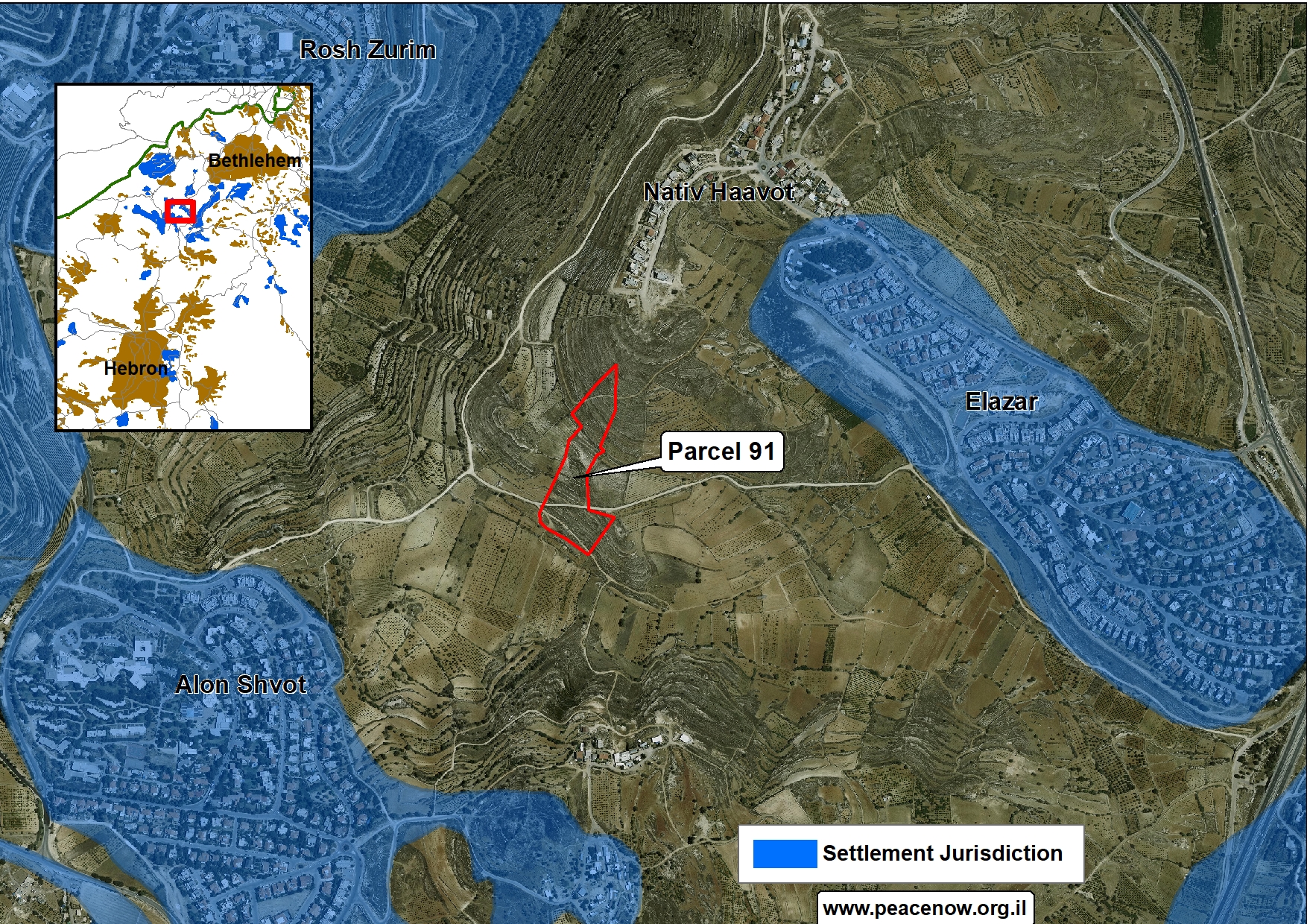
Map by Peace Now
In addition to Peace Now’s comprehensive recap of the Netiv Ha’avot saga, FMEP has covered the efforts of the Israeli government to exploit the evacuation of settlers from 15 homes in the Netiv Ha’avot outpost as an opportunity not only to advance construction in the Elazar settlement, but also to build an entirely new outpost as “temporary” housing for the settlers. The “temporary” outpost – where 15 mobile homes are parked – and connected to Israeli water, power, sewage, roads, and other infrastructure – is located outside of the borders of the Alon Shvut settlement. That fact did not stop the High Planning Council (a body within the Israeli Civil Administration which regulates planning and building in the West Bank) from approving the plan, noting that “the plan is improper, but we will have to approve it as a temporary solution.” As part of its approval of the plan, the Council ordered the government to take steps towards expanding the borders of the Alon Shvut settlement to include the area on which the outpost has been established, underscoring the meaninglessness of the word “temporary” in this context.
In addition to the new outpost/expansion of the Alon Shvut settlement, the State is also planning to retroactively legalize and expand the Netiv Ha’avot outpost – proving once again that Israel does not punish settler law-breaking, but instead handsomely rewards it.
Settlers Blame Obama for Slowed Israeli Population Growth in the West Bank
According to new data published by the Council of Jewish Communities in Judea and Samaria, the 2018 settler growth rate came in at 3%, compared to 3.4% in 2017. This is the tenth consecutive year that the settler growth rate has declined. In explaining the numbers, settlers are pointing fingers at former U.S. President Barack Obama, citing his policies opposing settlement construction (which was in line with the policies of every previous U.S. president since 1967) as the reason for the decline in the settler population growth rate. The head of the Council, Hananel Dorani, said:
“We’re happy to see that the number of residents in the area is growing, but in recent years there hasn’t been enough construction in the settlements…the relatively slow rate of construction is the result of, among other things, an eight-year construction freeze [there was no such freeze], and today only small-scale plans are being approved [demonstrably incorrect]. These figures are a shout out to the next government: We will be demanding more of an effort to clear obstacles to construction in Judea and Samaria and the Jordan Valley. This is the way to continue promoting the settlements and even increase the housing available in Israel, and as a result lowering [housing] prices.”
Israeli Justice Minister Stands with Families of Suspects in Deadly Jewish Terror Attack
Five Israeli settlers from the Rehelim settlement were arrested in connection with the murder of a Palestinian woman in October 2018. The suspects – who are minors and therefore unidentified in the press – are alleged to be responsible for throwing stones at a Palestinian vehicle, resulting in the death of Aisha Rabi, a mother of nine. The Israeli Shin Bet has since come under fire from Israeli politicians for the way it has handled the case, and settler leaders have offered blanket public support for the suspects and their families while leveling harsh criticism at the Shin Bet for its work to close the case. Israeli Justice Minister Ayelet Shaked went as far as to meet with the suspects’ parents in a display of solidarity with the families’ in their accusations against the Shin Bet’s work on the case.
Meretz chairwoman and Member of Knesset Tamar Zandberg sharply criticized Minister Shaked for the meeting, saying that Shaked has:
“different standards for Jews and Arabs…Instead of doing soul searching, (Shaked) is making an electoral calculation and running into the arms of families accused of terror.”
Breaking the Silence Launches New Tour of Central West Bank Settlements
The Israeli organization Breaking the Silence has launched a new political tour of the West Bank, focusing on settlements, Israeli government policy, and the goal of the occupation. After previewing the new tour, Haaretz columnists Gideon Levy and Alex Lavec write:
“during this seven-hour journey, an unvarnished picture emerges: The goals of the occupation were determined immediately after the 1967 war. Every Israeli government since, without exception, has worked to realize them. The aim: to prevent the establishment of any Palestinian entity between the Jordan River and the Mediterranean Sea, by carving up the West Bank and shattering it into shards of territory. The methods have varied, but the goal remains unwavering: eternal Israeli rule. That goal hasn’t been implemented only by right-wing zealots, but by the very establishment of Israel, its governmental agencies, with the backing of the judiciary and the media. On the road to a million settlers, the first million – all means were justified. Now, as that target draws closer, the central goal is the development of infrastructures. The separate roads, deceptive with their bypass routes, the tunnels and the interchanges, all of these are more fateful than another flood of settlers. They allow every settler to live in relative security, not to see Palestinians and not to hear about their existence, to live cheaply and to get to work in Israel fast. That’s the secret that’s made it possible for 650,000 Israelis to violate international law and norms of justice, to live in occupied areas and feel good about themselves. The occasional few bones that the occupier throws the occupied allows life under the boot to continue without excessive resistance.”
Breaking the Silence continues to run its flagship tours of Hebron and the south Hebron Hills, which attract approximately 5,000 participants each year to see the impact of Israeli occupation policies and radical settlers living in Hebron. Breaking the Silence staff are veteran combatants who speak out about the reality of what it means to serve as an occupying power over the Palestinians. Breaking the Silence has been a central target of the Israeli government in attempts to silence groups critical of Israeli policies by cutting their funding, criminalizing and restricting their operations, and waging smear campaigns against staff members.
Bonus Reads
- “Expanding the Limits of Jewish Sovereignty: A Brief History of Israeli Settlements” (Haaretz)
- “Israeli Housing Project in West Bank Would Surround Bethlehem with Settlements” (Haaretz)
- “Palestinians Are Right to Outlaw Selling Land to Settlers” (The Forward)
- “How Israel Usurps Palestinian Land In Calculated Stages” (Haaretz)
- “Peace Cast: West Bank Settlements” (Americans for Peace Now)
- “Minister Shaked says she changed the judicial system’s mindset” (World Israel News)
Welcome to FMEP’s Weekly Settlement Report, covering everything you need to know about Israeli settlement activity this week.
To subscribe to this report, please click here.
January 4, 2019
- Israel Advances Plans for 2,191 New Settlement Units – Including Establishing 2 New Settlements & Laying Groundwork for 2 New Settlement Industrial Zones
- Based on New Legal Tools to Take Palestinian Land, Israel Announces Intention to Build A New Settlement (“Givat Eitam/E-2”) Near Bethlehem
- Following High Profile Political Support, Settlers Violently Resist Evacuation from Amona Outpost Site
- Knesset Speaker & Leaders Call for Annexation of Hebron
- Regavim Petitions Jerusalem District Court to Stop the EU-Backed “Arab Takeover” of Area C
- Knesset Lawyer Criticizes Bill to Give Palestinian Land to the World Zionist Organization
- Sheldon Adelson’s Medical School in Ariel Settlement May Not Open
- Bonus Reads
Questions/comments? Email kmccarthy@fmep.org
Israel Advances Plans for 2,191 New Settlement Units – Including Establishing 2 New Settlements & Laying Groundwork for 2 New Settlement Industrial Zones

Map on Twitter by @JacobMagid
During its final meetings of 2018 (held on December 26th and 27th), the Israeli Civil Administration High Planning Council advanced plans for a total of 2,191 new settlement units. Peace Now reports that 87% of the settlement plans advanced are located deep inside of the West Bank, far beyond any of the negotiated parameters for a border between Israel and a future Palestinian state.
The flood of settlement approvals includes plans that will effectively create two new settlements (by legalizing the unauthorized outposts of Ibei Hanachal and Gva’ot, detailed below) and establish two new settlement industrial zones (one near the Beitar Illit settlement and one near the Avnei Hefetz settlement). Another plan, for an educational campus and a gas station, will serve to connect the unauthorized outpost of Mitzpeh Danny to a nearby settlement (Ma’aleh Mikhmash) – paving the way towards the eventual legalization of that outpost, creating yet another new settlement.
Of that total, plans for 1,159 units were given final approval for construction – meaning building permits can be issued immediately. These include
- 220 new units in the Givat Ze’ev settlement;
- 180 new units in the Neveh Daniel settlement;
- 135 new units in the Tene settlement;
- 120 new units in the Karmei Tzur settlement;
- 129 new units in the Avnei Hefetz settlement (where plans to build a new, noncontiguous industrial zone nearby were also advanced – see below);
- 61 new units in the Tzofim settlement;
- 42 new units in the Alfei Menashe settlement;
- 55 new units in the Tomer settlement;
- 18 new units in the Adora settlement;
- 16 new units in the Metzad settlement;
- 1 new units in the Shilo settlement; and,
- 62 new units in the Ma’aleh Mikhmash settlement;
-

Map by Peace Now
A plan to build an educational campus and a gas station between the Malakeh Mikhmash settlement and the unauthorized outpost of Mitzpeh Danny. Peace Now writes, “Although this is not a residential program, these buildings also qualify as the establishment of a new settlement complex in the West Bank. The plan covers 140 dunams and will create a permanent presence of hundreds of Israeli students and teachers…During the discussion it was noted that the Mateh Binyamin Regional Council is preparing a plan to regulate the outpost.”
- A plan to build a cemetary on an area of “state land” south of the Palestinian city of Qalqilya. The area used to be a closed firing zone, but that military designation was rescinded years back, and the site has since been the subject of settlement planning. Peace Now writes, “The planned cemetery is likely to be the first component on the road to the establishment of an industrial zone, which is also a type of settlement.”
Settlement plans that were advanced through earlier stages of the planning process include:
-
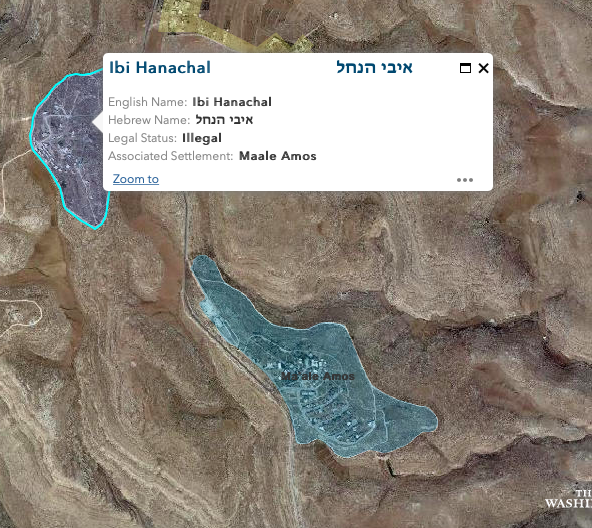
Map by WINEP
A plan for 98 units in the unauthorized Ibei Hanachal outpost, which will turn the outpost as a “neighborhood” of the Maale Amos settlement. In reality, the outpost is not contiguous with the built-up area of the Maale Amos settlement, meaning that the implementation of this plan will, in effect, create a distinct new settlement.
- A plan for 61 new units in the unauthorized Gva’ot outpost, an outpost originally built in 1999 by the settlers as a “neighborhood” of the Alon Shvut settlement. The settlers built a yeshiva there, but abandoned it not long after. The new settlement plan is for a public building, likely an educational institute with housing.
- 82 new units in th Ofra settlement. FMEP reported on this plan in the Dec 14th edition of the Settlement Report, in conjunction with the litany of punitive settlement plans advanced by Israel in response to terror attacks. The area where the new units are slated to be built is land that was allegedly purchased by the settlers from its original Palestinian owners.
- Plans for two new settlement industrial zones, one near the Beitar Illit settlement and one near the Avnei Hefetz settlement. The latter industrial zone, called Bustani Hefetz, will cover a large area of land (some 730 dunams) and will not be not contiguous with any other settlement. Peace Now writes, “an industrial zone of this scope, which is cut off from any other settlement, in all actuality constitutes a new settlement.”
- 121 new units in the Yitzhar settlement, where the IDF has been trying to rein in the violence perpetrated by the “Hilltop Youth” settlers, who are based in Yitzhar.
- 152 new units in the Shavei Shomron settlement.
- 212 new units in the Har Bracha settlement.
- 94 new units in the Beit Haggai settlement.
- A plan to legalize 75 existing settlement units in the Shvut Rachel settlement, which Israel considers a “neighborhood” of the Shiloh settlement.
- 100 new units in the Halamish settlement.
Peace Now released a statement saying:
“In 2018, the government advanced thousands of housing units, including most which can be found in isolated settlements deep inside the West Bank that Israel will eventually have to evacuate. Those who build these places have no intention of achieving peace and a two-state solution. The latest announcement, which as an aside was cynically passed on Christmas while most Western governments are on holiday, shows that Netanyahu is willing to sacrifice Israeli interests in favor of an election gift to the settlers in an attempt to attract a few more votes from his right-wing flank.”
Top Palestinian negotiator, Saeb Erekat, released a statement saying:
“While the world is celebrating Christmas with its spirit of peace and joy, the Grinch ‘occupation’ decided to steal the Christmas spirit from the people of Palestine. As part of his early election campaign, the Israeli Prime Minister Benjamin Netanyahu has as well stolen more Palestinian land and resources for the benefit of Israel’s illegal colonial settlement expansion. Such illegal actions are a deliberate campaign to destroy the two-state solution and to prevent the establishment of an independent and sovereign State of Palestine with East Jerusalem as its capital.”
Tamar Zandberg, head of the Meretz Party, slammed the new announcements, and previous decisions taken by the government to retroactively legalize 60 outposts. Zandberg said:
“The Israeli government has become a settlement government. (MKs Bezalel) Smotrich, Moti Yogev, (Justice Minister) Shaked and (Education Minister) Bennett are its landlords. They exploit the (Palestinian) attacks to build more settlements. But the truth needs to be said. To achieve security we need to evacuate settlements, not build more and more…”The 60 new settlements are the real threat to Israel’s security and to IDF soldiers. The pogroms they are waging in Palestinian villages. The stone-throwing, the shooting and the uprooting of the trees. This is the danger to our moral image and our security! They eight seats of Habayit Hayehudi party dictate eight million lives.”
Based on New Legal Tools to Take Palestinian Land, Israel Announces Intention to Build A New Settlement (“Givat Eitam/E-2”) Near Bethlehem
On December 26th, the Israeli Civil Administration announced that it will draft plans to build as many as 2,500 new settlement units at the Givat Eitam outpost site, creating a new settlement on a strategic hilltop that will cut off Bethlehem from the southern West Bank, completing the near encirclement of Bethlehem by Israeli settlements.
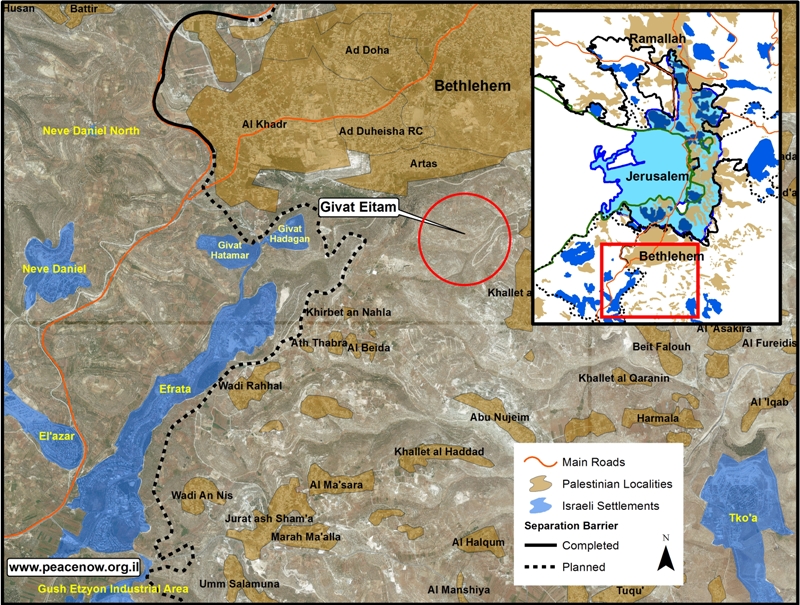
Map by Peace Now
For years, settlers have lobbied for construction at the site, but those efforts have been stymied by the lack of a legal access road to the outpost, which is surrounded by land that even Israel recognizes is privately owned by Palestinians. Until recently, Israel has balked at seizing private land from Palestinians for the exclusive benefit of the settlements. But now, several new legal opinions have allowed Israel to violate the private property rights of Palestinians for the sole purpose of legalizing settlements and settlement infrastructure. Those legal opinions include the “market regulation” principle, the opinion(s) regarding the Haresha outpost case, and the Regulation Law. It is unclear which legal argument will be applied to the Givat Eitam/E-2 case.
The Givat Eitam outpost has been nicknamed “E-2” by settlement watchers for for its resemblance, in terms of dire geopolitical implications, to the infamous E-1 settlement plan. Located east of the separation barrier on a strategic hilltop overlooking the Palestinian city of Bethlehem to its north, Givat Eitam/E-2 is located within the municipal borders of the Efrat settlement but is not contiguous with Efrat’s built-up area, making Givat Eitam/E-2 effectively a new settlement that, according to Peace Now, will:
“block Bethlehem from the south, and prevent any development in the only direction that has not yet been blocked by settlements (the city is already blocked from the North by the East Jerusalem settlements of Gilo and Har Homa, and from the West by the Gush Etzion Settlements) or bypass roads (that were paved principally for Israeli settlers). The planned building in area E2 would likely finalize the cutting off of Bethlehem city from the southern West Bank, delivering a crushing blow to the Two States solution.”
In September 2018 FMEP reported that the local council of the Efrat settlement encouraged the start of (unauthorized) construction of an outpost at the Givat Eitam/E-2 site (presuming that any such illegal construction would be retroactively legalized by the government) in response to a Palestinian terror attack in the Efrat settlement. Since then, the Civil Administration has allowed the settlers to build and maintain an agricultural farm there.
FMEP tracks all developments related to Israeli legislative, cabinet, and judicial action that promotes the retroactive legalization of outposts built on privately owned Palestinian land as part of its documentation of creeping annexation – available here.
Following High Profile Political Support, Settlers Violently Resist Evacuation from Amona Outpost Site
On January 3rd, 23 Israeli police officers were injured by Israeli settlers and their supporters who violently resisted the court-ordered evacuation from illegal encampments erected on privately owned Palestinian land as part of an effort to re-establish the Amona outpost. Approximately 300 settlers showed up at the Amona site (which is currently a closed military zone) overnight to resist the removal of settlers and two caravans from the hilltop, which was ordered by the Jerusalem District Court. The settlers and their supporters burned approximately 300 tires at the entrance to the outpost, poured oil on the access roads, and threw rocks and boulders at the Israeli police. Seven suspects were arrested and quickly released.
The evacuation of the outpost was reportedly carried out in defiance of a direct order from Prime Minister Netanyahu. According to the Haaretz report, Netanyahu gave orders to the Israeli military secretary, Col. Avi Bluth, to stop the evacuation. Col. Bluth did not relay the message in time, and the evacuation was carried out. Now, Netanyahu has ordered a disciplinary hearing to investigate the actions of Col. Bluth, which is scheduled for January 4th.
The violent evacuation of settlers from the Amona hilltop follows a week of high profile support for their efforts. Israeli Cultural Minister Miri Regev attended a ceremony near the recently re-established (yet unauthorized) Amona outpost to express her support for authorizing construction on the hilltop – which, according to the Israeli High Court of Justice, is privately owned Palestinian land. Regev could not go to the actual Amona site, because the area is a closed military zone where no one (settlers, politicians, and even the Palestinians who own the land) is permitted to enter. Regev and the settlers claim that the hilltop land has been legally purchased by the settlers, but that claim has not been investigated, much less verified. Casting doubt on the settlers’ claims, Haaretz notes:
“The lot in question is jointly owned by several different Palestinians, which means every single one of them would have to consent to the purchase for it to be legal. It’s not clear which, if any, of these Palestinians signed the sale document. In the end, the land was designated military land, is zoned for agriculture and has no building permits.The Binyamin Regional Council didn’t await the administration’s decision before moving two prefab homes into Amona and providing basic infrastructure such as water tankers.”
Israeli Attorney General Avichai Mandleblit slammed the settlers for trespassing and illegally moving caravans onto the site. Mandelblit criticized MK Bezalel Smotrich and the heads of regional settlement councils who went to the site to express support, saying:
“Breaking the law with the support of public figures, like placing caravans on privately-owned lands, can’t be a source of pride.”
A Haaretz report recently revealed Bezalel Smotrich was a founding member of a non-governmental group called Ofek Lehityashvut, which directly financed the illegal reestablishment of the Amona outpost last month by purchasing the two caravans that settlers moved onto the hilltop. The Haaretz report goes on to reveal that the Benyamin Regional Council has purposefully tailored various calls for proposals so that Ofek Kehityashvut would be the only group qualified to receive financing for that project. As a result of that manipulation, Ofek Kehityashvut has received substantial amounts of funding from the Benyamin REgional Council, which is an Israeli-taxpayer funded entity.
Knesset Speaker & Leaders Call for Annexation of Hebron
The speaker of the Israeli Knesset, Yuli Edelstein (Likud), called for Israel to apply its sovereignty over the city of Hebron – which would constitute an act of de facto annexation. Edelstein released a statement announcing his intention to go on a tour of Hebron – where some 500-800 settlers live under Israeli military protection amongst 200,000+ Palestinians – with the far-right, pro-annexationist group Im Tirzu. In the statement he wrote:
“In my view, it’s delusional that some Knesset members dare to undermine the Jewish people’s right to dwell in the city of our forefathers,” Edelstein said in a press statement issued prior to the conference. “We’re developing Hebron, investing in it and inculcating its importance in future generations. We are saying clearly – sovereignty in Hebron first.”
Speaker Edelstein also participated in a conference highlighting Israel’s historic connection to the city of Hebron. Organized by the Knesset Land of Israel Lobby, the event culminated in the signing of a document that reads:
“We, the undersigned, hereby express deep solidarity with the roots of the Jewish people in Hebron and the support of the Jewish community in Hebron that has clung to the city despite all the difficulties. We declare an unambiguous commitment to the continued existence, security and prosperity of Hebron as the city of both our forefathers and children.”
The event was co-organized by MK Bezalel Smotrich (Jewish Home) who said:
“Hebron is a litmus test. What is happening in Hebron shows our Jewish pulse….[those who call for settlers to leave Hebron] understand very well that if Hebron grows and develops, the entire settlement enterprise will grow and develop, so they invest in harming Hebron. But they will continue to shout and complain while we will continue to build, reach the people and connect with our roots.”
Regavim Petitions Jerusalem District Court to Stop the EU-Backed “Arab Takeover” of Area C
Following the Knesset’s passage of a bill in July 2018 that brought many West Bank legal matters under Israel’s domestic jurisdiction (an act of de facto annexation), the Jerusalem District Court is set to hear its first case concerning land disputes in the occupied territory. The bill was sponsored by Israeli Justice Minister Ayelet Shaked, whose three-fold rationale for the bill explicitly states that its purpose is to help settlers take more Palestinian land and shut-down Palestinian challenges to such thefts — by bringing matters to the Jerusalem Court instead of the High Court of Justice, which Shaked believes is too concerned with Palestinian rights and international law. The bill is part of the legislative body’s broader effort to erase all remaining distinctions (legal, judicial, economic, and otherwise) between sovereign Israel and the occupied territories, distinctions which allowed Israel to preserve the guise of respect for rule of law, and good intentions, for the last 50 years.
Looking to cash in the bill’s explicit purpose, the radical settler group Regavim initiated the petition asking the court to intervene to stop the “illegal Arab takeover” of land in the West Bank. Regavim’s petition claims that Palestinians are cultivating “state land” near the Mezad settlement. The petition also blames the European Union for its financial backing for the agricultural projects on the land. (Note: Regavim, like most settler media outlets, uses the word “Arab” to describe Palestinians, a vocabulary choice meant to erase any recognition of Palestinian identity).
A coordinator for Regavim told the Arutz Sheva outlet:
“The intervention of the European Union in what is happening in Area C is a brazen and aggressive intervention. We see extensive involvement on their part in lawbreaking and invading state land throughout Judea and Samaria. Their symbols are everywhere, and the State of Israel must respond to this blatant intervention on the diplomatic level as well.”
Shlomo Ne’eman, head of the Gush Etzion Regional Council said:
“The direct involvement of the European Union in financing Arab squatters in the territories and state lands has already become a plague on the state. We congratulate Justice Minister Ayelet Shaked on the obvious step that has led to great logic and justice in reducing the burden on the Supreme Court and in uniform enforcement against the land grabs by hostile elements…the Arabs understand that the real battle is on the ground. Foreign countries with their money are trying to shape a false consciousness and finally change the map of the state, but nothing can change history and our natural belonging on our national land.”
FMEP tracks the application of domestic Israeli law over the occupied West Bank (the de facto annexation of the West Bank) on its Annexation Policy Tables, which are regularly updated.
Knesset Lawyer Criticizes Bill to Give Palestinian Land to the World Zionist Organization
The legal advisors to the Knesset Constitution, Law and Justice Committee criticized a bill that would transfer vast tracts of land in Area C of the West Bank to the Settlement Division of the World Zionist Organization (WZO), a quasi-private state-funded entity that works to establish and expand settlements in the West Bank. Despite pressure to pass the bill, the legal advisors called on the committee to reexamine the text over concerns that it would also give the WZO authority over Palestinian communities in Area C. The experts wrote in a legal opinion for the committee:
“The proposed definitions of ‘rural settlement’ and ‘land’ do not include references to the character and nature of the settlement, and it seems that land that is government or abandoned property intended for Palestinian rural settlement will also be included in the boundaries of the proposed arrangement, and will be transferred to the management of the Settlement Division. Is the intention of the bill that the Settlement Division will also manage the Palestinian rural settlement in the area?”
As FMEP has previously reported, the bill was proposed by MK Bezalel Smotrich (Habayit Hayehudi) to accelerate the transfer of almost all of the land in Area C to the control of the World Zionist Organization. The land transfer is, in fact, taking place at the bureaucratic level, but Smotrich and the Israeli Cabinet (which endorsed the bill) are increasingly frustrated by the slow pace of the transfer (and perhaps also the limited scope of land slated to be handed over). Israeli Attorney General Avichai Mandelblit expressed his opposition to the bill, saying it is unnecessary given that ministry staffs are already working to transfer more land to the WZO through an administrative process.
In June 2018, when the Knesset gave preliminary approval to the bill, Peace Now responded:
“the government is scandalously planning to give the biggest land thieves responsibility for managing the land distribution, which will continue to be done under the cover of darkness if the bill passes into law.”
For more information on this bill, read a comprehensive background briefing by Peace Now.
Sheldon Adelson’s Medical School in Ariel Settlement May Not Open
The state-of-the-art medical school planned to be built in the Ariel settlement is now in danger of not opening, after a letter from the Israeli Justice Ministry warned that the school’s approval is in jeopardy. The Justice Ministry discovered an undisclosed conflict of interest that voids an important vote in favor of approving the school by the planning and budgeting subcommittee of the Higher Education Council. A member of the subcommittee, Dr. Rivka Wadmany-Shauman, allegedly met with the heads of Ariel University ahead of the vote, and made her approval of the new medical school conditional on being promoted to the rank of professor. Israel Hayom reports the Ariel University has already shelved plans to inaugurate the new school for its first semester in the Fall of 2019.
As FMEP has previously reported, Ariel University became an accredited Israeli university in 2012, following significant controversy and opposition, including from Israeli academics. It has since been the focus of additional controversy, linked to what is a clear Israeli government-backed agenda of exploiting academia to normalize and annex settlements. In 2018, the settlement broke ground on the new medical school, with significant financial backing from U.S. casino magnate and settlement financier, Sheldon Adelson. In February 2018, in an act of deliberate de facto annexation, the Israeli Knesset passed a law that extends the jurisdiction of the Israeli Council on Higher Education over universities in the settlements (beyond Israel’s self-declared borders), ensuring that the Ariel settlement medical school (and its graduates) are entitled to all the same rights, privileges, and certifications as schools and students in sovereign Israel.
As a reminder, Ariel is located in the heart of the northern West Bank, reaching literally to the midpoint between the Green Line and the Jordan border. The future of Ariel has long been one of the greatest challenges to any possible peace agreement, since any plan to attach Ariel to Israel will cut the northern West Bank into pieces.
Bonus Reads
- “Israeli settlements threaten to engulf West Bank communities” (Al-Monitor)
- “Israeli settlement activity appears to surge in Trump era” (AP)
- “It Pays Off to be an Israel Settler, Whether Trespasser or Landowner” (Haaretz+)
- “In the West Bank, the Israeli army works for the settlers” (Haaretz)
- “Netanyahu’s pro-settler allies force annexation into campaign agenda” (Al-Monitor)
Welcome to FMEP’s Weekly Settlement Report, covering everything you need to know about Israeli settlement activity this week.
To subscribe to this report, please click here.
December 21, 2018
- Israel Nears Final Move to Carry Out Massive Land Theft to “Regulate” Illegal Outposts
- Ministers Back a Bill to Legalize 66 Outposts
- In New Legal Opinion, Israeli AG Outlines Strategy for Legalizing Outposts
- New Outpost #1 : Settlers & Government Officials Illegally Re-Build Amona Outpost
- New Outpost #2: Settlers Build Outpost Overlooking Hebron
- More Details on the Plan to Dig a Tunnel Road to the Haresha Outpost
- High Court Criticizes State Over Illegal Road on Palestinian Land
- New Report Documents Israel’s “Severe and Regular” Violation of International Law in Hebron
- High-Rise Settlement Housing Promoted As a Means to Achieve 2020 Settler Vision & As a Solution to Israel’s Affordable Housing Shortage
- Fourth Quarter Decline in 2018 Settlement Construction Starts Doesn’t Tell the Whole Story
- Bonus Reads
Questions/comments? Email kmccarthy@fmep.org
Israel Nears Final Move to Carry Out Massive Land Theft to “Regulate” Illegal Outposts
As has become routine, Israeli settlers and their allies in government are exploiting the recent deaths of three Israelis (two soldiers and a baby) at the hands of Palestinian attackers as an opportunity to accelerate settlement-related activities. This includes advancing new legislation and accelerating/expanding the application of new legal tools designed to entrench and expand the permanence of some of the most radical Israeli settlers living in isolated outposts across the West Bank.
If implemented, the plans and legislation detailed below (and in last week’s settlement report) will expropriate huge amounts of land that even Israel recognizes as privately owned by Palestinians, in order to retroactively legalize Israeli outposts scattered across the West Bank. Such a move will complete what has been a gradual but steady formal suspension of even the pretense of maintaining the rule of law with regard to Israeli settlers’ or the Israeli government’s’ actions in the West Bank (which comes on top of Israel’s official and open contempt for international law). As Haaretz columnist Zvi Bar’el writes:
“The legal criminality that the government invented in honor of the settlers… is an unbridled attack on the rule of law, the undermining of Palestinian landowners’ right to appeal at the High Court, and the destruction of the planning and building system. And mainly, it turns terror into a real estate perk for lawbreaking extortionists.”
Americans for Peace Now said:
“In reaction to murderous terrorist attacks targeting West Bank Jewish settlers and Israeli soldiers, the government of Israel has come under pressure from the settlers to exact retribution against Palestinians. Two of the measures adopted are bound to open the floodgates for the legalization of existing settlement-outposts and the establishment of new ones.”
Ministers Back a Bill to Legalize 66 Outposts
On December 16th, the Israeli Cabinet voted unanimously to give government backing to a bill (called “Regulation Law 2” or the “Young Settlement Bill”) that directs the government to treat 66 illegal outposts built on privately owned Palestinian land as legal settlements, while giving the government 2 years to find a way to retroactively legalize those outposts.
The bill, proposed by MK Bezalel Smotrich (Habayit Hayehudi) and MK Yoav Kisch (Likud), also freezes any/all legal proceedings against the outposts and requires the government to connect the outposts to state infrastructure including water, electricity, provide garbage removal, and also approve budgets for them. The law also allows the finance minister to guarantee mortgages for settlers seeking to buy units in these outposts, even before the legal status of the land is resolved (a remarkable state-directed violation of normal practices in the mortgage industry). With government backing, the bill will now be introduced in the Knesset, where it must pass three readings before becoming law.
Though this bill has been ready for months, the Cabinet decided to advance the bill now in response to recent Palestinian terror attacks. MK Smotrich said: “This is the definitive answer to the murderous terrorism of the Arabs.” This sentiment was echoed widely across the settler movement.
The Cabinet voted to support the bill despite strong opposition from the Israeli Attorney General’s office. Deputy AG Ran Nizri told the Cabinet ahead of the vote that the bill has “significant legal problems,” represents a sweeping violation of the property rights of Palestinians in the West Bank, and will likely face a drawn out Court battle that might result in the High Court of Justice overturning the law. Notwithstanding these seemingly principled arguments opposing this tactic for legalizing outposts, it should be recalled that the Attorney General’s office has proposed what it believes is a more defensible means means to accomplish the same ends – called the Market Regulation principle (discussed below).
The Jerusalem Post speculates that passage of the “Regulation Law 2” in the Knesset may not be automatic, in light of past instances where international condemnation of such moves to legalize outposts led to hold-ups. The Times of Israel points out that the Trump Administration has failed to express any criticism about the new bill, which is unsurprising given Trump Administration officials’ statements and actions embracing and normalizing the settlements.
Israeli Justice Minister Shaked praised the bill, saying:
“[the bill is a] clear statement that will legalize young settlements [outposts] in Judea and Samaria. In the last three years, we changed the conversation from one of evacuation to one of legalization. There is no reason for the residents of Judea and Samaria to always have to live under the sword of evacuation.”
Peace Now said:
“Another populist and unconstitutional initiative is approved by the settler government, and only in such a state can an ‘illegal settlement’ be classified as a ‘young settlement.’ The settlers’ violence against Palestinian passerby that we witnessed during the weekend is a direct result of the government’s policy and of such bills that actually telling the settlers that they are above the law and whatever violation of the law the make, the government will legalize it.”
The bill is a follow-up to the first Regulation Law, which was passed by the Knesset in February 2017 but has since then been frozen by the High Court of Justice while it considers the law’s constitutionality. One month after passage of the Regulation Law, the Israeli Cabinet passed a resolution to enact the law expeditiously, at which point the cabinet created a committee – now headed by settler leader Pinchas Wallerstein – to build a list of outposts which the government can retroactively legalize and to complete the bureaucratic work required to do so. Wallerstein – who has a long history of ignoring Israeli law but is now responsible for massaging it to suit his needs – has been vocal about what the government can do immediately, telling the Knesset in October 2018 that there are at least 20 outposts which can be “easily” legalized as neighborhoods of existing settlements, and 50 more outposts that can be legalized but require more complex solutions.
The outposts slated to be legalized are scattered across the West Bank, many of which FMEP has reported on regularly, including: Haresha (the center of recent legal maneuvers aimed at legalizing an access road built on privately owned Palestinian land); Givat Assaf (where two Israeli soldiers were killed on December 13th); Havat Gilad (another outpost which gained political support following a Palestinian terror attack); Yitzhar South, Yitzhar East (satellites of the radical and violent Yitzhar settlement near Nablus; Ma’ale Rehavam (which was built on privately owned Palestinian land that the WZO illegally allotted to the settlers); Mitzpe Kramim (where once again the WZO gave settlers land owned by Palestinians. A court recently ruled the WZO acted in “good faith” in the transaction despite evidence to the contrary); Netiv Ha’avot (FMEP extensively covered the saga of Netiv Ha’avot); and, Adei Ad (a violent outpost that has been approved to be added to the jurisdiction of the new Amichai settlement in the Shilo Valley).
FMEP tracks all developments related to Israeli legislative, cabinet, and judicial action that promotes the retroactive legalization of outposts built on privately owned Palestinian land as part of its documentation of creeping annexation – available here.
In New Legal Opinion, Israeli AG Outlines Strategy for Legalizing Outposts
On December 13th, Israeli Attorney General Avichai Mandleblit issued a new legal opinion outlining how the government can implement the “market regulation” principle (which he invented) as a new legal basis for retroactively legalizing outposts and settlement structures built on privately owned Palestinian land. According to this principle – which contradicts any notion of rule of law or the sanctity of private property rights – settlement structures and outposts built illegally on private Palestinian land, can be legalized, if the settlers acted “in good faith” when they took over and built on the land. His opinion and subsequent arguments to the Israeli High Court of Justice (below) confirm that in the view of the Israel’s top law official, Israel has the right to expropriate privately owned Palestinian land in the occupied West Bank and give it to Israeli settlers; the only disagreement he has with the Knesset is over the method of doing so.
Peace Now has a comprehensive breakdown of the new legal opinion, including the specific criteria outlining which outposts can qualify under the new scheme. AG Mandelblit estimates that 2,000 illegal settlement structures qualify for retroactive legalization using this principle,
The Israeli government has already used the “market regulation principle” in court twice, both in defending against lawsuits filed by Palestinians (first in response to petitions by Palestinian landowners against structures on their land near the Ofra settlement, second in response to petitions filed by Palestinian landowners against the Mitzpe Kramim outpost). This week’s move by the Attorney General allows the government to proactively initiate proceedings to retroactively legalize unauthorized outposts and settlement structures.
Reportedly, the Attorney General prepared this legal opinion a while back, but was stopped from publishing it by Prime Minister Netanyahu, who was concerned about the international and diplomatic repercussions. It seems likely that the recent string of Palestinian terror attacks prompted Netanyahu to give the AG the green light to go ahead, along with advancing a number of other punitive settlement plans.
Shortly after approving the implementation of the “market regulation principle,” Mandleblit called on the High Court of Justice to overturn the Regulation Law, which the Court has been considering for more than a year. In a letter to the High Court Justices, Mandleblit argued that implementing the “market regulation principle” is “a more proportionate and balanced measure than the arrangement prescribed in the Regulation Law,” providing a more narrow legal basis by which Israel can strip Palestinian landowners of their rights (estimating that 2,000 structures can be legalized under the “market regulation principle,” compared to an estimated 4,000 under the Regulation Law). Of course, this argument overlooks the severe violation of Palestinian rights, the rule of law, and international law inherent in Israel’s decision to in effect erase Palestinian private property rights in the occupied territory to benefit the settlers.
Peace Now said:
“The attorney general is crossing yet another red line by laying the foundations for an institutionalized theft mechanism that will expropriate land from Palestinians and allocate it to settlers who stole it.This is part of a larger move led by AG Mandelblit to reduce the rights of Palestinians in the occupied territories and to expand the privileges of the settlers, thereby bringing us closer to an apartheid reality.”
FMEP tracks all developments related to Israeli legislative, cabinet, and judicial action that promotes the retroactive legalization of outposts built on privately owned Palestinian land as part of its documentation of creeping annexation – available here.
New Outpost #1 : Settlers & Government Officials Illegally Re-Build Amona Outpost
In recent days, dozens of Israeli settlers moved two mobile homes placed on the hilltop where the illegal Amona outpost once stood, claiming to have purchased the land from its Palestinian owners. Prominent settler leaders and MK Bezalel Smotrich (Habayit Hayehudi) visited the site to celebrate the resurrection of the infamous outpost, an endeavor which was directly supported and facilitated by the Binyamin Regional Council (a settlement regional authority which draws its budget from Israeli taxpayer funds).
Settlers have reportedly submitted documents to the Israeli Civil Administration which they claim prove the land has been legally purchased (a claim which, even if true, does not justify the settlers’ illegal invasion of and construction in an area designated by Israel as a closed military zone). The Civil Administration – which is the sovereign power over the West Bank and responsible for enforcing the law there – has confirmed that it is aware of the new outpost and has received documents from the settlers, but has not yet reviewed the documents.
Yesh Din, an Israeli NGO representing the Palestinian landowners, immediately filed a petition to have the illegal structures removed. Yesh Din also filed a criminal complaint against the Israeli government officials who were involved with invading the hilltop. As of this writing they have not received a response on either front. Peace Now has also stated it will pursue legal action against the settlers.
Yesh Din explains key context in the Amona outpost saga:
“After the evacuation [of the Amona outpost] in 2017, the Israeli army declared the area a closed military zone, prohibiting entry of Israelis and Palestinians to the area where the outpost had been located. The closure, however, was not enforced for Israelis, who freely entered, while Palestinians – including the legal landowners – were forbidden to enter and cultivate the very land for which they had struggled for years. In addition to the audacity of blatantly defying the High Court of Justice ruling and trampling on the rights of the landowners, the placing of the new structures this weekend violates the closure order and constitutes a further infringement of the law as the establishment of a new settlement in Amona was never authorized – certainly no permits or outline plans exist. But in the ‘land of the settlers,’ the concept of rule of law has long since lost any meaning. Any Israeli can decide to build a settlement on a hill, merely because they feel like it. The buildings then remain regardless of their illegality, Israeli authorities not daring to challenge their imposing presence.”
Benyamin Regional Council Chairman Yisrael Gantz said in a statement:
“After two years of this place being uninhabited, we are fortunate to resume Israeli life here. The plots upon which we erected the structures were legally purchased. Yesterday, I promised to establish a new settlement in Binyamin in response to the deadly attacks and today we are carrying it out.”
Yossi Dagan, head of the Samaria Regional Council said at the event:
“In these dark days, when terrorist attacks are so numerous and the honor of the people of Israel is harmed, we must get fired up and today’s ascent to Amona is an appropriate Zionist response.”
Peace Now said in a statement:
“There is no limit to the cynicism of the hilltop criminals who exploit the events of recent days to trample the law and ignite disturbances, all with public funds. These pyromaniacs are backed by Knesset members and local politicians… It is difficult to understand how an order has not yet been issued to evacuate them, and we ask whether the IDF and the police would have allowed this if they were Palestinians. This disgrace should be addressed today.”
Re-establishing the Amona outpost would hand a complete and total victory to the settlers who were forcibly evacuated from the site in 2017 – proving that not only does settler law-breaking go unpunished, but it is handsomely rewarded by the Israeli government, and that establishing illegal outposts is an effective route to establishing new settlements. Since being evacuated, the Amona outpost settlers have (so far) been “compensated” by the government with financial compensation and two new settlements:
- The first new government-backed settlement in 25 years, Amichai. The Israeli Civil Administration High Planning Council subsequently approved a plan to triple the size of the Amichai settlement to include the Adei Ad outpost and the lands between the two; and,
- The Shvut Rachel East settlement. This is an outpost that was granted authorization as a “neighborhood” of the Shilo settlement, but is properly understood as a new settlement unto itself. Teh Amona outpost settlers were first offered the Shvut Rachel East hilltop as a relocation site, but rejected it in favor of the nearby Amichai hilltop. Despite rejection, Shvut Rachel East received authorization anyways.
New Outpost #2: Settlers Build Outpost Overlooking Hebron
In recent days, a group of settlers have moved back into the site of an evacuated outpost near the city of Hebron, just north of the Kiryat Arba settlement, which settlers are calling Givat Mevaser. At a celebration of the decision by settlers to reestablish the outpost, the chairman of the Kiryat Arba settlement local council, Eliyahu Libman, said:
“We made a decision in light of the harsh news endured by the people of Israel last week to permanently move families into Givat Mevaser.”
The IDF was present at the celebratory event to protect the settlers, but an official at the Defense Ministry admitted that the settlers did not coordinate their actions with authorities. The site was previously approved to be developed into a settlement industrial zone, and according to a spokesperson for the new outpost, settlers are in the process of changing the building plan in order to get authorization for residential housing. Nonetheless, the settlers are at present violating Israeli law by taking up residence at the site.
More Details on the Plan to Dig a Tunnel Road to the Haresha Outpost
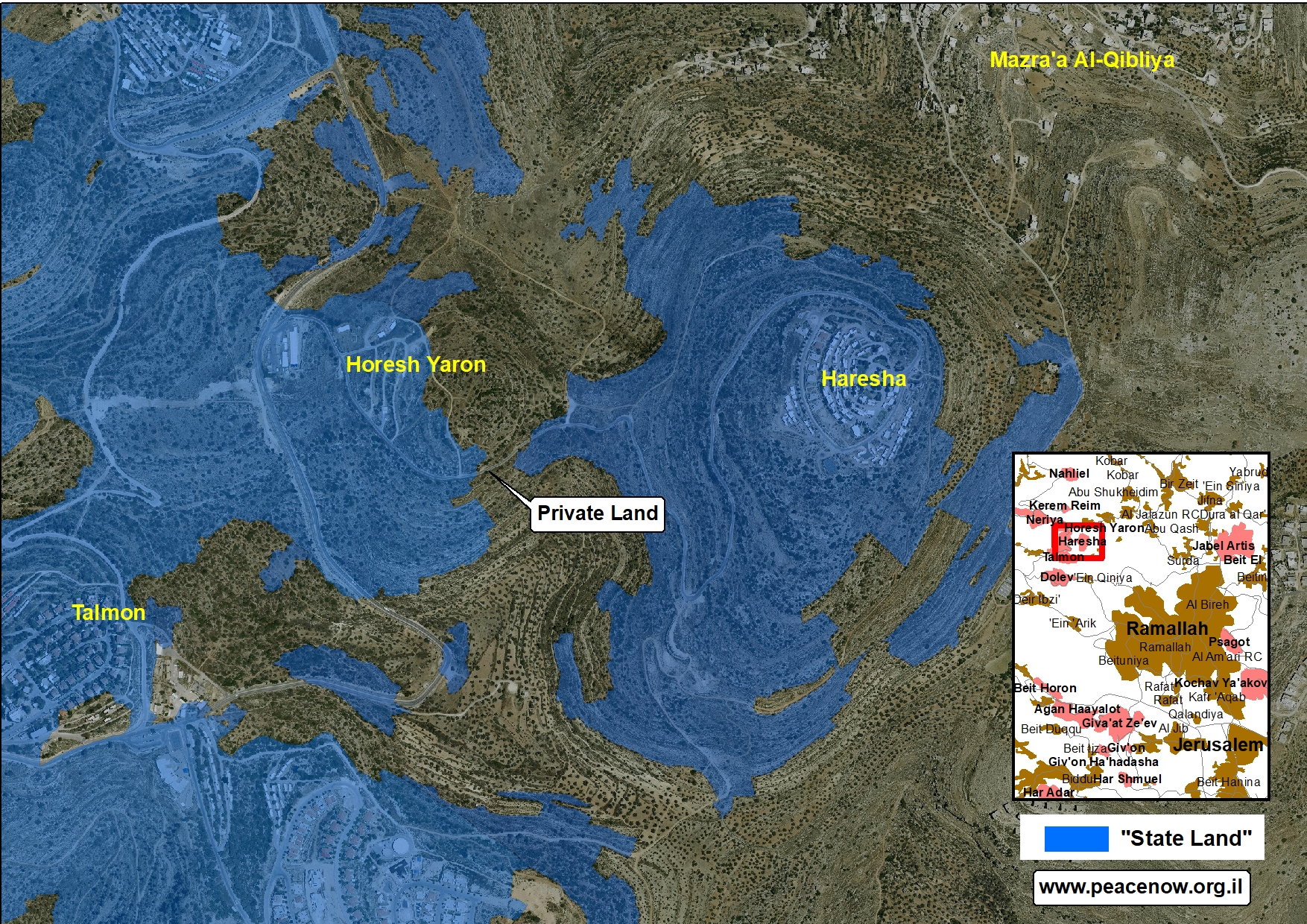 Kerem Navot has published a Justice Ministry opinion that provides further details on the government’s plan – approved on December 6th – to retroactively legalize the Haresha outpost by building a tunnel road underneath privately owned Palestinian land (an olive grove). The Justice Ministry document explains that while the Israeli government in principle has the right to permanently expropriate the land from its Palestinian owners, such an action would likely be challenged in the High Court of Justice, where it might be overturned. The Justice Ministry suggests instead that the government should “temporarily” expropriate the land while a tunnel is dug and road paved beneath the olive grove – with the plan being, ostensibly, to return the land to its Palestinian owners after construction is complete.
Kerem Navot comments:
“now, in order to legalize the outpost, shady legal advisers (of the type to whom Justice Minister Ayelet Shaked is drawn) write documents in which they lay down their doubts on whether to expropriate the grove ‘permanently,’ which will be cheaper and faster (but it is likely to be rejected by the High Court of Justice), or to ‘temporarily’ expropriate it solely for the construction of a tunnel through the ‘excavation and cover-up’ method.”
As a reminder, in November 2017 the Attorney General gave the Israeli government a green light to permanently expropriate the privately owned land based on a legal argument that holds Israeli settlers to be part of the “local population” of the West Bank, and therefore eligible to be the sole beneficiaries of state land expropriated for “public use.”
High Court Criticizes State Over Illegal Road on Palestinian Land
At a December 18th hearing, the High Court of Justice gave the government of Israel 60 days to explain why it should not be required to demolish a road and several buildings that were built on land that the state has admitted it believes is privately owned by Palestinians. The case is before the court on a petition by Palestinians who claim that a 200-meter (650-foot) stretch of the road is built on their land.
The Court also slammed the State for allowing the construction of the road and buildings to be completed after a stop-work order was issued against the construction, a stop-work order the State assured the Court would be implemented. At the December 18th hearing, an attorney from the State Prosecutor’s Office told the Court that the road in question was a dirt road, and argued that the state had not sanctioned or had a hand in its construction.
New Report Documents Israel’s “Severe and Regular” Violation of International Law in Hebron
Haaretz shares details from a leaked report written by the Temporary International Presence in Hebron (TIPH), which documents the totality of Israel’s policies in Hebron, serve to aid and protect settler and which collectively impose severe human rights violations and restrictions on Palestinians.
The report accuses Israel of being in “severe and regular breach” of international law, highlighting the many ways in which the human rights of Palestinians are systematically trampled on – specifically as it relates to radical settlers, their increasing activities in Hebron’s Old City, and the role of nearby settlements.
The Temporary International Presence in Hebron (TIPH) was first established in 1997 as part of the Oslo Accords’ Hebron Protocol, which allowed the partial redeployment of Israeli military forces to the part of the city that remained under its control. Israel must renew the TIPH’s mandate every six months; some fear that the next renewal has been jeopardized by the leaked report’s publication.
High-Rise Settlement Housing Promoted As a Means to Achieve 2020 Settler Vision & As a Solution to Israel’s Affordable Housing Shortage
Haaretz reports that the Yesha Council – the umbrella group representing all settlements in the West Bank – has adopted a strategic goal to advance “high quality, high density” settlement schemes in order to reach their goal of having 1 million settlers living in the West Bank by 2020. The basic idea is to build high-rise apartment complexes in settlements close to major highways in the West Bank and aggressively market them to Israelis who are seeking cheap rent and a fast commute, two key complaints of Israelis living and working in sovereign Israeli territory.
The strategy marks a shift in how settlements have typically been marketed to the Israeli public; once sold as an answer for young Israeli families looking for a single family unit with land, housing in settlements is now being marketed as the answer for young professionals looking for affordability, convenience and accessibility. The Yesha Council has coupled the new strategy with pressure on the government (and a promise to potential purchasers) to expedite West Bank infrastructure projects that will ease traffic, including bypass roads and detours around Palestinian towns.
In a February 2018 article, the Chairman of the Yesha Council wrote:
“Looking ahead, the patterns of thinking and action in the settlement movement need to be changed in two main areas: high-rise construction and doing away with admission committees. The available land for building is not plentiful. Until now, we’ve been used to rural communities with a one-family home on a half-dunam plot, but the goal from now on should be to build as many housing units as possible on that same land. High-density construction — building up or in a terraced fashion, depending on topography — will change the balance in the area and also require a new approach to infrastructure development to suit the number of residents in the future.” [Note: the Haaretz article explains that “admission committees” are a function of settlements which have standards for who is permitted to live there, mostly in ultra-orthodox and ideological settlements]
Fourth Quarter Decline in 2018 Settlement Construction Starts Doesn’t Tell the Whole Story
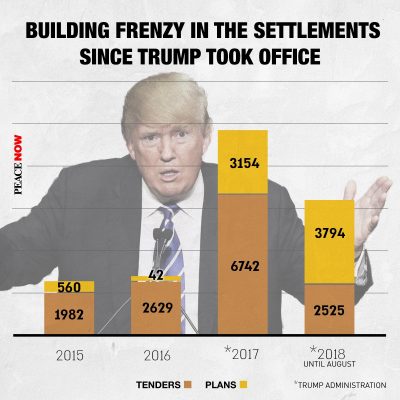
by Peace Now
The Israeli Central Bureau of Statistics (CBS) released new data showing a 52% decrease in the number of settlement construction starts in the third quarter of 2018 compared to the second quarter of 2018. News about a “decline,” relative to the last quarter, obscures the clear and alarming settlement surge currently taking place. As Peace Now has reported, by August 2018 the total number of settlement tenders and plans that have been advanced (6,319) is more than double the total amount in 2016 (3,189).
In addition, it is important to bear in mind that the number of construction starts do not begin to depict or reveal the level of settlement activity happening in the West Bank. Israel’s settlement enterprise is not solely a matter of residential housing plans, but also the unceasing expansion of infrastructure and security measures that exclusively benefit Israeli settlers, the normalization and development of settlement industrial zones, and illegal settlement activity (outposts, which are now regularly legalized ex post facto) that does not register in numbers tracking the settlement planning process.
Bonus Reads
- “Israel Has Weaponized the Settlements” (Haaretz Editorial)
- December 2018 public opinion poll – Palestinian Center for Policy and Survey Research
Welcome to FMEP’s Weekly Settlement Report, covering everything you need to know about Israeli settlement activity this week.
To subscribe to this report, please click here.
November 21, 2018
- Supreme Court Upholds Eviction of 40 Palestinians in Sheikh Jarrah, More Likely to Follow
- New Report Calls on AirBnB, Booking.com to Stop Listing Rentals Located in West Bank Settlements
- Settler Council Uses Taxpayer Money to Finance Illegal Construction of a Racetrack in Jordan Valley
- Knesset is Advancing a Bill to Give More Land in Area C to the World Zionist Organization
- Conference in Knesset Will Make Case for Evacuating Settlers from Hebron
- Bonus Reads
Questions/comments? Email kmccarthy@fmep.org
Supreme Court Upholds Eviction of 40 Palestinians in Sheikh Jarrah, More Likely to Follow
On November 15th, the Israeli Supreme Court denied an appeal that would have delayed the eviction of 40 members of a Palestinian family, the Sabags, from their homes in the East Jerusalem neighborhood of Sheikh Jarrah. The appeal asked the Court to take the time to reconsider ownership claims to the land. In denying the appeal, the Supreme Court upheld Israeli Jewish ownership claims to the plot of land based on its purchase in 1876. The eviction is expected to take place within months.
The land in question was abandoned during the 1948 war and was under Jordanian rule until 1967, during which time homes were built on it, including the those inhabited by the Sabag family. Notably, while Israeli law provides Jewish residents with the right to reclaim property lost in the 1948 War, it affords Palestinians no similar right to return to, or reclaim, property lost in that same war.
Responding the Supreme Court decision, 71-year old Mohammad Sabag said:
“We have two houses in Jaffa, on Hasneh Street and Hagidam Street, and we have 250 dunams [62.5 acres] in Yavneh and also in Ashdod. Why can’t I ask for my property from before 1948?”
In the early 2000s a company named Nahalat Shimon International (reportedly registered in Delaware, USA), “purchased” land in Sheikh Jarrah from the Jews who owned it prior to the 1948 war. Since then, Nahalat Shimon has been undertaking legal action to evict Palestinians. In 2009 the first eviction took place – sparking a sustained protest in the Sheikh Jarrah neighborhood which has garnered international attention.
The Sabag family has been fighting Nahalat Shimon’s attempts to evict them since 2008, claiming that the land was not properly registered with the Ottoman Empire prior to 1948, leaving ownership of the plot unclear. Settling the matter definitively, the Israeli Supreme Court refused to reconsider ownership claims to the land, saying that the statute of limitations has long since expired.
Looking at the broader impact of the ruling, Haaretz noted:
“The ruling will also make it very difficult for dozens of other Palestinian families in Sheikh Jarrah to avoid eviction.”
New Report Calls on AirBnB, Booking.com to Stop Listing Rentals Located in West Bank Settlements
A new report by Kerem Navot and Human Rights Watch details how online rental companies like AirBnB and Booking.com perpetuate Israel’s discrimination against Palestinians by listing rentals located in illegal Israeli settlements in the occupied West Bank. The report, entitled “Bed and Breakfast on Stolen Land,” details how rentals in West Bank settlements run afoul of the companies’ own business and human rights principles, and contribute to the economic viability and legitimization of the settlement enterprise.
On the eve of the report’s publication, AirBnB announced that it will remove 139 rental listings located in West Bank settlements, 15 of which are built on land which Israel has acknowledged is privately owned by Palestinians. Following AirBnB’s announcement, Booking.com signalled that it would not remove its listings from settlements, insisting that all their practices accord with all applicable local (Israeli) laws. According to Human Rights Watch, Booking.com has 26 rentals listings in settlements, 2 of which are located on privately owned Palestinian land that Israel expropriated for “public use” and then designated for the exclusive use of settlements.
Following AirBnB’s announcement, Human Rights Watch released a statement saying:
“By delisting rentals in illegal settlements off-limits to Palestinians, Airbnb has taken a stand against discrimination, displacement, and land theft. The continued business activities of Booking.com and other companies in settlements contribute to entrenching a two-tiered discriminatory regime in the West Bank.”
AirBnB’s decision sparked outrage and immediate calls for action from Israeli government officials, who are promoting several ways to retaliate against AirBnB. Officials have said that Israel will restrict AirBnB’s operations in sovereign Israeli territory and also levy a special new tax on its operations in light of its boycott of the settlements. Israeli Strategic Affairs Minister Gilad Erdan – whose responsibilities include fighting boycotts, divestment, and sanctions (BDS) – urged Israeli AirBnB hosts in settlements to sue the company. Israeli Tourism Minister Yariv Levin announced that the Israeli government will consult with the U.S. government in order to assist Americans in suing AirBnB (which is based in San Francisco); 24 states including California have passed anti-boycott legislation intended to stop U.S. companies and individuals from participating in boycotts of Israel and/or Israeli-controlled territories (i.e. settlements), though unless AirBnB is competing for government-funded contracts in these states, there is no basis to use these laws against it. Eugene Kontorovich, who self-identifies as a key figure in drafting the anti-boycott (but really anti-free speech) laws for states, called AirBnB’s decision “anti-Semitic.”
Peace Now released a statement slamming the Israeli government response, saying:
“Even if Netanyahu and Bennett refuse to see the Green Line, the rest of the world differentiates between Israel and the occupied territories. International companies are interested in doing business with Israel but are not ready to accept the continuation of military control over millions of Palestinians.”
Two years ago, +972 Magazine was first to report on the discriminatory and illegal nature of companies which list rentals across the Green Line, in what the international community considers as territory being held by Israel under military occupation.
Settler Council Uses Taxpayer Money to Finance Illegal Construction of a Racetrack in Jordan Valley
A freedom of information request filed by Peace Now and the Movement for Freedom of Information revealed that the Jordan Valley Regional Council – which Israeli municipal body thas authority for over settlements in the Jordan Valley and is responsible for enforcing building laws – is directly financing the illegal construction of a state-of-the-art car racing complex near the Jordan Valley settlement of Petza’el.
As +972 Mag and Kerem Navot revealed in August 2017, the large complex is being built partially on land that the Israeli army previously declared a closed firing zone, a designation which resulted in the forcible displacement of Palestinians who lived there. The land remains under this designation today.
In light of the track’s encroachment into the closed firing zone, the Israeli Civil Administration – the arm of the Israeli Defense Ministry that acts as the sovereign power in the West Bank – issued a stop-work order against the construction in February 2017 (which settlers ignored). Demonstrating that, as usual, law-breaking pays off for settlers, the Civil Administration also announced that it was considering a “master plan” for a touristic site – including a hotel – in the same area (with the development designed not to cross into the firing zone).
Despite the Civil Administration’s intervention and promise of a pay-off, the Jordan Valley Regional Council transferred NIS 284,000 (around $8,000) in 2017 for the construction of the racetrack, and then approved NIS 5,615,000 (around $1.5 million) for the project in 2018, nearly all of which comes from a grant to the Council for the project from the Israeli Interior Ministry.
In response to the new budget documents, the Israeli Interior Ministry told Haaretz that the grant was approved but will not actually be transferred until plans for the racetrack receive retroactive authorization from the government.
Peace Now states:
“In recent years, the Jordan Valley has become the wild west of the West Bank, and it appears that the regional council, which is supposed to be the sovereign that enforces the law, is a full partner in the crimes taking place there. This is an absurdity that is unfortunately all too common in the settlements. The Jordan Valley Regional Council is following in the footsteps of its big sisters among the regional councils–Binyamin, Shomron, Gush Etzion and Har Hevron–which regularly funnel public funds to illegal activity to create facts on the ground intended to deny Israel the option for a two-state solution.”
Knesset is Advancing a Bill to Give More Land in Area C to the World Zionist Organization
Earlier this month, the New Israel Fund reported on the Knesset’s ongoing consideration of a radical bill that seeks to accelerate the transfer of almost all of the land in Area C to the control of the World Zionist Organization (WZO).
As we have reported previously, the WZO’s Settlement Division was created by the Israeli government in 1968 – and is funded entirely by Israeli taxpayers. Its mandate is to manage West Bank land expropriated by Israel, in order to facilitate the settlement of Israeli Jews in the occupied territories. To make this possible, the Israeli government has allocated approximately 60% of all “state land” to the WZO’s Settlement Division [over the past 50 years Israel has declared huge areas of the West Bank to be “state land,” including more than 40% of Area C, where most of the settlements are located]. In addition, settlement and human rights watchdogs have repeatedly documented how the WZO’s Settlement Division has worked to take over additional land, including privately owned Palestinian land, in order to build more settlements.
At a hearing last week, Israeli Attorney General Avichai Mandelblit expressed his opposition to the bill (which is endorsed by the Israeli cabinet), saying it is unnecessary given that ministry staffs are already working to transfer more land to the WZO through an administrative process. MKs from the Jewish Home party have said they will bring the bill up for a vote at the committee level next week if they are not satisfied with the progress that the ministry staffs have made in transferring land to the WZO.
In June 2018, when the Knesset gave preliminary approval to the bill, Peace Now responded:
“the government is scandalously planning to give the biggest land thieves responsibility for managing the land distribution, which will continue to be done under the cover of darkness if the bill passes into law.”
For more information on this bill, read a complete background briefing by Peace Now.
Conference in Knesset Will Make Case for Evacuating Settlers from Hebron
Next week, the Knesset will hold a conference entitled, “Hebron First,” featuring Israeli civil society leaders making the case to lawmakers for the removal of Israeli settlers from Hebron. The event is being organized by MK Ayman Odeh (Joint List), Dov Khenin (Joint List), and Michal Rozin (Meretz). The President of B’Tselem, Hagai El-Ad, is expected to make a speech.
In a joint statement about the event, the MKs said:
“The settlement in Hebron is the expression of an extremist government policy that pours mass sums of money and endangers human lives to strengthen and maintain a handful of extremist settlers. The evacuation of the settlement in Hebron is a first and necessary step to promoting a diplomatic solution and bringing the Israeli-Palestinian conflict to an end.”
Over the five months, the Israeli government has advanced highly controversial plans that promote the growth and permanence of settlements in Hebron. Earlier this month (November 2018), Israeli Defense Minister Avigdor Liberman (who recently resigned) announced plans to build a new settlement above a section of the Palestinian market in the Old City of Hebron. In October 2018, the government announced a new settlement at the site of an Israeli military installment in Hebron, and in July 2018, the Cabinet decided to fund a new settler municipal body meant to empower Israeli settlers living in enclaves in downtown areas of Hebron, despite a court injunction against forming the body.
Bonus Reads
- “Avigdor Liberman: The settler defense minister who couldn’t please the settlers” (Times of Israel)
- “ ‘Things are going so well’: Settlers line up in opposition to elections” (Times of Israel)
- “Knesset conference calls for evacuation of Hebron settlers” (Ynet)
Welcome to FMEP’s Weekly Settlement Report, covering everything you need to know about Israeli settlement activity this week.
To subscribe to this report, please click here.
November 15, 2018
- Knesset Advances Bill to Allow Settler Group to Build in Silwan
- Settler: Amichai Settlement Was Meant to Nullify Two-State Solution
- Want to Track Settlements? There’s an App for That
- Bonus Reads
Questions/comments? Email kmccarthy@fmep.org
Knesset Advances Bill to Allow Settler Group to Build in Silwan
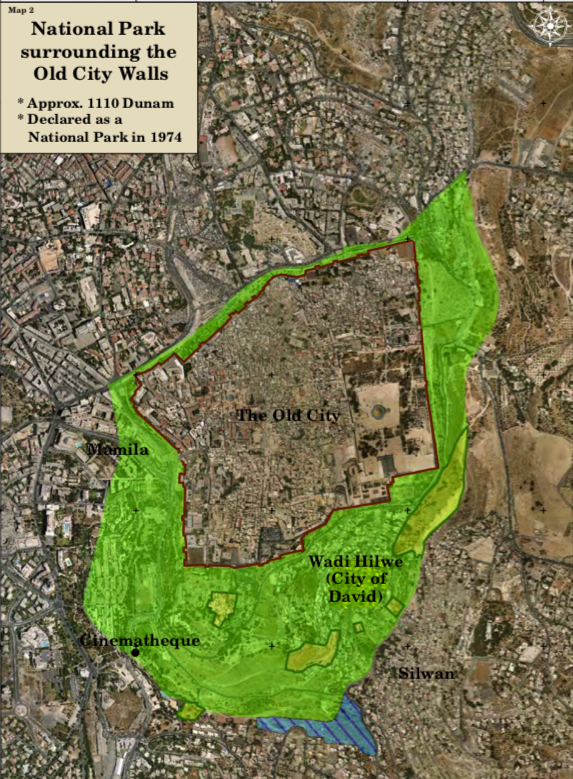
Map by Bimkom
Ir Amim reports that the Knesset has advanced an amendment to the National Parks, Natural Reserves and Memorial Sites Law – last considered in July 2018 – that will allow the Elad settler group to build settlement units in the Wadi Hilweh section of the Silwan neighborhood in East Jerusalem, in an area which Israel previously declared the “City of David National Park.” On November 15th, the proposed amendment (Amendment 17) entitled, “Planning for Housing in an Existing Neighborhood in a National Park,” was moved to the Knesset Interior Committee in preparation for a combined second and third reading, after which it will become law.
If passed into law, the amendment will create a custom made exception that exempts the City of David National Park from longstanding prohibitions against building inside of national parks. Elad has managed the “park” since 2001 on behalf of the Israel Nature and Parks Authority. In Haaretz, Ir Amim’s Director of International Relations & Advocacy, Betty Herschman, explains:
“Elad is not an environmental group or an archeological authority; it has no professional capacity to even compete for a bid to manage a national park (had there been a transparent tender process, which there was not). It is, though, a right-wing settler group. Elad is the only entity promoting this bill. Faced by objections from a spectrum of green groups, the group lobbied for a custom-made exemption to fit the City of David alone to push out Palestinians and permit building homes for settlers in a national park. That by itself should demonstrate Elad’s unfitness for running such a space. Amendment 17 is specifically designed to enable Elad to expand its foothold in Silwan where, backed by the state, it has seized roughly 75 Palestinian homes over the last several decades. The latest eviction took place last week.”
Ir Amim writes:
“Promotion of this [bill] lays bare the political drivers behind national park planning and development in East Jerusalem, an integral part of a larger settlement enterprise. National parks have become an effective tool for the state, working in cooperation with private bodies, to transfer administration and development powers for public, touristic, archaeological and educational projects into the hands of private right wing organizations; in so doing, enabling the Israelization of the Old City and surrounding band of Palestinian neighborhoods.”
For more information on the role on national parks around Jerusalem in advancing the Israeli settlement agenda in Palestinian neighborhoods, see Ir Amim’s reporting here; for a comprehensive survey and analysis of national parks in Jerusalem/East Jerusalem, see Bimkom’s report here.
Settler: Amichai Settlement Was Meant to Nullify Two-State Solution
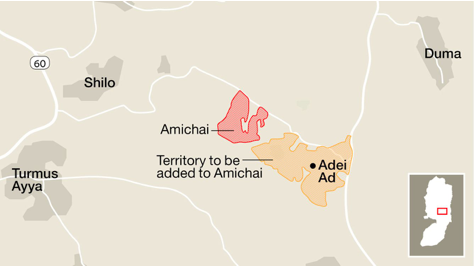
Map by Haaretz
A new Ynet report underscores the ideological significance of the Israeli government’s decision to approve plans for the first new government-backed settlement in 25 years, Amichai, which is currently under construction deep in the Shilo Valley.
As a reminder, Amichai is one of two new settlements the government promised as a pay-off to Israeli settlers who were forcibly removed from the unauthorized Amona outpost, following a High Court order (an order the government tried to avoid enforcing). The plans for the Amichai were originally approved in April 2017; in August 2018, the Israeli government approved another plan that massively expanded the municipal borders of the Amichai in order to annex several outposts – including the notorious and expansive Adei Ad outpost – to the settlement, expanding its footprint three-fold.
Recalling the Amona outpost settlers’ campaign to promote Amichai, a lead settler organizer told told Ynet:
“Some three years before the evacuation of [the unauthorized outpost of] Amona, a group of us residents were sitting in the office of the Defense Ministry’s legal advisor, Ahaz Ben Ari, in the Kirya IDF base in Tel Aviv. To our west was the Mediterranean Sea, to our east were the mountains of Judea and Samaria. Ben-Ari looked east and said, ‘You do realize you’re living there temporarily, right?’ We asked him what did he mean—’you’re talking about our homes, our lives.’ He answered, ‘The international community won’t let us stay there forever.’ I told him someone greater than us (Israel’s first prime minister David Ben-Gurion) once said, ‘What matters is not what the goyim say, but what the Jews do.’ And we said goodbye. This is the common view among the Israeli bureaucrats who decide and run things. This is the view that uses life in Judea and Samaria as a bargaining chip on the way to an arrangement with the Palestinians. Life in Judea and Samaria is put on hold. That is why the construction is only done within the confines of the separation barrier.
So the establishment of Amichai [beyond the separation barrier] is an internal statement to the bureaucrats as well as one to the international community that we’re done with just maintenance, and we’re moving forward by building a new community in the heart of the land. And not just a new community is being built, but this community is legalizing all of the smaller communities in the area. We’re leaving the confines of the separation barrier and building a community that completes the corridor of Jewish settlement from the beach in Tel Aviv to the Jordan Rift Valley. It nullifies the possibility of establishing an Arab state at the back of the mountain. And this isn’t my own personal statement, but a statement made by the prime minister and the entire Israeli government that voted unanimously to establish Amichai, a statement by the State of Israel.”
Want to Track Settlements? There’s an App for that
Americans for Peace Now has released a new and improved version of Facts on the Ground, APN’s smartphone app that gives users the ability to track, explore, and gain a comprehensive understanding of the settlements.
In announcing the updated app release, Americans for Peace Now says:
“Originally released in 2010, APN’s Facts on the Ground was the first-ever interactive online map of West Bank settlements. The new version features up-to-date statistics and data, including individual “snapshots” of every settlement and outpost in the West Bank. The app includes informational video, a comprehensive glossary, and a new, expansive statistics section from Peace Now. Facts on the Ground also marks the re-launch of APN’s Settlements in Focus publication. New issues, each profiling different West Bank settlements, will be featured on the app and available to all users.”
Bonus Reads
- “Occupation? What Occupation?” (Haaretz)
- “The Gatekeeper of Israeli Democracy & Rule of Law” (Al-Monitor)
- “How the tourism industry underpins illegal Israeli settlements” (Al Jazeera)
Welcome to FMEP’s Weekly Settlement Report, covering everything you need to know about Israeli settlement activity this week.
To subscribe to this report, please click here.
October 25, 2018
- More Evidence of WZO Support for Illegal Settlement Activity
- Israel to Expropriate More Palestinian Land to Widen West Bank Highway
- Settlers Take Over Another Building in Silwan
- Hugely Disproportionate Amount of Government Grants to Regional Councils Go to Settlements
- Fearing Unfavorable Court Ruling, Palestinians Petition ICC to Stop Hebron Settlement Plan
- Cabinet to Consider Bill to Allow the Knesset to Overrule the High Court of Justice
- Knesset Advances Bill to Politicize Legal Advisors
- More Drama Surrounding Palestinians Who Sold Old City House to Settlers
- Israeli “Sovereignty Movement” Asks Candidates About Annexation Views
- Bonus Reads
Comments, questions, or suggestions? Email Kristin McCarthy at kmccarthy@fmep.org.
More Evidence of WZO Support for Illegal Settlement Activity
The Israeli non-profit organization Kerem Navot revealed new documents offering new evidence that the Settlement Division of the World Zionist Organization employs unlawful practices in its drive to help settlers build illegal outposts and unauthorized settlement structures on Palestinian land in the West Bank. The documents show that the WZO’s Settlement Division has regularly engaged in practices including:
- Granting loans – using taxpayer money – for illegal construction of settlement unauthorized outposts;
- Accepting highly questionable “collateral” from the settlers to guarantee such loans, including sheep, a chicken coop, date trees, and agricultural equipment; and
- Providing false confirmations to private banks that settlers owned or were legally working land, in order to enable settlers to acquiring private mortgages for homes in unauthorized outposts and/or homes built illegally in existing settlements.
Dror Etkes, founder of Kerem Navot, told Haaretz:
“It’s been obvious for years that the [Settlement] division has adopted unlawful patterns of operation after assuming the role of contractor carrying out the dirty work that state authorities have tried to distance themselves from having direct responsibility for. The documents show systematic and continuous unlawful conduct intended to support the most extremist and violent elements among the settlers, people who are responsible for the expulsion and expropriation of Palestinian communities from wide areas of the West Bank.”
The WZO’s Settlement Division was created by the Israeli government in 1968 – and is funded entirely by Israeli taxpayers. Its mandate is to manage West Bank land expropriated by Israel, in order to facilitate the settlement of Israeli Jews in the occupied territories. To make this possible, the Israeli government has allocated approximately 60% of all “state land” to the WZO’s Settlement Division [over the past 50 years Israel has declared huge areas of the West Bank to be “state land,” including more than 40% of Area C, where most of the settlements are located]. But apparently that wasn’t enough for the WZO’s Settlement Division: settlement and human rights watchdogs have repeatedly documented how it has worked to take over additional land, including privately owned Palestinian land, in order to build more settlements.
Despite the controversies, in June 2018 the Knesset gave preliminary approval to a bill that would hand over almost all of Area C to the WZO’s Settlement Division. Peace Now responded at the time:
“the government is scandalously planning to give the biggest land thieves responsibility for managing the land distribution, which will continue to be done under the cover of darkness if the bill passes into law.”
Israel to Expropriate More West Bank Land to Widen West Bank Highway
According to Palestinian press reports, the Israeli Minister of Transportation Yisrael Katz has greenlighted a project to confiscate vast tracts of Palestinian land in the West Bank, in order to widen a section of the West Bank’s main north-south highway, Route 60, in an area spanning between Bethlehem-area settlements to Hebron-area settlements. In addition to confiscating land to add two lanes to the road (doubling the number of lanes from 2 to 4), Palestinians fear that the highway expansion is part of a larger project seeking to expand the West Bank settler population to 1 million Israelis by 2030, as promised by Education Minister and the leader of the Jewish Home party Naftali Bennet. The Israeli Transportation Ministry has reportedly allocated $50 million to the project.
Highway 60 is the sole major roadway providing north/south contiguity through the West Bank. Palestinian access to Route 60 is restricted in sections near settlements, and Route 60 has been completely severed between Jerusalem and Bethlehem by Israel’s separation barrier (there is literally a wall across the highway) in order to include the Efrat settlement on the Israeli side of the barrier. The economic, political, and social impacts of the closure of Highway 60 have been severe for the Palestinian population.
Settlers Take Over Another Building in Silwan
Ir Amim reports that the last remaining Palestinian tenants have been evicted from an apartment building located in the Batan al-Hawa section of Silwan, the site of the single largest settler takeover operation in East Jerusalem since the annexation of East Jerusalem in 1967.
The Abu-Sneina family was the last tenant in a 4-story, 10-unit building. The Israeli Custodian General transferred ownership of the building to the Ateret Cohanim settler organization (which works to establish Jewish enclaves inside densely populated Palestinian neighborhoods of East Jerusalem) in 2015, based on the settlers’ taking over management of the Benvenisti Trust, which oversaw the assets of Yemenite Jews who lived in the neighborhood in the 19th century. Palestinians have challenged the legitimacy of the Benvinisti Trust’s rights to the currently existing buildings, saying that the trust only covered the old buildings (none of which remain standing) and not the land. Indeed, the State admitted to the Courts on June 10, 2018 that the land had been transferred to the Benvenisti Trust/Ateret Cohanim without a proper investigation into its legal status. On June 17, 2018, the Israeli High Court of Justice ordered the Israeli government to provide more information and an explanation of the decision to give the land/buildings to the Trust. Nonetheless, in September 2018 the Jerusalem Magistrate Court ruled that evictions could proceed in buildings that Ateret Cohanim controls, even though Ateret Cohanim’s ownership of the buildings – based on its control of the Trust – remains in legal question.
As FMEP has previously reported, Ateret Cohanim is implementing a multifaceted campaign to remove Palestinians from their homes in the Batan al-Hawa section of Silwan, claiming that the Palestinians are illegally squatting on land owned by the Trust. To date, Ateret Cohanim has managed to acquire the deeds to six Palestinian homes in Batan al-Hawa, inserting some 20 Israeli Jewish families in place of evicted Palestinian residents. The organization has eviction orders pending against an additional 21 homes, with 800 Palestinians at risk of eviction.
Yakoub al-Rajabi, a Palestinian resident of Batan al-Hawa, recently told The Washington Post:
“We know that this was a well-orchestrated plan to force us to leave. And if we stay, it will paralyze us and isolate us in our homes.”
In a 2016 report that covers the Batan al-Hawa situation in detail, Ir Amim and Peace Now underscore the significance of Ateret Cohanim’s efforts:
“If the settlers are successful, Batan al-Hawa is anticipated to become the largest settlement compound in a Palestinian neighborhood in the Historic Basin of the Old City, with the outcome of significantly tightening the emerging ring of settlements around the Old City and severely undermining the possibility of a future two state solution in Jerusalem.”
Celebrating the takeover of another building in Batan al-Hawa in August 2018, Ateret Cohanim director Daniel Luria told The Times of Israel:
“Every acquisition is very difficult. We’re up against a mobilized Arab world, parts of which are violent. There is huge pressure and millions of dollars are being pumped in to strengthen the Arab hold on the city…[the] biggest problem is trying to get the Jewish world to understand what needs to be done. We have the best relations ever with a US administration. For [US Vice President Mike] Pence and [US Ambassador to Israel David] Friedman and the others, [settling Jews in East Jerusalem] is a no-brainer. What’s our right-wing government waiting for? It’s not about what the US says. It’s about what we do. We are not doing anything to stop the peace process but will not compromise on a millimeter of Jerusalem. You have to show strength of conviction and sovereignty to have peace and coexistence. This can only happen when you live together under Jewish sovereignty.”
Hugely Disproportionate Amount of Government Grants to Regional Councils Go To Settlements
The Knesset Research and Information Center issued a report revealing that 25% of all state funds allocated to Israeli regional councils are given to West Bank regional councils, despite the fact these settlement regional councils account for just 5% of all regional councils operating on both sides of the Green Line.
Examining funding channels – including grants to regional councils for education, welfare, and for projects of the Interior Ministry – it was found that the settlement regional councils are far better funded than those located in sovereign Israel. Putting a fine point on the discrepancy, a student attending school in a settlement receives nearly twice the amount of government benefits per year as compared to a student studying in sovereign Israeli territory.
MK Stav Shaffir (Zionist Union), who ordered the report, points out that the report doesn’t even begin to document the total amount of money that the government diverts from sovereign Israel into settlements:
“This is only the tip of the iceberg, since the report doesn’t include the budgets that are transferred outside the budget plan, like the Settlement Division’s budgets that are mostly invested in the West Bank settlements and not in the State of Israel.”
The Adva Center, an Israel non-profit that documents and analyzes the cost of occupation on the state budget, published a report [full report in Hebrew, executive summary in English] in August 2018 showing that Israel is not only disproportionately funding settlement councils in general, but in particular is disproportionately funding settlement councils located deep inside of the West Bank, in areas that are most problematic to any future attempts to draw borders for a two-state solution. Adva writes:
“Non-Haredi settlements in the occupied territories are still to be found at the top on 3 measures. Compared to several other types of municipalities – the 15 most affluent Israeli localities, the largely Mizrahi “development towns,” the Arab localities within Israel, and Haredi settlements, the non-Haredi settlements continue to enjoy the largest per capita municipal expenditure, the largest per capita central government “designated” subsidy (mainly for education and social welfare services), and the largest per capita central government balance grant. The non-Haredi settlements, on the other hand, include, among others, the so called “ideological” settlements, many of them deep inside Palestinian territories and strongly opposed to the creation of a Palestinian state.”
Fearing Unfavorable Court Ruling, Palestinians Petition ICC to Stop Hebron Settlement Plan
On October 18th, top Palestinian diplomat Saeb Erekat sent a letter to the International Criminal Court (ICC) asking it to expedite the launch of a criminal investigation into Israeli settlement activity, citing the urgency of preventing the construction of a new 31-unit settlement in the heart of Hebron. Palestinians most recently referred a case against Israeli settlements to the ICC for investigation in May 2018, its eighth referral on the matter.
Speaking to Al-Monitor, Tawfiq Jahshan – a lawyer for the Hebron Rehabilitation Committee – explained that Erekat’s letter might have been motivated by the Israeli government’s decision to approve the new settlement plan despite pending litigation against it. Jahshan said:
“There were deliberations [about petitions against the plan] and hearings. Most recently in June, the final hearing was postponed and the decision was to be notified — once issued — by way of email. But surprisingly Israel’s Cabinet approved Oct. 14 the financing of the project. By acting before the issuance of the judicial decision, the Israeli Cabinet gave the green light to the judges to refuse the objection…There is no competent Palestinian judicial body to examine such cases, so we have to resort to Israeli justice often unfair to us. Resorting to the ICC is a necessary step to face the injustice shown by the Israeli judiciary.”
To date, the Israeli Defense Ministry has not issued a response to either of the two formal complaints filed against the settlement plan. Both petitioners – the Hebron Municipality and Peace Now – have stated they will appeal the case to High Court of Justice if the Defense Ministry decides the settlement can be built.
Cabinet to Consider Bill to Allow the Knesset to Overrule the High Court of Justice
Israeli Justice Minister Ayelet Shaked and her Jewish Home party have decided to advance a new, narrow version of the so-called High Court override law which will make it impossible for the High Court of Justice to strike down the Knesset’s plans to deport African asylum seekers and migrants. The new version has been narrowed in order to gain support from parties that are willing to see the High Court overruled when it comes to Africa asylum seekers, but opposed to a broader overrule law.
The decision to advance the narrower version increases the likelihood that the law will pass, and in so doing deals another body blow to Israel’s judicial system. At the same time, the decision drew protest from hardliners. Seeking to assuage right-wing critics of the limited plan, Shaked announced that Jewish Home will demand support for the broader version of the law as a part of a future coalition agreement (elections are widely expected to be called soon, meaning the governing coalition agreement will need to be renegotiated). If the broader version passes into law, the Knesset will be able to reinstate any law struck down by the High Court (including most relevantly, the settlement Regulation Law, if it is struck down as expected).
Economic Minister Moshe Kahlon (leader of the Kulanu Party, which is part of the current governing coalition) has effectively blocked the broader bill from moving forward by whipping his party members to stand firm against it. Kahlon has taken heat from all sides concerning his support for the limited version this week. From the left, Zionist Union MK Michal Biran said:
“Kahlon declared he would support a narrow notwithstanding clause, concerning the infiltrators. Meaning, in some cases it’s allowed to bypass the High Court, but in other cases it’s not. Kahlon’s attempt to run between the raindrops in this extremist right-wing government shows lack of ideology, lack of trust in the justice system, and lack of trust in the fact the public is not stupid. Kahlon’s voters wanted to see a man in the government who represents the sane center, and got a submissive slave of Netanyahu. With his own hands Kahlon is helping bypass Basic Law: Human Dignity and Liberty over political whims.”
From the right, MK Shuli Mualim said:
“This is a test Minister Kahlon, who has for months been preventing the enactment of the broader legislation on the issue … the bill formulated now is exactly the kind of bill Kahlon claimed he would support. I expect him to keep his promises to the residents of southern Tel Aviv.”
The narrow bill will be presented to the Ministerial Committee on Legislation at its next meeting on October 28th, and is expected to receive the seal of government-backing. If the committee votes to back the bill, it will then be sent to the Knesset where it will need to pass three readings.
Knesset Advances Bill to Politicize Ministerial Legal Advisors
On October 22nd, the Knesset’s Constitution, Law, and Justice Committee reviewed a bill being promoted by Justice Minister Ayelet Shaked that, if passed, will allow each government minister to select his/her own ministerial legal advisor, a move which politicizes a key office charged with ensuring that the rule of law is followed when implementing policy. Legal advisors have the authority to block actions of the minister if they are deemed unlawful, a critical power that requires political independence from the ruling coalition and party figure at the head of the ministry. The bill has already passed its first Knesset reading.
The Haaretz Editorial Board published blistering piece on the bill, writing:
“Instead of legal advisers who are honest, independent, loyal to the law and prepared to warn against illegal, corrupt and improper activity, we will have legal advisers who close their eyes to government corruption and who will be prepared to whitewash anything. Instead of independent advisers we will get dependent and submissive ones.”
There has been widespread criticism of Shaked’s bill, including from Israeli Attorney General Avichai Mandelblit (who argued against the law before the Knesset), Israeli President Reuven Rivlin, and many other legal luminaries.
More Drama Surrounding Palestinians Who Sold Old City House to Israeli Settlers
The Israeli Shin Bet arrested (and later released) two Palestinian Authority (PA) officials suspected of abducting a Palestinian-American real estate dealer who was allegedly involved in the sale to an Israeli settler organization of a house in the Muslim Quarter of the Old City, abutting the al-Aqsa Mosque. The two men arrested were Adnan Ghaith, who was appointed as the Governor of Jerusalem by the Palestinian Authority (PA), and Jihad al-Fakih, the director of the PA’s intelligence efforts in Jerusalem. The PA claims that the Palestinian-American man surrendered himself willingly into its custody, where he reportedly remains under interrogation at the order of President Abbas. The unnamed individual’s family has submitted requests for help to the American Embassy in Jerusalem. The U.S. State Department has said it is in touch with the PA about the reports.
Israeli “Sovereignty Movement” Asks Candidates About Annexation Views
The settler organization known as the “Sovereignty Movement” has polled candidates running in the upcoming Israeli local elections on their support for annexation policies. The resulting compendium of candidate statements in support of annexation was published in the Arutz Sheva settler-aligned news outlet.
Local elections will be held October 30th across Israel and West Bank settlements. The Sovereignty Movement released a statement calling on candidates to support annexation, saying:
“Implementing Israeli sovereignty in Judea and Samaria constitutes the next essential step in the Zionist vision of the return of the People of Israel to its Land, and a vital step in security, but is also necessary in order to provide civil rights for the residents of Judea and Samaria that is equal to those of the rest of the citizens of Israel. The heads of local authorities understand well the difficult challenges in dealing with military figures to promote even the elementary civil needs of the residents. Applying sovereignty will put a stop to the discrimination and harming almost a half-million Judea and Samaria residents. This is the time to tell the different candidates in the various authorities: Support sovereignty and we will vote for you!.”
Bonus Reads
- “Israel Has Chosen Settlements Over Security” (The Forward)
Welcome to FMEP’s Weekly Settlement Report, covering everything you need to know about Israeli settlement activity this week.
To subscribe to this report, please click here.
September 20, 2018
- 2018 Settlement Construction Starts (& Finishes) Are Surging
- Settlement Projects Advance in Sheikh Jarrah, Jabal al-Mukaber
- Israeli Authorities Approve Plan to Seize Palestinian Land & Legalize Outpost Near Hebron
- Israel Issues “Gardening Orders” to Take Control of More Land in Silwan
- Israeli Tourism Ministers Boasts About Bankrolling Tourism Projects to Expand Settlements
- Shaked’s Judicial Interference is Subject of Special Knesset Session
- Bonus Reads
Comments, questions, or suggestions? Email Kristin McCarthy at kmccarthy@fmep.org. To subscribe to this report, please click here.
2018 Settlement Construction Starts (& Finishes) Are Surging
Image + Data by Peace Now
Recently released data from the Israeli Central Bureau of Statistics show that since January 2018, construction has started on a total of 1,073 new settlement units, and total of 1,075 new settlement units (started in previous years) have been completed – representing new housing for more than 10,000 settlers (assuming, conservatively, a family size of 5-6 people). Together the numbers mark a 66% increase over the same period in 2017. Though settlement plans have advanced at an alarming rate since the beginning of the Trump Administration, actual on-the-ground construction starts did not seen a significant surge until the second quarter of 2018, which saw a 187% increase over the first quarter.
Peace Now released a statement saying:
“The Netanyahu government continues to destroy the chances for peace. Further construction in the settlements undermines Israel’s interest in reaching a two-state solution, as such a solution will not be stable without a viable Palestinian state, which settlements increasingly threaten. Unfortunately, since Trump’s election, we have seen a sharp increase in the approval of the plans and tenders, and now we are beginning to see the consequences of these approvals on the ground.”
Settler leaders were characteristically dissatisfied with the pace of construction. The Director of the Yesha Council (and umbrella group representing all Israeli settlements), Yigal Dilmoni, told the Jerusalem Post:
“We are talking about a few hundreds units, which is very little, relative to thousands built throughout the country. Judea and Samaria still have the low building numbers, we expect and hope that we will be given more building permits.”
Settlement Projects Advance in Sheikh Jarrah, Jabal al-Mukaber
Ir Amim reports that two plans for new settlement buildings in the Palestinian East Jerusalem neighborhood of Sheikh Jarrah have been deposited for public review. If implemented, the two plans would build two new 6-story buildings in the Um Harun section of Sheikh Jarrah, one with 3 settlement units and the second with 10 settlement units. If implemented the plans will also involve the demolition of two buildings and the eviction of five Palestinian families living there.
The plans were originally approved for deposit in July 2017. As Ir Amim reported in detail at the time, both plans (numbers 14151 & 14029) are linked directly to Jerusalem settlement impresario Aryeh King. King can now count several significant victories for his settlement projects in sensitive Jerusalem neighborhoods over the past two weeks, totalling 309 new settlement units: Two plans were advanced in Sheikh Jarrah, totalling 14 units; one plan was advanced in Beit Hanina, totalling 75 units; also this week, King reportedly announced (though details are scant – stay tuned) that the government has approved a plan for 220 new units in the Nof Zion settlement enclave, located inside the Jabal al-Mukaber neighborhood. It is worth noting that, back in September 2017, the government was poised to issue permits for 176 units in Nof Zion – it is not clear if the 220 include those units, or are in addition to them, or if the numbers are inaccurate or deliberately misleading.
Settlement advancements in Sheikh Jarrah are becoming alarmingly routine. In addition to the developments this week, the inflammatory plan to build a Jewish religious school (known as the Glassman yeshiva project) was recommended for final approval. If implemented, an eight story building will be erected at the entrance to the Sheikh Jarrah neighborhood. The massive building will also include dormitories for young religious men and eight units to house “lecturers visiting from abroad.”
Israeli Authorities Approve Plan to Seize Palestinian Land & Legalize Outpost Near Hebron

by Land Research Center
The Land Research Center, a Palestinian organization, reports that the Israeli Civil Administration – the arm of the Israeli Defense Ministry that runs all affairs in the West Bank – has published a detailed plan to expand the borders of the Tene-Omarim settlement to include an outpost that was built without Israeli government authorization, located on lands claimed by the Palestinian village of Dahriyeh.
In order to carry out the plan, the Israeli Civil Administration will add 260,000 square meters of land (roughly 64 acres) to the settlement. The plan calls for 150 new units in Tene-Omarim in addition to new roads and open areas to connect the settlement to an outpost northeast of its borders.
In May 2018, the Israeli Civil Administration advanced plans for 143 new settlement units in Tene-Omarim.
Israel Issues “Gardening Orders” to Take Control of More Land in Silwan
On August 24th, the Israeli NGO Emek Shaveh reported that the Jerusalem Municipality had issued “gardening orders” as a means of taking over new areas of privately owned land in the Silwan and Abu-Tor neighborhoods of East Jerusalem (in the area known in Hebrew as the Ben Hinnom Valley). Under Israeli law, the Jerusalem municipality can issue orders to use private land for public purposes if it deems the land “unutilized” by its owners. News of the orders broke the day before U.S. National Security Advisor John Bolton attended a dinner party in Silwan hosted by the radical settler group Elad.
The orders seize 27 plots of land owned by Palestinians, based on the argument that the plots are not being used by their owners. The orders disingenuously note that Palestinian owners can seek to reclaim their land in the event that they obtain Israeli-issued building permits (without which they are unable to utilize the land for their own purposes). This explanation, as Emek Shaveh notes, ignores the fact that “the land owners cannot receive construction permits because their land is situated within a national park which, according to law, precludes construction.”
Emek Shaveh goes on to report:
“The gardening orders are the latest in a series of development activities in the Ben Hinnom Valley/Silwan area and will no doubt complement the Elad Foundation’s initiatives in the valley and efforts to link it with tourism ventures in the City of David/Wadi Hilweh. The Elad Foundation together with government ministries are currently promoting several projects within the area covered by the gardening order including a café in Abu Tor, the planned cable car intended to link West Jerusalem to the Kedem Center, and the archaeological excavations which the Elad Foundation has been funding in recent years adjacent to the Catholic cemetery.”
Israeli Tourism Ministers Boasts About Bankrolling Tourism Projects to Expand Settlements
At a meeting with the Yesha Council (the powerful umbrella group representing all Israeli settlements), Minister of Tourism Yariv Levin (Likud) told settler leaders:
“Tourism in Judea and Samaria (West Bank) is at a point of tremendous momentum. We now have a window of opportunity to make big moves in the tourism industry and this is a time of desire that should definitely be exploited. We will continue to establish and bankroll activities in Judea and Samaria in addition to establishing facts on the ground.”
Minister Levin boasted of having directed USD 11.15 million (NIS 40 million) to West Bank tourism projects over the past three years of his tenure.
In addition to his work directing taxpayer funds to the settlements, Minister Levin has also been pushing legislation and procedural rules that advance the direct application of Israeli laws over the settlements (an act of de facto annexation).
Shaked’s Judicial Interference is Subject of Special Knesset Session
On September 17th, the Knesset held a special session (during the Knesset recess) titled, “Justice Minister Ayelet Shaked’s attack on the High Court of Justice and the danger to democracy.” As FMEP has extensively documented, Justice Minister Shaked has been hard at work transforming the Israeli judicial branch in favor of pro-settlement and pro-annexation policies.
Meretz Chairwoman MK Tamar Zandberg opened the the special session defending her own party against accusations of political interference with the Court (Shaked denies a quote attributed to her saying that the High Court is an “arm of the Meretz party”). Zandberg said:
“the High Court of Justice was never a branch of Meretz. We often far from agree with the rulings of the High Court of Justice, which legitimized settlements, but we live in a democratic country governed by the rule of law, and the independence of the judicial system is one of its basic principles. The High Court of Justice is the focus of an extreme, unbridled attack aimed at clipping its wings and distorting the foundations on which it was established.”
One of many speakers, MK Michal Rozin (Meretz) said:
“Ayelet Shaked’s commander’s spirit is felt in the justice system – from the deepening of her control in the Judicial Appointments Committee, which has become a committee for the appointment of conservatives, to rulings which adopt her anti-constitutional lines, such as allowing the theft of Palestinian lands by the Jerusalem District Court. This spirit is aimed at applying sovereignty in the conquered territories, reducing the freedom of the citizens and expanding the Orthodox control on our daily lives.”
Appearing at the hearing under summons on behalf of the government, Justice Minister Shaked told her critics in the Knesset:
“I understand your anger about the fact that Jews are not being evacuated from their homes, but you must pull yourself together. We have a country to protect. The rule of law must be preserved. We cannot accept a situation in which your criticism of the court is sinking to such depths to which you have recently deteriorated. As the Minister of Justice, I call upon those who sit in this House – on the Left and the Right – to maintain dignified discourse. We don’t have another legal system. Of course it is legitimate to express criticism against a ruling. It is acceptable to argue over ideas, it is permissible to argue over areas of authority. I do so from time to time, but we must maintain respectability and dignified discourse.”
Bonus Reads
- “APN Peace Cast w/ Hagit Ofran” (Americans for Peace Now)
- “How Peace Keeps Receding in the Middle East” (Washington Post)
***NOTE: This week the Israeli government unleashed a massive wave of approvals to advance plans for settlement construction — in excess of 2,000 units — in highly sensitive and strategically significant areas deep inside the West Bank and in East Jerusalem. More approvals/advancements are expected in the coming weeks. See below for detailed coverage of the individual plans, keeping in mind both the significance of each approval on its own, and as part of the overarching Israeli government agenda clearly intending to both prevent any possibility of a Palestinian state and to further the march toward formal annexation of the West Bank. Also keep in mind, importantly, that there has been zero public push back from the Trump Administration against this surge, which comes on the heels of Ambassador Friedman’s statement last week that Israel will never be required to remove any settlements.***
August 24, 2018
- Settlement Wave, Part 1: High Planning Council Advances Plans for 1,004 Settlement Units (96% Located Deep in the West Bank)
- Settlement Wave, Part 2: Housing Ministry Published Tenders for 420 Settlement Units
- Settlement Wave, Part 3: Jerusalem District Committee Advances Plans for 603 Settlement Units in East Jerusalem
- Settlement Wave, Part 4: More Settlement Construction Coming Soon
- U.S. Stands by Israeli “Intentions” on Settlements
- State Tells High Court: We Can Annex the West Bank – International Law Be Damned
- This Week in Ariel: Settlers Celebrate 40 Years, A Construction Boom, A Medical School, & An Evangelical “Leadership Camp”
- Amana (the Official Settler Movement) Moves Its HQ to Sheikh Jarrah
- Settlement Gains in East Jerusalem Result in Palestinians Self-Demolitioning Their Homes
- Bonus Reads
Comments, questions, or suggestions? Email Kristin McCarthy at kmccarthy@fmep.org. To subscribe to this report, please click here.
Settlement Wave, Part 1: High Planning Council Advances Plans for 1,004 Settlement Units (96% Located Deep in the West Bank)
On August 22nd, the Israeli Defense Ministry’s High Planning Council (the body in the Israeli Defense Ministry responsible for regulating all construction in the West Bank) advanced plans for 1,004 new settlement units, 96% of which are located deep inside of the West Bank. Of the total, 620 units were approved for deposit for public review and 382 units were given final approval for construction.
As reported by Israeli settlement watchdog Peace Now, the plans approved for deposit for public review (totalling 620 units) are:
- 370 units in the Adam settlement (aka Geva Benyamin). This project was urged on by Defense Minister Liberman following a stabbing attack in the settlement, which resulted in one death and injuries to three others. The 370 units are part of a larger plan for 1,000+ units that will, if built, connect the Adam settlement to two large settlements in East Jerusalem (Neve Ya’akov and Pisgat Ze’ev) that are on the Israeli side of the separation barrier (the route of the barrier juts far beyond the 1967 Green Line to include Pisgat Ze’ev and Neve Ya’akov on the Israeli side while the Adam settlement is on the West Bank side). If the larger plan is implemented, the Adam settlement will have built up areas on both sides of the separation barrier, which could (in all likelihood) present Israel an opportunity to re-route the barrier around Adam — which would de facto annex even more West Bank land to Israel and further choke off Palestinian East Jerusalem from the West Bank to its north. [Note: FMEP’s Lara Friedman and Peace Now’s Hagit Ofran published an op-ed in Haaretz in 2008 warning of this plan – you can read that background here].
- 85 units in Karnei Shomron settlement. Israel has repeatedly confiscated as “state land” located between Karnei Shomron and the Palestinian village of Qalqilya (which is literally surrounded on three sides by the separation barrier). In November 2017, Israel began clearing landmines from that “state land” in order to prepare for settlement construction. At the time, Deputy Defense Minister Eli Ben-Dahan said that the new construction in the Karnei Shomron area will bring “a million Jews [to] live in Judea and Samaria in the future.”
- 84 units in the Kiryat Netafim settlement, located about half way between the Ariel settlement and the cluster of settlements close to the 1967 Green Line that are slated to be united into a “super settlement” area (Oranit, Elkana, Shiva Tikva, and others). The expansion of Kiryat Netafim will go towards creating a contiguous corridor of Israeli settlements stretching from sovereign Israeli territory, though the super settlement, to Ariel. As FMEP has repeatedly said, the Ariel settlement is located in the heart of the northern West Bank, reaching literally to the midpoint between the Green Line and the Jordan border. The future of Ariel has long been one of the greatest challenges to any possible peace agreement, since any plan to attach Ariel to Israel (with a finger of land running through settlements like Kiryat Netafim) will cut the northern West Bank into pieces.
- 52 units in the Beit El settlement. This is the second major approval for new units in Beit El in 2018, with a third plan for 300 more units coming soon, according to Israel Hayom. The construction boom is being hailed by the settler-aligned Arutz Sheva outlet, which wrote that the plans will increase the size of Beit El by 65%. If any of the units are constructed it will be first new, government-sanctioned construction in Beit El in over 10 years. U.S. Ambassador to Israel David Friedman is closely associated with the Beit El settlement, having donated to and fundraised for it prior to his appointment as ambassador (including in his capacity as the President of the American Friends of Beit El, reportedly from 2011 until he became ambassador).
- 29 units in the Otinel settlement, located south of Hebron. MK Yehuda Glick (Likud) lives in Otinel.
Plans that gained final approval, meaning no additional formal approvals are required to move ahead with construction (totalling 382 units) are:
- 168 units in the Tzofim settlement, located on the Israeli side of the separation barrier, but jutting towards the Karnei Shomron settlement, which also received advancements this week. See the section on Karnei Shomron, above, for context and news regarding this area of settlements.
- 108 units in the Nofim settlement, located on the Israeli side of the separation barrier but jutting towards the Karnei Shomron settlement, which also received advancements this week. See the section on Karnei Shomron, above, for context and news regarding this area of settlements.
- 56 units in the Barkan settlement, located near the Kiryat Netafim settlement. Both Barkan and Netafim are located about half way between the Ariel settlement and the cluster of settlements slated to be united into a “super settlement” area (Oranit, Elkana, Shiva Tikva, and others). See the section on Kiryat Netafim, above. for context and news regarding this area of settlements.
- 44 units in Ma’ale Adumim, the mega settlement just east of Jerusalem.
- 6 units in the Avnei Hefetz settlement, located southeast of the Palestinian city of Tulkarem.
Notably, Netanyahu intervened to remove two items from the High Planning Council’s agenda, both of which would have led to the retroactive legalization of illegal outposts. Those plans are:
- A plan to retroactively legalize the Ibei Hanahel outpost, which is a non-contiguous “neighborhood” of the Ma’ale Amos settlement, located deep in the southern West Bank. The plan would have allowed the outpost to be demolished and then rebuilt legally with residential units, transforming the outpost into a new, fully authorized settlement.
- A plan to build an education center in the Nofei Prat South outpost, which is a non-contiguous“neighborhood” of the Kfar Adumim settlement, located northeast of Jerusalem. The land on which the project would be built is located just 1.5 km away from the Khan Al-Ahmar Bedouin community – the same one that the Israeli government plans to forcibly evacuate in order to cleanse the area of Palestinians and expand settlements. The outpost was established by the Haroeh Ha’ivri (“the Hebrew Shepherd”) nonprofit association, which is funded by the Israeli Education Ministry.
In response to Netanyahu’s directive to remove these two items from the agenda, the heads of the Knesset’s “Land of Israel Lobby,” Bezalel Smotrich (Jewish Home) and Yoav Kisch (Likud), said that the Prime Minister should “ act with greater rigor to promote settlement, rather than doing the opposite.”
Settler leaders were also unsatisfied with the High Planning Council’s overall numbers. Yossi Dagan, head of the Samaria Regional Council (a municipal body for settlements in the northern West Bank), said:
“We are happy about every new house in Samaria, but we have to tell the truth. Hundreds of housing units are not enough for an area that constitutes 12% of the State of Israel…We expect the government to step in the gas, stop worrying about what they will say overseas, and develop this beautiful region.”
Settlement Wave, Part 2: Housing Ministry Published Tenders for 420 Settlement Units
On August 23rd, one day after the Defense Ministry’s High Planning Council advanced a huge tranche of settlement plans (detailed above), the Israeli Housing Ministry published tenders for a total of 425 settlement units (under plans previously approved by the High Planning Council).
Those tenders include:
- 211 units in the Ma’ale Efraim settlement, located in the Jordan Valley.
- 54 units in the Givat Ze’ev settlement, located north of Jerusalem.
- 52 units in the Beit Aryeh settlement, which comes in addition to the the publication of tenders for 511 units in the settlement last week.
- 42 units in the Ariel settlement. See reporting below for extensive coverage of the many reasons settlers in Ariel are celebrating this week.
Settlement Wave, Part 3: Jerusalem District Committee Advances Plans for 603 Settlement Units in East Jerusalem
In addition to the tranche of settlement plans advanced by the Defense Ministry’s High Planning Council and the tenders published by the Housing Ministry (detailed above), the Jerusalem District Committee deposited for public review (one of the final steps before approval) plans for a total of 608 new settlement units in East Jerusalem, with 345 units slated for the Gilo settlement and 263 units in the Ramot settlement.
On the plan for the Gilo settlement, Ir Amim explains:
“The Gilo plan is being promoted in tandem with development of the new Green Line branch of the Light Rail (construction of which was launched in May), which will be built adjacent to the settlement expansion. This sequencing of events once again exemplifies a pattern of the state investing billions of shekels in transportation infrastructures to allow for extensive construction beyond the Green Line.”
As Ir Amim notes, this week’s advancements come on the heels of Israel’s August 15th decision to publish tenders for 603 units in Ramat Shlomo, and its June 2018 advancement of plans for 1,064 settlement units in the Pisgat Ze’ev settlement — bringing Israel’s two-month total of settlement advancements in East Jerusalem to 2,275 units.
As a reminder, approvals/advancement of settlement plans is not the only ongoing threat to Palestinians in East Jerusalem. Settlers and settler-run organizations continue their campaign to take over sensitive areas in East Jerusalem neighborhoods neighborhood – like Silwan and Sheikh Jarrah – and to create more settler run tourist sites – like the Jerusalem cable car, the Kedem Center, the Abu-Tor footbridge, the Yemenite “heritage center,” and more – to erase the visibility of Palestinians in Jerusalem. Meanwhile, pending legislation in the Knesset seeks to gerrymander the borders of Jerusalem to create a Jewish majority by annexing settlements and cutting out Palestinian neighborhoods from the borders of the city. Sounding the alarm on all of these trends, Ir Amim writes:
“It is vital that the traditional calculus of settlement building be readjusted to a) treat these coordinated efforts to consolidate control of the Old City and surrounding Palestinian neighborhoods with the same urgency afforded to settlement building throughout the whole of East Jerusalem; b) ensure a holistic response that regards private settlement inside the Old City Basin and touristic settlement not as individual phenomena but as multiple elements of a unified and politically lethal strategy.”
Settlement Wave, Part 4: More Settlement Construction Coming Soon
In addition to the plans for 1,004 units that were advanced this week by the High Planning Council, the 425 tenders published by the Housing Ministry, and the 608 units advanced in East Jerusalem (all detailed above), this week saw reports that additional plans are expected to advance soon. Those are:
- Ir Amim reports that on September 2nd, the Jerusalem District Committee is expected to discuss a plan to build a six-story building in Sheikh Jarrah, a neighborhood in which at least 75 families face eviction by radical settlers, with the backing of the Israeli government and courts. For detailed reporting on the building, plans for which were deposited for public review in May 2018, see FMEP reporting here.
- Peace Now reports that tenders are expected to be issued (having already been marketed) for more units in the Adam (Geva Binyamin) settlement. If true, this will be another step towards uniting Adam to the East Jerusalem settlements – the details of which are covered above.
- Peace Now also notes that a plan for 300 units in Beit El is expected to be advanced. This comes in addition to the 52 tenders issued for Beit El this week.
- The Times of Israel reports that plans for hundreds of additional settlement units will soon be marketed for construction by the Defense Ministry. These plans received final approval before this week’s High Planning Council meeting. A Civil Administration official hinted that the plans will be marketed for the Alfei Menashe and Ma’ale Efraim settlements. [NOTE: This reporting was before the subsequent publication of tenders for 211 units in Ma’ale Efraim, covered above.]
U.S. Stands By Israeli “Intentions” on Settlements
Image by Peace Now
When asked for comment on the various major settlement announcements, the U.S. State Department said that the Trump Administration believes the Israeli government has clearly demonstrated an intent to “adopt a policy regarding settlement activity that takes the president’s concerns into consideration” – a statement that suggests unequivocally that the Trump Administration has given a green light for massive settlement expansion across the length and breadth of the West Bank and East Jerusalem.
Notably, on the same day that the bulk of the settlement announcements were made, President Trump’s National Security Advisor, Ambassador John Bolton, was on the ground in Jerusalem. Not only did he offer no comment or criticism of the settlement announcements, he very publicly joined Israeli politicians and settlers leaders for dinner in East Jerusalem, dining in the “City of David National Park,” the archeological/touristic/residential site in the Palestinian neighborhood of Silwan that is run by the radical Elad settler organization. As FMEP has repeatedly covered, the Elad settler organization is spearheading a government-aided campaign to evict Palestinians from their homes in Silwan, replace them with Jewish Israeli settlers, and transform the neighborhood into a Biblical tourist site emphasizing exclusively the area’s Jewish history.
The head of the Peace Now Settlement Watch program, Shabtay Bendet, told Al-Monitor:
“The situation on the ground is changing rapidly…Restraints on construction in the settlements have been lifted. The Americans don’t care…”
State Tells High Court: We Can Annex the West Bank, International Law Be Damned
On August 7th, the state’s private attorney Harel Arnon submitted a second brief [Hebrew] to the High Court of Justice in defense of the settlement “Regulation Law.” In it he argues that the Knesset is not bound by international law and has the right to apply its own laws outside of its borders and annex land, if it wishes.
Arnon argues:
“The mere application of a certain Israeli norm [law] to an anonymous place outside the state does not necessarily make that anonymous place part of Israel. The Knesset is not restricted from legislating extra-territorially anywhere in the world, including in the region, the Knesset can legislate in Judea and Samaria.”
The brief also argues:
“The Knesset is permitted to impose the powers of the military commander of the West Bank region as it sees fit. The Knesset is permitted to define the authorities of the military commander as it sees fit. The authority of the government of Israel to annex any territory or to enter into international conventions derives from its authority as determined by the Knesset…[and] the Knesset is allowed to ignore the directives of international law in any field it desires.”
Lawyers representing Adalah responded:
“the Israeli government’s extremist response has no parallel anywhere in the world. It stands in gross violation of international law and of the United Nations Charter which obligates member states to refrain from threatening or using force against the territorial integrity of other states – including occupied territories. The Israeli government’s extremist position is, in fact, a declaration of its intention to proceed with its annexation of the West Bank.”
Harel was ordered to submit a second defense of the bill in response to a petition filed by Adalah and Al-Mezan on behalf of seventeen local Palestinian authorities. The petition argues that the Regulation Law violates international law and that the Knesset cannot enact laws over the West Bank where the majority of the population is Palestinians (who are not Israeli citizens and cannot vote).
The High Court of Justice is widely expected to strike down the “Regulation Law,” but has yet to make a ruling. Just last week, Arnon made the case that the recently passed Nation-State Law, which makes “Jewish settlement,” a “constitutional value,” can help him defend the settlement law before the High Court.
For ongoing tracking of the Regulation Law and other annexation trends in Israel, see FMEP’s Annexation Policy Tables.
This Week in Ariel: Settlers Celebrate 40 Years, A Construction Boom, A Medical School, & An Evangelical “Leadership Camp”
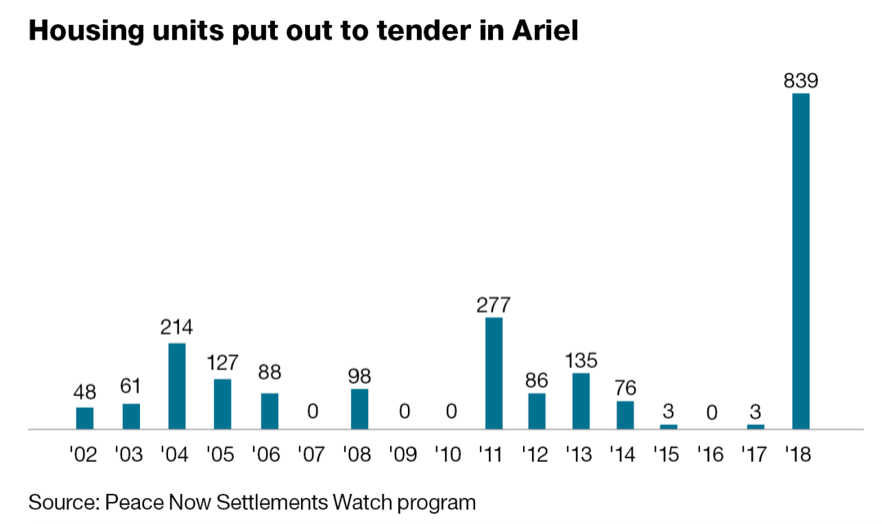 Haaretz published a lengthy report this week on the history of the the Ariel settlement – which is celebrating its 40th anniversary this month – and the dramatic spike in construction in the settlement in 2018. Even before tenders were issued for 42 new units this week (see above), plans for 839 units had already been approved during the first eight months of 2018, compared to tenders for fewer than 5 units each of the past three years. One of the original settlers of Ariel said:
“During the Obama years, everything here was frozen. But thanks to Donald Trump, we’re starting to see the light at the end of the tunnel.”
Not only has Ariel seen a massive surge in construction advancements this year, but the settlement broke ground on a new medical school heavily financed by U.S. casino magnate, and Trump backer, Sheldon Adelson (who this week gave $25 million to the GOP to help it keep the Senate, and in May gave the GOP $30 million to help it keep the House). Many settler leaders and Israeli officials, as well as Adelson and his wife Miriam, were in Ariel this weekend to attend a dedication ceremony for the medical school, despite ongoing controversy around its accreditation under domestic Israeli law. Prime Minister Netanyahu was notably absent from (and reportedly was not invited to) the ceremony, fueling rumors regarding the growing disaffection between him and Adelson.
According to another recent report in Haaretz, Ariel university is illegally dumping construction debris on land that Israel acknowledges is not “state land.” The dump site is outside of the so-called “Blue Line” which the Israeli government uses to demarcate the land that it considers “state land.” Since the dump site is not within the Blue Line, it is likely on land that even the government of Israel recognizes as being privately owned by Palestinians. Anti-settlement watchdog and founder of Kerem Navot, Dror Etkes, commented:
“It’s not surprising that Ariel University, which is the only university in the world built and existing by military order, has adopted the standards accepted in the West Bank involving the takeover of private Palestinian land.”
According to a third Haaretz report, the Israeli Education Ministry has signed a contract to sponsor 3,000-4,000 Israeli high school students of Ethiopian descent to take part in a leadership training program located in Ariel. The program, called “JH Israel,” was founded by American evangelical mega-church pastors Bruce and Heather Johnston, the latter of whom also runs the U.S. Israel Education Association, a pro-Israel, pro-settlement, non-profit group which works with the Family Research Council to lead Congressional delegations to Israel. The JH Israel website says its mission is to help Jewish Israeli students who are “disconnected from the roots of their faith” to establish “a deeper connection to God by embracing their biblical and cultural heritage.” The website also says that Ariel is “at the forefront of biblical prophecy unfolding in modern Israel.”
As FMEP has repeatedly documented, Ariel is located in the heart of the northern West Bank, reaching literally to the midpoint between the Green Line and the Jordan border. The future of Ariel has long been one of the greatest challenges to any possible peace agreement, since any plan to connect Ariel to Israel will cut the northern West Bank into pieces.
Peace Now Settlement Watch Director Shabtay Bendet spoke to Haaretz about the future of the Ariel settlement and the (other) significant repercussions of opening the new medical school. Bendet said:
“Most places in Israel don’t get recognized as cities unless they have 20,000 to 30,000 residents. Ariel became a city when it had just 11,000 residents. Why was this so significant? Because maybe you can uproot a settlement, but you don’t uproot a city. The same holds true for the university. Why was it so important for him to get it accredited? Because when a place has a university, that means it’s established — no pulling it out of the ground….By creating a buffer between the northern and southern parts of the West Bank it makes any future Palestinian state unviable. But besides that, it is also causing damage in the present because its continued expansion impinges on the ability of the surrounding Palestinian villages to develop and grow.”
Amana (the Official Settler Movement) Moves Its HQ to Sheikh Jarrah
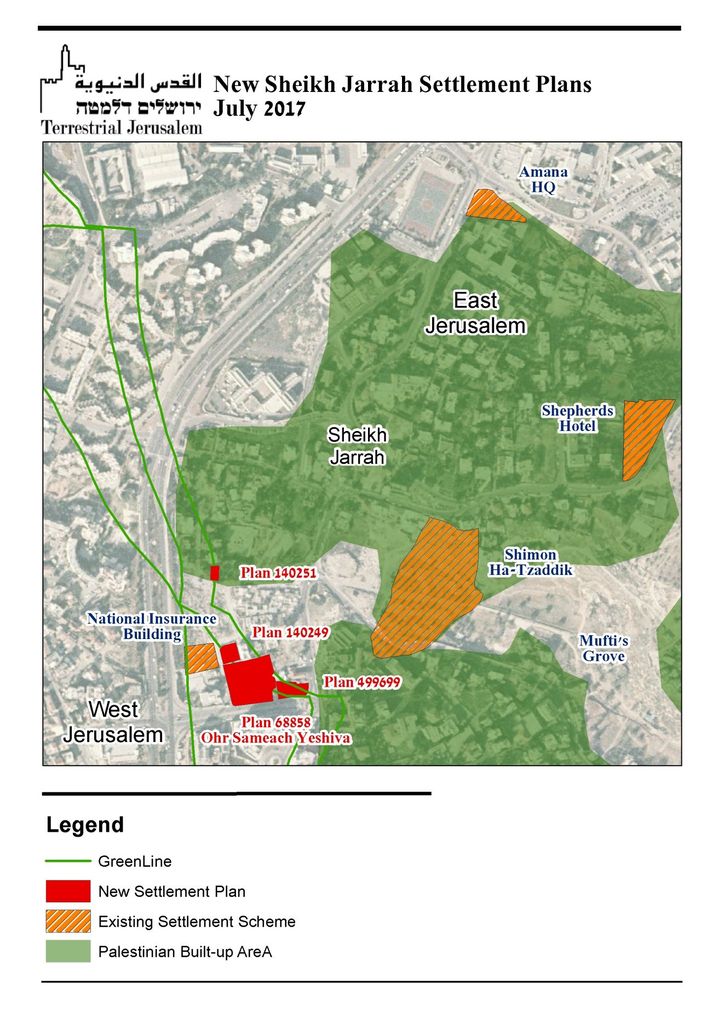 The Ynet news outlet reports that the Amana settler organization – the official body of the settlement movement, operating since the 1970s – has moved into its new headquarters in the heart of the Sheikh Jarrah neighborhood of East Jerusalem, where settlers are continuing to wage a displacement campaign against Palestinian residents. Though Amana has owned the plot of land since 1992, various legal challenges and incredibly sensitive geopolitical considerations have slowed construction of the building, called the “Amana House” (see a detailed history here).
Regarding the strategic implications of the location, Ynet reports:
“Amana says the new headquarters will help bolster the territorial contiguity of Jewish settlements in east Jerusalem.”
Agriculture and Rural Development Minister Uri Ariel (Bayit Yehudi) who previously served as the CEO of Amana, commented that the organization’s relocation:
“constitutes a significant reinforcement to the (Jewish) settlement in east Jerusalem and the bolstering of the Jewish territorial contiguity in the area.”
Several settlement plans are currently proceeding in Sheikh Jarrah, underscoring the strategic location and goals of settler activity in Sheikh Jarrah. As covered previously in this report, Israel is expected to advance a plan for a 6-story office building for settlers, located at the entrance to the neighborhood. Across the street from that building, a highly consequential plan for a new religious school (the Glassman yeshiva) was approved for deposit for public review in July 2017. The goal is clear: to unite the enclaves of settlers living inside of the Palestinian neighborhood by creating a contiguous area of settlement that connects to West Jerusalem, thereby cementing an immovable Jewish Israeli presence in a key Palestinian neighborhood – closing off the possibility of evacuation under a future peace deal.
Settlement Gains in East Jerusalem Result in Palestinians Self-Demolishing Their Homes
OCHA reports that two Palestinian homes in the East Jerusalem neighborhood of Beit Hanina were self-demolished after the Israeli Supreme Court ruled in favor of settlers’ ownership claims. OCHA writes:
“In recent decades, Israeli settler organizations, with the support of the Israeli authorities, have taken control of properties within Palestinian neighbourhoods in East Jerusalem, and some 180 Palestinian families are currently facing eviction cases, filed mainly by settler organizations.”
Bonus Reads
- “How Israeli Right-wing Thinkers Envision the Annexation of the West Bank” (Haaretz)
- “Let’s Admit It: The Settlers Have Won and We Have Lost” (Haaretz)
Welcome to FMEP’s Weekly Settlement Report, covering everything you need to know about Israeli settlement activity this week.
To receive this report via email, please click here.
August 9, 2018
- Israel Plans to Use “Nation-State Law” to Defend Settlement “Regulation Law”
- Israel Moves to Approve a New Settlement…By Expanding An Existing One (An Old Trick)
- Israeli Govt is Funding a Settler School Squatting in a Palestinian Home
- Transferring Israeli Trash to the West Bank
- Settler Regional Council Funds Activities Aimed at Undermining Israeli Law
- Bonus Read
Comments, questions, or suggestions? Email Kristin McCarthy at kmccarthy@fmep.org.
Israel Plans to Use “Nation-State Law” to Defend Settlement “Regulation Law”
The Israel State’s private attorney tasked with defending the settlement “Regulation Law,” Harel Arnon, told reporters that the recent passage of the Nation-State law (declaring Israel the nation-state of the Jewish people alone) will strengthen his efforts to keeping the Regulation Law on the books (an effort which is widely expected to fail). The settlement “Regulation Law” was passed by the Knesset in February 2017, as a means to allow Israel to expropriate privately owned Palestinian land for the exclusive use/benefit of settlers. The High Court of Justice is currently weighing petitions against the settlement “Regulation Law,” which has been frozen since August 2017.
Arnon said:
“The nation-state law certainly impacts the Regulation Law. There is no question. If until now, the argument in defense of the Regulation Law was that it seeks to balance the individual rights of Israeli residents (in the West Bank) with those of the Arab residents… what the nation-state law does is raise the status of Jewish settlement to one of constitutional value.”
The Nation-State law was passed by the Knesset on July 19th, and has since sparked condemnation and protest for the way it demotes the standing of minority communities in Israel. The law says “the state views the development of Jewish settlement as a national value and will act to encourage and promote its establishment and consolidation.” Nothing in the text suggests a distinction between “Jewish settlement” within Israel’s sovereign borders, and settlement in the occupied territories.
Yossi Alpher – former senior Mossad official and IDF intelligence officer) predicted as much in his weekly explainer for Americans for Peace Now. Deconstructing recent quotes by Prime Minister Netanyahu (“Without the Nation State law it would be impossible to ensure Israel’s future as a Jewish state for the coming generations”) and Tourism Minister Yariv Levin (“The hysterics of the political left prove that this is an excellent law. Once the composition of the [High Court] judges is changed, we can get what we wanted”), Alpher deduced:
“…the ultra-nationalist right, currently Israel’s political mainstream, intends to continue absorbing the land of the West Bank into Israel. Simultaneously it seeks, in one form or another, to disenfranchise more than three million Palestinians living there lest they become Israeli citizens and tilt the demographic balance away from ‘Jewish’ and (with a combined population including 45 percent Arabs but still excluding Gaza) toward ‘bi-national’. A Jewish nation state in which only Jews determine the country’s constitutional nature is the perfect ‘legal’ legislative vehicle for taking the necessary apartheid-like measures to make this happen.”
Israel Moves to Approve a New Settlement…By Expanding An Existing One (An Old Trick)
On August 8th, the Israeli Civil Administration announced that it is planning to retroactively legalize the Adei Ad outpost by massively expanding the borders of the (brand new) Amichai settlement to turn Adei Ad into a (non-contiguous) neighborhood of Amichai. In effect, this is a stealth operation by Israel to turn the Adei Ad outpost into an entirely new official, legal settlement.
Map by Haaretz
The massive expansion of the Amichai settlement and the transformation of Adei Ad into a brand new settlement, if implemented, will be a significant step towards creating an uninterrupted corridor of settlements connecting sovereign Israel to the Ariel settlement, through the isolated Shiloh Valley settlements, all the way to the Jordan Valley. In so doing, It will completely bisect the northern part of the West Bank.
The plan takes into account a Civil Administration “Blue Line” survey in 2017, which found that the strip of land between the Amichai settlement and the Adei Ad outpost is privately owned Palestinian land. It seems that the Civil Administration is opting (for now) not to use its newly endowed tools for expropriating privately owned land for the use of settlements, and is instead moving forward with a plan that will effectively leave Adei Ad – ostensibly now a neighborhood of Amichai – physically disconnected from its new parent settlement. The strip of Palestinian land in between the two will almost certainly become inaccessible to its Palestinian owners, as is much of the Palestinian land near Adei Ad, a notoriously radical and violent outpost. It is highly likely that at a later date the land will be expropriated.
The Civil Administration unveiled the new plan in a letter addressed to Israeli NGO Yesh Din, in response to a 2014 petition against the Adei Ad outpost filed by the group on behalf of Palestinian landowners. The Civil Administration’s letter claimed the 2017 “Blue Line” land survey determined that Adei Ad is built on “state land” and is therefore eligible for retroactive legalization (despite having been built there entirely illegally). Yesh Din and its clients have formally appealed the findings of that survey, contending that Adei Ad is partially on private land.
After the Amichai borders are expanded to give cover for the legalization of Adei Ad, the Israeli Civil Administration is set to transfer administrative responsibilities over the expanded settlement (including the Adei Ad “neighborhood”) to the Binyamin Regional Council – the municipal body responsible for administering services and enforcing building laws in settlements within its jurisdiction (though it rarely moves to enforce laws against the illegal settler construction). As Haaretz notes:
“Except in the rarest cases, the council does not enforce the law against illegal construction in its jurisdiction…As a result of the transfer of administrative powers to municipal authorities at Amichai, the settlers will be able to build new structures illegally without effective enforcement.”
Yesh Din’s attorney, Shlomi Zecharia, told Haaretz:
“The inhabitants of the villages near the outpost have become hostages to the policy that abundantly rewards prizes and gifts to ideological criminals. Cutting off farmlands by means of a false [expansion of] jurisdiction is extreme, disproportionate and needless, and in fact is intended to perpetuate restrictions on and infringement of Palestinian property, this time under the official auspices of the government.”
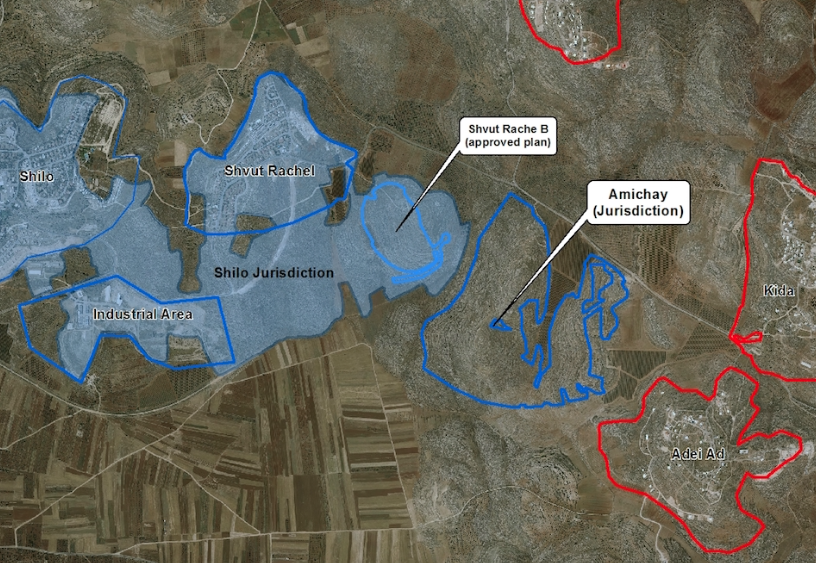
Map by Peace Now
Additionally worth noting, the Amichai expansion/Adei Ad legalization plan will represent yet another reward to settler law-breakers who evacuated from the unauthorized Amona outpost. Previously, the pay-off to settlers included the approval and construction of the Amichai settlement, which was the first new settlement to be built with government authorization in 25 years. It included, too, the approval of Shvut Rachel East, an outpost which – just like Adei Ad – became a non-contiguous “neighborhood” of an existing settlement (Shilo). The Amona pay-off package can now count a third settlement, Adei Ad. As FMEP documented at the time, the Trump Administration reportedly accepted the Amichai plan as an exception to its settlement policy which, at that time, was described in the media as President Trump asking Netanayahu “hold back on settlements for a little bit.”
Yesh Din comments on the Adei Ad scheme:
“Viewed in a broader context, this retroactive authorization is a major step towards fulfillment of Israel’s plan to annex Area C: retroactively authorizing unauthorized outposts at any price so as to ‘normalize’ them and render them permanent settlements; and creating continuous settler presence across the West Bank, from west to east, in order to facilitate the annexation, while dispossessing Palestinians of land that is their source of livelihood and in blatant disregard of international law and of the rights of Palestinian residents.”
Israeli Govt is Funding a Settler School Squatting in a Palestinian Home
The Times of Israel has a detailed report on a government-funded religious school that for years has been operating illegally in a privately owned Palestinian home near the Ofra settlement, in the center of the West Bank. The Mishpatei Eretz Institute, which is operating the school, receives around USD $55,000 annually from the Israeli Culture Ministry, and has received a total of USD $214,039 from government bodies over the past three years alone.
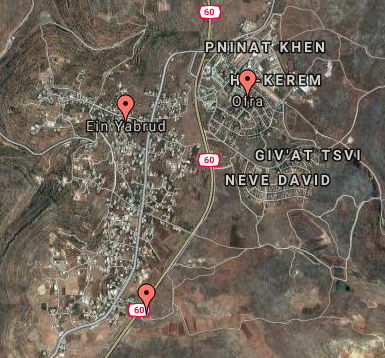
Map by Google, markers by The Times of Israel
In the mid 1990s the home was physically cut off from the Palestinian village to which it belongs when Israel paved Route 60, the major north-south highway in the West Bank. In 2003, Israeli settlers broke into the home while its owners, the Shehadeh family, were on a day trip to Ramallah. After invading the home, settlers produced forged documents claiming that the Al-Watan settler organization purchased the building, and then spent years trying to prove that the purchase was legitimate in order to have the building registered with the Civil Administration. The Shehadeh family also spent years trying to force the IDF to evict the squatters, but nothing was ever done. In the meantime, Al-Watan donated the building – even without having legally established ownership of it – to the Mishpatei Eretz Institute, which then began operating a religious school in the building with government funding.
In 2013, the Jerusalem District Court ruled against Al-Watan’s claim to the building (slamming the organization and its officers for engaging in rampant fraudulent activity), deciding that the documents had been forged and recognizing the original Palestinian owners’ rights. Ten days after the ruling, the IDF Central Command issued a military order seizing the plot of land the home sits on, claiming “security purposes.” The IDF also built a fence around the area. The military order seizing the land will remain in force until 2019.
When contacted about the story, the IDF acknowledged the 2013 Court ruling but did not offer an explanation for any of its actions dating to either before or after the court ruling. A lawyer representing the Palestinian owners told The Times of Israel that the family will soon petition the High Court of Justice to have the settlers, and their school, evicted.
The anti-settlement watchdog Kerem Navot told reporters:
“We see here another example that reveals the corrupt system that Israel maintains in the West Bank. Rather than enforce the law, and evict and punish the settlers who invaded the property, the IDF issued a corrupt military order based on security needs that de facto enables them to stay there. On top of that, we now discover that the government is generously funding criminal bodies like the Mishpatei Eretz Institute.”
Transferring Israeli Trash to the West Bank
Haaretz reports that the Israeli government is close to finalizing a new plan to transfer waste from Jerusalem to the West Bank. Under the scheme, Israel will build a waste treatment facility east of the Ma’ale Adumim settlement to handle waste from Jerusalem. The facility will recycle or burn as much of the waste as possible, and then transfer the resulting ash and any remaining waste back into Israel.
Since the West Bank is under a military occupation, environmental regulation standards are considerably lower than in sovereign Israeli territory, making the West Bank an ideal spot for Israel to dump/treat its waste on the cheap, a practice extensively documented in a 2017 report by B’Tselem. The report asserts:
“Waste treatment in the West Bank is simply one more facet of the exploitative policy Israel has practiced consistently for fifty years now, using Palestinian space and people to further its own interests. As part of this policy, Israel treats the West Bank – and particularly Area C, where it retained full control under the Oslo Accords – as an area meant to serve its needs exclusively, as if it were its sovereign territory.”
Echoing the B’Tselem report, MK Mossi Raz (Meretz) notes that the plan, though sold as an environmentally friendly solution, is part of Israel’s de facto annexation of the West Bank, saying:
“Although at first glance it looks as though the ministry wants to protect the environment, the government plans clearly demonstrate that the goal is to prepare the ground for annexation. The building of infrastructure in the occupied territories by the state, without cooperation from the PA, deepends Israeli control in the territories, and thereby in effect is bringing us even closer to the day when the Israeli government will annex the territories.”
The Israeli Defense Ministry is slowing down the implementation of the plan, which has broad support across other government ministries, for technical reasons — mainly having to do with a dispute about how the facility will be staffed.
Settler Regional Council Funds Activities Aimed at Undermining Israeli Law
In 2017 the Gush Etzion Regional Council contributed hundreds of thousands of shekels to illegal settlement and outpost construction in its jurisdiction, and heavily invested in projects connected to defending the unauthorized Netiv Ha’avot outpost against demolition. Data obtained by the Movement for Freedom of Information and analyzed by Peace Now show that the Gush Etzion Regional Council, which is supposed to be enforcing Israeli laws in areas under its jurisdiction, instead invested hundreds of thousands of shekels trying to help the illegal Netiv Ha’avot outpost skirt the law. The Council’s 2017 projects connected to Netiv Ha’avot included:
- The construction of a new, unauthorized observation tower (a memorial site) in the outpost. Construction of the tower moved forward after the High Court of Justice ruled that 17 buildings in Netiv Ha’avot were built partially on Palestinian land and must be demolished.
- A public campaign to save buildings in the Netiv Ha’avot outpost from demolition, including a payment to the radical Regavim settler organization in connection to the campaign (which is working to selectively enforce building laws against Palestinians in the West Bank). By the end of 2017, the council spent NIS 164,688 on the campaign – which, as Peace Now notes, became an even more active effort in 2018.
- Building a new (at that point unauthorized) outpost for those settlers facing evacuation from buildings in the Netiv Ha’avot outpost. The Council was able to recoup some of those expenses when the government later approved an NIS 60 million package to provide compensation for the settlers who were evacuated as well as funds for the Council.
In addition to the Netiv Ha’avot outpost expenditures, and other unauthorized settlement projects, the Gush Etzion Regional Council spent NIS 1,755 on an ATV tour for MK Yehuda Glick to conduct a “survey on the application of sovereignty over (i.e., annexation of) Gush Etzion.”
Peace Now says:
“It is time for official authorities that are obligated to act according to the law to stop funding illegal activities, attacking the High Court and evading enforcement of the law, especially when using public funds. The Interior Ministry must put an end to this sinister exploitation of the public coffers, and must get our taxpayers’ money back.”
Bonus Read
- “Fact and Fiction About the Amendment of the Israeli Supreme Court’s Jurisdiction Over West Bank Cases” (Lawfare Blog)