Welcome to FMEP’s Weekly Settlement Report, covering everything you need to know about Israeli settlement activity this week.
To subscribe to this report, please click here.
December 7, 2018
- Looming Mass Eviction in Silwan, Part 1: High Court Rules that Settler Organization Can Pursue Eviction of 700 Palestinians in Batan Al-Hawa Section of Silwan
- Looming Mass Eviction in Silwan, Part 2: Elad Settler Org Wins Eviction Case Against Palestinians in Wadi Hilweh Section of Silwan
- Israel to Fast-Track Two Settlement Plans in Sheikh Jarrah
- Justice Ministry Finalizes Legal Opinion to Retroactively Legalize the Haresha Outpost
- Three Illegal Outposts (& Ariel) Are Now “National Priority Areas” Eligible for Government Subsidies
- High Court Rules the Jewish National Fund is the Legal Owner of Land South of Bethlehem
- Israel Seizes Jordan Valley Land Owned by the Catholic Church
- Israeli Civil Administration Report Criticizing Yitzhar Settler Violence Leads to Renewed Calls to Annex the West Bank
- After IDF Killed Two Palestinians, Civil Administration Grants Settlers Victory in Struggle Over Hilltop
- The New Mayor of Jerusalem, Moshe Lion, On Settlements
- Al-Shabaka Policy Paper: “The EU & Jerusalem”
- Breaking the Silence Report – “Occupying Hebron: 2011-2017”
- U.S. Chatter on Economic Coexistence Initiatives (Which Normalize Settlements/Occupation) Provokes Strong Palestinian Response
- Bonus Reads
Questions/comments? Email kmccarthy@fmep.org
Looming Mass Eviction in Silwan, Part 1: High Court Rules that Settler Organization Can Pursue Eviction of 700 Palestinians in Batan Al-Hawa Section of Silwan
On November 22nd, the Israeli High Court of Justice ruled that the settler organization Ateret Cohanim can continue to pursue the eviction of 700 Palestinians from their homes in the Batan al-Hawa section of the Silwan neighborhood in East Jerusalem. This would be the largest displacement of Palestinians from East Jerusalem since 1967.
The High Court’s ruling did not decide the central issues in the case, which call into question Ateret Cohanim’s ownership of the land through its control of an historic Yemenite land trust (the Benvenisti Trust). The High Court reserved those issues for the Jerusalem Magistrate’s Court to decide as part of its consideration of individual eviction cases.
In its ruling, the High Court criticized of the government’s involvement in the case, specifically calling out the role the government played in transferring ownership of the land to Ateret Cohanim without properly informing the Palestinian residents. The High Court ruling said:
“We can’t continue without expressing surprise at the state’s assumption that a decision so significant to the lives of hundreds of people – ‘liberating’ the property on which they have lived for many years [and transferring it] to other hands – isn’t the kind of thing that ought to be publicized through reasonable means. Even the precise identity of the property’s residents wasn’t known, and that’s the interpretation kindest to the state…Evicting people who have lived on this land for decades – some of them without even knowing that the land belongs to others – creates a human problem. Especially when it’s done without compensation or any other solution. It seems the state would do better to consider providing a solution, in appropriate cases, for those evicted from their homes. Property rights are important, but it’s also important to defend people’s homes.”
B’Tselem commented:
“The judgment proves, yet again, that the Israeli High Court gives its seal of approval to almost any infringement of Palestinians’ rights by the Israeli authorities.”
Ateret Cohanim has waged a years-long eviction campaign against Palestinians living in Silwan, on property the settler NGO claims to own, based on its control of the historic Benvenisti Trust, which oversaw the assets of Yemenite Jews who lived in the neighborhood in the 19th century. Palestinians have challenged the legitimacy of the Benvinisti Trust’s claims to the currently existing buildings, saying that the trust only covered the old buildings (none of which remain standing) and not the land. Despite ongoing legal challenges, in October 2018 the Jerusalem Magistrate’s Court ruled in Ateret Cohanim’s favor in one of the cases connected to the Benvenisti Trust’s claim to the buildings there – resulting in the eviction of the last remaining Palestinian tenants (the Abu Sneina family) from a building in area of Silwan known as Batan al-Hawa.
The ruling this week does not give a final decision to the underlying questions of ownership, but it allows Ateret Cohanim to proceed – from a strengthened position – in its legal efforts to evict Palestinians from their homes.
Looming Mass Eviction in Silwan, Part 2: Elad Settler Org Wins Eviction Case Against Palestinians in Wadi Hilweh Section of Silwan
 On December 5, 2018 the Jerusalem Magistrate’s Court upheld the eviction of a Palestinian family – the Siyams – family their home in the Wadi Hilweh section of Silwan, in East Jerusalem, just 820 feet from the southern wall of Al-Aqsa Mosque. Like Ateret Cohanim (see above), the Elad settler organization has been waging a years-long legal battle to take control homes in Silwan, including a 20-year battle to take control of the Siyam family home, which Elad insists legally purchased it.
The Court ruling this week was the first ruling in the settlers’ favor. The Siyam family announced plans to petition the ruling to the Jerusalem District Court.
In response to the ruling, Peace Now said:
“This case is an example of how the settlers manage to take control of Palestinian property in East Jerusalem by combining manipulations, money, forgery and significant aid from the Israeli authorities. It is not a regular case between equal sides, but a story of David and Goliath, and the settlers are the Goliath. There is a settlers organization with almost unlimited financial resources and enormous political power against an ordinary Palestinian family that has been forced into court for more than 20 years, to invest tremendous resources in legal defense and to deal with various and varied purchase claims. This way the settlers are causing great damage to Israel when they harm the delicate fabric of life in Jerusalem and the possibility of compromise in Jerusalem and a two-state solution.”
Israel to Fast-Track Two Settlement Plans in Sheikh Jarrah
Ir Amim reports that the Jerusalem District Planning and Building Committee will meet on December 23rd to fast-track the approval of two plans for a total of 13 new settlement units in the Sheikh Jarrah neighborhood of East Jerusalem. The plans put approximately 5 Palestinian families at imminent risk of eviction.
On December 23, the Committee will discuss public objections to plans for the two settler building (one for 10 units and one for 3 units), which if approved, will result in the eviction of 5 Palestinian families.
Ir Amim further explains:
“The two plans in Sheikh Jarrah are being pushed by city councilperson and settler leader Arieh King, a close ally of Jerusalem’s just inaugurated mayor, Moshe Leon. King has recently joined the new mayor at several public events and is said to be eyeing a deputy mayor position in the new administration.”
+972 Magazine has an excellent piece on the resumption of evictions and settlement takeovers in Sheikh Jarrah, which have been stalled since 2009, in part due to international pressure. A prominent figure in the Sheikh Jarrah resistance movement, Saleh Diab, said:
“Ever since Trump said last year that Jerusalem belongs to the Jews, we have been feeling the change. The settlers are working quickly to evict us before the American administration changes…How will we go back to the days of protests? The police today are like the police in [apartheid] South Africa. Israelis who stood alongside us were fired from their jobs because of their views…Like in Khan al-Ahmar, they are trying to expel an entire community and turn us into refugees for a second time.”
PLO Spokeswoman Hanan Ashrawi released a statement saying:
“Since the beginning of the year, Israel has accelerated and intensified its efforts to entrench its colonial military occupation, especially in and around occupied Jerusalem…Israel’s extremist, racist government coalition headed by Prime Minister Benjamin Netanyahu is deliberately and systematically working to complete the total annexation and isolation of Jerusalem from its Palestinian environs and surrounding areas, as well as the distortion of the occupied city’s demographic, historical and cultural character…These measures pose a strategic threat to Palestinian human and national rights, especially through the imposition of new and ‘permanent’ realities on the ground that deliberately undermine the achievement of Palestinian statehood…At a time when the rights-based international system is under threat, the reality and future of Jerusalem is a litmus test for the world and the integrity of its legal and political system. It is our hope that the global community and people of conscience will rise to the challenge and defend the universality and indivisibility of human rights. The world must not fail Jerusalem.”
Justice Ministry Finalizes Legal Opinion to Retroactively Legalize the Haresha Outpost
On December 6, 2018, Israel Justice Minister Ayelet Shaked announced a new legal opinion that permits the Israeli government to proceed with its plan to retroactively legalize the Haresha outpost by building an access road through privately owned Palestinian land. According to the new opinion, the Israeli government is permitted to “temporarily seize” the privately owned land to build a tunnel underneath it leading to the outpost, though it leaves open the possibility for the government to permanently expropriate the land in the future. The lack of an access road has until now prevented the Israeli government from retroactively legalizing the entire Haresha outpost; once the access road is deemed legal, the government is expected to act quickly to legalize it and pursue plans to build more settlement units there. 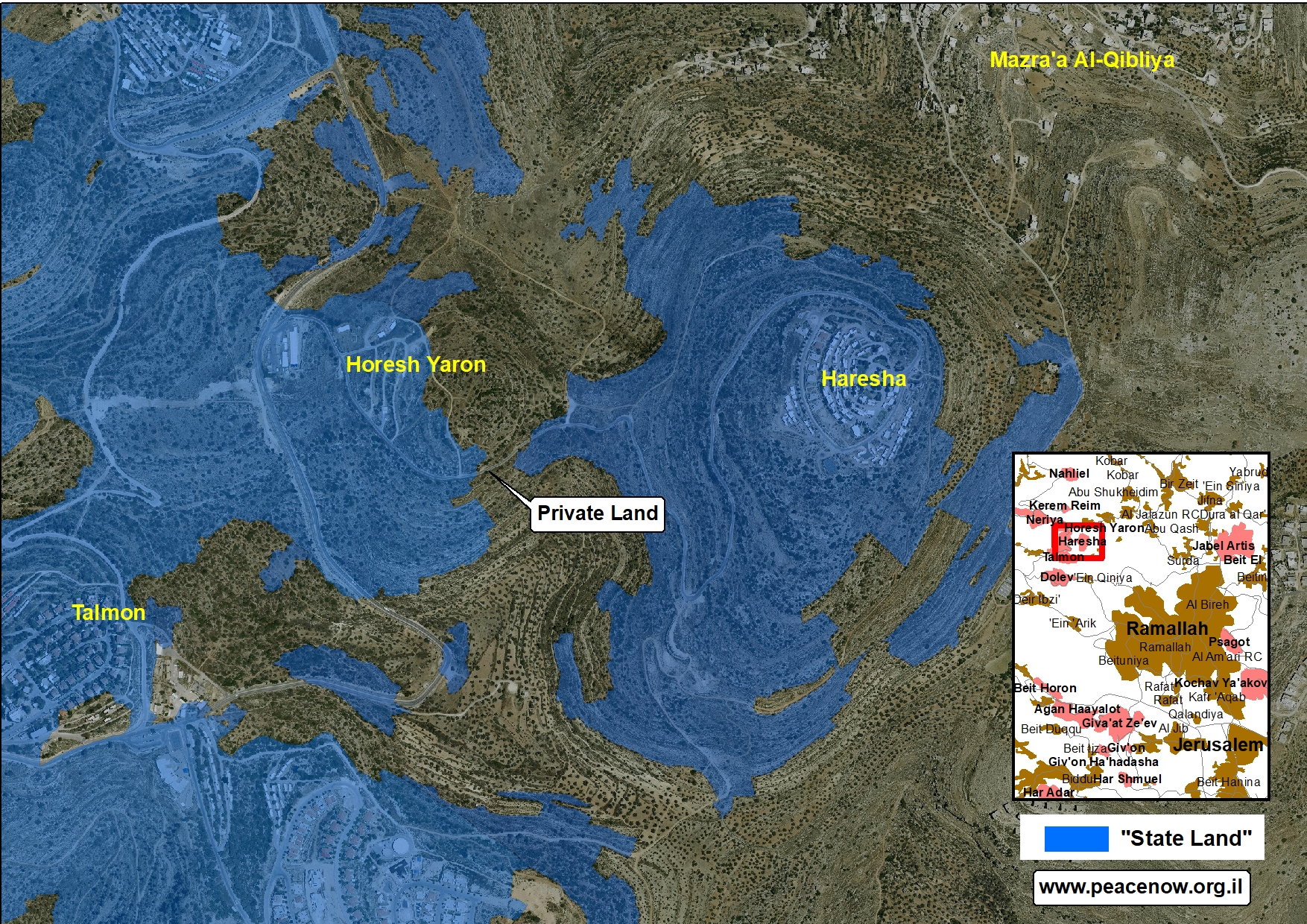
Israeli Attorney General Avichai Mandelblit – who signed off on the new Justice Ministry opinion – in November 2017 released a different legal argument in favor of permanently expropriating the land to legalize the access road, arguing that settlers are part of the “local population” of the West Bank and are therefore eligible to be the sole beneficiaries of land seized for “public use” (the access road is not open to Palestinian traffic). The opinion released this week, which cites Mandelblit’s previous opinion, finds yet another way to accomplish the same goal, by temporarily seizing the land to build a permanent tunnel for the settlers underneath it.
Justice Minister Ayelet Shaked said:
“From the beginning of my current term I have set a goal of normalizing the lives of the residents of Judea and Samaria and normalizing as many communities as possible. We have gone from a discourse of eviction to a discourse of normalization. These actions are in addition to the strengthening of the communities by other means, such as the transfer of authority in matters of Judea and Samaria from the Supreme Court to the Administrative Affairs Court in Jerusalem, as well as the equalization of legislation for Judea and Samaria…I will continue to work for the normalization of additional communities in Judea and Samaria. I thank Attorney General Avichai Mandelblit, Deputy Attorney General (Erez) Kaminitz and the Legal Advisor for the Judea and Samaria Area for their important activity on the issue.”
Peace Now told the Times of Israel:
“This move is a mockery of justice. Since the Regulation Law is tied up in court, the Ministry of Justice is yet again using every crooked justification it can concoct to expropriate private Palestinian land in order to dissect the West Bank with settlements until they have achieved their one-state apartheid agenda.”
Dror Etkes, founder of the anti-settlement watchdog group Kerem Navot, wrote:
“the outpost of Haresha, comprised of about 100 illegal structures, is of course not the story here. The story that the settlers are striving to resolve, with Mandelblit’s help, involves hundreds (yes hundreds!) of roads that have been illegally paved for decades around settlements and outposts, on land that even Israel recognizes as privately-owned. Now, with a little creativity and a lot of nerve, a legal mechanism has been invented to enable settlers to retroactively authorize the road system, without which the national land grab enterprise championed by Israel in the West Bank, can’t function.”
Three Illegal Outposts (& Ariel) Are Now “National Priority Areas” Eligible for Government Subsidies
On November 26th, Israeli Housing Minister Yoav Gallant announced that three illegal outposts – Kerem Reim, new Migron, and Shvut Rachel – will be considered “national priority” areas for development, marking the first time that illegal outposts are eligible for significant government subsidies to encourage growth.
In order to include the outposts, the Israeli Housing Ministry wrote and adopted a new criteria to make “neighborhoods located far from a ‘parent town’ that do not rely on the infrastructure of said town” eligible for priority status. For the purposes of the government subsidies plan, Kerem Reim is considered a “neighborhood” of the Talmon settlement, New Migron is considered a “neighborhood” of the Kochav Yochav settlement, and Shvut Rachel is considered a “neighborhood” of the Shilo settlement.
Though the Israeli government has rewritten its laws to consider these “children” outposts as “neighborhoods” of existing, government-approved settlements, they are, in fact, independent settlements. This fact is underscored by the Housing Ministry’s new criteria which admits that the outposts do not share the same infrastructure systems as the settlements of which they are considered a part (and, indeed, rewards that fact).
The Ariel settlement was also re-designated as a national priority area (having been previously selected and then later removed from the list), among a total of 583 communities from both sides of the Green Line. The selected communities, settlements, and outposts will benefit from massive government subsidies, including at least 50% of infrastructure costs for the construction of new housing. Israelis seeking to purchase a home in the selected communities will receive government loans and forms of assistance.
Haaretz reports Housing Minister Yoav Gallant remarked:
“it is a social and national duty to prevent negative migration from distant towns and to enable them to thrive and prosper.”
The Jerusalem Post quotes Gallant as saying that the decision to include the outposts:
“is a clear statement by the government that it will continue to develop and strengthen the settlements.”
High Court Rules the Jewish National Fund is the Legal Owner of Land South of Bethlehem
On November 28, 2018 the Israeli High Court of Justice ruled that the Jewish National Fund is the legal owner of 130 acres of land south of Bethlehem, ending a 22-year legal battle over ownership claims. Palestinians from a nearby village challenged the validity of the sale of the land to the Jewish National Fund when the organization moved to register its ownership of the land with the Israeli Civil Administration in 1996.
This week, the Court held that the Jewish National Fund (via its subsidiary company, Himnuta) had legally purchased the land in 1944 from its original Palestinian owners. The ruling will allow the settlers to move forward with plans for building more settlement units on the land, which is already home to one settlement, Rosh Tzurim, and to the headquarters of the Gush Etzion Regional Council.
The head of the Gush Etzion Regional Council, Shlomo Ne’eman, celebrated the ruling, saying:
“the task of expanding the lands of Gush Etzion is a national mission. The Supreme Court’s ruling gives us optimism that the court’s position will benefit the Jews and Jewish land in Judea and Samaria and will not automatically rule in favor of the thieving claims of the Arab intruders.”
Israel Seizes Jordan Valley Land Owned by the Catholic Church
On November 27, 2018, the Israeli Civil Administration announced that it is seizing 66 acres of land in the northern Jordan Valley that is owned by the Catholic Church. The Civil Administration said the land was needed for “military purposes.”
The Latin Patriarchate of Jerusalem responded to the seizure in a statement, saying:
“The Patriarchate is looking into the aspects of this decision in order to address it in the appropriate manner, have it contested and to stop further damage.”
Israeli Civil Administration Report Criticizing Yitzhar Settler Violence Leads to Renewed Calls to Annex the West Bank
An Israeli news outlet, Kan 11 news, revealed the existence of a new Civil Administration report that criticizes the Yitzhar settlement. According to Kan 11, the report states that Yitzhar is a source of violence that “undermines governance and the rule of law.”
In addition to documenting the violence perpetrated by Yitzhar residents against Palestinians living nearby, the report also documents incidents of Yitzhar settlers attacking Israeli forces. The report calls on the IDF Commander Maj. Nadav Padan to punish the Yitzhars settlers by scuttling plans to build a new kindergarten and by ceasing to guard dangerous roads around the settlement and its many outposts.
In response, Yossi Dagan (head of the Samaria Regional Council, a settlement municipal body) called for the author of the report to be fired, saying:
“Officials in the Civil Administration are torpedoing the approval of security elements which could have prevented terrorist attacks in threatened settlements such as Itamar, and in the Barkan industrial zone before the attack, as well as narratives of the Palestinian Authority and radical left-wing organizations.This is an example of the evil in the civil administration. I call on the head of the Civil Administration to remove the clerk … who acts like a politician and not as is required. This report is malicious and false. The Yitzhar leadership is leading the community in a good and positive direction, and this report has nothing but lies. This is the total loss of control of the Civil Administration. While murderers with the blood of Israelis on their hands, the Civil Administration refrains from punishing the sources of terror out of statements that this is collective punishment, and now they want to create collective punishment for the Jews. The head of the Civil Administration and the deputy defense minister should call this clerk for a hearing before his dismissal.”
In response to the report’s recommendations, MK Bezalel Smotrich (HaBayit HaYehudi) called for the entire Civil Administration to be disbanded. Smotrich announced that he will seek government backing for a bill to achieve that end during the next meeting of the Israeli Cabinet, scheduled for December 9th. Under the bill, Israeli settlers in the West Bank will come under the full sovereignty of domestic Israeli institutions, while Palestinians will be ruled by “Regional Liaison administrations.” The bill would effectively annex the entire West Bank to Israel.
Smotrich said:
“The Civil Administration must be shut down now. This document reflects a political agenda that is hostile to the settlement enterprise and to the local residents, [an agenda] which unfortunately is expanding in this unnecessary body…This is the same Civil Administration that for years has pushed for a policy of separation between Arabs involved in terrorism and the rest of the Arab population. Now it suddenly remembers to use collective punishment against Jewish residents…for years now, the residents of Judea and Samaria, who are equal citizens who serve in the army and in the reserve and who pay taxes, are not entitled to equal rights and receive inferior service from the Civil Administration instead of receiving optimal service from government ministries like all citizens of Israel. The time has come to fix that.”
After IDF Killed Two Palestinians, Civil Administration Grants Settlers Victory in Struggle Over Hilltop
On November 29th, Haaretz reported the tragic story of two Palestinians who were shot and killed by Israeli forces while protesting attempts by Israeli settlers to take over a hilltop belonging to the Palestinian village al-Mazra’ah al-Qibliyah, just north of Ramallah. Following a clash on October 26th, in which the IDF opened fire on Palestinian protesters – killing the two men – the IDF issued a military order closing the hilltop – known as Khirbet Na’alan – to Palestinians on Fridays. As Haaretz notes, the military order was a victory for the settlers, who have been aggressively trying to take over the hilltop since July 2018.
The residents of al-Mazra’ah al-Qibliyah have fought against the increasing encroachment of the Talmon settlement and its seven illegal satellite outposts, which collectively surround the village. Having seen several outposts take over their land illegally and under the protection of the IDF, Palestinians began actively trying to prevent the takeover of the Khirbet Na’alan hilltop. The settlers waged their own campaign to harass and intimidate the village, often entering the village at night to paint hateful messages and damage Palestinian property. Each Friday, the settlers would go pray at the site.
In response to petitions filed by Palestinians, the Israeli Civil Administration issued an order barring the settlers from accessing the hilltop. On the same day the villagers found out about the order, they watched 10 settlers from the Kerem Reim outpost (which was recently selected as a “national priority area” to encourage growth, see above) approach the hilltop with heavy IDF protection. It was on this day that the IDF opened fire on a group of Palestinians protesting the incursion, killing two and wounding many others.
Video of the bloody incidents shows the IDF opening fire at an incredibly close distance, and at least 10 Palestinians falling down amidst gunfire.
The New Mayor of Jerusalem, Moshe Lion, On Settlements
In a thorough analysis of the recent Jerusalem Municipal elections, Terrestrial Jerusalem’s Danny Seidemann shared key insights into what may be in store for settlement activity under Jerusalem’s new mayor, Moshe Lion. Seidemann writes:
“Lion emerged from the ranks of the less ideological elements in the Likud. However, support for East Jerusalem settlements and settlers is so deeply ingrained even in this segment of the party as to be second nature. Lion never mentioned the Palestinians of East Jerusalem in his campaign, and actively cooperated with Aryeh King, who represents the right-wing fringe of the East Jerusalem settlers. Consequently, it is highly likely that Lion will continue to do the bidding of the settlers in East Jerusalem, and to neglect the Palestinian sector. Nothing in his world view or the way he understands his political interests suggests otherwise.”
Al-Shabaka Policy Paper: “The EU & Jerusalem”
Al-Shabaka analyst Yara Hawari published a new paper exploring options for European Union member states to push back on U.S. policy and Israel’s annexation of Palestinian land. Hawari writes:
“The US embassy move has accelerated and legitimized a process of de-Palestinianization of Jerusalem that began over seven decades ago. In the absence of concrete pressure, Israel will continue to violate the fundamental rights of the Palestinian people in Jerusalem and the rest of historic Palestine, with the full support and encouragement of the Donald Trump administration as well as its far-right allies within Europe and in Latin America. Despite the inaction described above and the global political shift to the right, there remains potential for the EU to pressure Israel and pursue Palestinian human rights. This is due to strong European popular support for Palestinian rights and sovereignty that has allowed grassroots solidarity networks to grow, as well as the fact that the EU is premised on international law and human rights…”
Breaking the Silence Report – “Occupying Hebron: 2011-2017”
Breaking the Silence released a new compilation of testimonies from Israeli soldiers who served in the Hebron area. Breaking the Silence writes:
“The Israeli settlement in the heart of the city of Hebron marked its 50th anniversary this year. Its story is a microcosm of the occupation: contempt and disregard for the rule of law, daily violence, deprivation of Palestinian residents’ basic rights, and a military system that preserves all of the above. This booklet of testimonies intends to offer the public a glimpse of the reality in Hebron from our perspective as soldiers deployed there. These testimonies were given by soldiers who served in the city from 2011-2017. They reveal the violence and discrimination that have become an inextricable part of life in Hebron, and their impact on the lives of Palestinian residents.”
The online portal for the report also has an interactive map, where users can see where each incident took place against the backdrop of Hebron’s closed streets, religious sites, and settlement enclaves.
U.S. Chatter on Economic Coexistence Initiatives (Which Normalize Settlements/Occupation) Provokes Strong Palestinian Response
Top U.S. negotiators have continued hinting about a major economic element to the yet-to-be-unveiled “deal of the century.” As FMEP has documented to this point, Ambassador David Friedman has met with Israeli and Palestinian businessmen in a bid to promote joint projects in the Occupied Territories in a way that normalizes Israeli settlements and annexation bids.
On November 28th, Ambassador Friedman was interviewed by the Christian Broadcast Network. Part of the transcript of the interview reads:
Question: “One of the aspects of the peace plan seems to be a relationship between Palestinian businessmen and Israeli businessmen. Some would say you crossed a red line when you crossed the green line into Ariel officially. What was the importance of that meeting?”
Friedman: “On a practical level, I met with, I don’t know, maybe 8 or 10 Palestinian business leaders and, to a person, they all said to me, ‘let’s do business, let’s get going. We want to work with Jews; we want to work with Israelis.’… I try to look at everything from a lens of what is best for the United States. That’s my job. I represent the United States. But look, we are a nation under God; we’re built on Judeo-Christian values. Much as I try I cannot help but see the majesty of God’s work and all the miracles that happen in this incredible country.”
U.S. Special Representative for International Negotiations, Jason Greenblatt, wrote an op-ed also emphasizing, among of myriad of accusations against the Palestinian Authority, that the U.S. is hoping to jump-start economic development, separate from its “plan” to resolve core issues. The article reads:
“While waiting for a possible political solution, it is high time to build the Palestinian economy and provide Palestinians with the opportunities they deserve…We know that the Palestinians are not interested in mere economic peace. The Trump Administration continues to strive for a peace agreement, but the Palestinians need economic help now – with or without a peace agreement. The technology sector in the West Bank and Gaza has great potential and can be developed without treading into the politically contentious core issues of the conflict…I continue to meet with ordinary Palestinians and what is striking is that, although they complain about the Trump Administration’s policies, they remain focused on their economy…Palestinians are a proud people and want to create and earn on their own. They believe, as I do, that Palestinians should be allowed to improve their economy without worrying about whether they will give up on their national cause…Let’s be real – 136,000 Palestinians commute to work with Israelis every day because the opportunity is there. Anti-normalisation is a failed policy that only hurts the Palestinians. Let’s allow Palestinians to thrive in the way they are educated, capable of and deserve. We won’t tire of trying to resolve the political conflict (and certainly Palestinians won’t either), but we must focus on helping the Palestinian economy where we can, before it is too late.”
Palestinians reacted strongly to Greenblatt’s screed. Saeb Erekat, chief Palestinian negotiator, wrote in response:
“…economic desperation is seen by the Trump administration as an opportunity to force Palestinians to normalise Israel’s occupation, to legitimise its settlements and its whole system of oppression. The administration has been trying to divide Palestinians by claiming that the Palestinian leadership is preventing economic growth. However, there is a consensus among our people that the primary responsibility for our grave financial situation is the Israeli occupation.”
Hani Masri, a Palestinian political analyst, said:
“Trump thinks that what the Palestinian leadership has rejected can be passed through the people, but the majority of Palestinians will not positively absorb or accept what Greenblatt is promoting. There are economic interests between the Palestinians and Israelis, however the political issue is a different subject and can’t come at the expense of the legitimate rights of the Palestinians.”
Elsewhere, at an event hosted by the Brookings Institute, former peace negotiator Dennis Ross promoted draft legislation in the U.S. Congress that would invest heavily in joint economic projects in the West Bank which normalize the settlements. The Jewish Insider summarizes:
“[Dennis] Ross praised current draft legislation in Congress that would give upwards of $150 million to joint Israeli and Palestinian projects: [Ross:] ‘Cutting $10 million for projects that are joint projects between Israelis and Palestinians, the rationale for that is hard to grasp. If there is one thing that we should be doing [it is] demonstrating that when Israelis and Palestinians cooperate there’s a payoff for it. And that ought to be elementary. That ought to be just a given. Anything you’re doing should be to designed to elevate the payoffs of practical tangible cooperation.’”
Finally, the Friends of Beit El organization (previously headed by now-Ambassador David Friedman) hosted a star-studded fundraiser in New York to raise funds for and awareness of the Beit El settlement. It was attended by two Members of Congress and the speaker of the Israeli Knesset Yuli Edelstein, who told the crowd:
“Independence, sovereignty, will eventually come to Judea and Samaria and many more houses with be built in order to reach the number we all dream — a million Jews in Judea and Samaria.”
Notably, the mention of Rep. Nancy Pelosi, the newly elected Speaker of the House, elicited boos from the crowd.
Bonus Reads
- “Annexation – at what cost?” (Times of Israel)
- “Leftists on tour in Hebron confirmed in view that settlers ‘have already won’” (Times of Israel)
- “Shaked touts ‘confederation’ of Jordan WEst Bank, and Gaza” (Times of Israel)
- “Inside the Evangelical Money Flowing Into the West Bank” (Haaretz)
Welcome to FMEP’s Weekly Settlement Report, covering everything you need to know about Israeli settlement activity this week.
To subscribe to this report, please click here.
November 15, 2018
- Knesset Advances Bill to Allow Settler Group to Build in Silwan
- Settler: Amichai Settlement Was Meant to Nullify Two-State Solution
- Want to Track Settlements? There’s an App for That
- Bonus Reads
Questions/comments? Email kmccarthy@fmep.org
Knesset Advances Bill to Allow Settler Group to Build in Silwan
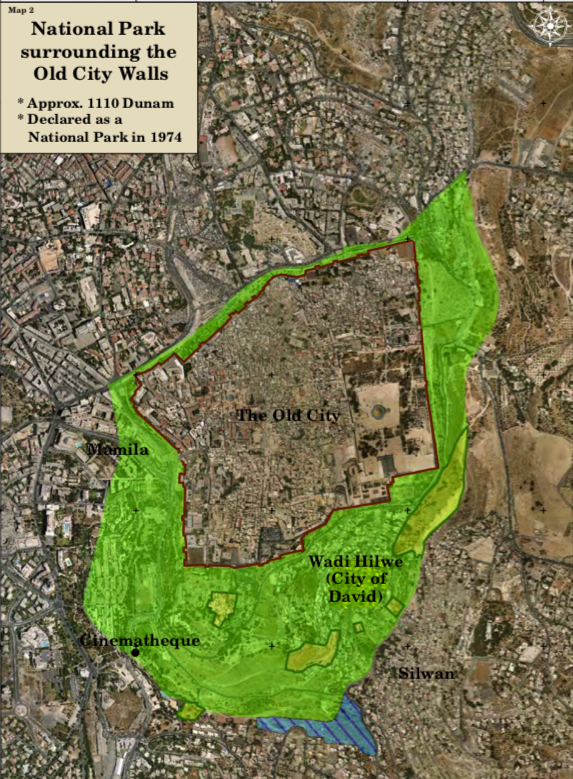
Map by Bimkom
Ir Amim reports that the Knesset has advanced an amendment to the National Parks, Natural Reserves and Memorial Sites Law – last considered in July 2018 – that will allow the Elad settler group to build settlement units in the Wadi Hilweh section of the Silwan neighborhood in East Jerusalem, in an area which Israel previously declared the “City of David National Park.” On November 15th, the proposed amendment (Amendment 17) entitled, “Planning for Housing in an Existing Neighborhood in a National Park,” was moved to the Knesset Interior Committee in preparation for a combined second and third reading, after which it will become law.
If passed into law, the amendment will create a custom made exception that exempts the City of David National Park from longstanding prohibitions against building inside of national parks. Elad has managed the “park” since 2001 on behalf of the Israel Nature and Parks Authority. In Haaretz, Ir Amim’s Director of International Relations & Advocacy, Betty Herschman, explains:
“Elad is not an environmental group or an archeological authority; it has no professional capacity to even compete for a bid to manage a national park (had there been a transparent tender process, which there was not). It is, though, a right-wing settler group. Elad is the only entity promoting this bill. Faced by objections from a spectrum of green groups, the group lobbied for a custom-made exemption to fit the City of David alone to push out Palestinians and permit building homes for settlers in a national park. That by itself should demonstrate Elad’s unfitness for running such a space. Amendment 17 is specifically designed to enable Elad to expand its foothold in Silwan where, backed by the state, it has seized roughly 75 Palestinian homes over the last several decades. The latest eviction took place last week.”
Ir Amim writes:
“Promotion of this [bill] lays bare the political drivers behind national park planning and development in East Jerusalem, an integral part of a larger settlement enterprise. National parks have become an effective tool for the state, working in cooperation with private bodies, to transfer administration and development powers for public, touristic, archaeological and educational projects into the hands of private right wing organizations; in so doing, enabling the Israelization of the Old City and surrounding band of Palestinian neighborhoods.”
For more information on the role on national parks around Jerusalem in advancing the Israeli settlement agenda in Palestinian neighborhoods, see Ir Amim’s reporting here; for a comprehensive survey and analysis of national parks in Jerusalem/East Jerusalem, see Bimkom’s report here.
Settler: Amichai Settlement Was Meant to Nullify Two-State Solution
Map by Haaretz
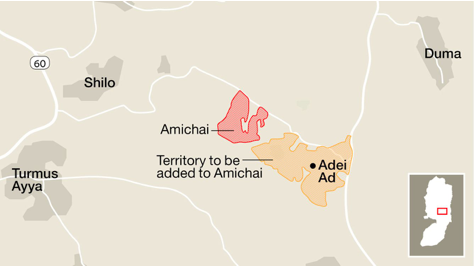
A new Ynet report underscores the ideological significance of the Israeli government’s decision to approve plans for the first new government-backed settlement in 25 years, Amichai, which is currently under construction deep in the Shilo Valley.
As a reminder, Amichai is one of two new settlements the government promised as a pay-off to Israeli settlers who were forcibly removed from the unauthorized Amona outpost, following a High Court order (an order the government tried to avoid enforcing). The plans for the Amichai were originally approved in April 2017; in August 2018, the Israeli government approved another plan that massively expanded the municipal borders of the Amichai in order to annex several outposts – including the notorious and expansive Adei Ad outpost – to the settlement, expanding its footprint three-fold.
Recalling the Amona outpost settlers’ campaign to promote Amichai, a lead settler organizer told told Ynet:
“Some three years before the evacuation of [the unauthorized outpost of] Amona, a group of us residents were sitting in the office of the Defense Ministry’s legal advisor, Ahaz Ben Ari, in the Kirya IDF base in Tel Aviv. To our west was the Mediterranean Sea, to our east were the mountains of Judea and Samaria. Ben-Ari looked east and said, ‘You do realize you’re living there temporarily, right?’ We asked him what did he mean—’you’re talking about our homes, our lives.’ He answered, ‘The international community won’t let us stay there forever.’ I told him someone greater than us (Israel’s first prime minister David Ben-Gurion) once said, ‘What matters is not what the goyim say, but what the Jews do.’ And we said goodbye. This is the common view among the Israeli bureaucrats who decide and run things. This is the view that uses life in Judea and Samaria as a bargaining chip on the way to an arrangement with the Palestinians. Life in Judea and Samaria is put on hold. That is why the construction is only done within the confines of the separation barrier.
So the establishment of Amichai [beyond the separation barrier] is an internal statement to the bureaucrats as well as one to the international community that we’re done with just maintenance, and we’re moving forward by building a new community in the heart of the land. And not just a new community is being built, but this community is legalizing all of the smaller communities in the area. We’re leaving the confines of the separation barrier and building a community that completes the corridor of Jewish settlement from the beach in Tel Aviv to the Jordan Rift Valley. It nullifies the possibility of establishing an Arab state at the back of the mountain. And this isn’t my own personal statement, but a statement made by the prime minister and the entire Israeli government that voted unanimously to establish Amichai, a statement by the State of Israel.”
Want to Track Settlements? There’s an App for that
Americans for Peace Now has released a new and improved version of Facts on the Ground, APN’s smartphone app that gives users the ability to track, explore, and gain a comprehensive understanding of the settlements.
In announcing the updated app release, Americans for Peace Now says:
“Originally released in 2010, APN’s Facts on the Ground was the first-ever interactive online map of West Bank settlements. The new version features up-to-date statistics and data, including individual “snapshots” of every settlement and outpost in the West Bank. The app includes informational video, a comprehensive glossary, and a new, expansive statistics section from Peace Now. Facts on the Ground also marks the re-launch of APN’s Settlements in Focus publication. New issues, each profiling different West Bank settlements, will be featured on the app and available to all users.”
Bonus Reads
- “Occupation? What Occupation?” (Haaretz)
- “The Gatekeeper of Israeli Democracy & Rule of Law” (Al-Monitor)
- “How the tourism industry underpins illegal Israeli settlements” (Al Jazeera)
Welcome to FMEP’s Weekly Settlement Report, covering everything you need to know about Israeli settlement activity this week.
To subscribe to this report, please click here.
October 25, 2018
- More Evidence of WZO Support for Illegal Settlement Activity
- Israel to Expropriate More Palestinian Land to Widen West Bank Highway
- Settlers Take Over Another Building in Silwan
- Hugely Disproportionate Amount of Government Grants to Regional Councils Go to Settlements
- Fearing Unfavorable Court Ruling, Palestinians Petition ICC to Stop Hebron Settlement Plan
- Cabinet to Consider Bill to Allow the Knesset to Overrule the High Court of Justice
- Knesset Advances Bill to Politicize Legal Advisors
- More Drama Surrounding Palestinians Who Sold Old City House to Settlers
- Israeli “Sovereignty Movement” Asks Candidates About Annexation Views
- Bonus Reads
Comments, questions, or suggestions? Email Kristin McCarthy at kmccarthy@fmep.org.
More Evidence of WZO Support for Illegal Settlement Activity
The Israeli non-profit organization Kerem Navot revealed new documents offering new evidence that the Settlement Division of the World Zionist Organization employs unlawful practices in its drive to help settlers build illegal outposts and unauthorized settlement structures on Palestinian land in the West Bank. The documents show that the WZO’s Settlement Division has regularly engaged in practices including:
- Granting loans – using taxpayer money – for illegal construction of settlement unauthorized outposts;
- Accepting highly questionable “collateral” from the settlers to guarantee such loans, including sheep, a chicken coop, date trees, and agricultural equipment; and
- Providing false confirmations to private banks that settlers owned or were legally working land, in order to enable settlers to acquiring private mortgages for homes in unauthorized outposts and/or homes built illegally in existing settlements.
Dror Etkes, founder of Kerem Navot, told Haaretz:
“It’s been obvious for years that the [Settlement] division has adopted unlawful patterns of operation after assuming the role of contractor carrying out the dirty work that state authorities have tried to distance themselves from having direct responsibility for. The documents show systematic and continuous unlawful conduct intended to support the most extremist and violent elements among the settlers, people who are responsible for the expulsion and expropriation of Palestinian communities from wide areas of the West Bank.”
The WZO’s Settlement Division was created by the Israeli government in 1968 – and is funded entirely by Israeli taxpayers. Its mandate is to manage West Bank land expropriated by Israel, in order to facilitate the settlement of Israeli Jews in the occupied territories. To make this possible, the Israeli government has allocated approximately 60% of all “state land” to the WZO’s Settlement Division [over the past 50 years Israel has declared huge areas of the West Bank to be “state land,” including more than 40% of Area C, where most of the settlements are located]. But apparently that wasn’t enough for the WZO’s Settlement Division: settlement and human rights watchdogs have repeatedly documented how it has worked to take over additional land, including privately owned Palestinian land, in order to build more settlements.
Despite the controversies, in June 2018 the Knesset gave preliminary approval to a bill that would hand over almost all of Area C to the WZO’s Settlement Division. Peace Now responded at the time:
“the government is scandalously planning to give the biggest land thieves responsibility for managing the land distribution, which will continue to be done under the cover of darkness if the bill passes into law.”
Israel to Expropriate More West Bank Land to Widen West Bank Highway
According to Palestinian press reports, the Israeli Minister of Transportation Yisrael Katz has greenlighted a project to confiscate vast tracts of Palestinian land in the West Bank, in order to widen a section of the West Bank’s main north-south highway, Route 60, in an area spanning between Bethlehem-area settlements to Hebron-area settlements. In addition to confiscating land to add two lanes to the road (doubling the number of lanes from 2 to 4), Palestinians fear that the highway expansion is part of a larger project seeking to expand the West Bank settler population to 1 million Israelis by 2030, as promised by Education Minister and the leader of the Jewish Home party Naftali Bennet. The Israeli Transportation Ministry has reportedly allocated $50 million to the project.
Highway 60 is the sole major roadway providing north/south contiguity through the West Bank. Palestinian access to Route 60 is restricted in sections near settlements, and Route 60 has been completely severed between Jerusalem and Bethlehem by Israel’s separation barrier (there is literally a wall across the highway) in order to include the Efrat settlement on the Israeli side of the barrier. The economic, political, and social impacts of the closure of Highway 60 have been severe for the Palestinian population.
Settlers Take Over Another Building in Silwan
Ir Amim reports that the last remaining Palestinian tenants have been evicted from an apartment building located in the Batan al-Hawa section of Silwan, the site of the single largest settler takeover operation in East Jerusalem since the annexation of East Jerusalem in 1967.
The Abu-Sneina family was the last tenant in a 4-story, 10-unit building. The Israeli Custodian General transferred ownership of the building to the Ateret Cohanim settler organization (which works to establish Jewish enclaves inside densely populated Palestinian neighborhoods of East Jerusalem) in 2015, based on the settlers’ taking over management of the Benvenisti Trust, which oversaw the assets of Yemenite Jews who lived in the neighborhood in the 19th century. Palestinians have challenged the legitimacy of the Benvinisti Trust’s rights to the currently existing buildings, saying that the trust only covered the old buildings (none of which remain standing) and not the land. Indeed, the State admitted to the Courts on June 10, 2018 that the land had been transferred to the Benvenisti Trust/Ateret Cohanim without a proper investigation into its legal status. On June 17, 2018, the Israeli High Court of Justice ordered the Israeli government to provide more information and an explanation of the decision to give the land/buildings to the Trust. Nonetheless, in September 2018 the Jerusalem Magistrate Court ruled that evictions could proceed in buildings that Ateret Cohanim controls, even though Ateret Cohanim’s ownership of the buildings – based on its control of the Trust – remains in legal question.
As FMEP has previously reported, Ateret Cohanim is implementing a multifaceted campaign to remove Palestinians from their homes in the Batan al-Hawa section of Silwan, claiming that the Palestinians are illegally squatting on land owned by the Trust. To date, Ateret Cohanim has managed to acquire the deeds to six Palestinian homes in Batan al-Hawa, inserting some 20 Israeli Jewish families in place of evicted Palestinian residents. The organization has eviction orders pending against an additional 21 homes, with 800 Palestinians at risk of eviction.
Yakoub al-Rajabi, a Palestinian resident of Batan al-Hawa, recently told The Washington Post:
“We know that this was a well-orchestrated plan to force us to leave. And if we stay, it will paralyze us and isolate us in our homes.”
In a 2016 report that covers the Batan al-Hawa situation in detail, Ir Amim and Peace Now underscore the significance of Ateret Cohanim’s efforts:
“If the settlers are successful, Batan al-Hawa is anticipated to become the largest settlement compound in a Palestinian neighborhood in the Historic Basin of the Old City, with the outcome of significantly tightening the emerging ring of settlements around the Old City and severely undermining the possibility of a future two state solution in Jerusalem.”
Celebrating the takeover of another building in Batan al-Hawa in August 2018, Ateret Cohanim director Daniel Luria told The Times of Israel:
“Every acquisition is very difficult. We’re up against a mobilized Arab world, parts of which are violent. There is huge pressure and millions of dollars are being pumped in to strengthen the Arab hold on the city…[the] biggest problem is trying to get the Jewish world to understand what needs to be done. We have the best relations ever with a US administration. For [US Vice President Mike] Pence and [US Ambassador to Israel David] Friedman and the others, [settling Jews in East Jerusalem] is a no-brainer. What’s our right-wing government waiting for? It’s not about what the US says. It’s about what we do. We are not doing anything to stop the peace process but will not compromise on a millimeter of Jerusalem. You have to show strength of conviction and sovereignty to have peace and coexistence. This can only happen when you live together under Jewish sovereignty.”
Hugely Disproportionate Amount of Government Grants to Regional Councils Go To Settlements
The Knesset Research and Information Center issued a report revealing that 25% of all state funds allocated to Israeli regional councils are given to West Bank regional councils, despite the fact these settlement regional councils account for just 5% of all regional councils operating on both sides of the Green Line.
Examining funding channels – including grants to regional councils for education, welfare, and for projects of the Interior Ministry – it was found that the settlement regional councils are far better funded than those located in sovereign Israel. Putting a fine point on the discrepancy, a student attending school in a settlement receives nearly twice the amount of government benefits per year as compared to a student studying in sovereign Israeli territory.
MK Stav Shaffir (Zionist Union), who ordered the report, points out that the report doesn’t even begin to document the total amount of money that the government diverts from sovereign Israel into settlements:
“This is only the tip of the iceberg, since the report doesn’t include the budgets that are transferred outside the budget plan, like the Settlement Division’s budgets that are mostly invested in the West Bank settlements and not in the State of Israel.”
The Adva Center, an Israel non-profit that documents and analyzes the cost of occupation on the state budget, published a report [full report in Hebrew, executive summary in English] in August 2018 showing that Israel is not only disproportionately funding settlement councils in general, but in particular is disproportionately funding settlement councils located deep inside of the West Bank, in areas that are most problematic to any future attempts to draw borders for a two-state solution. Adva writes:
“Non-Haredi settlements in the occupied territories are still to be found at the top on 3 measures. Compared to several other types of municipalities – the 15 most affluent Israeli localities, the largely Mizrahi “development towns,” the Arab localities within Israel, and Haredi settlements, the non-Haredi settlements continue to enjoy the largest per capita municipal expenditure, the largest per capita central government “designated” subsidy (mainly for education and social welfare services), and the largest per capita central government balance grant. The non-Haredi settlements, on the other hand, include, among others, the so called “ideological” settlements, many of them deep inside Palestinian territories and strongly opposed to the creation of a Palestinian state.”
Fearing Unfavorable Court Ruling, Palestinians Petition ICC to Stop Hebron Settlement Plan
On October 18th, top Palestinian diplomat Saeb Erekat sent a letter to the International Criminal Court (ICC) asking it to expedite the launch of a criminal investigation into Israeli settlement activity, citing the urgency of preventing the construction of a new 31-unit settlement in the heart of Hebron. Palestinians most recently referred a case against Israeli settlements to the ICC for investigation in May 2018, its eighth referral on the matter.
Speaking to Al-Monitor, Tawfiq Jahshan – a lawyer for the Hebron Rehabilitation Committee – explained that Erekat’s letter might have been motivated by the Israeli government’s decision to approve the new settlement plan despite pending litigation against it. Jahshan said:
“There were deliberations [about petitions against the plan] and hearings. Most recently in June, the final hearing was postponed and the decision was to be notified — once issued — by way of email. But surprisingly Israel’s Cabinet approved Oct. 14 the financing of the project. By acting before the issuance of the judicial decision, the Israeli Cabinet gave the green light to the judges to refuse the objection…There is no competent Palestinian judicial body to examine such cases, so we have to resort to Israeli justice often unfair to us. Resorting to the ICC is a necessary step to face the injustice shown by the Israeli judiciary.”
To date, the Israeli Defense Ministry has not issued a response to either of the two formal complaints filed against the settlement plan. Both petitioners – the Hebron Municipality and Peace Now – have stated they will appeal the case to High Court of Justice if the Defense Ministry decides the settlement can be built.
Cabinet to Consider Bill to Allow the Knesset to Overrule the High Court of Justice
Israeli Justice Minister Ayelet Shaked and her Jewish Home party have decided to advance a new, narrow version of the so-called High Court override law which will make it impossible for the High Court of Justice to strike down the Knesset’s plans to deport African asylum seekers and migrants. The new version has been narrowed in order to gain support from parties that are willing to see the High Court overruled when it comes to Africa asylum seekers, but opposed to a broader overrule law.
The decision to advance the narrower version increases the likelihood that the law will pass, and in so doing deals another body blow to Israel’s judicial system. At the same time, the decision drew protest from hardliners. Seeking to assuage right-wing critics of the limited plan, Shaked announced that Jewish Home will demand support for the broader version of the law as a part of a future coalition agreement (elections are widely expected to be called soon, meaning the governing coalition agreement will need to be renegotiated). If the broader version passes into law, the Knesset will be able to reinstate any law struck down by the High Court (including most relevantly, the settlement Regulation Law, if it is struck down as expected).
Economic Minister Moshe Kahlon (leader of the Kulanu Party, which is part of the current governing coalition) has effectively blocked the broader bill from moving forward by whipping his party members to stand firm against it. Kahlon has taken heat from all sides concerning his support for the limited version this week. From the left, Zionist Union MK Michal Biran said:
“Kahlon declared he would support a narrow notwithstanding clause, concerning the infiltrators. Meaning, in some cases it’s allowed to bypass the High Court, but in other cases it’s not. Kahlon’s attempt to run between the raindrops in this extremist right-wing government shows lack of ideology, lack of trust in the justice system, and lack of trust in the fact the public is not stupid. Kahlon’s voters wanted to see a man in the government who represents the sane center, and got a submissive slave of Netanyahu. With his own hands Kahlon is helping bypass Basic Law: Human Dignity and Liberty over political whims.”
From the right, MK Shuli Mualim said:
“This is a test Minister Kahlon, who has for months been preventing the enactment of the broader legislation on the issue … the bill formulated now is exactly the kind of bill Kahlon claimed he would support. I expect him to keep his promises to the residents of southern Tel Aviv.”
The narrow bill will be presented to the Ministerial Committee on Legislation at its next meeting on October 28th, and is expected to receive the seal of government-backing. If the committee votes to back the bill, it will then be sent to the Knesset where it will need to pass three readings.
Knesset Advances Bill to Politicize Ministerial Legal Advisors
On October 22nd, the Knesset’s Constitution, Law, and Justice Committee reviewed a bill being promoted by Justice Minister Ayelet Shaked that, if passed, will allow each government minister to select his/her own ministerial legal advisor, a move which politicizes a key office charged with ensuring that the rule of law is followed when implementing policy. Legal advisors have the authority to block actions of the minister if they are deemed unlawful, a critical power that requires political independence from the ruling coalition and party figure at the head of the ministry. The bill has already passed its first Knesset reading.
The Haaretz Editorial Board published blistering piece on the bill, writing:
“Instead of legal advisers who are honest, independent, loyal to the law and prepared to warn against illegal, corrupt and improper activity, we will have legal advisers who close their eyes to government corruption and who will be prepared to whitewash anything. Instead of independent advisers we will get dependent and submissive ones.”
There has been widespread criticism of Shaked’s bill, including from Israeli Attorney General Avichai Mandelblit (who argued against the law before the Knesset), Israeli President Reuven Rivlin, and many other legal luminaries.
More Drama Surrounding Palestinians Who Sold Old City House to Israeli Settlers
The Israeli Shin Bet arrested (and later released) two Palestinian Authority (PA) officials suspected of abducting a Palestinian-American real estate dealer who was allegedly involved in the sale to an Israeli settler organization of a house in the Muslim Quarter of the Old City, abutting the al-Aqsa Mosque. The two men arrested were Adnan Ghaith, who was appointed as the Governor of Jerusalem by the Palestinian Authority (PA), and Jihad al-Fakih, the director of the PA’s intelligence efforts in Jerusalem. The PA claims that the Palestinian-American man surrendered himself willingly into its custody, where he reportedly remains under interrogation at the order of President Abbas. The unnamed individual’s family has submitted requests for help to the American Embassy in Jerusalem. The U.S. State Department has said it is in touch with the PA about the reports.
Israeli “Sovereignty Movement” Asks Candidates About Annexation Views
The settler organization known as the “Sovereignty Movement” has polled candidates running in the upcoming Israeli local elections on their support for annexation policies. The resulting compendium of candidate statements in support of annexation was published in the Arutz Sheva settler-aligned news outlet.
Local elections will be held October 30th across Israel and West Bank settlements. The Sovereignty Movement released a statement calling on candidates to support annexation, saying:
“Implementing Israeli sovereignty in Judea and Samaria constitutes the next essential step in the Zionist vision of the return of the People of Israel to its Land, and a vital step in security, but is also necessary in order to provide civil rights for the residents of Judea and Samaria that is equal to those of the rest of the citizens of Israel. The heads of local authorities understand well the difficult challenges in dealing with military figures to promote even the elementary civil needs of the residents. Applying sovereignty will put a stop to the discrimination and harming almost a half-million Judea and Samaria residents. This is the time to tell the different candidates in the various authorities: Support sovereignty and we will vote for you!.”
Bonus Reads
- “Israel Has Chosen Settlements Over Security” (The Forward)
Welcome to FMEP’s Weekly Settlement Report, covering everything you need to know about Israeli settlement activity this week.
To subscribe to this report, please click here.
October 12, 2018
- Israeli Cabinet to Expedite Construction of 1st New Settlement in Hebron in 16 Years
- Israeli Settlers Move Into a House in Jerusalem’s Old City, Next to Temple Mount/al-Haram al-Sharif
- Settler’s New Silwan Property Sits on Massive Settler-Driven Excavation Site
- De Facto Annexation: Israel Applies Two Domestic Agricultural Laws to West Bank Settlements
- Government Approves Funds for Settlement Propaganda Film
- Shaked: Annexation Plan Can Accommodate 100,000 Palestinian Citizens in Area C
- Murder Prompts Critical Coverage of Settlement Industrial Zones
- Bonus Reads
Comments, questions, or suggestions? Email Kristin McCarthy at kmccarthy@fmep.org.
Israeli Cabinet to Expedite Construction of 1st New Settlement in Hebron in 16 Years
Israeli Defense Minister Avigdor Liberman announced on October 11th that he expects the Israeli Cabinet to move to expedite plans to build 31 new settlement units on Shuhada Street in the heart of downtown Hebron. The units, which would be the first new construction in Hebron to be approved in 16 years, would create a new settler enclave in the city (in effect, a new urban settlement, not connected to already existing settlements in the city).
The Israeli Civil Administration approved a building permit for the 31 units in October 2017, but did so conditionally. One condition was that the Palestinian municipality of Hebron and others would have the opportunity to file objections to the plan. Soon after, two appeals were filed with the Defense Ministry: one by the Palestinian municipality of Hebron and one by the Israeli settlement watchdog Peace Now. This week, in response to Liberman’s announcement and potential Cabinet-level involvement in the plan, the Israeli Defense Ministry said that “a decision will be released soon” on the petitions. Peace Now said that if the Defense Ministry rejects its appeal, it will file a petition with the High Court of Justice.
The legal objections to the plan stem from the problematic process by which Israel made land in downtown Hebron available for settlement construction. Located in the Israeli-controlled H-2 area of Hebron (where 500 Israeli settlers live amongst 40,000 Palestinians), the land was seized in the 1980s from the Hebron Municipality by Israel for military use. In 2007, the Civil Administration’s Legal Advisor issued an opinion stating that once Israel is done using the land for military purposes, it must be returned to the Hebron Municipality, which has protected tenancy rights to the land. Nonetheless, in 2015, the Israeli Civil Administration, with the consent of the Minister of Defense, quietly authorized the Housing Ministry to plan the area, paving the way for that same ministry to subsequently present the plan for 31 units.
The Cabinet might decide to take up the plan as soon as October 14th, during its next weekly meeting. Liberman’s move this week to involve the Cabinet is an attempt to expedite and coordinate the implementation of the plan, which requires funding from several ministries. It might also be an effort to put a thumb on the scale against petitions that have stalled (and may continue to stall) the plan’s implementation.
Israeli Settlers Move Into a House in Jerusalem’s Old City, Next to Temple Mount/al-Haram al-Sharif
Map by Peace Now
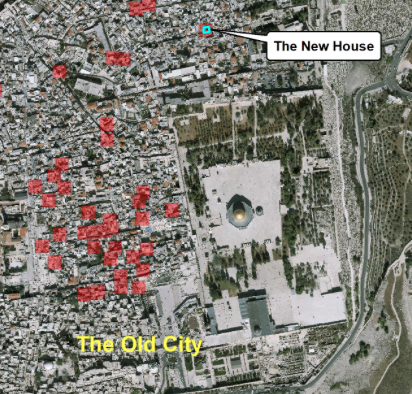
The radical Ateret Cohanim settler organization managed to purchase a house in an incredibly sensitive and inflammatory location inside the Muslim Quarter of the Old City of Jerusalem, only 100 meters from the Dome of the Rock/al-Haram al-Sharif. Settlers moved into the house this week and have already begun renovating the property. Some reports blamed infighting between Palestinian Authority President Mahmoud Abbas and political rival Mohammed Dahlan for the sale to the settlers. The settlers gained control of the house, which was owned by a prestigious Palestinian family for decades, after the Palestinians sold it to a middleman, who then sold it for $17 million to Ateret Cohanim.
News of the sale of the home to settlers has reverberated within the Palestinian body politic, engendering intense public outrage directed at Palestinian Authority officials who are believed to have been involved in killing the sale of the house to a Palestinian American with ties to Dahlan, and at others who vouched for the credibility of a middleman who eventually sold the house to settlers.
Internal politics notwithstanding, the fact of the matter is that the sale only advances Israeli settlers’ and Temple Mount activists’ ongoing efforts to undermine and change the status quo in the Old City and on the Temple Mount. Israeli provocations on and around the Temple Mount have proven to be (and continue to be) a volatile flashpoint for the outbreak of widespread violence.
Peace Now released a statement saying:
“The settlement activity around the Temple Mount is akin to playing with fire, and instead of keeping the pyromaniacs at a distance, the government serves them matches.”
Writing in 2009 but ringing even more true today, FMEP’s Lara Friedman and Terrestrial Jerusalem’s Daniel Seidemann warned:
“The city is the major fault line of the Israeli-Palestinian conflict, and earthquakes have been triggered invariably by events in and around the volcanic core of that conflict: the Haram al-Sharif/Temple Mount. It is precisely in this area – spreading from Sheikh Jarrah to Silwan – where events today have begun to careen out of control.”
Settler’s New Silwan Property Sits on Massive Settler-Driven Excavation Site
New details have emerged regarding the Silwan house that settlers moved into last week, having previously purchased it from its Palestinian owners (covered by FMEP last week). According to new Peace Now reporting, the significance of the property goes beyond its location in the Palestinian East Jerusalem neighborhood of Silwan (a site of concentrated and aggressive settlement activity). The house’s precise location sits on top of a massive and controversial underground archaeological excavation led by the Israel Antiquities Authority under the direction of the radical Elad settler organization. Elad is dedicated to increasing a Jewish presence in East Jerusalem neighborhoods at the expense of current and historical Palestinian connections.
Elad has been trying to acquire the property since the 1990s. The house is located next to the al-Ein mosque in Wadi Hilweh, near the Siloam Pool, which has been under settler control for the last few years. According to Peace Now, by purchasing the house, Elad will have “easy access to the underground excavation and to create an exit or entrance point to the underground project.” The ultimate goal of the project is to create a walking path from the Siloam Pool to the Temple Mount, a spiritual walk highlighting Jewish history that former Jerusalem Mayor Nir Barakat envisions as a way to teach pilgrims “exactly who owns this city.”
In 2017, the excavation project severely damaged Palestinian homes in Silwan above the site. At the time, Haaretz reported that:
“two senior Israel Antiquity Authority archaeologists criticized the excavations in internal correspondence. They wrote that the work being done in the tunnels, contrary to accepted practice, was ‘bad archaeology’ and added that ‘the authority could not be proud of this excavation.’”
Emek Shaveh, a non-governmental organization specifically dedicated to fighting attempts to co-opt the archeological history of Jerusalem to serve political agendas, has a large body of reporting on excavation projects linked to Elad, the Israel Antiquities Authority in Silwan. Emek Shaveh writes:
“Temple Mount/Haram al-Sharif in particular – i.e. the Old City and the village of Silwan – there can be no doubt but that Israel is interested in expanding its presence and entrenching its authority over the area. The Israeli authorities and settler NGOs invest their best efforts in transforming Silwan into a tourist site and into the Israeli settlement of ‘The City of David’. At the same time, the Old City is undergoing unprecedented development of a nature which prioritizes Jewish belonging and the Jewish people’s historic rights to Jerusalem… The volume and pace of archaeological works and development for tourism is in striking contrast with the years of neglect of the Palestinian population. These processes in the city solidify an Israeli vision that ancient Jerusalem should remain under Israeli sovereignty forever.”
De Facto Annexation: Israel Applies Two Domestic Agricultural Laws to West Bank Settlements
After months of pressure from senior government officials, this week the head of the Israeli Defense Forces agreed to allow the government to directly apply two Israeli laws over the West Bank settlements. One law, allowing settlers to share their egg quotas with farmers in Israeli proper, was passed by the Knesset in June 2018. The second law, regulating the production and sale of organic produce, was passed in 2005.
As FMEP has extensively documented (see Table #3 in red), this is just the latest in a string of moves over the past 2+ years by which the Knesset and Israeli government has begun institutionalizing the application of Israeli domestic law over areas of Israeli settlement outside of its borders, amounting to a process of de facto annexation. .
Government Approves Funds for Settlement Propaganda Film
The Israeli Minister of Social Equality, Gila Gamliel, has allocated 1.5 million shekels ($413,000 USD) to a film project that will glorify the history of the settlement movement and the personal stories of leading settlement figures. The project will be a governmental collaboration with the Menachem Begin Heritage Center and the Yesha Council – an umbrella group representing all settlements in the West Bank; both organizations will appoint representatives to the steering committee for the project.
Minister Gamliel said:
“This is the purpose of the testimonies project – to give expression to the significant role of the veterans of settlement in Judea and Samaria in fashioning the moral and Zionist image of the State of Israel.”
The Director-General of the Yesh Council, Yigal Dilmoni, said:
“There are many young people today who are searching for inspiration for Zionist activities…If we give them this story, it will give the next generation the strength to continue to carry out [the ideals of] Zionism, to build and develop the State of Israel.”
Haaretz quotes a source close to Minister Gamliel saying:
“This is another step toward sovereignty…This isn’t a project initiated by a nonprofit or an organization, but by the state itself.”
Contrary to the claims of those backing the project, the history and personal stories of leading figures of the settlement movement have been extensively documented – most epically by Akiva Eldar in “Lords of the Land: The War Over Israel’s Settlements in the Occupied Territories 1967-2007.” Eldar’s historical accounting of early settlers unveils the reality that most early settlers were knowingly and deliberately breaking Israeli law by building without government permits and directly undermining Israeli government policies. Another superb book, Dear Brothers: the West Bank Jewish Underground, by Haggai Segal (now a prominent right-wing Israeli journalist), provides first-hand documentation and testimony regarding a critical chapter in the settlement movement: the 1980s Jewish Underground, which among other things carried out and celebrated a series of terrorist attacks against Palestinian mayors and planned to blow up the Dome of the Rock. This new film project, on the other hand, promises to be a piece of propaganda designed to sanitize and mythologize these same people and events.
Shaked: Annexation Plan Can Accommodate 100,000 Palestinian Citizens in Area C
A lengthy profile of Israeli Justice Minister Ayelet Shaked shed new light on the Jewish Home’s plan for the annexation of the West Bank’s Area C. The Atlantic columnist and chief anchorwoman for The News Company in Israeli, Yonit Levi, writes:
“Bennett and Shaked are trying to advance a plan for the annexation of Area C, the part of the West Bank (about 60 percent) that is under Israeli control. The plan would require extending citizenship to the Palestinians who live there. ‘We can definitely take in 100,000 Palestinian citizens,’ Shaked says. ‘These processes take time to ripen. At the moment, the annexation plan looks like science fiction, but I think that slowly, gradually, people will see what’s going on in the Middle East and realize that it really could happen.’ Shaked, too, sees clearly that the annexation plan could put Israel on a confrontational path, even with the current supportive American administration—and even more so if the administration changes. ‘Sadly, it’s impossible to ignore the processes taking place in the Democratic Party. You know, the party itself is becoming less and less what’s considered Zionist,’ she says. When I ask her whether this is the result of processes occurring in Israel, she responds: ‘We’re also seeing a strengthening of the Palestinian narrative among liberal circles, not only in the United States, and we must deal with this, too. Clearly, the Democrats will return to power at some point—things always change there—and it’s obvious that we have to maintain good relations with them and explain what’s going on in Israel.’”
Murder Prompts Critical Coverage of Settlement Industrial Zones
In response to the heinous murder of Israeli employees by a Palestinian worker at the Barkan Industrial Zone (a settlement industrial zone located deep inside the West Bank, near the Ariel settlement), U.S. Ambassador to Israel described Barkan as a “model of Israeli-Palestinian coexistence since 1982, with thousands working and prospering together.” The reality of West Bank industrial zones, and the role they play in the lives of Palestinians, is, in fact, more complicated. For decades Israel has used industrial zones as another tool to expand and deepen control over West Bank land, and jobs in industrial zones – often the only jobs available for Palestinians living under an Israeli occupation that prevents the development of any normal Palestinian economy – are widely viewed by Palestinians as a double-edged sword.
These realities were touched on in some of the coverage of the murder. The New York Times wrote:
“The West Bank settlements, constructed in territory that Israel captured from Jordan in the 1967 war, and which the Palestinians envision as part of their state, are considered a violation of international law by most of the world. But many Israelis, particularly the settler leadership, hold up the Barkan industrial park, where the attack took place on Sunday, as a model of cooperation and an important source of employment for thousands of Palestinians…”
The Washington Post offers noted:
“Thousands of Israelis and Palestinians work side by side at the [Barkan] industrial zone, which includes 160 factories. The Palestinian economy is heavily restricted under Israeli military rule, forcing tens of thousands of Palestinians to seek work in Israel as well as Jewish settlements.”
Bonus Reads
- “‘Traitor? Who Me?’ Talia Sasson Sums Up Her Term as New Israel Fund President” (Haaretz)
- “Trump’s Pation-In-Chief” (ProPublica)
Welcome to FMEP’s Weekly Settlement Report, covering everything you need to know about Israeli settlement activity this week.
To subscribe to this report, please click here.
October 4, 2018
- More Settlement Expansion in East Jerusalem: Ramot & Ramat Shlomo
- Settlers Take Over Palestinian Building in Silwan, Evict Current Tenants
- The Kohelet Policy Forum: The Right-Wing Group Driving Pro-Settlement Policies
Comments, questions, or suggestions? Email Kristin McCarthy at kmccarthy@fmep.org.
More Settlement Expansion in East Jerusalem: Ramot & Ramat Shlomo
Ir Amim reports that on October 4th, the Jerusalem District Planning and Building Committee will discuss – and is expected to advance – two plans to expand settlements along the northern perimeter of East Jerusalem: a plan for 500 new units in the Ramat Shlomo settlement and a plan for 152 new units in the Ramot settlement. If implemented, both plans will compound the encroachment of settlements on the Palestinian East Jerusalem neighborhood of Beit Hanina; the Jerusalem Municipality only recently approved the first-ever settlement construction inside Beit Hanina.
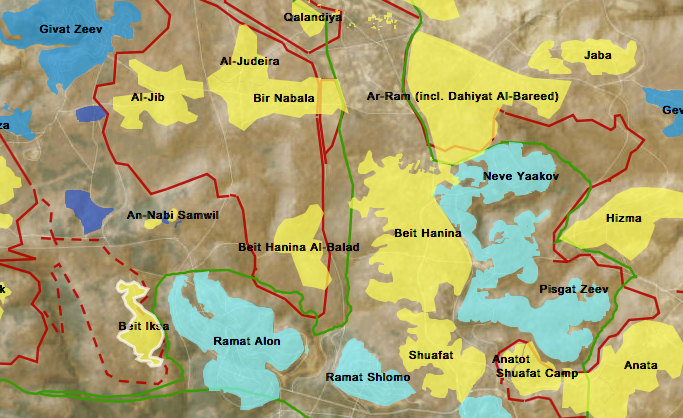
Map by WINEP
These two plans are just the latest advancements for Ramot and Ramat Shlomo: in August 2018 a plan for 263 units in Ramot was deposited for public review, and construction tenders were published for a plan for 603 units in Ramat Shlomo (under what is colloquially known as “The Biden Plan”).
The plan for 152 new units in the Ramot settlement is especially alarming because, as Ir Amim details, it is part of a larger scheme to claim undeveloped land in East Jerusalem for settlements:
“[The Ramot plan] represents a bold push toward Israel consolidating control of the undeveloped area between Ramot and Bir Nabala. Ir Amim has acquired documents showing plans to expand the entire northern section of the Ramot settlement toward the Palestinian area. As can be seen on the map, the large open area between the Israeli settlement and the Bir Nabala enclave is already cut by the Separation Barrier, which completely encircles the enclave, isolating its residents from the surrounding Palestinian space and imposing severe economic hardship.” [Editor’s note: for more on how the separation barrier has completely isolated the East Jerusalem neighborhood of Bir Nabala, see this short video by The Guardian].
.png)
For its part, the advancement of the Ramat Shlomo is also alarming, since Israeli authorities essentially rewrote the laws governing construction in Jerusalem in order to advance the project:
“The [Ramat Shlomo] plan includes Palestinian-owned land, in an area developers have now designated for a park and access road. In order to overcome the legal prohibition against submitting a plan on land not owned by the applicant, the developers successfully engaged the Jerusalem Municipality to sign on as an additional applicant, thereby enabling the expropriation of private Palestinian land. Despite this process contravening the Planning and Building Law, the District Committee approved the plan for deposit, circumventing the normal process of land reparcelization conducted to ensure an equitable distribution of land rights.”
The expected advancement of these plans for the expansion of the Ramot and Ramat Shlomo settlements is a continuations of an alarming acceleration in East Jerusalem settlement advancements since President Trump assumed office in January 2017, reflecting the sea change in U.S. policy towards settlements. Over the past two months alone, Israel has advanced plans for:
- 75 units in Beit Hanina (advanced through first stage of planning process)
- 13 units in Sheikh Jarrah (deposited for public review)
- 345 units in Gilo (deposited for public review)
- 1,064 units in Pisgat Ze’ev (deposited for public review)
- 263 units in Ramot (deposited for public review)
- 603 units (“The Biden Plan”) in Ramat Shlomo (tenders published)
- Reported above, 500 additional new units in the Ramat Shlomo in August 2018
- Reported above, 152 new units in Ramot settlement in August 2018.
Settlers Take Over Palestinian Building in Silwan, Evict Current Tenants
Ma’an News reports that the radical Elad settler organization has evicted a Palestinian family from a building that settlers purchased in the East Jerusalem neighborhood of Silwan. The previous owners of the building, who currently live in the U.S. – reportedly notified tenants at the property of the sale several months ago.
The settlers, under the protection of Israeli security forces, did not allow the evictees – 7 members of the Maswadeh family – to move their belongings out of the building before moving in. The Maswadeh family had rented two apartments in the building for the past 30 years. According to reports, the settlers have already started to build what appears to be a gate to control access to the property.
The Kohelet Policy Forum: The Right-Wing Group Driving Pro-Settlement Policies
Haaretz published a lengthy profile of the Kohelet Policy Forum, a right-wing advocacy organization that wields enormous influence over senior Israeli government figures, including Justice Minister Ayelet Shaked (Likud). The Kohelet Policy Forum is revealed to have played a major role in shaping several of the most significant pro-settlement, pro-annexationist legislative actions in the past year, including the high court override bill, the Nation-State Law, and a bill that would allow Israeli cabinet ministers to select their own personal legal advisors.
According to Haaretz, the Kohelet Policy Forum’s fingerprints “are visible in every explosive and divisive issue that has weakened the legal system and regulations.” FMEP tracks all these pieces of legislation, and many more, in its Annexation Policy Tables.
The funding sources for the Kohelet Policy Forum, which was established in 2013, are worth noting: the largest funder is an anonymous donor in the United States, who funds were transferred to Kohelet via an American nonprofit called American Friends of Kohelet Policy Forum. In 2016 the American group donated about 7.8 million shekels ($2.1 million) to Kohelet; in 2017 about 28.5 million shekels ($7.7 million). In light of Kohelet’s agenda, the anonymity of Kohelet’s major U.S. funder escapes the ire of the Israeli government, which has sought to stigmatize and shutdown groups which draw the majority of their funding from foreign sources.
Another main funder is the Tikvah Fund, a wealthy U.S.-based organization with a mission to promulgate American Republican Party views in Israel. Since its founding, the Kohelet Policy Forum has received over $1 million from the Tikvah Fund, and the two entities share board members. The Tikvah Fund also supports pro-settlement organizations.
Notably, Eugene Kontorovich is the head of the international law department at the Kohelet Policy Forum. Kontorovich self-identifies as a key figure in the drafting of “anti-BDS” (but actually, anti-free speech/pro-settlement) laws in the United States. At the core of these laws is the conflation of Israeli settlements with Israeli proper, based on Kontorovich’s argument that Israel is not occupying Palestinian territory. Kontorovich has also testified multiple times to U.S. Congress, including in support of moving the U.S. Embassy to Jerusalem; in support of Congress legislating U.S. foreign policy, including with regard to Jerusalem; on the impact of the BDS movement, and in support of U.S. recognition of Israel’s sovereignty over the Golan Heights.
Welcome to FMEP’s Weekly Settlement Report, covering everything you need to know about Israeli settlement activity this week.
To subscribe to this report, please click here.
September 20, 2018
- 2018 Settlement Construction Starts (& Finishes) Are Surging
- Settlement Projects Advance in Sheikh Jarrah, Jabal al-Mukaber
- Israeli Authorities Approve Plan to Seize Palestinian Land & Legalize Outpost Near Hebron
- Israel Issues “Gardening Orders” to Take Control of More Land in Silwan
- Israeli Tourism Ministers Boasts About Bankrolling Tourism Projects to Expand Settlements
- Shaked’s Judicial Interference is Subject of Special Knesset Session
- Bonus Reads
Comments, questions, or suggestions? Email Kristin McCarthy at kmccarthy@fmep.org. To subscribe to this report, please click here.
2018 Settlement Construction Starts (& Finishes) Are Surging
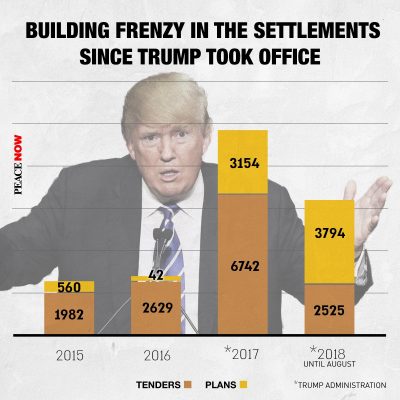
Image + Data by Peace Now
Recently released data from the Israeli Central Bureau of Statistics show that since January 2018, construction has started on a total of 1,073 new settlement units, and total of 1,075 new settlement units (started in previous years) have been completed – representing new housing for more than 10,000 settlers (assuming, conservatively, a family size of 5-6 people). Together the numbers mark a 66% increase over the same period in 2017. Though settlement plans have advanced at an alarming rate since the beginning of the Trump Administration, actual on-the-ground construction starts did not seen a significant surge until the second quarter of 2018, which saw a 187% increase over the first quarter.
Peace Now released a statement saying:
“The Netanyahu government continues to destroy the chances for peace. Further construction in the settlements undermines Israel’s interest in reaching a two-state solution, as such a solution will not be stable without a viable Palestinian state, which settlements increasingly threaten. Unfortunately, since Trump’s election, we have seen a sharp increase in the approval of the plans and tenders, and now we are beginning to see the consequences of these approvals on the ground.”
Settler leaders were characteristically dissatisfied with the pace of construction. The Director of the Yesha Council (and umbrella group representing all Israeli settlements), Yigal Dilmoni, told the Jerusalem Post:
“We are talking about a few hundreds units, which is very little, relative to thousands built throughout the country. Judea and Samaria still have the low building numbers, we expect and hope that we will be given more building permits.”
Settlement Projects Advance in Sheikh Jarrah, Jabal al-Mukaber
Ir Amim reports that two plans for new settlement buildings in the Palestinian East Jerusalem neighborhood of Sheikh Jarrah have been deposited for public review. If implemented, the two plans would build two new 6-story buildings in the Um Harun section of Sheikh Jarrah, one with 3 settlement units and the second with 10 settlement units. If implemented the plans will also involve the demolition of two buildings and the eviction of five Palestinian families living there.
The plans were originally approved for deposit in July 2017. As Ir Amim reported in detail at the time, both plans (numbers 14151 & 14029) are linked directly to Jerusalem settlement impresario Aryeh King. King can now count several significant victories for his settlement projects in sensitive Jerusalem neighborhoods over the past two weeks, totalling 309 new settlement units: Two plans were advanced in Sheikh Jarrah, totalling 14 units; one plan was advanced in Beit Hanina, totalling 75 units; also this week, King reportedly announced (though details are scant – stay tuned) that the government has approved a plan for 220 new units in the Nof Zion settlement enclave, located inside the Jabal al-Mukaber neighborhood. It is worth noting that, back in September 2017, the government was poised to issue permits for 176 units in Nof Zion – it is not clear if the 220 include those units, or are in addition to them, or if the numbers are inaccurate or deliberately misleading.
Settlement advancements in Sheikh Jarrah are becoming alarmingly routine. In addition to the developments this week, the inflammatory plan to build a Jewish religious school (known as the Glassman yeshiva project) was recommended for final approval. If implemented, an eight story building will be erected at the entrance to the Sheikh Jarrah neighborhood. The massive building will also include dormitories for young religious men and eight units to house “lecturers visiting from abroad.”
Israeli Authorities Approve Plan to Seize Palestinian Land & Legalize Outpost Near Hebron

by Land Research Center
The Land Research Center, a Palestinian organization, reports that the Israeli Civil Administration – the arm of the Israeli Defense Ministry that runs all affairs in the West Bank – has published a detailed plan to expand the borders of the Tene-Omarim settlement to include an outpost that was built without Israeli government authorization, located on lands claimed by the Palestinian village of Dahriyeh.
In order to carry out the plan, the Israeli Civil Administration will add 260,000 square meters of land (roughly 64 acres) to the settlement. The plan calls for 150 new units in Tene-Omarim in addition to new roads and open areas to connect the settlement to an outpost northeast of its borders.
In May 2018, the Israeli Civil Administration advanced plans for 143 new settlement units in Tene-Omarim.
Israel Issues “Gardening Orders” to Take Control of More Land in Silwan
On August 24th, the Israeli NGO Emek Shaveh reported that the Jerusalem Municipality had issued “gardening orders” as a means of taking over new areas of privately owned land in the Silwan and Abu-Tor neighborhoods of East Jerusalem (in the area known in Hebrew as the Ben Hinnom Valley). Under Israeli law, the Jerusalem municipality can issue orders to use private land for public purposes if it deems the land “unutilized” by its owners. News of the orders broke the day before U.S. National Security Advisor John Bolton attended a dinner party in Silwan hosted by the radical settler group Elad.
The orders seize 27 plots of land owned by Palestinians, based on the argument that the plots are not being used by their owners. The orders disingenuously note that Palestinian owners can seek to reclaim their land in the event that they obtain Israeli-issued building permits (without which they are unable to utilize the land for their own purposes). This explanation, as Emek Shaveh notes, ignores the fact that “the land owners cannot receive construction permits because their land is situated within a national park which, according to law, precludes construction.”
Emek Shaveh goes on to report:
“The gardening orders are the latest in a series of development activities in the Ben Hinnom Valley/Silwan area and will no doubt complement the Elad Foundation’s initiatives in the valley and efforts to link it with tourism ventures in the City of David/Wadi Hilweh. The Elad Foundation together with government ministries are currently promoting several projects within the area covered by the gardening order including a café in Abu Tor, the planned cable car intended to link West Jerusalem to the Kedem Center, and the archaeological excavations which the Elad Foundation has been funding in recent years adjacent to the Catholic cemetery.”
Israeli Tourism Ministers Boasts About Bankrolling Tourism Projects to Expand Settlements
At a meeting with the Yesha Council (the powerful umbrella group representing all Israeli settlements), Minister of Tourism Yariv Levin (Likud) told settler leaders:
“Tourism in Judea and Samaria (West Bank) is at a point of tremendous momentum. We now have a window of opportunity to make big moves in the tourism industry and this is a time of desire that should definitely be exploited. We will continue to establish and bankroll activities in Judea and Samaria in addition to establishing facts on the ground.”
Minister Levin boasted of having directed USD 11.15 million (NIS 40 million) to West Bank tourism projects over the past three years of his tenure.
In addition to his work directing taxpayer funds to the settlements, Minister Levin has also been pushing legislation and procedural rules that advance the direct application of Israeli laws over the settlements (an act of de facto annexation).
Shaked’s Judicial Interference is Subject of Special Knesset Session
On September 17th, the Knesset held a special session (during the Knesset recess) titled, “Justice Minister Ayelet Shaked’s attack on the High Court of Justice and the danger to democracy.” As FMEP has extensively documented, Justice Minister Shaked has been hard at work transforming the Israeli judicial branch in favor of pro-settlement and pro-annexation policies.
Meretz Chairwoman MK Tamar Zandberg opened the the special session defending her own party against accusations of political interference with the Court (Shaked denies a quote attributed to her saying that the High Court is an “arm of the Meretz party”). Zandberg said:
“the High Court of Justice was never a branch of Meretz. We often far from agree with the rulings of the High Court of Justice, which legitimized settlements, but we live in a democratic country governed by the rule of law, and the independence of the judicial system is one of its basic principles. The High Court of Justice is the focus of an extreme, unbridled attack aimed at clipping its wings and distorting the foundations on which it was established.”
One of many speakers, MK Michal Rozin (Meretz) said:
“Ayelet Shaked’s commander’s spirit is felt in the justice system – from the deepening of her control in the Judicial Appointments Committee, which has become a committee for the appointment of conservatives, to rulings which adopt her anti-constitutional lines, such as allowing the theft of Palestinian lands by the Jerusalem District Court. This spirit is aimed at applying sovereignty in the conquered territories, reducing the freedom of the citizens and expanding the Orthodox control on our daily lives.”
Appearing at the hearing under summons on behalf of the government, Justice Minister Shaked told her critics in the Knesset:
“I understand your anger about the fact that Jews are not being evacuated from their homes, but you must pull yourself together. We have a country to protect. The rule of law must be preserved. We cannot accept a situation in which your criticism of the court is sinking to such depths to which you have recently deteriorated. As the Minister of Justice, I call upon those who sit in this House – on the Left and the Right – to maintain dignified discourse. We don’t have another legal system. Of course it is legitimate to express criticism against a ruling. It is acceptable to argue over ideas, it is permissible to argue over areas of authority. I do so from time to time, but we must maintain respectability and dignified discourse.”
Bonus Reads
- “APN Peace Cast w/ Hagit Ofran” (Americans for Peace Now)
- “How Peace Keeps Receding in the Middle East” (Washington Post)
Welcome to FMEP’s Weekly Settlement Report, covering everything you need to know about Israeli settlement activity this week.
To subscribe to this report, please click here.
September 7, 2018
- Israel Advances Plan for New Settlement in East Jerusalem
- Even More East Jerusalem Settlement Plans Advanced
- Israel Demolishes Homes in al-Walajah, Advancing “Greater Jerusalem” Project
- State Admits to High Court it Built Settler Road on Palestinian Private Land
- Prominent Human Rights Activists Arrested While Leading Tour of Hebron Region
- Government Official Claims Jerusalem Cable Car Project Will Benefit Palestinians in Silwan
- BonusReads
Comments, questions, or suggestions? Email Kristin McCarthy at kmccarthy@fmep.org. To subscribe to this report, please click here.
Israel Advances Plan for New Settlement in East Jerusalem
On September 5th, the Jerusalem Local Planning and Building Committee advanced a plan to build a large new settlement enclave (150 units) within yet another Palestinian neighborhood of East Jerusalem. The project – a pet project of Jerusalem settlement financier (and since 2013, Jerusalem city council member) Aryeh King – would be the first-ever authorized settlement project in the Beit Hanina neighborhood of East Jerusalem, located north of the Old City.
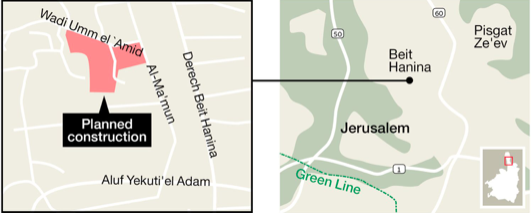
Map by Haaretz
The plan would build housing for approximately 75 settler families (which, based on a conservative estimate, would mean a population of around 500 settlers in Beit Hanina). If built, it would be one of the largest Israeli settlement enclaves inside any Palestinian neighborhood in East Jerusalem.
According to the plan, 75 units units would theoretically be earmarked for Palestinians – a point used by the plan’s supporters to suggest that it is actually benevolent. The key word here, however, is: theoretically. As noted by Jerusalem expert Danny Seidemann in another context:
“Since 1967, the Government of Israel has directly engaged in the construction of 55,000 units for Israelis in East Jerusalem; in contrast, fewer than 600 units have been built for Palestinians in East Jerusalem, the last of which were built 40 years ago.”
In announcing the approval of the plan, Israel’s deputy mayor made clear what part of the plan the Municipality is actually focused on:
“We’re happy to announce today that we’ve approved construction of 150 housing units in Beit Hanina, and especially that 75 Jewish families can now live there.”
Notably, the Jerusalem Local Planning and Building Committee advanced the plan through the first stage of the planning process, despite an objection filed by the private Palestinian company that owns 45% of the land upon which the new units would be built (ownership that the Israeli government tried – and so far failed – to cancel, through efforts to rescind the sale of the land to that company). The Committee explained its decision to ignore the objection by asserting that it was only discussing planning schemes and not ownership issues. The Jerusalem Municipality also weighed in, suggesting that the Palestinian company is too late in asserting its rights, saying that the ownership issue was “examined as part of the examination of the plan’s preconditions.”
Director of the Peace Now Settlement Watch program, Hagit Ofran, rejected that argument, saying:
“this is not a real estate project but a project of defiance and settlement. The fact that Israeli entrepreneurs, who own only half of the land, have prepared a plan without consulting Palestinian owners [of the other half] indicates that they have no intention of coexistence and peace.”
 A handful Israeli settlers already live in Beit Hanina, having directly acquired private property in the heart of the neighborhood. This small group of settlers clearly benefit from the plan, both because it lends legitimacy to their presence in and broader claims to the neighborhood, and because the new project would create a territorial linkage between the new settlement in Beit Hanina and the large ultra-Orthodox settlement of Ramat Shlomo to its south.
The historic nature of the Beit Hanina settlement plan is being hailed by pro-settlement media and activists. The Deputy Mayor of Jerusalem, Yossi Deitch, said, “I hope approval of the units will be the sign and signal that construction in the city will be unfrozen next year throughout the city and for all sectors. I’ll do everything possible to thaw the construction freeze in Jerusalem.”
Israel has increased home demolitions across East Jerusalem, including Beit Hanina, over the past year. In Beit Hanina, many homes are under the threat of demolition because they lack Israeli-issued building permits – permits that Palestinians find all but impossible to secure. Just this week, Israel demolished the Farrah family home in Beit Hanina, built over 16 years ago – despite the fact that the family has spent years attempting to obtain the necessary permits and has paid 250,000 shekel ($69,362) fine to the Israeli government.
Even More East Jerusalem Settlement Plans Advanced
In addition to the Beit Hanina settlement plan, Ir Amim reports that Jerusalem authorities have advanced several other inflammatory settlement projects in East Jerusalem over the past week:
- The Local Planning and Building Committee discussed issuing a permit to retroactively legalize unauthorized settlement construction – several shops and offices – in Silwan, located at the entrance of the settler-run City of David National Park. The buildings were constructed, without permits, under the direction of the radical Elad settler group, which is contracted by the Israel National Parks Authority to run the City of David National Park. As a reminder, Elad’s mission is to establish a permanent Jewish presence in Palestinian neighborhoods of East Jerusalem. The retroactive permit, in addition to legalizing the current buildings, would also allow the group to build an additional story to one of the buildings, to serve a”lookout” point. Demonstrating government collusion with the settlement enterprise in Jerusalem, the permit request was filed by the Israel National Parks Authority, not Elad.
- The Local Planning and Building Committee committee discussed public objections filed against a plan to build a 6-story office building for settlers at the entrance of the Sheikh Jarrah neighborhood. The office building, if approved, would be located adjacent to the site of a planned Jewish religious school to also be built in Sheikh Jarrah – called the Glassman Yeshiva. That school, once it is built, will house dozens of young religious settlers. Together, the two projects will flank the road leading into Sheikh Jarrah and become part of a settlement bridge/corridor connecting the isolated settlement enclaves in the heart of Sheikh Jarrah to West Jerusalem. Ir Amim notes that both settlement projects have been advanced “despite the area being zoned for public buildings for a Palestinian neighborhood sorely lacking in social services.” This latest advancement was anticipated and noted in last week’s Settlement Report.
- The Jerusalem Local Committee advanced two plans to increase the number of new units authorized to be built in the Gilo and Neve Ya’akov settlements. In both instances, the Local Committee discussed plans that increase the number of units permitted to be built under already-approved plans (adding an additional 48 units in both cases, bringing the Neve Ya’akov project to 86 units total and the Gilo project to 148 units total).
Israel Demolishes Homes in al-Walajah, Advancing “Greater Jerusalem” Project
On September 3rd, Israeli officials demolished four buildings in the al-Walajah village, on the pretext that they lack required Israel-issued building permits. Israeli security forces fired tear gas and rubber-coated steel bullets at a crowd of protestors who gathered to try to stop the demolition, injuring several.
The demolitions were in the Ein Juweza neighborhood of the village – an area that is technically located within the municipal borders of Jerusalem (the border runs through the village, leaving the rest of al-Walajah in the West Bank), and therefore subject to Israeli planning and building laws. An additional 189 homes in al-Walajah have demolition orders issued against them.
The lawyer representing al-Walajah residents in this case said,
“The residents’ attempts to submit a master plan [without which it is impossible for residents to even apply for permits to build on their own land] were thwarted by the objection of the state and subsequently, the planning authorities. In this situation of criminal neglect of the village and its residents, the only service the state gives them is ‘home demolition service.’ This is an impossible, illegal situation that contradicts the most minimal fairness.”
Ir Amim reports:
“While refusing to allow building in Walajeh, in the area around the village Israel is promoting construction of thousands of housing units for Israelis on lands – some of which were confiscated from Walajeh – in the settlements of Gilo and Har Gilo. To the north of the village, within the Green Line and on lands that belonged to Walajeh until 1948, a construction plan of over 4,000 housing units is being advanced. These construction plans, together with the national park declared on al-Walajeh land in 2013, are meant to create an Israeli continuum between Jerusalem and the Gush Etzion settlements surrounding Bethlehem. This morning’s demolitions in Walajeh are an inherent part of the policy to transform this area into an Israeli space.”
As FMEP has previously reported, residents of al-Walajah have long been struggling against the growing encroachment the nearby Etzion settlement bloc and the Israeli government’s attempt to de facto annex the bloc as part of “Greater Jerusalem.” Ir Amim explains several prongs of this effort, including a particularly problematic section of the separation barrier around al-Walajah that has been planned in order to (a) almost completely encircle the village, (b) turn its valuable agricultural land into an urban park for Jerusalem, and (c) enable construction of a highway that will connect the Etzion settlement bloc to Jerusalem with Israeli-only bypass roads.
State Admits to High Court it Built Settler Road on Palestinian Private Land
The Israeli government admitted to the High Court of Justice that it cut and paved a road on land that is privately owned by Palestinians in the South Hebron Hills. The State claimed it did so by mistake, believing the land in question, which had been included in construction plan for the settlement of Shima – despite the fact that Palestinian owners objected as soon as construction started in 2015. Even after the objections were lodged against the construction, Israeli authorities took months before issuing a stop work order, allowing the road to be completed/paved in the meantime.
In the brief submitted this week, the State asked the High Court to dismiss the case regarding the road, explaining that the Civil Administration had already taken action to correct the borders of the Shima settlement to, in effect, return the land to is owners (now paved with a road for the settlers). The State says that action was prompted in 2015 when the Civil Administration “Blue Line” team released new mapping of the area, which clarified that the land is indeed privately owned by Palestinians.
Commenting on the story, a spokesperson for Rabbis for Human Rights told Haaretz:
“The state acted like the ‘hilltop youth’ [a radical settler group]. You can’t explain this away using the excuse of an innocent mistake, given that even after our warnings it took a long and embarrassing legal procedure to get them to do the obvious: check who actually owns the land.”
Prominent Human Rights Activists Arrested While Leading Tour of the Hebron Region
Israeli security forces arrested three prominent human rights activists while they were leading a sizeable group on a tour of settlements and outposts in the Hebron/South Hebron Hills area. Avner Gvaryahu (Executive Director of Breaking the Silence), Michael Sfard (a prominent Israeli human rights lawyer), and Achiya Schatz (Communications Director for Breaking the Silence) were released after three hours of detention.
The men were arrested near the Mitzpe Yair outpost in Hebron, the same spot where activists from Taayush – “Israelis & Palestinians striving together to end the Israeli occupation and to achieve full civil equality through daily non-violent direct-action” – were violently attacked by settlers the previous week, with at least four wounded seriously enough to be evacuated to for medical treatment. In that attack, IDF soldiers reportedly stood by and did nothing (and in its aftermath, the Israeli government and senior officials, including Netanyahu, said nothing).
Breaking the Silence related the events, saying:
“As we drove up the road leading to the outpost, we were blocked by a Border Police jeep. Within minutes, we were presented with a ‘closed military zone’ order, signed by the brigade commander. We were given one minute to evacuate a group of 120 participants, some of whom weren’t so young. When we asked for more time to get everyone on the buses, the arrests started. As was reported in the media, the arrests were aimed at the leaders of the tour, which reinforced our suspicion that they were initially meant to sabotage the tour….Upon arriving at the police station, Avner, Achiya, and Michael had been told that they were in fact not arrested but rather detained, and that there was no immediate need for investigations or arrests. They were then told to return in a month and a half for further investigation.”
The group’s email to supporters ends:
“we refuse to cave in to settler violence and to surrender to their intimidation, incitement, and violence directed against those who oppose the immoral reality of the occupied territories.”
Government Official Claims Jerusalem Cable Car Project Will Benefit Palestinians in Silwan
On September 5th, the Society for the Protection of Nature held a public forum to discuss the planned cable car project in Jerusalem, which is slated to have its final stop at the settler-run Kedem Center in Silwan. The Kedem Center is a project of the radical Elad settler group, which works to settle Jewish Israelis inside Palestinian neighborhoods of East Jerusalem.
Sami Arsheid, a lawyer representing Palestinian residents of Silwan (who will be deeply impacted by the project), attended the town hall event to raise their concerns. Arsheid said that Palestinians had not been consulted and noted that the invitation to the meeting was written in Hebrew only.
A Israeli government official responsible for planning the cable car project, Aner Ozeri, stressed how the project will ease movement and alleviate transportation pressures, and insisted that the project will, in fact, benefit Palestinian residents of Silwan. Even if that claim turns out to be true, it glosses over the fact that, assuming the most benign intent, the Israeli government is engaging in planning in Silwan that rejects/ignores the views of the vast majority of the residents (i.e., the only residents of Silwan whose voices are listened to in this process are the settlers). Moreover, in the case of this plan the intent, entirely unhidden by planners, is by no means benign: the purpose of the cable car project has nothing to do with the interests of Palestinian residents – rather, its purpose is to facilitate tourist visits to Jewish sites in East Jerusalem, in a manner that prevents tourists from seeing or encountering Palestinians.
The meeting was also attended by government officials tasked with explaining and defending the project, as well as architects, academics, preservation experts, and tourism professionals who criticized the plan on a myriad of bases – mostly highlighting how the project will damage the historic landscape of Jerusalem.
Bonus Reads
- “In West Bank Settlements, It’s a Bull Housing Market” (Haaretz)
- “Israeli right wing party aims at one million settlers” (Al-Monitor)
Welcome to FMEP’s Weekly Settlement Report, covering everything you need to know about Israeli settlement activity this week.
To receive this report via email, please click here.
August 2, 2018
- Israel Launches New Settlement “Heritage Center” in Silwan
- University Heads Challenge Approval of the Ariel Settlement Medical School
- Liberman Promises 400 Settlement Units in Response to Terror
- The Not-So-New Trump Policy on Settlement Travel
- Just Released: 2018 Settlement Map from Peace Now
- Bonus Read
Comments, questions, or suggestions? Email Kristin McCarthy at kmccarthy@fmep.org.
Israel Launches New Settlement “Heritage Center” in Silwan
On August 1st, senior Israeli government officials were on hand to celebrate the beginning of construction on a new settlement complex, under the guise of a cultural center, located in the heart of the Batan al-Hawa section of the Silwan neighborhood in East Jerusalem. The event was heavily guarded by Israeli forces, in an open acknowledgement of the provocative nature of the settler campaign targeting Palestinian homes in Batan al-Hawa, which is located near the walls of the Old City in view of the Temple Mount/Al Aqsa Mosque.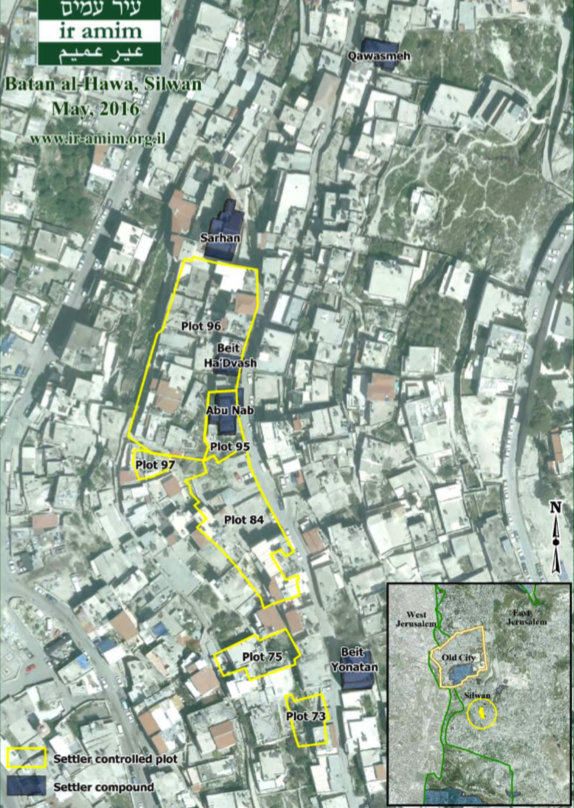
The new settlement initiative is part of a campaign by the Ateret Cohanim settler organization (which works to establish Jewish enclaves inside densely populated Palestinian neighborhoods of East Jerusalem) to exploit the area’s historical connection to Jewish immigrants as a pretext for taking land and establishing Jewish-Israeli control over the area. Israel’s Ministry of Jerusalem Affairs and Ministry of Culture and Sport are contributing an estimated $1.23 million USD to the cost of renovating an old Yemenite synagogue into a settler-run Jewish Yemeni heritage center — in a example of how the government is directly funding extremist settler activity in an area that Ir Amim identifies as “the site of the most substantial settler takeover campaign in Jerusalem since the annexation of East Jerusalem in 1967.”
Attendees at the launch included Cultural Affairs Minister Miri Regev, Jerusalem Affairs Minister Ze’ev Elkin (who is currently campaigning to become the mayor of Jerusalem), former U.S. presidential candidate and governor (and father of the current White House spokeswoman) Mike Huckabee, and former White House Communications Director Anthony Scaramucci (the latter two have been touring Israel and praising the settlements, with Huckabee going so far as to suggest that he might want to have his own home in a settlement someday).
The launch of the project ignores an ongoing legal case before the High Court of Justice that could affect Ateret Cohanim’s ownership claim to the land and building in question. Settlers are acting on the assumption that both are legally owned by the Benvenisti Trust (a historic trust that resettled Jewish Yemenite immigrants in the area in the late 1800s). Ateret Cohanim took control of the Benvenisti Trust in 2001, and in 2002 the Israeli Custodian General transferred land in Batan al-Hawa to the Trust/Ateret Cohanim. Since then, Ateret Cohanim has accelerated its multifaceted campaign to remove Palestinians from their homes, claiming that the Palestinians are illegally squatting on sacred religious land owned by the Trust.
So far, Ateret Cohanim has acquired the deed to six Palestinian homes in Batan al-Hawa, inserting some 20 Israeli Jewish families in place of evicted Palestinian residents. The organization has eviction orders pending against an additional 21 homes, with 800 Palestinians at risk of eviction.
On June 17, 2018, just two months ago, the Israeli High Court of Justice ordered the Israeli government to provide more information regarding its decision to transfer ownership of land in Batan al-Hawa to the Benvenisti Trust/Ateret Cohanim. The Court’s order was in response to a petition filed by Palestinian residents fighting eviction from their homes, and the State’s admission during oral arguments on June 10, 2018 that the land had been transferred to the Benvenisti Trust/Ateret Cohanim without a proper investigation into its legal status. The petitioners argue that the State’s decision to transfer the land was illegal on two fronts: (1) The Benvenisti Trust never owned the land in Batan al-Hawa, but only owned the buildings – all but one of which were demolished in the 1940s; and, (2) the land was transferred without the necessary legal notification to the residents living there.
Yakoub al-Rajabi, a Palestinian resident of Batan al-Hawa, told The Washington Post:
“We know that this was a well-orchestrated plan to force us to leave. And if we stay, it will paralyze us and isolate us in our homes.”
In a 2016 report that covers the Batan al-Hawa situation in detail, Ir Amim and Peace Now underscore the significance of Ateret Cohanim’s efforts, of which the new cultural center would be the crowning jewel:
“If the settlers are successful, Batan al-Hawa is anticipated to become the largest settlement compound in a Palestinian neighborhood in the Historic Basin of the Old City, with the outcome of significantly tightening the emerging ring of settlements around the Old City and severely undermining the possibility of a future two state solution in Jerusalem.”
Ateret Cohanim director Daniel Luria said:
“Every acquisition is very difficult. We’re up against a mobilized Arab world, parts of which are violent. There is huge pressure and millions of dollars are being pumped in to strengthen the Arab hold on the city…[the] biggest problem is trying to get the Jewish world to understand what needs to be done. We have the best relations ever with a US administration. For [US Vice President Mike] Pence and [US Ambassador to Israel David] Friedman and the others, [settling Jews in East Jerusalem] is a no-brainer. What’s our right-wing government waiting for? It’s not about what the US says. It’s about what we do. We are not doing anything to stop the peace process but will not compromise on a millimeter of Jerusalem. You have to show strength of conviction and sovereignty to have peace and coexistence. This can only happen when you live together under Jewish sovereignty.”
Cultural Minister Miri Regev said at the event:
“Look around. We are surrounded by Jewish heritage. The archaeologists won’t find a single Palestinian coin here! We have come home.”
University Heads Challenge Approval of the Ariel Settlement Medical School
The Israeli Committee of University Heads wrote a letter to the Higher Education Council demanding that it reconsider the approval granted to the new medical school in the Ariel settlement, which is already under construction. In a letter addressed to the Chairman of the Planning and Budgeting Committee of the Higher Education Council, Israeli university heads expressed concern that the decision to approve the medical school was tainted by political interference, and was carried out by an “expedited and improper” procedure. A source told Haaretz that the University Heads share a concern “that the Planning and Budgeting Committee [of the Higher Education Council] will be turned into a rubber stamp for [Education Minister Naftali] Bennett.” The signers call on the Planning and Budgeting Committee to hold new hearings on the settlement school to reconsider the data and merits of the proposal.
The letter comes on the heels of claims made publicly last week by three members of the Planning and Budgeting Committee that Education Minister Naftali Bennett interfered in the committee’s work, in order to expedite the approval of the medical school despite the fact that information about the project was missing.
As FMEP has repeatedly covered, the Ariel medical school is part of a government-backed agenda of exploiting academia to normalize and de facto annex settlements. Earlier this year, a part of this effort, the Israeli Knesset passed a law that extends the jurisdiction of the Israeli Council on Higher Education over universities in the settlements (beyond Israel’s self-declared and internationally recognized sovereign borders). This move ensures that the Ariel settlement medical school (and its graduates) are entitled to all the same rights, privileges, and certifications as schools and students in sovereign Israel. The Ariel settlement medical school enjoys the financial backing of American casino magnate, settlement benefactor, and close friend of President Trump Sheldon Adelson.
Liberman Promises 400 Settlement Units in Response to Terror
Defense Minister Avigdor Liberman promised to advance plans for 400 units in the Adam settlement in response to a Palestinian knife attack in the settlement that resulted in the death of one settler and injury to two others. In a tweet, Liberman claimed: “The best answer to terrorism is the expansion of settlements,” continuing, “That’s why I left this morning to promote a plan to build 400 housing units in Adam and approve it in planning institutions in the coming weeks.”
The Times of Israel notes that Liberman’s promise for 400 units is not a new plan but part of an existing plan – for a total of 1,000 units – already being advanced. Liberman’s promise is better understood as a signal to the High Planning Council to expedite the approval of the plan that is already in motion.
The Not-So-New Trump Policy on Visiting Settlements
The Palestinian Authority issued a sharp criticism this week of U.S. Ambassador David Friedman – and U.S. policy – after Friedman traveled to the Adam settlement to pay a condolence call on the widow of a settler murdered in a terror attack. Although Friedman is not the first U.S. Ambassador to visit an Israeli settlement, Friedman has made a habit of it (see here, here, and here for example), leading some observers to point out the self-evident fact that the Trump administration has – without making an official announcement – adopted a concrete change in U.S. policy regarding settlements, and is now not only refraining from criticizing settlement expansion, but is actively engaged in actions that legitimize settlements.
This week the Palestinian Authority said in a statement that the Trump administration and its “religious Zionist staff” were:
“continuing to make a mockery of international law in a bid to impose their positions and policies, which are blindly biased in favor of the Israeli occupation, on the international community with unprecedented arrogance.”
In a rare moment of agreement, settler leaders articulated a similar view of regarding this shift in the Trump Administration’s settlement policy, with the Binyamin Regional Council issuing a statement after Friedman’s visit saying:
“It seems as if we are talking about a change in US policy with respect to the Jewish communities of Judea and Samaria…they are being treated just like the rest of the country.”
Hananel Durani, head of the powerful Yesha Council which advances the interests of the settlements, said:
“I hope the US government will continue to support Israel and the settlements with the same kind of courageous friendship the ambassador demonstrated today.”
Settler leader Oded Revivi, who is head of the Efrat settlement council and foreign envoy for the Yesha Council, commented:
“I want to express my appreciation to Ambassador Friedman who saw fit to visit the settlement of Adam in Binyamin and comfort the bereaved family. This sends an important message to the world regarding strengthening the positive forces and combating the negative forces in the region.”
Just Released: 2018 Settlement Map from Peace Now
Peace Now recently released two 2018 settlement maps, one map the entire West Bank and a second detail map of East Jerusalem. Both are must-have resources for anyone tracking anything related to settlements and the factors that must be addressed in a negotiated solution to the conflict.
Bonus Reads
- “Once Again, Israel Denies the Bedouin What it Grants the Settlers” (Haaretz)
- “Israeli protesters seek return to destroyed West Bank settlements” (Al-Monitor)
- “A rotten system, not rotten apples” (+972 Mag)
- “More than 2,000 trees in West Bank Palestinian Villages Destroyed in Two Months” (Haaretz)
Welcome to FMEP’s Weekly Settlement Report, covering everything you need to know about Israeli settlement activity this week.
To receive this report via email, please click here.
July 12, 2018
- Continuing New Legal Strategy, Israel Argues “Market Regulation” Principle In Bid to Legalize Outpost
- Cabinet to Consider New Bill to Legalize 70 Outposts
- Cabinet to Consider Three Bills that Advance Annexation of Area C Settlements
- New Proof that the Israeli Government is Driving Unauthorized Settlement Activity
- High Court Freezes Plan for Settlement Committee in Hebron; IDF Seizes Private Land Near Kiryat Arba
- High Court Allows the Israel Land Authority to Remain Under the Influence of the Jewish National Fund
- New Bill Would Allow Settlers to Build on National Park Grounds in East Jerusalem
- Civil Administration Strike Will Delay Settlement Construction
- Amichai Settlement’s Makeshift Sewage Pit is Contaminating Nearby Palestinian Fields
- Israeli President Cautions Against Shaked’s Bill to Politicize Key Legal Appointments
- United Nations Envoy: Israel is Moving Towards Formal Annexation
- Bonus Reads
Comments, questions, or suggestions? Email Kristin McCarthy at kmccarthy@fmep.org.
Continuing New Legal Strategy, Israel Argues “Market Regulation” Principle In Bid to Legalize Outpost
On July 3rd the Israeli State Prosecutor’s Office told the Jerusalem District Court that it has the right to retroactively legalize the Mitzpe Kramim outpost based on the “market regulation” principle. This is the recently-invented legal principle according to which the government can seize privately owned Palestinian land to give to settlers if settlers can demonstrate (to the satisfaction of an Israeli government that is doing everything possible to help them) that they built on the land “in good faith,” based on government assurances, and if the rightful landowners are offered compensation. This is just the second time the government has used the “market regulation” principle to defend the seizure of privately owned Palestinian land in court, the first being in November 2017 when the State informed the High Court of Justice that it intended to expropriate private land near the Ofra settlement. Neither court ruled on either case.

Map by Haaretz
The government’s deployment of the “market regulation” principle in the Mitzpe Kramim case completely reverses the position the government has taken for the last 7 years on this specific outpost case. Since 2011, the Israeli government admitted that the land was privately owned, that it had been mistakenly given to the World Zionist Organization in the 1980s (the Mitzpe Kramim outpost was built without Israeli authorization in 1999), and that the situation should be corrected. In its argument on July 3, 2018, the government is expressing its newfound power to seize the land, asserting that the settlers built there “in good faith” and should not be punished for the government’s mistake, under the powers of the “market regulation.”
Peace Now said:
“The state’s announcement to the District Court is a new low in the moral and political deterioration led by the Netanyahu government. As the body that has assumed responsibility for the Occupied Territories for the last 51 years, the state should have protected the property rights of Palestinians, who have no civil rights nor the ability to defend their own land. The fact that the state failed to protect their land cannot be an excuse to steal the land and grant it to the settlers.”
As Peace Now also notes, in order to satisfy the 1967 Government Property Order (which is the law underlying the “market regulation” principle) all of the land owners must be invited to participate in the court case. However, the settlers who filed the petition regarding Mitzpe Kramim failed to include all of the registered land owners, meaning there is a long course of legal action ahead before the case. Should the Court decide the case in the settlers’ favor, it would set a potentially far-reaching precedent for implementing and upholding the “market regulation” principle.
Israeli Attorney General Avichai Mandelblit originally argued for the “market regulation” principle in late 2016 as an alternative legal basis to the Regulation Law, which he believes to be “a sweeping and injurious arrangement that does not meet the test of proportionality.” That law, passed by the Knesset in February 2017, is now in serious legal jeopardy. While the Israeli government continues to staunchly defend the broader legal basis for expropriating privately owned Palestinian land established under the “Regulation law,” its increased use of the “market regulation” principle makes clear that come what may, the Israeli government has the intention to do whatever it takes to “legally” seize Palestinian private land in order to legalize outposts (offering a stark illustration of the difference between “rule of law” and “rule by law.”)
For extensive reporting on and analysis of the “market regulation” principle and the “Regulation Law,” see FMEP’s tables documenting Israeli annexation policies.
Cabinet to Consider New Bill to Legalize 70 Outposts
MKs Bezalel Smotrich (Habayit Hayehudi) and Yoav Kisch (Likud) have submitted a bill for consideration by the Israeli Cabinet that seeks to retroactively legalize 70 unauthorized outposts across the West Bank. The Ministerial Committee for Legislation (a group of Cabinet members that decides whether or not to lend government backing to Knesset legislation before it is introduced) could vote on the July 15th, during its last weekly meeting before the Knesset recesses for its summer break. According to a Defense Ministry spokesperson, 50 of the 70 outposts can become part of existing official settlements — meaning that if passed into law, the bill would (a) significantly expand the borders/footprint of some 50 existing settlements (to include the outposts and land separately the outposts from the new parent settlement), and (b) create as many as 20 new settlements.
In addition, the bill would direct the government to treat the 70 unauthorized outposts as if they were legal settlements, which would include providing municipal services like water and electricity infrastructure at the expense of the relevant regional council (funded by Israeli tax-payers). The bill would also stop the potential of enforcement of the government’s own laws against the specified 70 outposts (reminder: the Israeli government rarely enforces building laws against Israeli settlers, actively funds outposts despite their illegality, and continues to invent new ways to legalize them). According to the bill, enforcement of building laws against the unauthorized outposts could only happen at the direction of the Defense Minister or the Prime Minister, with the backing of the Cabinet.
FMEP has repeatedly covered news regarding the government’s efforts to legalize outposts built on privately owned Palestinian land. The passage of the settlement “Regulation Law” gave the government new, sweeping authority to legalize outposts which it had been unable to address under existing Israeli law (because of the fact that they were built on privately owned Palestinian land, in effect turning these into cases of incontestable theft of private property. The 2005 Sasson Report admitted that there was no possible way to legalize outposts built on privately owned Palestinian land, and concluded that all such outposts should be evacuated). With the new law in place permitting Israel to launder this land theft, the Cabinet created a Defense Ministry task force – and appointed veteran settler leader Pinchas Wallerstein as its head – empowered to examine the individual legal situation of each outpost and devise plans to retroactively legalize as many outposts as possible. In January 2018, a leaked recording revealed that the task force had been working for six months to prescribe courses of action for the outposts. Despite this, settlers and Knesset members have complained that the task force has done nothing and has not been funded, using these as talking points in their push for the new Smotrich bill.
Developments related to these efforts are tracked in FMEP’s annexation policy tables.
Cabinet to Consider Three Bills that Advance Annexation of Area C Settlements
In addition to the outpost legalization bill (covered above), the Israeli Ministerial Committee on Legislation is slated at its next weekly meeting on July 15th to discuss three bills that seek to advance Israeli de facto annexation of Area C, after refraining from discussing them last week. Those bills are:
- A bill to recognize settlements in the South Hebron Hills as well as the Kiryat Arba settlement (which is, in effect, part of Hebron) as part of the Negev regional economy. Economically, the change would enable these settlements to benefit from government grants and programs for the Negev; politically, and far more importantly, the change would erase the Green Line, legally treating these settlements as part of sovereign Israeli territory (the Negev is an area located inside sovereign Israel).
- A bill to change a 1953 Jordanian law in order to allow Israelis to directly purchase property in the West Bank. Under the current law, private, non-Arab individuals cannot purchase land in the West Bank. In 1971, the law was amended to add a loophole allowing companies registered to operate in the West Bank (like the World Zionist Organization and the Jewish National Fund) to purchase property, and often do so only to give it to Israeli settlers. This additional change would open the door for private purchases across the West Bank by settlers and their backers, including in the heart of Palestinian cities. Notably, Israeli security officials have in the past objected to changing this law, based on their recognition of the fact that settlers implanting themselves wherever they want in the West Bank – including in acts intended to be deliberately provocative – will be a security nightmare for the IDF and will enable settlers and their financial patrons to further hijack the national security agenda of the state of Israel.
- A bill to rescind the 2005 Disengagement Law in order to allow four settlements in the northern West Bank to be rebuilt. The settlements – Sa-Nur, Homesh, Kadim and Ganim – were evacuated following the passage of the Disengagement Law. Notably, the head of the Samaria Regional Council, Yossi Dagan, is one of the settlers that was evacuated from Sa-Nur in 2005 and has championed the bill, which was submitted for Cabinet consideration by Bezalel Smotrich (Habayit Hayehudi).
New Proof that the Israeli Government is Driving Unauthorized Settlement Activity
The Israeli State Comptroller published a report that exposes how Israel government bodies have colluded with the Binyamin Regional Council (one of the main governing bodies over West Bank settlements) to bankroll the construction and ongoing support of unauthorized outposts, even as the Israeli Civil Administration acts to try to stop the illegal construction the government is funding.
The report reads:
“The [Binyamin Regional] council has been the driving force in the construction of unauthorized communities [outposts] and has financed them…In so doing, the council has dictated a negative standard of behavior, that has allowed for illegal construction in the Judea and Samaria and has even advanced such activity…Government offices were involved in financing the planning and construction of the unauthorized outposts.”
In one of several examples of how the collusion has worked, the Comptroller explained that the Esh Kodesh outpost – which is actually located outside of the Binyamin Regional Council’s jurisdiction – was built in 2000 without government permission. In 2014, the Interior Ministry financed the renovation of roads in the outpost. Meanwhile, the Civil Administration issued demolition orders against structures in the outpost in 2003, 2012, and 2013.
Sensing opportunity to promote their new bill to retroactively authorize outposts (see above), MKs Yoav Kisch (Likud) and MK Bezalel Smotrich (Bayit Yehudi) argued that the Comptroller’s report, by proving the the state has participated in building outposts, underlines the necessity of authorizing those outposts for the sake of the settlers who moved to the outposts at the encouragement of the state.
Adding to the Comptroller’s report (and echoing several of its key points), a freedom of information act filed by Peace Now revealed that the Binyamin Regional Council has been concealing massive and illegal annual contributions to the Amana organization, which leads wide scale illegal settlement construction. Amana received NIS 37 million over three years from the Council, which is 57% of the funds doled out to non-governmental groups over that period. The Comptroller’s report criticized the Council’s support for private organizations, which violates Israeli law restricting regional councils to supporting apolitical, public groups. The report said “the council serves as a conduit for transferring funds from the state to a private association.”
Peace Now writes:
“this data now reveals the depth of this robbing of public funds to finance political campaigns and illegal activity. It is time for the Interior Ministry to put an end to this abuse of Israelis’ taxpayer money and to demand that the authorities in the West Bank cease this illegal funding and give the money back.”
High Court Freezes Plan for Settlement Committee in Hebron; IDF Seizes Private Land Near Kiryat Arba
The Israel High Court has ordered a temporary freeze on a military order creating a new, autonomous settler committee to represent and service a cluster of Israeli settlement enclaves in Hebron’s city center, a plan announced by Defense Minister Avigdor Liberman in August 2017. The military order, if allowed to be implemented, would transfer responsibility for the settlers’ municipal services (roads, sewage, electricity, etc.) from the Hebron Municipality to the new settler committee, a plan which contradicts the 1997 Hebron Protocol.
The High Court gave the Israeli government 120 days to explain the legality of the plan, which was challenged on multiple fronts by the Hebron Municipality. The petition argued that the military order was intentionally vague in defining the legal and geographical jurisdiction of the proposed settler body, and pointed out that the new committee would be able to override decisions by the Hebron Municipality thereby stripping Palestinians of autonomy and representation in matters that directly affect them.
While the Court considers the matter, events on the ground continue to underscore the volatility of the situation in Hebron. Elor Azaria, the Israeli soldier who was caught on camera executing an incapacitated Palestinian on the streets of Hebron, victoriously returned to the city on July 3rd after serving only 9 months in jail. The festivities welcoming Azaria were planned by a group that included the extremist settler and politician, Baruch Marzel. Only two days after the Azaria lovefest, Marzel pitched a two-person tent on the sidewalk next to a Palestinian home in the Tel Rumeida neighborhood in the Old City of Hebron. According to the Palestinian news outlet Ma’an, Marzel was involved in attacks on Palestinians in Tel Rumeida the same day, in an incident that resulted in the arrest of one Palestinian. Israeli police removed Marzel’s encampment from the street.
Also in Hebron, Palestinian media reports that Israeli forces have confiscated a plot of privately owned Palestinian land near the Kiryat Arba settlement and the Ibrahimi Mosque/Cave of the Patriarchs. A Hebron activist reports that the Israeli Army set up a new camp across the street from the seized land about one month ago, and is now moving the camp to the new site with the intention of declaring it a “closed military zone” to prevent Palestinians from entering the area.
High Court Allows the Israel Land Authority to Remain Under the Influence of the Jewish National Fund
The High Court of Justice dismissed a petition filed by Adalah which alleged that the Jewish National Fund’s representation on the Israel Land Authority council infringes on the rights of Palestinian to equality and dignity. Under Israeli law, 6 of the 14 members on the Land Authority council are to be appointed by the Jewish National Fund, an organization the petitioners say (with good cause) “openly discriminates against non-Jews and sees itself as an entity that serves only one population.” The Israel Land Authority is responsible for deciding how (and to whom) to allocate or sell land in Israel, including the land owned by the Jewish National Fund (13% of all land in Israel).
Following the High Court’s dismissal of the petition, the Haaretz Editorial Board wrote:
“In a properly run country, people who declare that they’re committed to acting in a discriminatory way are immediately disqualified from a public role. One can only imagine what Israelis’ response would be if in a country where Jews were a minority, half of a group’s members stated their intention to discriminate against Jews.”
New Bill Would Allow Settlers to Build on National Park Grounds in East Jerusalem
The radical settler group Elad is lobbying for a bill that will allow the group to build settlement units on the grounds of one specific national park located in the East Jerusalem neighborhood of Silwan, where Elad is engaged in a variety of activities to displace Palestinians and replace them with Israeli settlers (as FMEP has reported on extensively). On July 10th, the bill was approved by the Knesset’s Interior and Environment Committee, despite objections submitted to the committee by the Justice Ministry and the Attorney General. The bill was sent to the Knesset plenum for its first of three votes.
The bill will allow Elad to build more homes for Israeli settlers on the grounds of the City of David national park, which is located immediately south of the Temple Mount, adjacent to the southern wall of the Old City of Jerusalem. Since 2001, Elad has managed the park grounds on behalf of the Israel Nature and Parks Authority, a scheme which gives the settler group authority over (but no legal responsibility towards) thousands of Palestinian homes and hundreds of settler homes – a demographic balance Elad is working hard to flip.
Ir Amim’s researcher Aviv Tatarsky told Haaretz:
“This isn’t the first time a monkey is being made of the law and common sense to advance the agenda of the Elad settlers. But even this law can’t change the fact that Silwan, like East Jerusalem, is entirely a Palestinian city. Israeli attempts to deny that simple truth impair the basic rights of 350,000 people in East Jerusalem. The residents of the Israeli city also pay a price for it.”
For more information on the role on national parks around Jerusalem in advancing the Israeli settlement agenda in Palestinian neighborhoods, see Ir Amim’s reporting here, and a key survey and analysis of national parks in Jerusalem/East Jerusalem by Bimkom here.
Civil Administration Strike Will Delay Settlement Construction
A recently released list of Civil Administration functions that will be brought to a halt during the impending union strike includes the High Planning Council’s work to advance settlement construction plans, though a Civil Administration spokesperson said that construction can be expected to climb next quarter.
Hananel Dorani, Chairman of the Yesha Council, the umbrella group representing settlements,wrote a letter to Prime Minister Netanyahu, Defense Minister Lieberman, and Finance Minister Kahlon. Dorani, highlighting the green light from the political echelon to promote settlements, criticized the Civil Administration while pushing for a resolution:
“Especially now, at a time when political approval was given to promote construction, it’s not only commonplace that the Civil Administration doesn’t meet the task properly, but the workers’ strike will exacerbate the situation and create a bottleneck that’ll be difficult to free from for years. Civil Administration employees’ demand to add additional positions and their requests to improve salary conditions so they can fill existing positions hasn’t been answered for a long time, leading to renewed sanctions. As is well known, this is not the first time Civil Administration employees have initiated sanctions, but this hasn’t yet been dealt with…this organization is routinely substandard, and for a long time important headquarters work wasn’t promoted, plans approved by the political echelon are halted and piled up on the table in the Civil Administration, budgets earmarked for infrastructure projects (transportation, cellular, etc.) aren’t realized, no work permits are issued, and more…We ask that you get involved with all relevant parties and act immediately and personally to restore the Civil Administration to full functioning.”
Samaria Regional Council chairman Yossi Dagan complained:
“As if it is not enough that every house in Judea and Samaria (West Bank) needs four different permits from the political echelon, now the residents have also become hostages in a conflict between Civil Administration employees and the Finance Ministry.”
The Civil Administration will also suspend the following operations: the flow of commercial goods between the West Bank (both settlements and Palestinian areas) and sovereign Israel; changes to the land and population registries, issuance of import licenses and business permits; and, significantly, all actions – including demolitions – against illegal construction, which might delay the demolition of the Khan al-Ahmar bedouin community.
Amichai Settlement’s Makeshift Sewage Pit is Contaminating Nearby Palestinian Fields
Raw sewage from the Amichai settlement (the first new government-backed settlement in 20 years, established in the Shiloh Valley as pay-off to the evacuees of the illegal Amona outpost) has been flowing into the agricultural lands of the nearby Palestinian village Turmus Ayya.
The settlers dug a temporary sewage site (a pit in the ground that is now overflowing) only a few meters from Palestinian farm lands. Settlers have been living in mobile homes on the site of the settlement (which has not been built yet) for less than four months, and Palestinians say the the sewage began overflowing two months ago. A permanent sewage site for the settlement has not yet been built, in part because the settlement plans were approved at a “dizzying speed,” as Haaretz explains it.
Israeli President Cautions Against Shaked’s Bill to Politicize Key Legal Appointments
At a swearing in ceremony for new judges, Israeli President Reuven Rivlin took the opportunity to pointedly criticize a bill promoted by Justice Minister Ayelet Shaked which would, by design, politicize the appointment of ministerial legal advisors (a bill FMEP reported on here).
Rivlin said:
“we need independent legal advisors whose commitment to the law and being gatekeepers flows in their veins and constitutes the essence of their professional ethic. I understand elected officials. I too served in one or two roles before I reached this house, and I didn’t always agree with the legal advisor’s position. However, I believe we must be careful not to weaken one of the important pillars of the executive branch in Israeli democracy. We all want a legal advisor who’ll serve all elected officials from anywhere in the political spectrum in exactly the same way. Faithfully, devotedly, professionally, committed to government policy and primarily responsibility to uphold the law.”
United Nations Envoy: Israel is Moving Towards Formal Annexation
Ahead of the United Nations Human Rights Council’s meeting on the Israeli-Palestinian conflict, legal expert Michael Lynk told press that:
“After years of creeping Israeli de facto annexation of the large swathes of the West Bank through settlement expansion, the creation of closed military zones and other measures, Israel appears to be getting closer to enacting legislation that will formally annex parts of the West Bank. This would amount to a profound violation of international law, and the impact of ongoing settlement expansion on human rights must not be ignored.”
The statement was later posted on the Human Rights Council’s website.
Bonus Reads
- “US administration silent on Israel’s occupation policy” (Al Monitor)
- “A Tango of Violence: Building Outposts on Palestinian Land” (Haaretz)
- “The Maps of Israeli Settlements that Shocked Barack Obama” (The New Yorker)
- “Israel slams ‘immoral’ Irish bill banning trade with settlements” (Times of Israel)
- “The demolition of Khan al-Ahmar is more than just a war crime” (+972 Mag)
Welcome to FMEP’s Weekly Settlement Report, covering everything you need to know about Israeli settlement activity this week.
To receive this report via email, please click here.
June 21, 2018
- Settlers Attack Israeli Police Evacuating Structures in West Bank Outpost
- Israel Strips Palestinians of Ability to Challenge Demolition Orders
- Applying Israeli Domestic Law to Settlements: Knesset Passes One Bill, Advances a Second
- High Court Demands Further Explanation re: Justice Ministry’s Decision Transfer Silwan/Batan al Hawa Property to Settlers
- Bibi Calls (again) for Permanent Control Over the West Bank
- A Case Study of Israel’s Discriminatory & Strategic Planning Policies in Area C: the Village of Nabi Samwil
- New UN Report Expected to Criticize Israel for Conduct in Gaza & for Settlement Activity
Comments, questions, or suggestions? Email Kristin McCarthy at kmccarthy@fmep.org.
Settlers Attack Israeli Police Evacuating Structures in West Bank Outpost
On June 17th, hundreds of Israeli police officers carried out the court-ordered evacuation of 10 uninhabited structures in the outpost known as West Tapuah, in an area south of Nablus known to be a hotbed of settler extremism. During the demolition, dozens of settlers attacked the police, throwing bleach, stones, sticks, eggs, and other objects. 11 police officers were injured; 6 settlers were arrested on the scene.
The court ordered the evacuation because settlers built the structures on privately owned Palestinian land. The evacuation comes on the heels of the February 2017 High Court ruling on a petition filed by Yesh Din regarding the outpost. In that ruling, the Court ordered the state to relocate or demolish 17 structures in the West Tapuah outpost, seven of which were relocated (to “state land” in the Tapuah settlement) prior to June 17th. But significantly, the ruling rejected Yesh Din’s motion to have the entire outpost evacuated, and instead accepted the state’s plan to retroactively legalize 18 structures in the outpost that were built on state land. The state argued for the plan based on the settlement “Regulation Law” which is currently being weighed by High Court and expected to be overturned.
The settler violence in the West Tapuah outpost came less than a week after similar settler violence against Israeli forces during the demolition of structures in the Netiv Ha’avot outpost (which the Israeli government also plans on retroactively legalizing). While several left-wing Israeli lawmakers spoke out against the violence coming from the settler movement, right-wing politicians who are typically quick to denounce Palestinian violence against Israeli police have been notably silent. Writing in Yediot Ahronot, former Peace Now Secretary General Yariv Oppenheimer observed:
“Justice Minister Shaked, who sponsored legislation to ramp up punishments for stone throwers, is silent. Internal Security Minister Erdan, who rushes to slam and point an accusing finger at the Arab sector following every incident, is silent. Defense Minister Lieberman, who made his political capital from his incitement against Arab Knesset members, is silent. And Prime Minister Netanyahu has already learned that he shouldn’t get into trouble with the hard core of the right-wing support base. The Tapuach settlers are immune. One doesn’t have to go too far to understand the extent of hypocrisy here. Only seven months ago, the whole country was shocked by the documentation of teenager Ahed Tamimi confronting and slapping two soldiers. The incident was met with endless condemnations from the Right, and although she didn’t physically wound anyone, the demand for her arrest was loud and clear.”
In +972 Mag, Joshua Leifer noted another inconsistency:
“In the West Bank, the consequences for throwing stones at Israeli soldiers differ dramatically, depending on who’s doing the throwing. The same act, when carried out by Jews in the West Bank, is met — often literally — with a soft-gloved hand. When carried out by Palestinians, the punishment can be as severe as death.”
Israel Strips Palestinians of Ability to Challenge Demolition Orders
On June 17th, a new Israeli military order entered into effect denying Palestinians living in the West Bank any right to legally challenge most demolition orders issued by the Civil Administration. The new diktat applies in cases where Israeli authorities deem Palestinian construction to be new, defined to mean construction that is incomplete or completed in the past six months. New residential construction may be demolished if still unoccupied or newly occupied (within 30 days). In cases where the owner of the targeted property has a building permit, they have 96 hours within which to apply to have the demolition canceled; if they fail to do so (and fail to self-demolish), Israeli authorities may “remove the structure and anything attached thereto from the property”, so long as it is “not located within the confines of a detailed building plan”, and after consulting with the legal advisor or his representative.
In short, under the new order, Israel can summarily demolish Palestinian homes, with impunity. This is just the latest Israeli effort to deny Palestinians the right to challenge Israeli policies that deprive them of the right to build on their own land.
B’Tselem notes:
“About a year ago, the state attempted to use a different method, originally designed to remove illegal settlement outposts. The military declared an area where an entire community resides as a ‘restricted area’ and ordered the removal of any real property found therein, foregoing the need to issue demolition orders for each structure separately. The state has so far issued such orders against three [Palestinian] communities. The communities have petitioned Israel’s High Court of Justice and are awaiting its decision.”
Prior to this new military order, Palestinians had a theoretical right to challenge demolition orders. That legal process was already deeply problematic (usually ending, predictably, with the demolition being carried out), but at least provided some hope and a delay before the family in question lost their home. This new order, in effect, removes even the pretense that Israel offers Palestinians any chance to defend their rights.
As B’Tselem explains:
“In essence, the new military order removes the façade of judicial review over demolition orders and over Israel’s planning and building policy in the West Bank. This is no trifling matter: upholding the regime of occupation requires façades and Israel goes to great lengths to maintain them. This is true of the military law enforcement system, the military courts and the takeover of tens of thousands of hectares in the West Bank. Israel’s readiness to lift the veil on this matter indicates its plan to accelerate and expand the dispossession of Palestinians throughout the West Bank, and a conviction that it will not be called to task over this either internationally or locally.”
Applying Israeli Domestic Law to Settlements: Knesset Passes One Bill, Advances a Second
On June 18th, the Israeli Knesset voted on two bills which apply Israeli domestic law over the settlements, further destroying the legal significance the Green Line and effecting the de facto annexation of the settlements.
The first bill, which was passed into law, allows chicken farmers located in the settlements to sell their egg-production quotas to farmers in sovereign Israel (whose quotas are smaller). The second bill, which was passed through its first reading, would allow certain tax revenues from inside sovereign Israel to be sent to the settlements (FMEP covered this bill in the June 8th Settlement Report).
Following the votes, MK Abd al-Hakim Hajj Yahya (Joint List) said:
“Carrying out creeping annexation on the backs of the chickens too is getting to be too much. These are quotas from people who are living [in the West Bank] in violation of international law – war criminals who are in the territories as settlers. What is needed is to return them [the settlers] rather than unnecessarily returning the egg quotas that they have there” to Israel.”
MK Hilik Bar (Zionist Union) challenged the Knesset in regards to the tax-sharing bill:
“Your agenda is annexation, so don’t carry out creeping annexation. Instead, put it on the table and pass an annexation bill. Let’s see you let the truth blow up in your faces.”
As FMEP has extensively documented, Israel’s accelerating efforts to apply Israel domestic law outside of its sovereign borders is one of the key ways by which Israel is moving to unilaterally annex territory in the West Bank.
High Court Demands Further Explanation re: Justice Ministry’s Decision Transfer Silwan/Batan al Hawa Property to Settlers
The Israeli High Court of Justice has ordered the Justice Ministry to provide more information regarding its 2002 decision to transfer land in the Batan al Hawa area of Silwan, in East Jerusalem, to a trust controlled by the Ateret Cohanim settler organization. The Court asked the Justice Ministry to explain how it determined that the original deed from the Ottoman era was eligible for transfer, and if the 700 Palestinians affected by the deed transfer were given proper notice. The Court also asked the petitioners to provide information on any previous legal data involving the land.
As FMEP reported last week, Ateret Cohanim facilitates and encourages Jewish Israelis to settle in Palestinian neighborhoods of East Jerusalem. Ir Amim reports that Ateret Cohanim’s takeover of land in Batan al-Hawa is, “the single largest takeover campaign in a Palestinian neighborhood of Jerusalem since 1967.”
Bibi Calls (again) for Permanent Control Over the West Bank
On June 17th, the Israeli Shin Bet announced that it had uncovered a Hamas cell in Nablus that had allegedly been working for months to plan bombings and suicide attacks on Tel Aviv, Jerusalem, and the Itamar settlement. In response, Prime Minister Netanyahu said, “Hamas is trying to harm us both from Gaza and from Judea and Samaria. That’s why we will continue to maintain security control over all the territory west of the Jordan [River].”
This is not the first time Netanyahu has said that Israel will never give up the West Bank. For example, in August 2017, he vowed that no more settlements would ever be removed and, speaking of the West Bank, promised, “We are here to stay, forever.” In a speech delivered in July 2014, during Israel’s military assault on Gaza, Netanyahu stated: “I think the Israeli people understand now what I always say: that there cannot be a situation, under any agreement, in which we relinquish security control of the territory west of the River Jordan.”
A Case Study of Israel’s Discriminatory & Strategic Planning Policies in Area C: the Village of Nabi Samwil
A new report published by Al-Haq – “Hidden In Plain Sight: The Village Of Nabi Samwil” – examines how the lives of Palestinians living in the village of Nabi Samwil have been severely impacted by Israel’s discriminatory planning policies. Al-Haq shows how Israel’s treatment of Nabi Samwil is aimed at displacing Palestinians from the area by creating “a coercive environment that propels their transfer from Nabi Samwil.”

Map by B’Tselem
Located on one of highest mountain tops east of Jerusalem, Nabi Samwil has been a target for Israeli takeover since 1971 (at least), when Israeli lawmakers lamented the failure of the government to include Nabi Samwil in the municipal borders of Jerusalem that were expanded following the 1967 war. Arguing that the village was of high strategic importance, the Israeli government took actions to encourage Palestinians to leave – including demolishing 52 homes in a single day – while advancing plans to build Israeli settlements in the area.
The situation took a turn for the worse in 1995 when, in light of the state’s new focus on the religious significance of the area, which is said to be where the prophet Samuel is buried, Israel declared the area a national park. Since then, Israel has undertaken excavations that have further negatively impacted Nabi Samwil residents.
The lives of Nabi Samwil’s residents became nearly unbearable starting in 2005, when Israel built its West Bank separation barrier to the east of the village – in effect isolating Nabi Samwil. The village is still technically located in the West Bank, not Jerusalem. Its residents carry West Bank ID cards, meaning they are legally forbidden from entering Israel without a special permit (which few have) and must look to the West Bank – now cut off from them by the barrier, for all their needs. In order to enter/exit the West Bank residents must pass through an Israeli checkpoint, where Israeli regulations prevent them from carrying virtually anything with them.
As a result, living conditions in Nabi Samwil – including decaying house, absence of health, education, and sanitation services, no local employment, and being cut off from the fabric of life of the West Bank (other Palestinians cannot visit Nabi Samwil unless they have an Israeli-issued permit to enter Jerusalem) – are among the worst in the entire West Bank. Efforts to improve these conditions have for years been blocked by Israel, even as settlement construction surges in the surrounding area.
Despite all of this, Nabi Samwil’s residents refuse to leave.
Al-Haq writes:
“Every aspect of life for Palestinians in Nabi Samwil is shaped and impacted by an array of Israeli policies and practices that target the land and its people. As described by one resident, living in Nabi Samwil is like being confined to ‘an invisible cage.’”
New UN Report Expected to Criticize Israel for Conduct in Gaza & for Settlement Activity
United Nations Secretary General Antonio Guterres is expected to release a new report that will be harshly critical of Israel’s handling of protests along the Gaza fence and, once again, call out Israel for its unabated, illegal settlement activity. The U.S. reportedly tried to suppress the report, which was leaked to the press before Amb. Nikki Haley announced the U.S. withdrawal from the UN Human Rights Council on June 19th.