Welcome to FMEP’s Weekly Settlement & Annexation Report. To subscribe to this report, please click here.
July 23, 2021
- Ben & Jerry’s Announces End of Ice Cream Sales in Settlements
- Report: Bennett Agreed to Delay Settlement Approvals at U.S. Request
- Israeli Lawyers Prepare Amicus Brief Opposing Sheikh Jarrah Displacement
- State Delays “Relocation” of Khan Al-Ahmar Community Until September 5th
- High Court Green-lights State Sponsorship of Illicit Settlement Activities via Amana Settler Org
- New Docs Show the Israeli Government Uses the JNF to Take Control of West Bank Land for Settlements, & How the JNF Uses a Subsidiary to Hide Deals
- Israeli Consumer Authority Refuses Request for Proper Labelling of Settlement Products
- Coalition of Palestinian Orgs Launches Campaign for Revocation of U.S. Charitable Designation for Settlement Groups
- Senior Israeli Government Official Lives in Settlement Under Demolition Order
- Testimonies Show Israeli IDF Complicity in Settler Violence
- Bonus Reads
Comments or questions? Email Kristin McCarthy – kmccarthy@fmep.org.
Ben & Jerry’s Announces End of Ice Cream Sales in Settlements
Ben & Jerry’s ice cream company has announced that it will not renew the license of its Israeli franchisee because that franchisee refuses to stop operating in settlements. Ben & Jerry’s linked this decision to the illegality of settlements, saying in a statement:
“We believe it is inconsistent with our values for Ben & Jerry’s ice cream to be sold in the Occupied Palestinian Territory (OPT). We also hear and recognize the concerns shared with us by our fans and trusted partners. We have a longstanding partnership with our licensee, who manufactures Ben & Jerry’s ice cream in Israel and distributes it in the region. We have been working to change this, and so we have informed our licensee that we will not renew the license agreement when it expires at the end of next year. Although Ben & Jerry’s will no longer be sold in the OPT, we will stay in Israel through a different arrangement. We will share an update on this as soon as we’re ready.”
Ben & Jerry’s decision to stop selling ice cream in the settlements – which are illegal under international law and have been shown by human rights organizations like Human Rights Watch and Amnesty International to be at the core of violations of Palestinian rights – has received an inordinate amount of attention from the media and from the Israeli government.
Quickly following the announcement that Ben and Jerry’s was exiting the settlements, pro-Israel allies in the U.S. expressed outrage and threatened legal repercussions under state anti-BDS laws. The U.S. State Department also expressed its disagreement with Ben & Jerry’s policy decision – and its outright opposition to, and commitment to combating, BDS targeting Israel and/or Israeli settlements. During a briefing, Spokesman Ned Price said:
“Our position on BDS has been clear. This is not something that we need to review. Again, the BDS movement unfairly singles out Israel… [the U.S.] will be a strong partner in fighting efforts around the world that potentially seek to delegitimize Israel [in a way that is] consistent with the First Amendment rights of the American people.”
Report: Bennett Agreed to Delay Settlement Approvals at U.S. Request
Israel Hayom reports that Prime Minister Naftali Bennett has agreed – at the request of the Biden Administration – to for the time being freeze construction approvals for new settlement units. The outlet reports that over the past month Bennett has prevented the Civil Administration’s High Planning Council from scheduling a meeting in which it could advance settlement construction plans.
The report has drawn criticism from within Naftali Bennet’s inner circle, with Interior Minister Ayelet Shaked threatening to leave the governing coalition – which cannot survive without her – if Bennett in fact agreed to a settlement freeze. Shaked told the press:
“If the government does something that is ideologically serious in my view, we will not be a part of it. For example, if the US administration demands a freeze in Judea and Samaria — there will be no government.”
In response to a question at a State Department press briefing about reports that the U.S. is pressuring the Bennett government to curb settlements, U.S. Department of State Spokesperson Ned Price did not confirm or deny the reports. Instead he merely reiterated the Biden Administration’s standard response to questions related to Israeli settlements, saying:
“When it comes to settlement activity, we have also been clear and consistent on that. We believe it’s critical to refrain from unilateral steps that increase tensions and make it more difficult to advance a negotiated two-state solution. This is a message we have conveyed in public, as I have just now, but also in private. And it has been the longstanding position, certainly the position of this administration and had been a longstanding position of prior administrations.”
Israeli Lawyers Prepare Amicus Brief Opposing Sheikh Jarrah Displacement
Peace Now has assembled a group of prominent Israeli legal authorities to prepare and submit an amicus brief arguing to the Israeli High Court that Palestinians living under the threat of forced displacement in Sheikh Jarrah should not be evicted by the state in favor of settlers. The brief – which deals with the spefic case of the Duweik family but can be applied broadly to other pending displacement cases in Sheikh Jarrah and Silwan – asserts that the Palestinian residents as long-term tenants the Palestinians have accumulated property rights to their homes and should not be evicted.
Peace Now summarizes:
“The brief addresses an approach that has emerged in international jurisprudence on human rights law which puts an emphasis on group vulnerability of occupants facing eviction and institutional, systemic discrimination against them. Where these are present, in certain circumstances, the occupants’ rights, stemming from the human right to housing and specifically, to live in their home and their family’s home – trump the right of the original owner or their substitute to regain possession of the property.
The brief reaches the conclusion that in the Duweik case, the occupants’ property rights and their right to housing supersede the right of the settlers acting on behalf of the pre-1948 original owners to receive possession of the property, based on the following:
1 – The fact that Palestinian residents of East Jerusalem are underprivileged, vulnerable and subjected to discrimination in every aspect of life, and particularly the fact that Israeli law on the restitution of property that changed hands due to wars, openly and deliberately discriminates against them;
2 – The fact that the family entered the property in good faith and/or in accordance with the law applicable at the time, and has developed a legitimate expectation to continue residing in it permanently and without interruption;
3 – The imbalance between the devastating harm the family would suffer and the minor damage the Benvenisti charitable endowment (represented by the settlers), which claims ownership of the property, would sustain, which clearly tips the scales in favor of the family.
In other words, according to the brief, even if the court finds the settlers do, in fact, have ownership, they are not necessarily entitled to remedy in the form of the families’ eviction from their homes, but rather to compensation from the state.”
Peace Now said in a statement about the amicus brief:
“There’s an elephant in the room, and the lofty legal debate in the Sheikh Jarrah and Batan al-Hawa eviction cases ignores it, producing a legal distortion and an egregious injustice. This is not just another real estate dispute between equal parties. This is an organized, programmatic effort, with ample governmental support, to dispossess hundreds of Palestinians from their homes and replace them with settlers. This amicus curiae brief can help the court see the bigger picture, deliver justice and avert the iniquity.”
Michael Sfard, one of the authors of the brief, said:
“For years, judges have been considering the eviction cases in East Jerusalem under the assumption that they involve a dispute between a landlord and a tenant and therefore, proof of ownership on the part of the settlers necessarily triggers a countdown to eviction. The brief reintroduces the context of the legal proceeding – dispossession by the stronger, dominant group against a vulnerable, discriminated community whose members, in some cases, entered the properties for lack of choice and always according to the applicable laws and with a legitimate expectation that the property will be their permanent home. I hope the court takes the opportunity provided by the brief to bolster and defend the occupants’ right to continue living in their homes – a right acknowledged by international human rights law.”
State Delays “Relocation” of Khan Al-Ahmar Community Until September 5th
According to reports, Israeli Prime Minister Naftali Bennett will soon decide whether to move forward with a deal negotiated by his predecessor for the “relocation” of the Khan Al-Ahmar bedouin community. Reportedly, the terms of the deal would see the Khan Al-Ahmar community agree to their relocation in exchange for Israeli residency. Under the reported terms of the agreement, the community would be allowed to re-establish their community several miles east of their current homes – at an empty site near Abu Dis. In expectation of that transfer, the government of Israel has already connected the area to water, electricity, and sewage.
Though the High Court had previously set July 2021 for the demolition and forcible relocation of Khan al-Ahmar, alternate Prime Minister and current Foreign Minister Yair Lapid requested an extension in order to give the new government time to review the deal which was negotiated under the Netanyahu government, and decide whether to move forward with it. Calling the decision a “sensitive issue,” Lapid asked the Court for additional time “to examine the necessary conditions for the evacuation of the outpost and to conduct a significant and in-depth inquiry of all the legal and international consequences of the move.” The Court subsequently gave the government an additional six weeks – until September 5th – to make up its mind.
It must be noted that, if reports are correct, Khan al-Ahmar leaders signed the deal to be removed from their longtime lands after prolonged coercive circumstances. Previous allegations regarding the nature of the Khan al-Ahmar relocation – specifically B’Tselem’s accusation that it is tantamount to a war crime – have not necessarily been assuaged by the community’s agreement. Since the 1950s – when the community was forced to leave their land in the Negev during the 1948 war – the Khan al-Ahmar bedouin community has lived and worked the lands located just east of Jerusalem, in the shadow of the land marked for the construction of the E-1 settlement (which is once again in the headlines).
The settler group Regavim – which petitioned the Court to force the government to demolish Khan al-Ahmar last year, in the midst of a global pandemic – is upset that the demolition has once again been delayed. In response, the organization issued a statement saying:
“Lapid’s announcement is a political move intended to signal to Bennett and his partners that none of their election promises can be fulfilled. Not in the Negev, not in the Galilee, and not in Khan al-Ahmar.” [Regavim called on Bennett] “to show who’s in charge. We call on you to evacuate Khan al-Ahmar immediately!”
Jerusalem expert Danny Seidemann has previously written:
“the story of Khan Al-Ahmar is not only about the tragedy for the village and its inhabitants, or about Israel’s readiness to carry out an ostensible war crime in the face of the world. It is also about Israel’s determination to clear the entire area of the West Bank east of Jerusalem, and located within the line of the built and planned barrier, of any Palestinian presence. This clearing will prepare the ground for the future construction of E1 and de facto annexation of this so-called bloc, which extends well beyond the built-up area of Maale Adumim.”
High Court Green-lights State Sponsorship of Illicit Settlement Activities via Amana Settler Org
On July 18th, the Israeli High Court of Justice dismissed a petition filed in 2019 by Peace Now that sought to stop the transfer of state funds to the Amana settler group, which regularly drives unauthorized (i.e. illegal even under Israeli domestic law) settlement activity. In its ruling, the Court did not reckon with the fundamental problem of allowing state funds to finance illegal activities, but instead ruled on a procedural point that the State (specifically settler municipal councils) is only permitted to fund public institutions – and the Court determined that Amana meets the criteria to be deemed a public institution.
One High Court justice, Menahem Mazuz, issued a minority opinion dissenting from the Court’s ruling. Mazuz said that in his opinion Amana should not be eligible to receive state funds because Amana, though it voluntarily operates on a non-profit basis, is not actually a registered non-profit (it is a cooperative association) and is therefore not subject to the same legal requirements of transparency and supervision.
At the time of filing the underlying petition against state funding for Amana, Peace Now wrote:
“Amana and the regional councils in the territories have established a sophisticated mechanism to exploit the public coffers for illegal activity and to create facts on the ground. There is no limit to the chutzpah of the settlement heads. On one hand, they build outposts, with far-reaching diplomatic consequences, with public funds, and on the other hand, they cry to the government and ask for their criminality ==to be retroactively legalized. What a responsible and fair government needs to do is shut the spigot to Amana and immediately evacuate the illegal outposts.” And, “the regional councils and Amana go to great efforts to hide the information about their financial sources and illegal activities. Even with the legal process in Peace Now’s petition against granting support money to Amana, the councils have refused to provide basic information on the amount of funds transferred to Amana and their use. Amana received tens of millions of shekels from the regional councils every year, and the information received about the activities in Gush Etzion in 2018 and 2019 is just the tip of the iceberg. Peace Now uncovered the mechanism behind the illegal outposts in its “Unraveling the Mechanism behind Illegal Outposts” report which describes the operation by local authorities in the West Bank, together with Amana and the Settlement Division, to support illegal outposts and construction in the settlements, but not all financial sources have been clarified. The support by the Gush Etzion Regional Council is only a small part of Amana’s multi-million shekels operation in this illegal activity, with far-reaching ramifications for Israel’s future.”
New Docs Show the Israeli Government Uses the JNF to Take Control of West Bank Land for Settlements, & How the JNF Uses a Subsidiary to Hide Deals
Haaretz has revealed new documents that show the Israeli Defense Ministry directed the Jewish National Fund (JNF) to purchase privately owned Palestinian land in the West Bank in order to expand settlements and retroactively legalize outposts. In some of the cases, certain JNF staff and the JNF’s subsidiary called Himunata acted to conceal the land purchases from the JNF’s Board of Directors. What’s more, with respect to a series of deals between 2018-2019, various irregularities call into question the validity of the land acquisitions.
According to Haaretz, the JNF’s board of directors has not yet reviewed or discussed the two reports, One report – the Yahav Report (written in 2020) – covers the land purchases in question. The second report – the Lamberger Report – details the lengths to which Himunata and its co-conspirators went to in order to hide the transactions from the JNF staff and Board of Directors.
The JNF’s active involvement in the settlement enterprise is not new, but the direct line between the government and the JNF in conspiring to find means by which to take possession of privately owned land that the government has not found other means by which to seize (and reminder: the Israeli government is very inventive and persistent in finding means by which to seize privately owned Palestinian land) is shocking, and new – showing the extent to which the government is supportive of settlement and outpost growth.
Israeli Consumer Authority Refuses Request for Proper Labelling of Settlement Products
In response to a request made by the nonprofit organization Combatants for Peace, Israel’s consumer protection agency has said it cannot mandate that manufacturers based in the settlements label their products as settlement products instead of using the misleading “Made in Israel” label. The reason given by the agency’s lawyer: the agency does not have the authority to declare that the locations in settlements are “not in the country of ‘Israel’.”
Eitay Mack, the lawyer representing Combatant for Peace, said:
“Not consuming products from the Israeli settlements and outposts in the West Bank is no different from not consuming animal products, or consuming only organic products and free-range eggs, or consuming kosher or non-kosher products, all of which can result from reasons of conscience, religion, ideology or the politics of a citizen of the State of Israel. The misleading labeling of products from the Israeli settlements and outposts as Made in Israel creates unfair competition toward those same Israelis who genuinely (despite the difficulties involved in it) devote their lives to manufacturing within [the borders] of the State of Israel.”
The consumer protection agency has now waded into an ongoing legal effort led by activists across the world to insist upon a product labelling regime that accurately labels settlement products. This effort is pushing against the ongoing campaign by the Israeli government and its allies to erase the Green Line and assert sovereignty – de facto and increasingly, for all intents and purpose, de jure annexation – over the settlements.
A centerpiece of this battle is the case of the Psagot Winery, which has been a willing legal test case for the Israeli government’s efforts. In the waning months of the Trump Administration, the Psagot case was delivered a major victory when then-Secretary of State Mike Pompeo announced new U.S. guidelines that require products made in all areas under Israeli control to be labelled as “Made in Israel” (or iterations thereof) when being exported to the U.S.
This massive and highly consequential shift in U.S. policy, which offers recognition of Israeli sovereignty not only over settlements (as the Trump Administration has previously done) but over all of Area C – some 60% of the West Bank, was – remains U.S. policy today, as the Biden Administration has not publicly reversed it. Notably, this policy, if focused on territory rather than on people, would in principle require even Palestinian-made goods originating from villages in Area C to be labelled as “Made in Israel”. Roughly 150,000 Palestinians live in Area C, where they are subjected to an escalating Israeli campaign to make life untenable for them via discriminatory planning policies and demolitions.
Coalition of Palestinian Orgs Launches Campaign for Revocation of U.S. Charitable Designation for Settlement Groups
A group of 150 Palestinian organizations, village councils, and activists have launched a campaign urging Americans to press the U.S. government to revoke the charitable designations of U.S.-based groups that finance Israeli settlement organizations. Since many of these organizations – including Elad, Israel Land Fund, and Ateret Cohanim – have fundraising arms based in New York, the campaign asks supporters to appeal to New York Attorney General Letitia James to revoke the licenses.
Sami Huraini, a Palestinian activist with Youth of Sumud, told WAFA:
“Israeli settler organizations have funneled US charitable money into a political campaign of displacement. Right now, over 100 homes and some 1,500 Palestinians in Silwan are facing displacement in favor of a theme park run on Palestinian lands by the settler organization Elad. Clearly, this is not the intended outcome of US charitable tax law.”
Hisham Sharabati of the Hebron Defense Committee told WAFA:
“Other campaigns seeking to challenge the flow of US charitable money have targeted the IRS and their complaints have been left unanswered by bureaucrats. This campaign is fundamentally different. Since US charities must maintain a 501(c)(3) status at the state level, the campaign targets one elected official who can be held accountable by her constituents – in this case, New York Attorney General Letitia James.”
Lara Kilani, Advocacy Officer of the Good Shepherd Collective, told WAFA:
“We can see the interest in joint struggle growing. The mobilization we saw in May to speak out against the eviction of families in Sheikh Jarrah and Israel’s bombing of Gazans illustrates that people want to be in solidarity with Palestinians. We’re offering a campaign that can advance liberation in real ways across movements. White supremacist groups like New Century Foundation exploit US charitable laws to finance violence against Black and Brown communities. If the New York Attorney General enforces the existing laws, it can help us cut the funding for these racist organizations.”
Senior Israeli Government Official Lives in Settlement Under Demolition Order
Newly published documents confirm that the Director-General of the Israeli Interior Ministry, Yair Hirsch, lives in an outpost (Kida) that is currently under demolition order because it was built without building permits. The documents were released thanks to a freedom of information request submitted by the anti-settlement watchdog Kerem Navot. The documents further show that the Israeli Civil Administration issued a stop-work order against Hirsch’s house in 2008.
Kerem Navot reports the story behind the Kida outpost and Yair Hirsch:
“Yair Hirsh lives in the illegal outpost of Kida, which was established in 2003 on a hill located about three kilometers east of the settlement of Shiloh. The outpost was founded on part of the historical lands of the village of Jalud, in an area where a team led by the attorney Plia Albeck implemented a large declaration of state land in 1991.
In 2000, about three years before the outpost was established, the Blue Line Team of the Civil Administration remapped Ableck’s declaration. The goal of the mapping was ostensibly to include as state land only the areas that had been “uncultivated” in the past, and to exclude from the declaration area lands that had been cultivated. But the inspection that we carried out revealed that this mapping was extremely negligently done (link to the aerial photos from 1980 and from 2020, in which the cultivated areas in the area can be seen, in the first comment).
Since 2000, the Blue Line Team has returned to map the state land that was declared for those outposts that the state wants to legalize, but for some reason, of all places, the outpost of the appointed Director General of the Ministry of the Interior was overlooked. The reason for this simple: if serious mapping were done in this place, it would become clear that most of the outposts’ houses were built on land that had been cultivated in the past, and therefore there is no way to legalize them.
This secret is well known in the Kida outpost. Therefore, its residents chose to up the ante, with the not-unreasonable assumption, unfortunately, that no one would dare to evict them. And so in recent years, what was once an outpost of modest caravans has become a neighborhood of luxurious villas, for which over each structure hangs a demolition order issued by the Civil Administration. This is how it is when one builds on looted land–a lot of money remains left over for building beautiful villas.
Yes, you got that right: the individual whom the Minister of the Interior selected to run the office that is responsible, among other things, for all of the local authorities in Israel and in the West Bank is someone who, along with all of his neighbors, built his home illegally on land that does not belong to him, and continues to live on it in spite of the demolition orders pending against him. Makes sense.”
Testimonies Show Israeli IDF Complicity in Settler Violence
Breaking the Silence has published a new collection of testimonies from former Israeli soldiers specifically highlighting how active duty soldiers are systematically complicit in settler violence. In 36 testimonies, you can read how the IDF teaches, positions, and incentivizes its soldiers to protect the settlers at all times and in all circumstances – even when the settlers are violent towards Palestinians and their property, and even when settlers are violent towards the Israeli army itself.
In releasing the report, Break the Silence writes:
“The testimony collection is titled ‘On Duty,’ which conveys a double meaning: firstly, that the soldiers are “on duty” to protect the settlers and to advance their political ideology on the ground, constantly remaining at the settler’s beck and call. At the same time, the settlers are “on duty” to advance and entrench the occupation and shape the reality on the ground, much of the time through the use of violence, none of which would be possible without the soldiers’ presence, protection, and even active help. ‘On Duty’ conveys the idea that both forces are constantly there, working to advance each other’s interests, and immediately available to each other. Video footage of this phenomenon is frequently documented by B’Tselem and other human rights groups, including this settler attack on Palestinain homes in the Nablus area, in which IDF soldiers were present and did not stop the attack, and this violent settler raid on ‘Asirah al-Qibliyah, in which an IDF soldier killed 19-year-old Husam ‘Asayrah.
Beyond providing testimony to the occurrence of settler attacks on Palestinians and their lands, ‘On Duty’ offers an explanation of the system that allows them to happen, described from the point of view and in the words of the soldiers who took part in the enforcement of this system. Testifiers to Breaking the Silence describe settlers’ attempts to ingratiate themselves with soldiers through the provision of gifts, food, and hospitality, and when soldiers act against the settlers’ desires, testimonies describe violent attacks by settlers against IDF soldiers. In addition, soldiers describe receiving instruction that their mission is to protect the Jewish settlers, but many are unaware of any clear orders as to how they are to enforce the law on violent settlers. These conditions make it near impossible for soldiers to carry out their task impartially when they are required to prevent or halt the violent attacks against Palestinians.
‘On Duty’ presents testimonies from soldiers who served in different units and across the West Bankwhich unequivocally show that the phenomenon of settler violence is an inevitable consequence of Israel’s occupation and policy of settling the West Bank. Were it not for the IDF’s continuous control over and presence in the occupied territories, this violence would not be a possibility.”
Bonus Reads
- “Bedouin Shepherds Used Palestinian Land With Permission. Israel Seized Their Tents Anyway” (Haaretz)
- “New Israeli government’s land seizure – where’s the EU?” (EU Observer // Sarit Michaeli)
- “Israel imposed tight restrictions on Palestinians in Hebron to secure settler raids” (MEMO)
- “Jenin becomes flashpoint for Israel-Palestinian confrontations” (Al-Monitor)
- “What Israeli soldiers don’t demolish by day, settlers burn by night” (+972 Magazine)
- “Israel turns Silwan into closed military site” (Al-Monitor)
- “Palestinians Fear Eviction From Their Jerusalem Neighborhood To Make Way For A Park” (NPR)
- “Palestinian-Jordanian crisis erupts ahead of Abdullah-Biden meeting” (Jerusalem Post)
- “No one told this young soldier to protect Palestinians from settlers” (Ynet)
Welcome to FMEP’s Weekly Settlement & Annexation Report. To subscribe to this report, please click here.
November 6, 2020
- Israel Moves Towards Destruction of 200+ Palestinian East Jerusalem Business to Make Way for “Silicon Wadi” Industrial Zone
- Israel Accelerates De Facto Annexation in Area C, Part 1: Israel Razes Entire Palestinian Community (a War Crime) on Eve of U.S. Election Drama
- Israel Accelerates De Facto Annexation in Area C, Part 2: Attorney General Approves Land Registration Process that Opens Another Door for Israel to Seize More Palestinian Land
- Israel Accelerates De Facto Annexation in Area C, Part 3: Tightening the Noose Around Khan Al-Ahmar
- Delayed for a Third Time, Israeli Government Silent on Givat Hamatos Tender
- Settler Campaign to Take Over West Bank Antiquity Sites/Objects Proceeds: Israel Fences Off More Land Near Herodium, Invades Sebastia Site
- Israel Begins Preparations for Construction of Settler-Backed Cable Car Line in Jerusalem, Despite Ongoing Court Case
- Knesset Land Caucus Plots Way Forward on Outpost Legalization
- Bonus Reads
Comments/questions? Contact Kristin McCarthy (kmccarthy@fmep.org)
Israel Moves Towards Destruction of 200+ Palestinian East Jerusalem Business to Make Way for “Silicon Wadi” Industrial Zone
Palestinian media reports that Israeli authorities have formally issued eviction notices to dozens of Palestinian business owners in the Wadi al-Joz district of East Jerusalem, as plans advance to level the entire area and replace it with a massive new business district, dubbed “Silicon Wadi.” The eviction notices instruct tenants to vacate by December 30th, after which time Israel will proceed with demolitions. The Jerusalem Post confirms that as part of the plan, “about 200 Palestinian-owned industrial buildings will have their tenants evicted and be demolished.” The Silicon Wadi project is projected to cost $600 million for construction covering 350,000 square meters to house high-tech companies, real estate, shopping centers, and hotels.
A PLO Spokeswoman said:
“Israel‘s focused and systematic plunder of occupied Jerusalem persists unabated, in violation of international law and proclaimed positions of states worldwide. In addition to a sharp increase in home demolitions and the displacement of many families in Jerusalem during the COVID-19 pandemic, the illegal Israeli ‘municipality’ has unveiled its plans to demolish decades-old Palestinian industrial area in the Wad al-Joz neighborhood and replace it with a gentrified settler neighborhood with the flashy name of ‘Silicon Wadi,’ This is an outrageous and criminal plan that will devastate 200 Palestinian businesses in the area and deprive hundreds of Palestinians of their sources of livelihood. It is a massive scheme that brings Israel’s displacement and replacement policy against the Palestinian people into sharp focus, especially in Jerusalem.”
In June 2020, when plans of the demolitions were revealed to the press, the chairman of East Jerusalem’s Arab Chamber of Commerce and Industry, Kamal Obeidat, called the planned demolitions a “racist order” to to change the character of the Palestinian city and use the land to build Israeli structures.
Grassroots Jerusalem explains the history and current reality facing the Wadi al-Joz neighborhood:
“Overlooking the Mount of Olives and the Kidron Valley, Wadi al-Joz was once the city’s industrial zone until the First and then the Second Intifada. The area is under the jurisdiction of Israeli civil law under the Jerusalem Municipality. As with many neighbourhoods in the area surrounding the Old City, Wadi al-Joz is experiencing severe challenges with the 2009 approved ‘Master Zone Plan’ and the subsequent aggressive expansion of Jewish presence in the area.”
Israel Accelerates De Facto Annexation in Area C, Part 1: Israel Razes Entire Palestinian Community (a War Crime) on Eve of U.S. Election Drama
Late in the evening of November 3rd, Israeli forces arrived at and proceeded to demolish the Palestinian community of Khirbet Humsah in the northern Jordan Valley, rendering 74 Palestinians homeless (of which 41 are minors). Palestinians report that they were given 10 minutes to vacate their tents before the bulldozers razed the herding community, in its entirety, to the ground. Levelling 76 structures in total, this was the largest single demolition by Israel in the past decade. Even prior to this massive demolition, Israel had already broken its own record for the most demolitions of Palestinian structures in a single year, the total now stands at 869 demolished Palestinian structures.
Yasser Abu al-Kbash, a resident of Khirbet Humsah, told NPR:
“I am 99% certain this was taking advantage of the U.S. elections. … There were no journalists around…Our bed is the ground. Our roof is the sky. We hope people will come and see our situation. They will see that Israel, which pretends to be a compassionate country, is chasing us.”
B’Tselem said in a statement:
“While the world deals with the coronavirus crisis, Israel has devoted time and effort to harassing Palestinians instead of helping protected residents living under its control. Israel tries to justify the demolitions with feeble excuses such as “law enforcement” or “building and planning considerations”, while deliberately creating a Kafkaesque reality that leaves Palestinians almost no way to build legally. While Israel has formally given up on annexing the West Bank, the demolition figures indicate that on the ground, reality remains unchanged and the de-facto annexation continues. Israel continues to treat the West Bank as its own – which includes preventing Palestinian development throughout the area (including East Jerusalem) so it can take over more and more land.”
Detailing Israel’s ongoing campaign against Palestinian life in Area C, B’Tselem writes:
“In the midst of an unprecedented health and economic crisis, more Palestinians in the West Bank (including East Jerusalem) lost their homes in the first 10 months of 2020 alone than in any full year since 2016 – the highest year on record since B’Tselem started collecting this data. As a result of Israel’s policy, 798 Palestinians have already lost their homes in 2020, including 404 minors who lived in 218 homes – compared to 677 Palestinians in all of 2019, 397 in 2018 and 521 in 2017….According to Civil Administration (CA) data, in the first 10 months of 2020 alone, the CA confiscated 242 prefabs from Palestinians, as opposed to six in all of 2015. In 2019, some 700 tractors and diggers were confiscated and about 7,500 trees uprooted in Area C. The CA even boasts that its figures show a decrease in international aid projects for Palestinians in Area C, such as setting up prefabs and laying infrastructure, to a mere 12 in 2019 compared to 75 in 2015.”
Yvonne Helle, a senior UN Development Programme official in the Palestinian territories, said about the demolition:
“So far in 2020, 689 structures have been demolished across the West Bank, including East Jerusalem, more than in any full year since 2016; rendering 869 Palestinians homeless. The lack of Israeli-issued building permits is typically cited as a reason, even though, due to the restrictive and discriminatory planning regime, Palestinians can almost never obtain such permits. Demolitions are a key means of creating an environment designed to coerce Palestinians to leave their homes. Located in the Jordan Valley, Humsa Al Bqai’a is one of 38 Bedouin and herding communities partially or fully located within Israeli-declared ‘firing zones.’ These are some of the most vulnerable communities in the West Bank, with limited access to education and health services, and to water, sanitation and electricity infrastructure. I remind all parties that the extensive destruction of property and the forcible transfer of protected people in an occupied territory are grave breaches of the Fourth Geneva Convention. While assuring that the humanitarian community stands ready to support all those who have been displaced or otherwise affected, I strongly reiterate our call to Israel to immediately halt unlawful demolitions.
The European Union said in a statement:
“Such developments constitute an impediment towards the two-state solution. The EU reiterates its call on Israel to halt all such demolitions, including of EU-funded structures, in particular in light of the humanitarian impact of the current coronavirus pandemic.”
Israel Accelerates De Facto Annexation in Area C, Part 2: Attorney General Approves Land Registration Process that Opens Another Door for Israel to Seize More Palestinian Land
Israeli news outlets report that the Israeli Attorney General supports a recent recommendation by COGAT – the Israeli authority responsible for coordinating civilian affairs in the West Bank – to resume the process of registering land in the West Bank. That recommendation came in response to an effort by MK Uzi Dayan (Likud), who contacted COGAT to push for the government to declare more of the West Bank as “state land.” In response, COGAT recommended the land registration process is a better option for taking control of more land, arguing that this would be faster, less expensive, and more final than having the state declare land in the West Bank to be “state land.” This is because declaration of state land can face legal challenges by Palestinians that may take years to resolve, whereas the land registration process affords Palestinians no such ability to challenge Israel’s decisions once they are made.
According to Israel Hayom, the Israeli land registration process would first require a survey of the land, after which time anyone claiming ownership could present documents to the Israeli government seeking to prove their ownership. In the case of land where Israel recognizes no valid ownership claims – including cases where Palestinians do not have documentation that Israel will accept – Haaretz reports that the process gives heavy weight to whomever currently controls the land (e.g., if a settler has built illegally on Palestinian land and lived there, under the protection of the IDF, the process will give weight to their claim absent overwhelming documentation, accepted by Israel, from the Palestinina owner). The registration decisions can be appealed, but once the claims are resolved by an Israeli official appointed to oversee the process, no further appeal is possible. Moreover, all “unclaimed” land – that is, land over which Israel does not recognize any legal ownership, will automatically become “state land.”
Shlomo Zacharia, a land lawyer working with Yesh Din, further explains how the process of Israeli-controlled land registration will dispossess Palestinians, saying:
“If a village has 30 plots, with [specific, documented] ownership claims on only 20 of those, the other ten automatically transfer to the state. If you haven’t filed a claim of ownership, it goes to the state. Period. The arrangement will primarily benefit the Civil Administration and the settlers, since most of the land allocated by the state goes to settlers, and because the arrangement process (in Israel and the West Bank) favors the person holding the land in practice.”
As a reminder, a 2018 report by Peace Now found that Israel almost exclusively allocates state land in the West Bank to Jewish Israeli settlers (99.76% of allocated state land) – meaning that Dayan’s push for state land declarations serves to benefit the expansion of settlement and settler infrastructure. At the time of is 2018 blockbuster report on Israel’s discriminatory land allocation, Peace Now said:
“The significance of the data is that the State of Israel, which has been in control of the West Bank for more than 50 years, allocates the land exclusively to Israelis, while allocating virtually no land for the unqualified benefit of the Palestinian population. Land is one of the most important public resources. Allocation of land for the use of only one population at the expense of another is one of the defining characteristics of apartheid. This is further proof that Israel’s continued control of the occupied territories over millions of Palestinian residents without rights and the establishment of hundreds of settlements on hundreds of thousands of dunams has no moral basis.”
Israel Accelerates De Facto Annexation in Area C, Part 3: Tightening the Noose Around Khan Al-Ahmar
On November 2nd, the Israeli state informed the High Court of Justice that it plans to delay carrying out the court-approved forcible transfer and demolition of Khan al-Ahmar (a war crime) for the coming months, asking the Court for more time to plan how the demolition will be implemented. The State was forced to file the affidavit in light of a petition by the Regavim settler group, which challenged the State’s delay in carrying out the demolition order, which was first issued ten years ago and then given the official greenlight by the Supreme Court in September 2018.
Notwithstanding the continued delay, the Israeli government said that it still “insists on the need to implement the demolition orders in the compound, and in this matter, there is no change in its position.”
Adv. Tawfiq Jabareen, the lawyer lawyer representing Khan al-Ahmar explained:
“The PM said they will try to negotiate with the village in order to evacuate them but if they have not reached an agreement within 4 months then they will begin thinking of evacuating them by force.”
Regarding the recent filing, the Globes news outlet reports (in Hebrew) that even though the filing was submitted jointly by the Defense Ministry and the Prime Minister’s office (signed by the Defense Ministry settler advisor Avi Roeh, who was previously found to have been funnelling government money to Regavim), there is a major disagreement between Gantz and Netanyahu on the matter. Perhaps surprising to those who expected Benny Gantz to moderate Netanyahu’s more extreme impulses, Gantz is reportedly pushing for the immediate demolition of Khan al-Ahmar, while Netanyahu prefers to delay.
B’Tselem spokesperson Sarit Michaeli tweeted:
“the international community is serious about defending the vestiges of its beloved 2 state solution, it must internalize that MoD Benny Gantz will not act of his own volition to prevent the war crime of demolishing Khan al-Ahmar. Only the prospect of real consequences will do.”
In response to the delay, the Director of Regavim slammed the government saying in a statement:
“The alleged commitment on the part of the state to enforce the law and to hold talks with the residents is no different from the previous times in which the state declared the exact same things to the High Court. Each time, another card is drawn from the pile of excuses that prevents the implementation of the state’s declarations. We wonder if Netanyahu has confused ‘cannot’ and ‘don’t want to.’”
Delayed for a Third Time, Israeli Government Silent on Givat Hamatos Tender
Ir Amim reports that, for the third time this year, the Israeli government refrained from opening bidding on the tender for the construction of the Givat Hamatos settlement, which had been scheduled for November 2nd. The tender was published in February 2020, but has yet to be made available online for bidding. Israeli authorities have not explained the delay or provided a new date for the tender to be opened.
In August, at the time of the second postponement, Ir Amim noted:
“Such recurring postponement of a tender is unprecedented. On the one hand, the delays are a sign that Israel is under strong pressure not to open the tender – which is seen as a red line by the international community; it may be that negotiations currently underway with Arab states under the auspices of the Trump administration are also a cause for the delay. On the other hand, the fact that Israel refuses to withdraw the tender and has repeatedly set new dates for its opening shows how determined the government is to begin construction in Givat Hamatos and therefore it is leaving the door open so that it can seize an opportunity once it feels able to do so.”
Givat Hamatos has long been regarded as a doomsday settlement by parties interested in preserving the possibility of a two-state solution. If the Givat Hamatos settlement is built, the Palestinian neighborhood of Beit Safafa in East Jerusalem will be completely surrounded by Israeli construction, severing its connection to the West Bank.
Settler Campaign to Take Over West Bank Antiquity Sites/Objects Proceeds: Israel Fences Off More Land Near Herodium, Invades Sebastia Site
Emek Shaveh reports that the Israeli Civil Administration is building a new fence around a section of the ancient site of Herodium, closing off the only available path by which Palestinians can freely access the site, located southeast of Bethlehem. Emek Shaveh has sent a letter to the Civil Administration requesting that the construction be stopped and that the new fence section be dismantled.
Emek Shaveh writes:
“The site is part of the fabric of their local heritage and residents of the villages used to tour the site freely and hold private and public events around the ruins. The fencing of lower Herodium follows closely after the expropriation of land at the sites of Deir Sam’an and Deir Kala’ northwest of Ramallah in September. These were the first expropriation orders for antiquity sites in the West Bank in 35 years. All of these developments attest to the increasing pressure by the settlers to clear Palestinians from antiquity sites in Area C of the West Bank.”
On November 5th, Palestinian media reported that Israeli soldiers accompanied by members of the IDF’s Corps of Engineers invaded the northern West Bank city of Sebastia, proceededing to close off the Sebastia archeological site. Shortly after, Israeli settlers visited the site. Sebastia is located in Area B of the West Bank, where the Palestinian Authority has a civilian authority, but Israel retains security control.
FMEP has covered the recent surge of settler pressure on the government to take control of archeological sites which are owned and/or controlled by Palestinians. Already racking up major victories, the Israeli Civil Administration issued expropriation orders for two archaeological sites in the West Bank located on privately owned Palestinian property northwest of Ramallah. The expropriations – the first of their kind in 35 years – come amidst a new campaign by settlers lobbying the government to take control of such sites, based on the settlers’ claims that antiquities are being stolen and the sites are being mis-managed by Palestinians. The settlers’ pressure is also credited as the impetus behind the government’s clandestine raid of a Palestinian village in July 2020 to seize an ancient font.The Palestinian envoy to UNESCO, Mounir Anastas, recently called on the United Nations to pressure Israel into returning the font to the Palestinian authorities.
A new settler group calling itself “Shomrim Al Hanetzach” (“Guardians of Eternity”) recently began surveying areas in the West Bank that Israel has designated as archeaological sites in order to call in Israeli authorities to demolish Palestinian construction in these areas. The group communicates its findings to the Archaeology Unit in the Israeli Civil Administration (reminder: the Civil Administration is the arm of the Israeli Defense Ministry which since 1967 has functioned as the de facto sovereign over the West Bank). The Archaeology Unit, playing its part, then delivers eviction and demolition orders against Palestinians, claiming that the structures damage antiquities in the area. As a reminder, in 2017, Israel declared 1,000 new archaeological sites in Area C of the West Bank. The new group is, not coincidentally, an offshoot of the radical Regavim organization, which among other things works to push Israeli authorities to demolish Palestinian construction that lacks Israeli permits (permits that Israel virtually never grants).
The new group has also raised public alarm about the Trump Plan, alleging that hundreds of biblical sites in the West Bank are slated to become Palestinian territory. The group’s leaders accuse the Palestinian Authority of mismanaging the sites and they accuse Palestinians of looting them. The group is demanding that Israel annex all the sites.
Israel Begins Preparations for Construction of Settler-Backed Cable Car Line in Jerusalem, Despite Ongoing Court Case
The Times of Israel reports that the Israeli government has approved the imminent implementation of two projects in preparation for the construction of a settler-backed cable car line slated to terminate in the Silwan neighborhood of East Jerusalem — despite the fact that an Israeli court has yet to make a final ruling on the fate of the cable car plan itself.
 First, the Jerusalem Development Authority received permission from the Agriculture Ministry’s Forest Commissioner’s Unit to cut down trees along the future route of the cable car route. The approval was quickly appealed by Emek Shaveh, which requested that the tree removal be delayed until the High Court rules on the legitimacy of the plan.
Then, on November 4th the director of the cable car project, Shmulik Tzabari, told a meeting of stakeholders that the excavation work would “soon commence,” including the relocation of underground infrastructure (water, sewage, phone/internet lines).
The cable car plan, touted by the radical Elad settler organizations as a tourist and project, is in reality intended to further entrench settler control in Silwan, via archeology and tourism sites, while simultaneously delegitimizing, dispossessing, and erasing the Palestinian presence there. Emek Shaveh and other non-governmental organizations, including Who Profits and Terrestrial Jerusalem, have repeatedly challenged (and provided evidence to discredit) the government’s contention that the cable car will serve as a legitimate tourist attraction and/or address a transportation need in Jerusalem, and have clearly enumerated the obvious political drivers behind the plan, the archeological heresies it validates, and the severe negative impacts the cable car project will have on Palestinian residents of Silwan.
Knesset Land Caucus Plots Way Forward on Outpost Legalization
The Land Caucus – a committee within the israeli Knesset – met on November 2nd to strategize how to push forward the retroactive legalization of unauthorized outposts in the coming months, worrying particularly about how the result of the U.S. election might derail future annexation plans.
The result of the meeting was a declaration calling on Netanyahu to grant authorization to all the outposts, but the caucus did not decide on whether it should spend its energy on advancing legislation to that end (the position of Ayelet Shaked), or should push for Netanyahu to issue a declaration (the position of Bezalel Smotrich).
Speaker of the Knesset Yariv Levin (Likud) urged the lawmakers to focus their efforts for the rest of the year on the 15 outposts located outside of the boundaries of Israeli annexation according to the Trump Plan.
Bonus Reads
- “Settlers Pray for Trump in Hebron” (The Times of Israel)
- “The Israeli Occupation Is Making the Most of One More Day of Trump” (Haaretz)
- “At the Foothills of an Israeli Settlement, Palestinians Are Used to Weekends of Terror” (Haaretz)
- “’I cry for my trees’: Israeli settler attacks wreck Palestinian olive harvest” (Haaretz)
- “A Small Palestinian Business Is Burglarized Over and Over, and Israeli Police Stand By” (Haaretz)
- “UN agencies and international NGOs call for the protection of Palestinian olive harvesters” (OCHA, OHCHR, AIDA)
- “Yossi Dagan: Sovereignty isn’t up to Washington – it’s up to us” (Arutz Sheva)
- “New chairman of Settlement Division prays at Temple Mount” (Jerusalem Post)
Welcome to FMEP’s Weekly Settlement Report, covering everything you need to know about Israeli settlement activity this week.
To subscribe to this report, please click here.
December 20, 2019
- Israeli Court Rules Sumreen Family Can Temporarily Temporarily Stay in East Jerusalem Home
- Judge Reopens Case Over Sale of Church Properties in Jerusalem’s Old City of to Settler Organizations
- Vying for Likud Leadership, Gideon Sa’ar Pressures Netanyahu on E-1 Settlement, Area C Annexation, and Evacuation of Khan al-Ahmar
- Visiting Harvard, Former Jerusalem Mayor Promotes Settler-Palestinian Business Projects
- UN: Since passage of UNSCR 2334 Three Years Ago, Israel Has Continuously Expanded Settlements
- In First, Delegation of UN Ambassadors Tour Israeli Settlements, Praise Settlement Industrial Zones
- Pompeo Slaps Back After Members of Congress Send Letter Objecting to Shift in U.S. Settlements Policy
- Bonus Reads
Questions/comments? Contact Kristin at kmccarthy@fmep.org
Israeli Court Rules Sumreen Family Can Temporarily Temporarily Stay in East Jerusalem Home
The Jerusalem District Court has ruled that the Sumreen family is permitted to remain in their East Jerusalem home as the court considers the family’s appeal against a lower court ruling that granted ownership of their home to the Jewish National Fund, which has worked in concert with the radical settler group Elad to gain control of the property.
The Sumreen family has been forced into the battle over its legal ownership of the home after the state of Israel, prompted repeatedly by the JNF, declared the Sumreen’s home to be “absentee” property. After that designation – which was not communicated to the Sumreen family – Israeli law permitted the state to take over the rights to the building. The state then sold the rights to the home – located in the Silwan neighborhood of East Jerusalem – to the JNF in 1991. The Jewish National Fund has pursued the eviction of the 18-member Sumreen family since then. Israeli courts ruled in favor of the Sumreen family’s ownership claims to the home for years, until a September 2019 ruling by the Jerusalem Magistrate’s Court granted ownership of the family’s home to the JNF, a decision the family immediately appealed to the Jerusalem District Court.
A full history of the saga involving the Sumreen family – which is similar to dozens of other Paelstinian homes in Silwan that were declared Absentee Property in the 1990s – can be found on the Peace Now website here.
Judge Reopens Case Over Sale of Church Properties in Jerusalem’s Old City of to Settler Organizations
On November 28th, the Jerusalem District Court ruled to reopen a high profile case which previously awarded the radical settler group Ateret Cohanim ownership rights to three historic church properties in the Old City of Jerusalem. The court made the decision because shell companies involved in the real estate transaction failed to respond to a court requests. Jerusalem District Judge Tamar Bar-Asher also ordered Ateret Cohanim to pay the church $14,400 (NIS 50,000) to cover legal expenses.
In June 2019, the High Court ruled in favor of Ateret Cohanim’s ownership claims to the three buildings. That ruling was promptly challenged by the Greek Patriarchate, which claimed to have new evidence showing Ateret Cohanim’s forgery of key documents and its payment of bribes to obtain the property. The original Jerusalem District Court ruling acknowledged that there were problems in the transaction, but found that the church failed to prove its allegations of bribery and corruption.
The legal battle over the properties dates back to 2004, when the Greek Orthodox Patriarchate agreed to sell the three properties to a foreign real estate company under three separate contracts. It did so not knowing that the radical settler group Ateret Cohanim was behind the transaction. News of the sales made headlines in early 2005.
Upon the revelation that Ateret Cohanim was the real buyer, the Greek Orthodox Patriarchate was deeply embarrassed and immediately sought to retain control of the properties. The Patriarchate alleged that the transactions involved corruption and bribery, arguing that the legal documents had been signed without permission by a finance employee. Dismissing the church’s arguments, this week the Supreme Court upheld prior rulings that the signatures on the lease documents were valid, with the finance employee acting as a legal proxy of the Patriarchate.
The Greek Orthodox Church has received significant blowback from the sale of these properties. In January 2018, Palestinians protested in Bethlehem in an attempt to block the arrival of Patriarch Theophilos III for Christmas celebrations.
Vying for Likud Leadership, Gideon Sa’ar Pressures Netanyahu on E-1 Settlement, Area C Annexation, and Evacuation of Khan al-Ahmar
On December 10th, Gideon Sa’ar launched his campaign to challenge Netanyahu as the head of the Likud party by touring the E-1 settlement site on the outskirts of Jerusalem. With press following his every move, Sa’ar promised to build E-1, implement Israeli sovereignty over Area C, and evict the bedouin residents of the village of Khan al-Ahmar, located in the shadow of the E-1 site. All three of his promises are key longrunning asks of the powerful settler movement, which has been a pillar of support for Netanyahu despite its displeasure with Netanyahu’s delay in delivering on those specific promises.
In a swipe at Netanyahu, Sa’ar said:
“The struggle for E-1 is a struggle for the heart of Israel,” Sa’ar said. “Netanyahu out of all people, who built the Har Homa neighborhood [in Jerusalem] despite international pressure, should be building here. The rule for Har Homa should be the rule for E-1 and Givat Hamatos [in Jerusalem].” And, “In Khan al-Ahmar, as in the rest of Area C, the question is simple. Who is in control – Israel, or the Palestinian Authority, which is using aide from the European Union to create facts on the ground? The Supreme Court has rejected appeals against [Khan al-Akhmar’s] demolition four times.The future of Judea and Samaria will be determined by actions, not words. Evacuate Khan al-Akhmar immediately. A solution needs to be found for the residents, but you have to understand that the issue here is not just about the residents, the question is who is the sovereign here and what will be the future of Area C as a whole, and here we need to take clear, continuous action.”
The E-1 settlement plan still needs to receive final approval from the Israeli High Planning Committee, the body of the Civil Administration which regulates all construction in the West Bank. The plan has been approved for public deposit, but until this juncture Netanyahu has kept his finger off the trigger – keeping the plan from being deposited.
A week after his E-1/Khan al-Ahmar tour, Sa’ar launched a second attack on Netanyahu’s failure to deliver on major Jerusalem-area settler demands. Touring the Givat Hamatos settlement site in East Jerusalem, Sa’ar said:
“The future of Jerusalem will be decided through actions, not words…this location has strategic significance…Construction here will damage the territorial contiguity that the Palestinians are striving for and will be a barrier to the establishment of a Palestinian state. That is why there is also diplomatic pressure, European mainly, to prevent construction for Jews here….The demographic balance between the Jewish majority and Arab minority over the last decade has changed for the worse.”
The Givat Hamatos settlement has been approved but not constructed. Sa’ar’s assertion of the strategic significance of Givat Hamatos is correct; located in the southern part of East Jerusalem, Givat Hamatos has long been called a doomsday settlement by parties interested in preserving the possibility of a two-state solution. If Givat Hamatos is built, the Palestinian neighborhood of Beit Safafa in East Jerusalem will be completely surrounded by Israeli construction, severing its connection to the West Bank.
if built the settlement will severe any territorial connection between the Palestinian East Jerusalem neighborhood and the West Bank – leaving the neighborhood completely encircled by Israeli construction. Terrestrial Jerusalem’s Danny Seidemann writes:
“In short, Givat Hamatos is not just another detrimental settlement; it is a game-changer. While it is a smaller project, its implications are no less problematic than those of E-1 – something very much recognized by the Palestinians. The key difference is this: while global opposition has been rallied against E-1, far less attention and opposition has been devoted to Givat Hamatos. Most importantly, with E-1 there is a tripwire. Should Netanyahu decide to proceed on E-1, there will be up to a year to stop him. With Givat Hamatos there will be no warning, and the damage will be mostly immediate.”
Seidemann speculates that Netanyahu, under an ever-increasing amount of pressure both politically and personally, specifically increasingly likely to move forward with settlement plans for the E-1 settlement and forcibly evacuating the Khan al-Ahmar bedouin village.
Seidemann writes:
“Netanyahu is fighting for his political life and is determined to avoid criminal prosecution and prison time. There is very little he will not do in order to remain Prime Minister under indictment. His failure to approve E-1 and to evacuate Khan al Ahmar has become a rallying point for the settler right, with periodic advertisements appearing in the right wing press calling on him to implement both. The fact that he has refrained thus far from carrying out both these schemes is testimony to the impact that EU engagement on these issues. Sensing Netanyahu’s vulnerability, Sa’ar is attempting to use E-1 and Khan al Ahmar to embarrass and pressure the Prime Minister, and to shift votes to himself. Under circumstances like these, Netanyahu may find the price of ignoring Sa’ar’s pressure to be greater than the anticipated harsh EU response.”
Visiting Harvard, Former Jerusalem Mayor Promotes Settler-Palestinian Business Projects
Likud MK and former Jerusalem mayor Nir Barkat recently lectured at Harvard Business School, a platform he used to promote “economic peace” schemes that normalize settlements in the name of boosting the West Bank economy. Arutz Sheva, the settler-run media outlet, reports that Barkat’s speech included a push for joint economic projects between Israelis living in the West Bank (settlers) and Palestinians. Arutz Sheva writes:
“He [Barkat] further advanced his vision for increased economic cooperation with the Palestinian workforce via a plan to develop increased ‘industrial clusters’ throughout Judea and Samaria along the lines of those which already exist in places like Barkan and Mishor Adumim.”
Barkat’s language aligns with the work of the Judea and Samaria Chamber of Commerce – an Orwellian-named business scheme FMEP has tracked from its emergence – and the growing attention to and support for its work in U.S. Congress.
Barkat has enjoyed a close relationship with Harvard Business School professor Michael Porter for years, and has spoken at Harvard at Porter’s invitation at least once before.
UN: Since passage of UNSCR 2334 Three Years Ago, Israel Has Continuously Expanded Settlements
Nearing the three-year anniversary of the passage of UNSCR 2334 condemning Israel’s settlement activities, U.N. Secretary-General Antonio Guterres and U.N. Mideast envoy Nickolay Mladenov told the Security Council that Israel has not ceased the expansion of settlements. They reported that since passage of UNSCR 2334, Israel has approved plans for 22,000 new settlement units and have issued 8,000 tenders for settlement construction.
U.N. Secretary-General Antonio Guterres said:
“The existence and expansion of settlements fuel resentment and hopelessness among the Palestinian population and significantly heighten Israeli-Palestinian tensions. In addition, they continue to undermine the prospects for ending the (Israeli) occupation and achieving the two-state solution by systematically eroding the possibility of establishing a contiguous and viable Palestinian state.”
In First, Delegation of UN Ambassadors Tour Israeli Settlements, Praise Settlement Industrial Zones
At the invitation of Israeli Ambassador to the UN Danny Danon, twenty-three ambassadors to the UN participated in a delegation to Israeli settlements in the northern West Bank, marking the first time a UN delegation has taken an official delegation to the settlements. Participants included UN ambassadors from Poland, Romania, the Czech Republic, Ukraine, Guatemala, and Haiti.
The tour included a stop at Barkan settlement industrial zone, which appears to have won support from at least one UN Ambassador for economic peace schemes that, in the name of coexistence and prosperity, entrench the occupation and exploitation of Palestinian workers and their economy.
The Ambassador from Bosnia, Sven Alkala, said:
“We have seen Arab and Israeli coexistence in factories and we think this is a very important project. By buying these products, we can give peace a real chance.”
As FMEP has previously explained, for decades Israel has used industrial zones as another tool to expand and deepen control over West Bank land and natural resources. Industrial zones perpetuate Israel’s economic exploitation of occupied territory (including the local workforce, land, and other natural resources), and that it is Orwellian to label such initiatives as “coexistence” programs, or to suggest that they offer the Palestinians benefits they should welcome. Importantly, jobs in industrial zones – often the only jobs available for Palestinians living under an Israeli occupation that prevents the development of any normal Palestinian economy – are widely viewed by Palestinians as a double-edged sword. The Israeli group Who Profits recently explained:
“Israeli Industrial Zones constitute a foundational pillar of the economy of the occupation. They contribute to the economic development of the settlements, which are in violation of international law and the Fourth Geneva Convention, while relying on the de-development of the Palestinian economy and the exploitation of Palestinian land and labor…The Industrial Zones in the oPt form part of a practice of ‘financial annexation’ which is an essential component of the broader policy of annexation taking place.”
Pompeo Slaps Back After Members of Congress Send Letter Objecting to Shift in U.S. Settlements Policy
U.S. Secretary of State Mike Pompeo responded to criticisms against the Trump Administration’s settlement policy announcement launched by a group of 106 Congressional Democrats, calling the positions they were defending “foolish.” The Democratic letter to Secretary Pompeo, rather than making the case for a principled stance against Israeli settlement activity, focused on the suggestion that the Trump administration is out of step with bipartisan U.S. policy on settlements, as well as the fact that settlements run afoul of international law.
Responding to the signers of the letter, Pompeo (unsurprisingly) disagreed with both assertions. He went on to use the Democrats’ arguments as a springboard for writing his own largely ahistorical version of the history of U.S. settlements policy, and for re-hashing a number of highly creative arguments challenging the view that settlements are illegal — arguments formulated and promulgated by a handful of ideological legal experts who have for decades defended all Israeli activities related to the occupation.
Praising Sec. Pompeo’s letter, U.S. Ambassador to Israel David Friedman succinctly summarized Pompeo’s letter, saying:
“In his response to the 106 congressmen, Secretary Pompeo lays to rest the criticism that the Administration’s determination with regard to Israeli settlements was contrary to law or inconsistent with bipartisan policy. Indeed, the administration’s decision, in reversing secretary Kerry’s unfortunate statement in support of UNSCR 2334, restores the United States to its historic and appropriate role in mediating the conflict between Israelis and Palestinians.”
Bonus Reads
- “Expansion of Nof Zion in the heart of Jabal Mukkaber” (Terrestrial Jerusalem)
- “Renewed effort to advance Atarot settlement” (Terrestrial Jerusalem)
- “Palestinians plan legal steps to stop new Hebron settlement” (Al Monitor)
- “Despite Court Order, Israeli Army Denies Palestinian Landowners Access to Evacuated Settlement Site” (Haaretz)
- “Fearing Investigation, Israel Says Hague Has No Jurisdiction in West Bank or Gaza” (Haaretz)
- “High Court: Israel Police Handling of Palestinian Complaint ‘Troubling, to Say the Least’” (Haaretz)
- “France to support Palestinian agriculture in West Bank areas under Israeli control” (Al-Monitor)
- “UN: Israel has advanced 22,000 housing units in West Bank” (AP)
- “Bennett, the Battle for Judea Has Been Decided” (Haaretz)
- “Local settlers despair as Hilltop Youth moves in” (Ynet)
Welcome to FMEP’s Weekly Settlement Report, covering everything you need to know about Israeli settlement activity this week.
To subscribe to this report, please click here.
May 10, 2019
- Annexation Proceeds: Israel Tourism Ministry Creates Official Funding Channel for Hotels in Settlements
- Settlers Take Over Another Palestinian Home in Hebron, IDF Says It Was for “Military Needs”
- IDF Helps Settlers Celebrate Passover At the Site of the Evacuated Amona Outpost (Which Palestinians Still Cannot Access)
- Israel Issues Construction Permits for Two Settler Bypass Roads
- Every Month Israeli Forces Evacuate the Same Outpost; This Time, 18 Settlers Were Arrested
- No Shame: Settler Builds Illegal Outpost Near Khan Al-Ahmar While Calling for Bedouins’ Eviction
- UNSC Holds Meeting on Israeli Settlements; U.S. Peace Envoy Says Settlements Are Not a Problem
- Greenblatt Touts “Shared Prosperity” Paradigm for Peace Plan Following Beverly Hills Conference
- Bonus Reads
Annexation Proceeds: Israel Tourism Ministry Creates Official Funding Channel for Hotels in Settlements
On April 18th, Israeli Tourism Minister Yariv Levin – who has emerged as a frontrunner to be given the Justice Ministry portfolio in the next government – announced that his ministry had launched a new grant program to expedite funding channels for the construction of hotels in settlements located in Area C of the West Bank. Under previously Israeli law, hotel projects in settlements had to receive special approval from the government; the new program expedites and normalizes that process.
These grants are more than an economic program. Investing in the growing tourism industry inside of settlements in the West Bank is a strategic endeavor intended to entrench settlements, provide for their expansion, normalize their existence within the international community, and advance their seamless integration into Israeli territory. In a recent report on companies which profit from tourism in the settlements, Amnesty International further explains:
“In recent years the Israeli government has invested huge sums to develop the tourism industry in settlements. It uses the designation of certain locations as tourist sites to justify the takeover of Palestinian land and homes, and often deliberately constructs settlements next to archaeological sites to emphasize the Jewish people’s historic connections to the region.”
Following the announcement of the new grant program, Hananel Dorani – Chairman of the powerful Yesha Council, a settlement umbrella group – told the press:
“We thank [Tourism] Minister Yariv Levin (Likud) for his important work on the issue of tourism in Judea, Samaria, and the Jordan Valley. Building hotels and guest houses in the area is an important step which shows the deepening of our roots in the ground and paves the way for Israeli sovereignty in Judea and Samaria. Giving grants for the creation of hotels is another supplemental step which will help solve the problem of where to sleep and will strengthen settlements and our hold on Judea and Samaria.”
Oded Revivi – the foreign envoy of the the Yesha Council – commented:
“[Tourists] will see how there are good neighborly relations between Jews and Arabs. Unlike what has been told to them, they will see that there is not war here every day and that there is no apartheid.”
The Palestinian Ministry of Foreign Affairs and Expatriates said in a statement:
“These plans fall within the framework of the gradual erosion of the occupied Palestinian territory, in particular Area C, under various security, military, economic, settlement and tourism pretexts, which requires the international community to move urgently to save what is left of the chance to achieve peace on the basis of a two-state solution.”
Settlers Take Over Another Palestinian Home in Hebron, IDF Says It Was for “Military Needs”
In early May 2019, a group of settlers broke into a Palestinian-owned home in the Casbah area of the Old City of Hebron. The settlers moved in and promptly started renovating the property. The property is legally owned by the Arafeh family, who were forced to move out in 2005 due to the extreme restrictions on Palestinian movement in the area imposed by the Israeli military.

Map by Peace Now
A lawyer for the Arafeh family asked the Israeli Civil Administration to evict the settlers from the privately owned property. Rather than take action against the settlers, a spokesperson for the Civil Administration justified the settlers’ illegal entrance to the property and the “renovations” they undertook, arguing that the settlers were working on behalf of the IDF to build a military post on the roof of the Arafeh family’s house. This, despite the fact that, according to Peace Now, the Palestinian homeowners never received a notification that the IDF was seizing the property, as required under Israeli law.
Peace Now said in a statement:
“If the works were done for the IDF, it is a shame that the IDF does not respect Palestinian ownership and treats their empty homes as if they were no-man’s property. The Palestinians were forced to leave their houses because of the heavy restrictions imposed by the IDF in order to protect the settlers in Hebron. Those ‘temporary’ restrictions have remained in place now for decades, and the way the IDF and the settlers treat the Palestinian properties show that the security excuse cannot hold anymore and that what is done in the Old City of Hebron may be better described as forced displacement. If the works were done by the settlers, then it is part of a cruel method of the Palestinian dispossession in Hebron: first the IDF closes streets, shops and Palestinian homes to protect a handful of settlers. Then, because of the severe restrictions, Palestinian families are forced to leave their homes. And then settlers take over the empty houses without any permit. Finally the government allows them to remain and establish a new, illegal settlement in the heart of the Palestinian population.”
IDF Helps Settlers Celebrate Passover At the Site of the Evacuated Amona Outpost (Which Palestinians Still Cannot Access)
Haaretz reports that the Israeli military assisted settlers in trespassing into the site of the evacuated Amona outpost to celebrate Passover. The land – which in 2017 the Israeli High Court ruled to be legally owned by Palestinians – remains inaccessible to the Palestinian landowners under a military closure order barring all civilians from entering the area. In practice, the closure only applies to Palestinians. Settlers, on the other hand, are not only given free rein in the area but received high profile political backing and significant funding in their December 2018 efforts to illegally rebuild the Amona outpost. With much scandal, in January the IDF removed several pre-fab structures the settlers managed to install at the Amona site, and evacuated the settlers despite their violent resistance.
In January 2019, the Israeli NGO Yesh Din assisted the Palestinian landowners to filed a new petition with the Higher Court of Justice to reverse the military closure order to allow Palestinian landowners to access their land and restrict Israeli settlers from doing so. The petition is still pending.
Israel Issues Construction Permits for Two Settler Bypass Roads
On May 1st, the Israeli Civil Administration approved construction permits for two new bypass roads for settlers – the Huwwara and Al-Arroub roads. The approval brings construction of the roads closer, though it may still be stalled if Palestinians challenge the government’s confiscation of privately owned Palestinian land for the roads (confiscated on the basis of “security needs”). It’s worth recalling that a recent Kerem Navot report found that a whopping 47% of the total land seized by Israel for “security needs” is currently used to serve the needs of the settler population.
Peace Now said in a statement:
“These expropriations are part of the government’s continued capitulation to the settlers to build Israeli-oriented bypass roads throughout the West Bank. The settlers know very well that without good roads the settlements will not be able to develop, and tactically demand that they be built ‘for security reasons.’ This stated rationale masks the real goal behind these roads: to expand the settlements and to advance plans for annexing the West Bank at the cost of a two-state solution.”
Both roads will be located deep inside of the West Bank: the Huwwara road will serve settlements near Nablus and the Al-Arroub road will serve settlements near Hebron. Among the many benefits for settlers, bypass roads entrench the presence of settlements, enable their expansion, and advance their seamless integration into Israel proper.
Gloating over the new roads, Samaria Regional Council chief Yossi Dagan said:
“The Prime Minister has proven his leadership, responsibility, and his integrity. Netanyahu kept his promise, and I praise him for sticking by the agreement. The Hawara and Al-Arroub bypass roads are strategic roads, which, God-willing, will change the map of the State of Israel in general and the map of Judea and Samaria in particular.”
Every Month Israeli Forces Evacuate the Same Outpost; This Time, 18 Settlers Were Arrested
According to Haaretz, the cat and mouse game (once dubbed “the never-ending evacuation”) between settlers and the IDF over the “Esther Maoz” outpost site has finally resulted in the arrest of 18 settlers.
For years, the IDF has evacuated settlers from the outpost only to allow them to immediately rebuild it. Following the settlers evacuation and arrest, the NGO Honenu – which acts as a legal defense fund for settlers – alleged that the security forces “used intense violence” against the settlers.
The Esther Maoz site is located near the Kokhav Hashahar settlement, and can only be accessed by road from inside of the settlement.
No Shame: Settler Builds Illegal Outpost Near Khan Al-Ahmar While Calling for Bedouins’ Eviction
An Israeli settler name Boaz Ido is funding the illegal construction of an unauthorized outpost just hundreds of meters from the location of the embattled Khan al-Ahmar Bedouin community. Construction at the outpost site has continued despite stop-work orders issued against it by the Civil Administration.
While funding the illegal project, Ido has lobbied the government to forcibly remove Khan al-Ahmar’s inhabitants, based on the argument that the village lacks the required Israel-issued building permits.
Haaretz visited the site of Ido’s new outpost and found a group of Israeli settlers working to construct a straw and mud structure. The location of the construction falls within the approved borders of the Ma’ale Adumim settlement, but is not contiguous with the built-up area of the settlement. Moreover, there are no valid building plans or permits for Ido’s current undertaking.
Dror Etkes, founder of Kerem Navot, told Haaretz:
“It’s no wonder that someone who has been investing so much energy into evicting the Bedouin neighbors who were in the area for decades before him is the same person who is investing a lot of energy into controlling land that he has not even a hint of a right to.”
Ido is a well-connected settler living in the Ma’ale Adumim area. He runs the nearby “Genesis Land” tourism site and is an active member of the Jerusalem Periphery Forum, a group working to evict bedouin from the area. Ido has been deeply involved in pushing the government to evict the bedouin from Khan al-Ahmar, including extracting assurances from Prime Minister Netanyahu and briefing the Knesset about “Palestinian take over of Area C.” According to the settler-run Arutz Sheva outlet, Ido told the Knesset members:
“We cannot lose control of Route 1 and permit illegal [Arab] construction as in the Negev. We are working continuously on the ground and I am pleased that, for the first time, in 2016, cooperation with the Civil Administration has been stepped up, with corresponding results – a halt to illegal construction as well as a small reduction in the number of structures on the ground.”
So in addition to his current hypocrisy, Ido is also complicit in an extraordinary manipulation of facts regarding Area C — a term which refers to the 60% of the occupied West Bank which the Oslo Accords temporarily assigned to complete Israeli control (civil and security) as part of an interim agreement designed to remain in place for a short period, pending conclusion of permanent status negotiations. Since then, Israel has implemented a discriminatory planning policy in Area C, which B’Tselem says is aimed at “preventing Palestinian development and dispossessing Palestinians of their land.”
While implementing a planning system under which it is nearly impossible for Palestinians to obtain building permits, Israel routinely enforces demolition orders against Palestinian structures built without permits while looking the other way with regards to illegal settlement construction in the area. In addition, the government is undertaking a systematic campaign to retroactively authorize the vast majority of illegal outposts and unauthorized settlement construction – – a contradiction which clearly benefits Ido’s new outpost.
UNSC Holds Meeting on Israeli Settlements; U.S. Peace Envoy Says Settlements Are Not a Problem
On May 9th the United Nations Security Council held a meeting at the request of Indonesia, Kuwait, and South Africa entitled “Israeli Settlements and Settlers: Core of the Occupation, Protection Crisis and Obstruction of Peace.” The informal “Arria formula” meeting provided a forum for member states to be briefed by experts in the field; speakers included John Quigley ( Ohio State University), Emily Schaeffer Omer-Man (Israeli human rights attorney); Mohammed Khatib (Popular Struggle Coordination Committee); and James Zogby (Arab American Institute). Member states in attendance included France, Germany, Russia, and Colombia.
U.S. Special Representative for International Negotiations Jason Greenblatt delivered remarks at the meeting on behalf of the United States (not as an expert). His remarks – rather than dealing with the substance of criticisms on settlements – sought to flip the script and attack the UNSC for alleged anti-Israel bias and accuse it of ignoring Hamas attacks on Israelis. Unsurprisingly, given the Trump administration’s public embrace of settlements, Greenblatt said:
“Let’s stop pretending that settlements are what’s keeping the sides from a negotiated peaceful solution. This farce and obsessive focus on one aspect of this complicated conflict helps no one.”
Arab American Institute President Dr. Jim Zogby said of the deterioration of U.S. policy on settlements:
“There has been a steady erosion of US policy on Israeli settlements, it went from rejection to acceptance, and from passive acquiescence to legitimization. It saddens me as an American to say: This makes my government complicit, and more recently an enabler of this criminal activity. A new strategy is needed, not just to challenge Israel, but to challenge the impunity the US has bestowed on Israel that makes it unaccountable.”
Indonesian Foreign Minister Retno Marsudi, who chaired the meeting, said:
“inaction was not an option. Public pressure to end the settlement is absolutely vital… Indonesia will spare no effort to ensure that the Palestinian issue remains one of the main focus of the UN.”
Marsudi also suggested creating an international day of solidarity with the victims of illegal settlements.
Greenblatt Touts “Shared Prosperity” Paradigm for Peace Plan Following Beverly Hills Conference
On April 29th, following a private briefing for attendees at the ritzy Milken Institute’s 2019 Global Conference, U.S. Special Representative for International Negotiations Jason Greenblatt tweeted:
“this year’s [Milken Global Conference] theme ‘Driving Shared Prosperity’ couldn’t be more fitting for what Jared, Amb. David Friedman and I hope will be the future of our peace vision for Israel, Palestinians and the region.”
Jared Kushner also made an appearance at the conference, held in Beverly Hills, California. Kushner and Greenblatt were not listed among the conference speakers, which included prominent celebrity figures such as animal biologist Jane Goodall and NFL quarterback Tom Brady.
The Milken Institute describes itself as:
“a nonprofit, nonpartisan think tank determined to increase global prosperity by advancing collaborative solutions that widen access to capital, create jobs and improve health. We do this through independent, data-driven research, action-oriented meetings, and meaningful policy initiatives.”
Bonus Reads
- “Will Netanyahu Annex the Settlements?” (Newsweek)
- “As Israeli Group Expands, Palestinian Houses Face Demolition” (Associated Press)
- “Some of Israel’s Best American Friends Worried by Netanyahu Annexation Talk” (Times of Israel)
Welcome to FMEP’s Weekly Settlement Report, covering everything you need to know about Israeli settlement activity this week.
To subscribe to this report, please click here.
September 14, 2018
- Khan al-Ahmar Verdict Is A Greenlight for East Jerusalem Settlement Schemes
- New Outpost Established in the Jordan Valley
- U.S. Ambassador: We Have Never Challenged an Israeli Settlement Plan
- Dismantling the Notion that Israel & the WZO Acted “In Good Faith” in Recent Outpost Case
- Aryeh King on the New East Jerusalem Settlement: Beit Hanina Will Begin to “Judaize”
- New Polling: Palestinians View Two-State Solution as Linked to Settlement Expansion
- Bonus Reads
Comments, questions, or suggestions? Email Kristin McCarthy at kmccarthy@fmep.org. To subscribe to this report, please click here.
Khan al-Ahmar Verdict Is A Greenlight for East Jerusalem Settlement Schemes
Last week, the Israeli High Court lifted an order preventing the Israeli government from forcibly removing residents from the Khan al-Ahmar Bedouin community and demolishing the village in the E-1 area, east of Jerusalem. Looking at the implications of the ruling, Jerusalem expert Danny Seidemann, founder of the Terrestrial Jerusalem, warns:
“the verdict gives a green light for the removal of Khan al-Ahmar, and provides a basis for removal of other Palestinian villages located on West Banks lands coveted by settlers and their allies…next in line are other Bedouin communities in that area, including Jabel Al Baba, as well as Susiya (in the southern Hebron hills), and Palestinian communities in areas targeted by the settlers in East Jerusalem (like Sheikh Jarrah and Batan al Hawa in Silwan – for recent developments see here).”
Seidemann further notes:
“the evacuation of Khan El Ahmar is not only about the tragic fate of the residents themselves…As we [Terrestrial Jerusalem] underlined several times in the past, the stubbornness, not to say the obsession, of the government of Israel with Khan Al Ahmar is mostly due to its location close to E1, within what is viewed by Israeli authorities as the ‘Maale Adumim bloc,’ extending deep into the West Bank to include the settlement of Kfar Adumim. The Court’s green light for the displacement of Khan al-Ahmar, alongside the start of the national electoral campaign, raises the risk that Prime Minister Netanyahu – always looking for a way to score points with the right and far-right – will decide to pursue push ahead with E-1 (the other grand scheme available in East Jerusalem is Givat Hamatos; the risk that he will move on that scheme is also serious).”
Palestinians recently took the Khan al-Ahmar case to the International Criminal Court (ICC), filing an addendum to a petition that was submitted to the ICC against Israeli settlements in May 2018.
When asked about the Khan al-Ahmar case, U.S. State Department spokesperson Heather Nauert acknowledged that the U.S.has been tracking the case but deferred to Israeli judicial proceedings on the matter, saying that the U.S. understanding is that “all appeals have been exhausted” and parroting the Israeli government talking point arguing that, “Israel is offering land [to the Bedouin], which includes access to water, electric, infrastructure, schools, and necessary things of that sort to the incoming residents.” This talking point glosses over the patent illegality – under international law – of forcibly transferring the Bedouin. It also glosses over the actual details of the very problematic “offer” Israel is making to the Bedouin – i.e., a location adjacent to a garbage dump or a wastewater facility.
New Outpost Established in the Jordan Valley
Ma’an News reports that settlers have set up a new unauthorized outpost on Palestinian land in the Jordan Valley, between the Palestinian village of Tubas and the Israeli settlement of Shadmot Mechola. Previously a single tent established at the site in May 2018, settlers significantly expanded the outpost, raised Israeli flags over the new dwellings, and primed the site for permanent residences.
According to reports, the outpost prevents Palestinians residents from Tubas, an agricultural center, from accessing their privately owned land – land that Palestinians have long used to herd sheep.
As FMEP has previously reported, Israel has effectively annexed 85% of land in the Jordan Valley, through ongoing settlement building and the declaration of “closed military zones” on vast swaths of farmland. A recent report by B’Tselem documents how Israeli settlers were allowed to establish two new outposts in the Jordan Valley in 2017. Israel has also undertaken alarming efforts to evict Palestinians from their land in the Jordan Valley, particularly Palestinian communities that have the misfortune of being located near to an Israeli settlement. Simultaneously, Israel has approved new settlement plans in the Jordan Valley and has advanced plans to retroactively legalize outposts in the Jordan Valley.
U.S. Ambassador: We Have Never Challenged an Israeli Settlement Plan
In a new interview, U.S. Ambassador to Israel David Friedman said that Israel “shouldn’t have to ask permission from the U.S.” to expand settlements in the West Bank and confirmed what settlement watchers have long believed: that the Trump Administration never challenged an Israeli construction plan in the West Bank. The full interview was published in the Israeli daily newspaper Israel Hayom, which is owned by U.S. settlement financier, Netanyahu supporter and Trump backer Sheldon Adelson.
Friedman also explained, for the first time publicly, the process by which Israel consults with the U.S. before advancing settlement plans. According to Friedman, prior to announcing settlement advancements, the Netanyahu government presents the plans to the U.S., which then offers commentary on the plans. Friedman said:
“We don’t tell Israel what to do and what not to do. It’s a sovereign country and they have to make those decisions. But we do have an open relationship and a good faith relationship, we talk about these plans and we do so from the perspective that the president expressed early on in his presidency – that settlements are not an obstacle to peace but if unrestrained settlement expansion continues, mathematically speaking, there will be much greater limits on territory that could be given to Palestinians. We never tell them, ‘You must pull this out.’ If we have an issue with something we say, ‘Do you really need to go this far? Can you build closer in to the existing property lines?’”
Since Trump took office almost two years ago, only a single report has surfaced suggesting Trump Administration intervened to stop an Israeli plan related to settlements. In that case, the U.S. reportedly took a position opposing [at that specific time] legislation seeking to annex settlements. The bill was tabled by the Netanyahu government, with Netanyahu citing White House concerns when explaining to his coalition partners his decision to table the bill. At the time, the White House responded, “It’s fair to say that the U.S. is discouraging actions that it believes will unduly distract the principals from focusing on the advancement of peace negotiations. The Jerusalem expansion bill was considered by the administration to be one of those actions.”
Dismantling the Notion that Israel & the WZO Acted “In Good Faith” in Recent Outpost Case
Hagit Ofran, the Director of Peace Now’s Settlement Watch program, wrote a blistering takedown of the Jerusalem District Court’s ruling that held that the State of Israel and the World Zionist Organization acted “in good faith” when giving privately owned Palestinian land to settlers, who built the Mitzpe Kramim outpost on the land in question. That ruling, as FMEP previously explained, is a monumental new legal precedent that – if allowed to stand – will open the door for retroactive “legalization” of many more outposts, effectively green-lighting a new series of land grabs – now extending to land that even Israel recognizes is privately owned by Palestinian – for the sake of settlements.
Ofran writes:
“One can believe that the outpost settlers really thought that the land was not privately owned by Palestinians. But it is difficult to attribute ‘total innocence and honesty’ to anyone who builds without permits in an illegal outpost. Had the settlers bothered to ask for a permit, the Civil Administration would have immediately discovered that this was private land, and they would have been saved from stealing. (It is reasonable to assume that the government would not have approved the establishment of the outpost because at least until the establishment of the Netanyahu governments, the official policy was that no new settlements would be established.). But the court did not rule on the good faith of the settlers. The discussion dealt with the good faith of those who gave them the land, i.e. the state and the Settlement Division.”
Aryeh King on the New East Jerusalem Settlement: Beit Hanina Will Begin to “Judaize”
As FMEP reported last week, the Jerusalem Planning and Building Committee has approved plans for a new settlement in the Beit Hanina neighborhood of East Jerusalem. New reporting by Al-Monitor provides more evidence of the ideologically driven strategy at play:
“[Rabbi Aryeh] King, a [Jerusalem] city council member and activist who has been buying up Palestinian land for Jews, pledged that Arab Beit Hanina ‘would begin to Judaize, and hopefully soon become a neighborhood with a firm Jewish majority as befits the capital of the Jewish people.’ Indeed, implementation of the plan would turn Beit Hanina into one of the largest Jewish settlements in Palestinian neighborhoods.”
Renowned Israeli journalist Akiva Eldar also connects the Beit Hanina settlement plan to the recently-passed Nation-State Law, writing:
“The decision, announced with little fanfare, lays the foundation stone for the recently adopted nationality law, which anchors the Jewish nature of the State of Israel. For instance, it encourages Jewish-only communities and codifies the ‘national value’ of Jewish settlement in the homeland of the Jewish people. After all, what is more of a national value than Jewish settlement in Jerusalem, the city enshrined by the controversial legislation as the capital of Israel?”
New Polling: Palestinians View Two-State Solution as Linked to Settlement Expansion
New polling and analysis from the Palestine Center for Policy and Survey Research (PSR) finds that amongst Palestinians:
“In the past few years, 55 to 65 percent of Palestinians have said that they believe that settlement construction has expanded so much that the two-state solution is no longer practical or feasible. On average, three-quarters of those who reach this conclusion shift to opposing the two-state solution, while a similar percentage of those who think the two-state solution remains feasible remain in favor of it. In other words, support for the two-state solution is strongly linked to perceptions of feasibility, and settlements are making it seem unfeasible.”
The full results of PSR’s latest poll can be found here.
Bonus Reads
- “Do Palestinians Still Support the Two-State Solution? Why Israeli Settlements Are the Greatest Obstacle to Peace” (Foreign Affairs)
- “For Israel, Khan al-Ahmar residents lack ‘good faith’ displayed by settlers” (+972 Mag)
- “How Oslo Accords Contributed to Israeli Occupation” (Ynet)
- “Israelis Can’t Escape Apartheid” (Haaretz)
- “25 Years On, Some Israeli Right-Wingers Ready to Declare Oslo Accords Dead” (The Times of Israel)
- “This BDS Movement Just Loves Israeli Settlers” (Haaretz)
***NOTE: This week the Israeli government unleashed a massive wave of approvals to advance plans for settlement construction — in excess of 2,000 units — in highly sensitive and strategically significant areas deep inside the West Bank and in East Jerusalem. More approvals/advancements are expected in the coming weeks. See below for detailed coverage of the individual plans, keeping in mind both the significance of each approval on its own, and as part of the overarching Israeli government agenda clearly intending to both prevent any possibility of a Palestinian state and to further the march toward formal annexation of the West Bank. Also keep in mind, importantly, that there has been zero public push back from the Trump Administration against this surge, which comes on the heels of Ambassador Friedman’s statement last week that Israel will never be required to remove any settlements.***
August 24, 2018
- Settlement Wave, Part 1: High Planning Council Advances Plans for 1,004 Settlement Units (96% Located Deep in the West Bank)
- Settlement Wave, Part 2: Housing Ministry Published Tenders for 420 Settlement Units
- Settlement Wave, Part 3: Jerusalem District Committee Advances Plans for 603 Settlement Units in East Jerusalem
- Settlement Wave, Part 4: More Settlement Construction Coming Soon
- U.S. Stands by Israeli “Intentions” on Settlements
- State Tells High Court: We Can Annex the West Bank – International Law Be Damned
- This Week in Ariel: Settlers Celebrate 40 Years, A Construction Boom, A Medical School, & An Evangelical “Leadership Camp”
- Amana (the Official Settler Movement) Moves Its HQ to Sheikh Jarrah
- Settlement Gains in East Jerusalem Result in Palestinians Self-Demolitioning Their Homes
- Bonus Reads
Comments, questions, or suggestions? Email Kristin McCarthy at kmccarthy@fmep.org. To subscribe to this report, please click here.
Settlement Wave, Part 1: High Planning Council Advances Plans for 1,004 Settlement Units (96% Located Deep in the West Bank)
On August 22nd, the Israeli Defense Ministry’s High Planning Council (the body in the Israeli Defense Ministry responsible for regulating all construction in the West Bank) advanced plans for 1,004 new settlement units, 96% of which are located deep inside of the West Bank. Of the total, 620 units were approved for deposit for public review and 382 units were given final approval for construction.
As reported by Israeli settlement watchdog Peace Now, the plans approved for deposit for public review (totalling 620 units) are:
- 370 units in the Adam settlement (aka Geva Benyamin). This project was urged on by Defense Minister Liberman following a stabbing attack in the settlement, which resulted in one death and injuries to three others. The 370 units are part of a larger plan for 1,000+ units that will, if built, connect the Adam settlement to two large settlements in East Jerusalem (Neve Ya’akov and Pisgat Ze’ev) that are on the Israeli side of the separation barrier (the route of the barrier juts far beyond the 1967 Green Line to include Pisgat Ze’ev and Neve Ya’akov on the Israeli side while the Adam settlement is on the West Bank side). If the larger plan is implemented, the Adam settlement will have built up areas on both sides of the separation barrier, which could (in all likelihood) present Israel an opportunity to re-route the barrier around Adam — which would de facto annex even more West Bank land to Israel and further choke off Palestinian East Jerusalem from the West Bank to its north. [Note: FMEP’s Lara Friedman and Peace Now’s Hagit Ofran published an op-ed in Haaretz in 2008 warning of this plan – you can read that background here].
- 85 units in Karnei Shomron settlement. Israel has repeatedly confiscated as “state land” located between Karnei Shomron and the Palestinian village of Qalqilya (which is literally surrounded on three sides by the separation barrier). In November 2017, Israel began clearing landmines from that “state land” in order to prepare for settlement construction. At the time, Deputy Defense Minister Eli Ben-Dahan said that the new construction in the Karnei Shomron area will bring “a million Jews [to] live in Judea and Samaria in the future.”
- 84 units in the Kiryat Netafim settlement, located about half way between the Ariel settlement and the cluster of settlements close to the 1967 Green Line that are slated to be united into a “super settlement” area (Oranit, Elkana, Shiva Tikva, and others). The expansion of Kiryat Netafim will go towards creating a contiguous corridor of Israeli settlements stretching from sovereign Israeli territory, though the super settlement, to Ariel. As FMEP has repeatedly said, the Ariel settlement is located in the heart of the northern West Bank, reaching literally to the midpoint between the Green Line and the Jordan border. The future of Ariel has long been one of the greatest challenges to any possible peace agreement, since any plan to attach Ariel to Israel (with a finger of land running through settlements like Kiryat Netafim) will cut the northern West Bank into pieces.
- 52 units in the Beit El settlement. This is the second major approval for new units in Beit El in 2018, with a third plan for 300 more units coming soon, according to Israel Hayom. The construction boom is being hailed by the settler-aligned Arutz Sheva outlet, which wrote that the plans will increase the size of Beit El by 65%. If any of the units are constructed it will be first new, government-sanctioned construction in Beit El in over 10 years. U.S. Ambassador to Israel David Friedman is closely associated with the Beit El settlement, having donated to and fundraised for it prior to his appointment as ambassador (including in his capacity as the President of the American Friends of Beit El, reportedly from 2011 until he became ambassador).
- 29 units in the Otinel settlement, located south of Hebron. MK Yehuda Glick (Likud) lives in Otinel.
Plans that gained final approval, meaning no additional formal approvals are required to move ahead with construction (totalling 382 units) are:
- 168 units in the Tzofim settlement, located on the Israeli side of the separation barrier, but jutting towards the Karnei Shomron settlement, which also received advancements this week. See the section on Karnei Shomron, above, for context and news regarding this area of settlements.
- 108 units in the Nofim settlement, located on the Israeli side of the separation barrier but jutting towards the Karnei Shomron settlement, which also received advancements this week. See the section on Karnei Shomron, above, for context and news regarding this area of settlements.
- 56 units in the Barkan settlement, located near the Kiryat Netafim settlement. Both Barkan and Netafim are located about half way between the Ariel settlement and the cluster of settlements slated to be united into a “super settlement” area (Oranit, Elkana, Shiva Tikva, and others). See the section on Kiryat Netafim, above. for context and news regarding this area of settlements.
- 44 units in Ma’ale Adumim, the mega settlement just east of Jerusalem.
- 6 units in the Avnei Hefetz settlement, located southeast of the Palestinian city of Tulkarem.
Notably, Netanyahu intervened to remove two items from the High Planning Council’s agenda, both of which would have led to the retroactive legalization of illegal outposts. Those plans are:
- A plan to retroactively legalize the Ibei Hanahel outpost, which is a non-contiguous “neighborhood” of the Ma’ale Amos settlement, located deep in the southern West Bank. The plan would have allowed the outpost to be demolished and then rebuilt legally with residential units, transforming the outpost into a new, fully authorized settlement.
- A plan to build an education center in the Nofei Prat South outpost, which is a non-contiguous“neighborhood” of the Kfar Adumim settlement, located northeast of Jerusalem. The land on which the project would be built is located just 1.5 km away from the Khan Al-Ahmar Bedouin community – the same one that the Israeli government plans to forcibly evacuate in order to cleanse the area of Palestinians and expand settlements. The outpost was established by the Haroeh Ha’ivri (“the Hebrew Shepherd”) nonprofit association, which is funded by the Israeli Education Ministry.
In response to Netanyahu’s directive to remove these two items from the agenda, the heads of the Knesset’s “Land of Israel Lobby,” Bezalel Smotrich (Jewish Home) and Yoav Kisch (Likud), said that the Prime Minister should “ act with greater rigor to promote settlement, rather than doing the opposite.”
Settler leaders were also unsatisfied with the High Planning Council’s overall numbers. Yossi Dagan, head of the Samaria Regional Council (a municipal body for settlements in the northern West Bank), said:
“We are happy about every new house in Samaria, but we have to tell the truth. Hundreds of housing units are not enough for an area that constitutes 12% of the State of Israel…We expect the government to step in the gas, stop worrying about what they will say overseas, and develop this beautiful region.”
Settlement Wave, Part 2: Housing Ministry Published Tenders for 420 Settlement Units
On August 23rd, one day after the Defense Ministry’s High Planning Council advanced a huge tranche of settlement plans (detailed above), the Israeli Housing Ministry published tenders for a total of 425 settlement units (under plans previously approved by the High Planning Council).
Those tenders include:
- 211 units in the Ma’ale Efraim settlement, located in the Jordan Valley.
- 54 units in the Givat Ze’ev settlement, located north of Jerusalem.
- 52 units in the Beit Aryeh settlement, which comes in addition to the the publication of tenders for 511 units in the settlement last week.
- 42 units in the Ariel settlement. See reporting below for extensive coverage of the many reasons settlers in Ariel are celebrating this week.
Settlement Wave, Part 3: Jerusalem District Committee Advances Plans for 603 Settlement Units in East Jerusalem
In addition to the tranche of settlement plans advanced by the Defense Ministry’s High Planning Council and the tenders published by the Housing Ministry (detailed above), the Jerusalem District Committee deposited for public review (one of the final steps before approval) plans for a total of 608 new settlement units in East Jerusalem, with 345 units slated for the Gilo settlement and 263 units in the Ramot settlement.
On the plan for the Gilo settlement, Ir Amim explains:
“The Gilo plan is being promoted in tandem with development of the new Green Line branch of the Light Rail (construction of which was launched in May), which will be built adjacent to the settlement expansion. This sequencing of events once again exemplifies a pattern of the state investing billions of shekels in transportation infrastructures to allow for extensive construction beyond the Green Line.”
As Ir Amim notes, this week’s advancements come on the heels of Israel’s August 15th decision to publish tenders for 603 units in Ramat Shlomo, and its June 2018 advancement of plans for 1,064 settlement units in the Pisgat Ze’ev settlement — bringing Israel’s two-month total of settlement advancements in East Jerusalem to 2,275 units.
As a reminder, approvals/advancement of settlement plans is not the only ongoing threat to Palestinians in East Jerusalem. Settlers and settler-run organizations continue their campaign to take over sensitive areas in East Jerusalem neighborhoods neighborhood – like Silwan and Sheikh Jarrah – and to create more settler run tourist sites – like the Jerusalem cable car, the Kedem Center, the Abu-Tor footbridge, the Yemenite “heritage center,” and more – to erase the visibility of Palestinians in Jerusalem. Meanwhile, pending legislation in the Knesset seeks to gerrymander the borders of Jerusalem to create a Jewish majority by annexing settlements and cutting out Palestinian neighborhoods from the borders of the city. Sounding the alarm on all of these trends, Ir Amim writes:
“It is vital that the traditional calculus of settlement building be readjusted to a) treat these coordinated efforts to consolidate control of the Old City and surrounding Palestinian neighborhoods with the same urgency afforded to settlement building throughout the whole of East Jerusalem; b) ensure a holistic response that regards private settlement inside the Old City Basin and touristic settlement not as individual phenomena but as multiple elements of a unified and politically lethal strategy.”
Settlement Wave, Part 4: More Settlement Construction Coming Soon
In addition to the plans for 1,004 units that were advanced this week by the High Planning Council, the 425 tenders published by the Housing Ministry, and the 608 units advanced in East Jerusalem (all detailed above), this week saw reports that additional plans are expected to advance soon. Those are:
- Ir Amim reports that on September 2nd, the Jerusalem District Committee is expected to discuss a plan to build a six-story building in Sheikh Jarrah, a neighborhood in which at least 75 families face eviction by radical settlers, with the backing of the Israeli government and courts. For detailed reporting on the building, plans for which were deposited for public review in May 2018, see FMEP reporting here.
- Peace Now reports that tenders are expected to be issued (having already been marketed) for more units in the Adam (Geva Binyamin) settlement. If true, this will be another step towards uniting Adam to the East Jerusalem settlements – the details of which are covered above.
- Peace Now also notes that a plan for 300 units in Beit El is expected to be advanced. This comes in addition to the 52 tenders issued for Beit El this week.
- The Times of Israel reports that plans for hundreds of additional settlement units will soon be marketed for construction by the Defense Ministry. These plans received final approval before this week’s High Planning Council meeting. A Civil Administration official hinted that the plans will be marketed for the Alfei Menashe and Ma’ale Efraim settlements. [NOTE: This reporting was before the subsequent publication of tenders for 211 units in Ma’ale Efraim, covered above.]
U.S. Stands By Israeli “Intentions” on Settlements
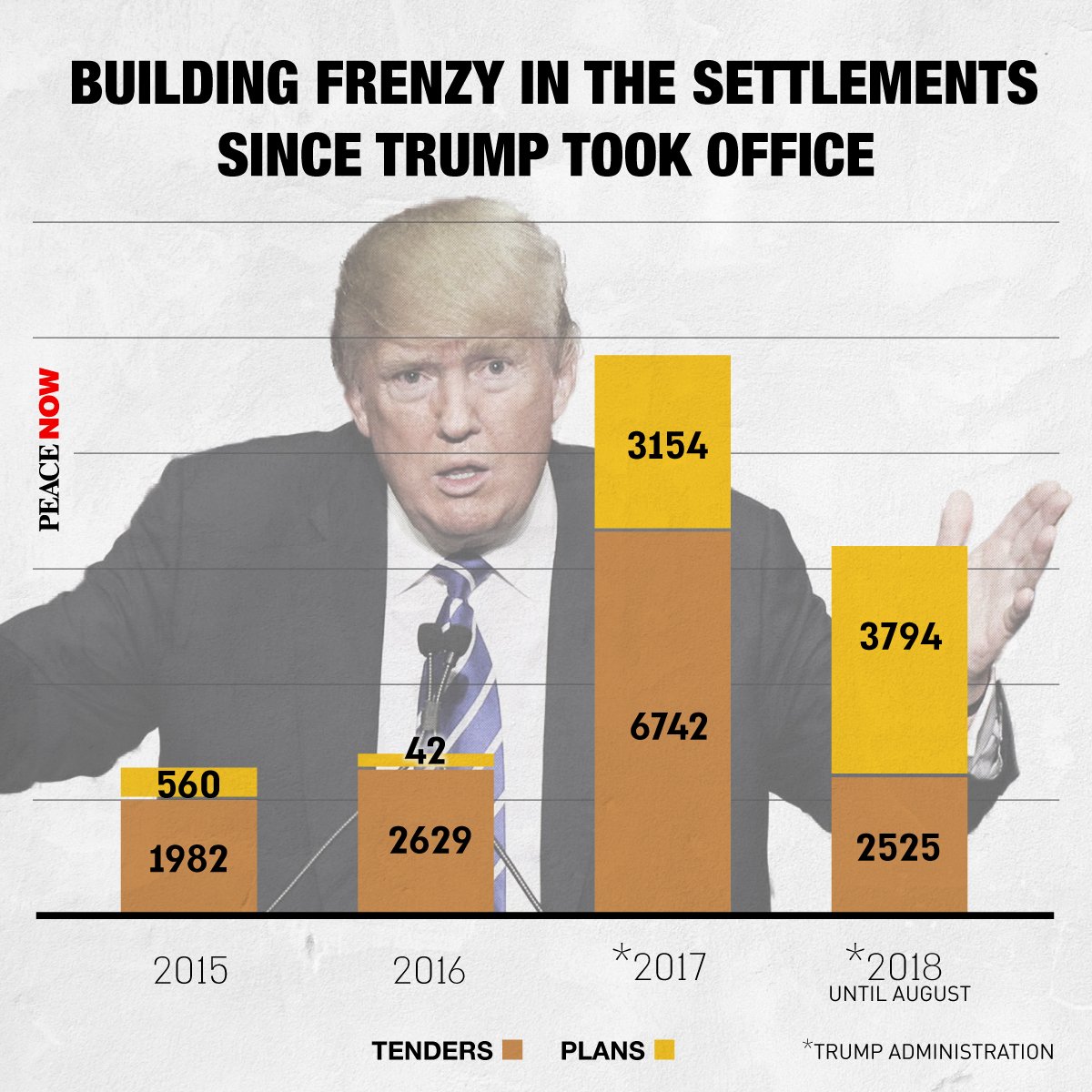
Image by Peace Now
When asked for comment on the various major settlement announcements, the U.S. State Department said that the Trump Administration believes the Israeli government has clearly demonstrated an intent to “adopt a policy regarding settlement activity that takes the president’s concerns into consideration” – a statement that suggests unequivocally that the Trump Administration has given a green light for massive settlement expansion across the length and breadth of the West Bank and East Jerusalem.
Notably, on the same day that the bulk of the settlement announcements were made, President Trump’s National Security Advisor, Ambassador John Bolton, was on the ground in Jerusalem. Not only did he offer no comment or criticism of the settlement announcements, he very publicly joined Israeli politicians and settlers leaders for dinner in East Jerusalem, dining in the “City of David National Park,” the archeological/touristic/residential site in the Palestinian neighborhood of Silwan that is run by the radical Elad settler organization. As FMEP has repeatedly covered, the Elad settler organization is spearheading a government-aided campaign to evict Palestinians from their homes in Silwan, replace them with Jewish Israeli settlers, and transform the neighborhood into a Biblical tourist site emphasizing exclusively the area’s Jewish history.
The head of the Peace Now Settlement Watch program, Shabtay Bendet, told Al-Monitor:
“The situation on the ground is changing rapidly…Restraints on construction in the settlements have been lifted. The Americans don’t care…”
State Tells High Court: We Can Annex the West Bank, International Law Be Damned
On August 7th, the state’s private attorney Harel Arnon submitted a second brief [Hebrew] to the High Court of Justice in defense of the settlement “Regulation Law.” In it he argues that the Knesset is not bound by international law and has the right to apply its own laws outside of its borders and annex land, if it wishes.
Arnon argues:
“The mere application of a certain Israeli norm [law] to an anonymous place outside the state does not necessarily make that anonymous place part of Israel. The Knesset is not restricted from legislating extra-territorially anywhere in the world, including in the region, the Knesset can legislate in Judea and Samaria.”
The brief also argues:
“The Knesset is permitted to impose the powers of the military commander of the West Bank region as it sees fit. The Knesset is permitted to define the authorities of the military commander as it sees fit. The authority of the government of Israel to annex any territory or to enter into international conventions derives from its authority as determined by the Knesset…[and] the Knesset is allowed to ignore the directives of international law in any field it desires.”
Lawyers representing Adalah responded:
“the Israeli government’s extremist response has no parallel anywhere in the world. It stands in gross violation of international law and of the United Nations Charter which obligates member states to refrain from threatening or using force against the territorial integrity of other states – including occupied territories. The Israeli government’s extremist position is, in fact, a declaration of its intention to proceed with its annexation of the West Bank.”
Harel was ordered to submit a second defense of the bill in response to a petition filed by Adalah and Al-Mezan on behalf of seventeen local Palestinian authorities. The petition argues that the Regulation Law violates international law and that the Knesset cannot enact laws over the West Bank where the majority of the population is Palestinians (who are not Israeli citizens and cannot vote).
The High Court of Justice is widely expected to strike down the “Regulation Law,” but has yet to make a ruling. Just last week, Arnon made the case that the recently passed Nation-State Law, which makes “Jewish settlement,” a “constitutional value,” can help him defend the settlement law before the High Court.
For ongoing tracking of the Regulation Law and other annexation trends in Israel, see FMEP’s Annexation Policy Tables.
This Week in Ariel: Settlers Celebrate 40 Years, A Construction Boom, A Medical School, & An Evangelical “Leadership Camp”
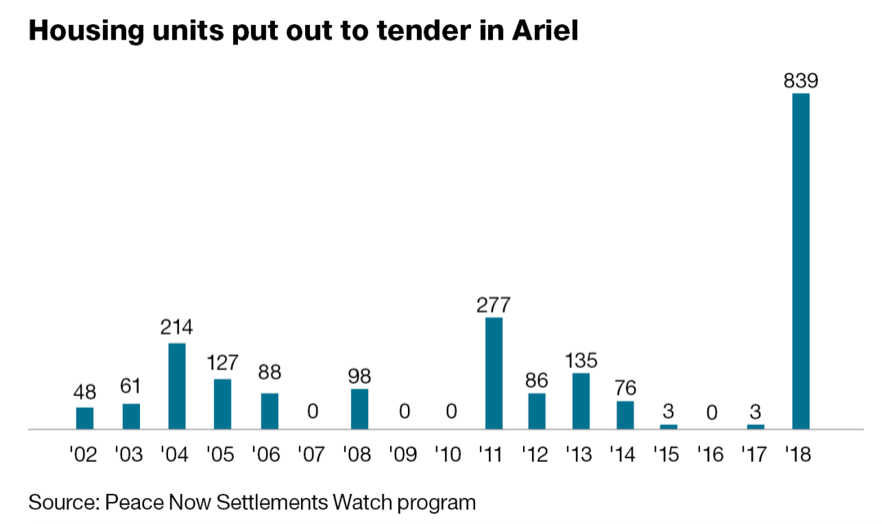 Haaretz published a lengthy report this week on the history of the the Ariel settlement – which is celebrating its 40th anniversary this month – and the dramatic spike in construction in the settlement in 2018. Even before tenders were issued for 42 new units this week (see above), plans for 839 units had already been approved during the first eight months of 2018, compared to tenders for fewer than 5 units each of the past three years. One of the original settlers of Ariel said:
“During the Obama years, everything here was frozen. But thanks to Donald Trump, we’re starting to see the light at the end of the tunnel.”
Not only has Ariel seen a massive surge in construction advancements this year, but the settlement broke ground on a new medical school heavily financed by U.S. casino magnate, and Trump backer, Sheldon Adelson (who this week gave $25 million to the GOP to help it keep the Senate, and in May gave the GOP $30 million to help it keep the House). Many settler leaders and Israeli officials, as well as Adelson and his wife Miriam, were in Ariel this weekend to attend a dedication ceremony for the medical school, despite ongoing controversy around its accreditation under domestic Israeli law. Prime Minister Netanyahu was notably absent from (and reportedly was not invited to) the ceremony, fueling rumors regarding the growing disaffection between him and Adelson.
According to another recent report in Haaretz, Ariel university is illegally dumping construction debris on land that Israel acknowledges is not “state land.” The dump site is outside of the so-called “Blue Line” which the Israeli government uses to demarcate the land that it considers “state land.” Since the dump site is not within the Blue Line, it is likely on land that even the government of Israel recognizes as being privately owned by Palestinians. Anti-settlement watchdog and founder of Kerem Navot, Dror Etkes, commented:
“It’s not surprising that Ariel University, which is the only university in the world built and existing by military order, has adopted the standards accepted in the West Bank involving the takeover of private Palestinian land.”
According to a third Haaretz report, the Israeli Education Ministry has signed a contract to sponsor 3,000-4,000 Israeli high school students of Ethiopian descent to take part in a leadership training program located in Ariel. The program, called “JH Israel,” was founded by American evangelical mega-church pastors Bruce and Heather Johnston, the latter of whom also runs the U.S. Israel Education Association, a pro-Israel, pro-settlement, non-profit group which works with the Family Research Council to lead Congressional delegations to Israel. The JH Israel website says its mission is to help Jewish Israeli students who are “disconnected from the roots of their faith” to establish “a deeper connection to God by embracing their biblical and cultural heritage.” The website also says that Ariel is “at the forefront of biblical prophecy unfolding in modern Israel.”
As FMEP has repeatedly documented, Ariel is located in the heart of the northern West Bank, reaching literally to the midpoint between the Green Line and the Jordan border. The future of Ariel has long been one of the greatest challenges to any possible peace agreement, since any plan to connect Ariel to Israel will cut the northern West Bank into pieces.
Peace Now Settlement Watch Director Shabtay Bendet spoke to Haaretz about the future of the Ariel settlement and the (other) significant repercussions of opening the new medical school. Bendet said:
“Most places in Israel don’t get recognized as cities unless they have 20,000 to 30,000 residents. Ariel became a city when it had just 11,000 residents. Why was this so significant? Because maybe you can uproot a settlement, but you don’t uproot a city. The same holds true for the university. Why was it so important for him to get it accredited? Because when a place has a university, that means it’s established — no pulling it out of the ground….By creating a buffer between the northern and southern parts of the West Bank it makes any future Palestinian state unviable. But besides that, it is also causing damage in the present because its continued expansion impinges on the ability of the surrounding Palestinian villages to develop and grow.”
Amana (the Official Settler Movement) Moves Its HQ to Sheikh Jarrah
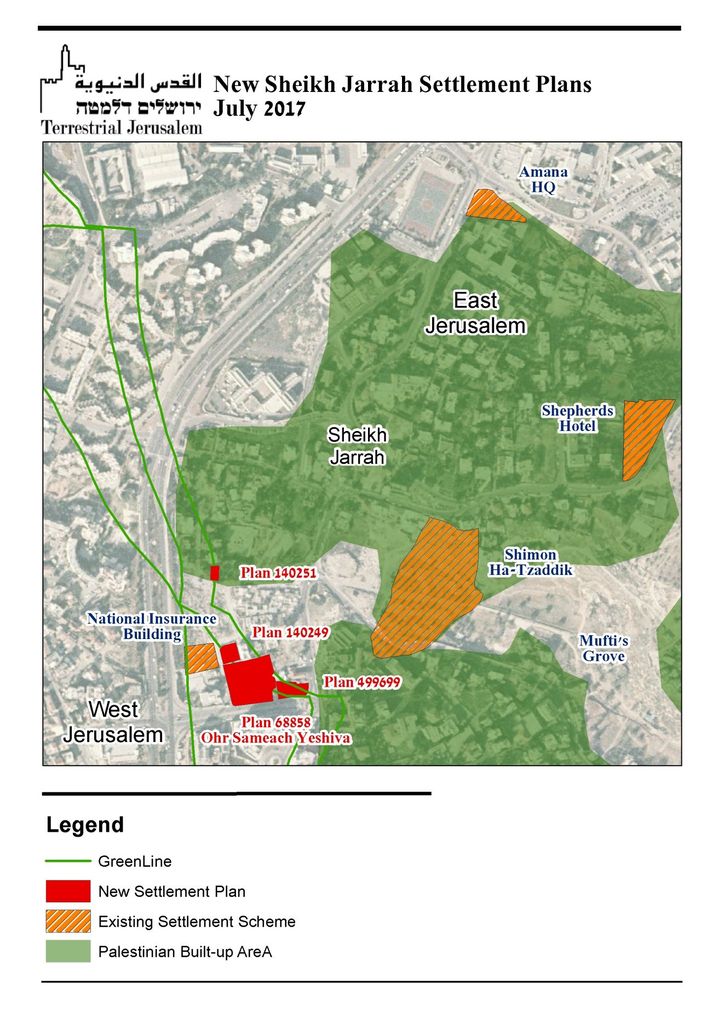 The Ynet news outlet reports that the Amana settler organization – the official body of the settlement movement, operating since the 1970s – has moved into its new headquarters in the heart of the Sheikh Jarrah neighborhood of East Jerusalem, where settlers are continuing to wage a displacement campaign against Palestinian residents. Though Amana has owned the plot of land since 1992, various legal challenges and incredibly sensitive geopolitical considerations have slowed construction of the building, called the “Amana House” (see a detailed history here).
Regarding the strategic implications of the location, Ynet reports:
“Amana says the new headquarters will help bolster the territorial contiguity of Jewish settlements in east Jerusalem.”
Agriculture and Rural Development Minister Uri Ariel (Bayit Yehudi) who previously served as the CEO of Amana, commented that the organization’s relocation:
“constitutes a significant reinforcement to the (Jewish) settlement in east Jerusalem and the bolstering of the Jewish territorial contiguity in the area.”
Several settlement plans are currently proceeding in Sheikh Jarrah, underscoring the strategic location and goals of settler activity in Sheikh Jarrah. As covered previously in this report, Israel is expected to advance a plan for a 6-story office building for settlers, located at the entrance to the neighborhood. Across the street from that building, a highly consequential plan for a new religious school (the Glassman yeshiva) was approved for deposit for public review in July 2017. The goal is clear: to unite the enclaves of settlers living inside of the Palestinian neighborhood by creating a contiguous area of settlement that connects to West Jerusalem, thereby cementing an immovable Jewish Israeli presence in a key Palestinian neighborhood – closing off the possibility of evacuation under a future peace deal.
Settlement Gains in East Jerusalem Result in Palestinians Self-Demolishing Their Homes
OCHA reports that two Palestinian homes in the East Jerusalem neighborhood of Beit Hanina were self-demolished after the Israeli Supreme Court ruled in favor of settlers’ ownership claims. OCHA writes:
“In recent decades, Israeli settler organizations, with the support of the Israeli authorities, have taken control of properties within Palestinian neighbourhoods in East Jerusalem, and some 180 Palestinian families are currently facing eviction cases, filed mainly by settler organizations.”
Bonus Reads
- “How Israeli Right-wing Thinkers Envision the Annexation of the West Bank” (Haaretz)
- “Let’s Admit It: The Settlers Have Won and We Have Lost” (Haaretz)
Welcome to FMEP’s Weekly Settlement Report, covering everything you need to know about Israeli settlement activity this week.
To receive this report via email, please click here.
July 19, 2018
- It’s the Settlements, Stupid: Documents Reveal Israel Planned Khan al-Ahmar Bedouin Removal for 40+ Years
- New Law Puts West Bank Legal Matters under Domestic Israeli Jurisdiction
- Since 1967, Israel Gave 99.76% of “State Land” in the West Bank to Settlers (But Blames Palestinians)
- Birthright & the Settlers
- Jordan Valley Settlement Council Confirms Participation in (Illegal) Outpost Activity, Refuses to Release Any Details
- Huge Expansion Approved for Pisgat Ze’ev; Jerusalem Expert: this is “Natural Response” to Trump’s Jerusalem Policy
- Bonus Reads
Comments, questions, or suggestions? Email Kristin McCarthy at kmccarthy@fmep.org.
It’s the Settlements, Stupid: Documents Reveal Israel Planned Khan al-Ahmar Bedouin Removal for 40+ Years
A recently discovered document from the 1970s confirms that the removal of Bedouin communities from the Maale Adumim/E-1 area east of Jerusalem (like Khan al-Ahmar) has been planned for decades and is directly connected to plans to expand Israeli settlements and annex West Bank territory.
The document, entitled “A proposal to plan the Ma’aleh Adumim region and establish the community settlement of Ma’aleh Adumim B,” was written by settler activist Uri Ariel (who is currently serving as Israel’s Agricultural Minister). It lays out a plan to create a “Jewish corridor” of settlements connecting the coast to the Jordan River, recommending that Bedouin be evacuated from the area east of Jerusalem in order to build a new settlement: “Maale Adumim B.”
Haaretz reports that “a large part of the plan has been executed, except for the eviction of all the area’s Bedouin,” adding “Today, under a government in which [Agricultural Minister Uri] Ariel’s Habayit Hayehudi party is so powerful, the open expulsion of Bedouin is possible.”
Jerusalem expert Danny Seidemann adds:
“the story of Khan Al-Ahmar is not only about the tragedy for the village and its inhabitants, or about Israel’s readiness to carry out an ostensible war crime in the face of the world. It is also about Israel’s determination to clear the entire area of the West Bank east of Jerusalem, and located within the line of the built and planned barrier, of any Palestinian presence. This clearing will prepare the ground for the future construction of E1 and de facto annexation of this so-called bloc, which extends well beyond the built-up area of Maale Adumim.”
New Law Puts West Bank Legal Matters under Domestic Israeli Jurisdiction
On July 16th, the Knesset voted 56-48 to pass a law that, in effect, further extends Israeli sovereignty into the West Bank, suspends even the pretense that Israel’s justice system is interested in protecting the rights of Palestinians living under occupation, and strengthens the hand of settlers and their supporters.
Specifically, since 1967, the court of first jurisdiction for cases related to Palestinians living in the West Bank — where Palestinians can legally challenge State actions (and inactions) regarding planning and construction, travel permits, freedom of information, and freedom of movement — has been the Israeli High Court of Justice, reflecting the extraordinariness of Israeli judges issuing, in effect, extra-territorial legal rulings.
The new law strips Palestinians of this direct avenue to the High Court of Justice. It compels Palestinians living in the West Bank to file petitions with the Jerusalem District Court (located within Israel’s sovereign borders). The High Court of Justice will only hear Palestinians’ cases on appeal from the district court, adding more time and higher costs to any potential appellant. The bill has been championed by Justice Minister Ayelet Shaked (Jewish Home), whose three-fold rationale for the bill explicitly states its purpose: to help settlers take more Palestinian land and shut-down Palestinian challenges to such thefts.
Shaked celebrated the passage of the bill, saying:
“The High Court petition party of Palestinians and extreme left organization against the settlements in Judea and Samaria is over today. From now on they will have to go through the judicial hurdle like any other Israeli citizen [note: Palestinians living in the West Bank are not Israeli citizens and as such do not enjoy the same rights or privileges as settlers in an Israeli court].”
Reiterating her call for annexation of the settlements, Shaked added that:
“Hebron, Ra’anana, Elon Moreh and Kiryat Arba [all but Ra’anana being places located deep inside the West Bank] are all inseparable parts of the Land of Israel.”
With the passage of the bill, the Israeli Knesset has further revealed – with startling honesty – its intention to treat the occupied territories as if they are sovereign Israeli territory. The bill is part of the legislative body’s broader effort to erase all remaining distinctions (legal, judicial, economic, and otherwise) between sovereign Israel and the occupied territories, distinctions which allowed Israel to preserve the guise of respect for rule of law, and good intentions, for the last 50 years. Lara Friedman points out:
“…this [the passage of the new law] is good news, further removing the pretense that Israel’s justice system protects Palestinian rights. For 50yrs the High Court’s rulings have at BEST dealt Palestinians pyrrhic victories that have systemically legitimized occupation & rule by law.”
FMEP tracks the application of domestic Israeli law over the occupied West Bank (the de facto annexation of the West Bank) on its Annexation Policy Tables, which are regularly updated.
Since 1967, Israel Gave 99.76% of “State Land” in the West Bank to Settlers (But Blames Palestinians)
On July 17, Israel’s Peace Now published a new report (covered in the New York Times) showing that Israel has allocated 99.76% of “State Land” in the West Bank to Israeli settlers, and just .24% to the local Palestinian population living under Israeli occupation. Israel has declared a total of 16% of land in the West Bank – including nearly half of all land in Area C – as “state land,” a method of land confiscation Israel has exploited to take control of West Bank land. This works out to around 260 square miles (674,459 dunams) of West Bank land granted to the settlers, and less than 1 square mile (1625 dunams) granted to the Palestinians.
Adding insult to injury, the 1 square mile of land granted for Palestinians was mostly for the purpose of establishing Israeli settlements and for the forced transfer of Bedouin communities off other land coveted by Israel (as in the case of Khan al-Ahmar).
The data upon which the report is based was furnished to Peace Now and the Movement for Freedom of Information in response to a two-year old freedom of information request to the Israeli Civil Administration (which is the sovereign governing power over the West Bank and is obligated under international law to protect the rights of the occupied people). In its response to the request, the Civil Administration suggested that Palestinians are to blame for the stark inequality, since they have refrained from applying to use the land. A statement from the Civil Administration reads:
“Applications for the allocation of state land are routinely submitted by all the population, both Palestinian and Israeli. It should be emphasized that the number of requests submitted by Palestinian residents is generally very low.”
With this argument, the Civil Administration has constructed a classic “damned if they do, damned if they don’t” argument. If Palestinians apply to use the land, they would legitimize Israel’s authority to declare West Bank land “State Land” in the first place as well as Israel’s authority to grant or deny its use, whether to Palestinians or settlers. If Palestinians don’t apply, they are blamed for Israel’s decisions on allocating virtually all of the land to settlers. This argument also ignores the fact that the the pattern of allocation of “State Land” revealed in this report is not an exception to, but an illustration of, the rules according to which the Civil Administration has run the West Bank for the past 51 years – rules that overwhelmingly favor the settlers over the Palestinians, most blatantly when it comes to land and construction.
More fundamentally, setting aside the question of whether Israel has abused its authority in declaring so much of the West Bank to be “State Land,” the Civil Administration’s response completely ignores the fact that Israel has a legal responsibility under international law regarding stewardship of “state land” held under its occupation. As the Association for Civil Rights in Israel explains:
“Israel holds state land in an occupied territory as a trustee, and must do everything possible to preserve and develop it for the benefit of the local Palestinian population. The very use of state land for the purpose of building settlements and/or developing infrastructure and industrial zones not in favor of the Palestinian population constitutes a violation of international law. ”
The New York Times observes, correctly:
“The lopsided allocation is hardly surprising. Israeli legal experts say the whole point of seeking out state lands, the bulk of which were designated in the 1980s, was to aid the growing settlement enterprise, which most of the world considers a violation of international law. But the paucity of land allocated to the Palestinians shows the extent of competition over territory, and the effort Israel puts toward building the settlements.”
Peace Now said:
“The significance of the data is that the State of Israel, which has been in control of the West Bank for more than 50 years, allocates the land exclusively to Israelis, while allocating virtually no land for the unqualified benefit of the Palestinian population. Land is one of the most important public resources. Allocation of land for the use of only one population at the expense of another is one of the defining characteristics of apartheid. This is further proof that Israel’s continued control of the occupied territories over millions of Palestinian residents without rights and the establishment of hundreds of settlements on hundreds of thousands of dunams has no moral basis.”
The Peace Now report shines a harsh spotlight on a key facet of Israel’s decades long effort to confiscate land and transfer it to the settlers, particularly in Area C, and it comes at a time when Israeli lawmakers are loudly and clearly calling for the unilateral annexation of Area C – all of which FMEP documents in its Annexation Policy Tables.
Birthright & the Settlers
Adding to the swirling coverage of participants leaving Birthright trips to learn about Palestinians and realities in the West Bank and East Jerusalem, Birthright (an organization which organizes free trips to Israel for young Jews around the world) has come under the spotlight this week for two settlement-related reasons: the harassment of Birthright participants who left the trip to tour Hebron, and Birthright’s partnership with the radical settler group Elad.
First, cameras caught settlers harassing a group of Birthright participants who left the trip to tour Hebron with Breaking the Silence. The tour guide, a former IDF soldier, was attacked by the settlers. Breaking the Silence regularly takes groups to Hebron to observe the apartheid-like reality that exists there, “sterile streets” (an Israeli military term for streets which Palestinians are forbidden to access) and all. Part of that reality is daily settler violence, as Breaking the Silence explains:
“Near daily occurrences of abuse of the Palestinian population by settlers, including humiliation and physical attacks, are part and parcel of the lives of those Palestinians who still live in H2. Even worse, twisted norms of law enforcement in which two different populations are subject to two different sets of laws – one military and one civilian – creates a situation of selective law enforcement at best, and complete lack of law enforcement over the residents of the Jewish settlement at worst.”
Second, Birthright’s partnership with the radical Elad settler organization was exposed when a second group of youth left a Birthright trip during a tour of Silwan (aka the City of David) with Elad, which manages the City of David National Park (which was declared on Silwan land). Elad is engaged in a range of activities to enact their extremist political agenda, at the expense of Palestinians. The group left the Birthright tour to join a Peace Now visit with the Palestinian Sumreen family, who are under threat of eviction from their Silwan home because of the actions of the Elad and the JNF. Birthright responded by accusing the participants who left the trip of seeking to advance a “political agenda,” and defending itself as an “apolitical” organization. Birthright’s response is especially ironic given Birthright’s own choice to ally itself with Elad — an organization that explicitly exists to promote an extremist political and ideological agenda (for further irony, see this proud announcement by a former Birthright participant noting that it was her experience with Birthright that inspired her to become a settler).
Peace Now later said in an email:
“Peace Now has no fight with Birthright. What we oppose are government (or any other) efforts to insert political programming into trips like Birthright’s that intentionally conceal the occupation, such as Elad tours. Elad’s far-right, one-state agenda is well-known, and it is involved in the legal acrobatics underway to evict Palestinian families from their homes.”
Jordan Valley Settlement Council Confirms Participation in (Illegal) Outpost Activity, Refuses to Release Any Details
The Jordan Valley Settlement Council, which represents the majority of Israeli settlements located in the West Bank section of the Jordan Valley, has admitted that it supports illegal outposts in the area, but declined to provide information on its activities. The admission came in response to a freedom of information request made by an Israeli lawyer representing the anti-occupation group Machsom Watch and the coexistence group Combatants for Peace.
In the written refusal to divulge information about the Jordan Valley Settlement Council’s involvement with outposts, staff member Oshra Yihye said that its refusal is based on the fact that the parties requesting the information are critical of settlers living in the Council’s jurisdiction. Yihye also claimed that revealing the information will interfere with Council’s operations. Some Jordan Valley settlers are known to violently attack Palestinian farmers and their property, and settlers have been repeatedly caught on video attacking Israeli activists trying to assist the Palestinians.
Israel has effectively annexed 85% of land in the Jordan Valley, through ongoing settlement building and the declaration of “closed military zones” on vast swaths of farmland. A recent report by B’Tselem documents how Israeli settlers were allowed to establish two new outposts in the Jordan Valley last year. In recent months, Israel has delivered eviction notices to entire Palestinian communities near Israeli settlements in the Jordan Valley. Simultaneously, settlers have been allowed to continue construction on a tourist project – a car race track built in a closed military zone (land expropriated from Palestinians ostensibly for security purposes), despite a court ordered stop-work order.
Huge Expansion Approved for Pisgat Ze’ev; Jerusalem Expert: this is “Natural Response” to Trump’s Jerusalem Policy
On July 2nd, the Israeli Housing Ministry deposited for public review plans for 1,064 units in the Pisgat Ze’ev settlement in East Jerusalem. Jerusalem expert and founder of Terrestrial Jerusalem, Danny Seidemann, recently punctuated the significance of the move, explaining:
“Politically speaking, this approval signals a clear statement by Israeli authorities. These plans received initial approval from the Planning Board in July 2017, as [Terrestrial Jerusalem] reported in detailed here. While the approval of these plans at this time, after a year’s delay, is indeed in large part the normal course of events in the bureaucratic decision, the publication could not have taken place without the advance knowledge and blessing of Netanyahu. As such, this is yet another component in Netanyahu’s systematic effort to tighten Israel’s grip on East Jerusalem, his natural response to Jerusalem having been ‘taken off the table’ by President Trump.”
While pointing out that the Pisgat Ze’ev plans are the first East Jerusalem settlement plans to be deposited for public review this year, Seidemann says:
“This should by no means lead to the conclusion that until now there has been a de facto settlement freeze in East Jerusalem. Before the Pisgat Ze’ev approvals, other settlement activities were proceeding apace, including ground being broken for the expansion East Talpiyot and deliberations on a major new plan in Southeastern Gilo (Master Plan 125195).”
For more analysis from Terrestrial Jerusalem on the Pisgat Ze’ev plans, see here.
Bonus Reads
- “How a West Bank Highway’s Road Sign Captures the Israeli Psyche” (Haaretz)
- “Bulldozers In The West Bank: How recent Israeli Settlement Expansion Jeopardizes the Peace Process” (Forbes)
- “Israel Accelerates ‘Greater Jerusalem’ Plan” (Ahram Online)
***In total, the Israeli government advanced plans for 3,120 new settlement units this week alone. Details, along with additional significant settlement news, are below.***
Welcome to FMEP’s Weekly Settlement Report, covering everything you need to know about Israeli settlement activity this week.
To receive this report via email, please click here.
June 1, 2018
- Plans Advance for 1,958 New Settlement Units
- Tenders Published for 1,162 New Settlement Units
- Israeli Chief Justice Questions Legal Opinion Regarding Status of Settlers
- Knesset Advances Bill to Bring West Bank Land Cases Under Israeli Domestic Jurisdiction (De Facto Annexation)
- Labor MK Calls on Left to Endorse De Facto Annexation of “Settlement Blocs”
- Israeli Security Increase Presence Near Radical Settlements
- Human Rights Watch: Israeli Banks Are Integral Part of the Settlements Enterprise
- U.S. Ambassador Friedman on Settlements, Annexation, Trump “Peace Plan,” & More
- Bonus Reads
Comments, questions, or suggestions? Email Kristin McCarthy at kmccarthy@fmep.org.
Plans Advance for 1,958 New Settlement Units
On May 30th, the Israeli High Planning Council advanced plans for 1,958 new settlement units, located across the West Bank. Of the total, 696 units received final approval and 1,262 units were approved for deposit for public review (a key, step in the planning process). Peace Now estimates that 80% of the planned units are to be built in isolated settlements and that 1,500 of the units are to be built outside of the “built up” area of existing settlements. Two of the plans would establish two entirely new settlements.

Map by Peace Now
Adding insult to injury (or in this case, to a war crime), the Council gave final approval (“validation”) to a provocative plan to build 92 units near the Kfar Adumim settlement east of Jerusalem, less than a mile from the soon-to-be forcibly removed Khan al-Ahmar bedouin community. Those new units will considerably expand the footprint of the Kfar Adumim settlement by building a new neighborhood (called “Nofei Bereishit” meaning “the landscapes of Genesis” in Hebrew), which will serve to connect the existing settlement structures to the site of a future school campus slated to serve several Israeli settlements in the area.
With respect to the Kfar Adumim expansion plan, Peace Now writes:
“The approval of the plan is the embodiment of exploitation and evil. The government stubbornly refuses to grant building permits to 32 Palestinian families living on about 40 dunams in the area and intends to evict them, but at the same time approves construction on large areas for hundreds of Israeli families. If there is anything that blackens Israel’s image in this world, it is the cruelty and discrimination that reeks to the heavens in this case. Neither is there any real Israeli national interest behind the destruction of the village.”
With respect to the plans advanced for two new government-sanctioned settlements, the details are:
- A plan for 189 units in the unauthorized outpost of Zayit Ra’anan, near the Talmon settlement northwest of Ramallah. As Peace Now explains, this plan constitutes the sanctioning of a new settlement entirely. Talmon has three satellite outposts, according to a map by WINEP. Zayit Ra’anan is the outpost the furthest from the settlement.
- A plan to authorize the “Brosh Educational Institution,” an outpost in the Jordan Valley. This too constitutes the establishment of an entirely new settlement. As Peace Now explains, the settlers who established the Brosh outpost named their endeavor an “Educational Institution” in order to obscure their intent to build a settlement. The plan for the “Brosh Educational Institute” includes residential buildings.
These approvals are notable for two reasons: First, they show that the Israeli government is significantly expanding the footprint of settlements across the West Bank, including in isolated settlements. Second, the plans demonstrate that the Israeli government is not acting, in any way, with “restraint” in regards to its settlement activity (per a reported agreement between the U.S. and Israel, “restrained” settlement growth limits Israel’s building to areas adjacent to existing settlement buildings). The reaction of the Trump Administration to the approvals suggests that the U.S. isn’t in any way troubled that Israel appears to be defying its commitment. An official at the U.S. National Security Council told The Times of Israel:
“The Israeli government has made clear that going forward, its intent is to adopt a policy regarding settlement activity that takes the president’s concerns into consideration. The United States welcomes this. The president has made his position on new settlement activity clear, and we encourage all parties to continue to work toward peace.”
Tenders Published for 1,162 New Settlement Units
One day after the High Planning Council advanced plans for nearly 2,000 new settlement units (above), on May 31st the Israeli Housing Ministry issued tenders for another 1,162 new settlement units that had previously approved by the High Planning Council (once planning approvals are complete, the decision on if/when to issue construction tenders for an approved plan rests with the Housing Ministry). The 1,162 tenders issued this week are are for:
- 459 new units in the Ma’ale Adumim settlement;
- 409 new units in the Ariel settlement;
- 250 new units in the Elkana settlement; and
- 44 new units in the Ma’ale Ephraim settlement.
Israeli Chief Justice Questions Legal Opinion Regarding Status of Settlers
On May 31st, Israeli Chief Justice Esther Hayut issued a significant legal opinion that complicates the growing momentum across the Israeli government to adopt and implement a legal precedent holding that Israeli settlers are a part of the “local population” of the West Bank. Chief Justice Hayut said the precedent does not constitute “a binding law” saying it “appears that the ruling contradicts previous rulings…and it contains both a novelty and a difficulty.” The ruling in question, written by retired Justice Salim Joubran in 2016, is currently being used as a precedent to justify the expropriation of privately owned Palestinian land near the Haresha outpost, and adopting the precedent was a key recommendation of the recently-released “Zandberg Report” which gave the Israeli government a plethora of legal tools to retroactively legalize outposts and settlements structures.
Hayut’s opinion was issued in response to a petition by the Israeli NGO Yesh Din, which asked to Court to reopen the Amona outpost case where the “local population” precedent was set. The opinion itself was not published until October 2017 (meaning the precedent was not known to the public or able to be debated until now, precisely when the government is moving swiftly to implement it). While Hayut declined to reopen the Amona outpost case, she took the opportunity to address the question raised by Yesh Din regarding the underlying precedent that was set in the case.
FMEP tracks the evolving legal architecture of the Israeli government’s efforts to retroactively legalize outposts and settlement structures (our regularly updated data tables are available here).
Knesset Advances Bill to Bring West Bank Land Cases Under Israeli Domestic Jurisdiction
On May 28th, the Israeli Knesset advanced a bill through its first reading that, if passed, will give jurisdiction the Jerusalem District Court jurisdiction over land disputes in the occupied West Bank. Since 1967, such cases have been under the jurisdiction of the Israeli High Court of Justice, reflecting the unusual – indeed, legally extraordinary – situation in which an Israeli court is ruling on with respect to land and people that are not part of sovereign Israel. The bill passed by a vote of 47 to 45, and will need to be voted through two more readings in the Knesset plenum before it becomes law.
As FMEP explained when the bill gained government backing in February 2018, the bill’s main proponent, Justice Minister Ayelet Shaked, has three main rationales for the bill: (a) to further extend and formalize Israel’s extraterritorial application of its domestic law and legal structures, giving a regular Israeli domestic court jurisdiction over non-citizen Palestinians living in territory that is beyond Israel’s sovereign borders; (b) to give settlers an advantage in court over Palestinian plaintiffs; and (c) to circumvent what Shaked sees (according to a Justice Ministry official) as the High Court being “overly concerned with international law and with protecting the rights of the ‘occupied’ population in Judea and Samaria.” Under Shaked’s proposal, some Palestinian cases could still reach the High Court of Justice, but only after the much more conservative Jerusalem District Court rules, adding time and cost to any Palestinian land petition.
Yesh Din representative Gilad Grossman commented:
“This bill is designed to indicate a kind of normalcy. [It is meant] to show that we’re not talking about an area conquered by one nation whose residents [Israelis] do whatever they want and no one enforces the law against them in an equal manner, but rather that these are conflicts between neighbors just like in Tel Aviv, Haifa or any other town within sovereign Israel.”
FMEP tracks the progress of this bill in its compendium of annexation policies currently being advanced and implemented in Israel. This bill (tracked on the third table) is just one mechanism by which Israeli lawmakers are moving to apply Israeli domestic law extraterritorially – which amounts to de facto annexation of the West Bank.
Labor MK Calls on Left to Endorse De Facto Annexation of “Settlement Blocs”
Last weekend, MK Eitan Cabel (Labor, the largest faction in the Zionist Union coalition) published an op-ed in the Hebrew edition of Haaretz arguing that Israel should define and then apply Israeli law to the “settlement blocs,” which he defines to include Ma’ale Adumim, the Etzion Bloc, the Jordan Valley, Ariel, Karnei Shomron, and more. Cabel promised to release and campaign for the full plan (presumably with more details) sometime soon.
In the op-ed and in subsequent comments to the press, Cabel calculates that 300,000 Israeli settlers will be annexed into Israel under his scheme. Cabel’s calls for the 100,000 settlers outside of those areas to be compensated and for a total construction freeze to be implemented there. He proposes that the status of those areas will be negotiated if, “one day, the Palestinian Nelson Mandela arrives.”
Zionist Union Chairman and Labor Party leader Avi Gabbai – who has said Israel should not evacuate settlements in any peace deal – slammed Cabel’s plan, saying:
“In a democratic party, everyone can have their opinion, but Labor is for separation, not annexation. Separating from the Palestinians must come as part of an agreement. I am not in favor of a unilateral step. I think in negotiations we can reach better results than without them. This is the best time for negotiations because of our alliance with the US and because the Arab countries want peace.”
Cabel’s plan impressed Naftali Bennett (Jewish Home) who tweeted in support of the op-ed, saying it was a step in the direction of his own proposed scheme to annex all of Area C in the West Bank (60% of the occupied land). Apparently agreeing with that point, an unnamed Labor Party official said:
“It’s a delusional initiative. It’s like [Habayit Hayehudi leader Naftali] Bennett speaking through Cabel…He’s [Cabel] suggesting an annexation, but doesn’t say what will become of the Palestinian population in those territories. These are irresponsible and ill-prepared statements.”
Peace Now tweeted in response:
“Another dangerous, self-defeating remark from this weekend for the Labor party. Veteran MK Cabel’s call for unilateral annexation of the “blocs,” including Ariel & Karnei Shomron, is a cowardly rhetorical surrender to the right’s one-state apartheid agenda. Shameful & disturbing….For everyone who supports cutting Israel a break on building in the ‘blocs,’ this is what happens when you give in. Not only is a top Labor MK adopting the right’s maximalist interpretation of the term ‘blocs,’ he is now making the Maale Adumim annexation bill look tame….One can only assume @netanyahu‘s support for annexing the blocs, but it should be noted that at least publicly he has not advocated as much as Cabel just did.”
As Peace Now suggests, using the term “settlement blocs” is unfortunately misleading, and implies an agreed upon acceptance of what the blocs are and the fact that they are inarguably Israel’s to keep. The term “settlement blocs” has no legal definition or standing, and they are indisputably a matter for negotiations aimed at a two-state solution. The terminology has been used for decades by the Israeli government to convey legitimacy to building in the so-called “blocs.” For more context, see resources from Americans for Peace Now here and here. (NOTE: A Haaretz investigation last year estimated that a total of 380,000 Israeli settlers live in the West Bank, of which 170,000 live outside of the so-called blocs, as defined by Haaretz).
Applying Israel law to areas outside of Israel’s sovereign borders is de facto annexation, as FMEP has explained and documented.
Israeli Security Increase Presence Near Radical Settlements
In early May (before the U.S. Embassy opening and the beginning of Ramadan), Israeli security forces increased troop deployments across the West Bank in order to “prevent friction” between Israeli settlers and Palestinians.
According to a Haaretz report, the decision to increase Israel’s security presence was preceded by a series of discussions over the past month between the army, the police, and the Shin Bet. One such meeting was held at the Prime Minister’s office. A source told Haaretz that the meeting participants came to a consensus that settlers from Yitzhar are the main perpetrators responsible for the escalating frequency of “price tag” attacks against Palestinians. As recapped by Haaretz, the main concern of the Israeli officials is that settler attacks might foment Palestinian attacks in response. Haaretz reports:
“The main concern within the Jewish Division of the Shin Bet, which investigates the activities of Jewish Israeli extremists, is that price tag attacks during Ramadan, a fast month, and coming shortly after the controversial transfer of the U.S. Embassy to Jerusalem and the tensions on the border with the Gaza Strip, could spur terrorist attacks against Israelis.”
Despite the rise in settler violence, Israel MK Bezalel Smotrich took the opportunity to accuse the Israeli police of “bullying” Israeli settlers – an accusation that echoed complaints from settlers, including those from Yitzhar, regarding an increased IDF presence. The Israeli Police issued a response, saying Smotrich’s comments were regrettable.
Even with higher troop deployment, settlers continue to attack Palestinians and their property on a weekly basis.
Human Rights Watch: Israeli Banks Are Integral Part of the Settlements Enterprise
In a new heavily researched, documented report titled “Israeli Banks in West Bank Settlements,” Human Rights Watch documents how Israeli banks facilitate and profit from Israeli settlements and makes the case that these banks are therefore complicit in war crimes, including pillaging. HRW reports:
“Most Israeli banks finance or ‘accompany’ construction projects in the settlements by becoming partners in settlement expansion, supervising each stage of construction, holding the buyers’ money in escrow, and taking ownership of the project in case of default by the construction company. Most of that construction takes place on ‘state land,’ which can include land unlawfully seized from Palestinians and which Israel uses in a discriminatory fashion, allocating one third of state land in the West Bank, not including East Jerusalem, to the World Zionist Organization and just 1 percent for use by Palestinians.”
HRW concludes that banks operating in the settlements are, therefore, unavoidably complicit in violating the human rights of Palestinians, and the only remedy is for these banks cease settlement-related operations.
To illustrate the point that human rights violations are an inherent part of all settlements in the West Bank, HRW partnered with the Israeli NGO Kerem Navot to share the story of how the construction of the Elkana settlement and the Israeli separation barrier has deprived Palestinians from the nearby city of Mas-ha of access to their own lands. Banks that have financed projects in Elkana are part of the machinery that entrenches and expands the theft.
Kerem Navot writes:
“Settlements wreck havoc on Palestinian life in the West Bank. For example, as depicted in the animation, the Aamer family used to walk 20 minutes from their West Bank home to their farm. Then Israel built an Israeli-only settlement on part of it, with help from Israeli banks, turning it into a 2-hour detour on what’s left of their land. Banks and all businesses should cease doing business in and with settlements.”
This is just the latest HRW report on the Israeli banking sector and the occupation, and it builds on a September 2017 legal analysis titled, “Israeli Law and Banking in the West Bank.” In the 2017 report, HRW took apart a common legal defense Israeli banks deploy to defend their settlement practices: that Israeli law requires them to operate in the settlements. HRW concluded that there is no such legal requirement currently in Israeli law.
U.S. Ambassador Friedman on Settlements, Annexation, Trump “Peace Plan,” & More
In a wide-ranging (and stunning) interview this week with The Times of Israel, U.S. Ambassador David Friedman spoke revealingly about behind-the-scenes policy discussions within the Trump Administration, including on the topic of settlements, the status of the West Bank, and Israeli annexation proposals.
A few key Friedman quotes from the transcript include:
- On Israel’s settlement activity during the Trump Administration: “The administration’s stance has been that the settlement enterprise is not an impediment to a peace deal, but that unrestrained settlement activity is not consistent with the cause of peace. Where you draw that line or slice that, I am reluctant to go into now. I have felt for years that there has been an oversimplification by the international community of the legal claims, if you will, within the West Bank. That came to a head in December of 2016, with UN Security Council Resolution 2334. It’s not a secret that the Trump administration does not support that resolution, would have vetoed that resolution, had Nikki Haley been the ambassador rather than Samantha Power. I think you can draw some insight from the administration’s views on that resolution.”
- On how Friedman views the international consensus holding that Israeli settlements in the occupied West Bank are illegal: “…Look, I don’t believe the settlements are illegal. I think I’ve been clear on that for years. President Reagan was very clear that he would never suggest Israel would go back to the 1967 borders. They were called the suicide borders; they were considered indefensible. So the notion that Israel’s presence over the Green Line is illegal is something the United States has through many leaders rejected, which is why that UN resolution in 2016 was so offensive to so many people.”
- On whether the Trump Administration discussed annexation proposals with the Israeli government: “We have not had discussions with Israel about annexation…I’ve done lots of listening, so those discussions have taken place, but not in the sense of planning or seeking to execute a strategy, just in the context of enabling me to hear everybody’s views.”
- On the State Department’s decision to stop using “occupied territories” in materials, and instead use “West Bank”: “I believe this is a highly controversial issue and we ought to be using terminology that doesn’t prejudge issues…I was perfectly happy with any geographic identification that people could commonly understand that didn’t involve an adjective. West Bank is fine, Judea and Samaria would have been fine. If there’s another name that would do it justice, that would have been fine. I didn’t think it was appropriate to use “occupied territories,” because I just found it to be unnecessarily political and judgmental on an issue that was still unsettled in many people’s minds.”
Bonus Reads
- “The UN Database on Businesses in Israeli Settlements: Pitfalls and Opportunities” (Al-Shabaka)
- “Checking Supreme Court’s powers, Bennett looks to ‘rebalance’ Israeli democracy” (Times of Israel)
Welcome to FMEP’s Weekly Settlement Report, covering everything you need to know about Israeli settlement activity this week.
To receive this report via email, please click here.
May 25, 2018
- Israeli Government to Advance 3,900 Settlement Units Next Week
- Finance Ministry Announces Bargain Construction in Beit El & Ma’ale Adumim Settlements
- Defense Ministry Supports Expropriation of Private Palestinian Land for Settlements
- High Court Supports Destruction of Khan al-Ahmar [A War Crime], Clearing the Way for E-1 Settlement
- Palestinians Ask the ICC to Open Investigation into the Israeli Settlement Regime
- Bonus Reads
Comments, questions, or suggestions? Email Kristin McCarthy at kmccarthy@fmep.org.
Israeli Government to Advance 3,900 Settlement Units Next Week
Israeli Defense Minister Avigdor Lieberman (Yisrael Beiteinu) announced that the High Planning Council (the body in the Defense Ministry’s which oversees all construction in the occupied West Bank) is expected to advance plans for 3,900 settlement units next week. Of that total, 2,500 units will reportedly receive final approval for construction and 1,400 will be advanced through the planning process. Peace Now estimates that 52% of the units will be located in isolated settlements.
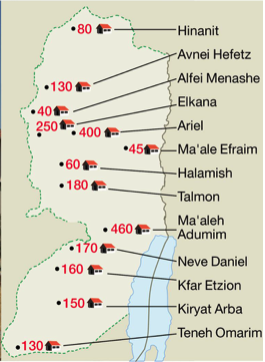
Map by Haaretz
Lieberman – whom The Times of Israel and Haaretz note has repeatedly inflated settlement approval numbers in the past – said the specific plans set to advance will include:
- 400 units in the Ariel settlement (where a medical school financed by Sheldon Adelson was recently brought under Israeli domestic jurisdiction, in a case of de facto annexation. And where a future stop on the recently approved settler-only light rail is slated to be built.);
- 460 units in the Ma’aleh Adumim settlement;
- 250 units for an assisted living center in the Elkana settlement (where the settler-only light rail will also have a stop);
- 180 units in the the Talmon settlement;
- 170 units in the Neve Daniel settlement;
- 160 units in the Kfar Etzion settlement;
- 150 units in the Kiryat Arba settlement (where construction preparations for a new industrial zone – which in reality is a new settlement in Hebron – recently began);
- 130 units in the Avnei Hefetz settlement;
- 130 units in the Tene Omarim settlement;
- 80 units in the Hinanit settlement;
- 60 units in the Halamish settlement (where settlers have built a strategic outpost, with the protection of the IDF, in order to further restrict Palestinian access to the area);
- 45 units in the Ma’ale Efraim settlement;
- 40 units in the Avnei Hafetz settlement;
- 45 units in unspecified settlements.
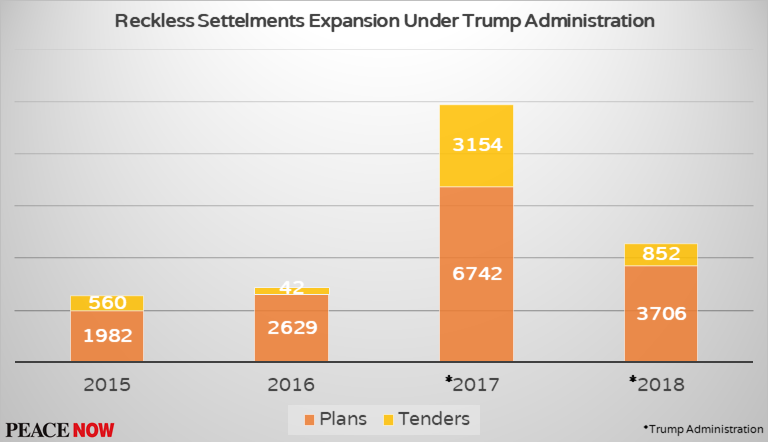
This will be the third meeting of the High Planning Council in 2018, in accordance with a reported agreement between Israel and the United States to consolidate and coordinate the number of times settlement plans are announced. The first regularly scheduled meeting of the year was in January, when 1,122 new settlement units were advanced, of which 352 received final approval for construction. The Council met again, unexpectedly in February, which Lieberman tried to minimize by calling it “less significant” because the majority of the projects approved were non-residential. In fact, the projects were extremely significant. All of the plans expanded the footprint of settlements located deep inside the West Bank – including plans for a race track and hotel in the Jordan Valley. One “unusual” plan even created a new outpost to house settlers evacuated from a different outpost (the Netiv Ha’avot outpost case that FMEP has covered in exhaustive detail).
The anti-settlement watchdog group Peace Now writes:
“In the year and a half since President Trump took office some 14,454 units in the West Bank has been approved (in plans and tenders, including today’s announcement not including East Jerusalem), which is more than three times the amount that was approved in the year and half before his inauguration (4,476 units)…The Netanyahu government is clearly continuing to take advantage of the carte blanche the Trump Administration has given it in order to destroy the chances for peace. It is well-known that for a two-state solution to be feasible Israel will have to withdraw from most of the West Bank, yet the government keeps raising the political cost of this redeployment and the evictions it will entail. By adding housing to settlements, the government shows total disregard for the two-state solution.”
In reaction to Lieberman’s announcement, PLO Executive Committee member Hanan Ahrawi said:
“Such egregious policies affirm the imperative need for the International Criminal Court to open an immediate criminal investigation into Israel’s flagrant violations of international law and conventions,” she said in a statement….Israel’s declared intention to build thousands of illegal settler units in the occupied West Bank discloses the real nature of Israeli colonialism, expansionism and lawlessness…Undoubtedly, Israel is deliberately working to enhance its extremist Jewish settler population and to superimpose ‘Greater Israel’ on all of historic Palestine…It is evident that the recent provocative and unlawful moves adopted by the United States, Guatemala and Paraguay have emboldened Israel to move forward with enhancing its illegal settlement enterprise, thereby finalizing the total annexation of the occupied West Bank.”
Saeb Erekat, a top diplomat for the Palestinian Authority released a video response, in which he highlighted the PA’s recent referral to the International Criminal Court (ICC) to investigate Israeli settlement crimes (see FMEP’s coverage on the ICC referral, below). Erekat said in part:
“This is a flagrant violation and an eye opener to the judicial council of the ICC that an official judicial investigation must be opened immediately. This cannot go on. Israel cannot continue business as usual with this impunity and immunity that they think they have.”
Nadil Abu Rudeina, a spokesman for PA President Mahmoud Abbas, said:
“The continuation of the settlement policy, statements by American officials supporting settlements and incitement by Israeli ministers have ended the two-state solution and ended the American role in the region.”
Finance Ministry Announces Bargain Construction in Beit El & Ma’ale Adumim Settlements
In addition to the approvals expected from the High Planning Council this week, the Israeli Finance Ministry has announced that a 300-unit project in the Beit El settlement and 44-unit project in the Ma’ale Adumim settlement have been marketed as part of the “Buyer’s Price” program. Under this program, the government sells land to construction companies at low prices, and those companies commit to offering future settlement units at below market prices. With the plan being marketed in Beit El, the government is accepting bids on the project from construction companies which commit to pricing the apartments 20% below market value – in effect creating a powerful financial subsidy that incentivizes Israelis to move into settlements.
The Beit El project involves 5 buildings with a total of 296 units. According to Ynet:
“the program’s goal is to transform Beit El’s southeast agricultural area into a residential neighborhood as well as unification and re-division of the lands, which will be allocated to building houses, public offices, commercial areas, routes, and a public open space.”
FMEP has covered the progress of this Beit El project repeatedly over the past year, particularly because the push around Beit El projects typifies the Netanyahu-Trump era of settlement growth. Beit El settlers have lobbied for the project for over 5 years, ever since the settlers were evacuated from an outpost of Beit El (called “Ulpana”) in 2012. When the outpost was evacuated, Prime Minister Netanyahu promised to build replacement settlement units in Beit El. Buoyed by the apparent green-light from the Trump administration, over the summer of 2017 settler leaders repeatedly and publicly shamed Netanyahu for failing to fulfill that promise, and in response Netanyahu very publicly and repeatedly promised that the settlement units will be built expeditiously. After being ignored by the High Council during its September meeting, the plan for 296 units was then approved for marketing in October 2017. Now, this week, the government has acted on that approval to market the plan, moving ever closer to the start of construction. As the Ynet report notes, if/when the 300 units are built, this will be the first new, government-sanctioned construction in the Beit El settlement in 10 years.
Also in Beit El, the settler-aligned media outlet Arutz Sheva reports that the IDF plans to build a new “razor wire” fence to separate the settlement from the Palestinian Jalazone refugee camp, located across the street (where it has been since before Beit El’s establishment). At the time of this writing, there has been no additional reporting on where the fence will be placed, and if it relates to plans to build a wall between Beit El and the Jalazone refugee camp. To better understand the severe implications of the Beit El settlement on the lives of Palestinian in Jalazone, see B’Tselem’s updated, expanded, and now pictorial project: “Life under the shadow of the Beit El Settlement.”
As a reminder, U.S. Ambassador to Israel David Friedman is closely associated with the Beit El settlement, having donated to and fundraised for it prior to his appointment as ambassador (including in his capacity as the President of the American Friends of Beit El, reportedly from 2011 until he became ambassador).
The Beit El settlement was established in 1977, on land previously seized by Israel for military purposes. A second military seizure in 1979 enabled Beit El to expand. This method of establishing and expanding settlements has been repeatedly challenged in Israeli courts. The Israeli group Yesh Din led one such petition against Beit El, seeking to have the second seizure annulled; that petition was dismissed earlier this year. Yesh Din writes:
“The State understood that it was impossible to legally defend the land theft that has been ongoing in Beit El for 40 years on land that was seized for arbitrary reasons, but it refrained, once again, from defending the rights of the weakest population, simply because they are Palestinians. Despite this, we at Yesh Din will continue to fight against the dispossession of Palestinians and the infringement of their rights.”
Defense Ministry Supports Expropriation of Private Palestinian Land for Settlements
On May 24th, the Israeli Defense Ministry released a legal opinion endorsing the government’s plan to expropriate privately owned Palestinian land in the Ofra settlement in order to retroactively legalize illegal settlement structures built there. The opinion adopts the “market regulation” principle as a legal basis for Israel to expropriate privately owned Palestinian land in cases of settlements in which decades-old structures were built and/or purchased by Israelis “in good faith” (believing the Israeli government to be the rightful owner of the land). The legal opinion also calls for the Palestinian owners to be “fully compensated, if not more than that,” and recommends that the principle should not apply to cases of unauthorized outposts. The Ofra situation is a test case for the “market regulation” principle, which has not yet been used (or tested in court) to justify expropriating Palestinian land for Israeli settlements.
Defense Ministry legal advisor Itai Ofir called on Attorney General Avichai Mandleblit to adopt the legal opinion as a government policy, which stands a good chance of happening (Mandleblit already endorsed the Ofra expropriation on that basis). In fact, the Attorney General invented the “market regulation” principle in the first place, as an alternative to the legal argument made in the Regulation Law (which he opposed). The “market regulation” principle was also recommended in the recently released “Zandberg Report,” as one of the tools that the Israeli government should use to carry out massive land expropriations, retroactive legalizations, and continued and intensified settlement growth.
FMEP has chronologically documented the development and adoption of the “market regulation” principle in the Annexation Policies tables.
High Court Supports Destruction of Khan al-Ahmar [A War Crime], Clearing the Way for E-1 Settlement
On May 24th, the High Court of Justice upheld a government plan to destroy the Palestinian Bedouin community of Khan al-Ahmar and forcibly relocate its residents out of the Ma’ale Adumim/E-1 settlement area east of Jerusalem – which Israel is expected to carry out soon. The Court reasoned that the community’s structures were built on State Land without the proper permits, even though Israel deliberately makes such permits nearly impossible to obtain. Clearing Khan al-Ahmar from the its current site (where it has been for 60+ years) is widely interpreted to be a step towards building the “doomsday” E-1 settlement which, if built, will complete a ring of Israeli settlements around East Jerusalem, destroying the territorial contiguity between Palestinians living there and the West Bank, and preventing any possibility of a viable, contiguous Palestinian state with its capital in East Jerusalem.

Map by Ir Amim
Israel has faced intense criticism for its plan to forcibly relocate Khan al-Ahmar, a plan many, including B’Tselem, call a war crime. A group of 76 U.S. Members of Congress recently sent a letter to Netanyahu beseeching him to abandon the plan, as well as the plan to demolish the Palestinian community of Susya, in the South Hebron Hills.
Peace Now says:
“The State of Israel must implement a policy of moral values, justice, equality and human rights for the Jahalin people. It is not in the Israeli interest to forcibly move them from their homes. We must stop the abuse that has been going on for decades, and allow them to live according to their way of life, to make a living and to educate their children in a way that is no different from that of the Jews living in their neighborhoods.”
The Jahalin Bedouin built the Khan al-Ahmar community in the area east of Jerusalem in the 1950s, after they were expelled from their lands in the Negev by the Israeli military. A total of 18 Bedouin tribes live in the vicinity of Ma’ale Adumim/E-1, totaling approximately 3,000 people, who have already endured numerous demolitions this year alone. The Ma’ale Adumim settlement was built in 1975 on land near where the Khan al-Ahmar community already existed; the plan for the E-1 settlement was approved in 1999.
Palestinians Ask the ICC to Open Investigation into the Israeli Settlement Regime
The Palestinian Authority has officially asked the International Criminal Court (ICC) to open an investigation into the Israeli government’s illegal settlement activity. The text of the referral can be found here. Citing “sufficient compelling evidence” and an “alarming intensification of Israeli crimes,” Palestinian Minister of Foreign Affairs Riad Malki asked the ICC to immediately open an investigation into war crimes and crimes against humanity that have been committed against Palestinians in the West Bank, East Jerusalem, and Gaza. The referral requests that the investigation include:
“those who plan, prepare and implement policies linked to the settlements regime as well as those who enable it, whether through financial, military, or logistical support or otherwise aid and abet or encourage the commission of crimes connected to that regime.”
The referral lists specific, ongoing crimes that are “among the most widely documented in contemporary history,” for the ICC to investigate. The PA’s allegations mainly relate to settlement activity (much of which is documented on a weekly basis in FMEP’s Settlement Reports) including: the unlawful appropriation and destruction of private and public properties, including land, houses and buildings, as well as natural resources; the forcible transfer of Palestinians; the unlawful transfer of the Israeli Occupying Power’s population into Occupied Palestinian Territory; the “persecution, including the grave, widespread and systematic denial or violation of basic human rights on discriminatory grounds against Palestinians, including those resulting in or intended to achieve the deportation of forcible transfer, directly or indirectly, of the Palestinian population, the re-population of ‘cleansed’ territories with Israeli settlers and the unlawful appropriation of Palestinian land and properties”; and “the establishment of a system of apartheid based in particular on the adoption of discriminatory laws, policies and practices as well as the commission of inhumane acts intended to establish an institutionalized regime of separation and advancement of Israeli settlements accompanied by the systematic oppression and domination by Israeli settlers over Palestinians.”
After the PA submitted its referral, Israeli Foreign Minister Avigdor Lieberman argued that the “ICC lacks jurisdiction over the Israeli-Palestinian issue, since Israel is not a member of the Court and because the Palestinian Authority is not a state.” While Israel is not a member of the ICC, the State of Palestine acceded to the ICC in December 2014, and its membership took force in April 2015. In January 2015, the ICC’s Office of the Prosecutor opened a preliminary inquiry to “ascertain whether the criteria for opening an investigation are met.” The preliminary inquiry is listed as “ongoing” on the ICC website. Following by the referral for an investigation submitted this week, ICC Chief Prosecutor Mrs. Fatou Bensouda released a statement saying:
“Since 16 January 2015, the situation in Palestine has been subject to a preliminary examination in order to ascertain whether the criteria for opening an investigation are met. This preliminary examination has seen important progress and will continue to follow its normal course, strictly guided by the requirements of the Rome Statute.”
The press release also notes that this is the eighth referral on the matter to date (previously, the situation in Palestine was referred to the ICC for investigation by Uganda, the Democratic Republic of the Congo, the Central African Republic, Mali, the Comoros Islands, and the Gabonese Republic).
Bonus Reads
- “Minister Ariel initiates museum of settlement” (Arutz Sheva)
- “Cherry Plantation Burned in Settlement a Hay Torched in Southern West Bank” (Haaretz)
- “Sheikh Jarrah: A Tale of Eviction and Resettlement” (Al Jazeera)
“In new film, Tel Aviv leftist picks up and moves to a West Bank settlement” (Times of Israel)
Welcome to FMEP’s Weekly Settlement Report, covering everything you need to know about Israeli settlement activity this week.
To receive this report via email, please click here.
November 30, 2017
- Israeli Attorney General Argues Against “Regulation Law,” But Endorses its Goal
- One Structure Demolished in the Netiv Ha’avot Outpost, But Will Others Follow?
- Interior Ministry Pushes Plan for a New Settlement City in West Bank “Seam-Line” Region
- Ir Amim & Bimkom Report – “Deliberately Planned: A Policy to Thwart Planning in the Palestinian Neighborhoods of Jerusalem”
- UPDATES: Bedouin Communities Fight Eviction; Jerusalem “Supermajority” Bill Advances
- Bonus Reads
Comments, questions, or suggestions? Email Kristin McCarthy at kmccarthy@fmep.org.
Israeli Attorney General Argues Against “Regulation Law,” But Endorses its Goal
On November 22nd, Israeli Attorney General Avichai Mandleblit issued his much-anticipated response to a petition before the Supreme Court challenging the constitutionality of the “Regulation Law,” a law passed by the Knesset in February 2017 paving the way for the retroactive legalization of 55 Israeli outposts, 4,000 illegally constructed settlement units, and seizure of thousands of dunams of Palestinian agricultural land. Two petitions were filed against the law, one by a group of Israeli NGOs (ACRI, Peace Now, and Yesh Din),the second by a group of Palestinian NGOs including Al-Mezan and Adalah.
In a 72-page opinion, AG Mandleblit said the law is “a sweeping and injurious arrangement that does not meet the test of proportionality,” adding it “will also cause severe discrimination against the Palestinian population in the region.” At the same time, Mandelblit’s underlying argument – consistent with his actions and words in recent weeks – effectively endorsed the goal of retroactively legalizing the illegal construction and land seizures through other legal means.
The Palestinian NGOs sharply criticized the AG’s opinion, saying:
Although Israeli Attorney General Avichai Mandelblit maintains that the law should be repealed, his position is still problematic from the standpoint of international law. In parallel to his opposition to the law, the AG noted that “validating” the settlements is a worthy act and that the State of Israel now has a number of other tools at its disposal that allow it to “validate” Israeli construction on private Palestinian land that was transferred to a settlement “in good faith.”
In the AG’s response, he authorizes use of these tools including, amongst other measures, expropriation of Palestinian land for “public needs,” such “regulating” the construction of an access road to an illegal Israeli settlement outpost.
Adalah, JLAC, and Al Mezan emphasize that the AG’s position clashes directly with international law explicitly forbidding the construction of settlements and the transfer of the occupying power’s civilian population into occupied territory – this is considered a war crime. International law specifically bans harm to Palestinian property in the West Bank for the purposes of development and expansion of settlements.
Peace Now, ACRI, and Yesh Din also issued a joint statement criticizing the Attorney General for his support for retroactive legalization by means other than the Regulation Law, saying:
…despite opposing the “Regularization Law”, Mandelblit has recently approved other legal steps to allow for the takeover of privately owned Palestinian land. During the past two weeks, the AG issued two legal opinions, one concerning land near the Haresha outpost and another in Ofra, in which he approved expropriation of private Palestinian land for the sole benefit of settlements.
In his legal opinions Mandelblit fails to recognize that any takeover of private Palestinian land for the purpose of settlements stands in violation of IHL, specifically the laws of occupation that apply to the West Bank.
The undersigned organizations [ACRI, Peace Now, and Yesh Din] will continue to work against any government initiative, whether through legislation or by form of legal opinions, which violates human rights of Palestinians in the West Bank.
One Structure Demolished in the Netiv Ha’avot Outpost, But Will Others Follow?
On November 29th, the Israeli army razed an illegally-built structure in the unauthorized outpost of Netiv Ha’avot, near the Elazar settlement south of Jerusalem. Dozens of settlers protested the demolition by barricading themselves inside, forcing the Israeli army to remove them one-by-one against their protests before demolishing the building.
As FMEP reported in October, the Supreme Court upheld a 2016 decision ordering the demolition of 17 structures in Netiv Ha’avot that were built on privately owned Palestinian land. The structure razed on November 29th was the second to be demolished in accordance with this ruling, following the razing of a memorial statue earlier this year. The remaining 15 structures are residential homes and must be demolished by March 2018, according to the court order.

Map by Haaretz
However, Haaretz reports that Israeli Attorney General Avichai Mandleblit will soon decide whether to save six of the remaining structures from complete demolition by issuing building permits for the sections of the homes that were built (without permits) on Israeli state land. The six structures – unlike the remaining nine – were built mostly on land that has not been proven to be privately owned by Palestinians (allowing Israel to seize it as “state land”). As FMEP reported last month, the Supreme Court has already dismissed a similar petition submitted by the settlers arguing for partial demolitions; the AG’s issuance of building permits would circumvent the court’s decision.
The Netiv Ha’avot settlers are also fighting to retroactively legalize the entire unauthorized Netiv Ha’avot outpost (not only the 17 structures that have been ordered to be demolished), which was built without permission from the Israeli government. In October, the High Planning Council advanced plans to build homes for Netiv Ha’avot residents in an alternate, ostensibly permitted, location; however, the plans specified a parcel of land that is also problematic under Israeli law because it is outside of the borders of any “legal” settlement. Indicative of how the settlement planning process often rewards illegal settlement activity with more settlement activity, the Council sought to address this challenge by ordering the borders of the nearby Alon Shvut settlement to be expanded to incorporate the land where the structures are planned to be built.
Interior Ministry Pushes Plan for a New Settlement City in West Bank “Seam-Line” Region
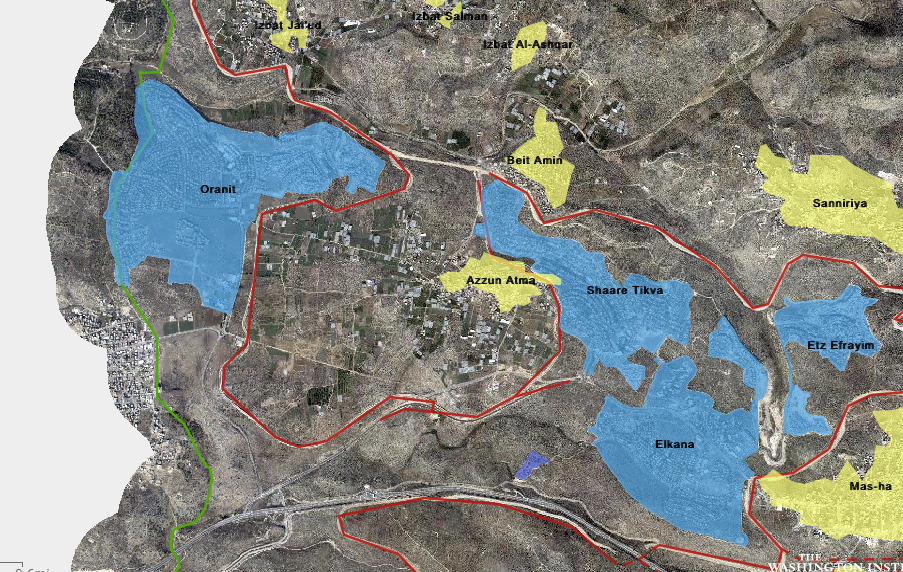
Map by WINEP
The Israeli Interior Ministry has reportedly recommended creating a new Israeli [settlement] city in the West Bank that unites four West Bank settlements – Etz Efraim, Sha’arei Tikva, Oranit and Elkana – allowing for increased construction on the land between them. The four settlements are all located in the “seam-line” zone, the area created by the weaving route of the Israeli separation barrier that was built to keep many settlements on the Israeli side of the barrier despite being east of the 1967 Green Line.
FMEP will report more details on this story as it develops.
Ir Amim & Bimkom Report – “Deliberately Planned: A Policy to Thwart Planning in the Palestinian Neighborhoods of Jerusalem”
A new report by Ir Amim and Bimkom shines a harsh spotlight on the discriminatory urban planning process in East Jerusalem, as well as the increasing rate of home demolitions that, coupled with settlement expansion, are undermining the future of the Palestinian community there. In three case studies, the report’s authors look at how Israel deliberately blocks applications for planning and building in Palestinian neighborhoods in East Jerusalem, making it impossible for Palestinians to build legally.
Ir Amim & Bimkom write
This discrimination in planning is the product of a policy driven by demographic considerations – in particular, the objective of increasing the Israeli population while reducing the Palestinian population, with the underlying goal of ensuring Jewish demographic superiority….
The outcome of this policy has a devastating impact at both the individual and community levels. Barriers to legal building push many Palestinians to build without permits. Each year, the Jerusalem Municipality (herein, Municipality) and the District Planning Bureau (formerly under the auspices of the Interior Ministry and now the Finance Ministry), demolish dozens of housing units constructed without permits in the Palestinian neighborhoods of East Jerusalem; in 2016 alone, the authorities demolished 123 housing units. The psychological and economic ramifications of this reality are profound. Moreover, inadequate planning prevents the construction of schools and the development of public spaces and employment and commercial zones, thereby weakening the community as a whole.
This treatment is clearly discriminatory, particularly when contrasted with the fact that the Israeli government continues to approve and fast-track approvals both for settlement planning in construction in major settlement neighborhoods of East Jerusalem and in settlement enclaves located in the heart of Palestinian neighborhoods. For details see this recent report from Peace Now.
UPDATES: Bedouin Communities Fight Eviction; Jerusalem “Supermajority” Bill Advances
- Over 100 Palestinians joined residents of Jabal al-Baba to protest the Bedouin community’s imminent eviction from the E-1 settlement area just east of Jerusalem. The Jabal al-Baba community, which has lived in the area since it was expelled from the Negev in 1948, was given an eviction notice earlier this month demanding that it leave the area and stating that all structures there will be demolished. Jabal al-Baba is one of the many Bedouin communities located near Israeli settlements in Area C that are facing the imminent threat of eviction; the Khan al-Ahmar community (also located in the Maale Adumim/E-1 area) and two Jordan Valley bedouin villages have also been ordered to leave their land. The European Union has called on Israel to halt the planned demolitions. The EU statement also highlighted the impending demolition of Susiya, a Palestinian city in the South Hebron Hills. Both Susiya and Khan al-Ahmar were the subject of concern of a recent letter to Prime Minister Netanyahu, signed by 10 U.S. Senators, demanding the demolitions be canceled and articulating serious concerns about the settlement enterprise, saying, “these communities are currently facing the imminent threat of evacuations and demolitions, and have been targeted by settlement movement activists seeking to entrench the Israeli occupation and prevent the ultimate creation of an independent Palestinian state.”
- The Knesset’s Constitution, Law & Justice Committee voted to advance a bill that, if passed into law, will require a supermajority of votes in the Knesset to approve any deal that transfers sovereignty of any part of Jerusalem to a foreign power. This law would in effect give a minority in the Knesset veto power over any future peace deal with the Palestinians. The bill is now set for two final votes in the Knesset before becoming law. Ir Amim provides valuable analysis of the bill, and points out that the language is careful to differentiate between territorial concessions and municipal changes, a distinction that is apparently intended to support other pending legislation that would bureaucratically excise some Palestinian neighborhoods from Jerusalem – a move that the Knesset is also considering in order to manufacture and preserve a Jewish majority in the city.
Bonus Reads
- “UN Settlement Business Data Can Stem Abuse” (Human Rights Watch)
- “Border Homes, in Jerusalem but Not, Face an Existential Deadline” (New York Times)
- “Why Won’t Israel Let Me Mourn My Father?” (New York Times)
- “US Ambassador David Friedman Drops Out of West Bank Memorial Ceremony for Murdered US Citizen” (Jerusalem Post)
__
FMEP has long been a trusted resource on settlement-related issues, reflecting both the excellent work of our grantees on the ground and our own in-house expertise. FMEP’s focus on settlements derives from our commitment to achieving lasting Israeli-Palestinian peace, and our recognition of the fact that Israeli settlements – established for the explicit purpose of dispossessing Palestinians in the West Bank and East Jerusalem of land and resources, and depriving them of the very possibility of self-determination in their own state with borders based on the 1967 lines – are antithetical to that goal.