Welcome to FMEP’s Weekly Settlement Report, covering everything you need to know about Israeli settlement activity this week.
To receive this report via email, please click here.
August 2, 2018
- Israel Launches New Settlement “Heritage Center” in Silwan
- University Heads Challenge Approval of the Ariel Settlement Medical School
- Liberman Promises 400 Settlement Units in Response to Terror
- The Not-So-New Trump Policy on Settlement Travel
- Just Released: 2018 Settlement Map from Peace Now
- Bonus Read
Comments, questions, or suggestions? Email Kristin McCarthy at kmccarthy@fmep.org.
Israel Launches New Settlement “Heritage Center” in Silwan
On August 1st, senior Israeli government officials were on hand to celebrate the beginning of construction on a new settlement complex, under the guise of a cultural center, located in the heart of the Batan al-Hawa section of the Silwan neighborhood in East Jerusalem. The event was heavily guarded by Israeli forces, in an open acknowledgement of the provocative nature of the settler campaign targeting Palestinian homes in Batan al-Hawa, which is located near the walls of the Old City in view of the Temple Mount/Al Aqsa Mosque.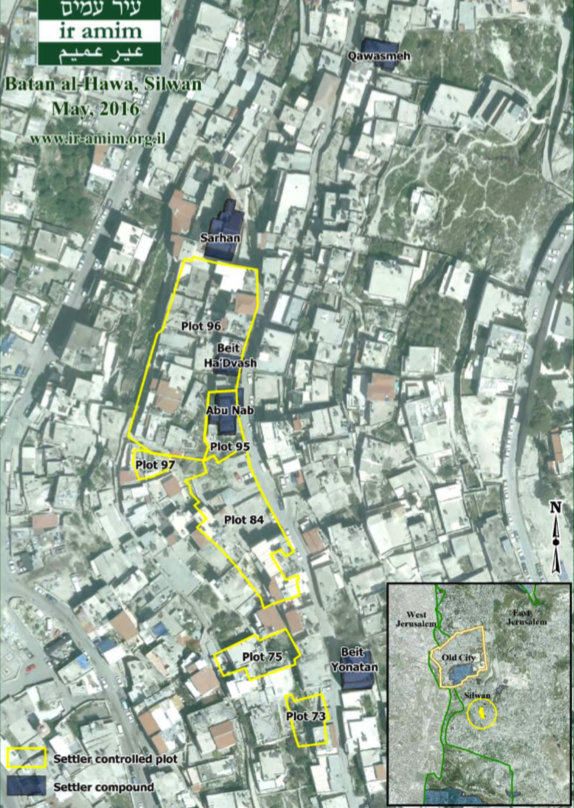
The new settlement initiative is part of a campaign by the Ateret Cohanim settler organization (which works to establish Jewish enclaves inside densely populated Palestinian neighborhoods of East Jerusalem) to exploit the area’s historical connection to Jewish immigrants as a pretext for taking land and establishing Jewish-Israeli control over the area. Israel’s Ministry of Jerusalem Affairs and Ministry of Culture and Sport are contributing an estimated $1.23 million USD to the cost of renovating an old Yemenite synagogue into a settler-run Jewish Yemeni heritage center — in a example of how the government is directly funding extremist settler activity in an area that Ir Amim identifies as “the site of the most substantial settler takeover campaign in Jerusalem since the annexation of East Jerusalem in 1967.”
Attendees at the launch included Cultural Affairs Minister Miri Regev, Jerusalem Affairs Minister Ze’ev Elkin (who is currently campaigning to become the mayor of Jerusalem), former U.S. presidential candidate and governor (and father of the current White House spokeswoman) Mike Huckabee, and former White House Communications Director Anthony Scaramucci (the latter two have been touring Israel and praising the settlements, with Huckabee going so far as to suggest that he might want to have his own home in a settlement someday).
The launch of the project ignores an ongoing legal case before the High Court of Justice that could affect Ateret Cohanim’s ownership claim to the land and building in question. Settlers are acting on the assumption that both are legally owned by the Benvenisti Trust (a historic trust that resettled Jewish Yemenite immigrants in the area in the late 1800s). Ateret Cohanim took control of the Benvenisti Trust in 2001, and in 2002 the Israeli Custodian General transferred land in Batan al-Hawa to the Trust/Ateret Cohanim. Since then, Ateret Cohanim has accelerated its multifaceted campaign to remove Palestinians from their homes, claiming that the Palestinians are illegally squatting on sacred religious land owned by the Trust.
So far, Ateret Cohanim has acquired the deed to six Palestinian homes in Batan al-Hawa, inserting some 20 Israeli Jewish families in place of evicted Palestinian residents. The organization has eviction orders pending against an additional 21 homes, with 800 Palestinians at risk of eviction.
On June 17, 2018, just two months ago, the Israeli High Court of Justice ordered the Israeli government to provide more information regarding its decision to transfer ownership of land in Batan al-Hawa to the Benvenisti Trust/Ateret Cohanim. The Court’s order was in response to a petition filed by Palestinian residents fighting eviction from their homes, and the State’s admission during oral arguments on June 10, 2018 that the land had been transferred to the Benvenisti Trust/Ateret Cohanim without a proper investigation into its legal status. The petitioners argue that the State’s decision to transfer the land was illegal on two fronts: (1) The Benvenisti Trust never owned the land in Batan al-Hawa, but only owned the buildings – all but one of which were demolished in the 1940s; and, (2) the land was transferred without the necessary legal notification to the residents living there.
Yakoub al-Rajabi, a Palestinian resident of Batan al-Hawa, told The Washington Post:
“We know that this was a well-orchestrated plan to force us to leave. And if we stay, it will paralyze us and isolate us in our homes.”
In a 2016 report that covers the Batan al-Hawa situation in detail, Ir Amim and Peace Now underscore the significance of Ateret Cohanim’s efforts, of which the new cultural center would be the crowning jewel:
“If the settlers are successful, Batan al-Hawa is anticipated to become the largest settlement compound in a Palestinian neighborhood in the Historic Basin of the Old City, with the outcome of significantly tightening the emerging ring of settlements around the Old City and severely undermining the possibility of a future two state solution in Jerusalem.”
Ateret Cohanim director Daniel Luria said:
“Every acquisition is very difficult. We’re up against a mobilized Arab world, parts of which are violent. There is huge pressure and millions of dollars are being pumped in to strengthen the Arab hold on the city…[the] biggest problem is trying to get the Jewish world to understand what needs to be done. We have the best relations ever with a US administration. For [US Vice President Mike] Pence and [US Ambassador to Israel David] Friedman and the others, [settling Jews in East Jerusalem] is a no-brainer. What’s our right-wing government waiting for? It’s not about what the US says. It’s about what we do. We are not doing anything to stop the peace process but will not compromise on a millimeter of Jerusalem. You have to show strength of conviction and sovereignty to have peace and coexistence. This can only happen when you live together under Jewish sovereignty.”
Cultural Minister Miri Regev said at the event:
“Look around. We are surrounded by Jewish heritage. The archaeologists won’t find a single Palestinian coin here! We have come home.”
University Heads Challenge Approval of the Ariel Settlement Medical School
The Israeli Committee of University Heads wrote a letter to the Higher Education Council demanding that it reconsider the approval granted to the new medical school in the Ariel settlement, which is already under construction. In a letter addressed to the Chairman of the Planning and Budgeting Committee of the Higher Education Council, Israeli university heads expressed concern that the decision to approve the medical school was tainted by political interference, and was carried out by an “expedited and improper” procedure. A source told Haaretz that the University Heads share a concern “that the Planning and Budgeting Committee [of the Higher Education Council] will be turned into a rubber stamp for [Education Minister Naftali] Bennett.” The signers call on the Planning and Budgeting Committee to hold new hearings on the settlement school to reconsider the data and merits of the proposal.
The letter comes on the heels of claims made publicly last week by three members of the Planning and Budgeting Committee that Education Minister Naftali Bennett interfered in the committee’s work, in order to expedite the approval of the medical school despite the fact that information about the project was missing.
As FMEP has repeatedly covered, the Ariel medical school is part of a government-backed agenda of exploiting academia to normalize and de facto annex settlements. Earlier this year, a part of this effort, the Israeli Knesset passed a law that extends the jurisdiction of the Israeli Council on Higher Education over universities in the settlements (beyond Israel’s self-declared and internationally recognized sovereign borders). This move ensures that the Ariel settlement medical school (and its graduates) are entitled to all the same rights, privileges, and certifications as schools and students in sovereign Israel. The Ariel settlement medical school enjoys the financial backing of American casino magnate, settlement benefactor, and close friend of President Trump Sheldon Adelson.
Liberman Promises 400 Settlement Units in Response to Terror
Defense Minister Avigdor Liberman promised to advance plans for 400 units in the Adam settlement in response to a Palestinian knife attack in the settlement that resulted in the death of one settler and injury to two others. In a tweet, Liberman claimed: “The best answer to terrorism is the expansion of settlements,” continuing, “That’s why I left this morning to promote a plan to build 400 housing units in Adam and approve it in planning institutions in the coming weeks.”
The Times of Israel notes that Liberman’s promise for 400 units is not a new plan but part of an existing plan – for a total of 1,000 units – already being advanced. Liberman’s promise is better understood as a signal to the High Planning Council to expedite the approval of the plan that is already in motion.
The Not-So-New Trump Policy on Visiting Settlements
The Palestinian Authority issued a sharp criticism this week of U.S. Ambassador David Friedman – and U.S. policy – after Friedman traveled to the Adam settlement to pay a condolence call on the widow of a settler murdered in a terror attack. Although Friedman is not the first U.S. Ambassador to visit an Israeli settlement, Friedman has made a habit of it (see here, here, and here for example), leading some observers to point out the self-evident fact that the Trump administration has – without making an official announcement – adopted a concrete change in U.S. policy regarding settlements, and is now not only refraining from criticizing settlement expansion, but is actively engaged in actions that legitimize settlements.
This week the Palestinian Authority said in a statement that the Trump administration and its “religious Zionist staff” were:
“continuing to make a mockery of international law in a bid to impose their positions and policies, which are blindly biased in favor of the Israeli occupation, on the international community with unprecedented arrogance.”
In a rare moment of agreement, settler leaders articulated a similar view of regarding this shift in the Trump Administration’s settlement policy, with the Binyamin Regional Council issuing a statement after Friedman’s visit saying:
“It seems as if we are talking about a change in US policy with respect to the Jewish communities of Judea and Samaria…they are being treated just like the rest of the country.”
Hananel Durani, head of the powerful Yesha Council which advances the interests of the settlements, said:
“I hope the US government will continue to support Israel and the settlements with the same kind of courageous friendship the ambassador demonstrated today.”
Settler leader Oded Revivi, who is head of the Efrat settlement council and foreign envoy for the Yesha Council, commented:
“I want to express my appreciation to Ambassador Friedman who saw fit to visit the settlement of Adam in Binyamin and comfort the bereaved family. This sends an important message to the world regarding strengthening the positive forces and combating the negative forces in the region.”
Just Released: 2018 Settlement Map from Peace Now
Peace Now recently released two 2018 settlement maps, one map the entire West Bank and a second detail map of East Jerusalem. Both are must-have resources for anyone tracking anything related to settlements and the factors that must be addressed in a negotiated solution to the conflict.
Bonus Reads
- “Once Again, Israel Denies the Bedouin What it Grants the Settlers” (Haaretz)
- “Israeli protesters seek return to destroyed West Bank settlements” (Al-Monitor)
- “A rotten system, not rotten apples” (+972 Mag)
- “More than 2,000 trees in West Bank Palestinian Villages Destroyed in Two Months” (Haaretz)
Welcome to FMEP’s Weekly Settlement Report, covering everything you need to know about Israeli settlement activity this week.
To receive this report via email, please click here.
July 19, 2018
- It’s the Settlements, Stupid: Documents Reveal Israel Planned Khan al-Ahmar Bedouin Removal for 40+ Years
- New Law Puts West Bank Legal Matters under Domestic Israeli Jurisdiction
- Since 1967, Israel Gave 99.76% of “State Land” in the West Bank to Settlers (But Blames Palestinians)
- Birthright & the Settlers
- Jordan Valley Settlement Council Confirms Participation in (Illegal) Outpost Activity, Refuses to Release Any Details
- Huge Expansion Approved for Pisgat Ze’ev; Jerusalem Expert: this is “Natural Response” to Trump’s Jerusalem Policy
- Bonus Reads
Comments, questions, or suggestions? Email Kristin McCarthy at kmccarthy@fmep.org.
It’s the Settlements, Stupid: Documents Reveal Israel Planned Khan al-Ahmar Bedouin Removal for 40+ Years
A recently discovered document from the 1970s confirms that the removal of Bedouin communities from the Maale Adumim/E-1 area east of Jerusalem (like Khan al-Ahmar) has been planned for decades and is directly connected to plans to expand Israeli settlements and annex West Bank territory.
The document, entitled “A proposal to plan the Ma’aleh Adumim region and establish the community settlement of Ma’aleh Adumim B,” was written by settler activist Uri Ariel (who is currently serving as Israel’s Agricultural Minister). It lays out a plan to create a “Jewish corridor” of settlements connecting the coast to the Jordan River, recommending that Bedouin be evacuated from the area east of Jerusalem in order to build a new settlement: “Maale Adumim B.”
Haaretz reports that “a large part of the plan has been executed, except for the eviction of all the area’s Bedouin,” adding “Today, under a government in which [Agricultural Minister Uri] Ariel’s Habayit Hayehudi party is so powerful, the open expulsion of Bedouin is possible.”
Jerusalem expert Danny Seidemann adds:
“the story of Khan Al-Ahmar is not only about the tragedy for the village and its inhabitants, or about Israel’s readiness to carry out an ostensible war crime in the face of the world. It is also about Israel’s determination to clear the entire area of the West Bank east of Jerusalem, and located within the line of the built and planned barrier, of any Palestinian presence. This clearing will prepare the ground for the future construction of E1 and de facto annexation of this so-called bloc, which extends well beyond the built-up area of Maale Adumim.”
New Law Puts West Bank Legal Matters under Domestic Israeli Jurisdiction
On July 16th, the Knesset voted 56-48 to pass a law that, in effect, further extends Israeli sovereignty into the West Bank, suspends even the pretense that Israel’s justice system is interested in protecting the rights of Palestinians living under occupation, and strengthens the hand of settlers and their supporters.
Specifically, since 1967, the court of first jurisdiction for cases related to Palestinians living in the West Bank — where Palestinians can legally challenge State actions (and inactions) regarding planning and construction, travel permits, freedom of information, and freedom of movement — has been the Israeli High Court of Justice, reflecting the extraordinariness of Israeli judges issuing, in effect, extra-territorial legal rulings.
The new law strips Palestinians of this direct avenue to the High Court of Justice. It compels Palestinians living in the West Bank to file petitions with the Jerusalem District Court (located within Israel’s sovereign borders). The High Court of Justice will only hear Palestinians’ cases on appeal from the district court, adding more time and higher costs to any potential appellant. The bill has been championed by Justice Minister Ayelet Shaked (Jewish Home), whose three-fold rationale for the bill explicitly states its purpose: to help settlers take more Palestinian land and shut-down Palestinian challenges to such thefts.
Shaked celebrated the passage of the bill, saying:
“The High Court petition party of Palestinians and extreme left organization against the settlements in Judea and Samaria is over today. From now on they will have to go through the judicial hurdle like any other Israeli citizen [note: Palestinians living in the West Bank are not Israeli citizens and as such do not enjoy the same rights or privileges as settlers in an Israeli court].”
Reiterating her call for annexation of the settlements, Shaked added that:
“Hebron, Ra’anana, Elon Moreh and Kiryat Arba [all but Ra’anana being places located deep inside the West Bank] are all inseparable parts of the Land of Israel.”
With the passage of the bill, the Israeli Knesset has further revealed – with startling honesty – its intention to treat the occupied territories as if they are sovereign Israeli territory. The bill is part of the legislative body’s broader effort to erase all remaining distinctions (legal, judicial, economic, and otherwise) between sovereign Israel and the occupied territories, distinctions which allowed Israel to preserve the guise of respect for rule of law, and good intentions, for the last 50 years. Lara Friedman points out:
“…this [the passage of the new law] is good news, further removing the pretense that Israel’s justice system protects Palestinian rights. For 50yrs the High Court’s rulings have at BEST dealt Palestinians pyrrhic victories that have systemically legitimized occupation & rule by law.”
FMEP tracks the application of domestic Israeli law over the occupied West Bank (the de facto annexation of the West Bank) on its Annexation Policy Tables, which are regularly updated.
Since 1967, Israel Gave 99.76% of “State Land” in the West Bank to Settlers (But Blames Palestinians)
On July 17, Israel’s Peace Now published a new report (covered in the New York Times) showing that Israel has allocated 99.76% of “State Land” in the West Bank to Israeli settlers, and just .24% to the local Palestinian population living under Israeli occupation. Israel has declared a total of 16% of land in the West Bank – including nearly half of all land in Area C – as “state land,” a method of land confiscation Israel has exploited to take control of West Bank land. This works out to around 260 square miles (674,459 dunams) of West Bank land granted to the settlers, and less than 1 square mile (1625 dunams) granted to the Palestinians.
Adding insult to injury, the 1 square mile of land granted for Palestinians was mostly for the purpose of establishing Israeli settlements and for the forced transfer of Bedouin communities off other land coveted by Israel (as in the case of Khan al-Ahmar).
The data upon which the report is based was furnished to Peace Now and the Movement for Freedom of Information in response to a two-year old freedom of information request to the Israeli Civil Administration (which is the sovereign governing power over the West Bank and is obligated under international law to protect the rights of the occupied people). In its response to the request, the Civil Administration suggested that Palestinians are to blame for the stark inequality, since they have refrained from applying to use the land. A statement from the Civil Administration reads:
“Applications for the allocation of state land are routinely submitted by all the population, both Palestinian and Israeli. It should be emphasized that the number of requests submitted by Palestinian residents is generally very low.”
With this argument, the Civil Administration has constructed a classic “damned if they do, damned if they don’t” argument. If Palestinians apply to use the land, they would legitimize Israel’s authority to declare West Bank land “State Land” in the first place as well as Israel’s authority to grant or deny its use, whether to Palestinians or settlers. If Palestinians don’t apply, they are blamed for Israel’s decisions on allocating virtually all of the land to settlers. This argument also ignores the fact that the the pattern of allocation of “State Land” revealed in this report is not an exception to, but an illustration of, the rules according to which the Civil Administration has run the West Bank for the past 51 years – rules that overwhelmingly favor the settlers over the Palestinians, most blatantly when it comes to land and construction.
More fundamentally, setting aside the question of whether Israel has abused its authority in declaring so much of the West Bank to be “State Land,” the Civil Administration’s response completely ignores the fact that Israel has a legal responsibility under international law regarding stewardship of “state land” held under its occupation. As the Association for Civil Rights in Israel explains:
“Israel holds state land in an occupied territory as a trustee, and must do everything possible to preserve and develop it for the benefit of the local Palestinian population. The very use of state land for the purpose of building settlements and/or developing infrastructure and industrial zones not in favor of the Palestinian population constitutes a violation of international law. ”
The New York Times observes, correctly:
“The lopsided allocation is hardly surprising. Israeli legal experts say the whole point of seeking out state lands, the bulk of which were designated in the 1980s, was to aid the growing settlement enterprise, which most of the world considers a violation of international law. But the paucity of land allocated to the Palestinians shows the extent of competition over territory, and the effort Israel puts toward building the settlements.”
Peace Now said:
“The significance of the data is that the State of Israel, which has been in control of the West Bank for more than 50 years, allocates the land exclusively to Israelis, while allocating virtually no land for the unqualified benefit of the Palestinian population. Land is one of the most important public resources. Allocation of land for the use of only one population at the expense of another is one of the defining characteristics of apartheid. This is further proof that Israel’s continued control of the occupied territories over millions of Palestinian residents without rights and the establishment of hundreds of settlements on hundreds of thousands of dunams has no moral basis.”
The Peace Now report shines a harsh spotlight on a key facet of Israel’s decades long effort to confiscate land and transfer it to the settlers, particularly in Area C, and it comes at a time when Israeli lawmakers are loudly and clearly calling for the unilateral annexation of Area C – all of which FMEP documents in its Annexation Policy Tables.
Birthright & the Settlers
Adding to the swirling coverage of participants leaving Birthright trips to learn about Palestinians and realities in the West Bank and East Jerusalem, Birthright (an organization which organizes free trips to Israel for young Jews around the world) has come under the spotlight this week for two settlement-related reasons: the harassment of Birthright participants who left the trip to tour Hebron, and Birthright’s partnership with the radical settler group Elad.
First, cameras caught settlers harassing a group of Birthright participants who left the trip to tour Hebron with Breaking the Silence. The tour guide, a former IDF soldier, was attacked by the settlers. Breaking the Silence regularly takes groups to Hebron to observe the apartheid-like reality that exists there, “sterile streets” (an Israeli military term for streets which Palestinians are forbidden to access) and all. Part of that reality is daily settler violence, as Breaking the Silence explains:
“Near daily occurrences of abuse of the Palestinian population by settlers, including humiliation and physical attacks, are part and parcel of the lives of those Palestinians who still live in H2. Even worse, twisted norms of law enforcement in which two different populations are subject to two different sets of laws – one military and one civilian – creates a situation of selective law enforcement at best, and complete lack of law enforcement over the residents of the Jewish settlement at worst.”
Second, Birthright’s partnership with the radical Elad settler organization was exposed when a second group of youth left a Birthright trip during a tour of Silwan (aka the City of David) with Elad, which manages the City of David National Park (which was declared on Silwan land). Elad is engaged in a range of activities to enact their extremist political agenda, at the expense of Palestinians. The group left the Birthright tour to join a Peace Now visit with the Palestinian Sumreen family, who are under threat of eviction from their Silwan home because of the actions of the Elad and the JNF. Birthright responded by accusing the participants who left the trip of seeking to advance a “political agenda,” and defending itself as an “apolitical” organization. Birthright’s response is especially ironic given Birthright’s own choice to ally itself with Elad — an organization that explicitly exists to promote an extremist political and ideological agenda (for further irony, see this proud announcement by a former Birthright participant noting that it was her experience with Birthright that inspired her to become a settler).
Peace Now later said in an email:
“Peace Now has no fight with Birthright. What we oppose are government (or any other) efforts to insert political programming into trips like Birthright’s that intentionally conceal the occupation, such as Elad tours. Elad’s far-right, one-state agenda is well-known, and it is involved in the legal acrobatics underway to evict Palestinian families from their homes.”
Jordan Valley Settlement Council Confirms Participation in (Illegal) Outpost Activity, Refuses to Release Any Details
The Jordan Valley Settlement Council, which represents the majority of Israeli settlements located in the West Bank section of the Jordan Valley, has admitted that it supports illegal outposts in the area, but declined to provide information on its activities. The admission came in response to a freedom of information request made by an Israeli lawyer representing the anti-occupation group Machsom Watch and the coexistence group Combatants for Peace.
In the written refusal to divulge information about the Jordan Valley Settlement Council’s involvement with outposts, staff member Oshra Yihye said that its refusal is based on the fact that the parties requesting the information are critical of settlers living in the Council’s jurisdiction. Yihye also claimed that revealing the information will interfere with Council’s operations. Some Jordan Valley settlers are known to violently attack Palestinian farmers and their property, and settlers have been repeatedly caught on video attacking Israeli activists trying to assist the Palestinians.
Israel has effectively annexed 85% of land in the Jordan Valley, through ongoing settlement building and the declaration of “closed military zones” on vast swaths of farmland. A recent report by B’Tselem documents how Israeli settlers were allowed to establish two new outposts in the Jordan Valley last year. In recent months, Israel has delivered eviction notices to entire Palestinian communities near Israeli settlements in the Jordan Valley. Simultaneously, settlers have been allowed to continue construction on a tourist project – a car race track built in a closed military zone (land expropriated from Palestinians ostensibly for security purposes), despite a court ordered stop-work order.
Huge Expansion Approved for Pisgat Ze’ev; Jerusalem Expert: this is “Natural Response” to Trump’s Jerusalem Policy
On July 2nd, the Israeli Housing Ministry deposited for public review plans for 1,064 units in the Pisgat Ze’ev settlement in East Jerusalem. Jerusalem expert and founder of Terrestrial Jerusalem, Danny Seidemann, recently punctuated the significance of the move, explaining:
“Politically speaking, this approval signals a clear statement by Israeli authorities. These plans received initial approval from the Planning Board in July 2017, as [Terrestrial Jerusalem] reported in detailed here. While the approval of these plans at this time, after a year’s delay, is indeed in large part the normal course of events in the bureaucratic decision, the publication could not have taken place without the advance knowledge and blessing of Netanyahu. As such, this is yet another component in Netanyahu’s systematic effort to tighten Israel’s grip on East Jerusalem, his natural response to Jerusalem having been ‘taken off the table’ by President Trump.”
While pointing out that the Pisgat Ze’ev plans are the first East Jerusalem settlement plans to be deposited for public review this year, Seidemann says:
“This should by no means lead to the conclusion that until now there has been a de facto settlement freeze in East Jerusalem. Before the Pisgat Ze’ev approvals, other settlement activities were proceeding apace, including ground being broken for the expansion East Talpiyot and deliberations on a major new plan in Southeastern Gilo (Master Plan 125195).”
For more analysis from Terrestrial Jerusalem on the Pisgat Ze’ev plans, see here.
Bonus Reads
- “How a West Bank Highway’s Road Sign Captures the Israeli Psyche” (Haaretz)
- “Bulldozers In The West Bank: How recent Israeli Settlement Expansion Jeopardizes the Peace Process” (Forbes)
- “Israel Accelerates ‘Greater Jerusalem’ Plan” (Ahram Online)
Welcome to FMEP’s Weekly Settlement Report, covering everything you need to know about Israeli settlement activity this week.
To receive this report via email, please click here.
July 12, 2018
- Continuing New Legal Strategy, Israel Argues “Market Regulation” Principle In Bid to Legalize Outpost
- Cabinet to Consider New Bill to Legalize 70 Outposts
- Cabinet to Consider Three Bills that Advance Annexation of Area C Settlements
- New Proof that the Israeli Government is Driving Unauthorized Settlement Activity
- High Court Freezes Plan for Settlement Committee in Hebron; IDF Seizes Private Land Near Kiryat Arba
- High Court Allows the Israel Land Authority to Remain Under the Influence of the Jewish National Fund
- New Bill Would Allow Settlers to Build on National Park Grounds in East Jerusalem
- Civil Administration Strike Will Delay Settlement Construction
- Amichai Settlement’s Makeshift Sewage Pit is Contaminating Nearby Palestinian Fields
- Israeli President Cautions Against Shaked’s Bill to Politicize Key Legal Appointments
- United Nations Envoy: Israel is Moving Towards Formal Annexation
- Bonus Reads
Comments, questions, or suggestions? Email Kristin McCarthy at kmccarthy@fmep.org.
Continuing New Legal Strategy, Israel Argues “Market Regulation” Principle In Bid to Legalize Outpost
On July 3rd the Israeli State Prosecutor’s Office told the Jerusalem District Court that it has the right to retroactively legalize the Mitzpe Kramim outpost based on the “market regulation” principle. This is the recently-invented legal principle according to which the government can seize privately owned Palestinian land to give to settlers if settlers can demonstrate (to the satisfaction of an Israeli government that is doing everything possible to help them) that they built on the land “in good faith,” based on government assurances, and if the rightful landowners are offered compensation. This is just the second time the government has used the “market regulation” principle to defend the seizure of privately owned Palestinian land in court, the first being in November 2017 when the State informed the High Court of Justice that it intended to expropriate private land near the Ofra settlement. Neither court ruled on either case.

Map by Haaretz
The government’s deployment of the “market regulation” principle in the Mitzpe Kramim case completely reverses the position the government has taken for the last 7 years on this specific outpost case. Since 2011, the Israeli government admitted that the land was privately owned, that it had been mistakenly given to the World Zionist Organization in the 1980s (the Mitzpe Kramim outpost was built without Israeli authorization in 1999), and that the situation should be corrected. In its argument on July 3, 2018, the government is expressing its newfound power to seize the land, asserting that the settlers built there “in good faith” and should not be punished for the government’s mistake, under the powers of the “market regulation.”
Peace Now said:
“The state’s announcement to the District Court is a new low in the moral and political deterioration led by the Netanyahu government. As the body that has assumed responsibility for the Occupied Territories for the last 51 years, the state should have protected the property rights of Palestinians, who have no civil rights nor the ability to defend their own land. The fact that the state failed to protect their land cannot be an excuse to steal the land and grant it to the settlers.”
As Peace Now also notes, in order to satisfy the 1967 Government Property Order (which is the law underlying the “market regulation” principle) all of the land owners must be invited to participate in the court case. However, the settlers who filed the petition regarding Mitzpe Kramim failed to include all of the registered land owners, meaning there is a long course of legal action ahead before the case. Should the Court decide the case in the settlers’ favor, it would set a potentially far-reaching precedent for implementing and upholding the “market regulation” principle.
Israeli Attorney General Avichai Mandelblit originally argued for the “market regulation” principle in late 2016 as an alternative legal basis to the Regulation Law, which he believes to be “a sweeping and injurious arrangement that does not meet the test of proportionality.” That law, passed by the Knesset in February 2017, is now in serious legal jeopardy. While the Israeli government continues to staunchly defend the broader legal basis for expropriating privately owned Palestinian land established under the “Regulation law,” its increased use of the “market regulation” principle makes clear that come what may, the Israeli government has the intention to do whatever it takes to “legally” seize Palestinian private land in order to legalize outposts (offering a stark illustration of the difference between “rule of law” and “rule by law.”)
For extensive reporting on and analysis of the “market regulation” principle and the “Regulation Law,” see FMEP’s tables documenting Israeli annexation policies.
Cabinet to Consider New Bill to Legalize 70 Outposts
MKs Bezalel Smotrich (Habayit Hayehudi) and Yoav Kisch (Likud) have submitted a bill for consideration by the Israeli Cabinet that seeks to retroactively legalize 70 unauthorized outposts across the West Bank. The Ministerial Committee for Legislation (a group of Cabinet members that decides whether or not to lend government backing to Knesset legislation before it is introduced) could vote on the July 15th, during its last weekly meeting before the Knesset recesses for its summer break. According to a Defense Ministry spokesperson, 50 of the 70 outposts can become part of existing official settlements — meaning that if passed into law, the bill would (a) significantly expand the borders/footprint of some 50 existing settlements (to include the outposts and land separately the outposts from the new parent settlement), and (b) create as many as 20 new settlements.
In addition, the bill would direct the government to treat the 70 unauthorized outposts as if they were legal settlements, which would include providing municipal services like water and electricity infrastructure at the expense of the relevant regional council (funded by Israeli tax-payers). The bill would also stop the potential of enforcement of the government’s own laws against the specified 70 outposts (reminder: the Israeli government rarely enforces building laws against Israeli settlers, actively funds outposts despite their illegality, and continues to invent new ways to legalize them). According to the bill, enforcement of building laws against the unauthorized outposts could only happen at the direction of the Defense Minister or the Prime Minister, with the backing of the Cabinet.
FMEP has repeatedly covered news regarding the government’s efforts to legalize outposts built on privately owned Palestinian land. The passage of the settlement “Regulation Law” gave the government new, sweeping authority to legalize outposts which it had been unable to address under existing Israeli law (because of the fact that they were built on privately owned Palestinian land, in effect turning these into cases of incontestable theft of private property. The 2005 Sasson Report admitted that there was no possible way to legalize outposts built on privately owned Palestinian land, and concluded that all such outposts should be evacuated). With the new law in place permitting Israel to launder this land theft, the Cabinet created a Defense Ministry task force – and appointed veteran settler leader Pinchas Wallerstein as its head – empowered to examine the individual legal situation of each outpost and devise plans to retroactively legalize as many outposts as possible. In January 2018, a leaked recording revealed that the task force had been working for six months to prescribe courses of action for the outposts. Despite this, settlers and Knesset members have complained that the task force has done nothing and has not been funded, using these as talking points in their push for the new Smotrich bill.
Developments related to these efforts are tracked in FMEP’s annexation policy tables.
Cabinet to Consider Three Bills that Advance Annexation of Area C Settlements
In addition to the outpost legalization bill (covered above), the Israeli Ministerial Committee on Legislation is slated at its next weekly meeting on July 15th to discuss three bills that seek to advance Israeli de facto annexation of Area C, after refraining from discussing them last week. Those bills are:
- A bill to recognize settlements in the South Hebron Hills as well as the Kiryat Arba settlement (which is, in effect, part of Hebron) as part of the Negev regional economy. Economically, the change would enable these settlements to benefit from government grants and programs for the Negev; politically, and far more importantly, the change would erase the Green Line, legally treating these settlements as part of sovereign Israeli territory (the Negev is an area located inside sovereign Israel).
- A bill to change a 1953 Jordanian law in order to allow Israelis to directly purchase property in the West Bank. Under the current law, private, non-Arab individuals cannot purchase land in the West Bank. In 1971, the law was amended to add a loophole allowing companies registered to operate in the West Bank (like the World Zionist Organization and the Jewish National Fund) to purchase property, and often do so only to give it to Israeli settlers. This additional change would open the door for private purchases across the West Bank by settlers and their backers, including in the heart of Palestinian cities. Notably, Israeli security officials have in the past objected to changing this law, based on their recognition of the fact that settlers implanting themselves wherever they want in the West Bank – including in acts intended to be deliberately provocative – will be a security nightmare for the IDF and will enable settlers and their financial patrons to further hijack the national security agenda of the state of Israel.
- A bill to rescind the 2005 Disengagement Law in order to allow four settlements in the northern West Bank to be rebuilt. The settlements – Sa-Nur, Homesh, Kadim and Ganim – were evacuated following the passage of the Disengagement Law. Notably, the head of the Samaria Regional Council, Yossi Dagan, is one of the settlers that was evacuated from Sa-Nur in 2005 and has championed the bill, which was submitted for Cabinet consideration by Bezalel Smotrich (Habayit Hayehudi).
New Proof that the Israeli Government is Driving Unauthorized Settlement Activity
The Israeli State Comptroller published a report that exposes how Israel government bodies have colluded with the Binyamin Regional Council (one of the main governing bodies over West Bank settlements) to bankroll the construction and ongoing support of unauthorized outposts, even as the Israeli Civil Administration acts to try to stop the illegal construction the government is funding.
The report reads:
“The [Binyamin Regional] council has been the driving force in the construction of unauthorized communities [outposts] and has financed them…In so doing, the council has dictated a negative standard of behavior, that has allowed for illegal construction in the Judea and Samaria and has even advanced such activity…Government offices were involved in financing the planning and construction of the unauthorized outposts.”
In one of several examples of how the collusion has worked, the Comptroller explained that the Esh Kodesh outpost – which is actually located outside of the Binyamin Regional Council’s jurisdiction – was built in 2000 without government permission. In 2014, the Interior Ministry financed the renovation of roads in the outpost. Meanwhile, the Civil Administration issued demolition orders against structures in the outpost in 2003, 2012, and 2013.
Sensing opportunity to promote their new bill to retroactively authorize outposts (see above), MKs Yoav Kisch (Likud) and MK Bezalel Smotrich (Bayit Yehudi) argued that the Comptroller’s report, by proving the the state has participated in building outposts, underlines the necessity of authorizing those outposts for the sake of the settlers who moved to the outposts at the encouragement of the state.
Adding to the Comptroller’s report (and echoing several of its key points), a freedom of information act filed by Peace Now revealed that the Binyamin Regional Council has been concealing massive and illegal annual contributions to the Amana organization, which leads wide scale illegal settlement construction. Amana received NIS 37 million over three years from the Council, which is 57% of the funds doled out to non-governmental groups over that period. The Comptroller’s report criticized the Council’s support for private organizations, which violates Israeli law restricting regional councils to supporting apolitical, public groups. The report said “the council serves as a conduit for transferring funds from the state to a private association.”
Peace Now writes:
“this data now reveals the depth of this robbing of public funds to finance political campaigns and illegal activity. It is time for the Interior Ministry to put an end to this abuse of Israelis’ taxpayer money and to demand that the authorities in the West Bank cease this illegal funding and give the money back.”
High Court Freezes Plan for Settlement Committee in Hebron; IDF Seizes Private Land Near Kiryat Arba
The Israel High Court has ordered a temporary freeze on a military order creating a new, autonomous settler committee to represent and service a cluster of Israeli settlement enclaves in Hebron’s city center, a plan announced by Defense Minister Avigdor Liberman in August 2017. The military order, if allowed to be implemented, would transfer responsibility for the settlers’ municipal services (roads, sewage, electricity, etc.) from the Hebron Municipality to the new settler committee, a plan which contradicts the 1997 Hebron Protocol.
The High Court gave the Israeli government 120 days to explain the legality of the plan, which was challenged on multiple fronts by the Hebron Municipality. The petition argued that the military order was intentionally vague in defining the legal and geographical jurisdiction of the proposed settler body, and pointed out that the new committee would be able to override decisions by the Hebron Municipality thereby stripping Palestinians of autonomy and representation in matters that directly affect them.
While the Court considers the matter, events on the ground continue to underscore the volatility of the situation in Hebron. Elor Azaria, the Israeli soldier who was caught on camera executing an incapacitated Palestinian on the streets of Hebron, victoriously returned to the city on July 3rd after serving only 9 months in jail. The festivities welcoming Azaria were planned by a group that included the extremist settler and politician, Baruch Marzel. Only two days after the Azaria lovefest, Marzel pitched a two-person tent on the sidewalk next to a Palestinian home in the Tel Rumeida neighborhood in the Old City of Hebron. According to the Palestinian news outlet Ma’an, Marzel was involved in attacks on Palestinians in Tel Rumeida the same day, in an incident that resulted in the arrest of one Palestinian. Israeli police removed Marzel’s encampment from the street.
Also in Hebron, Palestinian media reports that Israeli forces have confiscated a plot of privately owned Palestinian land near the Kiryat Arba settlement and the Ibrahimi Mosque/Cave of the Patriarchs. A Hebron activist reports that the Israeli Army set up a new camp across the street from the seized land about one month ago, and is now moving the camp to the new site with the intention of declaring it a “closed military zone” to prevent Palestinians from entering the area.
High Court Allows the Israel Land Authority to Remain Under the Influence of the Jewish National Fund
The High Court of Justice dismissed a petition filed by Adalah which alleged that the Jewish National Fund’s representation on the Israel Land Authority council infringes on the rights of Palestinian to equality and dignity. Under Israeli law, 6 of the 14 members on the Land Authority council are to be appointed by the Jewish National Fund, an organization the petitioners say (with good cause) “openly discriminates against non-Jews and sees itself as an entity that serves only one population.” The Israel Land Authority is responsible for deciding how (and to whom) to allocate or sell land in Israel, including the land owned by the Jewish National Fund (13% of all land in Israel).
Following the High Court’s dismissal of the petition, the Haaretz Editorial Board wrote:
“In a properly run country, people who declare that they’re committed to acting in a discriminatory way are immediately disqualified from a public role. One can only imagine what Israelis’ response would be if in a country where Jews were a minority, half of a group’s members stated their intention to discriminate against Jews.”
New Bill Would Allow Settlers to Build on National Park Grounds in East Jerusalem
The radical settler group Elad is lobbying for a bill that will allow the group to build settlement units on the grounds of one specific national park located in the East Jerusalem neighborhood of Silwan, where Elad is engaged in a variety of activities to displace Palestinians and replace them with Israeli settlers (as FMEP has reported on extensively). On July 10th, the bill was approved by the Knesset’s Interior and Environment Committee, despite objections submitted to the committee by the Justice Ministry and the Attorney General. The bill was sent to the Knesset plenum for its first of three votes.
The bill will allow Elad to build more homes for Israeli settlers on the grounds of the City of David national park, which is located immediately south of the Temple Mount, adjacent to the southern wall of the Old City of Jerusalem. Since 2001, Elad has managed the park grounds on behalf of the Israel Nature and Parks Authority, a scheme which gives the settler group authority over (but no legal responsibility towards) thousands of Palestinian homes and hundreds of settler homes – a demographic balance Elad is working hard to flip.
Ir Amim’s researcher Aviv Tatarsky told Haaretz:
“This isn’t the first time a monkey is being made of the law and common sense to advance the agenda of the Elad settlers. But even this law can’t change the fact that Silwan, like East Jerusalem, is entirely a Palestinian city. Israeli attempts to deny that simple truth impair the basic rights of 350,000 people in East Jerusalem. The residents of the Israeli city also pay a price for it.”
For more information on the role on national parks around Jerusalem in advancing the Israeli settlement agenda in Palestinian neighborhoods, see Ir Amim’s reporting here, and a key survey and analysis of national parks in Jerusalem/East Jerusalem by Bimkom here.
Civil Administration Strike Will Delay Settlement Construction
A recently released list of Civil Administration functions that will be brought to a halt during the impending union strike includes the High Planning Council’s work to advance settlement construction plans, though a Civil Administration spokesperson said that construction can be expected to climb next quarter.
Hananel Dorani, Chairman of the Yesha Council, the umbrella group representing settlements,wrote a letter to Prime Minister Netanyahu, Defense Minister Lieberman, and Finance Minister Kahlon. Dorani, highlighting the green light from the political echelon to promote settlements, criticized the Civil Administration while pushing for a resolution:
“Especially now, at a time when political approval was given to promote construction, it’s not only commonplace that the Civil Administration doesn’t meet the task properly, but the workers’ strike will exacerbate the situation and create a bottleneck that’ll be difficult to free from for years. Civil Administration employees’ demand to add additional positions and their requests to improve salary conditions so they can fill existing positions hasn’t been answered for a long time, leading to renewed sanctions. As is well known, this is not the first time Civil Administration employees have initiated sanctions, but this hasn’t yet been dealt with…this organization is routinely substandard, and for a long time important headquarters work wasn’t promoted, plans approved by the political echelon are halted and piled up on the table in the Civil Administration, budgets earmarked for infrastructure projects (transportation, cellular, etc.) aren’t realized, no work permits are issued, and more…We ask that you get involved with all relevant parties and act immediately and personally to restore the Civil Administration to full functioning.”
Samaria Regional Council chairman Yossi Dagan complained:
“As if it is not enough that every house in Judea and Samaria (West Bank) needs four different permits from the political echelon, now the residents have also become hostages in a conflict between Civil Administration employees and the Finance Ministry.”
The Civil Administration will also suspend the following operations: the flow of commercial goods between the West Bank (both settlements and Palestinian areas) and sovereign Israel; changes to the land and population registries, issuance of import licenses and business permits; and, significantly, all actions – including demolitions – against illegal construction, which might delay the demolition of the Khan al-Ahmar bedouin community.
Amichai Settlement’s Makeshift Sewage Pit is Contaminating Nearby Palestinian Fields
Raw sewage from the Amichai settlement (the first new government-backed settlement in 20 years, established in the Shiloh Valley as pay-off to the evacuees of the illegal Amona outpost) has been flowing into the agricultural lands of the nearby Palestinian village Turmus Ayya.
The settlers dug a temporary sewage site (a pit in the ground that is now overflowing) only a few meters from Palestinian farm lands. Settlers have been living in mobile homes on the site of the settlement (which has not been built yet) for less than four months, and Palestinians say the the sewage began overflowing two months ago. A permanent sewage site for the settlement has not yet been built, in part because the settlement plans were approved at a “dizzying speed,” as Haaretz explains it.
Israeli President Cautions Against Shaked’s Bill to Politicize Key Legal Appointments
At a swearing in ceremony for new judges, Israeli President Reuven Rivlin took the opportunity to pointedly criticize a bill promoted by Justice Minister Ayelet Shaked which would, by design, politicize the appointment of ministerial legal advisors (a bill FMEP reported on here).
Rivlin said:
“we need independent legal advisors whose commitment to the law and being gatekeepers flows in their veins and constitutes the essence of their professional ethic. I understand elected officials. I too served in one or two roles before I reached this house, and I didn’t always agree with the legal advisor’s position. However, I believe we must be careful not to weaken one of the important pillars of the executive branch in Israeli democracy. We all want a legal advisor who’ll serve all elected officials from anywhere in the political spectrum in exactly the same way. Faithfully, devotedly, professionally, committed to government policy and primarily responsibility to uphold the law.”
United Nations Envoy: Israel is Moving Towards Formal Annexation
Ahead of the United Nations Human Rights Council’s meeting on the Israeli-Palestinian conflict, legal expert Michael Lynk told press that:
“After years of creeping Israeli de facto annexation of the large swathes of the West Bank through settlement expansion, the creation of closed military zones and other measures, Israel appears to be getting closer to enacting legislation that will formally annex parts of the West Bank. This would amount to a profound violation of international law, and the impact of ongoing settlement expansion on human rights must not be ignored.”
The statement was later posted on the Human Rights Council’s website.
Bonus Reads
- “US administration silent on Israel’s occupation policy” (Al Monitor)
- “A Tango of Violence: Building Outposts on Palestinian Land” (Haaretz)
- “The Maps of Israeli Settlements that Shocked Barack Obama” (The New Yorker)
- “Israel slams ‘immoral’ Irish bill banning trade with settlements” (Times of Israel)
- “The demolition of Khan al-Ahmar is more than just a war crime” (+972 Mag)
Welcome to FMEP’s Weekly Settlement Report, covering everything you need to know about Israeli settlement activity this week.
To receive this report via email, please click here.
June 8, 2018
- Government to High Court: The “Regulation Law” Has Flaws, But Striking it Down Would ‘Undermine the Knesset’s Sovereignty’
- Attorney General to High Court: “Regulation Law” Should Be Overturned, But Not Because of International Law
- Petitioners to High Court: Settlement “Regulation Law” Violates International Law, Must Be Struck Down
- Knesset Pushes De Facto Annexation with New Tax Legislation
- Settlers Plan Protest Against Netiv Ha’avot Outpost Demolitions
- Defense Ministry Reassures Knesset About Plan Stop “Palestinian Takeover” of Area C
- Wild Wild West: Government Funded Horse Farms Built Illegally on Palestinian Land
- Bonus Reads
Comments, questions, or suggestions? Email Kristin McCarthy at kmccarthy@fmep.org.
Government to High Court: The “Regulation Law” Has Flaws, But Striking it Down Would ‘Undermine the Knesset’s Sovereignty’
The Israeli High Court of Justice heard oral arguments on the settlement “Regulation Law” on Sunday, June 3rd. The law was passed by the Knesset in February 2017 to provide an avenue for the Israeli government to seize privately owned Palestinian land for settlements and outposts. For a more detailed explanation and chronological documentation of the “Regulation Law” and the events related to it, see FMEP’s tables tracking annexation policies here.
The Israeli government was represented by private attorney Harel Arnon, and the Israeli Knesset was represented by attorney Eyal Yinon. Though arguing separately, Arnon and Yinon made some of the same flabbergasting arguments in defense of the extraordinary concept that Israel can and must legislate laws for the occupied territories, outside of Israel’s sovereign borders, and that in doing so it has the right, and even the necessity, to trample the basic concept of the sanctity of private property ownership. Their defense, which reads like a laundry list of the classic logic fallacies, argued (and threatened):
- False Dilemma/False Choice fallacy: Arnon admitted, “It’s possible to find a flaw here and there; but in the end, there is no other solution.” Yinon argued that the Court should try to fix the law instead of striking it down.
- Slippery Slope fallacy: Arnon argued, “The Knesset has the right to dictate the rules of the games of the legal system” threatening, “If the High Court lets international law trump Israeli Knesset laws, then soon it will need to worry about petitions against Israeli control of the West Bank and Golan areas which until now were not in play.”
- Two Wrongs Make a Right, Tu Quoque (“you too”), and False Dilemma/False Choice fallacies: Since the government helped finance and plan settlements and outposts built on private Palestinian land, it cannot punish the settlers now. Arnon said that the government has “spoken in two voices,” on the one hand financing the settlements, and then calling them illegal in retrospect.
- Appeal to Pity fallacy: The lawyers doubled down on the “distress of the settlers” argument made in written defenses submitted to the Court last year. They argue that the law is a response to the plight of Israeli settlers whom government has thus far left hanging out to dry. Yinon argued, “extraordinary measures must be taken to address the real distress” of the settlers.
- Appeal to Ignorance and Equivocation fallacies: Arnon argued, “I do not know of a case in which they [the government and/or the settlers] took control of private land and expelled its owners. These are lands that were uncultivated and unregulated, and there was a basis for assuming that they would become state land in the future.” The argument suggests that legal ownership of the land is a technical and irrelevant matter. It also suggests that the Palestinians did not use or want their own land — until Israelis took it — and they are just trying to cause problems.
- Ad Hominem fallacy: Arnon told Israel Radio that the petitioners have “a political motive, and not concerns for the landowners’ interests…” He also noted that “the law allows for generous compensation or alternative land, while leaving the settlers in their homes.”
- Straw Man fallacy: Arnon asserted that the effort to strike down the law “has only one purpose – to destroy the settlement enterprise.”
Arnon ventured to give the High Court three government-approved ways to move forward: allow the Regulation Law to stand, warts and all; amend the law by somehow shrinking its scope; or withhold judgement on the law and instead instruct the Knesset on how to amend the law so that it does not run afoul of the Court. The High Court does not have to choose any of Arnon’s options.
Attorney General to High Court: “Regulation Law” Should Be Overturned, But Not Because of International Law
Attorney General Avichai Mandleblit – who has made his opposition to the legal framework in the “Regulation Law” abundantly clear by refusing to represent the government in the case – was not present for the oral arguments at the High Court this week, but his office was represented by attorney Anar Helman. Helman told the court:
“In the attorney general’s opinion the Regulation Law is null and void…In the attorney general’s view, the dominant feature of this law is insensitive to human rights of those whose rights were violated—the Palestinian resident who have rights over the lands. There is no balance…Neither the Palestinians’ nor the Israeli citizens’ right to property is absolute, but the Regulation Law’s purpose is not to strike a balance (between the two) but to mainly promote the regulation for the betterment of Israeli settlements.”
Helman called for the law to be struck down based on Israeli domestic law, but lended the Attorney General’s support to the utter disregard for international law which formed the basis of the Knesset and State’s defense of the law (see the section above). Helman told the Court to put aside issues of international law, to be decided on another day.
Helman’s hedging on international law is consistent with the Attorney General’s prescription of an alternative legal basis by which Israel can (and should) regulate land disputes in the West Bank. In his written opposition to the Regulation Law, AG Mandelblit endorsed the concept of expropriating privately owned Palestinian land for settlements based on the “Market Regulation” principle. That principle – which is being swiftly adopted by the Israel government as a new and powerful tool to – justifies the Israeli government expropriating privately owned Palestinian land in order to retroactively legalize settlement structures and outposts, based on the fact that the illegal settler construction was undertaken “in good faith.”
Notably, Chief Justice Hayut criticized all three attorneys who argued on behalf of government bodies for having “openly avoided those issues” of international law.
Petitioners to High Court: Settlement “Regulation Law” Violates International Law, Must Be Struck Down
The groups challenging the Regular Law – including Yesh Din, Peace Now, Adalah, and ACRI on behalf of 40 Palestinian local councils – presented the Court one straightforward, clear-cut, legally decisive argument: The “Regulation Law” violates international law. This is the very same argument that the lawyers representing the State, the Knesset, and the Attorney General attempted to persuade the Court to completely reject or ignore.
Attorney Michael Sfard, representing Yesh Din, argued that international law only allows an occupying power to temporarily seize land for security needs, not to “take land from Mousa [in order] to give it to Moshe.”
Representing Adalah, attorney Hassan Jabareen argued that the basic premise of the government’s defense – that the Knesset has authority to legislate Palestinian affairs in the occupied West Bank – is illegitimate. Jabareen explained that the Knesset’s assertion of power over West Bank affairs (and the government’s defense of it) constitutes a “legal revolution” which seeks to change the norm that has maintained a separation between Israel’s domestically elected government and the Israeli military’s administration of the occupied territories.
Attorney Suhad Bishara, representing Adalah, told the High Court, powerfully:
“This law, intended to authorize theft of land, is illegitimate and violates international humanitarian law. This law makes the Palestinian invisible. They take from me because I am Palestinian. Legally, I do not exist. My rights do not exist. They take from me by force because I am under occupation.”
Knesset Pushes De Facto Annexation with New Tax Legislation
The Knesset’s Interior Committee sent a bill to the Knesset plenum which seeks to extend Israeli law into the West Bank (an act of de facto annexation) in order to send certain Israeli tax revenues to settlements. Current Israeli law allows tax funds to be transferred between communities inside of sovereign Israel, a tax sharing arrangement that stops at the Green Line; the bill advanced this week will allow a one-directional transfer from Israel into West Bank settlements, with the Interior Committee discussion making it clear that the law will not allow tax revenue from wealthy West Bank settlements to be brought into sovereign Israel.
The Haaretz Editorial Board eviscerated the bill in a piece titled “The Knesset Wants Apartheid.” In it, the Editors write:
“The current Knesset is persistently carrying out a creeping legal annexation of the occupied territories, applying more and more Knesset laws to the West Bank while erasing the Green Line…This government is acting for the settlers’ interests on two levels: It is advancing bills intended to blur the distinction between the sovereign state of Israel and the settlements. At the same time, it continues to conduct clear financial discrimination in favor of the settlements, which receive much more generous government funding and have the status of a national priority region.”
Joint List MK Yousef Jabareen criticized the bill, saying
“its goal is to legitimize funneling municipal taxes and other taxes collected in Israel to settlements in the occupied territories…In practice this is another in a series of annexation bills the rightist government is advancing to apply Israeli law beyond the Green Line.”
Peace Now slammed the bill, tweeting:
“Are you an Israeli within the Green Line? The @netanyahu govt is advancing a bill to send your property taxes from localities within Israel to those in the settlements. As for Israeli communities affected by Gaza rocket fire, for this govt they take a back seat.”
The flow of tax revenue from sovereign Israel into the settlements is a complex and multifaceted issue. According to Adva, an Israeli NGO which produces an annual report documenting the price of the occupation, approximately 25% of Israel’s annual budget goes to the Defense Ministry, which administers all affairs in the Occupied Territories. However, the Defense Ministry is a black hole when it comes to its books, and it is unclear how much of the government’s tax-payer funded budget goes towards settlements or the occupation more generally. If passed into law, this new bill will only add to the extraordinarily high cost of the occupation that is levied on Israeli taxpayers.
Settlers Plan Protest Against Netiv Ha’avot Outpost Demolitions
Settlers from the Netiv Ha’avot outpost are planning a final protest against the demolition of 15 structures in the outpost which are slated to be demolished on June 12th. According to a report from Arutz Sheva, a settler-aligned media outlet, the settlers and their allies are planning to rally against the demolitions as they take place. Just this week a group of settlement-based rabbis penned a letter calling for the Israeli public to join the demonstration.
According to a seperate report by the Arutz Sheva, the head of the IDF Central Command has been negotiating with the settlers regarding the protests. Under a reported agreement, “violence is not expected, and there will be passive resistance in 2 of the 15 houses” (whatever that means). Last year, when the IDF moved in to demolish another structure in the Netiv Ha’avot outpost protests against the demolition turn (mildly) violent. Israeli soldiers had to drag settlers out of a building one-by-one, and settler set tires on fire in an attempt to prevent the IDF from reaching the unauthorized structure.
The planned demolitions are just the latest development in the saga of Netiv Ha’avot. After a protracted legal battle the High Court refused to compromise on the demolition plan, so the state and the Knesset has been advancing legislation that will retroactively legalize the entire outpost, creating in effect an entirely new, official settlement to house the settlers who will be displaced by the demolitions next week, and – to top it all off – to create a slush fund to pay-off the settlers impacted by the demolitions.
Defense Ministry Reassures Knesset About Plan Stop “Palestinian Takeover” of Area C
A report from the settler-aligned (and Sheldon Adelson-backed) media outlet Israel Hayom detailed the proceedings of an emergency hearing – held by the Knesset’s Foreign Affairs & Defense Subcommittee on Judea and Samaria – entitled, “the Palestinian Authority’s strategic takeover of Area C.”
During the hearing the Defense Ministry’s settlement affairs secretary, Kobu Eliraz, told Knesset members that the Defense Ministry is “familiar” with the Palestinian Authority’s alleged efforts to take over Area C and is “pursuing operative, legal and administrative measures to stop it. We have an orderly work plan in place that includes clear objectives.” Eliraz also noted that the Defense Ministry has stopped nearly all “illegal” funding from the European Union for Palestinian communities in Area C.
Colonel Uri Mendes, deputy head of the Civil Administration, was also in attendance and noted that the Civil Administration (which is the body of the Israeli Defense Ministry which, under current Israeli law, acts as the sovereign power administering Palestinian affairs in the West Bank) meets once a month to discuss illegal Palestinian construction in Area C.
The Knesset committee hearing and the comments of the Defense Ministry officials represent an extraordinary manipulation of the facts regarding Area C — a term which refers to the 60% of the occupied West Bank which the Oslo Accords temporarily assigned to complete Israeli control (civil and security) as part of an interim agreement designed to remain in place for a short period pending conclusion of final status negotiations. Since then, Israel has implemented a discriminatory planning policy in Area C, which B’Tselem says is aimed at “preventing Palestinian development and dispossessing Palestinians of their land.” While implementing a planning system under which it is nearly impossible for Palestinians to obtain building permits, Israel routinely enforces demolition orders against Palestinian structures built without the permissions.
The facts well-documented facts regarding construction, demolition, displacement, and settlement growth show clearly that it is, in fact, Israel who is implementing an unapologetic and undisguised takeover of Area C. Members of the Knesset and the Defense Ministry do not try to hide that fact, evidenced not only in the subcommittee hearing but also in the growing call for Israel to unilaterally annex Area C. Just this week, punctuating the effort to normalize Israeli de facto annexation of Area C, Israeli Foreign Minister Tzipi Hotovely asked the travel site TripAdvisor to designate “Israel” as the location of hotels that are located in Area C settlements (the site currently lists the location, accurately, as “Palestinian Territories”). In a letter to the CEO, Hotovely argued that “There must be no politicization of sites in Judea and Samaria that fall under Israeli control.” TripAdvisor declined the suggestion, replying that the site “complies with international tourism industry standards.”
Wild Wild West: Government Funded Horse Farms Built Illegally on Palestinian Land
A new report by Kerem Navot, titled “Blazing Saddles,” reveals that government-funded horse farms in the West Bank are an increasingly popular and effective way in which settlers are illegally seizing Palestinian land.
The report maps the locations and examines the legal status of 65 such horse farms: 28 are professionally operated as business ventures, while the remaining 37 are private, hobby stables. In total, 31 horse farms (11 professional and 20 private) are built partially or entirely on privately owned Palestinian land.
The report also explains how government money is flowing to many of the professional horse stables through healthcare organization which fund therapeutic riding lessons as a treatment for patients (many of whom are living in sovereign Israel and traveling to the West Bank settlements for riding lessons).
Kerem Navot also reports:
“Illegal construction of stables and horse farms in settlements and outposts is also well known to the civilian body responsible for enforcing planning and construction laws in the West Bank, namely the Civil Administration. Over the years, the Civil Administration’s supervision unit has issued no fewer than 44 demolition orders for illegally constructed Israeli structures that are used as stables and horse farms. Needless to mention, as with the vast majority of demolition orders issued by the Civil Administration over the years for thousands of structures in settlements and outposts, in most of these cases nothing was done to implement the orders, evacuate the structures, demolish them, or punish the perpetrators.”
Bonus Reads
- “Will Israel Annex the Jordan Valley?” (Al-Monitor)
- “The Israeli gov’t is arguing that annexation is good for Palestinians” (+972 Mag)
- “Israel’s Land-Grab Law is a Brazen, Decisive Step Towards Annexation” (Haaretz)S
***In total, the Israeli government advanced plans for 3,120 new settlement units this week alone. Details, along with additional significant settlement news, are below.***
Welcome to FMEP’s Weekly Settlement Report, covering everything you need to know about Israeli settlement activity this week.
To receive this report via email, please click here.
June 1, 2018
- Plans Advance for 1,958 New Settlement Units
- Tenders Published for 1,162 New Settlement Units
- Israeli Chief Justice Questions Legal Opinion Regarding Status of Settlers
- Knesset Advances Bill to Bring West Bank Land Cases Under Israeli Domestic Jurisdiction (De Facto Annexation)
- Labor MK Calls on Left to Endorse De Facto Annexation of “Settlement Blocs”
- Israeli Security Increase Presence Near Radical Settlements
- Human Rights Watch: Israeli Banks Are Integral Part of the Settlements Enterprise
- U.S. Ambassador Friedman on Settlements, Annexation, Trump “Peace Plan,” & More
- Bonus Reads
Comments, questions, or suggestions? Email Kristin McCarthy at kmccarthy@fmep.org.
Plans Advance for 1,958 New Settlement Units
On May 30th, the Israeli High Planning Council advanced plans for 1,958 new settlement units, located across the West Bank. Of the total, 696 units received final approval and 1,262 units were approved for deposit for public review (a key, step in the planning process). Peace Now estimates that 80% of the planned units are to be built in isolated settlements and that 1,500 of the units are to be built outside of the “built up” area of existing settlements. Two of the plans would establish two entirely new settlements.

Map by Peace Now
Adding insult to injury (or in this case, to a war crime), the Council gave final approval (“validation”) to a provocative plan to build 92 units near the Kfar Adumim settlement east of Jerusalem, less than a mile from the soon-to-be forcibly removed Khan al-Ahmar bedouin community. Those new units will considerably expand the footprint of the Kfar Adumim settlement by building a new neighborhood (called “Nofei Bereishit” meaning “the landscapes of Genesis” in Hebrew), which will serve to connect the existing settlement structures to the site of a future school campus slated to serve several Israeli settlements in the area.
With respect to the Kfar Adumim expansion plan, Peace Now writes:
“The approval of the plan is the embodiment of exploitation and evil. The government stubbornly refuses to grant building permits to 32 Palestinian families living on about 40 dunams in the area and intends to evict them, but at the same time approves construction on large areas for hundreds of Israeli families. If there is anything that blackens Israel’s image in this world, it is the cruelty and discrimination that reeks to the heavens in this case. Neither is there any real Israeli national interest behind the destruction of the village.”
With respect to the plans advanced for two new government-sanctioned settlements, the details are:
- A plan for 189 units in the unauthorized outpost of Zayit Ra’anan, near the Talmon settlement northwest of Ramallah. As Peace Now explains, this plan constitutes the sanctioning of a new settlement entirely. Talmon has three satellite outposts, according to a map by WINEP. Zayit Ra’anan is the outpost the furthest from the settlement.
- A plan to authorize the “Brosh Educational Institution,” an outpost in the Jordan Valley. This too constitutes the establishment of an entirely new settlement. As Peace Now explains, the settlers who established the Brosh outpost named their endeavor an “Educational Institution” in order to obscure their intent to build a settlement. The plan for the “Brosh Educational Institute” includes residential buildings.
These approvals are notable for two reasons: First, they show that the Israeli government is significantly expanding the footprint of settlements across the West Bank, including in isolated settlements. Second, the plans demonstrate that the Israeli government is not acting, in any way, with “restraint” in regards to its settlement activity (per a reported agreement between the U.S. and Israel, “restrained” settlement growth limits Israel’s building to areas adjacent to existing settlement buildings). The reaction of the Trump Administration to the approvals suggests that the U.S. isn’t in any way troubled that Israel appears to be defying its commitment. An official at the U.S. National Security Council told The Times of Israel:
“The Israeli government has made clear that going forward, its intent is to adopt a policy regarding settlement activity that takes the president’s concerns into consideration. The United States welcomes this. The president has made his position on new settlement activity clear, and we encourage all parties to continue to work toward peace.”
Tenders Published for 1,162 New Settlement Units
One day after the High Planning Council advanced plans for nearly 2,000 new settlement units (above), on May 31st the Israeli Housing Ministry issued tenders for another 1,162 new settlement units that had previously approved by the High Planning Council (once planning approvals are complete, the decision on if/when to issue construction tenders for an approved plan rests with the Housing Ministry). The 1,162 tenders issued this week are are for:
- 459 new units in the Ma’ale Adumim settlement;
- 409 new units in the Ariel settlement;
- 250 new units in the Elkana settlement; and
- 44 new units in the Ma’ale Ephraim settlement.
Israeli Chief Justice Questions Legal Opinion Regarding Status of Settlers
On May 31st, Israeli Chief Justice Esther Hayut issued a significant legal opinion that complicates the growing momentum across the Israeli government to adopt and implement a legal precedent holding that Israeli settlers are a part of the “local population” of the West Bank. Chief Justice Hayut said the precedent does not constitute “a binding law” saying it “appears that the ruling contradicts previous rulings…and it contains both a novelty and a difficulty.” The ruling in question, written by retired Justice Salim Joubran in 2016, is currently being used as a precedent to justify the expropriation of privately owned Palestinian land near the Haresha outpost, and adopting the precedent was a key recommendation of the recently-released “Zandberg Report” which gave the Israeli government a plethora of legal tools to retroactively legalize outposts and settlements structures.
Hayut’s opinion was issued in response to a petition by the Israeli NGO Yesh Din, which asked to Court to reopen the Amona outpost case where the “local population” precedent was set. The opinion itself was not published until October 2017 (meaning the precedent was not known to the public or able to be debated until now, precisely when the government is moving swiftly to implement it). While Hayut declined to reopen the Amona outpost case, she took the opportunity to address the question raised by Yesh Din regarding the underlying precedent that was set in the case.
FMEP tracks the evolving legal architecture of the Israeli government’s efforts to retroactively legalize outposts and settlement structures (our regularly updated data tables are available here).
Knesset Advances Bill to Bring West Bank Land Cases Under Israeli Domestic Jurisdiction
On May 28th, the Israeli Knesset advanced a bill through its first reading that, if passed, will give jurisdiction the Jerusalem District Court jurisdiction over land disputes in the occupied West Bank. Since 1967, such cases have been under the jurisdiction of the Israeli High Court of Justice, reflecting the unusual – indeed, legally extraordinary – situation in which an Israeli court is ruling on with respect to land and people that are not part of sovereign Israel. The bill passed by a vote of 47 to 45, and will need to be voted through two more readings in the Knesset plenum before it becomes law.
As FMEP explained when the bill gained government backing in February 2018, the bill’s main proponent, Justice Minister Ayelet Shaked, has three main rationales for the bill: (a) to further extend and formalize Israel’s extraterritorial application of its domestic law and legal structures, giving a regular Israeli domestic court jurisdiction over non-citizen Palestinians living in territory that is beyond Israel’s sovereign borders; (b) to give settlers an advantage in court over Palestinian plaintiffs; and (c) to circumvent what Shaked sees (according to a Justice Ministry official) as the High Court being “overly concerned with international law and with protecting the rights of the ‘occupied’ population in Judea and Samaria.” Under Shaked’s proposal, some Palestinian cases could still reach the High Court of Justice, but only after the much more conservative Jerusalem District Court rules, adding time and cost to any Palestinian land petition.
Yesh Din representative Gilad Grossman commented:
“This bill is designed to indicate a kind of normalcy. [It is meant] to show that we’re not talking about an area conquered by one nation whose residents [Israelis] do whatever they want and no one enforces the law against them in an equal manner, but rather that these are conflicts between neighbors just like in Tel Aviv, Haifa or any other town within sovereign Israel.”
FMEP tracks the progress of this bill in its compendium of annexation policies currently being advanced and implemented in Israel. This bill (tracked on the third table) is just one mechanism by which Israeli lawmakers are moving to apply Israeli domestic law extraterritorially – which amounts to de facto annexation of the West Bank.
Labor MK Calls on Left to Endorse De Facto Annexation of “Settlement Blocs”
Last weekend, MK Eitan Cabel (Labor, the largest faction in the Zionist Union coalition) published an op-ed in the Hebrew edition of Haaretz arguing that Israel should define and then apply Israeli law to the “settlement blocs,” which he defines to include Ma’ale Adumim, the Etzion Bloc, the Jordan Valley, Ariel, Karnei Shomron, and more. Cabel promised to release and campaign for the full plan (presumably with more details) sometime soon.
In the op-ed and in subsequent comments to the press, Cabel calculates that 300,000 Israeli settlers will be annexed into Israel under his scheme. Cabel’s calls for the 100,000 settlers outside of those areas to be compensated and for a total construction freeze to be implemented there. He proposes that the status of those areas will be negotiated if, “one day, the Palestinian Nelson Mandela arrives.”
Zionist Union Chairman and Labor Party leader Avi Gabbai – who has said Israel should not evacuate settlements in any peace deal – slammed Cabel’s plan, saying:
“In a democratic party, everyone can have their opinion, but Labor is for separation, not annexation. Separating from the Palestinians must come as part of an agreement. I am not in favor of a unilateral step. I think in negotiations we can reach better results than without them. This is the best time for negotiations because of our alliance with the US and because the Arab countries want peace.”
Cabel’s plan impressed Naftali Bennett (Jewish Home) who tweeted in support of the op-ed, saying it was a step in the direction of his own proposed scheme to annex all of Area C in the West Bank (60% of the occupied land). Apparently agreeing with that point, an unnamed Labor Party official said:
“It’s a delusional initiative. It’s like [Habayit Hayehudi leader Naftali] Bennett speaking through Cabel…He’s [Cabel] suggesting an annexation, but doesn’t say what will become of the Palestinian population in those territories. These are irresponsible and ill-prepared statements.”
Peace Now tweeted in response:
“Another dangerous, self-defeating remark from this weekend for the Labor party. Veteran MK Cabel’s call for unilateral annexation of the “blocs,” including Ariel & Karnei Shomron, is a cowardly rhetorical surrender to the right’s one-state apartheid agenda. Shameful & disturbing….For everyone who supports cutting Israel a break on building in the ‘blocs,’ this is what happens when you give in. Not only is a top Labor MK adopting the right’s maximalist interpretation of the term ‘blocs,’ he is now making the Maale Adumim annexation bill look tame….One can only assume @netanyahu‘s support for annexing the blocs, but it should be noted that at least publicly he has not advocated as much as Cabel just did.”
As Peace Now suggests, using the term “settlement blocs” is unfortunately misleading, and implies an agreed upon acceptance of what the blocs are and the fact that they are inarguably Israel’s to keep. The term “settlement blocs” has no legal definition or standing, and they are indisputably a matter for negotiations aimed at a two-state solution. The terminology has been used for decades by the Israeli government to convey legitimacy to building in the so-called “blocs.” For more context, see resources from Americans for Peace Now here and here. (NOTE: A Haaretz investigation last year estimated that a total of 380,000 Israeli settlers live in the West Bank, of which 170,000 live outside of the so-called blocs, as defined by Haaretz).
Applying Israel law to areas outside of Israel’s sovereign borders is de facto annexation, as FMEP has explained and documented.
Israeli Security Increase Presence Near Radical Settlements
In early May (before the U.S. Embassy opening and the beginning of Ramadan), Israeli security forces increased troop deployments across the West Bank in order to “prevent friction” between Israeli settlers and Palestinians.
According to a Haaretz report, the decision to increase Israel’s security presence was preceded by a series of discussions over the past month between the army, the police, and the Shin Bet. One such meeting was held at the Prime Minister’s office. A source told Haaretz that the meeting participants came to a consensus that settlers from Yitzhar are the main perpetrators responsible for the escalating frequency of “price tag” attacks against Palestinians. As recapped by Haaretz, the main concern of the Israeli officials is that settler attacks might foment Palestinian attacks in response. Haaretz reports:
“The main concern within the Jewish Division of the Shin Bet, which investigates the activities of Jewish Israeli extremists, is that price tag attacks during Ramadan, a fast month, and coming shortly after the controversial transfer of the U.S. Embassy to Jerusalem and the tensions on the border with the Gaza Strip, could spur terrorist attacks against Israelis.”
Despite the rise in settler violence, Israel MK Bezalel Smotrich took the opportunity to accuse the Israeli police of “bullying” Israeli settlers – an accusation that echoed complaints from settlers, including those from Yitzhar, regarding an increased IDF presence. The Israeli Police issued a response, saying Smotrich’s comments were regrettable.
Even with higher troop deployment, settlers continue to attack Palestinians and their property on a weekly basis.
Human Rights Watch: Israeli Banks Are Integral Part of the Settlements Enterprise
In a new heavily researched, documented report titled “Israeli Banks in West Bank Settlements,” Human Rights Watch documents how Israeli banks facilitate and profit from Israeli settlements and makes the case that these banks are therefore complicit in war crimes, including pillaging. HRW reports:
“Most Israeli banks finance or ‘accompany’ construction projects in the settlements by becoming partners in settlement expansion, supervising each stage of construction, holding the buyers’ money in escrow, and taking ownership of the project in case of default by the construction company. Most of that construction takes place on ‘state land,’ which can include land unlawfully seized from Palestinians and which Israel uses in a discriminatory fashion, allocating one third of state land in the West Bank, not including East Jerusalem, to the World Zionist Organization and just 1 percent for use by Palestinians.”
HRW concludes that banks operating in the settlements are, therefore, unavoidably complicit in violating the human rights of Palestinians, and the only remedy is for these banks cease settlement-related operations.
To illustrate the point that human rights violations are an inherent part of all settlements in the West Bank, HRW partnered with the Israeli NGO Kerem Navot to share the story of how the construction of the Elkana settlement and the Israeli separation barrier has deprived Palestinians from the nearby city of Mas-ha of access to their own lands. Banks that have financed projects in Elkana are part of the machinery that entrenches and expands the theft.
Kerem Navot writes:
“Settlements wreck havoc on Palestinian life in the West Bank. For example, as depicted in the animation, the Aamer family used to walk 20 minutes from their West Bank home to their farm. Then Israel built an Israeli-only settlement on part of it, with help from Israeli banks, turning it into a 2-hour detour on what’s left of their land. Banks and all businesses should cease doing business in and with settlements.”
This is just the latest HRW report on the Israeli banking sector and the occupation, and it builds on a September 2017 legal analysis titled, “Israeli Law and Banking in the West Bank.” In the 2017 report, HRW took apart a common legal defense Israeli banks deploy to defend their settlement practices: that Israeli law requires them to operate in the settlements. HRW concluded that there is no such legal requirement currently in Israeli law.
U.S. Ambassador Friedman on Settlements, Annexation, Trump “Peace Plan,” & More
In a wide-ranging (and stunning) interview this week with The Times of Israel, U.S. Ambassador David Friedman spoke revealingly about behind-the-scenes policy discussions within the Trump Administration, including on the topic of settlements, the status of the West Bank, and Israeli annexation proposals.
A few key Friedman quotes from the transcript include:
- On Israel’s settlement activity during the Trump Administration: “The administration’s stance has been that the settlement enterprise is not an impediment to a peace deal, but that unrestrained settlement activity is not consistent with the cause of peace. Where you draw that line or slice that, I am reluctant to go into now. I have felt for years that there has been an oversimplification by the international community of the legal claims, if you will, within the West Bank. That came to a head in December of 2016, with UN Security Council Resolution 2334. It’s not a secret that the Trump administration does not support that resolution, would have vetoed that resolution, had Nikki Haley been the ambassador rather than Samantha Power. I think you can draw some insight from the administration’s views on that resolution.”
- On how Friedman views the international consensus holding that Israeli settlements in the occupied West Bank are illegal: “…Look, I don’t believe the settlements are illegal. I think I’ve been clear on that for years. President Reagan was very clear that he would never suggest Israel would go back to the 1967 borders. They were called the suicide borders; they were considered indefensible. So the notion that Israel’s presence over the Green Line is illegal is something the United States has through many leaders rejected, which is why that UN resolution in 2016 was so offensive to so many people.”
- On whether the Trump Administration discussed annexation proposals with the Israeli government: “We have not had discussions with Israel about annexation…I’ve done lots of listening, so those discussions have taken place, but not in the sense of planning or seeking to execute a strategy, just in the context of enabling me to hear everybody’s views.”
- On the State Department’s decision to stop using “occupied territories” in materials, and instead use “West Bank”: “I believe this is a highly controversial issue and we ought to be using terminology that doesn’t prejudge issues…I was perfectly happy with any geographic identification that people could commonly understand that didn’t involve an adjective. West Bank is fine, Judea and Samaria would have been fine. If there’s another name that would do it justice, that would have been fine. I didn’t think it was appropriate to use “occupied territories,” because I just found it to be unnecessarily political and judgmental on an issue that was still unsettled in many people’s minds.”
Bonus Reads
- “The UN Database on Businesses in Israeli Settlements: Pitfalls and Opportunities” (Al-Shabaka)
- “Checking Supreme Court’s powers, Bennett looks to ‘rebalance’ Israeli democracy” (Times of Israel)
Welcome to FMEP’s Weekly Settlement Report, covering everything you need to know about Israeli settlement activity this week.
To receive this report via email, please click here.
May 25, 2018
- Israeli Government to Advance 3,900 Settlement Units Next Week
- Finance Ministry Announces Bargain Construction in Beit El & Ma’ale Adumim Settlements
- Defense Ministry Supports Expropriation of Private Palestinian Land for Settlements
- High Court Supports Destruction of Khan al-Ahmar [A War Crime], Clearing the Way for E-1 Settlement
- Palestinians Ask the ICC to Open Investigation into the Israeli Settlement Regime
- Bonus Reads
Comments, questions, or suggestions? Email Kristin McCarthy at kmccarthy@fmep.org.
Israeli Government to Advance 3,900 Settlement Units Next Week
Israeli Defense Minister Avigdor Lieberman (Yisrael Beiteinu) announced that the High Planning Council (the body in the Defense Ministry’s which oversees all construction in the occupied West Bank) is expected to advance plans for 3,900 settlement units next week. Of that total, 2,500 units will reportedly receive final approval for construction and 1,400 will be advanced through the planning process. Peace Now estimates that 52% of the units will be located in isolated settlements.
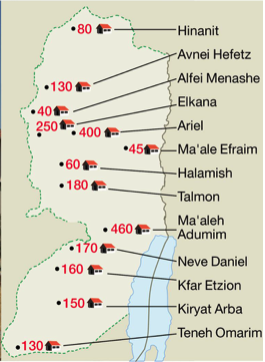
Map by Haaretz
Lieberman – whom The Times of Israel and Haaretz note has repeatedly inflated settlement approval numbers in the past – said the specific plans set to advance will include:
- 400 units in the Ariel settlement (where a medical school financed by Sheldon Adelson was recently brought under Israeli domestic jurisdiction, in a case of de facto annexation. And where a future stop on the recently approved settler-only light rail is slated to be built.);
- 460 units in the Ma’aleh Adumim settlement;
- 250 units for an assisted living center in the Elkana settlement (where the settler-only light rail will also have a stop);
- 180 units in the the Talmon settlement;
- 170 units in the Neve Daniel settlement;
- 160 units in the Kfar Etzion settlement;
- 150 units in the Kiryat Arba settlement (where construction preparations for a new industrial zone – which in reality is a new settlement in Hebron – recently began);
- 130 units in the Avnei Hefetz settlement;
- 130 units in the Tene Omarim settlement;
- 80 units in the Hinanit settlement;
- 60 units in the Halamish settlement (where settlers have built a strategic outpost, with the protection of the IDF, in order to further restrict Palestinian access to the area);
- 45 units in the Ma’ale Efraim settlement;
- 40 units in the Avnei Hafetz settlement;
- 45 units in unspecified settlements.
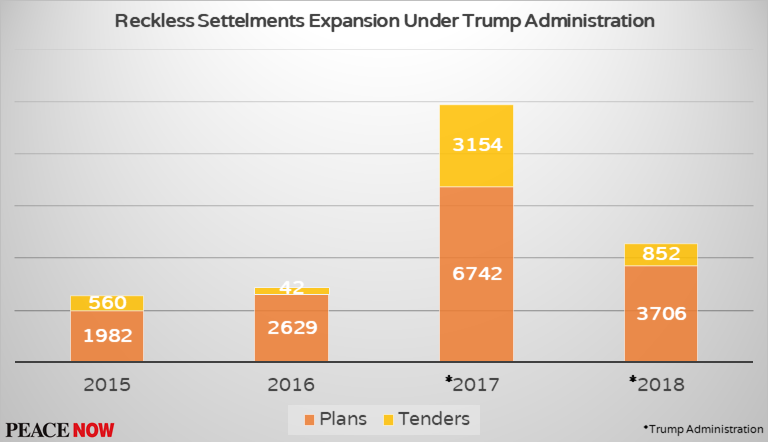
This will be the third meeting of the High Planning Council in 2018, in accordance with a reported agreement between Israel and the United States to consolidate and coordinate the number of times settlement plans are announced. The first regularly scheduled meeting of the year was in January, when 1,122 new settlement units were advanced, of which 352 received final approval for construction. The Council met again, unexpectedly in February, which Lieberman tried to minimize by calling it “less significant” because the majority of the projects approved were non-residential. In fact, the projects were extremely significant. All of the plans expanded the footprint of settlements located deep inside the West Bank – including plans for a race track and hotel in the Jordan Valley. One “unusual” plan even created a new outpost to house settlers evacuated from a different outpost (the Netiv Ha’avot outpost case that FMEP has covered in exhaustive detail).
The anti-settlement watchdog group Peace Now writes:
“In the year and a half since President Trump took office some 14,454 units in the West Bank has been approved (in plans and tenders, including today’s announcement not including East Jerusalem), which is more than three times the amount that was approved in the year and half before his inauguration (4,476 units)…The Netanyahu government is clearly continuing to take advantage of the carte blanche the Trump Administration has given it in order to destroy the chances for peace. It is well-known that for a two-state solution to be feasible Israel will have to withdraw from most of the West Bank, yet the government keeps raising the political cost of this redeployment and the evictions it will entail. By adding housing to settlements, the government shows total disregard for the two-state solution.”
In reaction to Lieberman’s announcement, PLO Executive Committee member Hanan Ahrawi said:
“Such egregious policies affirm the imperative need for the International Criminal Court to open an immediate criminal investigation into Israel’s flagrant violations of international law and conventions,” she said in a statement….Israel’s declared intention to build thousands of illegal settler units in the occupied West Bank discloses the real nature of Israeli colonialism, expansionism and lawlessness…Undoubtedly, Israel is deliberately working to enhance its extremist Jewish settler population and to superimpose ‘Greater Israel’ on all of historic Palestine…It is evident that the recent provocative and unlawful moves adopted by the United States, Guatemala and Paraguay have emboldened Israel to move forward with enhancing its illegal settlement enterprise, thereby finalizing the total annexation of the occupied West Bank.”
Saeb Erekat, a top diplomat for the Palestinian Authority released a video response, in which he highlighted the PA’s recent referral to the International Criminal Court (ICC) to investigate Israeli settlement crimes (see FMEP’s coverage on the ICC referral, below). Erekat said in part:
“This is a flagrant violation and an eye opener to the judicial council of the ICC that an official judicial investigation must be opened immediately. This cannot go on. Israel cannot continue business as usual with this impunity and immunity that they think they have.”
Nadil Abu Rudeina, a spokesman for PA President Mahmoud Abbas, said:
“The continuation of the settlement policy, statements by American officials supporting settlements and incitement by Israeli ministers have ended the two-state solution and ended the American role in the region.”
Finance Ministry Announces Bargain Construction in Beit El & Ma’ale Adumim Settlements
In addition to the approvals expected from the High Planning Council this week, the Israeli Finance Ministry has announced that a 300-unit project in the Beit El settlement and 44-unit project in the Ma’ale Adumim settlement have been marketed as part of the “Buyer’s Price” program. Under this program, the government sells land to construction companies at low prices, and those companies commit to offering future settlement units at below market prices. With the plan being marketed in Beit El, the government is accepting bids on the project from construction companies which commit to pricing the apartments 20% below market value – in effect creating a powerful financial subsidy that incentivizes Israelis to move into settlements.
The Beit El project involves 5 buildings with a total of 296 units. According to Ynet:
“the program’s goal is to transform Beit El’s southeast agricultural area into a residential neighborhood as well as unification and re-division of the lands, which will be allocated to building houses, public offices, commercial areas, routes, and a public open space.”
FMEP has covered the progress of this Beit El project repeatedly over the past year, particularly because the push around Beit El projects typifies the Netanyahu-Trump era of settlement growth. Beit El settlers have lobbied for the project for over 5 years, ever since the settlers were evacuated from an outpost of Beit El (called “Ulpana”) in 2012. When the outpost was evacuated, Prime Minister Netanyahu promised to build replacement settlement units in Beit El. Buoyed by the apparent green-light from the Trump administration, over the summer of 2017 settler leaders repeatedly and publicly shamed Netanyahu for failing to fulfill that promise, and in response Netanyahu very publicly and repeatedly promised that the settlement units will be built expeditiously. After being ignored by the High Council during its September meeting, the plan for 296 units was then approved for marketing in October 2017. Now, this week, the government has acted on that approval to market the plan, moving ever closer to the start of construction. As the Ynet report notes, if/when the 300 units are built, this will be the first new, government-sanctioned construction in the Beit El settlement in 10 years.
Also in Beit El, the settler-aligned media outlet Arutz Sheva reports that the IDF plans to build a new “razor wire” fence to separate the settlement from the Palestinian Jalazone refugee camp, located across the street (where it has been since before Beit El’s establishment). At the time of this writing, there has been no additional reporting on where the fence will be placed, and if it relates to plans to build a wall between Beit El and the Jalazone refugee camp. To better understand the severe implications of the Beit El settlement on the lives of Palestinian in Jalazone, see B’Tselem’s updated, expanded, and now pictorial project: “Life under the shadow of the Beit El Settlement.”
As a reminder, U.S. Ambassador to Israel David Friedman is closely associated with the Beit El settlement, having donated to and fundraised for it prior to his appointment as ambassador (including in his capacity as the President of the American Friends of Beit El, reportedly from 2011 until he became ambassador).
The Beit El settlement was established in 1977, on land previously seized by Israel for military purposes. A second military seizure in 1979 enabled Beit El to expand. This method of establishing and expanding settlements has been repeatedly challenged in Israeli courts. The Israeli group Yesh Din led one such petition against Beit El, seeking to have the second seizure annulled; that petition was dismissed earlier this year. Yesh Din writes:
“The State understood that it was impossible to legally defend the land theft that has been ongoing in Beit El for 40 years on land that was seized for arbitrary reasons, but it refrained, once again, from defending the rights of the weakest population, simply because they are Palestinians. Despite this, we at Yesh Din will continue to fight against the dispossession of Palestinians and the infringement of their rights.”
Defense Ministry Supports Expropriation of Private Palestinian Land for Settlements
On May 24th, the Israeli Defense Ministry released a legal opinion endorsing the government’s plan to expropriate privately owned Palestinian land in the Ofra settlement in order to retroactively legalize illegal settlement structures built there. The opinion adopts the “market regulation” principle as a legal basis for Israel to expropriate privately owned Palestinian land in cases of settlements in which decades-old structures were built and/or purchased by Israelis “in good faith” (believing the Israeli government to be the rightful owner of the land). The legal opinion also calls for the Palestinian owners to be “fully compensated, if not more than that,” and recommends that the principle should not apply to cases of unauthorized outposts. The Ofra situation is a test case for the “market regulation” principle, which has not yet been used (or tested in court) to justify expropriating Palestinian land for Israeli settlements.
Defense Ministry legal advisor Itai Ofir called on Attorney General Avichai Mandleblit to adopt the legal opinion as a government policy, which stands a good chance of happening (Mandleblit already endorsed the Ofra expropriation on that basis). In fact, the Attorney General invented the “market regulation” principle in the first place, as an alternative to the legal argument made in the Regulation Law (which he opposed). The “market regulation” principle was also recommended in the recently released “Zandberg Report,” as one of the tools that the Israeli government should use to carry out massive land expropriations, retroactive legalizations, and continued and intensified settlement growth.
FMEP has chronologically documented the development and adoption of the “market regulation” principle in the Annexation Policies tables.
High Court Supports Destruction of Khan al-Ahmar [A War Crime], Clearing the Way for E-1 Settlement
On May 24th, the High Court of Justice upheld a government plan to destroy the Palestinian Bedouin community of Khan al-Ahmar and forcibly relocate its residents out of the Ma’ale Adumim/E-1 settlement area east of Jerusalem – which Israel is expected to carry out soon. The Court reasoned that the community’s structures were built on State Land without the proper permits, even though Israel deliberately makes such permits nearly impossible to obtain. Clearing Khan al-Ahmar from the its current site (where it has been for 60+ years) is widely interpreted to be a step towards building the “doomsday” E-1 settlement which, if built, will complete a ring of Israeli settlements around East Jerusalem, destroying the territorial contiguity between Palestinians living there and the West Bank, and preventing any possibility of a viable, contiguous Palestinian state with its capital in East Jerusalem.

Map by Ir Amim
Israel has faced intense criticism for its plan to forcibly relocate Khan al-Ahmar, a plan many, including B’Tselem, call a war crime. A group of 76 U.S. Members of Congress recently sent a letter to Netanyahu beseeching him to abandon the plan, as well as the plan to demolish the Palestinian community of Susya, in the South Hebron Hills.
Peace Now says:
“The State of Israel must implement a policy of moral values, justice, equality and human rights for the Jahalin people. It is not in the Israeli interest to forcibly move them from their homes. We must stop the abuse that has been going on for decades, and allow them to live according to their way of life, to make a living and to educate their children in a way that is no different from that of the Jews living in their neighborhoods.”
The Jahalin Bedouin built the Khan al-Ahmar community in the area east of Jerusalem in the 1950s, after they were expelled from their lands in the Negev by the Israeli military. A total of 18 Bedouin tribes live in the vicinity of Ma’ale Adumim/E-1, totaling approximately 3,000 people, who have already endured numerous demolitions this year alone. The Ma’ale Adumim settlement was built in 1975 on land near where the Khan al-Ahmar community already existed; the plan for the E-1 settlement was approved in 1999.
Palestinians Ask the ICC to Open Investigation into the Israeli Settlement Regime
The Palestinian Authority has officially asked the International Criminal Court (ICC) to open an investigation into the Israeli government’s illegal settlement activity. The text of the referral can be found here. Citing “sufficient compelling evidence” and an “alarming intensification of Israeli crimes,” Palestinian Minister of Foreign Affairs Riad Malki asked the ICC to immediately open an investigation into war crimes and crimes against humanity that have been committed against Palestinians in the West Bank, East Jerusalem, and Gaza. The referral requests that the investigation include:
“those who plan, prepare and implement policies linked to the settlements regime as well as those who enable it, whether through financial, military, or logistical support or otherwise aid and abet or encourage the commission of crimes connected to that regime.”
The referral lists specific, ongoing crimes that are “among the most widely documented in contemporary history,” for the ICC to investigate. The PA’s allegations mainly relate to settlement activity (much of which is documented on a weekly basis in FMEP’s Settlement Reports) including: the unlawful appropriation and destruction of private and public properties, including land, houses and buildings, as well as natural resources; the forcible transfer of Palestinians; the unlawful transfer of the Israeli Occupying Power’s population into Occupied Palestinian Territory; the “persecution, including the grave, widespread and systematic denial or violation of basic human rights on discriminatory grounds against Palestinians, including those resulting in or intended to achieve the deportation of forcible transfer, directly or indirectly, of the Palestinian population, the re-population of ‘cleansed’ territories with Israeli settlers and the unlawful appropriation of Palestinian land and properties”; and “the establishment of a system of apartheid based in particular on the adoption of discriminatory laws, policies and practices as well as the commission of inhumane acts intended to establish an institutionalized regime of separation and advancement of Israeli settlements accompanied by the systematic oppression and domination by Israeli settlers over Palestinians.”
After the PA submitted its referral, Israeli Foreign Minister Avigdor Lieberman argued that the “ICC lacks jurisdiction over the Israeli-Palestinian issue, since Israel is not a member of the Court and because the Palestinian Authority is not a state.” While Israel is not a member of the ICC, the State of Palestine acceded to the ICC in December 2014, and its membership took force in April 2015. In January 2015, the ICC’s Office of the Prosecutor opened a preliminary inquiry to “ascertain whether the criteria for opening an investigation are met.” The preliminary inquiry is listed as “ongoing” on the ICC website. Following by the referral for an investigation submitted this week, ICC Chief Prosecutor Mrs. Fatou Bensouda released a statement saying:
“Since 16 January 2015, the situation in Palestine has been subject to a preliminary examination in order to ascertain whether the criteria for opening an investigation are met. This preliminary examination has seen important progress and will continue to follow its normal course, strictly guided by the requirements of the Rome Statute.”
The press release also notes that this is the eighth referral on the matter to date (previously, the situation in Palestine was referred to the ICC for investigation by Uganda, the Democratic Republic of the Congo, the Central African Republic, Mali, the Comoros Islands, and the Gabonese Republic).
Bonus Reads
- “Minister Ariel initiates museum of settlement” (Arutz Sheva)
- “Cherry Plantation Burned in Settlement a Hay Torched in Southern West Bank” (Haaretz)
- “Sheikh Jarrah: A Tale of Eviction and Resettlement” (Al Jazeera)
“In new film, Tel Aviv leftist picks up and moves to a West Bank settlement” (Times of Israel)
Welcome to FMEP’s Weekly Settlement Report, covering everything you need to know about Israeli settlement activity this week.
To receive this report via email, please click here.
May 10, 2018
- Israeli Government Task Force Recommends Massive, Unlimited Land Theft to “Legalize” 1000s of Unauthorized Settlement Buildings
- DETAILS: Zandberg Report Recommendations (as reported in English-language media)
- REACTIONS to Zandberg: Some Celebrate, Others Sound the Alarm
- Efrat Becomes First Settlement to Acquire Private Drone to Police Palestinians
- Financing Occupation: World Zionist Organization Offers Cheap Rent in Settlements
- Israeli Cabinet Votes to Back Legislation Stripping High Court of Significant Power
- Former Top Military Prosecutor – Current NGO Monitor Employee – Lives in House Built on Stolen Palestinian Land
- Bonus Reads
Comments, questions, or suggestions? Email Kristin McCarthy at kmccarthy@fmep.org.
Israeli Government Task Force Recommends Massive, Unlimited Land Theft to “Legalize” 1000s of Unauthorized Settlement Buildings
Last year, the Israeli government formed a task force to develop new legal solutions that will save settlement buildings and outposts that were built without Israeli authorization on privately owned Palestinian land in the West Bank.The committee’s final report mapping out a menu of options to accomplish that end – called the “Zandberg Report” after the committee’s chair, Dr. Haya Zandberg – was published (in Hebrew) on Friday, May 4th. Soon after its publication, Defense Minister Avigdor Liberman announced he will be introducing a plan “within weeks” that will operationalize the report’s recommendations.
Described by the The Jerusalem Post as “the latest attempt by settler leaders, right-wing politicians and judicial experts to normalize settlement building in Area C of the West Bank by divorcing it from existing legal constraints,” it is clear that the recommendations toss out even a pretense of respect for the rule of law in order to entrench and expand Israeli settlements, rewarding Israeli settlers who broke Israeli law. If implemented, the recommendations will “legalize” the outright theft of land recognized by Israel as privately owned by Palestinians and will lay the groundwork for continued, additional expropriation of privately-owned land for settlement-related construction.
DETAILS: Zandberg Report Recommendations (as reported in English-language media)
The report opens by stating that “the State of Israel, as the state of the Jewish people, has a right and claim over areas whose status is disputed in the Land of Israel.” The contents of the report make clear that the drafters define “the Land of Israel” as including all of the West Bank.
The authors go on to offer a number of unprecedented legal arguments and recommendations. Those include:
1 – Calling for wholesale implementation of the “Market Regulation” principle, and additional, similar actions. “Market Regulation” is a recently invented Israeli legal principle that involves granting post-facto legitimacy to illegally built settlement construction in cases where settlers built “in good faith,” i.e., they do so under the belief that their actions were correct and legal. FMEP has covered the “Market Regulation” principle several times in the past, and tracks the operationalization of it in real time on our annexation policy tables. Attorney General Avichai Mandelblit first introduced the “Market Regulation” argument in late 2016 as an alternative legal basis to the one that was eventually adopted by the Knesset in the Regulation Law. In November 2017, the government embraced Mandelblit’s “Market Regulation” principle when it submitted a brief to the High Court of Justice announcing its plan to retroactively legalize the settlers’ construction on privately owned Palestinian land near the Ofra settlement by expropriating that land.
In addition, the report recommends legalizing illegal construction in cases where settlements have expanded beyond their borders onto private land, and where that structures in question “were built over a decade ago, without any protest and with the support of the state.”
2 – Endorsing the expropriation of privately owned Palestinian land for “public use.” As an occupying power, Israel technically has the right to expropriate land for public use — meaning, for the benefit of the public that resides in the territories held under occupation. Since 1967, Israel has interpreted that authority in a manner that is both legally questionable and which discloses a very clear political and territorial agenda, using “public use” as the basis for expropriating West Bank land for the exclusive benefit of Israel and Israeli settlers. The Zandberg report makes this explicit, endorsing expropriations for the purpose of building new roads that connect isolated outposts and settlements to more developed areas. Defending this self-serving interpretation of “public use,” the report cites an opinion by (now retired) High Court Justice Salim Joubran, which held that settlers are legally a part of the “local population” of the West Bank and that the IDF is obligated to provide for their welfare. As another means of connecting isolated settlements and outposts, the report also recommends that the State consider building tunnels or bridges through privately owned Palestinian land to connect isolated settlement areas to more developed areas. The report argues “the ownership underground and [in the air] above the ground belongs to the state.”
FMEP has repeatedly reported on the events related to the legal basis created by Justice Joubran’s opinion, and FMEP tracks the operationalization of the legal basis on our annexation policy tables. Joubran’s opinion was made public in October 2017, prompting the Israeli NGO Yesh Din to file a new petition regarding the case it was related to – the Amona outpost case. Then, in November 2017 the High Court accepted the “local population” argument as an adequate legal basis for expropriating Palestinian land near the unauthorized outpost of Haresha in order to legalize an access road that had illegally been built on the private land.
3- Recommending a principle of flexibility in defining “adjacent areas.” The basis of this recommendation is the idea that Israel’s right to use land that is immediately adjacent to authorized settlements cannot be questioned, and that by interpreting the concept of “adjacent areas” broadly, Israel can justify taking large swathes of West Bank land located around and between settlements, including private land. Doing so would enable Israel to incorporate unauthorized outposts as “daughter neighborhoods” of existing settlements, even when located a great distance away. Doing so would also allow private Palestinian land surrounding isolated outposts to be seized and zoned for settlement construction and expansion (some outposts are located on pockets of territory designated by Israel as “state land,” prohibiting, under current law, the outpost to expand).
4 – Calling for the establishment of new, official settlements. The report endorses the establishment of independent new settlements for satellite outposts that are not connected to the main settlement area, like what Israel is in the process of doing for the Havat Gilad outpost.
5 – Recommending an end to the work of the “Blue Line Team.” This is the team within the Israeli Defense Forces which was tasked with examining and correcting the demarcation of land in the West Bank that Israel has granted to settlements. Ending the work of the team means Israel will cease making any effort to identify if and where settlement boundaries include private Palestinian land, let alone retroactively returning such land to the control of its owners. Israeli Attorney General Avichai Mandelblit has reportedly already agreed to this recommendation.
6 – Calling for Regional Settlement Councils to be allowed to provide municipal services to (currently) unauthorized outposts. Many unauthorized outposts – being outside the jurisdiction of regional councils (because they are not officially recognized by the government) – lack connections to the Israeli power grid and water supply. This recommendation will allow settlement Regional Councils to hook up outposts to the Israeli grid, an ability which had already been extended to local settlement councils.
REACTIONS to Zandberg: Some Celebrate, Others Sound the Alarm
Justice Minister Ayelet Shaked: “The end of the era of uprooting settlements without purpose in Judea and Samaria, was led by a team that found legal ways to regulate settlements in Judea and Samaria and to end the shame of evacuating settlements for no real reason. The report gives legal tools that are compatible with international law, for the settlement of settlements in Judea and Samaria.”
Education Minister Naftali Bennett (Jewish Home): “We act responsibly and creatively and within a few weeks we will present a comprehensive and systematic plan of action for the legalization of outposts in Judea and Samaria.”
Agricultural Minister Uri Ariel (Jewish Home): “The Settlement Committee was established in order to find a solution for thousands of houses in settlements that are in danger because of petitions by radical leftist parties and the Palestinian Authority, which exploit the judicial system to harm and sabotage Jewish settlement in Judea and Samaria. The report sets before us, the government, the simple truth that it is possible and necessary to settle settlement in Judea and Samaria after 50 years of settlement. I call on the prime minister to immediately adopt the report and put an end to the unnecessary and painful demolition and destruction of homes and settlements in Judea and Samaria established with the encouragement and support of successive Israeli governments.”
MK Ksenia Svetlova (Zionist Union): “Because the government was unable to implement the Levy report, they need to be able to show some sort of result on this issue…It will give a tailwind to settlers to continue building illegally…” She referred to the report as a “legal carte blanche,” providing another avenue for advancing the so-called “Regulation Law.” She added, “I believe in international legitimacy, and nobody has recognized our sovereignty in the West Bank.”
Peace Now: “This is a serious and dangerous report, which recommends that Israel blatantly violate international law and trample on the protected needs and rights of the Palestinian population…the implementation of its recommendations would lead to apartheid in practice.
Talia Sasson (author of the 2005 Sasson Report and current head of The New Israel Fund): The report was written “on the basis that the political debate over the West Bank is over…Their legal attitude to issues of land ownership is one of ‘we don’t want to know.’ ”
Michael Sfard (human rights lawyer): Referring to a 1979 court ruling that held Palestinian land could not be confiscated by the state for the use of settlement building, Sfard said: “The adoption of this report would signify the end of that ruling. It has been abused quite regularly on the ground, but never before at the legal level.”
[Updated post-publication with new statements]
Efrat Becomes First Settlement to Acquire Private Drone to Police Palestinians
The Efrat settlement, located south of Bethlehem, recently became the first settlement to have its own drone to police the skies. The settlement held a demonstration of the drone’s capabilities over the weekend, stressing that the drone is able to quickly identify Palestinians on the ground.
The purchase of the drone was supported by a $37,000 donation from the International Fellowship of Christians and Jews, an organization which claims to be the “largest Christian-supported humanitarian agency helping Israel and the Jewish people around the world,” counting 1.6 million Christian donors who contribute a total of $140 million annually. The group’s founder, Rabbi Yechiel Eckstein, told the Jerusalem Post that he plans on equipping more settlements with their own private drones.
Military-grade drones have long been a part of the Israeli military’s blockade of Gaza, and Gaza residents have long noted with despair the audible buzzing of drones above them. The Washington Post wrote that the buzz of drones is the “the most enduring reminder of Israel’s unblinking vigilance and its unfettered power to strike at a moment’s notice.” Just last week, and for the first time ever, Israel used drones to drop tear gas on Palestinians participating in protests along the fence separating Israel from the Gaza Strip.
The privatization of drones follows the diffusion of drone technology throughout the Israeli armed forces; as of last year, Israel had furnished camera-equipped drones to hundreds of IDF units.
Financing Occupation: World Zionist Organization Offers Cheap Rent in Settlements
A freedom of information request filed by two Israeli NGOs has revealed that the Settlement Division of the World Zionist Organization (WZO) offers mobile homes for rent in West Bank settlements for 20-30% cheaper than in Israel proper. According to the data, 37% of the division’s rental properties are located inside of West Bank settlements.
The Settlement Division is technically part of the World Zionist Organization, but in practice the unit is fully funded by the Israeli government and even splits its real estate profits with the Israeli Housing and Construction Ministry. Together, the WZO and the Israeli government work in coordination to develop West Bank settlements and encourage Jews to move into them.
From the beginning of the Israeli settlement movement, the Israeli government has provided significant economic subsidies to encourage its citizens to move to the West Bank (subsidies which is not offered to citizens living in Israel proper, where a housing shortage has been front-page news for years).
Israeli Cabinet Votes to Back Legislation Stripping High Court of Significant Power
On May 6, 2018, the Israeli Cabinet voted to support legislation that, if passed by the Knesset, will empower the Knesset to reinstate laws struck down by the High Court with a bare-bones majority vote (61 of 120). This move by the Cabinet sends the bill – known as the override law – to the Knesset, where it appears to have been put on ice due to opposition within the governing coalition.
The Cabinet’s decision to vote on the bill and send it to the Knesset took place entirely at the insistence of Jewish Home leaders Naftali Bennett and Ayelet Shaked, in defiance of a request from Prime Minister Netanyahu’s (Likud) to delay the Cabinet vote until the Ministers could reach a compromise on the text of the bill. Instead, Bennett and Shaked plowed ahead with their own version of the bill without consensus in the Cabinet. The Jewish Home version is the most extreme: it would allow the Knesset to reinstate bills with just 61-votes, a threshold so low that it would effectively allow governing coalitions to pass laws that are immune to judicial review. Chief Justice Esther Hayut warned that the 61-vote version sets the bar too low, calling it a “danger to democracy and to the court.”
As of this writing, Netanyahu has not yet weighed in on the Cabinet’s action on the bill, which leaves Likud faction votes uncertain. Finance Minister Moshe Kahlon – who heads the Kulanu Party, the second largest party in the governing coalition – has promised to instruct his faction to vote against the bill should it be brought up, a move which could shelve the bill for six months according to Knesset procedures. Kahlon, who was not present during the Cabinet’s discussion or vote, said:
“The passage of the bill in the Ministerial Committee of Legislation is a violation of the coalition agreements and a blow to law enforcement. The Kulanu faction will continue to struggle against the override powers clause and we will fight. We will not allow extreme elements to lead the daily agenda in the State of Israel.”
Adding to the dissent, a spokesman for Israeli Attorney General Avichai Mandelblit reiterated the AG’s opposition to all versions of the bill currently under consideration. As an alternative, Mandelblit has recommended a bill that would require a majority vote in the High Court (6 out of 9) to overturn a bill, and then a vote of 70 MKs to reinstate any bill that was struck down.
Former Top Military Prosecutor – Current NGO Monitor Employee – Lives in House Built on Stolen Palestinian Land
Dror Etkes – founder of the anti-settlement watchdog group Kerem Navot – revealed that Maurice Hirsch, Israel’s former chief military prosecutor in the West Bank – lives in a house that the Israeli Defense Ministry has admitted was built on privately owned Palestinian land. Hirsch is currently employed by NGO Monitor, a group dedicated to quashing activisim critical of Israel or Israeli policies.
Bonus Reads
- “Ultra-Orthodox population grows in Israeli settlements” (i24 News)
- “Israeli forces expel Palestinian families from homes in Jordan Valley for army training” (Maan News)
- “How the U.S. State Department Deleted the Occupied Territories” (Haaretz)
Welcome to FMEP’s Weekly Settlement Report, covering everything you need to know about Israeli settlement activity this week.
To receive this report via email, please click here.
May 3, 2018
- Forging Ahead with Another Settler Project at Entrance of Sheikh Jarrah
- Israeli NGOs File Challenge Against Settler Footbridge Near Old City
- Kerem Navot Report: Some of Israel’s West Bank Police Stations are on Private Palestinian Land
- Update: High Court Override Legislation is in Limbo
- Bonus Reads
Comments, questions, or suggestions? Email Kristin McCarthy at kmccarthy@fmep.org.
Forging Ahead with Another Settler Project at Entrance of Sheikh Jarrah
On April 26th, the Jerusalem District Planning and Building Committee advanced a plan, backed by settlers, to build a 6-story commercial building at the entrance of the Palestinian East Jerusalem neighborhood of Sheikh Jarrah – taking the key step of depositing the plan for public review. The building will be across the street from one of the most provocative settlement projects that were advanced last year: a new religious school (the Or Sameach Yeshiva/Glassman Complex) described by Terrestrial Jerusalem to be: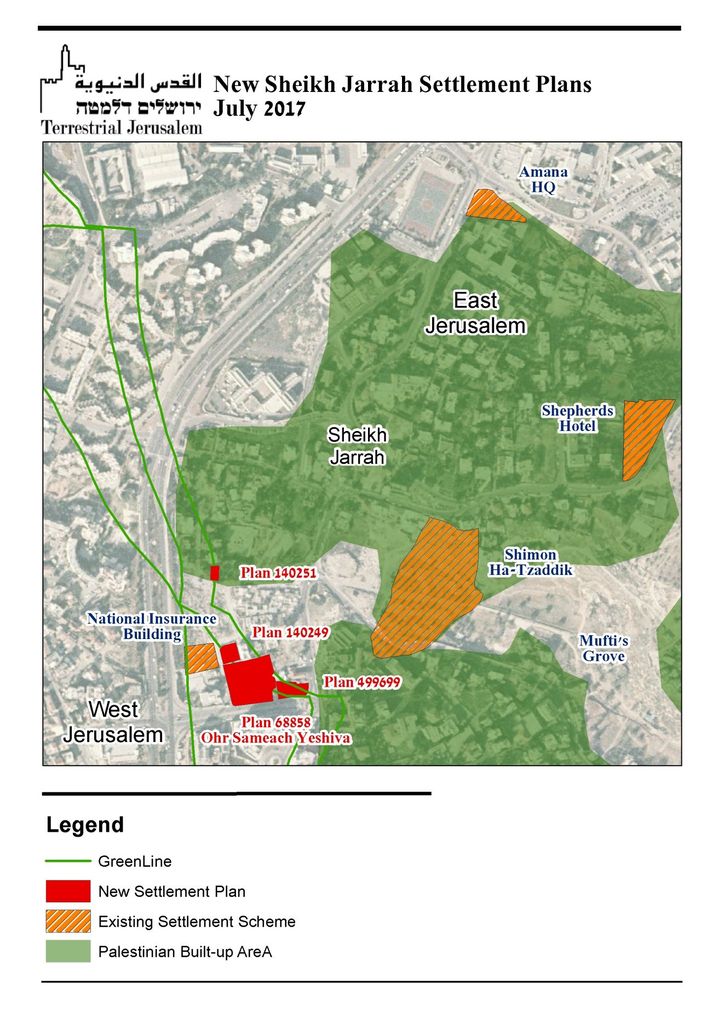
“a clear effort to exploit Torah study to expand and normalize occupation in East Jerusalem (including by making the site politically untouchable, as it will now be linked with religious activities).”
The location of the yeshiva and the 6-story building (which, once built, will literally flank both sides of the road leading into Sheikh Jarrah) will strengthen Israeli settlers’ hold on the neighborhood. Together they will advance the settlers’ goal of cementing the presence of the settlement enclaves inside of Sheikh Jarrah by connecting them more seamlessly to the neighborhood’s outer periphery and the rest of Jerusalem.
Sheikh Jarrah and its Palestinian residents are the target of intense settler activity, which FMEP has covered repeatedly in the past.
Israeli NGOs File Challenge Against Settler Footbridge Near Old City
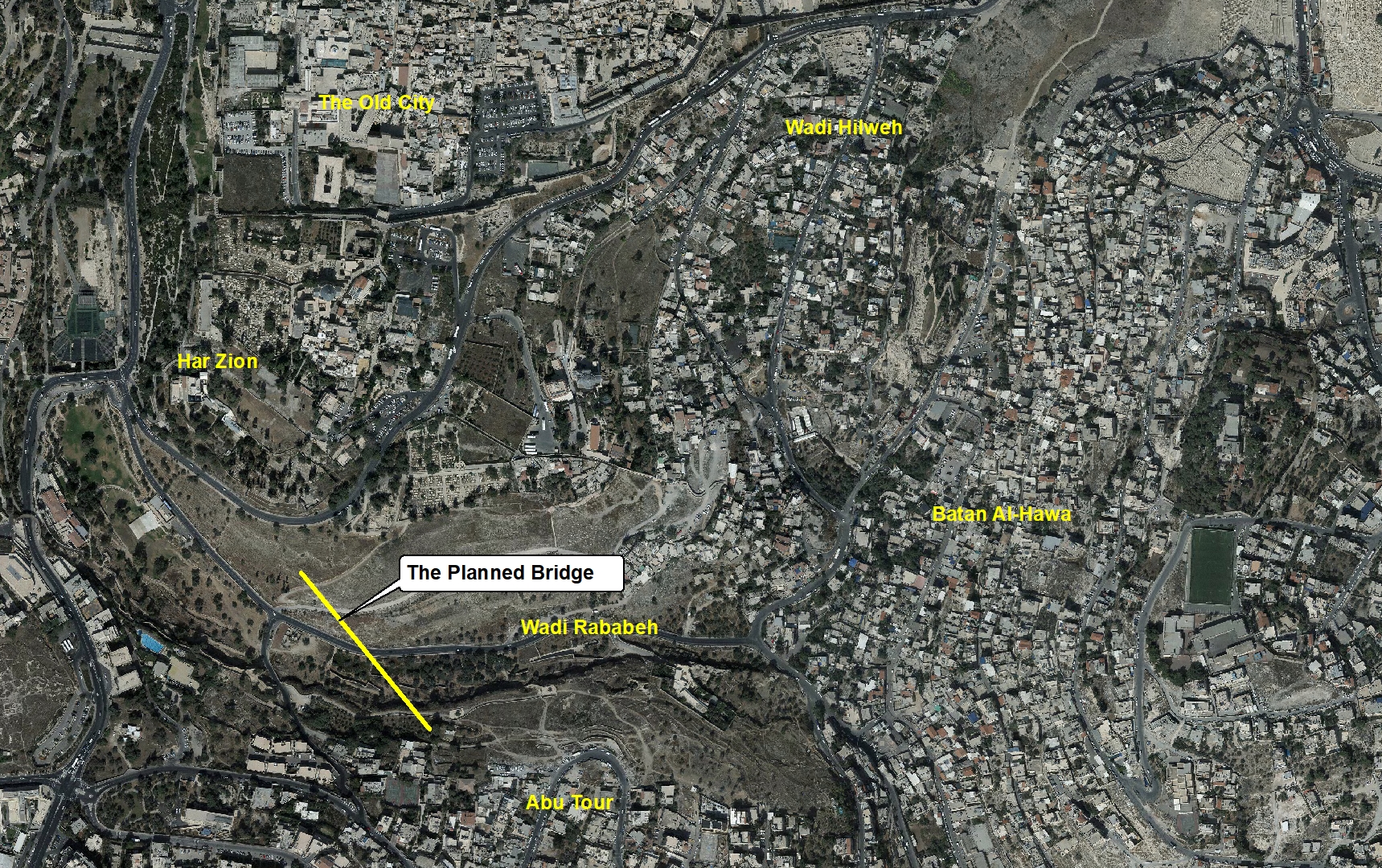
Map by Peace Now
The petitioners argue:
“The proposed bridge is located in one of the most sensitive and significant areas in Jerusalem and one of the most important in the world. The Old City basin is one of Jerusalem’s most precious cultural, religious and historical assets, as well as politically significant. Construction and development in this area should be done in a careful and considerate way, in a meaningful public debate and in the context of a true planning vision.
It is not without reason that the designs were set in the planned area. . . [an area] whose main purpose is to preserve and protect the Old City basin from rapid development and construction initiatives that might damage the important values in this special area. These plans do not allow the issuance of permits for such a significant construction and do not allow expropriation at all without proper documentation, and they explicitly state the need for detailed planning with the approval of the District Committee.
It is important to note that in addition to the familiar tension between development and tourism needs and the principles of conservation and protection of historical and environmental values, the Old City basin is also an urban area with a population of tens of thousands of people who live alongside and sometimes within historic sites. The bridge and pedestrian traffic will have significant implications for the area and its character for the residents living in the area.
For all these reasons, extreme caution is required in approving development plans in the Old City basin. The permit in question was approved in violation of all the proper planning and public principles, and therefore there is a need to cancel it.”
Peace Now reports that Elad has already started building infrastructure for the footbridge in Abu Tor, despite lacking a building permit (the plan was approved, but permits have not been issued). Peace Now appealed to the Jerusalem Municipality to have the construction stopped; the Municipality responded saying the construction does not relate to the bridge but to a permit that was issued for the “restoration of terraces” on the same land. Peace Now appealed again two weeks ago, arguing that Elad’s current undertakings – which include building walls, pouring of concrete, and excavating – require an additional permit (how it is being argued that those projects relate to the “restoration of terraces” is unclear). The Municipality has not yet responded.
As FMEP has covered many times in the past, Elad’s mission is to establish Jewish hegemony in Jerusalem, and it often uses tourism as a pretext for its activities in Jerusalem’s most contested neighborhoods. Kerem Navot says the Abu Ror footbridge is part of Elad’s efforts to take control of areas surrounding the neighborhood of Silwan.
Kerem Navot Report: Some of Israel’s West Bank Police Stations are on Private Palestinian Land
New research published by the anti-settlement watchdog Kerem Navot documents the legal status of land in the West Bank on which 38 Israeli police stations have been built, and reveal that four stations are built illegally on privately-owned Palestinian land.
The report reveals that of the 38 police stations in the occupied territories:
- 17 stations are on land declared by Israel to be “state land”
- 8 stations are on land Israel seized for “security purposes”
- 2 stations are on land expropriated for “public purposes”
- 1 station (servicing the Givat Ze’ev settlement) is fully on privately-owned Palestinian land
- 1 station (servicing the Ma’ale Adumim settlement) is partially on privately-owned Palestinian land, and partially on land that was seized from the Palestinian owners for “public purposes”
- 1 station (servicing the Elkana settlement) is partially on privately-owned Palestinian land and partially on land seized from Palestinian owners for “security purposes”
- 1 station (servicing the Vered Yeriho settlement) is partially on privately-owned Palestinian land and partially on land that was declared “state land”
Kerem Navot writes:
“As is well known, there are two communities in the West Bank, each of which has completely different rights, and previous reports have been devoted to describing the Israeli Police’s failure to enforce the law in cases of settler violence in a sense reminiscent of values of equality. This modest document will not address this fundamental ethical issue… this report solely seeks to address the geographical-statutory aspect of the deployment of Israel Police stations throughout the West Bank…The initial idea for addressing this aspect arose when, over the course of our research in recent years, we incidentally discovered that several police stations in the West Bank are illegally located on private Palestinian-owned land. There is no need to elaborate on the paradoxical severity of this fact.”
Update: High Court Override Legislation is in Limbo
It appears that the Israeli Knesset, which convened this week for the summer session, will not take immediate action on a bill to empower the Knesset to reinstate laws struck down by the High Court of Justice (reminder: the High Court is expected to strike down the Regulation Law, and MKs have already stated their desire to make sure it remains on the books). Prime Minister Netanyahu (Likud) and Justice Minister Ayelet Shaked (Jewish Home) were not able to reach a compromise on the specifics of the bill during a meeting with Chief Justice Esther Hayut last weekend, and no news of the bill has surfaced since. It is unclear if Naftali Bennett (Jewish Home) intends to follow through on the threat he made last week to call for elections if Netanyahu does not advance his version of the bill – which will allow the Knesset to reinstate laws with a bare-bones, 61-vote majority in the Knesset – this week.
While political leaders debate amongst themselves, a new public opinion poll found that 65% of Israelis believe that the version of the bill pushed by Ayelet Shaked and Jewish Home party leaders would “grant the government ‘unlimited’ and unchecked power.” 58% of the public said they believed the law would lead to more corruption.
Bonus Reads
- “Settler Rail Line to Israel Latest Land Grab, Palestinians Say” (Al Jazeera)
- “Thirteen Cases of Vandalism, One Arrest: Who is Behind the Wave of West Bank Hate Crimes?” (Haaretz)
- “‘Price tag’ hate crimes against Palestinian on the rise in Israel and West Bank” (NBC News)
- “Christians in Jerusalem’s Old City ‘under threat’ from settlers” (The Guardian)
Welcome to FMEP’s Weekly Settlement Report, covering everything you need to know about Israeli settlement activity this week.
To receive this report via email, please click here.
March 30, 2018
- 2017 – A Record Year in Settlement Expansion
- Hebron Settlers Leave One Disputed Property, Only to Enter Two More
- Settlers Celebrate Moving to Amichai, the First New Government-Backed Settlement in 25 Years
- Housing Minister on Annexation: Settlements are a Non-Negotiable Security Asset, Israel Must Keep Building
- Ambassador Friedman: U.S. Will Not Intervene To Stop Israeli Annexation
- After Annexing Settlement Universities, Israeli Education Ministry Moves to Censor Campus Criticism of Settlements/Occupation
- Terrestrial Jerusalem Report: “The Creation of a Settler Realm in and Around Jerusalem’s Old City”
- Al-Shabaka Policy Brief: Israel’s Annexation Crusade in Jerusalem
- Yesh Din/Emek Shaveh Report: “Appropriating the Past: Israel’s Archaeological Practices in the West Bank”
- Emek Shaveh Report: The Jerusalem Cable Car Undermines the History & Multiculturalism of the Historic Basin
- You Can’t Make This Stuff Up: Settler Lands Helicopter at Qalandiya Checkpoint (in Attempt to Seize It)
- Bonus Reads
Comments, questions, or suggestions? Email Kristin McCarthy at kmccarthy@fmep.org
2017 – A Record Year in Settlement Expansion
In its annual report on settlement activity, the settlement watchdog group Peace Now documents two significant facts about settlement growth in 2017 – the first year in the era of the Trump Administration era. Peace Now figures show that there was a large spike in new settlement starts compared to previous years; and second, most of these new construction starts are located in areas that are beyond the area that Israel can realistically expect to retain under any negotiated two-state agreement. 
Specifically, Peace Now reports that in 2017, construction began on 2,783 new settler housing units, an increase of around 17% over the yearly average rate since 2009. In terms of location of these new starts, Peace Now found that:
- More than three-quarters of the new housing starts are in settlements located deep inside the West Bank, beyond what would be a realistic border for a negotiated two-state agreement.
- Fewer than one-fifth of the new construction starts are located in areas west of the security barrier, as currently constructed (i.e., in settlements already de facto annexed to Israel by the barrier).
- At least one out of every ten of the new settlement starts is illegal according to Israeli laws (all settlements are illegal under international law), with most located in illegal outposts.
Director of the Peace Now Settlement Watch project, Shabtay Benet told i24News,
“If in the past, the government had focused on construction and housing within the blocs, it appears that the government is [today] openly working toward a reality of annexation.”
In addition, Peace Now documents in detail other major 2017 settlement-related developments, including:
- the establishment of three new illegal outposts in 2017: “Neve Achi” (near Ramallah ), “Kedem Arava” (near Jericho), and “Shabtai’s Farm” (south of Hebron).
- the establishment of the new “legal” settlement of “Amichai,” which is the first new settlement built with government approval in 25 years.
- Construction of a major new bypass road to link settlers more seamlessly to Jerusalem,
- The seizure by Israel of nearly 1,000 dunams of Palestinian land near Nablus in order to begin legalizing outposts in the area.
- The approval by the Israeli government of 31 new units for settlers in the heart of the Palestinian city of Hebron.
 The report also provides a timeline of data showing the fluctuation of Israeli government policy regarding outposts from 1996-2017. The data indicate that a 2006 pledge by Netanyahu to cease funding the construction of new outposts (a pledge that followed the publication of the government-mandated report on outposts known as the Sasson Report) expired in 2012, at which time the government began allowing (if not supporting) the construction of new outposts. Since 2012, 16 new outposts have been built and allowed to remain, some of which are now in the process of being retroactively legalized by the government.
The full report is available online here.
Hebron Settlers Leave One Disputed Property, Only to Enter Two More
After nearly eight months of illegally occupying a disputed property in Hebron, more than 100 settlers left the Beit Machpelah/Abu Rajab building. The High Court has ruled that the settlers must leave the residence while the Justices’ consider a case regarding rightful ownership of the property – a case that is not expected to wrap up in the near term.
In tandem with the departure of the settlers, the new head of the Israeli Army’s Central Command, Maj. Gen. Nadav Padan, signed an order declaring the area around the property – which is across the street from the the Tomb of the Patriarchs/Al-Ibrahimi Mosque – as a “closed military zone,” where civilian access is forbidden. Ostensibly intended to prevent the settlers from re-entering the property, the order will inevitably further restrict freedom of movement for Palestinians, who already face acute limitations resulting from segregated and closed-off streets, a maze of checkpoints, harassment by settlers living in the middle of the city, and the heavy IDF presence guarding a few hundred Israeli settlers living amidst ~150,000 Palestinians in Hebron.

Map by Peace Now
Undeterred (or emboldened) by their experience with the Beit Machpelah/Abu Rajab building, Hebron settlers subsequently broke into and occupied two additional properties in downtown Hebron (which settlers are calling “Beit Leah” and “Beit Rachel,” and which Palestinians call the “Zaatari Compound,” after the Palestinian family who owns the buildings). Like in the case of the Beit Machpelah/Abu Rajab building, ownership of these two properties is disputed, with settlers claiming to have purchased the properties lawfully from Palestinian owners, and the Palestinians denying having sold them. And like the past nearly eight months in the case of the Beit Machpelah/Abu Rajab building, the settlers are for now being allowed to stay in the two disputed properties, under the protection of the IDF, in violation of Israeli law.
Breaking the Silence – an Israeli NGO recently barred from giving tours in Hebron – told The Times of Israel that the removal of the settlers from the Beit Machpelah/Abu Rajab building was “appropriate” but:
“Still, this is just only a drop of water in the sea of illegal invasions that we guarded as soldiers… For 50 years, settlers have been establishing facts on the ground and we are being sent to guard them at the expense of the Palestinians.”
With respect to the two new properties occupied by the settlers, Peace Now said:
“The settlers’ recent break-in into the Zaatari compound constitutes just the latest in a slew of such unauthorized incidents in Hebron. Their strategy is clear. Since they have failed thus far to obtain the ownership rights legally, instead they must resort to illegal means to establish facts on the ground by squatting, knowing that the right-wing government will be reluctant to attract negative publicity from its base by evicting settlers, and will in turn attempt to delay the eviction or perhaps find a way to legalize the take-over. Fellow Israeli citizens must not give in to this emotional blackmail, and the authorities must evict these squatters without delay.”
Settlers Celebrate Moving to Amichai, the First New Government-Backed Settlement in 25 Years
Settlers who were removed from the unauthorized Amona outpost last year held a ceremony March 26, 2018, marking the day that they moved into Amichai, the new settlement that was promised to them as compensation. Amichai is the first new settlement built with government approval in 25 years. The leader of the law-breaking Amona settlers, Avichai Boaran, said at the ceremony:
“After a long wait and a stubborn struggle – tomorrow it happens. Amichai residents enter their new community! We are looking forward to entering our new homes, which we were able to establish with the blood of our hearts, with determination and faith, love for the land and for Zionism.”
The settlers will be housed in temporary mobile homes while construction continues in the settlement. The Master Plan approved for Amichai permits 102 units on a hilltop in the Shiloh Valley, a third of which face additional legal proceedings as a result of petitions filed by Palestinian landowners.
As FMEP has covered many times in the past, Amichai is the first of two new settlements approved by the Israeli government in early 2017 as pay-off to settlers who were forced to leave the Amona outpost by the High Court of Justice. That Amona outpost was established without authorization from the Israeli government and was located on private Palestinian land; the government of Israel fought for years to retroactively legalize it, but eventually was forced by the High Court to evacuate its residents (evacuation that some residents resisted violently). The establishment of Amichai clearly demonstrates that settler law-breaking not only goes unpunished, but is handsomely rewarded by the Israeli government, and that establishing illegal outposts is an effective route to establishing new settlements.
Housing Minister on Annexation: Settlements are a Non-Negotiable Security Asset, Israel Must Keep Building
Minister of Housing and Construction, Yoav Galant (Kulanu), told settler leaders that he believes Israel must bolster the settlements, calling them “non-negotiable [security] assets” that Israel must always maintain “full control” over. Galant’s remarks were made during a meeting with leaders of the Yesha Council (a settlement umbrella group) during which he also bragged about doubling the budget for settlement construction. He said:
“The Ministry of Construction and Housing, headed by me, has invested twice the budgets of the previous government in planning and development in Yehuda and Shomron.” [Note: “Yehuda and Shomron” means Judea and Samaria, the biblical names for the area in the West Bank]
Yesha Council Chairman Chananel Dorani thanked Minister Galant for his support, saying:
“Minister Galant leads the Housing Ministry to important goals and objectives for the development of the State of Israel, the area of Yehuda, Shomron and the Jordan Valley is a suitable space for massive construction and dispersal of the population of the country. I am thankful for your consistent support for the settlement, for the ideal, but also for the actions.”
Ambassador Friedman: U.S. Will Not Intervene To Stop Israeli Annexation
In an interview with an Israeli Orthodox newspaper this week, U.S. Ambassador David Friedman was quoted as suggesting that the U.S. was ready to replace President Abbas if he refused to play ball with U.S. efforts. Friedman subsequently claimed he was misquoted. He did not, however, suggest that he was misquoted on another subject that came up in that interview: possible annexation of part of the West Bank. Friedman was asked in the interview if the U.S. would support partial annexation of the West Bank. Friedman reportedly answered:
“On these issues, Israel ought to decide for itself, we will not intervene with the government in Jerusalem regarding its way of handling the conflict. We will definitely express our opinion when asked, but we’ll avoid unnecessary involvement in decision making.”
Friedman’s remark come amidst a growing wave of legislation and legal opinions pushing Israeli annexation schemes forward, none of which the U.S. has publically intervened to stop, or even criticize. To date, Israeli Prime Minister Netanyahu has held at bay the most forthright annexation legislation – like a bill to annex Ma’ale Adumim/E-1, the “Greater Jerusalem Bill,” a Jordan Valley annexation bill, and the Likud-inspired the “Annexation/Sovereignty Bill” – always citing concerns about coordinating with the United States. Friedman’s comments, which were neither clarified nor contradicted by anyone in Washington, suggest that the Trump Administration would not object to legislation of this kind moving forward.
Simultaneously, Netanyahu has allowed annexation to proceed on several more subtle fronts, including: giving government support to the “Ariel Bill” (now law) which effectively annexed settlement universities and colleges; giving government support to a bill that would transfer jurisdiction over West Bank land disputes from the High Court to the Jerusalem District Court (where a pro-settlement judge was recently installed by Justice Minister Shaked); defending the “Regulation Law” and, at least seemingly, beginning to implement it against the dictates of a court-ordered injunction; finding additional legal bases (1 and 2) to retroactively legalize outposts; installing radical settlers in government posts tasked with handling land disputes in the West Bank and East Jerusalem; and much more. These annexation policies are, of course, in addition to the day-to-day settlement construction on the ground that is gobbling up more and more West Bank land (documented in detail in Peace Now’s comprehensive report on settlement activity in 2017, discussed above).
Americans for Peace Now responded to Friedman’s latest pro-settlement, pro-annexation remarks, saying:
“Friedman is a loose cannon, whose statements on the Israeli-Palestinian conflict routinely upend longstanding US foreign policy. Given Friedman’s advocacy on their behalf, it is not difficult to see why settler leaders see President Trump and his Middle East team as sent by God.”
After Annexing Settlement Universities, Israeli Education Ministry Moves to Censor Campus Criticism of Settlements/Occupation
A month after bringing settlement universities under Israeli sovereign control (affectively annexing them), the Israeli Council of Higher Education advanced a new code of ethics that seeks to ban professors in all Israeli universities from criticising settlements or the occupation.
The new code has five principles, most having to do with preventing discrimination based on political views and affiliation. The principles include clauses prohibiting lecturers from calling for or engaging in activity that promotes an academic boycott of Israel or its academic institutions (some of which are now in the settlements), and another clause that prohibits faculty from promoting the idea of boycotting Israel.
Israel’s Association of University Heads (VERA) slammed the move as an attempt to politically censor academia, saying they will not “serve as political thought police for the government.” The statement from VERA, representing the heads of Israeli universities, goes on to say:
“We are already seeing a dangerous deterioration on the edge of the abyss with regards to freedom of expression and academic freedom, as is customary in dark countries and not in a country that claims to be a democracy. [We] do not accept the dictation from ‘the top’ and do not intend to serve as a tool for narrow political interests. We will continue to fight for academic freedom, free speech and freedom of expression in the democratic State of Israel.”
Education Minister Naftali Bennett, who requested the new code, called the statement from VERA “puzzling” and turned logic on its head to defend the new code from criticism, saying:
“We must keep the world of academic free of politics and foreign interests. Complete academic freedom – yes. Promoting political agendas and calling for a boycott – no. We are in fact limiting the freedom of condemnation and increasing the freedom of expression, so the academic discourse in Israel remains free of politics and discrimination. At the gates of academia, leave politics outside.”
Now that the new code has been adopted, the Council for Higher Education is seeking input from universities. After the input is collected, the Council will review and amend the code before bringing it up for a final vote. The Council said it aims to have the code adopted by universities by 2019, with required reporting on efforts to implement its provision due to the Council in 2020.
Terrestrial Jerusalem Report: “The Creation of a Settler Realm in and Around Jerusalem’s Old City”
Terrestrial Jerusalem published a comprehensive look at how Israel is creating a “settler realm” in Jerusalem. The report opens,
“taken as a whole, the array of ongoing projects and plans centered on the Old City and its immediate hinterlands represents an unprecedented move to fundamentally change the character and fabric of life in these areas, turning them into – as we’ve termed it in the past – a Disneyland-style area in which one historical and religious narrative, the Jewish one, predominates and marginalizes/erases all others.”

Map by Terrestrial Jerusalem
The report focuses on 12 recent and ongoing projects that are taking place largely in the context of a 2005 decision of the Sharon government – following its withdrawal from Gaza – to pursue, “a thinly veiled scheme to consolidate the settlers’ control over the public domain in the Old City and its environs.” At that point, an ad hoc, what had been an incremental settler campaign to establish Jewish hegemony over East Jerusalem became a multi-million-shekel per year government-backed endeavor to fortify a Jewish Israeli settler control over all areas of East Jerusalem and the Old City.
Commenting on the settler regime, Terrestrial Jerusalem founder Daniel Seidemann writes:
“While these are all recent developments, they reflect the culmination of a process that has been going on for many years. The data … further illustrate the predominant role played by Elad and the JDA [the Jerusalem Development Authority] in advancing settlers’ control over East Jerusalem, and the complicity of the State in doing so, as detailed in the Comptroller Report published on November 2016 (see our analysis here). Indeed, the settler “DNA” has been injected into virtually all of the governmental organs with any relevant authority in and around the Old City: the Israel Lands Authority, the Custodian General, the Absentee Property Custodian, the Israel Police, the Planning Committees, the Jerusalem Municipality, the Ministry of Finance and many more. Similarly, many of the authorities of these governmental agencies have been outsourced to the settlers. The governmental adoption of the settler ideology and the outsourcing of governmental authority create a situation in which the public interest and the settler interest have become virtually indistinguishable. No new master plan has been created, and none is necessary – the brakes that slowed these schemes have merely been removed. Israel remains a feisty, albeit increasingly challenged democracy: when it comes to the Old City and its visual basin, it morphs into something highly reminiscent of a regime.”
Al-Shabaka Policy Brief: Israel’s Annexation Crusade in Jerusalem
A new report from Al-Shabaka: The Palestinian Policy Network, titled “Israel’s Annexation Crusade in Jerusalem: The Role of Ma’ale Adumim and the E1 Corridor,” paints a picture of Israeli policies building towards the eventual annexation of the settlements bordering Jerusalem, paying particular attention to the history and centrality of the Ma’ale Adumim and E1 settlement areas. Though Netanyahu has delayed the outright annexation of these settlements by blocking the passage of the “Greater Jerusalem Bill,” Al-Shabaka’s brief examines several other bills, projects, resolutions, and regulations that effectively advance the annexation more subtly.
The report’s author, Zena Agha, concludes with key recommendations emphasizing the need to more stridently highlight and oppose the Israeli settlement enterprise and the creeping annexation inherent in recent policies. Agha writes,
“Since it is evident that the Trump administration will not be the restraining force on the right-wing coalition in the Knesset, nations other than the US as well as international bodies must apply pressure on the Israeli government to ensure any annexation bill is costly. Palestinian civil society and the Palestine solidarity movement must go further in raising awareness of how close the Israeli settlement project is to the point of no return in their current and planned campaigns with policymakers.”
Yesh Din/Emek Shaveh Report: “Appropriating the Past: Israel’s Archaeological Practices in the West Bank”
In a new joint report documenting a 4-year project, Emek Shaveh and Yesh Din reveal how Israeli organizations used a guise of archaeological preservation to dispossess Palestinians of privately owned land across the West Bank since 1967. The report, titled “Appropriating the Past: Israel’s Archaeological Practices in the West Bank,” introduces the topic by explaining:
“Israel continues to use its position as the administrator of archaeological sites in the West Bank as a means to deepen its control over West Bank land, to expand the settlement enterprise, and extend the policy of dispossession of Palestinians from their lands and cultural assets. Although the takeover of land through archaeology is not the main method of achieving Israeli control over land, it is significant because of its symbolic aspects and impact on public awareness.”
The report goes on to document several examples of how archaeology is used to advance settlements. Those include:
- Gerrymandering the jurisdiction of settlements to include antiquity sites, as in the case of the Anatot-Almon settlement and the Tel-Alamit antiquity site;
- Illegally invading of antiquity sites, as in the case of the Ain al Qaws spring near Nabi Saleh; and,
- Using archaeological excavations to retroactively justify the establishment of new settlements, as in the case of the Shiloh settlement and the now evacuated Amona outpost.
The report concludes:
“By controlling all aspects of archaeology – the excavations, management of the sites, the interpretation of the nds, and which knowledge is disclosed to (or concealed from) the public – Israel appropriates the archaeological treasures uncovered in the West Bank and exploits them in order to sustain a narrative of continued Israeli control over the OPT.”
The report is available online here.
Emek Shaveh Report: The Jerusalem Cable Car Undermines the History & Multiculturalism of the Historic Basin
In a recent paper, the Israeli NGO Emek Shaveh analyzes the detrimental impacts of the new Israeli cable car project, including the dispossession and tangible economic consequences facing Palestinian Jerusalemites.
The paper concludes:
“The cable car is an experimental project driven by political interests in the most important and sensitive site in our region – the Old City of Jerusalem. Although this project is presented to the public as a response to transportation and tourism needs, its goal is political – strengthening Israel’s hold on East Jerusalem with a national-religious narrative and by “establishing facts on the ground” that will erase the chances of a historic compromise in the Holy Basin and the rich cultural diversity of the city. The cable car will also seriously damage the historical nature of the Old City and corrupt its famous beauty, which attracts visitors from all over the world.”
FMEP has tracked the planning process for the cable car, a project promoted by the settler group Elad. Elad aggressively pursues the eviction of Palestinians and the growing presence of Jewish Israelis across East Jerusalem, but particularly in the Silwan neighborhood where the Kedem Center is being built to serve as the final stop of the cable car line. The project has been harshly critiqued by the international community.
You Can’t Make This Stuff Up: Settler Lands Helicopter at Qalandiya Checkpoint (in Attempt to Seize It)
This week, Yedidya Meshulami – a settler living in an illegal outpost near Nablus – attempted to usurp the Israeli Army and take control of the Qalandiya checkpoint by landing his personal helicopter nearby, declaring “I don’t care what they do to me, I’ll take it [the checkpoint] over.” Israeli security forces arrested Meshulami and seized his helicopter (shortly thereafter he was released to house arrest; it goes without saying that had he been a Palestinian seeking to take over the checkpoint by any means whatsoever, he would still be in custody). The Qalandiya checkpoint is the most heavily trafficked checkpoint in the West Bank, through which 26,000 Palestinians (who are lucky enough to have permits to enter Israel) pass en route to Jerusalem on a daily basis.
Meshulami landed his helicopter at the site of the defunct Atarot airport, situated on a strategic strip of land between Jerusalem and Ramallah near the Qalandiya checkpoint he hoped to take control over. Rumors concerning plans to build a settlement at the Atarot site have been rumbling for over a year, fed by the Knesset’s decision to allocate millions of shekels to the project last October. Developing the airport into an Israeli settlement would deprive a future Palestinian state of the only airport in the West Bank, would cut through many Palestinian neighborhoods, and would further sever East Jerusalem from a Palestinian state (acting like E-1 on Jerusalem’s northeast flank, and like Givat Hamatos on Jerusalem’s southern flank).
Meshulami, lives in an unauthorized outpost called “Alumot” near the settlement of Itamar, south of Nablus. Meshulami helped establish the outpost in 1996 after serving in the Israeli Air Force and, despite lacking permits, he personally built an airstrip in the outpost in 2013. According to reports this week, Israeli security forces had previously revoked Meshulami’s pilot license for flying over the West Bank without a permit. Two days after his arrest, the IDF raided the illegal airstip and seized a second helicopter. They also found an ultralight plane that will reportedly be seized in the coming days.
Bonus Reads
- VIDEO: Times of Israel Settlements Correspondent Jacob Magid discusses internal settler dynamis w/ Ron Kampeas (FMEP)
- “Settler Violence Against Palestinians Is on the Rise, but Goes Regularly Unpunished” (Haaretz)
- “Israel’s government and the settlers want terror.” (Haaretz+)
- “Israel’s Separation Barrier: Legitimate in theory, malicious in practice” (Times of Israel)
Welcome to FMEP’s Weekly Settlement Report, covering everything you need to know about Israeli settlement activity this week.
To receive this report via email, please click here.
March 15, 2018
- Settler Put in Charge of Office Dedicated to Seizing Palestinian Property in East Jerusalem
- 7 Months After Illegally Breaking In/Occupying Hebron Property, High Court Orders IDF to Evacuate Settlers
- Israel Moves to Confiscate More Palestinian Land Near Nablus
- B’Tselem Report: “Life Under the Shadow of the Beit El Settlement”
- “Settlements Are A War Crime”: UN High Commissioner Weighs in on 2017 Settlement Activities
- Bonus Reads
Comments, questions, or suggestions? Email Kristin McCarthy at kmccarthy@fmep.org.
Settler Put in Charge of Office Dedicated to Seizing Palestinian Property in East Jerusalem
A recent Haaretz report revealed that, more than a year ago, the Israeli Justice Ministry transferred authority over East Jerusalem absentee property cases to a division within the Justice Ministry headed by radical Israeli settler leader Hananel Gurfinkel. According to the report, over the course of the time Gurfinkel has been responsible for the East Jerusalem portfolio, the Justice Ministry has significantly increased its cooperation with nonprofit settler organizations to evict Palestinians and transfer the property to Israeli Jews – particularly in the Silwan and Sheikh Jarrah neighborhoods. The responsibility was transferred from the “Unit for the Location and Restitution of Unclaimed Property” in the Administrator General’s Office, to the economic unit, which Gurfinkel has lead for many years.
Gurfinkel lives in the Nof Zion settlement enclave, located in the Jabal al-Mukaber neighborhood of East Jerusalem (Nof Zion is set to triple in size, btw), and has a history of leading efforts to evict Palestinians from East Jerusalem and to replace them with Israeli Jews. Back in 2016, while serving in the Administrator General’s office he reportedly founded ”Building Jerusalem,” a nonprofit organization dedicated to combating the “Arab conquest” of Jerusalem. In that time he has also been elected to the central committee of the right-wing Habayit Hayehudi political party.
With Gurfinkel in charge of the Administrator General’s East Jerusalem property cases, the office has drawn much criticism, particularly around its decision to hire attorney Moshe Segal to represent the government in property disputes against Palestinians. Segal was reportedly hired without going through a competitive bidding process, as required for government contracts. Even more alarming, Segal provides legal representation to two of the most aggressive settler groups active in East Jerusalem – Elad and Ateret Cohanim – which regularly petition the Administrator General to evict Palestinians and award property rights to Israeli Jews. Segal representation of these clients appears to pose a blatant conflict of interest.
After initially – and bizarrely – denying that Segal works for the government, the Justice Ministry defended Segal’s hiring and dismissed the idea that there might be a conflict of interest, saying “the administrator general and attorney Segal do not represent opposing positions” (suggesting with remarkable honestly, that it is the official view of the Ministry that the positions of the settler organizations and the government are indistinguishable). The Justice Ministry further defended its operations, saying in part:
“The handling of assets managed by the administrator general division were transferred to the economic unit … as part of a structural change and based on the giving of additional tasks to the Unit for the Location and Restitution of Unclaimed Property…The administrator general division manages the property of private owners all over the country and is obligated to act for their benefit, including handling suits against trespassers. The division has no separate policy concerning management of property located in one region or another.”
The Haaretz Editorial Board issued a blistering response to their paper’s breaking news, saying that assigning such authorities to Gurfinkel is “crooked, improper, and possibly illegal.”
7 Months After Illegally Breaking In/Occupying Hebron Property, High Court Orders IDF to Evacuate Settlers
On March 12, the Israeli High Court of Justice finally issued a ruling to evict nearly 100 Israeli settlers who have been squatting in a disputed property in Hebron, after having broken into the building nearly seven months ago. Since first ordering them to leave the site in October 2017, the High Court has repeatedly agreed to delay the evacuation, pending various appeals. Since then, the settlers have repeatedly petitioned the Court for delays and comprises, all of which the High Court has rejected.
Peace Now told The Times of Israel that the government should “show zero tolerance for any further attempts to postpone the evacuation” and that hopefully “this time the invaders will honor the court and evacuate without violence and without unnecessary dramas.”
The property, which the settlers have named “Beit Machpelah” (Palestinians call it the “Abu Rajab House”) sits across the street from the historic religious site known as the Tomb of the Patriarch to Jews and the Ibrahimi Mosque to Muslims. Palestinians claim it is owned by the Abu Rajab family, while settlers claim the property was legally purchased. When the settlers broke into the property, the Israeli army protected their presence there (allowing them to freely enter and exit the property) and declared the area a closed military zone to keep Palestinians away from the settlers. The army also failed to protect Palestinians from the settlers, some of whom are violent, squatting there. In a recently published report, the United Nations High Commissioner for Human Rights addresses the case of the disputed property (page 4 and 6), documenting several incidents of settler-violence resulting in hospitalization and slamming the IDF for not intervening, and in once case arresting Palestinians who were the victims of the settlers’ stone-throwing.
Israel Moves to Confiscate More Palestinian Land Near Nablus
According to a report by Al Jazeera, the Israeli army entered the Palestinian town of Burin in an effort to inform its leaders that Israel intends to confiscate a parcel of land in the city that is currently the site of a local secondary school. IDF soldiers reportedly said that the land is being confiscated for “security reasons.” According to Yahia Kadous, who is the head of Burin, Israel has already seized much of the land around the school, and the latest decision is a continuation of Israel’s incremental annexation of land on the village’s periphery.

Map by WINEP
Burin is a Palestinian town just south of Nablus, near the notoriously violent Israeli settlement of Yitzhar. Settlers, mainly from Yitzhar, have launched a string of attacks on the Burin and other surrounding villages over the past year. The Israeli NGO Yesh Din has documented 20 incidents of settlers throwing stones at Burin residents and houses over the past six months alone. As is often the case across the West Bank, the IDF stands idly by as settlers attack, and in some cases the IDF enters Burin to disperse counter-protests – deploying tear gas canisters and stun grenades. In early March, a Yesh Din video showed Israeli soldiers invading Burin and firing a tear gas canister at a Palestinian couple and their infant who were fleeing their home as the soldiers approached.
In response to the constant violence and the IDF’s abdication of responsibility, Yesh Din has launched a campaign seeking to compel the IDF to do more to stop the attacks on Burin. Yesh Din unveiled the campaign, writing:
“The residents of Burin and surrounding villages are thus repeatedly impacted not only by the violence of settlers, but also by the violence of the Israeli security forces, whose task it is to provide protection for the Palestinians. This reality must and can be prevented. Yesh Din has launched a public campaign calling for an immediate end to settler harassment in the Yitzhar area including settler trespass into the village and fields of Burin. The campaign calls upon the Head of the Central Command in the Israeli army to fulfil his duty to protect Palestinians and prevent offences from being committed against them by Israeli civilians. We demand that the Israeli authorities investigate and bring the Israeli perpetrators to justice.”
B’Tselem Report: “Life Under the Shadow of the Beit El Settlement”
In a new publication, B’Tselem documents the detrimental impact that the Beit El settlement has had on 14,000 Palestinians living in the nearby al-Jalazun refugee camp. As a reminder, U.S. Ambassador David Friedman served as President of American Friends of Beit El, and on his watch the organization raised major funding to support the settlement.
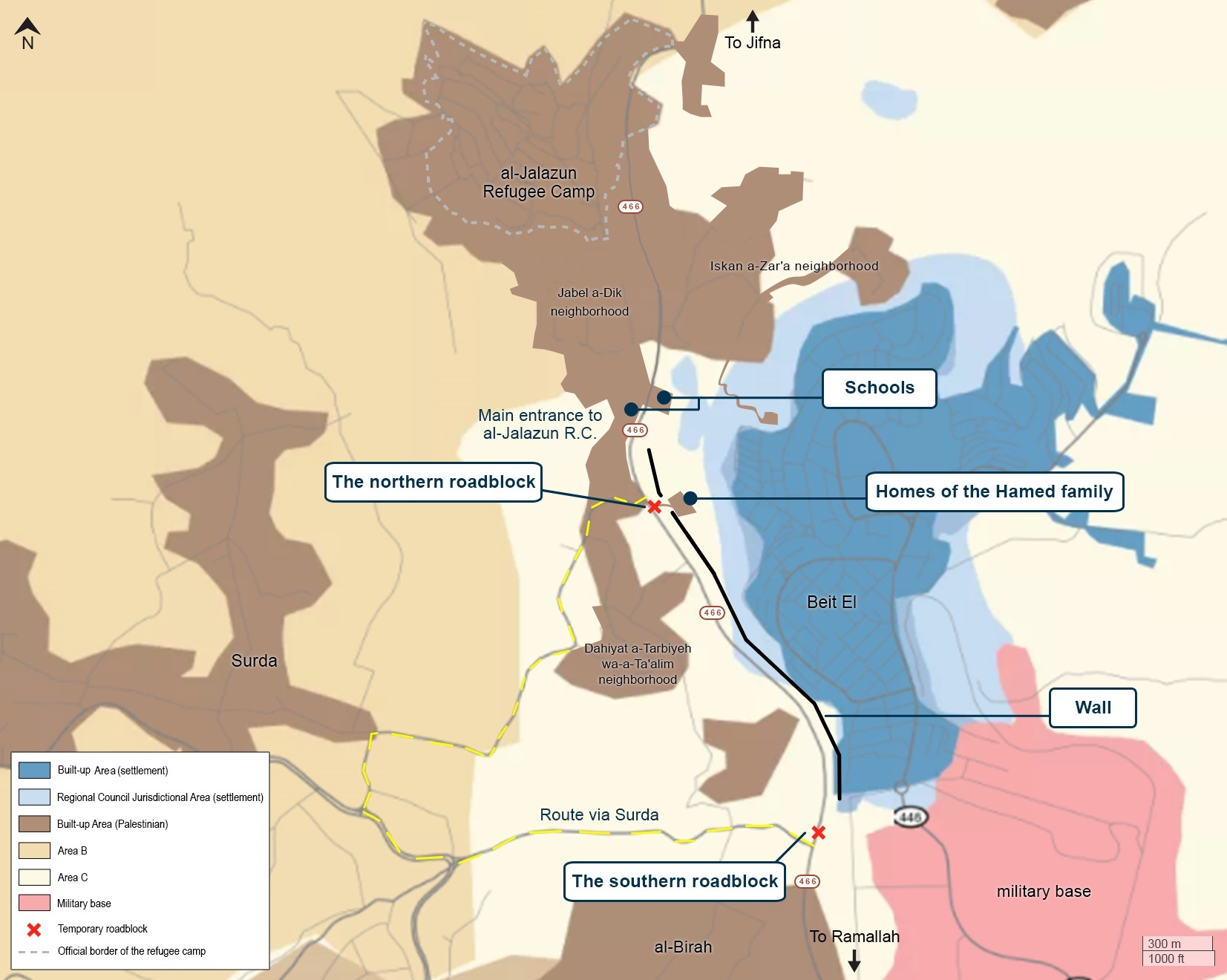
Map by B’Tselem
The Israeli army frequently denies al-Jalazun residents the right to use roads near Beit El, which severely restricts their ability to commute to jobs or seek medical treatment, or to simply go about their lives unmolested. Additionally, the Beit El settlement successfully lobbied the Israeli government to build a massive separation wall between the settlement and the refugee camp, a wall which has cut-off one Palestinian family from the camp.
B’Tselem compiled numerous testimonies from residents of al-Jalazun refugee camp that shed light on how such severe infringements on freedom of movement have impacted their daily lives. On resident, Muhammad Safi, said:
“Life here has become unbearable. If it happened once a year, or even once a month, I might have been able to live with it, but for months it happened here every day and it was unbearable. The humiliation, the anxiety, the fear I and other taxi drivers working this route feel all the time can make a person sick. I’m thinking about looking for other work, but there aren’t too many alternatives. I pray to God to make it better for us.”
“Settlements Are A War Crime”: UN High Commissioner Weighs in on 2017 Settlement Activities
The United Nations High Commissioner for Human Rights recently submitted the annual report tracking the expansion of Israel settlements, documenting activities from November 2016 through October 2017. The report covers a lot of ground — documenting and condemning Israeli activities in Area C of the West Bank, legislative initiatives concerning Jerusalem, discriminatory planning and zoning practices, home demolitions and evictions, the role of Israeli security forces, an increase in settler violence, and instances of collective punishment. It also reiterates that all Israeli settlements in occupied territories are a war crime under the Fourth Geneva Convention.
In a key section describing how many of these policies create what the report calls a “coercive environment” that amounts to a population transfer, the report says:
“Forcible transfer does not necessarily require the use of physical force by authorities; it may be triggered by specific factors that give individuals or communities no choice but to leave, amounting to what is known as a ‘coercive environment’. Any transfer without the genuine and fully informed consent of those affected is considered forcible. Genuine consent to a transfer cannot, however, be presumed in an environment marked by the use or threat of physical force, coercion, fear of violence, or duress (A/HRC/34/38, para. 28; A/HRC/34/39 para. 41). Human rights, such as the rights to freedom of movement, privacy and family life, in addition to economic, social and cultural rights (A/HRC/16/71, para. 24), are usually violated within the context of forcible transfer.”
Bonus Reads
- “Do Israeli Settlers Have Any Power in America?” (The Forward)
- “Israeli Settlers Hold Country Hostage to their Ideology”(Al-Monitor)
- “West Bank demolitions and displacement continue at similar pace to 2017” (OCHA)