Welcome to FMEP’s Weekly Settlement Report, covering everything you need to know about Israeli settlement activity this week.
To subscribe to this report, please click here.
February 15, 2019
- Israel Announces Plan to Retroactively Legalize Settlement Units Built on Privately Owned Palestinian Land
- Jerusalem Planning Authorities Are Quietly Advancing Sensitive Settlement Projects in East Jerusalem
- Peace Now Files Appeal Against Settler Land Grab for New “E-2/Givat Eitam” Settlement
- Peace Now Petitions High Court to End Flow of Public Funds to Settler Organization
- AG Paves Way for Ariel Medical School to Open, Despite Rejection by Key Committee
- Following Expulsion of International Observers, Emboldened Settlers Attack Palestinians
- Yitzhar Settlers Attack Palestinian School, So IDF Restricts Palestinian Access to Roads to Allow Yitzhar Settler Protests
- NEW: Ir Amim Publishes 2019 Map of Settlement Projects In and Around Jerusalem’s Old City
- Bonus Reads
Questions/comments? Email kmccarthy@fmep.org
Israel Announces Plan to Retroactively Legalize Settlement Units Built on Privately Owned Palestinian Land
On February 10th, the Israeli government informed the Jerusalem District Court that it plans to invoke the “market regulation” principle in order to retroactively legalize four structures in the Alei Zahav settlement – structures built on land that even Israel acknowledges is privately owned by Palestinians.
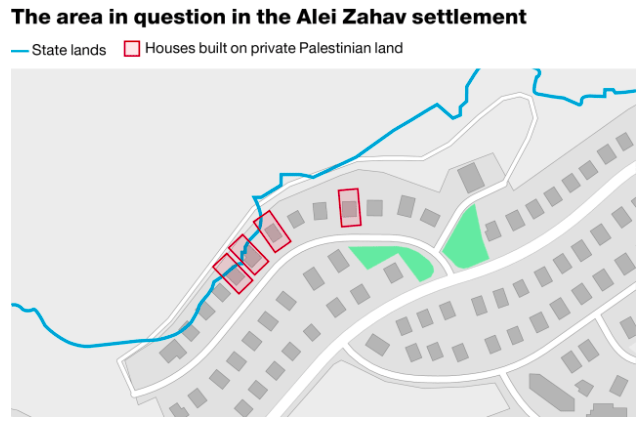
According to Haaretz, a 2016 land survey conducted by the Israeli Civil Administration discovered the existence of privately owned Palestinian land in the settlement, which older Israeli maps had marked as “state land.” After the discovery, settlers went to court to sue the World Zionist Organization (which was allocated the land by the Israeli government), the Israeli Defense Ministry, and the contractor who built the settlement demanding that they fix the situation. The state’s response to the Jerusalem District Court this week freezes the settler’s petition while the government’s plan is implemented.
The “market regulation” principle was identified by Israeli Attorney General Avichai Mandelblit as an alternative to the settlement Regulation Law (the controversial law passed by the Knesset that, in effect, lets the Israeli government suspend the rule of law to seize privately owned Palestinian land for the benefit of settlers). Both the Regulation Law and the “market regulation” principle are designed to give Israel legal cover to retroactively legalize outposts and settlement structures that, because they are built on land that Israel acknowledges is privately owned by Palestinians, the State had been unable legalize under existing Israeli law (despite great efforts to do so). The “market regulation” principle holds that Israeli settlement construction can be retroactively legalized if it was carried out “in good faith” with government support on land that was later discovered to be privately owned by Palestinians.
The Israeli High Court is already considering a petition against the constitutionality of the “market regulation” principle, a case stemming from the State’s first attempt to implement it in order to retroactively legalize the Mitzpe Kramim outpost.
If allowed to proceed on the basis of the “market regulation” principle, the state will first have to publish an official planning scheme for the area, and allow the public (including the Palestinian landowners, as recognized by Israeli) to object. Attorney Alaa Mahajna, who is representing the Palestinian landowners involved in the case, said:
“Even without making use of the vilified expropriation law [aka the Regulation Law], the state still finds ways and uses other routes to attain the same goal, giving its legal imprimatur to robbery of land, with residents who are protected under international law.”
FMEP tracks the ongoing legislative, political, and legal transformations happening in the Israeli government to justify the expropriation of Palestinian land for the settlements in its Annexation Policy Tables.
Jerusalem Planning Authorities Are Quietly Advancing Sensitive Settlement Projects in East Jerusalem
Ir Amim reports that East Jerusalem settlement planning authorities are advancing sensitive settlement projects in East Jerusalem through secretive and expedited processes, thereby limiting the opportunity for stakeholders and the public to challenge the plans.
For example, on February 5th, the Jerusalem Local Planning and Building Committee discussed public objections filed against two settlement plans in Sheikh Jarrah. Both of the plans are being promoted by East Jerusalem settlement impresario and city council member Aryeh King. The committee did not notify those objecting to the plan that these proceedings were planned, and so no one objecting to the plan was present in the February 5th discussion. The plans, which would allow for the construction of two new buildings – one with 10 units and the other with 3 units – would involve the eviction of 5 Palestinian families from buildings that would be demolished.
On February 17th, the Jerusalem District Planning and Building Committee will consider the Glassman Yeshiva project – a plan to build a Jewish religious school, including dormitories, at the entrance to the Sheikh Jarrah neighborhood. Ir Amim reports that it is unclear what the committee will do in considering the plan, since authorities have advanced the plan outside of the normal planning process, even succeeding in have land allocated for the yeshiva despite the fact that the plan was never deposited for public review (meaning stakeholders and the public have had no opportunity to object).
Ir Amim writes:
“Despite their tremendous political and environmental sensitivity, plans are now being fast tracked, some outside of appropriate planning channels and with limited public participation, in service to decidedly political considerations and with the prominent involvement of settler associations. The new map and accompanying map notes detail the numerous projects and eviction cases now advancing.”
For an explanation of how East Jerusalem settlement planning/approval is supposed to work under Israeli law and practice, see Terrestrial Jerusalem’s presentation here.
Peace Now Files Appeal Against Settler Land Grab for New “E-2/Givat Eitam” Settlement
On February 7th, the settlement watchdog group Peace Now and dozens of Palestinian landowners filed a petition with the Israeli Custodian of Government and Abandoned Property demanding the annulment of the allocation of “state land” for the sole declared purpose of building the new “E-2/Givat Eitam” settlement.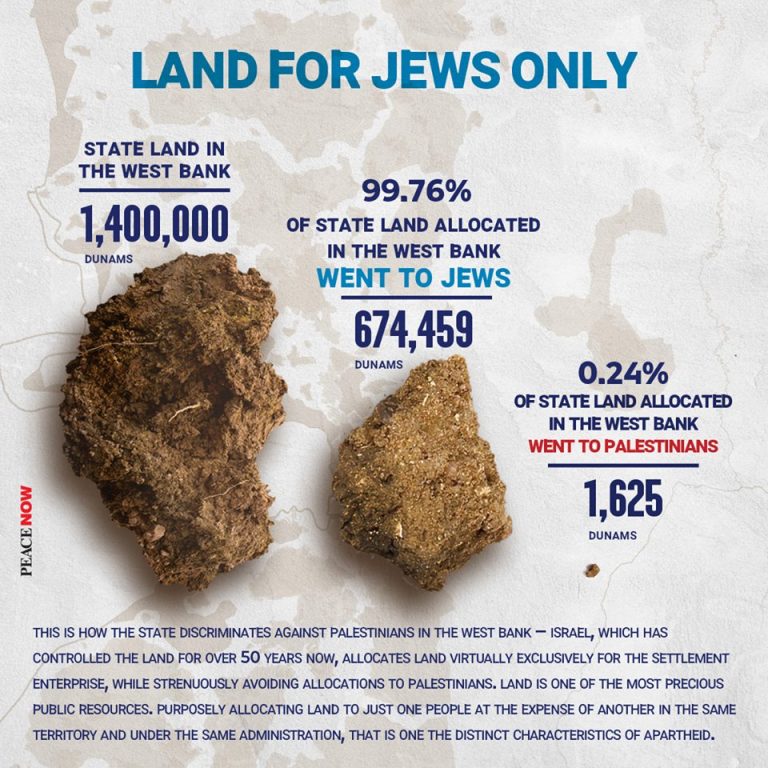 Rather than challenging Israel’s classification of the land as “state land,” the petition asks that the land be allocated instead for Palestinian use, challenging Israel’s discriminatory allocation of “state land” for the settlements. It builds on recent revelations that since 1967, Israel has allocated a jaw-dropping 99.8% of state land in the West Bank to settlements and just 0.2% for Palestinians.
The petition argues that the allocation of state land for the exclusive use of settlements/settlers is illegal both under the Hague Conventions and under domestic anti-discrimination laws in Israel.
Regarding the new petition, Peace Now says:
“Since the 1979 Elon Moreh ruling, no petition has succeeded in undermining the legal infrastructure that enables the ongoing expansion of the settlement enterprise. This initiative and the surrounding public struggle aims to undermine the prevailing view that “state land” in the occupied territories effectively constitutes land available for Israeli use, and to obligate the Supreme Court and the Israeli public, to address this fundamental question.”
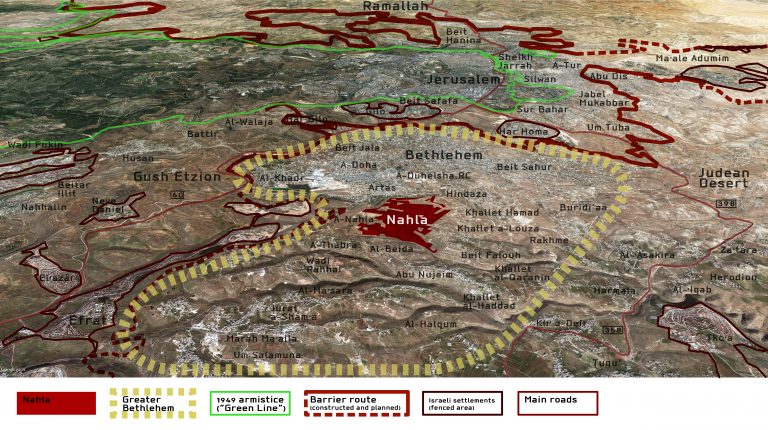
Israel announced on December 26, 2018 that it will draft plans to build as many as 2,500 new settlement units at the Givat Eitam outpost site, creating a new settlement on a strategic hilltop that will cut off Bethlehem from the southern West Bank, completing the encirclement of Bethlehem by Israeli settlements.
Map by Peace Now
The Givat Eitam outpost has been nicknamed “E-2” by settlement watchers for for its resemblance, in terms of dire geopolitical implications, to the infamous E-1 settlement plan. Located east of the separation barrier on a strategic hilltop overlooking the Palestinian city of Bethlehem to its north, the site of Givat Eitam/E-2 is within the municipal borders of the Efrat settlement but is not contiguous with Efrat’s built-up area. As such, Givat Eitam/E-2 would effectively be a new settlement that, according to Peace Now, would:
“block Bethlehem from the south, and prevent any development in the only direction that has not yet been blocked by settlements (the city is already blocked from the North by the East Jerusalem settlements of Gilo and Har Homa, and from the West by the Gush Etzion Settlements) or bypass roads (that were paved principally for Israeli settlers). The planned building in area E2 would likely finalize the cutting off of Bethlehem city from the southern West Bank, delivering a crushing blow to the Two States solution.”
Peace Now Petitions High Court to End Flow of Public Funds to Settler Organization
The settlement watchdog group Peace Now has filed a petition with the High Court of Justice to stop public funding flowing to the radical Amana settler organization, which is a private, for-profit entity engaging in various illegal activities to establish and expand Israeli settlements and outposts across the West Bank.
The new petition is based on Peace Now’s investigative work revealing the substantial amount of money that has been secretly funneled to Amana through settlement regional councils. The settlement regional council budgets obtained by Peace Now revealed that money allocated to support non-profit public welfare groups was instead being used to fund Amana. Funding for Amana in this manner violates Israeli Interior Ministry policies prohibiting public subsidies for private, for-profit entities – and it is this funding that Peace Now is petitioning the High Court to end.
Peace Now’s work is backed up two separate reports of the Israeli Comptroller’s office, one from November 2017 and another from July 2018, which detailed the extent to which the Binyamin Regional Council – the largest settlement regional council – secretly funneled money to organizations engaged in illegal settlement construction. The July 2018 report revealed that the Binyamin Regional Council funneled $10 million to Amana between 2013-2015 alone.
Peace Now said in a statement:
“This grave phenomenon in which taxpayers’ money is transferred to an organization that has specialized in construction violations for decades, is against the law and regulations; an organization that works tirelessly to change reality by illegally establishing unauthorized facts on the ground, is dire and must be stopped. Only a complete cessation of this cash flow will prevent further construction rampages throughout the West Bank, and retain the opportunity for a future agreement.”
AG Paves Way for Ariel Medical School to Open, Despite Rejection by Key Committee
On February 13th, Israeli Attorney General Avichai Mandelblit announced that the vote last week by the Planning & Budgeting Committee of the Council for Higher Education in Israel is a non-binding recommendation, and that the fate of the Ariel settlement’s new medical school will be determined by a final vote to be held by the council’s main body. In so doing, Mandelblit made it possible for the main body of the Council for Higher Education in Israel to vote against its own professional subcommittee, contrary to the normal practice. Indeed, Haaretz columnist Or Kashti even called it “unreasonable.”
Mandelblit said that the Council for Higher Education in Israel should reconvene to vote within the next two months in order to give the medical school, its faculty, and its students, adequate time to prepare. Haaretz reports that Education Minister Naftali Bennett – who serves as the Chairman of the Council for Higher Education in Israel – is expected to delay the vote until he is confident that he has enough votes in favor of approving the medical school.
In addition, Mandelblit also allowed the West Bank arm of the Council for Higher Education – a settler body which oversees and promotes educational institutes located in West Bank settlements (i.e. outside of sovereign Israeli territory) – to take vote on the matter. Unsurprisingly, on Feb. 13th the settler body voted unanimously to approve the medical school. It did so in a vote that was held in the final hours before that settler body was absorbed by Council for Higher Education in Israel, following a law passed by the Israeli Knesset in Feb 2018 that extends the jurisdiction of the Council for Higher Education in Israel to include schools in the settlements (an act of de facto annexation).
Weighing in on the debate, the Haaretz Editorial Board noted that supporters of the Ariel medical school – including Naftali Bennett – lobbied for the settlers’ own Council for Higher Education to be permitted to vote on the matter in an attempt to overrule the Planning & Budgeting Committee’s unfavorable decision. The Board writes:
“In a country governed by the rule of law, the [Planning & Budgeting] committee’s latest vote should have settled the matter. But Ariel University and its supporters, above all Education Minister Naftali Bennett, have ways to circumvent the committee. We will soon find out whether Mendelblit will approve this move, enabling Ariel to overcome the professional objections of the Planning and Budgeting Committee, the opposition of the other universities and Wadmany Shauman’s conflict of interest. This hasty resort to the Council for Higher Education in Judea and Samaria – which has never dealt with budgetary issues, only ideological ones – should set off alarm bells. After the Planning and Budgeting Committee’s previous vote, approving the med school, no one demanded reaffirmation from the council. That’s not how the higher education system should operate. The Planning and Budgeting Committee steers its course, including the disbursal of its 11 billion shekel ($3 billion) annual budget.”
As FMEP has previously reported, Ariel University became an accredited Israeli university in 2012, following significant controversy and opposition, including from Israeli academics. It has since been the focus of additional controversy, linked to what is a clear Israeli government-backed agenda of exploiting academia to normalize and annex settlements. In 2018, the settlement broke ground on the new medical school, with significant financial backing from U.S. casino magnate, settlement financier, and Trump backer Sheldon Adelson. In February 2018, in an act of deliberate de facto annexation, the Israeli Knesset passed a law extending the jurisdiction of the Israeli Council on Higher Education over universities in the settlements (beyond Israel’s recognized sovereign borders), ensuring that the Ariel settlement medical school (and its graduates) would be entitled to all the same rights, privileges, and certifications as schools and students in sovereign Israel.
The Ariel settlement is located in the heart of the northern West Bank, reaching literally to the midpoint between the Green Line and the Jordan border. The future of Ariel has long been one of the greatest challenges to any possible peace agreement, since any plan to attach Ariel to Israel will cut the northern West Bank into pieces.
Following Expulsion of International Observers, Emboldened Settlers Attacks on Palestinians
In the week since Israeli Prime Minister announced that he would not renew the mandate of the Temporary International Presence in Hebron (TIPH) – in effect, expelling international observers from the city – radical, violent settlers have repeatedly harassed and attacked Palestinians, including school children. Thus far the Israeli military has failed to intervene to stop the encounters.
Following the expulsion of the observers, who previously escorted Palestinian school children on their daily commute near settlement enclaves in downtown Hebron, Palestinians formed a volunteer group to escort and protect the children. On February 10th, alarming video footage shows settlers harassing and attacking this new group as it was escorting children. In response, the Israeli army issued an order on Feb. 13th that declared the area as a closed military zone, barring the volunteers from escorting the students.
On the evening of February 12th, a group of settlers attacked Palestinian homes on Shuhada Street, the main street in downtown Hebron which Israel has “sterilized” by preventing all Palestinian vehicles, limiting Palestinian pedestrians, and relegating Palestinian foot traffic to a specific area. One Palestinian resident reported that a settler jumped onto his roof and broke into his home; the IDF had to escort the settler out, and disperse the group of settlers who were chanting anti-Palestinian threats. Video footage captured the scenes.
Yitzhar Settlers Attack Palestinian School, So IDF Restricts Palestinian Access to Roads to Allow Yitzhar Settler Protests
On February 10th, dozens of settlers from the Yitzhar settlement descended from their hilltop neighborhood to violently attack a high school in the Palestinian village of Urif. According to reports, high school students clashed with IDF soldiers who were providing protection for the raiding group of settlers. Ten students reportedly required medical care for tear gas inhalation.
The next day, on February 11th, the Israeli IDF sealed off several roads near the Yitzhar settlement to allow the settlers to assemble to protest against “the deteriorating security situation in the West Bank.”
The anti-settlement group Yesh Din recently published a report, entitled “Yitzhar – A Case Study,” chronicling the violence of the Yitzhar settlement, and how that violence is used as a strategic means to take over Palestinian land.
NEW: Ir Amim Publishes 2019 Map of Settlement Projects In and Around Jerusalem’s Old City
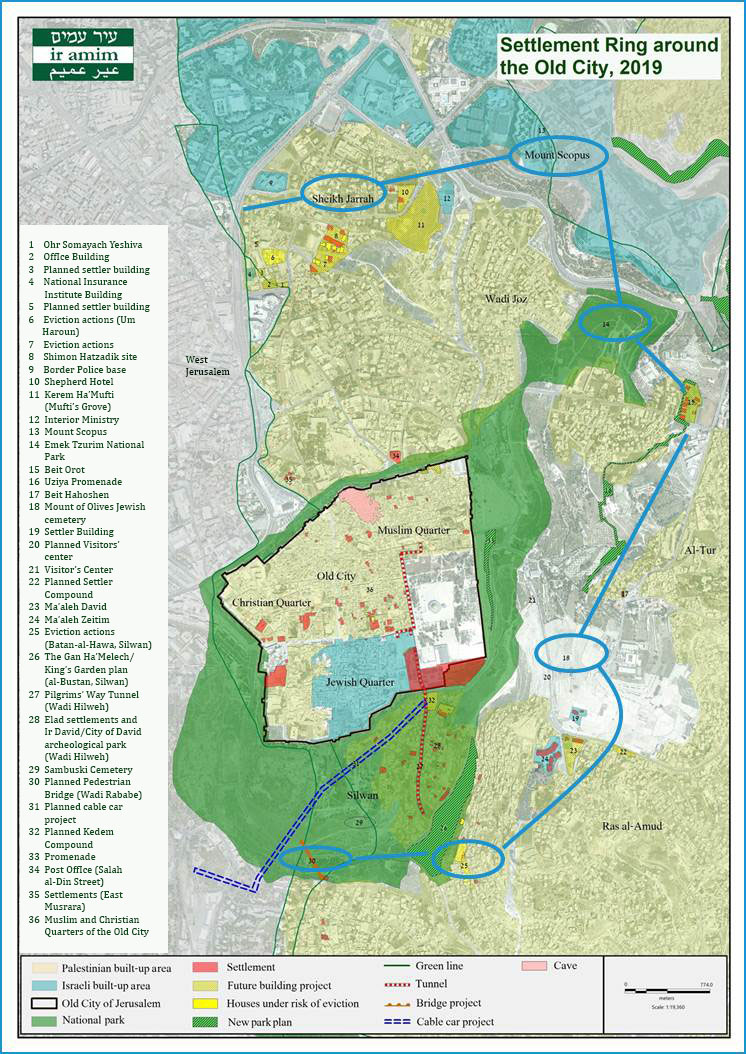 Ir Amim released an updated map showing settler activities around Jerusalem’s Old City.
Announcing the new map, Ir Amim writes:
“Ir Amim’s latest map, ‘Settlement Ring around the Old City, 2019,’ graphically illustrates the accelerated, intensifying chain of new facts on the ground in the most historically contested and politically sensitive part of Jerusalem: the Old City and adjacent ring of Palestinian neighborhoods. In addition to a mounting number of state-sponsored settlement campaigns inside Palestinian neighborhoods – settler initiated evictions of Palestinians, takeovers of their homes, and the expansion of settler compounds – touristic settlement sites function as key points along a ring of tightening Israeli control….These projects – including promenades, national parks and visitor centers – serve manifold purposes: They connect otherwise isolated and relatively small settlement compounds inside Palestinian neighborhoods, creating a contiguous ring of settler controlled areas; They fracture the Palestinian space, disrupting freedom of movement and breaking large neighborhoods into smaller, easier to police enclaves;While the number of ideologically driven settlers living inside Palestinian neighborhoods may still be relatively small, tens of thousands of non-ideological Israeli tourists visiting these sites serves to strengthen the Jewish presence inside Palestinian areas of the city.”
The map can be downloaded here and accompanying detailed notes here.
Bonus Reads
- “Why Residents of Jerusalem’s Sheikh Jarrah Face Eviction” (Al-Monitor)
- “Imminent Eviction of Palestinian family in East Jerusalem” (OCHA)
- “Two Jewish Groups’ Disagreement Over Jewish Law Might Dash Jerusalem’s Dreams (Haaretz)
- “What Kind of Occupation do Israelis Want?” (Ynet)
Welcome to FMEP’s Weekly Settlement Report, covering everything you need to know about Israeli settlement activity this week.
To subscribe to this report, please click here.
February 8, 2019
- Another Challenge to Israel’s Plan to Retroactively Legalize Adei Ad Outpost
- New Eviction Proceedings Against Two Palestinian Families in the Muslim Quarter of the Old City
- Higher Education Council Reverses Approval of Adelson-Backed Medical School in Ariel University
- Activists Ask High Court to Revoke Status of West Bank Nature Reserve Run By Settlers
- Settlers Threaten to Blacklist Palestinians Who Work with Human Rights Organizations
- Prominent Israeli Politicians Pledge To End Two-State Solution
- 40 Ambassadors to the United Nations Visit Settler-Run Tourist Site in Occupied East Jerusalem
- Settler Org Credits Trump for Growth in West Bank Settler Population & Death of Two-State Solution
- New B’Tselem Report Slams High Court for Role in Dispossessing Palestinians, Validating Occupation
- Video Compilation of Likud Candidates Touting Role of Tourism in Expanding Settlements
- EU Settlement Report Details “Unprecedented” Level of Settlement Advancements 2018
- Bonus Reads
Questions/comments? Email kmccarthy@fmep.org
Another Challenge to Israel’s Plan to Retroactively Legalize Adei Ad Outpost
On January 31st, Yesh Din filed a petition with the High Court of Justice to reverse an expansion of “state land” boundaries in the Shiloh Valley that seized privately owned Palestinian land in order to retroactively legalize the notoriously (and recently) violent Adei Ad outpost.
In 2014, Palestinian landowners, in cooperation with Yesh Din, first petitioned the Court to evacuate the unauthorized Adei Ad outpost which was built on their land in contravention of both international and Israeli law. Instead of enforcing the law, the Israeli Civil Administration announced that it would “reexamine” the boundaries of state land in the area, an examination which found that Adei Ad was, according to the new Israeli mapping of the area, built on state land. To make the findings of the reexamination official, the Civil Administration used an entirely new procedure (a “declaration amendment”) to expand the boundaries of a previous state land declaration. In so doing, the Civil Administration found a way to avoid issuing a new state land declaration, which can be challenged in a court by Palestinians and legal groups like Yesh Din. For “declaration amendments,” landowners can only seek recourse through the Civil Administration. Objections filed to the expansion of state land in this case were all dismissed.
The new Yesh Din petition filed on January 31st challenges the secretive and unjust process by which the Civil Administration expanded the scope of state land to include the Adei Ad outpost. The petition reads:
“[…] Not only does the procedural structure for objection to the declaration, as stated in the procedure, substantially diminish the rights of the petitioners and other objectors who seek to receive their day in court before an independent and impartial judiciary (which is offered without exception to their neighbors, indicative of institutional discrimination), but even in substantive terms, the decision of the first respondent [the head of the Civil Administration] was carried out in violation of the law, in contrast to judicial decisions, in a manner entirely lacking transparency and conveying the arbitrariness that ultimately results from irrelevant considerations — the desire to legalize the outpost of Adei Ad at all costs.”
The new petition seeks to stop the implementation of the next step in the Civil Administration’s process to retroactively legalize Adei Ad, a plan that was announced in August 2018. Under the scheme, Adei Ad will be retroactively legalized by defining it as a “neighborhood” of the Amichai settlement – the first new government-backed settlement in 25 years, approved as payoff to the settlers who were evacuated from the unauthorized Amona outpost – located nearby.
In 2013, Yesh Din published a lengthy report about the Adei Ad outpost – how it was established and how the settlers who live there use violence to take over more and more land from nearby Palestinians.
Kerem Navot recently wrote:
“The outpost of Adei Ad has the hard-earned dubious reputation as one of the wildest and most violent outposts in the West Bank. Since its establishment in the late 1990s, settlers have initiated numerous violent incidents, all based on one simple rationale: take control of as much land as possible. As a reward for 20 years of wreaking havoc, the state is currently authorizing the outpost and has recently deemed it a ‘neighborhood.’ Guess whose: a ‘neighborhood’ of the settlement of Amichai that was established less than two years ago after the state granted “compensation” estimated at 300 million shekels, to the group of land thieves who were evicted from the outpost of Amona.”
New Eviction Proceedings Against Two Palestinian Families in the Muslim Quarter of the Old City
Ir Amim reports that settlers are behind two new eviction proceedings against Palestinians in the Muslim Quarter of the Old City of Jerusalem.
In the first case, the Abu Asab family received a notice that they must vacate their home in the Muslim Quarter by February 12th. The family has been renting the house since the 1960s, when the Old City was under the authority of the Jordanian government, which managed leases for vacant properties. In 2014, a settler-run trust – the Maisel Trust – petitioned to annul the family’s protected tenancy rights, arguing that those rights had been lost when the original tenants allegedly “abandoned” the property (the current residents are second generation relatives of the original renters). The Court ruled in the settlers’ favor in, and a subsequent appeal against the ruling was rejected.
In the second case, just 100 meters away from the Abu Asab family home, the Ghaith-Sub Laban family was warned that another settler-managed trust – the Gengel Trust – filed a new request for their eviction, arguing that the original tenants had abandoned the home and therefore forfeited their protected tenancy rights. The new eviction proceedings were initiated despite a 2016 Supreme Court ruling that held that Nora Gaith and husband Mustafa Sub Laban are legally allowed to remain in the apartment for 10 years), at which time their protected tenancy will be (prematurely) terminated and their children’s status as protected tenants annulled.
Ir Amim notes that there are a total of eight Palestinian families at imminent risk of eviction in the Muslim Quarter of the Old City, all in close proximity to the cases detailed above.
Higher Education Council Reverses Approval of Adelson-Backed Medical School in Ariel University
On February 7th, the Planning & Budgeting subcommittee of Israel’s Higher Education Council voted 3-2 against the approval of a medical school in Ariel University, reversing the subcommittee’s previous vote to approve the medical school in July 2018.
The Israeli Attorney General’s office ordered the second vote after it was revealed that one of the members of the subcommittee should not have been able to vote in July 2018, due to a major conflict of interest (Ariel University had promised the individual a promotion in the event the school was approved).
Since receiving the approval in July 2018, Ariel University has taken significant steps towards opening the medical school this fall, despite multiple unfolding controversies surrounding the process by which the school was approved. In addition to addition to the controversy surrounding the July 2018 vote, Israeli Education Minister Naftali Bennett is accused of violating government rules to secure a legal opinion in favor bringing the school under Israeli domestic laws (an act of de facto annexation). Bennett is also accused of inappropriately intervening to expedite the approval of the school.
In response to the vote Israeli Education Minister Naftali Bennett, said:
“I do not intend to give up. I will fight the university cartel until we establish the Faculty of Medicine at Ariel University.”
Following the vote, the settler Yesha Council (an umbrella group which lobbies on behalf of the settlements) issued a statement saying:
“We expect the Israeli government to handle the matter and renew the permit in the coming year.”
As FMEP has previously reported, Ariel University became an accredited Israeli university in 2012, following significant controversy and opposition, including from Israeli academics. It has since been the focus of additional controversy, linked to what is a clear Israeli government-backed agenda of exploiting academia to normalize and annex settlements. In 2018, the settlement broke ground on the new medical school, with significant financial backing from U.S. casino magnate, settlement financier, and Trump backer Sheldon Adelson. In February 2018, in an act of deliberate de facto annexation, the Israeli Knesset passed a law that extends the jurisdiction of the Israeli Council on Higher Education over universities in the settlements (beyond Israel’s recognized sovereign borders), ensuring that the Ariel settlement medical school (and its graduates) would be entitled to all the same rights, privileges, and certifications as schools and students in sovereign Israel.
As a reminder, Ariel is located in the heart of the northern West Bank, reaching literally to the midpoint between the Green Line and the Jordan border. The future of Ariel has long been one of the greatest challenges to any possible peace agreement, since any plan to attach Ariel to Israel will cut the northern West Bank into pieces.
Activists Ask High Court to Revoke Status of West Bank Nature Reserve Run By Settlers
A group of Israeli human rights activists have petitioned the Israeli High Court to revoke the special status of the Umm Zuka nature reserve and firing zone in the West Bank, saying the Israel’s designation of the land as a protected area has only served as a pretext to remove Palestinians and allow settlers to take over.
The petition goes on to explain that Israeli settlers have built an unauthorized outpost on the land that is slated to be added to the existing nature reserve, and have essentially turned the wilderness area into a private settler park where Palestinians are not allowed to enter. Despite complaints, the Israeli Civil Administration has not removed the unauthorized outpost – which consists of several structures connected to the water, sewage, and electricity of a nearby army base. The Civil Administration spokesperson told Haaretz that it is undertaken unspecified “enforcement proceedings” against the unauthorized outpost.
Eitay Mack, a lawyer who filed the petition on behalf of the group, told Haaretz:
“the reserve and the firing zone have effectively become a private settler farm that receives personal security service from Israel Defense Forces soldiers and bars entry to the farm’s enormous territory on the basis of ethnicity, nationality, religion and political opinions.”
Settlers Threaten to Blacklist Palestinians Who Work with Human Rights Organizations
Settlers have taken to posting signs in Palestinian villages warning that Palestinians who cooperate with human rights organizations will be prohibited from working in of Israeli settlements. The posters threaten:
“Do you wish to keep working in the settlements? Do you want to provide a living for your families from the Jews? Whoever cooperates with any one of these individuals and organizations (Ta’ayush and Rabbis for Human Rights) will never be allowed to enter the settlements for work. Be warned!”
+972 Magazine reports that the settlers behind the posters have also distributed leaflets to business owners inside of the settlements which list names of Palestinians alleged to work with (or have family members who work with) human rights groups – ostensibly encouraging Israeli business owners to fire them.
An Israeli activist working with the Tayyush organization (which is named on the posters as a group Palestinians cannot work with) explained:
“These flyers are yet another reminder that we [Israeli human rights groups] are a target of far-right groups, which get their marching orders from the Israeli government. The goal is clear: to expel Palestinians from their Area C of the West Bank and minimize their ability to defend themselves.”
Observers have noted the similarity between these flyers and signs posted by the Ku Klux Klan in the US years back targeting Black Americans.
Prominent Israeli Politicians Pledge To End Two-State Solution
In the context of Israel’s current election campaign, dozens of Israeli politicians have signed a pledge to the “Nahalah Movement” which reads:
“I hereby commit to be loyal to the land of Israel, not to cede one inch of our inheritance from our forefathers. I hereby commit to act to realize the settlement plan for the settlement of 2 million Jews in Judea and Samaria in accordance with Prime Minister Yitzhak Shamir’s plan, as well as to encourage and lead the redemption of all the lands throughout Judea and Samaria. I commit to act to cancel the declaration of two states for two peoples and replace it with the stately declaration: The land of Israel: One country for one people.”
Among the most prominent signatories are Knesset Speaker Yuli Edelstein (Likud), Transportation Minister Yisrael Katz (Likud), Justice Minister Ayelet Shaked (New Right) Education Minister Naftali Bennett (New Right), Tourism Minister Yariv Levin, Environmental Protection and Jerusalem Affairs Minister Zeev Elkin, Public Security Minister Gilad Erdan, Culture Minister Miri Regev, Regional Cooperation Minister Tzachi Hanegbi, Communication Minister Ayoub Kara, Immigration and Absorption Minister Yoav Galant, Social Equality Minister Gila Gamliel.
The petition was introduced and signed as the climax of the Nahalah Movement’s two-week-long protest outside of Prime Minister Netanyahu’s residence in Jerusalem. The activists were protesting what they portray as Netanyahu’s policy of severely restricting settlement construction. The Nahalah movement calls for unconstrained settlement construction and the establishment of new settlements. The Nahalah Movement released a statement saying:
“The signing of the petition opposite the Prime Minister’s Residence at the height of the Likud primary election campaign and at the height of the efforts to compile the [Knesset] lists in the right-wing and center bloc and in particular ahead of the coming election campaigns constitutes an ideological and ethical loyalty test for the various contenders.”
The settlement agenda promoted by former Prime Minister Yitzhak Shamir – the one mentioned in the Nahalah pledge – was one of unrestrained growth and absolute opposition to compromise with the Palestinians and/or Arab governments in the region. Notably, Shamir’s promotion of the settlement enterprise was strongly opposed by then-U.S. President George W. Bush, who threatened to cut U.S. aid to Israel if settlement construction did not stop.
40 Ambassadors to the United Nations Visit Settler-Run Tourist Site in Occupied East Jerusalem
A group of 40 Ambassadors to the United Nations visited a tourist site run by the radical Elad settler organization in the East Jerusalem neighborhood of Silwan. The delegation was led by Israel’s own Ambassador to the UN, Danny Danon, who appeared on video saying:
“We arrive today with nearly 40 UN Ambassadors to the City of David, Ir David, to show them the real truth about Israel….when the Ambassadors come here and they see for themselves the history of the Jewish people they understand why you cannot disconnect the Jewish people from our eternal capital Jerusalem.”
In the same clip, the President of Elad (aka the “City of David Foundation”) said:
“Why are they here? Far away from the halls of the United Nations building, here they will travel with us through the field and actually lift up the archaeological evidence and see the facts in front of their eyes. This is not a matter of fantasy and not only a matter of faith. Here we have facts that prove the connection of the Jewish people to Jerusalem.”
As a reminder, the explicit ambition of the Elad settler organization is to increase Jewish hegemony across all of Jerusalem at the explicit and intended expense of the Palestinian East Jerusalemites. In Silwan in particular, Elad has undertaken a multi-faceted campaign to evict Palestinians and increase the number of Jewish settlers living there.
Intending to give a backhanded compliment to the visiting delegation, Eugene Kontorovich – who heads the international law department at the Kohelet Policy Forum, a right-wing pro-settlement organization – tweeted that the UN Ambassadors must not agree with U.N. Resolution 2334, which calls on the international community to differentiate between Israel and areas occupied by Israel in their dealings in the region. Kontorovich also told Jewish Insider:
“The Security Council resolution calls on countries to ‘differentiate’ between Israel and territories that came under its control in 1967. The resolution is of course not binding, and by going on in official state visit across the green line in the company of Israeli government officials, these UN ambassadors show that they are fully aware what a dead letter the resolution is.”
As a reminder, Kontorovich self-identifies as a key figure in the drafting of “anti-BDS” (but actually, anti-free speech/pro-settlement) laws in the United States. At the core of these laws is the conflation of Israeli settlements with Israeli proper, based on Kontorovich’s argument that Israel is not occupying Palestinian territory. Kontorovich has also testified multiple times to U.S. Congress, including in support of moving the U.S. Embassy to Jerusalem; in support of Congress legislating U.S. foreign policy, including with regard to Jerusalem; on the impact of the BDS movement, and in support of U.S. recognition of Israel’s sovereignty over the Golan Heights.
Settler Org Credits Trump for Growth in West Bank Settler Population & Death of Two-State Solution
A settler-run organization has released an analysis of Israeli government data citing the Trump Administration as a key driver of a “surge” in the growth rate of the Israeli settler population in 2018, and predicted a larger surge to come. The group claims the settler population in the West Bank grew by 3.3% last year (449,508 – excluding East Jerusalem – as of January 2019), compared to a 1.9% increase in Israel’s overall population.
The director of the group, Baruch Gordon, told the Associated Press:
“Since the change of the U.S. administration, the atmosphere for construction permits has become much easier. They’re being given with greater ease. I think possibly the next report and certainly in the ones after that, I think we’ll start to see a huge surge in the numbers here….Those who continue to talk about a two-state solution, in my mind it’s just a sign that they’re removed from the reality and the facts on the ground.”
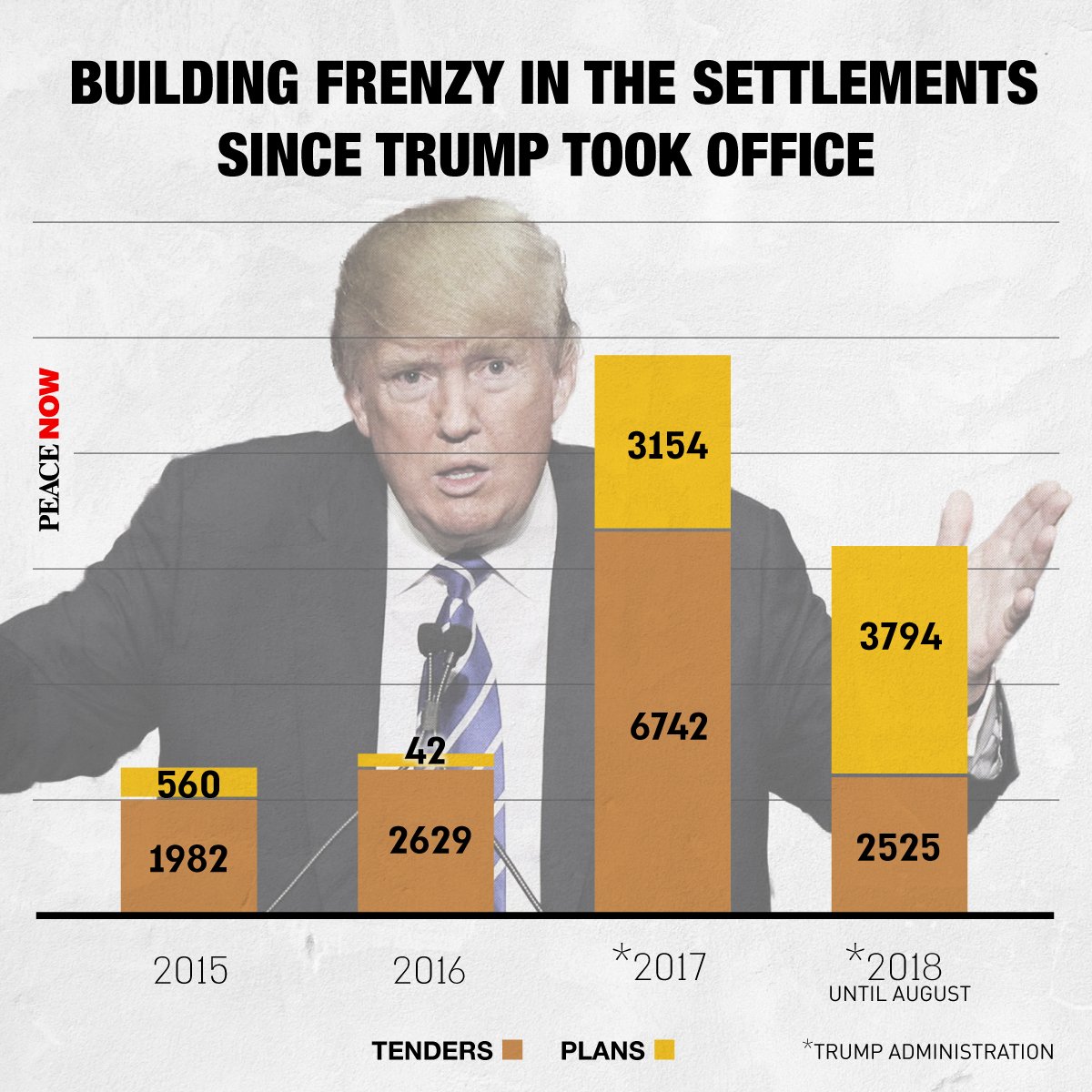
Image by Peace Now
When another settler organization – the Council of Jewish Communities in Judea and Samaria – published near identical data points in January 2019 (literally last month), the overwhelming response of the settler community was to blame former U.S. President Barack Obama for a slowdown in the population growth from the 2017 rate, which was at 3.4%. However, if Gordon is correct in his prediction of a settler surge to come, that surge will indeed by blamed on or credited to – depending on the source – U.S. President Donald Trump.
Peace Now has documented the sharp in increase in settlement advancements in 2018, which will eventually result in an increase in the population of settlers (by as many as 60,000 settlers) once those new units are built and sold.
Nabil Abu Rudeineh, spokesman for Palestinian President Mahmoud Abbas, told the AP:
“The American support for settlements through silence is doomed to failure because there is no peace and stability without an agreement with the Palestinian people and its legitimate leadership.”
New B’Tselem Report Slams High Court for Role in Dispossessing Palestinians, Validating Occupation
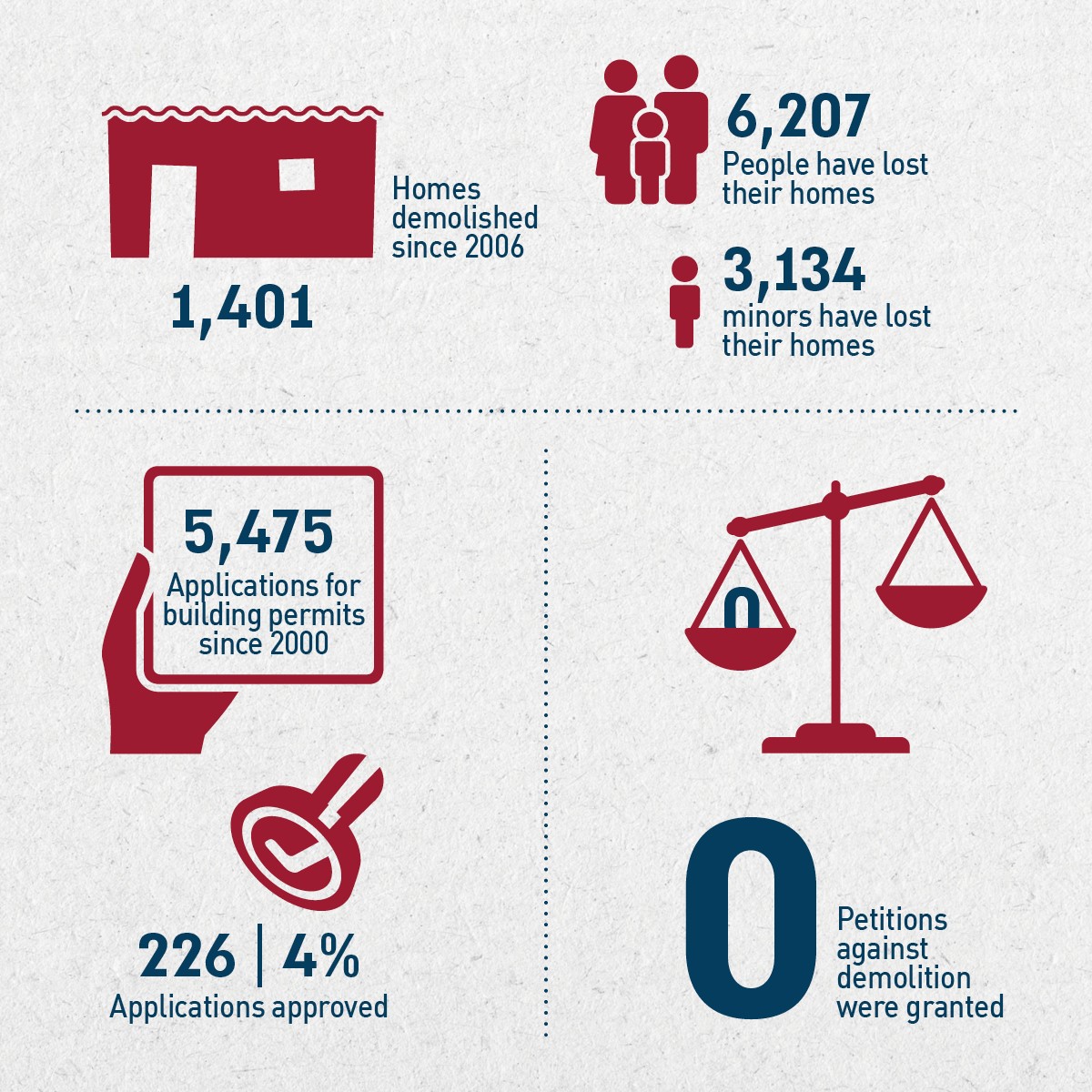
Image by B’Tselem
B’Tselem published an important new report entitled “Fake Justice: The Responsibility Israel’s High Court Justices Bear for the Demolition of Palestinian Homes and the Dispossession of Palestinians.” The report examines the role the highest court in Israel (and the only practicable avenue by which Palestinians can challenge Israeli policies and settler actions) has played in perpetuating the severe injustices inflicted upon Palestinians by the Israeli occupation and providing a guise of legality to for the Israeli policies behind them. Looking at its actions over the years as a whole, the report concludes that the court’s support of Israeli planning policy in the West Bank is tantamount to support for “forcible transfer” — a war crime.
The report’s executive summary explains:
“On the declarative level, Israeli authorities consider the demolition of Palestinian homes in the West Bank as no more than a matter of illegal construction, as if Israel does not have long-term goals in the West Bank and as if the matter does not have far-reaching implications for the human rights of hundreds of thousands of individuals, including their ability to subsist, make a living and manage their own routine. The Supreme Court has fully embraced this point of view. In hundreds of rulings and decisions handed down over the years on the demolition of Palestinian homes in the West Bank, the justices have regarded Israeli planning policy as lawful and legitimate, nearly always focusing only on the technical issue of whether the petitioners had building permits. Time and time again, the justices have ignored the intent underlying the Israeli policy and the fact that, in practice, this policy imposes a virtually blanket prohibition on Palestinian construction. They have also ignored the policy’s consequences for Palestinians: the barest – sometimes positively appalling – living conditions, being compelled to build homes without permits, and absolute uncertainty as to the future.”
The report is available to read and download here.
Video Compilation of Likud Candidates Touting Role of Tourism in Expanding Settlements
The Israeli archaeological group Emek Shaveh produced a video compilation of prominent Likud candidates touting their role in driving settlement tourism projects – in statements made in anticipation of the Likud primary elections (which were held on February 5th). Snippets in the video include:
- Former Mayor of Jerusalem Nir Barakat bragging about his work on behalf of settlement projects run by Elad in the Silwan neighborhood;
- Transportation Minister Yaariv Levin bragging on Facebook about the huge investments his ministry made into developing a settlement tourism industry, including doubling the amount of tourism to the West Bank in two years, funding two hotels in the Kiryat Arba settlement, and starting a grants program for tourist projects in settlements;
- Jerusalem Affairs Minister Zeev Elkin celebrating the opening of a “visitors center” in a settlement near the central West Bank city of Nablus.
Emek Shaveh writes:
“What was previously termed ‘hidden settlement’ has quietly transformed amid the Likud primaries into open policy. The extent of the Israeli government’s investments in the tourist settlement is now being exposed.”
There has been a growing awareness of – and opposition to – Israel’s overt investment in settlement tourism as means to expand and entrench Israeli settlements, most acutely in East Jerusalem. In February 2018, a leaked report by the European Union said explicitly that Israeli archaeological and tourism projects in East Jerusalem are “a political tool to modify the historical narrative and to support, legitimacy and expand settlements.”
Emek Shaveh issued a statement elaborating on leaked EU report, saying:
“Archaeological tourism projects are favored by the settlers as a means of winning the hearts of minds of the Israeli, Jewish and evangelical publics. The EU now recognizes how archaeological sites in East Jerusalem are being used as a political tool to ‘modify the historical narrative and to support, legitimise and expand settlements’. The City of David in Silwan, the new cable car project, the national parks in Palestinian neighborhoods compliment evictions and house demolitions in marginalising and disenfranchising the East Jerusalem Palestinian public. The difference between ‘cultural projects’ such as the national parks or the City of David and house demolitions is that in addition to the physical displacement, the former also expropriate the narrative, dispossessing the Palestinians from their historical and cultural contexts. When it comes to Jerusalem, narrative is not an abstract issue because in Jerusalem history and questions of present-day sovereignty are intertwined. And when it will come to determining the final status of the city, the question of who ‘owns’ the history of the city will be crucial.”
EU Settlement Report Details “Unprecedented” Level of Settlement Advancements 2018
On February 4th, the European Union issued its bi-annual report (pdf) documenting and analyzing trends in Israeli settlement activity from July through December 2018. It also provides a big picture summary of settlement activity in recent years, which found that there was a three-to-four-fold increase in settlement advancements in 2017/2018 (the era of U.S. President Donald Trump) compared to 2015/2016 (under Barack Obama).
The full report is available as a pdf here.
Bonus Reads
- “As West Bank Violence Surges, Israel is Silent on Attacks by Jews” (New York Times)
- “Digging Up Controversy” (US News)
- “US Blocks UN Statement on Israel Ending Hebron Monitors Mention” (Ynet)
- “CAF rejects tender for Jerusalem’s Railway as it Traverses ‘67 Borders” (Maan News)
Welcome to FMEP’s Weekly Settlement Report, covering everything you need to know about Israeli settlement activity this week.
To subscribe to this report, please click here.
January 4, 2019
- Israel Advances Plans for 2,191 New Settlement Units – Including Establishing 2 New Settlements & Laying Groundwork for 2 New Settlement Industrial Zones
- Based on New Legal Tools to Take Palestinian Land, Israel Announces Intention to Build A New Settlement (“Givat Eitam/E-2”) Near Bethlehem
- Following High Profile Political Support, Settlers Violently Resist Evacuation from Amona Outpost Site
- Knesset Speaker & Leaders Call for Annexation of Hebron
- Regavim Petitions Jerusalem District Court to Stop the EU-Backed “Arab Takeover” of Area C
- Knesset Lawyer Criticizes Bill to Give Palestinian Land to the World Zionist Organization
- Sheldon Adelson’s Medical School in Ariel Settlement May Not Open
- Bonus Reads
Questions/comments? Email kmccarthy@fmep.org
Israel Advances Plans for 2,191 New Settlement Units – Including Establishing 2 New Settlements & Laying Groundwork for 2 New Settlement Industrial Zones

Map on Twitter by @JacobMagid
During its final meetings of 2018 (held on December 26th and 27th), the Israeli Civil Administration High Planning Council advanced plans for a total of 2,191 new settlement units. Peace Now reports that 87% of the settlement plans advanced are located deep inside of the West Bank, far beyond any of the negotiated parameters for a border between Israel and a future Palestinian state.
The flood of settlement approvals includes plans that will effectively create two new settlements (by legalizing the unauthorized outposts of Ibei Hanachal and Gva’ot, detailed below) and establish two new settlement industrial zones (one near the Beitar Illit settlement and one near the Avnei Hefetz settlement). Another plan, for an educational campus and a gas station, will serve to connect the unauthorized outpost of Mitzpeh Danny to a nearby settlement (Ma’aleh Mikhmash) – paving the way towards the eventual legalization of that outpost, creating yet another new settlement.
Of that total, plans for 1,159 units were given final approval for construction – meaning building permits can be issued immediately. These include
- 220 new units in the Givat Ze’ev settlement;
- 180 new units in the Neveh Daniel settlement;
- 135 new units in the Tene settlement;
- 120 new units in the Karmei Tzur settlement;
- 129 new units in the Avnei Hefetz settlement (where plans to build a new, noncontiguous industrial zone nearby were also advanced – see below);
- 61 new units in the Tzofim settlement;
- 42 new units in the Alfei Menashe settlement;
- 55 new units in the Tomer settlement;
- 18 new units in the Adora settlement;
- 16 new units in the Metzad settlement;
- 1 new units in the Shilo settlement; and,
- 62 new units in the Ma’aleh Mikhmash settlement;
-

Map by Peace Now
A plan to build an educational campus and a gas station between the Malakeh Mikhmash settlement and the unauthorized outpost of Mitzpeh Danny. Peace Now writes, “Although this is not a residential program, these buildings also qualify as the establishment of a new settlement complex in the West Bank. The plan covers 140 dunams and will create a permanent presence of hundreds of Israeli students and teachers…During the discussion it was noted that the Mateh Binyamin Regional Council is preparing a plan to regulate the outpost.”
- A plan to build a cemetary on an area of “state land” south of the Palestinian city of Qalqilya. The area used to be a closed firing zone, but that military designation was rescinded years back, and the site has since been the subject of settlement planning. Peace Now writes, “The planned cemetery is likely to be the first component on the road to the establishment of an industrial zone, which is also a type of settlement.”
Settlement plans that were advanced through earlier stages of the planning process include:
-
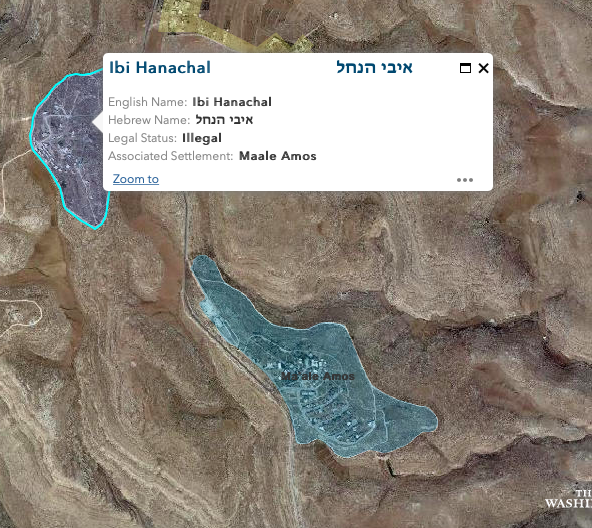
Map by WINEP
A plan for 98 units in the unauthorized Ibei Hanachal outpost, which will turn the outpost as a “neighborhood” of the Maale Amos settlement. In reality, the outpost is not contiguous with the built-up area of the Maale Amos settlement, meaning that the implementation of this plan will, in effect, create a distinct new settlement.
- A plan for 61 new units in the unauthorized Gva’ot outpost, an outpost originally built in 1999 by the settlers as a “neighborhood” of the Alon Shvut settlement. The settlers built a yeshiva there, but abandoned it not long after. The new settlement plan is for a public building, likely an educational institute with housing.
- 82 new units in th Ofra settlement. FMEP reported on this plan in the Dec 14th edition of the Settlement Report, in conjunction with the litany of punitive settlement plans advanced by Israel in response to terror attacks. The area where the new units are slated to be built is land that was allegedly purchased by the settlers from its original Palestinian owners.
- Plans for two new settlement industrial zones, one near the Beitar Illit settlement and one near the Avnei Hefetz settlement. The latter industrial zone, called Bustani Hefetz, will cover a large area of land (some 730 dunams) and will not be not contiguous with any other settlement. Peace Now writes, “an industrial zone of this scope, which is cut off from any other settlement, in all actuality constitutes a new settlement.”
- 121 new units in the Yitzhar settlement, where the IDF has been trying to rein in the violence perpetrated by the “Hilltop Youth” settlers, who are based in Yitzhar.
- 152 new units in the Shavei Shomron settlement.
- 212 new units in the Har Bracha settlement.
- 94 new units in the Beit Haggai settlement.
- A plan to legalize 75 existing settlement units in the Shvut Rachel settlement, which Israel considers a “neighborhood” of the Shiloh settlement.
- 100 new units in the Halamish settlement.
Peace Now released a statement saying:
“In 2018, the government advanced thousands of housing units, including most which can be found in isolated settlements deep inside the West Bank that Israel will eventually have to evacuate. Those who build these places have no intention of achieving peace and a two-state solution. The latest announcement, which as an aside was cynically passed on Christmas while most Western governments are on holiday, shows that Netanyahu is willing to sacrifice Israeli interests in favor of an election gift to the settlers in an attempt to attract a few more votes from his right-wing flank.”
Top Palestinian negotiator, Saeb Erekat, released a statement saying:
“While the world is celebrating Christmas with its spirit of peace and joy, the Grinch ‘occupation’ decided to steal the Christmas spirit from the people of Palestine. As part of his early election campaign, the Israeli Prime Minister Benjamin Netanyahu has as well stolen more Palestinian land and resources for the benefit of Israel’s illegal colonial settlement expansion. Such illegal actions are a deliberate campaign to destroy the two-state solution and to prevent the establishment of an independent and sovereign State of Palestine with East Jerusalem as its capital.”
Tamar Zandberg, head of the Meretz Party, slammed the new announcements, and previous decisions taken by the government to retroactively legalize 60 outposts. Zandberg said:
“The Israeli government has become a settlement government. (MKs Bezalel) Smotrich, Moti Yogev, (Justice Minister) Shaked and (Education Minister) Bennett are its landlords. They exploit the (Palestinian) attacks to build more settlements. But the truth needs to be said. To achieve security we need to evacuate settlements, not build more and more…”The 60 new settlements are the real threat to Israel’s security and to IDF soldiers. The pogroms they are waging in Palestinian villages. The stone-throwing, the shooting and the uprooting of the trees. This is the danger to our moral image and our security! They eight seats of Habayit Hayehudi party dictate eight million lives.”
Based on New Legal Tools to Take Palestinian Land, Israel Announces Intention to Build A New Settlement (“Givat Eitam/E-2”) Near Bethlehem
On December 26th, the Israeli Civil Administration announced that it will draft plans to build as many as 2,500 new settlement units at the Givat Eitam outpost site, creating a new settlement on a strategic hilltop that will cut off Bethlehem from the southern West Bank, completing the near encirclement of Bethlehem by Israeli settlements.
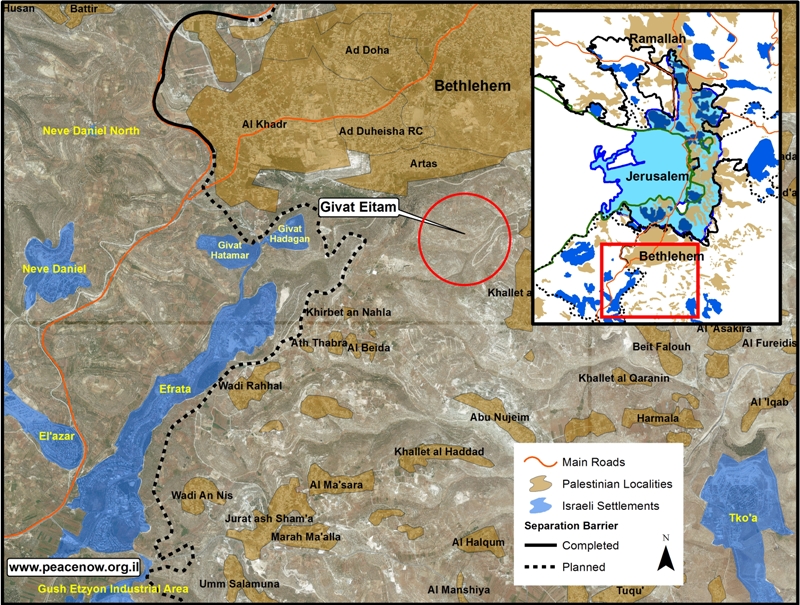
Map by Peace Now
For years, settlers have lobbied for construction at the site, but those efforts have been stymied by the lack of a legal access road to the outpost, which is surrounded by land that even Israel recognizes is privately owned by Palestinians. Until recently, Israel has balked at seizing private land from Palestinians for the exclusive benefit of the settlements. But now, several new legal opinions have allowed Israel to violate the private property rights of Palestinians for the sole purpose of legalizing settlements and settlement infrastructure. Those legal opinions include the “market regulation” principle, the opinion(s) regarding the Haresha outpost case, and the Regulation Law. It is unclear which legal argument will be applied to the Givat Eitam/E-2 case.
The Givat Eitam outpost has been nicknamed “E-2” by settlement watchers for for its resemblance, in terms of dire geopolitical implications, to the infamous E-1 settlement plan. Located east of the separation barrier on a strategic hilltop overlooking the Palestinian city of Bethlehem to its north, Givat Eitam/E-2 is located within the municipal borders of the Efrat settlement but is not contiguous with Efrat’s built-up area, making Givat Eitam/E-2 effectively a new settlement that, according to Peace Now, will:
“block Bethlehem from the south, and prevent any development in the only direction that has not yet been blocked by settlements (the city is already blocked from the North by the East Jerusalem settlements of Gilo and Har Homa, and from the West by the Gush Etzion Settlements) or bypass roads (that were paved principally for Israeli settlers). The planned building in area E2 would likely finalize the cutting off of Bethlehem city from the southern West Bank, delivering a crushing blow to the Two States solution.”
In September 2018 FMEP reported that the local council of the Efrat settlement encouraged the start of (unauthorized) construction of an outpost at the Givat Eitam/E-2 site (presuming that any such illegal construction would be retroactively legalized by the government) in response to a Palestinian terror attack in the Efrat settlement. Since then, the Civil Administration has allowed the settlers to build and maintain an agricultural farm there.
FMEP tracks all developments related to Israeli legislative, cabinet, and judicial action that promotes the retroactive legalization of outposts built on privately owned Palestinian land as part of its documentation of creeping annexation – available here.
Following High Profile Political Support, Settlers Violently Resist Evacuation from Amona Outpost Site
On January 3rd, 23 Israeli police officers were injured by Israeli settlers and their supporters who violently resisted the court-ordered evacuation from illegal encampments erected on privately owned Palestinian land as part of an effort to re-establish the Amona outpost. Approximately 300 settlers showed up at the Amona site (which is currently a closed military zone) overnight to resist the removal of settlers and two caravans from the hilltop, which was ordered by the Jerusalem District Court. The settlers and their supporters burned approximately 300 tires at the entrance to the outpost, poured oil on the access roads, and threw rocks and boulders at the Israeli police. Seven suspects were arrested and quickly released.
The evacuation of the outpost was reportedly carried out in defiance of a direct order from Prime Minister Netanyahu. According to the Haaretz report, Netanyahu gave orders to the Israeli military secretary, Col. Avi Bluth, to stop the evacuation. Col. Bluth did not relay the message in time, and the evacuation was carried out. Now, Netanyahu has ordered a disciplinary hearing to investigate the actions of Col. Bluth, which is scheduled for January 4th.
The violent evacuation of settlers from the Amona hilltop follows a week of high profile support for their efforts. Israeli Cultural Minister Miri Regev attended a ceremony near the recently re-established (yet unauthorized) Amona outpost to express her support for authorizing construction on the hilltop – which, according to the Israeli High Court of Justice, is privately owned Palestinian land. Regev could not go to the actual Amona site, because the area is a closed military zone where no one (settlers, politicians, and even the Palestinians who own the land) is permitted to enter. Regev and the settlers claim that the hilltop land has been legally purchased by the settlers, but that claim has not been investigated, much less verified. Casting doubt on the settlers’ claims, Haaretz notes:
“The lot in question is jointly owned by several different Palestinians, which means every single one of them would have to consent to the purchase for it to be legal. It’s not clear which, if any, of these Palestinians signed the sale document. In the end, the land was designated military land, is zoned for agriculture and has no building permits.The Binyamin Regional Council didn’t await the administration’s decision before moving two prefab homes into Amona and providing basic infrastructure such as water tankers.”
Israeli Attorney General Avichai Mandleblit slammed the settlers for trespassing and illegally moving caravans onto the site. Mandelblit criticized MK Bezalel Smotrich and the heads of regional settlement councils who went to the site to express support, saying:
“Breaking the law with the support of public figures, like placing caravans on privately-owned lands, can’t be a source of pride.”
A Haaretz report recently revealed Bezalel Smotrich was a founding member of a non-governmental group called Ofek Lehityashvut, which directly financed the illegal reestablishment of the Amona outpost last month by purchasing the two caravans that settlers moved onto the hilltop. The Haaretz report goes on to reveal that the Benyamin Regional Council has purposefully tailored various calls for proposals so that Ofek Kehityashvut would be the only group qualified to receive financing for that project. As a result of that manipulation, Ofek Kehityashvut has received substantial amounts of funding from the Benyamin REgional Council, which is an Israeli-taxpayer funded entity.
Knesset Speaker & Leaders Call for Annexation of Hebron
The speaker of the Israeli Knesset, Yuli Edelstein (Likud), called for Israel to apply its sovereignty over the city of Hebron – which would constitute an act of de facto annexation. Edelstein released a statement announcing his intention to go on a tour of Hebron – where some 500-800 settlers live under Israeli military protection amongst 200,000+ Palestinians – with the far-right, pro-annexationist group Im Tirzu. In the statement he wrote:
“In my view, it’s delusional that some Knesset members dare to undermine the Jewish people’s right to dwell in the city of our forefathers,” Edelstein said in a press statement issued prior to the conference. “We’re developing Hebron, investing in it and inculcating its importance in future generations. We are saying clearly – sovereignty in Hebron first.”
Speaker Edelstein also participated in a conference highlighting Israel’s historic connection to the city of Hebron. Organized by the Knesset Land of Israel Lobby, the event culminated in the signing of a document that reads:
“We, the undersigned, hereby express deep solidarity with the roots of the Jewish people in Hebron and the support of the Jewish community in Hebron that has clung to the city despite all the difficulties. We declare an unambiguous commitment to the continued existence, security and prosperity of Hebron as the city of both our forefathers and children.”
The event was co-organized by MK Bezalel Smotrich (Jewish Home) who said:
“Hebron is a litmus test. What is happening in Hebron shows our Jewish pulse….[those who call for settlers to leave Hebron] understand very well that if Hebron grows and develops, the entire settlement enterprise will grow and develop, so they invest in harming Hebron. But they will continue to shout and complain while we will continue to build, reach the people and connect with our roots.”
Regavim Petitions Jerusalem District Court to Stop the EU-Backed “Arab Takeover” of Area C
Following the Knesset’s passage of a bill in July 2018 that brought many West Bank legal matters under Israel’s domestic jurisdiction (an act of de facto annexation), the Jerusalem District Court is set to hear its first case concerning land disputes in the occupied territory. The bill was sponsored by Israeli Justice Minister Ayelet Shaked, whose three-fold rationale for the bill explicitly states that its purpose is to help settlers take more Palestinian land and shut-down Palestinian challenges to such thefts — by bringing matters to the Jerusalem Court instead of the High Court of Justice, which Shaked believes is too concerned with Palestinian rights and international law. The bill is part of the legislative body’s broader effort to erase all remaining distinctions (legal, judicial, economic, and otherwise) between sovereign Israel and the occupied territories, distinctions which allowed Israel to preserve the guise of respect for rule of law, and good intentions, for the last 50 years.
Looking to cash in the bill’s explicit purpose, the radical settler group Regavim initiated the petition asking the court to intervene to stop the “illegal Arab takeover” of land in the West Bank. Regavim’s petition claims that Palestinians are cultivating “state land” near the Mezad settlement. The petition also blames the European Union for its financial backing for the agricultural projects on the land. (Note: Regavim, like most settler media outlets, uses the word “Arab” to describe Palestinians, a vocabulary choice meant to erase any recognition of Palestinian identity).
A coordinator for Regavim told the Arutz Sheva outlet:
“The intervention of the European Union in what is happening in Area C is a brazen and aggressive intervention. We see extensive involvement on their part in lawbreaking and invading state land throughout Judea and Samaria. Their symbols are everywhere, and the State of Israel must respond to this blatant intervention on the diplomatic level as well.”
Shlomo Ne’eman, head of the Gush Etzion Regional Council said:
“The direct involvement of the European Union in financing Arab squatters in the territories and state lands has already become a plague on the state. We congratulate Justice Minister Ayelet Shaked on the obvious step that has led to great logic and justice in reducing the burden on the Supreme Court and in uniform enforcement against the land grabs by hostile elements…the Arabs understand that the real battle is on the ground. Foreign countries with their money are trying to shape a false consciousness and finally change the map of the state, but nothing can change history and our natural belonging on our national land.”
FMEP tracks the application of domestic Israeli law over the occupied West Bank (the de facto annexation of the West Bank) on its Annexation Policy Tables, which are regularly updated.
Knesset Lawyer Criticizes Bill to Give Palestinian Land to the World Zionist Organization
The legal advisors to the Knesset Constitution, Law and Justice Committee criticized a bill that would transfer vast tracts of land in Area C of the West Bank to the Settlement Division of the World Zionist Organization (WZO), a quasi-private state-funded entity that works to establish and expand settlements in the West Bank. Despite pressure to pass the bill, the legal advisors called on the committee to reexamine the text over concerns that it would also give the WZO authority over Palestinian communities in Area C. The experts wrote in a legal opinion for the committee:
“The proposed definitions of ‘rural settlement’ and ‘land’ do not include references to the character and nature of the settlement, and it seems that land that is government or abandoned property intended for Palestinian rural settlement will also be included in the boundaries of the proposed arrangement, and will be transferred to the management of the Settlement Division. Is the intention of the bill that the Settlement Division will also manage the Palestinian rural settlement in the area?”
As FMEP has previously reported, the bill was proposed by MK Bezalel Smotrich (Habayit Hayehudi) to accelerate the transfer of almost all of the land in Area C to the control of the World Zionist Organization. The land transfer is, in fact, taking place at the bureaucratic level, but Smotrich and the Israeli Cabinet (which endorsed the bill) are increasingly frustrated by the slow pace of the transfer (and perhaps also the limited scope of land slated to be handed over). Israeli Attorney General Avichai Mandelblit expressed his opposition to the bill, saying it is unnecessary given that ministry staffs are already working to transfer more land to the WZO through an administrative process.
In June 2018, when the Knesset gave preliminary approval to the bill, Peace Now responded:
“the government is scandalously planning to give the biggest land thieves responsibility for managing the land distribution, which will continue to be done under the cover of darkness if the bill passes into law.”
For more information on this bill, read a comprehensive background briefing by Peace Now.
Sheldon Adelson’s Medical School in Ariel Settlement May Not Open
The state-of-the-art medical school planned to be built in the Ariel settlement is now in danger of not opening, after a letter from the Israeli Justice Ministry warned that the school’s approval is in jeopardy. The Justice Ministry discovered an undisclosed conflict of interest that voids an important vote in favor of approving the school by the planning and budgeting subcommittee of the Higher Education Council. A member of the subcommittee, Dr. Rivka Wadmany-Shauman, allegedly met with the heads of Ariel University ahead of the vote, and made her approval of the new medical school conditional on being promoted to the rank of professor. Israel Hayom reports the Ariel University has already shelved plans to inaugurate the new school for its first semester in the Fall of 2019.
As FMEP has previously reported, Ariel University became an accredited Israeli university in 2012, following significant controversy and opposition, including from Israeli academics. It has since been the focus of additional controversy, linked to what is a clear Israeli government-backed agenda of exploiting academia to normalize and annex settlements. In 2018, the settlement broke ground on the new medical school, with significant financial backing from U.S. casino magnate and settlement financier, Sheldon Adelson. In February 2018, in an act of deliberate de facto annexation, the Israeli Knesset passed a law that extends the jurisdiction of the Israeli Council on Higher Education over universities in the settlements (beyond Israel’s self-declared borders), ensuring that the Ariel settlement medical school (and its graduates) are entitled to all the same rights, privileges, and certifications as schools and students in sovereign Israel.
As a reminder, Ariel is located in the heart of the northern West Bank, reaching literally to the midpoint between the Green Line and the Jordan border. The future of Ariel has long been one of the greatest challenges to any possible peace agreement, since any plan to attach Ariel to Israel will cut the northern West Bank into pieces.
Bonus Reads
- “Israeli settlements threaten to engulf West Bank communities” (Al-Monitor)
- “Israeli settlement activity appears to surge in Trump era” (AP)
- “It Pays Off to be an Israel Settler, Whether Trespasser or Landowner” (Haaretz+)
- “In the West Bank, the Israeli army works for the settlers” (Haaretz)
- “Netanyahu’s pro-settler allies force annexation into campaign agenda” (Al-Monitor)
Welcome to FMEP’s Weekly Settlement Report, covering everything you need to know about Israeli settlement activity this week.
To subscribe to this report, please click here.
November 8, 2018
- Jerusalem Municipality Gives Final Approval to Two East Jerusalem Settlement Schemes Pushing Towards Beit Hanina
- Claiming Ignorance, State Tells the Court it Will Demolish New Jordan Valley Outpost
- Government Officials Lay Cornerstone of “New Migron” Settlement
- Israel Seizes Palestinian Land to Build New Road to Settlement
- Bennett Violated Govt Rules to Get a Legal Opinion Supporting the De Facto Annexation of Ariel University
- In Reversal, Israeli Ministers Embrace Bill to Allow Knesset to Overrule High Court on Any Issue (Not Just on Deporting Asylum Seekers)
- Settlers Group Alleges Palestinians are Undertaking a European-Backed Scheme to “Take Over” Area C of West Bank
- UN Report Details Israel’s De Facto Annexation of West Bank Land
- Four Alleged Security Incidents Near Settlements
- Bonus Reads
Comments, questions, or suggestions? Email Kristin McCarthy at kmccarthy@fmep.org.
Jerusalem Municipality Gives Final Approval to Two East Jerusalem Settlement Schemes Pushing Towards Beit Hanina
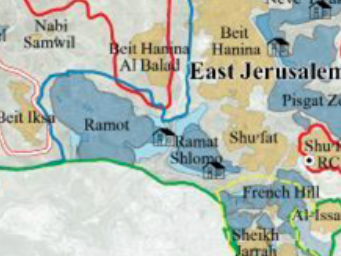 On November 6th, Jerusalem planning authorities granted approval to two settlement projects totalling 652 units in strategic areas that will increase the encroachment of settlements on the Palestinian East Jerusalem neighborhood of Beit Hanina – where the Israeli government is also advancing the first-ever government-backed settlement enclave inside of the neighborhood. This week the Committee approved:
- A plan for 152 new units in the Ramot settlement in northern Jerusalem, extending the settlement’s footprint towards the Palestinian neighborhood of Beit Hanina.
- A plan for 640-units in the Ramat Shlomo settlement, to be built partially on Palestinian land, also extending the settlement north towards an existing settlement enclave inside of the Palestinian Beit Hanina neighborhood.
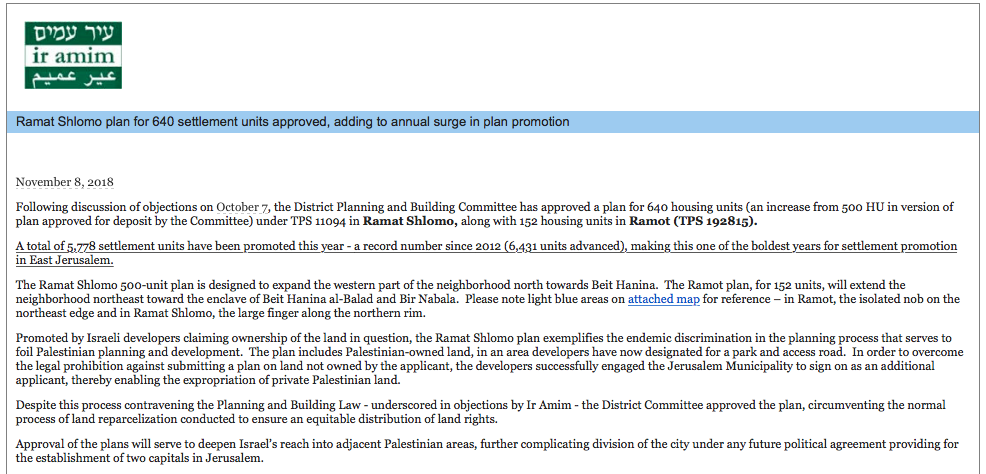
In granting final approval for the Ramat Shlomo plan, the Jerusalem District Planning and Building Committee decided to increase the number of approved units, from the proposed 500 to 640. And significantly, the Committee rejected serious complaints about expropriating privately owned Palestinian land for settlement purposes.
The Israel anti-settlement watchdog NGO Ir Amim filed one such complaint against the plan, explaining:
“Promoted by Israeli developers claiming ownership of the land in question, the Ramat Shlomo plan exemplifies the endemic discrimination in the planning process that serves to foil Palestinian planning and development. The plan includes Palestinian-owned land, in an area developers have now designated for a park and access road. In order to overcome the legal prohibition against submitting a plan on land not owned by the applicant, the developers successfully engaged the Jerusalem Municipality to sign on as an additional applicant, thereby enabling the expropriation of private Palestinian land.”
Ir Amim researcher Aviv Tartarsky told Haaretz this week:
“It’s very disappointing that the district committee relied on formalistic reasons to approve a step that violates the property rights of Palestinian landowners through and through. These aren’t extremist settlers in outposts somewhere out on hilltops in Samaria [the northern West Bank] but state institutions that are working in Israel’s capital city. This decision is additional proof that Israeli control in East Jerusalem means a regime based on serious discrimination.”
The new approvals add to an ever-growing tidal wave of settlement activity in East Jerusalem affecting the viability of the two-state solution, while tightening the screws on the local Palestinian population.
Claiming Ignorance, State Tells the Court it Will Demolish New Jordan Valley Outpost
Israeli government lawyers told the High Court of Justice that the State of Israel does not know who built an illegal outpost on a disused military base in the Jordan Valley, which settlers have named “Camp Gadi”, and announced that the Civil Administration will demolish it. If the Civil Administration moves to demolishes the outpost, it will require evicting several settler families who are squatting there, and shutting down a pre-military school that the families have been promoting.
The head of the Jordan Valley Regional Council, David Lahiani, seemed to contradict the government’s claim to innocence when he said that he has been in touch with the Civil Administration about legalizing the outpost. If Lahiani has been in touch with the Civil Administration, then questions arise about at what point the Israeli government learned about the outpost and who is behind it. Lahiani’s statement also contradicts (or at least raises questions about) a prior statement from the Jordan Valley Regional Council which denied involvement in establishing the outpost. Further calling into question the role of the Jordan Valley Regional Council, Lahiani was in a picture taken at the outpost which was uploaded to Facebook on October 24th.
Government Officials Lay Cornerstone of “New Migron” Settlement
A cornerstone laying ceremony marked the start of construction on the “New Migron” settlement, to be for the settlers who were removed from the illegal Migron outpost. Several government officials were on hand to lay the cornerstone of the new settlement, plans for which were approved in 2017, near the Kochav Yaakov settlement north of Jerusalem.
In 2011, the Israeli High Court ruled that the Migron outpost must be evacuated because it was built on privately owned Palestinian land. Most of the illegal outpost’s residents were evacuated and most buildings were demolished in Migron in 2012. Determined to demonstrate its support for settlers in the face of this court-compelled evacuation, the government promised to establish two new settlements: “New Migron” (located close to Kochav Yaakov settlement) as well as the approval of a plan for 184 housing units east of the Adam settlement (aka Geva Binyamin). All said, the two new settlements and temporary housing for the evicted settlers cost Israeli taxpayers millions of dollars – sending settlers a clear message that for them, law-breaking pays off.
At the ceremony this week, Jerusalem Affairs Minister Ze’ev Elkin said:
“During such events, it is customary to rejoice, but as someone who accompanied Migron from the moment of the evacuation to the present day, this is not a happy event. We would be happy if we had another legal system that made a logical decision, and I long for the days when the justice system will do justice. The settlement will grow and expand this way from time immemorial. The evacuation attempts will only lead to the strengthening and expansion of settlement.”
Housing Minister Yoav Galant, also at the ceremony, said:
“laying the cornerstone means that the territories of Yehudah and Shomron are not negotiable. It is not a subject for sale. We are laying a cornerstone for Migron and we will build it. I will see to it that the Israeli government does so by the end of the year.”
Knesset Speaker Yuli Edelstein, also in attendance, said:
“I did not come here to convince anyone about our rights in the land of Israel, I came here with mixed feelings of happiness from laying the cornerstone, alongside the great sadness of the difficult evacuation five years ago. We are here, first and foremost, thanks to the families of Migron that did not give up.”
Israel Seizes Palestinian Land to Build New Road to Settlement
According to Maan News, Israeli forces seized 38 acres (155 dunams) of Palestinian land in order to pave a road to the Beit Aryeh settlement, located northwest of Ramallah. Members of the al-Lubban al-Gharbi village council claim that the land is privately owned by Palestinians from the village and called on village residents to find documents proving land ownership in anticipation of an appeal against the construction.
So far this year, the Beit Aryeh settlement has been the beneficiary of two significant settlement advancements totalling 563 new units:
- On August 23, 2018 the Israeli Housing Ministry published a tender for 52 new settlement units in Beit Aryeh.
- On August 11, 2018 the government published a tender for 511 new settlement units in Beit Aryeh.
Bennett Violated Govt Rules to Get a Legal Opinion Supporting the De Facto Annexation of Ariel University
According to a new Haaretz report, Education Minister Naftali Bennett violated Israeli guidelines by using a private law firm to support his Knesset bill bringing settlement colleges and universities under the authority of the Israeli Higher Education Council. Prior to the Knesset’s passage of Bennet’s bill in February 2018, the Higher Education Council only included schools located inside of sovereign Israeli territory. The new law is tantamount to de facto annexation of settlement schools, and members of the Israeli Higher Education Council remain vocally opposed to the move.
The use of a private law firm is seen as an attempt to bypass the Education Ministry’s own apolitical (for now) legal advisors, and is a breach of the guidelines set years ago for every ministry by the Israeli Attorney General. The guidelines stipulate that in cases where private opinions are sought, the legal advisors for the ministry must supervise the process.
Bennet reportedly used an opinion paper issued by the Herzog Fox & Neeman firm stating the inclusion of Ariel University in the domestic Higher Education Council would not violate existing grant terms between universities in sovereign Israel and the European Union (which does not do business in the occupied territories). The opinion was then presented to members of the Higher Education Council to assuage fears that implementing the new law would result in losing international funding. The opinion said that the potential for funding cuts is “nearly non-existent.”
An anonymous senior official with the Higher Education Council told Haaretz:
“You cannot base official policy on an opinion paid for by an interested party. That’s not serious.”
Ariel University has not yet been admitted to the Council, despite the passage of the law in February 2018 and despite Minister Bennett’s repeated threats to end state relations with the Council if it did not immediately grant membership to the school. Israeli President Reuven Rivlin issued a rebuke to Bennett’s threats, saying:
“It’s possible to love Ariel without mocking academia.”
In Reversal, Israeli Ministers Embrace Bill to Allow Knesset to Overrule High Court on Any Issue (Not Just on Deporting Asylum Seekers)
At a meeting on November 4th, ministers in the governing Israeli coalition reportedly decided to abandon a bill that would empower the Knesset to reinstate its plan to deport African asylum seekers after it was struck down by the High Court, in favor of a much more far-reaching bill granting the Knesset the ability to reinstate any law the High Court strikes down. The passage of that bill would likely impact the fate of not only African asylum seekers but settlement-related legislation that has already been passed – most notably,the settlement Regulation Law – and other undemocratic measures that might follow. This news follows an exact opposite announcement two weeks ago, when Justice Minister Ayelet Shaked embraced the single-issue version of the bill, while promising to make the unlimited version a sticking point in any future coalition agreement.
Notably, the leaders of the current governing coalition decided to make this move at a meeting that was not attended by Kulanu Party leader Moshe Kahlon, who has until now blocked the coalition from advancing the unlimited version bill.
Israeli Attorney General Mandelblit vehemently opposes the bill. Mandelblit said:
“One must vigorously oppose this bill, which harms the constitutional regime of the State of Israel as a Jewish and democratic state. Removing all restrictions on undermining the human rights of a specific group, as is proposed now, has far-reaching implications for constitutional law and the democratic regime in Israel, and I strongly oppose it.”
Settlers Group Alleges Palestinians are Undertaking a European-Backed Scheme to “Take Over” Area C of West Bank
The radical settler organization Regavim – which devotes its efforts to systematically mapping out and expelling Palestinians from strategic areas in Jerusalem, the West Bank, and the Negev – presented a new report to the Knesset this week claiming that the Palestinian Authority (PA) is using European funding to take over land in Area C of the West Bank. The report alleges that the PA uses European money to pave roads, build on strategic military and diplomatic locations, and “steal” water resources, at the expense of Israel.
Regavim warns:
“If the government does not come to its senses and does something now, the Palestinian plan will create irrevocable changes and facts on the ground.”
Adding irony to Regavim’s current efforts to stop “illegal” Palestinian activity in the West Bank, in August 2018 the Israeli daily newspaper Yedioth Ahronoth published a comprehensive investigation into Regavim’s leaders. The group’s stated mission is “to ensure responsible, legal, accountable & environmentally friendly use of Israel’s national lands and the return of the rule of law to all areas and aspects of the land and its preservation.” The investigation revealed, however, that the organization’s efforts to identify and stop illegal construction are merely a tool to dispossess Palestinians of their land.
The Investigation found, in fact, that Regavim and its leaders have a demonstrable disregard for the Israeli planning and building laws that they purport to be dedicated to enforcing, evidenced most plainly by the fact that 15 Regavim officers are living in structures built on privately owned Palestinian land, some with demolition orders issued against them. These include the building where Yehuda Eliyahu, the current executive director of Regavim, lives.
UN Report Details Israel’s De Facto Annexation of West Bank Land
The United Nations Special Rapporteur on Situation of Human Rights in Palestinian Territories, Michael Lynk, issued a new report to the UN General Assembly – half of which is devoted to documenting the Israeli government’s annexation of Palestinian land in East Jerusalem and de facto annexation of land in the occupied West Bank.
The report concludes in part:
“These statements of political intent, together with Israel’s colonizing acts on the ground, its legislative activity, and its refusal to adhere to its solemn obligations under international law or to follow the direction of the international community with respect to its 51-year-old occupation, have established the probative evidence that Israel has effectively annexed a significant part of the West Bank and is treating this territory as its own. While Israel has not yet declared formal sovereignty over any parts of the West Bank, the Special Rapporteur submits that the strict prohibition against annexation in international law applies not only to a formal declaration, but also to those acts of territorial appropriation by Israel that have been a cumulative part of its efforts to stake a future claim of formal sovereignty over the occupied Palestinian territory.”
Four Alleged Security incidents Near Settlements
In the past three days, Israeli authorities have reported four security incidents near settlements:
On November 7th, the IDF reported that unknown assailants shot at a bus and lightly injured two Israelis near the settlement of Beit El, located deep inside the West Bank near Ramallah.
On November 6th, three Palestinian men were arrested near the Mevo Dotan settlement, south of Jenin, one of whom was allegedly carrying a gun.
Earlier on November 6th, a Palestinian woman was shot and arrested near the Kfar Adumim settlement, between Jerusalem and Jericho,after allegedly attacking Israeli border policemen with a pair of scissors.
On November 5th, a Palestinian man was shot and arrested after allegedly attempting to stab Israeli settlers and an Israeli IDF officer near the Kiryat Arba settlement, in Hebron.
Bonus Reads
- Khan al-Ahmar and Israel’s Creeping Annexation of the West Bank” (Newsweek)
- “Everyone Knows Settlers Cut Down Palestinian Olive Trees. But Israel Doesn’t Care” (Haaretz)
- “Settler leaders warned Rabin not to ‘cross redlines’ before assassination” (Times of Israel)
- “Hard Questions, Tough Answers: Why the Israeli mainstream turned right” (Americans for Peace Now)
- “An Interview with MK Sharen Haskel” (Fathom Journal)
- “Israeli justice minister opposes letting government jurists act as ‘gatekeepers’” (Haaretz)
Welcome to FMEP’s Weekly Settlement Report, covering everything you need to know about Israeli settlement activity this week.
To subscribe to this report, please click here.
August 31, 2018
- Setting a New Legal Precedent, Court Accepts “Market Regulation” Principle As Basis for Legalizing Outpost
- Shaked & Regavim Take Credit for Precedent-Setting Outpost Legalization Victory
- Another New Outpost – Continuing the Trend of Unannounced, Unopposed, & Highly Consequential Settlement Expansion
- Special U.S. Regulations Protect Israel’s Settlement Enterprise from Quality Aerial Documentation
- Bonus Reads
Comments, questions, or suggestions? Email Kristin McCarthy at kmccarthy@fmep.org. To subscribe to this report, please click here.
Setting a New Legal Precedent, Court Accepts “Market Regulation” Principle As Basis for Legalizing Outpost
Jerusalem District Court Ruling
On August 18th, Jerusalem District Court Judge Arnon Darel ruled in favor of retroactively legalizing the Mitzpe Kramim outpost, holding that privately owned Palestinian land can (and should) be expropriated for the settlements in instances where Israeli settlers built “in good faith” and with government support – a rationale called the “market regulation” principle. According to the ruling, the Court held that the parties responsible for the outpost – the Israeli government, the World Zionist Organization, and the settlers – all acted in “good faith.” Specifically, the Court held that the State acted in “good faith” even though it was negligent in its responsibility to protect the rights of Palestinians and correctly record/manage the status of land in the West Bank; and, that the settlers acted in “good faith,” even though they built the outpost without government authorization, without building permits, and without a master plan.
This is the first time an Israeli court has accepted the “market regulation” principle as a valid basis for legalizing outposts, setting a monumental new precedent according to which outposts that the government had previously been unable to legalize (because they were built on land recognized by Israel as privately owned by Palestinians) to petition for authorization. With this judgment, the public got a first glimpse of the incredibly broad interpretation of “good faith” that the Jerusalem District Court (now the court of first jurisdiction for land disputes in the West Bank) is inclined to apply on behalf of law-breaking settlers.
Peace Now released a statement saying:
“The court today chose to ‘align’ with the project of annexation and dispossession of the Israeli government led by the Netanyahu and the Jewish Home. It is absurd to attribute ‘good faith’ to the settlers of an illegal outpost whose homes were built illegally and without permits on private Palestinians land, because of a ‘mistake’ made by the authorities in allocating the land. The Israeli Authorities should protect the properties of the people under their control, and failing to do so cannot be used as an excuse to take the land from the Palestinian owners. Let us hope that the Supreme Court will erase this shame.”
Background on the Mitzpe Kramim Case
 The outpost at the center of the case – Mitzpe Kramim – was built in 1999 without government authorization on land near the Kochav Hashachar settlement, located deep inside the West Bank, closer to the Jordan River than sovereign Israeli territory. In the 1970s, land in the area was taken by the State of Israel by military order; subsequently, the land on which the outpost was built was allocated to the World Zionist Organization (WZO), apparently based on the (mistaken) assumption that the land in question was part of that military seizure. The WZO then gave the land to settlers, even issuing a certificate of ownership in their names. However, the land in question was not included in the military seizure of the 1970s, but was/is In fact recorded in the Land Registry as privately owned by Palestinians from the village of Deir Jarir. This fact should, under Israeli law, invalidate the government’s allocation of the land to the WZO, and the WZO’s grant of the land to the settlers.
In 2011, the registered Palestinian landowners filed a petition with the High Court of Justice to have the Mitzpe Kramim outpost removed from their land, only to see the settlers file their own petition in 2013 with the Jerusalem District Court (which froze the High Court’s consideration of the Palestinians’ petition), seeking to be registered as the rightful landowners. In their petition, the settlers – who are represented by Harel Arnon, the same lawyer hired to represent the Israeli government in its defense of the “Regulation Law” – argued that they are innocent victims of a mistake by the government, and as such should not be forced to bear the consequences of having built their homes on someone else’s land. Originally the Israeli government, admitting that the Civil Administration had made a mistake in mapping the area, argued that the settlers should be removed. In July 2018, the State completely reversed its stance, submitting a new argument to the Court citing the “market regulation” principle in defense of expropriating the land for the settlers.
In its ruling this week, the Jerusalem District Court gave legal validity to the newly invented “market regulation” basis for taking Palestinian land that had previously been impossible for the State to legally expropriate.
What’s Next?
Now that the Jerusalem District Court has ruled in favor of the settlers’ claim, the High Court of Justice is set to take up the original petition filed by the Palestinian landowners to have the outpost removed. Part of the High Court’s deliberations will now have to grapple with the new jurisprudence established by the Jerusalem District Court on the “market regulation” principle.
Regardless of whether or not the High Court allows the Jerusalem District Court’s ruling to stand, that ruling has already energized pro-settlement, pro-annexation Israeli policymakers and influencers, who (unsurprisingly) have lauded the ruling and urged more outpost legalization cases forward. The ruling also legitimizes the longstanding arrangement between Israel and the settlers: the government turns a blind eye to illegal settlement activity (including rebuffing efforts by settlement watchdogs to force it to take action, and when forced by the courts to take action, drags its feet to allow illegal activities to become more deeply entrenched), only to go to any lengths to authorize the illegal actions post-facto. This modus operandi allows Israel to circumvent the limitations of Israeli law, bureaucracy and international criticism, all of which would otherwise restrain (to some extent) unfettered settlement construction and land theft in the West Bank.
FMEP tracks the ongoing legislative, political, and legal transformations happening in the Israeli government to justify the expropriation of Palestinian land for the settlements in its Annexation Policy Tables. As a reminder, the “market regulation” principle was promoted by Israeli Attorney General Avichai Mandelblit, who offered it as an alternative to the legal basis provided in the “Regulation Law” to legalize unauthorized outposts and settlement construction.
Shaked & Regavim Take Credit for Precedent-Setting Outpost Legalization Victory
Celebrating the Jerusalem District Court’s ruling on the Mitzpe Kramim outpost case (covered above), Justice Minister Ayelet Shaked (Likud) said:
“The District Court today clearly stated that whoever settled [the land] with the state’s approval and in good faith, would not be evacuated. The injustice done in the evacuations of the Amona and Netiv Ha’avot [outposts] should not be repeated. The court should not be a party to the political debate between the Right and Left. That should be left to the ballot box. Through joint and intensive work, we have brought about a policy change in the state’s responses to the High Court of Justice. Now we are seeing a change in the district court.” [emphasis added]
Indeed, Justice Minister Shaked has led a years-long effort to re-make the judicial branch, injecting pro-settlement policies and figures into key positions within the Court system, with the explicit goal of protecting all Israeli settlements and outposts from any legal accountability for illegal actions. Part of that effort was her decision in 2015 to hire a private lawyer, Amir Fisher (who also represents the settler group Regavim), to essentially write the State’s responses to petitions before the High Court that deal with settlements.
As noted in the section above, the state of Israel reversed its own position vis a vis the future of Mitzpe Kramim in its 2018 submission to the Court, a reversal that happened after Fisher and Shaked were firmly in control of the State’s handling of outpost legalization cases. What’s more, Shaked installed a pro-settlement judge on the Jerusalem District Court (which issued the precedent-setting ruling this week), and then promoted legislation that strips the High Court of Justice of its primary jurisdiction over certain West Bank legal petitions (including Palestinian petitions relating to land disputes, travel permits, and building permits) and gave that jurisdiction to the Jerusalem District Court. Shaked is currently promoting another bill which would allowed the Knesset to reinstate any law struck down by the High Court of Justice. The Ministerial Committee on Legislation, of which Shaked and Education Minister Naftali Bennett are members, voted to give government backing to the bill in May 2018. The totality of Shaked’s efforts are documented, on an ongoing basis, in FMEP’s Annexation Policy Tables.
Shaked’s fellow travelers at Regavim released a statement following the Jerusalem District court ruling, emphasizing the far-reaching implications:
“This is a product of a long legal battle, run by the settlements and settling bodies. They asked to legalize outposts that were established by the State of Israel. This blessed decision is a historic one. We call upon the attorney general to apply the principles of this decision to all other outposts in Judea and Samaria that need regularization.”
The fruits of Shaked and Regavim’s work was applauded by many others in the government, including Education Minister Naftali Bennett (Jewish Home), who said the ruling was a:
“victory for decency and common sense, another step toward legalizing the settlements in Judea and Samaria and turning them into an integral part of the State of Israel.”
Culture Minister Miri Regev (Likud) said she was:
“happy that common sense and justice prevailed over cold formalism..[the ruling sends] a clear-cut message to the Palestinians and their collaborators from far-left organizations, that you don’t destroy and evacuate communities in the Land of Israel.”
Agriculture Minister Uri Ariel (Jewish Home) said:
“This is a blessed month of settlement, and after the decision of the Housing Cabinet to establish three new towns [in the Negev], comes the court’s decision regarding Mitzpeh Kramim. Such significant decisions strengthen and expand the settlement of the Land of Israel.”
Knesset speaker Yuli Edenstein (Likud) said:
“The determination and strong spirit of the people of Mitzpeh Kramim proved themselves. I welcome this just, requisite ruling from the District Court in Jerusalem. We will continue to strengthen settlement in Israel!”
Another New Outpost – Continuing the Trend of Unannounced, Unopposed, & Highly Consequential Settlement Expansion
Haaretz reports that settlers have built a strategic new outpost deep inside the West Bank near the settlement of Eli, in a bid to eventually annex privately owned Palestinian land that falls between Eli and pockets of “state land” in the area. The new outpost was built without Israeli permits on the outer edge of newly declared “state land,” some of which had been used as farmland by Palestinians. Haaretz notes a trend:
“Around the West Bank, settlers have been setting up farms near the outer edge of state-owned land, as in the case near Eli, in an effort to expand existing settlements. Even though they have been established without permission, no legal action has been taken against them.”
The Israeli Civil Administration – responsible for enforcing building laws in the occupied territory – told Haaretz that it is unaware of the new outpost. The Head of the Binyamin Regional Council (an Israeli municipal body responsible for settlements in the northern West Bank – recently proven to be bankrolling new outposts), Avi Roeh, denied that the Council was involved with the new outpost.
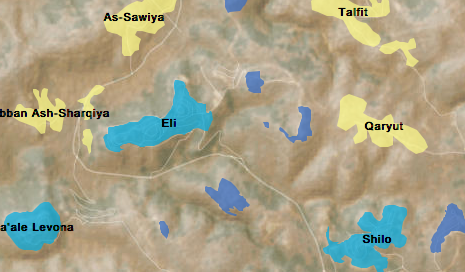
Map by WINEP
The new outpost is the fifth illegal satellite of the Eli settlement, stretching the band of Israeli settlements further and further east towards the Jordan Valley. Eli is located between the Ariel and Shilo settlements (both of which have seen tremendous growth and government support over the past two years – Ariel with its new medical school and Shilo with the promotion of the new Amichai settlement to its immediate east), in an area where settlers are working to connect settlements and outposts into a contiguous band of settlement stretching from sovereign Israeli territory all the way to the Jordan Valley.
As evidenced this week in the Israeli court system, the government – which consistently turns a blind eye to illegal outpost construction – is willing to go to great lengths to retroactively legalize outposts, even when the cost to Israeli taxpayers is enormous and even when doing so contradicts any notion of justice under the law.
Special U.S. Regulations Protect Israel’s Settlement Enterprise from Quality Aerial Documentation
Al-Shabaka published a new report this week detailing a little-known U.S. law that restricts companies from producing high quality satellite imagery of the West Bank. Al-Shabaka explains the significance of that limitation on U.S. companies like Google:
“Although the legislation was implemented under the pretense of protecting Israel’s national security, it is better characterized as an act of censorship. By deliberately blurring aerial images of Palestine-Israel, the [The Kyl-Bingaman Amendment (KBA) to the US National Defense Authorization Act] hinders the work of archaeologists, environmentalists, geographers, and humanitarians. It poses serious obstacles, not only for the preservation of cultural heritage, but also for holding Israel to account for land grabs, home demolitions, and settlement activity….While the legislation only applies to US companies, their hegemony in the commercial market for satellite imagery has elevated the legislation to de facto institutionalization on a global scale, affecting the access of researchers worldwide.”
The report can be accessed here.
Bonus Reads
- “The West Bank Model is a Failure” (The New York Times)
- “Israeli Taxpayers Bear Financial Burden of Evicting Illegal West Bank Outposts, And Sometimes, Making them Legal” (Haaretz)
***NOTE: This week the Israeli government unleashed a massive wave of approvals to advance plans for settlement construction — in excess of 2,000 units — in highly sensitive and strategically significant areas deep inside the West Bank and in East Jerusalem. More approvals/advancements are expected in the coming weeks. See below for detailed coverage of the individual plans, keeping in mind both the significance of each approval on its own, and as part of the overarching Israeli government agenda clearly intending to both prevent any possibility of a Palestinian state and to further the march toward formal annexation of the West Bank. Also keep in mind, importantly, that there has been zero public push back from the Trump Administration against this surge, which comes on the heels of Ambassador Friedman’s statement last week that Israel will never be required to remove any settlements.***
August 24, 2018
- Settlement Wave, Part 1: High Planning Council Advances Plans for 1,004 Settlement Units (96% Located Deep in the West Bank)
- Settlement Wave, Part 2: Housing Ministry Published Tenders for 420 Settlement Units
- Settlement Wave, Part 3: Jerusalem District Committee Advances Plans for 603 Settlement Units in East Jerusalem
- Settlement Wave, Part 4: More Settlement Construction Coming Soon
- U.S. Stands by Israeli “Intentions” on Settlements
- State Tells High Court: We Can Annex the West Bank – International Law Be Damned
- This Week in Ariel: Settlers Celebrate 40 Years, A Construction Boom, A Medical School, & An Evangelical “Leadership Camp”
- Amana (the Official Settler Movement) Moves Its HQ to Sheikh Jarrah
- Settlement Gains in East Jerusalem Result in Palestinians Self-Demolitioning Their Homes
- Bonus Reads
Comments, questions, or suggestions? Email Kristin McCarthy at kmccarthy@fmep.org. To subscribe to this report, please click here.
Settlement Wave, Part 1: High Planning Council Advances Plans for 1,004 Settlement Units (96% Located Deep in the West Bank)
On August 22nd, the Israeli Defense Ministry’s High Planning Council (the body in the Israeli Defense Ministry responsible for regulating all construction in the West Bank) advanced plans for 1,004 new settlement units, 96% of which are located deep inside of the West Bank. Of the total, 620 units were approved for deposit for public review and 382 units were given final approval for construction.
As reported by Israeli settlement watchdog Peace Now, the plans approved for deposit for public review (totalling 620 units) are:
- 370 units in the Adam settlement (aka Geva Benyamin). This project was urged on by Defense Minister Liberman following a stabbing attack in the settlement, which resulted in one death and injuries to three others. The 370 units are part of a larger plan for 1,000+ units that will, if built, connect the Adam settlement to two large settlements in East Jerusalem (Neve Ya’akov and Pisgat Ze’ev) that are on the Israeli side of the separation barrier (the route of the barrier juts far beyond the 1967 Green Line to include Pisgat Ze’ev and Neve Ya’akov on the Israeli side while the Adam settlement is on the West Bank side). If the larger plan is implemented, the Adam settlement will have built up areas on both sides of the separation barrier, which could (in all likelihood) present Israel an opportunity to re-route the barrier around Adam — which would de facto annex even more West Bank land to Israel and further choke off Palestinian East Jerusalem from the West Bank to its north. [Note: FMEP’s Lara Friedman and Peace Now’s Hagit Ofran published an op-ed in Haaretz in 2008 warning of this plan – you can read that background here].
- 85 units in Karnei Shomron settlement. Israel has repeatedly confiscated as “state land” located between Karnei Shomron and the Palestinian village of Qalqilya (which is literally surrounded on three sides by the separation barrier). In November 2017, Israel began clearing landmines from that “state land” in order to prepare for settlement construction. At the time, Deputy Defense Minister Eli Ben-Dahan said that the new construction in the Karnei Shomron area will bring “a million Jews [to] live in Judea and Samaria in the future.”
- 84 units in the Kiryat Netafim settlement, located about half way between the Ariel settlement and the cluster of settlements close to the 1967 Green Line that are slated to be united into a “super settlement” area (Oranit, Elkana, Shiva Tikva, and others). The expansion of Kiryat Netafim will go towards creating a contiguous corridor of Israeli settlements stretching from sovereign Israeli territory, though the super settlement, to Ariel. As FMEP has repeatedly said, the Ariel settlement is located in the heart of the northern West Bank, reaching literally to the midpoint between the Green Line and the Jordan border. The future of Ariel has long been one of the greatest challenges to any possible peace agreement, since any plan to attach Ariel to Israel (with a finger of land running through settlements like Kiryat Netafim) will cut the northern West Bank into pieces.
- 52 units in the Beit El settlement. This is the second major approval for new units in Beit El in 2018, with a third plan for 300 more units coming soon, according to Israel Hayom. The construction boom is being hailed by the settler-aligned Arutz Sheva outlet, which wrote that the plans will increase the size of Beit El by 65%. If any of the units are constructed it will be first new, government-sanctioned construction in Beit El in over 10 years. U.S. Ambassador to Israel David Friedman is closely associated with the Beit El settlement, having donated to and fundraised for it prior to his appointment as ambassador (including in his capacity as the President of the American Friends of Beit El, reportedly from 2011 until he became ambassador).
- 29 units in the Otinel settlement, located south of Hebron. MK Yehuda Glick (Likud) lives in Otinel.
Plans that gained final approval, meaning no additional formal approvals are required to move ahead with construction (totalling 382 units) are:
- 168 units in the Tzofim settlement, located on the Israeli side of the separation barrier, but jutting towards the Karnei Shomron settlement, which also received advancements this week. See the section on Karnei Shomron, above, for context and news regarding this area of settlements.
- 108 units in the Nofim settlement, located on the Israeli side of the separation barrier but jutting towards the Karnei Shomron settlement, which also received advancements this week. See the section on Karnei Shomron, above, for context and news regarding this area of settlements.
- 56 units in the Barkan settlement, located near the Kiryat Netafim settlement. Both Barkan and Netafim are located about half way between the Ariel settlement and the cluster of settlements slated to be united into a “super settlement” area (Oranit, Elkana, Shiva Tikva, and others). See the section on Kiryat Netafim, above. for context and news regarding this area of settlements.
- 44 units in Ma’ale Adumim, the mega settlement just east of Jerusalem.
- 6 units in the Avnei Hefetz settlement, located southeast of the Palestinian city of Tulkarem.
Notably, Netanyahu intervened to remove two items from the High Planning Council’s agenda, both of which would have led to the retroactive legalization of illegal outposts. Those plans are:
- A plan to retroactively legalize the Ibei Hanahel outpost, which is a non-contiguous “neighborhood” of the Ma’ale Amos settlement, located deep in the southern West Bank. The plan would have allowed the outpost to be demolished and then rebuilt legally with residential units, transforming the outpost into a new, fully authorized settlement.
- A plan to build an education center in the Nofei Prat South outpost, which is a non-contiguous“neighborhood” of the Kfar Adumim settlement, located northeast of Jerusalem. The land on which the project would be built is located just 1.5 km away from the Khan Al-Ahmar Bedouin community – the same one that the Israeli government plans to forcibly evacuate in order to cleanse the area of Palestinians and expand settlements. The outpost was established by the Haroeh Ha’ivri (“the Hebrew Shepherd”) nonprofit association, which is funded by the Israeli Education Ministry.
In response to Netanyahu’s directive to remove these two items from the agenda, the heads of the Knesset’s “Land of Israel Lobby,” Bezalel Smotrich (Jewish Home) and Yoav Kisch (Likud), said that the Prime Minister should “ act with greater rigor to promote settlement, rather than doing the opposite.”
Settler leaders were also unsatisfied with the High Planning Council’s overall numbers. Yossi Dagan, head of the Samaria Regional Council (a municipal body for settlements in the northern West Bank), said:
“We are happy about every new house in Samaria, but we have to tell the truth. Hundreds of housing units are not enough for an area that constitutes 12% of the State of Israel…We expect the government to step in the gas, stop worrying about what they will say overseas, and develop this beautiful region.”
Settlement Wave, Part 2: Housing Ministry Published Tenders for 420 Settlement Units
On August 23rd, one day after the Defense Ministry’s High Planning Council advanced a huge tranche of settlement plans (detailed above), the Israeli Housing Ministry published tenders for a total of 425 settlement units (under plans previously approved by the High Planning Council).
Those tenders include:
- 211 units in the Ma’ale Efraim settlement, located in the Jordan Valley.
- 54 units in the Givat Ze’ev settlement, located north of Jerusalem.
- 52 units in the Beit Aryeh settlement, which comes in addition to the the publication of tenders for 511 units in the settlement last week.
- 42 units in the Ariel settlement. See reporting below for extensive coverage of the many reasons settlers in Ariel are celebrating this week.
Settlement Wave, Part 3: Jerusalem District Committee Advances Plans for 603 Settlement Units in East Jerusalem
In addition to the tranche of settlement plans advanced by the Defense Ministry’s High Planning Council and the tenders published by the Housing Ministry (detailed above), the Jerusalem District Committee deposited for public review (one of the final steps before approval) plans for a total of 608 new settlement units in East Jerusalem, with 345 units slated for the Gilo settlement and 263 units in the Ramot settlement.
On the plan for the Gilo settlement, Ir Amim explains:
“The Gilo plan is being promoted in tandem with development of the new Green Line branch of the Light Rail (construction of which was launched in May), which will be built adjacent to the settlement expansion. This sequencing of events once again exemplifies a pattern of the state investing billions of shekels in transportation infrastructures to allow for extensive construction beyond the Green Line.”
As Ir Amim notes, this week’s advancements come on the heels of Israel’s August 15th decision to publish tenders for 603 units in Ramat Shlomo, and its June 2018 advancement of plans for 1,064 settlement units in the Pisgat Ze’ev settlement — bringing Israel’s two-month total of settlement advancements in East Jerusalem to 2,275 units.
As a reminder, approvals/advancement of settlement plans is not the only ongoing threat to Palestinians in East Jerusalem. Settlers and settler-run organizations continue their campaign to take over sensitive areas in East Jerusalem neighborhoods neighborhood – like Silwan and Sheikh Jarrah – and to create more settler run tourist sites – like the Jerusalem cable car, the Kedem Center, the Abu-Tor footbridge, the Yemenite “heritage center,” and more – to erase the visibility of Palestinians in Jerusalem. Meanwhile, pending legislation in the Knesset seeks to gerrymander the borders of Jerusalem to create a Jewish majority by annexing settlements and cutting out Palestinian neighborhoods from the borders of the city. Sounding the alarm on all of these trends, Ir Amim writes:
“It is vital that the traditional calculus of settlement building be readjusted to a) treat these coordinated efforts to consolidate control of the Old City and surrounding Palestinian neighborhoods with the same urgency afforded to settlement building throughout the whole of East Jerusalem; b) ensure a holistic response that regards private settlement inside the Old City Basin and touristic settlement not as individual phenomena but as multiple elements of a unified and politically lethal strategy.”
Settlement Wave, Part 4: More Settlement Construction Coming Soon
In addition to the plans for 1,004 units that were advanced this week by the High Planning Council, the 425 tenders published by the Housing Ministry, and the 608 units advanced in East Jerusalem (all detailed above), this week saw reports that additional plans are expected to advance soon. Those are:
- Ir Amim reports that on September 2nd, the Jerusalem District Committee is expected to discuss a plan to build a six-story building in Sheikh Jarrah, a neighborhood in which at least 75 families face eviction by radical settlers, with the backing of the Israeli government and courts. For detailed reporting on the building, plans for which were deposited for public review in May 2018, see FMEP reporting here.
- Peace Now reports that tenders are expected to be issued (having already been marketed) for more units in the Adam (Geva Binyamin) settlement. If true, this will be another step towards uniting Adam to the East Jerusalem settlements – the details of which are covered above.
- Peace Now also notes that a plan for 300 units in Beit El is expected to be advanced. This comes in addition to the 52 tenders issued for Beit El this week.
- The Times of Israel reports that plans for hundreds of additional settlement units will soon be marketed for construction by the Defense Ministry. These plans received final approval before this week’s High Planning Council meeting. A Civil Administration official hinted that the plans will be marketed for the Alfei Menashe and Ma’ale Efraim settlements. [NOTE: This reporting was before the subsequent publication of tenders for 211 units in Ma’ale Efraim, covered above.]
U.S. Stands By Israeli “Intentions” on Settlements
Image by Peace Now
When asked for comment on the various major settlement announcements, the U.S. State Department said that the Trump Administration believes the Israeli government has clearly demonstrated an intent to “adopt a policy regarding settlement activity that takes the president’s concerns into consideration” – a statement that suggests unequivocally that the Trump Administration has given a green light for massive settlement expansion across the length and breadth of the West Bank and East Jerusalem.
Notably, on the same day that the bulk of the settlement announcements were made, President Trump’s National Security Advisor, Ambassador John Bolton, was on the ground in Jerusalem. Not only did he offer no comment or criticism of the settlement announcements, he very publicly joined Israeli politicians and settlers leaders for dinner in East Jerusalem, dining in the “City of David National Park,” the archeological/touristic/residential site in the Palestinian neighborhood of Silwan that is run by the radical Elad settler organization. As FMEP has repeatedly covered, the Elad settler organization is spearheading a government-aided campaign to evict Palestinians from their homes in Silwan, replace them with Jewish Israeli settlers, and transform the neighborhood into a Biblical tourist site emphasizing exclusively the area’s Jewish history.
The head of the Peace Now Settlement Watch program, Shabtay Bendet, told Al-Monitor:
“The situation on the ground is changing rapidly…Restraints on construction in the settlements have been lifted. The Americans don’t care…”
State Tells High Court: We Can Annex the West Bank, International Law Be Damned
On August 7th, the state’s private attorney Harel Arnon submitted a second brief [Hebrew] to the High Court of Justice in defense of the settlement “Regulation Law.” In it he argues that the Knesset is not bound by international law and has the right to apply its own laws outside of its borders and annex land, if it wishes.
Arnon argues:
“The mere application of a certain Israeli norm [law] to an anonymous place outside the state does not necessarily make that anonymous place part of Israel. The Knesset is not restricted from legislating extra-territorially anywhere in the world, including in the region, the Knesset can legislate in Judea and Samaria.”
The brief also argues:
“The Knesset is permitted to impose the powers of the military commander of the West Bank region as it sees fit. The Knesset is permitted to define the authorities of the military commander as it sees fit. The authority of the government of Israel to annex any territory or to enter into international conventions derives from its authority as determined by the Knesset…[and] the Knesset is allowed to ignore the directives of international law in any field it desires.”
Lawyers representing Adalah responded:
“the Israeli government’s extremist response has no parallel anywhere in the world. It stands in gross violation of international law and of the United Nations Charter which obligates member states to refrain from threatening or using force against the territorial integrity of other states – including occupied territories. The Israeli government’s extremist position is, in fact, a declaration of its intention to proceed with its annexation of the West Bank.”
Harel was ordered to submit a second defense of the bill in response to a petition filed by Adalah and Al-Mezan on behalf of seventeen local Palestinian authorities. The petition argues that the Regulation Law violates international law and that the Knesset cannot enact laws over the West Bank where the majority of the population is Palestinians (who are not Israeli citizens and cannot vote).
The High Court of Justice is widely expected to strike down the “Regulation Law,” but has yet to make a ruling. Just last week, Arnon made the case that the recently passed Nation-State Law, which makes “Jewish settlement,” a “constitutional value,” can help him defend the settlement law before the High Court.
For ongoing tracking of the Regulation Law and other annexation trends in Israel, see FMEP’s Annexation Policy Tables.
This Week in Ariel: Settlers Celebrate 40 Years, A Construction Boom, A Medical School, & An Evangelical “Leadership Camp”
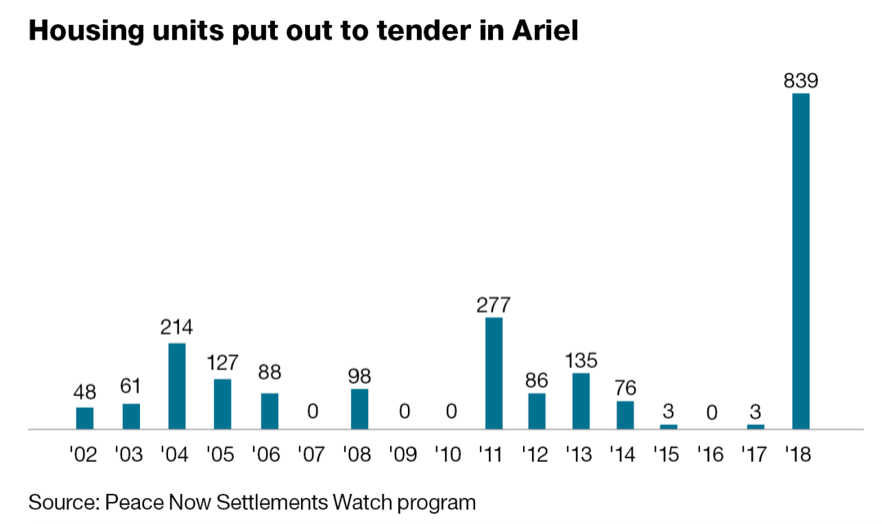 Haaretz published a lengthy report this week on the history of the the Ariel settlement – which is celebrating its 40th anniversary this month – and the dramatic spike in construction in the settlement in 2018. Even before tenders were issued for 42 new units this week (see above), plans for 839 units had already been approved during the first eight months of 2018, compared to tenders for fewer than 5 units each of the past three years. One of the original settlers of Ariel said:
“During the Obama years, everything here was frozen. But thanks to Donald Trump, we’re starting to see the light at the end of the tunnel.”
Not only has Ariel seen a massive surge in construction advancements this year, but the settlement broke ground on a new medical school heavily financed by U.S. casino magnate, and Trump backer, Sheldon Adelson (who this week gave $25 million to the GOP to help it keep the Senate, and in May gave the GOP $30 million to help it keep the House). Many settler leaders and Israeli officials, as well as Adelson and his wife Miriam, were in Ariel this weekend to attend a dedication ceremony for the medical school, despite ongoing controversy around its accreditation under domestic Israeli law. Prime Minister Netanyahu was notably absent from (and reportedly was not invited to) the ceremony, fueling rumors regarding the growing disaffection between him and Adelson.
According to another recent report in Haaretz, Ariel university is illegally dumping construction debris on land that Israel acknowledges is not “state land.” The dump site is outside of the so-called “Blue Line” which the Israeli government uses to demarcate the land that it considers “state land.” Since the dump site is not within the Blue Line, it is likely on land that even the government of Israel recognizes as being privately owned by Palestinians. Anti-settlement watchdog and founder of Kerem Navot, Dror Etkes, commented:
“It’s not surprising that Ariel University, which is the only university in the world built and existing by military order, has adopted the standards accepted in the West Bank involving the takeover of private Palestinian land.”
According to a third Haaretz report, the Israeli Education Ministry has signed a contract to sponsor 3,000-4,000 Israeli high school students of Ethiopian descent to take part in a leadership training program located in Ariel. The program, called “JH Israel,” was founded by American evangelical mega-church pastors Bruce and Heather Johnston, the latter of whom also runs the U.S. Israel Education Association, a pro-Israel, pro-settlement, non-profit group which works with the Family Research Council to lead Congressional delegations to Israel. The JH Israel website says its mission is to help Jewish Israeli students who are “disconnected from the roots of their faith” to establish “a deeper connection to God by embracing their biblical and cultural heritage.” The website also says that Ariel is “at the forefront of biblical prophecy unfolding in modern Israel.”
As FMEP has repeatedly documented, Ariel is located in the heart of the northern West Bank, reaching literally to the midpoint between the Green Line and the Jordan border. The future of Ariel has long been one of the greatest challenges to any possible peace agreement, since any plan to connect Ariel to Israel will cut the northern West Bank into pieces.
Peace Now Settlement Watch Director Shabtay Bendet spoke to Haaretz about the future of the Ariel settlement and the (other) significant repercussions of opening the new medical school. Bendet said:
“Most places in Israel don’t get recognized as cities unless they have 20,000 to 30,000 residents. Ariel became a city when it had just 11,000 residents. Why was this so significant? Because maybe you can uproot a settlement, but you don’t uproot a city. The same holds true for the university. Why was it so important for him to get it accredited? Because when a place has a university, that means it’s established — no pulling it out of the ground….By creating a buffer between the northern and southern parts of the West Bank it makes any future Palestinian state unviable. But besides that, it is also causing damage in the present because its continued expansion impinges on the ability of the surrounding Palestinian villages to develop and grow.”
Amana (the Official Settler Movement) Moves Its HQ to Sheikh Jarrah
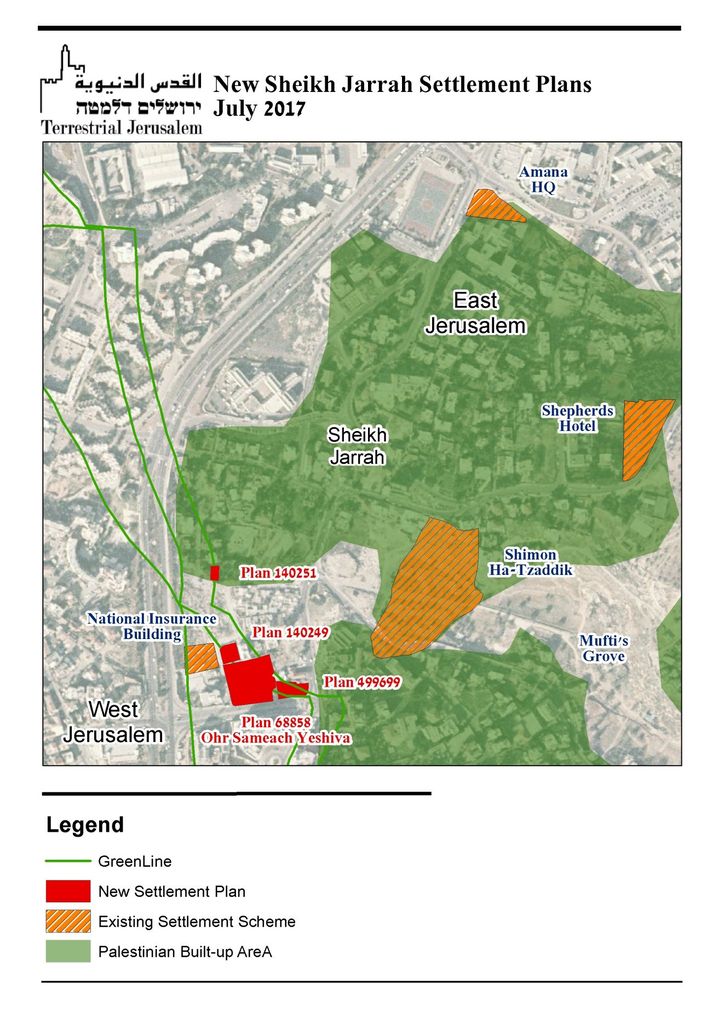 The Ynet news outlet reports that the Amana settler organization – the official body of the settlement movement, operating since the 1970s – has moved into its new headquarters in the heart of the Sheikh Jarrah neighborhood of East Jerusalem, where settlers are continuing to wage a displacement campaign against Palestinian residents. Though Amana has owned the plot of land since 1992, various legal challenges and incredibly sensitive geopolitical considerations have slowed construction of the building, called the “Amana House” (see a detailed history here).
Regarding the strategic implications of the location, Ynet reports:
“Amana says the new headquarters will help bolster the territorial contiguity of Jewish settlements in east Jerusalem.”
Agriculture and Rural Development Minister Uri Ariel (Bayit Yehudi) who previously served as the CEO of Amana, commented that the organization’s relocation:
“constitutes a significant reinforcement to the (Jewish) settlement in east Jerusalem and the bolstering of the Jewish territorial contiguity in the area.”
Several settlement plans are currently proceeding in Sheikh Jarrah, underscoring the strategic location and goals of settler activity in Sheikh Jarrah. As covered previously in this report, Israel is expected to advance a plan for a 6-story office building for settlers, located at the entrance to the neighborhood. Across the street from that building, a highly consequential plan for a new religious school (the Glassman yeshiva) was approved for deposit for public review in July 2017. The goal is clear: to unite the enclaves of settlers living inside of the Palestinian neighborhood by creating a contiguous area of settlement that connects to West Jerusalem, thereby cementing an immovable Jewish Israeli presence in a key Palestinian neighborhood – closing off the possibility of evacuation under a future peace deal.
Settlement Gains in East Jerusalem Result in Palestinians Self-Demolishing Their Homes
OCHA reports that two Palestinian homes in the East Jerusalem neighborhood of Beit Hanina were self-demolished after the Israeli Supreme Court ruled in favor of settlers’ ownership claims. OCHA writes:
“In recent decades, Israeli settler organizations, with the support of the Israeli authorities, have taken control of properties within Palestinian neighbourhoods in East Jerusalem, and some 180 Palestinian families are currently facing eviction cases, filed mainly by settler organizations.”
Bonus Reads
- “How Israeli Right-wing Thinkers Envision the Annexation of the West Bank” (Haaretz)
- “Let’s Admit It: The Settlers Have Won and We Have Lost” (Haaretz)
Welcome to FMEP’s Weekly Settlement Report, covering everything you need to know about Israeli settlement activity this week.
To receive this report via email, please click here.
August 2, 2018
- Israel Launches New Settlement “Heritage Center” in Silwan
- University Heads Challenge Approval of the Ariel Settlement Medical School
- Liberman Promises 400 Settlement Units in Response to Terror
- The Not-So-New Trump Policy on Settlement Travel
- Just Released: 2018 Settlement Map from Peace Now
- Bonus Read
Comments, questions, or suggestions? Email Kristin McCarthy at kmccarthy@fmep.org.
Israel Launches New Settlement “Heritage Center” in Silwan
On August 1st, senior Israeli government officials were on hand to celebrate the beginning of construction on a new settlement complex, under the guise of a cultural center, located in the heart of the Batan al-Hawa section of the Silwan neighborhood in East Jerusalem. The event was heavily guarded by Israeli forces, in an open acknowledgement of the provocative nature of the settler campaign targeting Palestinian homes in Batan al-Hawa, which is located near the walls of the Old City in view of the Temple Mount/Al Aqsa Mosque.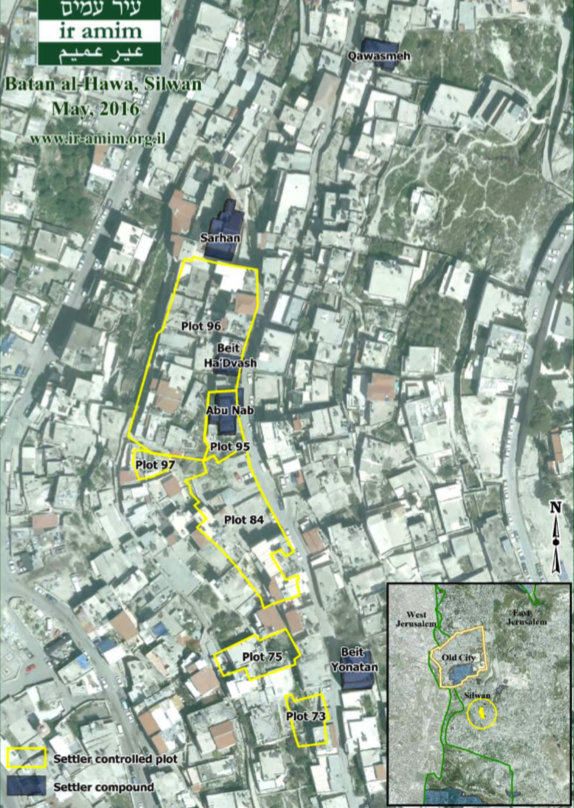
The new settlement initiative is part of a campaign by the Ateret Cohanim settler organization (which works to establish Jewish enclaves inside densely populated Palestinian neighborhoods of East Jerusalem) to exploit the area’s historical connection to Jewish immigrants as a pretext for taking land and establishing Jewish-Israeli control over the area. Israel’s Ministry of Jerusalem Affairs and Ministry of Culture and Sport are contributing an estimated $1.23 million USD to the cost of renovating an old Yemenite synagogue into a settler-run Jewish Yemeni heritage center — in a example of how the government is directly funding extremist settler activity in an area that Ir Amim identifies as “the site of the most substantial settler takeover campaign in Jerusalem since the annexation of East Jerusalem in 1967.”
Attendees at the launch included Cultural Affairs Minister Miri Regev, Jerusalem Affairs Minister Ze’ev Elkin (who is currently campaigning to become the mayor of Jerusalem), former U.S. presidential candidate and governor (and father of the current White House spokeswoman) Mike Huckabee, and former White House Communications Director Anthony Scaramucci (the latter two have been touring Israel and praising the settlements, with Huckabee going so far as to suggest that he might want to have his own home in a settlement someday).
The launch of the project ignores an ongoing legal case before the High Court of Justice that could affect Ateret Cohanim’s ownership claim to the land and building in question. Settlers are acting on the assumption that both are legally owned by the Benvenisti Trust (a historic trust that resettled Jewish Yemenite immigrants in the area in the late 1800s). Ateret Cohanim took control of the Benvenisti Trust in 2001, and in 2002 the Israeli Custodian General transferred land in Batan al-Hawa to the Trust/Ateret Cohanim. Since then, Ateret Cohanim has accelerated its multifaceted campaign to remove Palestinians from their homes, claiming that the Palestinians are illegally squatting on sacred religious land owned by the Trust.
So far, Ateret Cohanim has acquired the deed to six Palestinian homes in Batan al-Hawa, inserting some 20 Israeli Jewish families in place of evicted Palestinian residents. The organization has eviction orders pending against an additional 21 homes, with 800 Palestinians at risk of eviction.
On June 17, 2018, just two months ago, the Israeli High Court of Justice ordered the Israeli government to provide more information regarding its decision to transfer ownership of land in Batan al-Hawa to the Benvenisti Trust/Ateret Cohanim. The Court’s order was in response to a petition filed by Palestinian residents fighting eviction from their homes, and the State’s admission during oral arguments on June 10, 2018 that the land had been transferred to the Benvenisti Trust/Ateret Cohanim without a proper investigation into its legal status. The petitioners argue that the State’s decision to transfer the land was illegal on two fronts: (1) The Benvenisti Trust never owned the land in Batan al-Hawa, but only owned the buildings – all but one of which were demolished in the 1940s; and, (2) the land was transferred without the necessary legal notification to the residents living there.
Yakoub al-Rajabi, a Palestinian resident of Batan al-Hawa, told The Washington Post:
“We know that this was a well-orchestrated plan to force us to leave. And if we stay, it will paralyze us and isolate us in our homes.”
In a 2016 report that covers the Batan al-Hawa situation in detail, Ir Amim and Peace Now underscore the significance of Ateret Cohanim’s efforts, of which the new cultural center would be the crowning jewel:
“If the settlers are successful, Batan al-Hawa is anticipated to become the largest settlement compound in a Palestinian neighborhood in the Historic Basin of the Old City, with the outcome of significantly tightening the emerging ring of settlements around the Old City and severely undermining the possibility of a future two state solution in Jerusalem.”
Ateret Cohanim director Daniel Luria said:
“Every acquisition is very difficult. We’re up against a mobilized Arab world, parts of which are violent. There is huge pressure and millions of dollars are being pumped in to strengthen the Arab hold on the city…[the] biggest problem is trying to get the Jewish world to understand what needs to be done. We have the best relations ever with a US administration. For [US Vice President Mike] Pence and [US Ambassador to Israel David] Friedman and the others, [settling Jews in East Jerusalem] is a no-brainer. What’s our right-wing government waiting for? It’s not about what the US says. It’s about what we do. We are not doing anything to stop the peace process but will not compromise on a millimeter of Jerusalem. You have to show strength of conviction and sovereignty to have peace and coexistence. This can only happen when you live together under Jewish sovereignty.”
Cultural Minister Miri Regev said at the event:
“Look around. We are surrounded by Jewish heritage. The archaeologists won’t find a single Palestinian coin here! We have come home.”
University Heads Challenge Approval of the Ariel Settlement Medical School
The Israeli Committee of University Heads wrote a letter to the Higher Education Council demanding that it reconsider the approval granted to the new medical school in the Ariel settlement, which is already under construction. In a letter addressed to the Chairman of the Planning and Budgeting Committee of the Higher Education Council, Israeli university heads expressed concern that the decision to approve the medical school was tainted by political interference, and was carried out by an “expedited and improper” procedure. A source told Haaretz that the University Heads share a concern “that the Planning and Budgeting Committee [of the Higher Education Council] will be turned into a rubber stamp for [Education Minister Naftali] Bennett.” The signers call on the Planning and Budgeting Committee to hold new hearings on the settlement school to reconsider the data and merits of the proposal.
The letter comes on the heels of claims made publicly last week by three members of the Planning and Budgeting Committee that Education Minister Naftali Bennett interfered in the committee’s work, in order to expedite the approval of the medical school despite the fact that information about the project was missing.
As FMEP has repeatedly covered, the Ariel medical school is part of a government-backed agenda of exploiting academia to normalize and de facto annex settlements. Earlier this year, a part of this effort, the Israeli Knesset passed a law that extends the jurisdiction of the Israeli Council on Higher Education over universities in the settlements (beyond Israel’s self-declared and internationally recognized sovereign borders). This move ensures that the Ariel settlement medical school (and its graduates) are entitled to all the same rights, privileges, and certifications as schools and students in sovereign Israel. The Ariel settlement medical school enjoys the financial backing of American casino magnate, settlement benefactor, and close friend of President Trump Sheldon Adelson.
Liberman Promises 400 Settlement Units in Response to Terror
Defense Minister Avigdor Liberman promised to advance plans for 400 units in the Adam settlement in response to a Palestinian knife attack in the settlement that resulted in the death of one settler and injury to two others. In a tweet, Liberman claimed: “The best answer to terrorism is the expansion of settlements,” continuing, “That’s why I left this morning to promote a plan to build 400 housing units in Adam and approve it in planning institutions in the coming weeks.”
The Times of Israel notes that Liberman’s promise for 400 units is not a new plan but part of an existing plan – for a total of 1,000 units – already being advanced. Liberman’s promise is better understood as a signal to the High Planning Council to expedite the approval of the plan that is already in motion.
The Not-So-New Trump Policy on Visiting Settlements
The Palestinian Authority issued a sharp criticism this week of U.S. Ambassador David Friedman – and U.S. policy – after Friedman traveled to the Adam settlement to pay a condolence call on the widow of a settler murdered in a terror attack. Although Friedman is not the first U.S. Ambassador to visit an Israeli settlement, Friedman has made a habit of it (see here, here, and here for example), leading some observers to point out the self-evident fact that the Trump administration has – without making an official announcement – adopted a concrete change in U.S. policy regarding settlements, and is now not only refraining from criticizing settlement expansion, but is actively engaged in actions that legitimize settlements.
This week the Palestinian Authority said in a statement that the Trump administration and its “religious Zionist staff” were:
“continuing to make a mockery of international law in a bid to impose their positions and policies, which are blindly biased in favor of the Israeli occupation, on the international community with unprecedented arrogance.”
In a rare moment of agreement, settler leaders articulated a similar view of regarding this shift in the Trump Administration’s settlement policy, with the Binyamin Regional Council issuing a statement after Friedman’s visit saying:
“It seems as if we are talking about a change in US policy with respect to the Jewish communities of Judea and Samaria…they are being treated just like the rest of the country.”
Hananel Durani, head of the powerful Yesha Council which advances the interests of the settlements, said:
“I hope the US government will continue to support Israel and the settlements with the same kind of courageous friendship the ambassador demonstrated today.”
Settler leader Oded Revivi, who is head of the Efrat settlement council and foreign envoy for the Yesha Council, commented:
“I want to express my appreciation to Ambassador Friedman who saw fit to visit the settlement of Adam in Binyamin and comfort the bereaved family. This sends an important message to the world regarding strengthening the positive forces and combating the negative forces in the region.”
Just Released: 2018 Settlement Map from Peace Now
Peace Now recently released two 2018 settlement maps, one map the entire West Bank and a second detail map of East Jerusalem. Both are must-have resources for anyone tracking anything related to settlements and the factors that must be addressed in a negotiated solution to the conflict.
Bonus Reads
- “Once Again, Israel Denies the Bedouin What it Grants the Settlers” (Haaretz)
- “Israeli protesters seek return to destroyed West Bank settlements” (Al-Monitor)
- “A rotten system, not rotten apples” (+972 Mag)
- “More than 2,000 trees in West Bank Palestinian Villages Destroyed in Two Months” (Haaretz)
Welcome to FMEP’s Weekly Settlement Report, covering everything you need to know about Israeli settlement activity this week.
To receive this report via email, please click here.
July 28, 2018
- Israel Advances Plans to Establish Three New Settlements
- Israeli Settlement Activists Invade Site of Evacuated Outpost They Plan to Rebuild
- Bennett Intervened to Expedite Approval of Medical School in Ariel Settlement
- Yair Lapid Presents (Yet Another) Rorschach Test on His Settlement Policy
- Bonus Reads
Comments, questions, or suggestions? Email Kristin McCarthy at kmccarthy@fmep.org.
Israel Advances Plans to Establish Three New Settlements
The Israeli government deposited three major settlement plans for public review this week. As noted by Peace Now, all of these plans are related to efforts to legalize outposts located near, but not directly adjacent to, existing “legal” settlements — in effect creating three new settlements under the cover of legalizing “neighborhoods” of existing ones. Two of the plans deal with outposts located in the Jordan Valley; the third deals with an outpost located east of Ramallah.

Map by Peace Now
The deposit of these plans comes in the context of the government’s exploration of legal means to retroactively legalize outposts. A task force appointed by the Israeli government recently issued a report – known as the Zandberg Report – recommending that the government adopt a very flexible understanding of legal criteria for handling isolated outposts located near to settlements. Peace Now explains:
“In the Zandberg Report there is a detailed reference to situations of outposts built away from the mother settlement. Under the descriptive name ‘hanging islands,’ the regularization team suggests that the planning principle that expansion of settlements should be made adjacent to the existing settlement (‘adjacent planning’) should be applied in a ‘flexible manner’ in the Occupied Territories.”
Specifically, the settlements plans deposited for public review are:
- A plan to retroactively legalize an outpost known as “Brosh/Betronot,” by approving an educational campus there (including housing, tourism facilities, a gas station and other public institutions and buildings);
- A plan to build an educational campus on land between the Maale Michmash settlement and the Mitzpeh Danny outpost, which dovetails with ongoing efforts to retroactively legalize that outpost.
- A plan to build 125 settlement units in the Givat Sal’it outpost, as part of preparations to treat the outpost as a “neighborhood” of the nearby Mechola settlement.
Israeli Settlement Activists Invade Site of Evacuated Outpost They Plan to Rebuild
On July 24th, hundreds of Israeli settlers snuck into the site of the long-evacuated settlement of Sa-Nur, located northwest of Nablus, to protest against the Cabinet’s decision to block a bill aimed at allowing the settlement to be rebuilt/re-populated.
The protest was led by settlers who were evacuated from four settlements in the northern West Bank (Sa-Nur, Homesh, Ganim, and Kadim) as part of the 2005 Disengagement Plan, which also saw Israel evacuate its settlements from the Gaza Strip. Bayit Yehudi MKs Mualem-Rafaeli and Bezalel Smotrich, who were part of the group that infiltrated the site, have been promoting a bill that would overturn the 2005 disengagement plan, allowing Israel to reclaim the land and rebuild the settlements.
Mualem-Rafaeli said:
“Over the past year and a half, we have been pushing for the cancelation of that Disengagement Law that was imposed on the northern Samaria, which unfortunately has gone up to the Ministerial Committee again and again and has failed to pass due to a veto by the prime minister. As we mark 13 years to the expulsion, to the complete darkness cast over the Jewish settlement that was destroyed in the communities in the northern Samaria, we are turning the light back on. We’re still committed to this place.”
Smotrich added:
“Mistakes must be remedied. There isn’t a child who doesn’t understand this expulsion has been foolishness. The discussion is with the prime minister and the defense minister. The answer as to why this law hasn’t been canceled yet is at the hands of Netanyahu. We already learned that when public pressure is created, we eventually achieve the goal, as we did with the Regulation Law.”
Bennett Intervened to Expedite Approval of Medical School in Ariel Settlement
Members of Israel’s top academic council slammed Education Minister Naftali Bennett (Jewish Home) for interfering in their work. The controversy surrounds Bennett’s intervention to expedite the approval of a new medical school in the Ariel settlement. That school opened in June 2017, with a ceremony attended by Bennett and the school’s largest financial-benefactor Sheldon Adelson. During a meeting of the Planning and Budgeting Committee of Council of Higher Education [known as “Vatat”] on July 25th, three committee members read a letter of protest, saying in part:
“Bennett’s intervention in the committee’s professional work is being done almost publicly….Recently Vatat has made decisions in an expedited and improper fashion, and even by circumventing the committee. These decisions were made without exhaustive academic and professional discussion and contrary to accepted procedures. The source of these decisions is motivations which, in our opinion, stem from extraneous considerations that erode the high standards that characterize the decisions of the Planning and Budgeting Committee, a situation that undermines the values and needs of higher education.”
Specifically referring to the Ariel settlement university, a committee member said:
“In violation of accepted procedures that are in place for more than 15 years, the [medical school’s] approval was hastily inserted into the agenda of a meeting scheduled months in advance to discuss readying the budget for the next academic year, in preparation for the budget’s approval a week later. t’s not proper that such an important decision be discussed in haste. We are well aware of the need to increase the number of medical students in Israel, but a hasty decision may actually do more harm than good.”
According to Haaretz reporting, it is highly unusual for committee members to publicly criticize the committee’s work. Because the letter was read aloud during the committee’s meeting, the contents will be included in the official meeting minutes, making the members’ criticisms a matter of public record.
Prof. Yaffa Zilbershats, who was appointed by Naftali Bennett to head the Planning and Budgeting Committee in 2015, issued an official written statement defending the process by which the Ariel settlement’s medical school was approved. The statement read in part:
“…there is no political intervention in the work of the committee..The professional committees did a comprehensive examination and submitted all the required materials to the Vatat members for discussion. The materials were sent in time, and all the time necessary was devoted to a discussion at the meeting…There is no place to argue that the decision to establish the medical faculty in Ariel undermined the budget work.”
As FMEP has previously reported, Ariel University became an accredited Israeli university in 2012, following significant controversy and opposition, including from Israeli academics. It has since been the focus of additional controversy, linked to what is a clear Israeli government-backed agenda of exploiting academia to normalize and annex settlements. Earlier this year, in an act of deliberate de facto annexation, the Israeli Knesset passed a law that extends the jurisdiction of the Israeli Council on Higher Education over universities in the settlements (beyond Israel’s self-declared borders), ensuring that the Ariel settlement medical school (and its graduates) are entitled to all the same rights, privileges, and certifications as schools and students in sovereign Israel.
As a reminder, Ariel is located in the heart of the northern West Bank, reaching literally to the midpoint between the Green Line and the Jordan border. The future of Ariel has long been one of the greatest challenges to any possible peace agreement, since any plan to attach Ariel to Israel will cut the northern West Bank into pieces.
Yair Lapid Presents (Yet Another) Rorschach Test on His Settlement Policy
On a visit this week to Israeli settlements in the Jordan Valley, Yesh Atid party chairman Yair Lapid continued to be coy regarding the specifics of his stance on Israeli settlement policy, refusing to say whether settlements in the Jordan Valley will need to be evacuated or allowed to remain under a Lapid-negotiated peace deal. Speaking to reporters, Lapid said the Jordan Valley must remain Israel’s “security border,” but when asked to clarify what that means for Israeli settlers, Lapid quipped “Not for nothing did I say it will remain the ‘security’ border. Everyone can decipher on his own what that means.”
Now a key Lapid talking point, the Yesh Atid party leader also explained why he refuses to be more specific:
“The great mistake of the Israeli left over generations has been its willingness to always starts negotiations by announcing what it will give up and what it will not give up.”
Beyond a negotiating strategy, Lapid (who presents himself as a centrist) has been on a publicity tour over the past months in what is widely seen as a bid to win some of Netanyahu’s (mostly right-of-center) supporters ahead of the next elections. As part of this effort, Lapid (whose party is currently polling in second place in a hypothetical election) has presented a rorschach-like test for voters with respect to settlements, likely hoping that his deliberate ambiguity will lead voters to see whatever it is they want to see. Formerly a devout two-state supporter, Lapid’s recent, less-than-specific settlement statements include:
- In March 2018, Lapid gave an interview to Newsweek where he was asked about his position on settlements. Lapid said that the “settlement blocs” will be part of Israel but did not elaborate when asked about the 1967 Green Line as a basis for a Palestinian state.
- In January 2018, Lapid supported a bill to extend the Israeli Higher Education Council’s jurisdiction over the settlements, an act of de facto annexation that is just one in a string of proposals for applying domestic Israeli law over the settlements.
- In September 2017, Lapid rebuffed criticism that his party was insufficiently supportive of the settlements, denying reports that Yesh Atid was boycotting a celebration of the 50th anniversary of Israeli settlement in the West Bank.
- In July 2017, Lapid railed against settlers who invaded a home in central Hebron, and called for their immediate removal.
- In July 2017, Lapid attended a ceremony in the unauthorized Netiv Ha’avot oupost, during which he promised to support the effort to legalize the outpost and save structures that the High Court ordered demolished.
- In March 2017, Lapid said: “We don’t want a Palestinian state. It’s simply the best way to get rid of four million Palestinians whom we want to get out of our lives the question is not whether it’s right or not, but how to create the highest wall possible between us and the Palestinians with security guarantees for Israelis.”
Bonus Reads
- “How Israel boosted its settlement programme after Trump’s election victory” (Middle East Eye)
***In total, the Israeli government advanced plans for 3,120 new settlement units this week alone. Details, along with additional significant settlement news, are below.***
Welcome to FMEP’s Weekly Settlement Report, covering everything you need to know about Israeli settlement activity this week.
To receive this report via email, please click here.
June 1, 2018
- Plans Advance for 1,958 New Settlement Units
- Tenders Published for 1,162 New Settlement Units
- Israeli Chief Justice Questions Legal Opinion Regarding Status of Settlers
- Knesset Advances Bill to Bring West Bank Land Cases Under Israeli Domestic Jurisdiction (De Facto Annexation)
- Labor MK Calls on Left to Endorse De Facto Annexation of “Settlement Blocs”
- Israeli Security Increase Presence Near Radical Settlements
- Human Rights Watch: Israeli Banks Are Integral Part of the Settlements Enterprise
- U.S. Ambassador Friedman on Settlements, Annexation, Trump “Peace Plan,” & More
- Bonus Reads
Comments, questions, or suggestions? Email Kristin McCarthy at kmccarthy@fmep.org.
Plans Advance for 1,958 New Settlement Units
On May 30th, the Israeli High Planning Council advanced plans for 1,958 new settlement units, located across the West Bank. Of the total, 696 units received final approval and 1,262 units were approved for deposit for public review (a key, step in the planning process). Peace Now estimates that 80% of the planned units are to be built in isolated settlements and that 1,500 of the units are to be built outside of the “built up” area of existing settlements. Two of the plans would establish two entirely new settlements.

Map by Peace Now
Adding insult to injury (or in this case, to a war crime), the Council gave final approval (“validation”) to a provocative plan to build 92 units near the Kfar Adumim settlement east of Jerusalem, less than a mile from the soon-to-be forcibly removed Khan al-Ahmar bedouin community. Those new units will considerably expand the footprint of the Kfar Adumim settlement by building a new neighborhood (called “Nofei Bereishit” meaning “the landscapes of Genesis” in Hebrew), which will serve to connect the existing settlement structures to the site of a future school campus slated to serve several Israeli settlements in the area.
With respect to the Kfar Adumim expansion plan, Peace Now writes:
“The approval of the plan is the embodiment of exploitation and evil. The government stubbornly refuses to grant building permits to 32 Palestinian families living on about 40 dunams in the area and intends to evict them, but at the same time approves construction on large areas for hundreds of Israeli families. If there is anything that blackens Israel’s image in this world, it is the cruelty and discrimination that reeks to the heavens in this case. Neither is there any real Israeli national interest behind the destruction of the village.”
With respect to the plans advanced for two new government-sanctioned settlements, the details are:
- A plan for 189 units in the unauthorized outpost of Zayit Ra’anan, near the Talmon settlement northwest of Ramallah. As Peace Now explains, this plan constitutes the sanctioning of a new settlement entirely. Talmon has three satellite outposts, according to a map by WINEP. Zayit Ra’anan is the outpost the furthest from the settlement.
- A plan to authorize the “Brosh Educational Institution,” an outpost in the Jordan Valley. This too constitutes the establishment of an entirely new settlement. As Peace Now explains, the settlers who established the Brosh outpost named their endeavor an “Educational Institution” in order to obscure their intent to build a settlement. The plan for the “Brosh Educational Institute” includes residential buildings.
These approvals are notable for two reasons: First, they show that the Israeli government is significantly expanding the footprint of settlements across the West Bank, including in isolated settlements. Second, the plans demonstrate that the Israeli government is not acting, in any way, with “restraint” in regards to its settlement activity (per a reported agreement between the U.S. and Israel, “restrained” settlement growth limits Israel’s building to areas adjacent to existing settlement buildings). The reaction of the Trump Administration to the approvals suggests that the U.S. isn’t in any way troubled that Israel appears to be defying its commitment. An official at the U.S. National Security Council told The Times of Israel:
“The Israeli government has made clear that going forward, its intent is to adopt a policy regarding settlement activity that takes the president’s concerns into consideration. The United States welcomes this. The president has made his position on new settlement activity clear, and we encourage all parties to continue to work toward peace.”
Tenders Published for 1,162 New Settlement Units
One day after the High Planning Council advanced plans for nearly 2,000 new settlement units (above), on May 31st the Israeli Housing Ministry issued tenders for another 1,162 new settlement units that had previously approved by the High Planning Council (once planning approvals are complete, the decision on if/when to issue construction tenders for an approved plan rests with the Housing Ministry). The 1,162 tenders issued this week are are for:
- 459 new units in the Ma’ale Adumim settlement;
- 409 new units in the Ariel settlement;
- 250 new units in the Elkana settlement; and
- 44 new units in the Ma’ale Ephraim settlement.
Israeli Chief Justice Questions Legal Opinion Regarding Status of Settlers
On May 31st, Israeli Chief Justice Esther Hayut issued a significant legal opinion that complicates the growing momentum across the Israeli government to adopt and implement a legal precedent holding that Israeli settlers are a part of the “local population” of the West Bank. Chief Justice Hayut said the precedent does not constitute “a binding law” saying it “appears that the ruling contradicts previous rulings…and it contains both a novelty and a difficulty.” The ruling in question, written by retired Justice Salim Joubran in 2016, is currently being used as a precedent to justify the expropriation of privately owned Palestinian land near the Haresha outpost, and adopting the precedent was a key recommendation of the recently-released “Zandberg Report” which gave the Israeli government a plethora of legal tools to retroactively legalize outposts and settlements structures.
Hayut’s opinion was issued in response to a petition by the Israeli NGO Yesh Din, which asked to Court to reopen the Amona outpost case where the “local population” precedent was set. The opinion itself was not published until October 2017 (meaning the precedent was not known to the public or able to be debated until now, precisely when the government is moving swiftly to implement it). While Hayut declined to reopen the Amona outpost case, she took the opportunity to address the question raised by Yesh Din regarding the underlying precedent that was set in the case.
FMEP tracks the evolving legal architecture of the Israeli government’s efforts to retroactively legalize outposts and settlement structures (our regularly updated data tables are available here).
Knesset Advances Bill to Bring West Bank Land Cases Under Israeli Domestic Jurisdiction
On May 28th, the Israeli Knesset advanced a bill through its first reading that, if passed, will give jurisdiction the Jerusalem District Court jurisdiction over land disputes in the occupied West Bank. Since 1967, such cases have been under the jurisdiction of the Israeli High Court of Justice, reflecting the unusual – indeed, legally extraordinary – situation in which an Israeli court is ruling on with respect to land and people that are not part of sovereign Israel. The bill passed by a vote of 47 to 45, and will need to be voted through two more readings in the Knesset plenum before it becomes law.
As FMEP explained when the bill gained government backing in February 2018, the bill’s main proponent, Justice Minister Ayelet Shaked, has three main rationales for the bill: (a) to further extend and formalize Israel’s extraterritorial application of its domestic law and legal structures, giving a regular Israeli domestic court jurisdiction over non-citizen Palestinians living in territory that is beyond Israel’s sovereign borders; (b) to give settlers an advantage in court over Palestinian plaintiffs; and (c) to circumvent what Shaked sees (according to a Justice Ministry official) as the High Court being “overly concerned with international law and with protecting the rights of the ‘occupied’ population in Judea and Samaria.” Under Shaked’s proposal, some Palestinian cases could still reach the High Court of Justice, but only after the much more conservative Jerusalem District Court rules, adding time and cost to any Palestinian land petition.
Yesh Din representative Gilad Grossman commented:
“This bill is designed to indicate a kind of normalcy. [It is meant] to show that we’re not talking about an area conquered by one nation whose residents [Israelis] do whatever they want and no one enforces the law against them in an equal manner, but rather that these are conflicts between neighbors just like in Tel Aviv, Haifa or any other town within sovereign Israel.”
FMEP tracks the progress of this bill in its compendium of annexation policies currently being advanced and implemented in Israel. This bill (tracked on the third table) is just one mechanism by which Israeli lawmakers are moving to apply Israeli domestic law extraterritorially – which amounts to de facto annexation of the West Bank.
Labor MK Calls on Left to Endorse De Facto Annexation of “Settlement Blocs”
Last weekend, MK Eitan Cabel (Labor, the largest faction in the Zionist Union coalition) published an op-ed in the Hebrew edition of Haaretz arguing that Israel should define and then apply Israeli law to the “settlement blocs,” which he defines to include Ma’ale Adumim, the Etzion Bloc, the Jordan Valley, Ariel, Karnei Shomron, and more. Cabel promised to release and campaign for the full plan (presumably with more details) sometime soon.
In the op-ed and in subsequent comments to the press, Cabel calculates that 300,000 Israeli settlers will be annexed into Israel under his scheme. Cabel’s calls for the 100,000 settlers outside of those areas to be compensated and for a total construction freeze to be implemented there. He proposes that the status of those areas will be negotiated if, “one day, the Palestinian Nelson Mandela arrives.”
Zionist Union Chairman and Labor Party leader Avi Gabbai – who has said Israel should not evacuate settlements in any peace deal – slammed Cabel’s plan, saying:
“In a democratic party, everyone can have their opinion, but Labor is for separation, not annexation. Separating from the Palestinians must come as part of an agreement. I am not in favor of a unilateral step. I think in negotiations we can reach better results than without them. This is the best time for negotiations because of our alliance with the US and because the Arab countries want peace.”
Cabel’s plan impressed Naftali Bennett (Jewish Home) who tweeted in support of the op-ed, saying it was a step in the direction of his own proposed scheme to annex all of Area C in the West Bank (60% of the occupied land). Apparently agreeing with that point, an unnamed Labor Party official said:
“It’s a delusional initiative. It’s like [Habayit Hayehudi leader Naftali] Bennett speaking through Cabel…He’s [Cabel] suggesting an annexation, but doesn’t say what will become of the Palestinian population in those territories. These are irresponsible and ill-prepared statements.”
Peace Now tweeted in response:
“Another dangerous, self-defeating remark from this weekend for the Labor party. Veteran MK Cabel’s call for unilateral annexation of the “blocs,” including Ariel & Karnei Shomron, is a cowardly rhetorical surrender to the right’s one-state apartheid agenda. Shameful & disturbing….For everyone who supports cutting Israel a break on building in the ‘blocs,’ this is what happens when you give in. Not only is a top Labor MK adopting the right’s maximalist interpretation of the term ‘blocs,’ he is now making the Maale Adumim annexation bill look tame….One can only assume @netanyahu‘s support for annexing the blocs, but it should be noted that at least publicly he has not advocated as much as Cabel just did.”
As Peace Now suggests, using the term “settlement blocs” is unfortunately misleading, and implies an agreed upon acceptance of what the blocs are and the fact that they are inarguably Israel’s to keep. The term “settlement blocs” has no legal definition or standing, and they are indisputably a matter for negotiations aimed at a two-state solution. The terminology has been used for decades by the Israeli government to convey legitimacy to building in the so-called “blocs.” For more context, see resources from Americans for Peace Now here and here. (NOTE: A Haaretz investigation last year estimated that a total of 380,000 Israeli settlers live in the West Bank, of which 170,000 live outside of the so-called blocs, as defined by Haaretz).
Applying Israel law to areas outside of Israel’s sovereign borders is de facto annexation, as FMEP has explained and documented.
Israeli Security Increase Presence Near Radical Settlements
In early May (before the U.S. Embassy opening and the beginning of Ramadan), Israeli security forces increased troop deployments across the West Bank in order to “prevent friction” between Israeli settlers and Palestinians.
According to a Haaretz report, the decision to increase Israel’s security presence was preceded by a series of discussions over the past month between the army, the police, and the Shin Bet. One such meeting was held at the Prime Minister’s office. A source told Haaretz that the meeting participants came to a consensus that settlers from Yitzhar are the main perpetrators responsible for the escalating frequency of “price tag” attacks against Palestinians. As recapped by Haaretz, the main concern of the Israeli officials is that settler attacks might foment Palestinian attacks in response. Haaretz reports:
“The main concern within the Jewish Division of the Shin Bet, which investigates the activities of Jewish Israeli extremists, is that price tag attacks during Ramadan, a fast month, and coming shortly after the controversial transfer of the U.S. Embassy to Jerusalem and the tensions on the border with the Gaza Strip, could spur terrorist attacks against Israelis.”
Despite the rise in settler violence, Israel MK Bezalel Smotrich took the opportunity to accuse the Israeli police of “bullying” Israeli settlers – an accusation that echoed complaints from settlers, including those from Yitzhar, regarding an increased IDF presence. The Israeli Police issued a response, saying Smotrich’s comments were regrettable.
Even with higher troop deployment, settlers continue to attack Palestinians and their property on a weekly basis.
Human Rights Watch: Israeli Banks Are Integral Part of the Settlements Enterprise
In a new heavily researched, documented report titled “Israeli Banks in West Bank Settlements,” Human Rights Watch documents how Israeli banks facilitate and profit from Israeli settlements and makes the case that these banks are therefore complicit in war crimes, including pillaging. HRW reports:
“Most Israeli banks finance or ‘accompany’ construction projects in the settlements by becoming partners in settlement expansion, supervising each stage of construction, holding the buyers’ money in escrow, and taking ownership of the project in case of default by the construction company. Most of that construction takes place on ‘state land,’ which can include land unlawfully seized from Palestinians and which Israel uses in a discriminatory fashion, allocating one third of state land in the West Bank, not including East Jerusalem, to the World Zionist Organization and just 1 percent for use by Palestinians.”
HRW concludes that banks operating in the settlements are, therefore, unavoidably complicit in violating the human rights of Palestinians, and the only remedy is for these banks cease settlement-related operations.
To illustrate the point that human rights violations are an inherent part of all settlements in the West Bank, HRW partnered with the Israeli NGO Kerem Navot to share the story of how the construction of the Elkana settlement and the Israeli separation barrier has deprived Palestinians from the nearby city of Mas-ha of access to their own lands. Banks that have financed projects in Elkana are part of the machinery that entrenches and expands the theft.
Kerem Navot writes:
“Settlements wreck havoc on Palestinian life in the West Bank. For example, as depicted in the animation, the Aamer family used to walk 20 minutes from their West Bank home to their farm. Then Israel built an Israeli-only settlement on part of it, with help from Israeli banks, turning it into a 2-hour detour on what’s left of their land. Banks and all businesses should cease doing business in and with settlements.”
This is just the latest HRW report on the Israeli banking sector and the occupation, and it builds on a September 2017 legal analysis titled, “Israeli Law and Banking in the West Bank.” In the 2017 report, HRW took apart a common legal defense Israeli banks deploy to defend their settlement practices: that Israeli law requires them to operate in the settlements. HRW concluded that there is no such legal requirement currently in Israeli law.
U.S. Ambassador Friedman on Settlements, Annexation, Trump “Peace Plan,” & More
In a wide-ranging (and stunning) interview this week with The Times of Israel, U.S. Ambassador David Friedman spoke revealingly about behind-the-scenes policy discussions within the Trump Administration, including on the topic of settlements, the status of the West Bank, and Israeli annexation proposals.
A few key Friedman quotes from the transcript include:
- On Israel’s settlement activity during the Trump Administration: “The administration’s stance has been that the settlement enterprise is not an impediment to a peace deal, but that unrestrained settlement activity is not consistent with the cause of peace. Where you draw that line or slice that, I am reluctant to go into now. I have felt for years that there has been an oversimplification by the international community of the legal claims, if you will, within the West Bank. That came to a head in December of 2016, with UN Security Council Resolution 2334. It’s not a secret that the Trump administration does not support that resolution, would have vetoed that resolution, had Nikki Haley been the ambassador rather than Samantha Power. I think you can draw some insight from the administration’s views on that resolution.”
- On how Friedman views the international consensus holding that Israeli settlements in the occupied West Bank are illegal: “…Look, I don’t believe the settlements are illegal. I think I’ve been clear on that for years. President Reagan was very clear that he would never suggest Israel would go back to the 1967 borders. They were called the suicide borders; they were considered indefensible. So the notion that Israel’s presence over the Green Line is illegal is something the United States has through many leaders rejected, which is why that UN resolution in 2016 was so offensive to so many people.”
- On whether the Trump Administration discussed annexation proposals with the Israeli government: “We have not had discussions with Israel about annexation…I’ve done lots of listening, so those discussions have taken place, but not in the sense of planning or seeking to execute a strategy, just in the context of enabling me to hear everybody’s views.”
- On the State Department’s decision to stop using “occupied territories” in materials, and instead use “West Bank”: “I believe this is a highly controversial issue and we ought to be using terminology that doesn’t prejudge issues…I was perfectly happy with any geographic identification that people could commonly understand that didn’t involve an adjective. West Bank is fine, Judea and Samaria would have been fine. If there’s another name that would do it justice, that would have been fine. I didn’t think it was appropriate to use “occupied territories,” because I just found it to be unnecessarily political and judgmental on an issue that was still unsettled in many people’s minds.”
Bonus Reads
- “The UN Database on Businesses in Israeli Settlements: Pitfalls and Opportunities” (Al-Shabaka)
- “Checking Supreme Court’s powers, Bennett looks to ‘rebalance’ Israeli democracy” (Times of Israel)
Welcome to FMEP’s Weekly Settlement Report, covering everything you need to know about Israeli settlement activity this week.
To receive this report via email, please click here.
May 25, 2018
- Israeli Government to Advance 3,900 Settlement Units Next Week
- Finance Ministry Announces Bargain Construction in Beit El & Ma’ale Adumim Settlements
- Defense Ministry Supports Expropriation of Private Palestinian Land for Settlements
- High Court Supports Destruction of Khan al-Ahmar [A War Crime], Clearing the Way for E-1 Settlement
- Palestinians Ask the ICC to Open Investigation into the Israeli Settlement Regime
- Bonus Reads
Comments, questions, or suggestions? Email Kristin McCarthy at kmccarthy@fmep.org.
Israeli Government to Advance 3,900 Settlement Units Next Week
Israeli Defense Minister Avigdor Lieberman (Yisrael Beiteinu) announced that the High Planning Council (the body in the Defense Ministry’s which oversees all construction in the occupied West Bank) is expected to advance plans for 3,900 settlement units next week. Of that total, 2,500 units will reportedly receive final approval for construction and 1,400 will be advanced through the planning process. Peace Now estimates that 52% of the units will be located in isolated settlements.
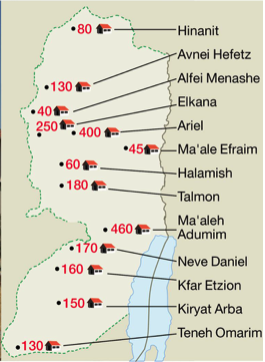
Map by Haaretz
Lieberman – whom The Times of Israel and Haaretz note has repeatedly inflated settlement approval numbers in the past – said the specific plans set to advance will include:
- 400 units in the Ariel settlement (where a medical school financed by Sheldon Adelson was recently brought under Israeli domestic jurisdiction, in a case of de facto annexation. And where a future stop on the recently approved settler-only light rail is slated to be built.);
- 460 units in the Ma’aleh Adumim settlement;
- 250 units for an assisted living center in the Elkana settlement (where the settler-only light rail will also have a stop);
- 180 units in the the Talmon settlement;
- 170 units in the Neve Daniel settlement;
- 160 units in the Kfar Etzion settlement;
- 150 units in the Kiryat Arba settlement (where construction preparations for a new industrial zone – which in reality is a new settlement in Hebron – recently began);
- 130 units in the Avnei Hefetz settlement;
- 130 units in the Tene Omarim settlement;
- 80 units in the Hinanit settlement;
- 60 units in the Halamish settlement (where settlers have built a strategic outpost, with the protection of the IDF, in order to further restrict Palestinian access to the area);
- 45 units in the Ma’ale Efraim settlement;
- 40 units in the Avnei Hafetz settlement;
- 45 units in unspecified settlements.
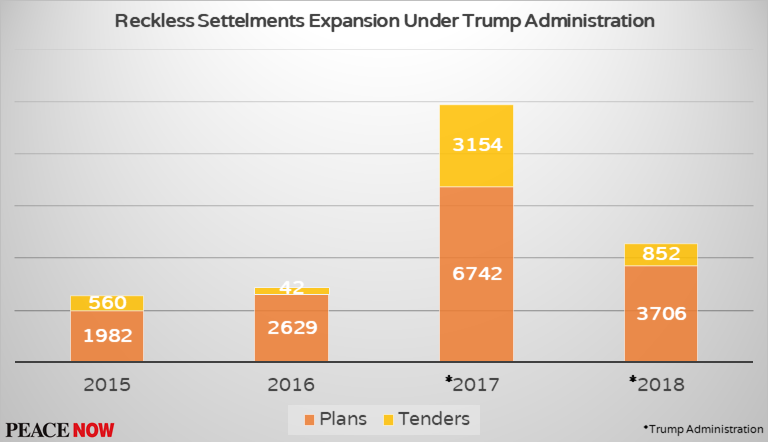
This will be the third meeting of the High Planning Council in 2018, in accordance with a reported agreement between Israel and the United States to consolidate and coordinate the number of times settlement plans are announced. The first regularly scheduled meeting of the year was in January, when 1,122 new settlement units were advanced, of which 352 received final approval for construction. The Council met again, unexpectedly in February, which Lieberman tried to minimize by calling it “less significant” because the majority of the projects approved were non-residential. In fact, the projects were extremely significant. All of the plans expanded the footprint of settlements located deep inside the West Bank – including plans for a race track and hotel in the Jordan Valley. One “unusual” plan even created a new outpost to house settlers evacuated from a different outpost (the Netiv Ha’avot outpost case that FMEP has covered in exhaustive detail).
The anti-settlement watchdog group Peace Now writes:
“In the year and a half since President Trump took office some 14,454 units in the West Bank has been approved (in plans and tenders, including today’s announcement not including East Jerusalem), which is more than three times the amount that was approved in the year and half before his inauguration (4,476 units)…The Netanyahu government is clearly continuing to take advantage of the carte blanche the Trump Administration has given it in order to destroy the chances for peace. It is well-known that for a two-state solution to be feasible Israel will have to withdraw from most of the West Bank, yet the government keeps raising the political cost of this redeployment and the evictions it will entail. By adding housing to settlements, the government shows total disregard for the two-state solution.”
In reaction to Lieberman’s announcement, PLO Executive Committee member Hanan Ahrawi said:
“Such egregious policies affirm the imperative need for the International Criminal Court to open an immediate criminal investigation into Israel’s flagrant violations of international law and conventions,” she said in a statement….Israel’s declared intention to build thousands of illegal settler units in the occupied West Bank discloses the real nature of Israeli colonialism, expansionism and lawlessness…Undoubtedly, Israel is deliberately working to enhance its extremist Jewish settler population and to superimpose ‘Greater Israel’ on all of historic Palestine…It is evident that the recent provocative and unlawful moves adopted by the United States, Guatemala and Paraguay have emboldened Israel to move forward with enhancing its illegal settlement enterprise, thereby finalizing the total annexation of the occupied West Bank.”
Saeb Erekat, a top diplomat for the Palestinian Authority released a video response, in which he highlighted the PA’s recent referral to the International Criminal Court (ICC) to investigate Israeli settlement crimes (see FMEP’s coverage on the ICC referral, below). Erekat said in part:
“This is a flagrant violation and an eye opener to the judicial council of the ICC that an official judicial investigation must be opened immediately. This cannot go on. Israel cannot continue business as usual with this impunity and immunity that they think they have.”
Nadil Abu Rudeina, a spokesman for PA President Mahmoud Abbas, said:
“The continuation of the settlement policy, statements by American officials supporting settlements and incitement by Israeli ministers have ended the two-state solution and ended the American role in the region.”
Finance Ministry Announces Bargain Construction in Beit El & Ma’ale Adumim Settlements
In addition to the approvals expected from the High Planning Council this week, the Israeli Finance Ministry has announced that a 300-unit project in the Beit El settlement and 44-unit project in the Ma’ale Adumim settlement have been marketed as part of the “Buyer’s Price” program. Under this program, the government sells land to construction companies at low prices, and those companies commit to offering future settlement units at below market prices. With the plan being marketed in Beit El, the government is accepting bids on the project from construction companies which commit to pricing the apartments 20% below market value – in effect creating a powerful financial subsidy that incentivizes Israelis to move into settlements.
The Beit El project involves 5 buildings with a total of 296 units. According to Ynet:
“the program’s goal is to transform Beit El’s southeast agricultural area into a residential neighborhood as well as unification and re-division of the lands, which will be allocated to building houses, public offices, commercial areas, routes, and a public open space.”
FMEP has covered the progress of this Beit El project repeatedly over the past year, particularly because the push around Beit El projects typifies the Netanyahu-Trump era of settlement growth. Beit El settlers have lobbied for the project for over 5 years, ever since the settlers were evacuated from an outpost of Beit El (called “Ulpana”) in 2012. When the outpost was evacuated, Prime Minister Netanyahu promised to build replacement settlement units in Beit El. Buoyed by the apparent green-light from the Trump administration, over the summer of 2017 settler leaders repeatedly and publicly shamed Netanyahu for failing to fulfill that promise, and in response Netanyahu very publicly and repeatedly promised that the settlement units will be built expeditiously. After being ignored by the High Council during its September meeting, the plan for 296 units was then approved for marketing in October 2017. Now, this week, the government has acted on that approval to market the plan, moving ever closer to the start of construction. As the Ynet report notes, if/when the 300 units are built, this will be the first new, government-sanctioned construction in the Beit El settlement in 10 years.
Also in Beit El, the settler-aligned media outlet Arutz Sheva reports that the IDF plans to build a new “razor wire” fence to separate the settlement from the Palestinian Jalazone refugee camp, located across the street (where it has been since before Beit El’s establishment). At the time of this writing, there has been no additional reporting on where the fence will be placed, and if it relates to plans to build a wall between Beit El and the Jalazone refugee camp. To better understand the severe implications of the Beit El settlement on the lives of Palestinian in Jalazone, see B’Tselem’s updated, expanded, and now pictorial project: “Life under the shadow of the Beit El Settlement.”
As a reminder, U.S. Ambassador to Israel David Friedman is closely associated with the Beit El settlement, having donated to and fundraised for it prior to his appointment as ambassador (including in his capacity as the President of the American Friends of Beit El, reportedly from 2011 until he became ambassador).
The Beit El settlement was established in 1977, on land previously seized by Israel for military purposes. A second military seizure in 1979 enabled Beit El to expand. This method of establishing and expanding settlements has been repeatedly challenged in Israeli courts. The Israeli group Yesh Din led one such petition against Beit El, seeking to have the second seizure annulled; that petition was dismissed earlier this year. Yesh Din writes:
“The State understood that it was impossible to legally defend the land theft that has been ongoing in Beit El for 40 years on land that was seized for arbitrary reasons, but it refrained, once again, from defending the rights of the weakest population, simply because they are Palestinians. Despite this, we at Yesh Din will continue to fight against the dispossession of Palestinians and the infringement of their rights.”
Defense Ministry Supports Expropriation of Private Palestinian Land for Settlements
On May 24th, the Israeli Defense Ministry released a legal opinion endorsing the government’s plan to expropriate privately owned Palestinian land in the Ofra settlement in order to retroactively legalize illegal settlement structures built there. The opinion adopts the “market regulation” principle as a legal basis for Israel to expropriate privately owned Palestinian land in cases of settlements in which decades-old structures were built and/or purchased by Israelis “in good faith” (believing the Israeli government to be the rightful owner of the land). The legal opinion also calls for the Palestinian owners to be “fully compensated, if not more than that,” and recommends that the principle should not apply to cases of unauthorized outposts. The Ofra situation is a test case for the “market regulation” principle, which has not yet been used (or tested in court) to justify expropriating Palestinian land for Israeli settlements.
Defense Ministry legal advisor Itai Ofir called on Attorney General Avichai Mandleblit to adopt the legal opinion as a government policy, which stands a good chance of happening (Mandleblit already endorsed the Ofra expropriation on that basis). In fact, the Attorney General invented the “market regulation” principle in the first place, as an alternative to the legal argument made in the Regulation Law (which he opposed). The “market regulation” principle was also recommended in the recently released “Zandberg Report,” as one of the tools that the Israeli government should use to carry out massive land expropriations, retroactive legalizations, and continued and intensified settlement growth.
FMEP has chronologically documented the development and adoption of the “market regulation” principle in the Annexation Policies tables.
High Court Supports Destruction of Khan al-Ahmar [A War Crime], Clearing the Way for E-1 Settlement
On May 24th, the High Court of Justice upheld a government plan to destroy the Palestinian Bedouin community of Khan al-Ahmar and forcibly relocate its residents out of the Ma’ale Adumim/E-1 settlement area east of Jerusalem – which Israel is expected to carry out soon. The Court reasoned that the community’s structures were built on State Land without the proper permits, even though Israel deliberately makes such permits nearly impossible to obtain. Clearing Khan al-Ahmar from the its current site (where it has been for 60+ years) is widely interpreted to be a step towards building the “doomsday” E-1 settlement which, if built, will complete a ring of Israeli settlements around East Jerusalem, destroying the territorial contiguity between Palestinians living there and the West Bank, and preventing any possibility of a viable, contiguous Palestinian state with its capital in East Jerusalem.

Map by Ir Amim
Israel has faced intense criticism for its plan to forcibly relocate Khan al-Ahmar, a plan many, including B’Tselem, call a war crime. A group of 76 U.S. Members of Congress recently sent a letter to Netanyahu beseeching him to abandon the plan, as well as the plan to demolish the Palestinian community of Susya, in the South Hebron Hills.
Peace Now says:
“The State of Israel must implement a policy of moral values, justice, equality and human rights for the Jahalin people. It is not in the Israeli interest to forcibly move them from their homes. We must stop the abuse that has been going on for decades, and allow them to live according to their way of life, to make a living and to educate their children in a way that is no different from that of the Jews living in their neighborhoods.”
The Jahalin Bedouin built the Khan al-Ahmar community in the area east of Jerusalem in the 1950s, after they were expelled from their lands in the Negev by the Israeli military. A total of 18 Bedouin tribes live in the vicinity of Ma’ale Adumim/E-1, totaling approximately 3,000 people, who have already endured numerous demolitions this year alone. The Ma’ale Adumim settlement was built in 1975 on land near where the Khan al-Ahmar community already existed; the plan for the E-1 settlement was approved in 1999.
Palestinians Ask the ICC to Open Investigation into the Israeli Settlement Regime
The Palestinian Authority has officially asked the International Criminal Court (ICC) to open an investigation into the Israeli government’s illegal settlement activity. The text of the referral can be found here. Citing “sufficient compelling evidence” and an “alarming intensification of Israeli crimes,” Palestinian Minister of Foreign Affairs Riad Malki asked the ICC to immediately open an investigation into war crimes and crimes against humanity that have been committed against Palestinians in the West Bank, East Jerusalem, and Gaza. The referral requests that the investigation include:
“those who plan, prepare and implement policies linked to the settlements regime as well as those who enable it, whether through financial, military, or logistical support or otherwise aid and abet or encourage the commission of crimes connected to that regime.”
The referral lists specific, ongoing crimes that are “among the most widely documented in contemporary history,” for the ICC to investigate. The PA’s allegations mainly relate to settlement activity (much of which is documented on a weekly basis in FMEP’s Settlement Reports) including: the unlawful appropriation and destruction of private and public properties, including land, houses and buildings, as well as natural resources; the forcible transfer of Palestinians; the unlawful transfer of the Israeli Occupying Power’s population into Occupied Palestinian Territory; the “persecution, including the grave, widespread and systematic denial or violation of basic human rights on discriminatory grounds against Palestinians, including those resulting in or intended to achieve the deportation of forcible transfer, directly or indirectly, of the Palestinian population, the re-population of ‘cleansed’ territories with Israeli settlers and the unlawful appropriation of Palestinian land and properties”; and “the establishment of a system of apartheid based in particular on the adoption of discriminatory laws, policies and practices as well as the commission of inhumane acts intended to establish an institutionalized regime of separation and advancement of Israeli settlements accompanied by the systematic oppression and domination by Israeli settlers over Palestinians.”
After the PA submitted its referral, Israeli Foreign Minister Avigdor Lieberman argued that the “ICC lacks jurisdiction over the Israeli-Palestinian issue, since Israel is not a member of the Court and because the Palestinian Authority is not a state.” While Israel is not a member of the ICC, the State of Palestine acceded to the ICC in December 2014, and its membership took force in April 2015. In January 2015, the ICC’s Office of the Prosecutor opened a preliminary inquiry to “ascertain whether the criteria for opening an investigation are met.” The preliminary inquiry is listed as “ongoing” on the ICC website. Following by the referral for an investigation submitted this week, ICC Chief Prosecutor Mrs. Fatou Bensouda released a statement saying:
“Since 16 January 2015, the situation in Palestine has been subject to a preliminary examination in order to ascertain whether the criteria for opening an investigation are met. This preliminary examination has seen important progress and will continue to follow its normal course, strictly guided by the requirements of the Rome Statute.”
The press release also notes that this is the eighth referral on the matter to date (previously, the situation in Palestine was referred to the ICC for investigation by Uganda, the Democratic Republic of the Congo, the Central African Republic, Mali, the Comoros Islands, and the Gabonese Republic).
Bonus Reads
- “Minister Ariel initiates museum of settlement” (Arutz Sheva)
- “Cherry Plantation Burned in Settlement a Hay Torched in Southern West Bank” (Haaretz)
- “Sheikh Jarrah: A Tale of Eviction and Resettlement” (Al Jazeera)
“In new film, Tel Aviv leftist picks up and moves to a West Bank settlement” (Times of Israel)