Welcome to FMEP’s Weekly Settlement Report, covering everything you need to know about Israeli settlement activity this week.
To subscribe to this report, please click here.
March 29, 2024
- Israel to Legalize Ahiya Outpost, Framing it as a Neighborhood of the Shilo Settlement
- Israel Expedites New West Bank Road for Settlers, Foreshadowing Mass Expansion of Settlement Growth West of Ramallah
- U.S. Undercuts Its Own Sanctions on Settlers, Says Israel Banks Can Continue Hosting Accounts
- Haaretz Reveals Mortgage Fraud Behind Some Outposts Construction
- Palestinian NGOs Issue Alert on Israeli Crimes in the West Bank, East Jerusalem
- The Health & Psychological Impacts of Settler Terrorism
- Settlement Wastewater is Damaging Palestinian Land, Livelihood & Contributing to Forcible Displacement
- Bonus Reads
Israel to Legalize Ahiya Outpost, Framing it as a Neighborhood of the Shilo Settlement
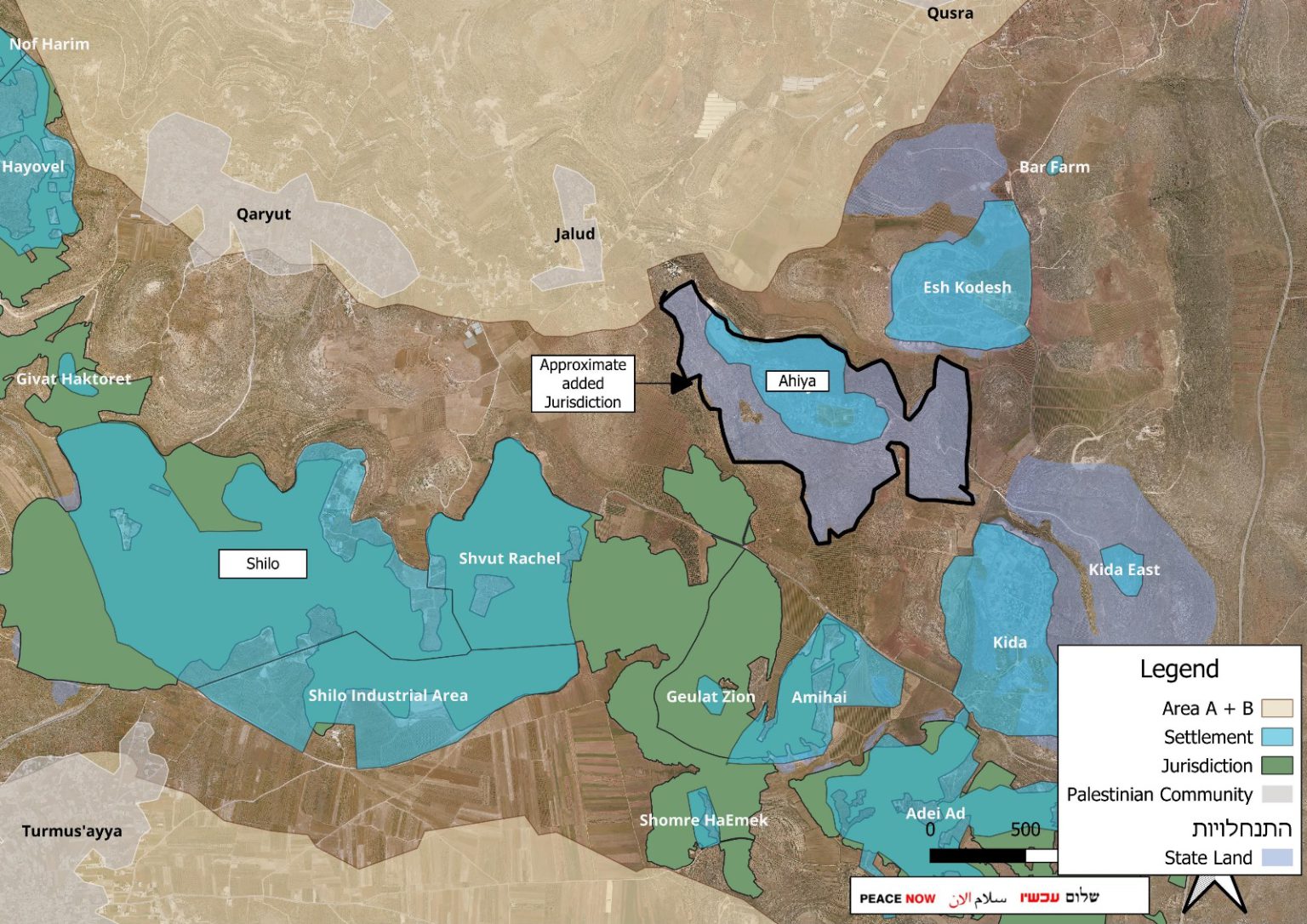 Peace Now reports that the Israeli Civil Administration announced that it will grant retroactive authorization to the Ahiya outpost by massively expanding the jurisdiction of the Shilo settlement to include the land on which the outpost was illegally constructed. The outpost is not contiguous with the built up area of the Shile outpost, and is more properly understood to be a new outpost, not simply an expansion of an existing one.
Peace Now explains:
“According to Peace Now’s estimation, the decision to approve the outpost of Ahiya as a neighborhood of Shilo rather than a new settlement is intended to prevent international criticism and the need to pass the decision in the security cabinet. On the other hand, the decision serves Minister Smotrich, who in the past month has exerted increased authority over settlements and declared a record number of dunams as state lands, promoted thousands of housing units, and more. In 2023, Israel approved five outposts as new settlement neighborhoods, reaching a record number of 15 outposts approved as settlements in 2023. In 2018, Minister Smotrich proposed legislation to regulate approximately 70 outposts as settlements. Since assuming office, he has announced several initiatives to achieve this objective.”
The Shilo settlement is located in the heart of the northern West Bank, in the Shiloh Valley, in an area of settlements that are designed to form an uninterrupted corridor of Israeli control connecting sovereign Israel to the Ariel settlement, through the isolated Shiloh Valley settlements, all the way to the Jordan Valley. In so doing, It will completely bisect the northern part of the West Bank.
The Shiloh settlement has spun off several illegal outposts (Amichai, Adei Ad, Shvut Rachel) which have systematically been added to the Shilo settlement by expanding the settlements borders, a move which rewards illegal construction and land theft and further encourages it. This pattern is exemplified by the Amihai outpost.
The Amichai settlement was approved for construction in 2017, making it (at that time) the first new settlement formally approved by the Israeli government in 25 years. Aerial imagery from 2021 show the massive growth Amichai has enjoyed in the years that followed its establishment, a previously empty hilltop with cultivated fields nearby have been transformed into a sizable suburban neighborhood. In addition to new construction, Amichai was also massively expanded, subsequent to its initial construction, when the Israeli Civil Administration announced that its plan to retroactively legalize the Adei Ad outpost by significantly expanding the borders of the Amichai settlement to turn Adei Ad into a (non-contiguous) neighborhood. In effect, this was a slight-of-hand by Israel to turn the Adei Ad outpost into an entirely new official, legal settlement. In 2013, Israel allocated additional land near the Amichai settlement to the World Zionist Organization, in order to expand the settlement. This has all come at the continued cost to Palestinians from the nearby village of Turmus Ayya on whose land Amichai was established and whom settlers from the Amichai outpost and others nearby routinely harass and terrorize.
In a statement, Peace Now says:
“Establishing another settlement is the last thing Israel needs. Deepening Israeli presence in the West Bank serves only a small and extremist group in Israel and harms the entire Israeli public. The Israeli government, under Minister Smotrich’s leadership, continues to evade a political solution and imposes facts on the ground that will escalate violence and deepen the dispossession and oppression of Palestinians in the West Bank.”
Israel Expedites New West Bank Road for Settlers, Foreshadowing Mass Expansion of Settlement Growth West of Ramallah
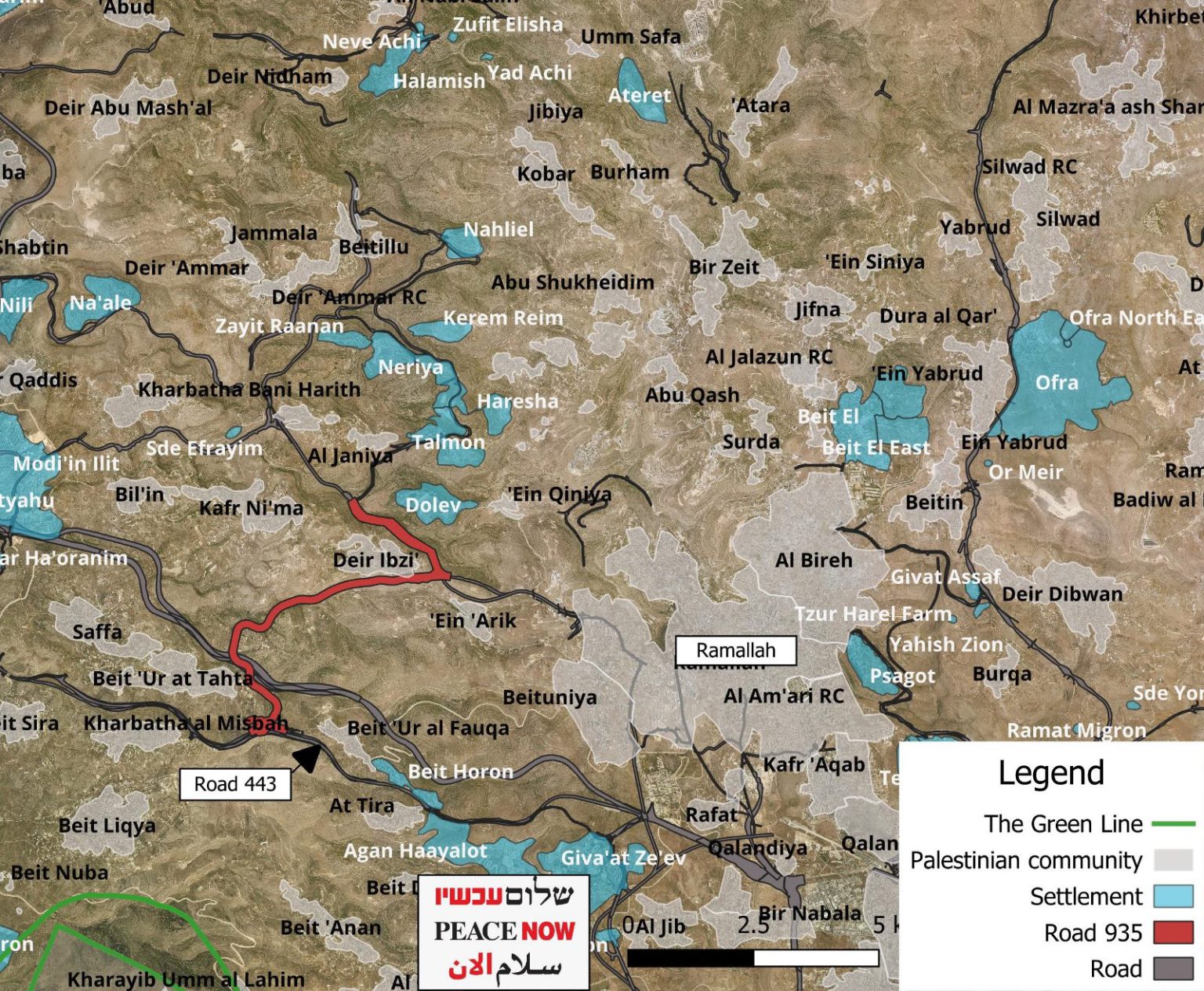 Peace Now reports that Israeli Finance Minister Bezalel Smotrich and Transportation Minister Miri Regev announced plan to fast-track the planning and construction of a new road for settlers in the West Bank, designed to connect the Gush Talmonim settlement area west of Ramallah to Route 443. This road will give the settlements in this area (including Dolev, Almon, Haresha, and others) a more direct route to Jerusalem through Palestinian land, which Israel will expropriate. – and, according to Peace Now, will facilitate the massive expansion of the Gush Talmonim settlement by the tens of thousands.
Peace Now writes:
“The Gush Talmonim Road – Route 443 is an extremely dangerous project for the area west to Ramallah. Its construction will create a wide and densely populated settlement bloc, exacerbating friction between settlers and Palestinians and further complicating a political solution. The road will not reduce violence in the area but rather escalate it to new heights. The political solution lies not in such illogical roads but in a political horizon and hope for both peoples.”
U.S. Undercuts Its Own Sanctions on Settlers, Says Israel Banks Can Continue Hosting Accounts
According to reporting by the Times of Israel, this week the U.S. government sent a letter to the Israeli Finance Ministry saying that, in effect, Israeli banks can maintain accounts for the seven individuals sanctioned by the U.S. government without facing repercussions. The letter is reported to have stated that the sanctions were not intended to cut off sanctioned individuals from all of their assets, only from international/foreign transactions, and that the individuals should be permitted access to their bank accounts for basic purchases.
The letter was prompted by a series of events stemming from recently announced sanctions on Israeli settlers who have participated in violence against Palestinians. Following the U.S.’s announcement, several European countries (and possibly the EU) followed suit, and Israeli banks moved to close accounts for those individuals in fear of being locked out of international banking systems for violating sanctions. Israeli Finance Minister Bezalel Smotrich, seeking retaliation against the banks for the decision to close the accounts, threatened to take steps to cut Palestinian banking off from Israeli banks (the Palestinian economy operates in shekels and is largely dependent on the Israeli banking sector).
Muhammad Shehada, Chief of Communications at the Euro-Med Human Rights Monitor, posted on X:
“Biden quietly reverses the (feckless) sanctions he put on 7 individual settlers, removing the freeze on their accounts & effectively emptying the sanctions of any practical content according to Israel Hayom! It was purely a PR stunt all along to whitewash his complicity in Gaza.”
Tariq Habash, a former political apointee in the U.S. Department of Education who recently resigned in protest of the Biden Administration’s Israel policy, posted:
“The Biden Admin has now eroded the primary policy to deter illegal settlement expansions in the West Bank, undermining the entire purpose of issuing sanctions and compromising U.S. policy yet again.”
Hugh Lovatt, Senior Policy Fellow at the European Council on Foreign Relations, posted on X:
“Once again, the U.S. is scared of its own bark and inherently unable to put any meaningful pressure on Israel. It has promised to undermine the potency of its (secondary) sanctions regime. What could potentially have turned into a game changer is now barely an inconvenience.”
Former J Street lobbyist Dylan Williams posted:
“Between this bizarre move to ease the impact of sanctions on violent settlers and accepting Israel’s patently false assurance that it’s following US and international law per NSM-20, the Biden administration is regressing when it comes to standing up for US interests with Israel.”
Haaretz Reveals Mortgage Fraud Behind Some Outposts Construction
Haaretz and Kerem Navot recently revealed a pattern or mortgage fraud behind the construction of some outposts. The investigation shows that Israeli banks issue mortgages to settlers for the construction of homes in a settlement (with specific land parcel numbers recorded), but the actual construction happens elsewhere – thereby enabling the costly construction of outposts. The complicity/knowledge of the banks in issuing these mortgages is unclear and different for each case – but it is clear that the World Zionist Organization is deeply involved in these dealings.
Most flagrantly, Israeli Finance Minister Bezalel Smotrich – who is also a minister in the Defense Ministry overseeing settlement affairs – himself engaged in this fraud. He took a mortgage for a lot in the Kedumim settlement, but built the house on totally unrelated land located outside the settlement’s zoning plan.
In addition, Yehuda Eliyahu – who Smotrich appointed as head of the Settlement Administration that Smotrich created – also participated in this scheme. He received a 2004 mortgage on a land parcel in the Neria settlement, but built in what is now called the Haresha outpost.
Dror Etkes, founder of the Kerem Navot settlement watchdog group, told Haaretz:
“The two main protagonists of this story, Finance Minister Smotrich and his longtime friend-partner Yehuda Eliyahu, together with their friends in the settlement department, were part of a group of settlers who obtained mortgages while misleading the banks. This may be the reason why 11 years later, as an MK, it was so important for Smotrich to exempt the activity of the settlement department from the Freedom of Information Act.“
Palestinian NGOs Issue Alert on Israeli Crimes in the West Bank, East Jerusalem
Amidst ongoing genocide in Gaza, the three preeminent Palestinian human rights groups – Al-Haq, Al-Mezan, and the Palsetinian Center for Human Rights, have issued a new report on spike in Israeli violations and crimes in the West Bank in the first months of 2024. These crimes include extrajudicial killings, attacks on medical personnel, raids and arrests, demolitions and land razings, land confiscation, settlement expansion, settler violence, and more.
In conclusion, the groups write:
“Our organizations believe that the main target of the Israeli crimes and violations in the West Bank is the existence of the Palestinian people in Mandatory Palestine, for the purpose of entrenching the Zionist settler-colonial project. This is particularily evident in Gaza as well, where the Israeli military aggression has led to the forced displacement of approximately 1.9 million Palestinians within the Gaza Strip amid systematic targeting and destruction, rendering the Strip unlivable and thereby forcing its people to flee. The absence of accountability and concrete enforcement of international law, the international community’s inaction and third states’ complicity are fueling the continuation of Israel’s settler-colonial project and ongoing genocide in Gaza.
Our organizations emphasize that these crimes and violations would not have continued without Israel’s long-enjoyed impunity and third states failure to hold perpetrators accountable and put an end to these crimes, according to Common Article 1 of the Four Geneva Conventions and Articles 146 and 147 of the Fourth Geneva Convention.
Our organizations also call upon the Prosecutor of the International Criminal Court to expedite the investigation into the situation in Palestine initiated more than two years ago and issue arrest warrants to hold the perpetrators accountable for these crimes, particularly the ongoing genocide in the Gaza Strip.
As Israel attempts to eliminate the Palestinian people and their right to self-determination, our organizations reiterate that addressing the situation in Palestine requires tackling the root causes of the Palestinian struggle, emphasizing that the international community and the United Nations member states hold the primary responsibility for the violence in Palestine through their inaction and complicity in Israel’s systematic and widespread violations. We urge the international community to assume its responsibilities to stop the ongoing genocide against the Palestinian people.”
The Health & Psychological Impacts of Settler Terrorism
Physicians for Human Rights has released a new report detailing the multifaceted trauma inflicted on Palestinians in the West Bank by settler terrorism. PHRI writes in the intro:
“For over five years, we’ve been flooded with reports chronicling settler violence. However, this worn-out term obscures a grim reality: life beside settler outposts and farms entail daily exposure to oppressive and coercive mechanisms, systemic discrimination, and a continuous sense of insecurity and fear. Our latest position paper explores how constant exposure to such routine violence is detrimental to the health of Palestinians, highlighting the social and psychological repercussions.”
The paper can be downloaded here.
Settlement Wastewater is Damaging Palestinian Land, Livelihood & Contributing to Forcible Displacement
The Norwegian Refugee Committee has issued a new report on the damage that settlement wastewater is inflicting on Palestinian land and livelihoods. The organization investigated two sites in the West Bank and found human sewage and animal waste flowing from settlements into Palestinian land, destroying crops and land. This, in turn, severely impacts the productivity of Palestinian agriculture, and contributes to the many pressures from Israeli settlers and the government which force Palestinians off their land. The Israeli Water Authority is responsible for water and sewage management for settlements in the West Bank.
One Palestinian farmer who has land close to Immanuel settlement industrial zone, told NRC:
“Wastewater has extensively flooded my land. A salt layer now covers the soil, significantly impacting the quality of the produced oil from my olive groves. Olive trees each used to yield no less than 25 kilograms of olives, but today production has dropped by half.”
Samah Hadid, NRC’s Middle East and North Africa Head of Advocacy said:
“Israel’s settlements routinely contaminate critical water systems and agricultural lands with wastewater, exacerbating environmental risks, further destabilising the already fragile Palestinian economy, and heightening the likelihood of various diseases like diarrhoea and kidney failure.”
In 2017, B’Tselem published a comprehensive report criticizing the illegal Israeli practice of exporting its waste to the occupied territories. The report provides more context for the extent to which hazardous wastewater poses significant damage to Palestinian land and futures. The report says:
“Israel regards the facilities built in the West Bank as part of its local waste management system, yet it applies less rigorous regulatory standards there than it does inside its own territory. Whereas polluting plants located within Israel are subject to progressive air pollution control legislation, polluting plants in the industrial zones of settlements are subject to virtually no restrictions. Moreover, the facilities in settlements are not required to report on the amount of waste they process, the hazards their operation pose, or the measures they adopt to prevent – or at least reduce – these risks. B’Tselem sent requests for information on these matters to the Ministry of Environmental Protection and the Civil Administration. The requests have gone unanswered.
…For many years, Israel has been taking advantage of its power as occupier to transfer the treatment of waste (including hazardous waste) and sewage from its sovereign territory to the West Bank. To that end, it has created a situation in which environmental legislation in the West Bank is much laxer than inside Israel, conveniently overlooking the long-term impact of environmental hazards on the Palestinian population and on natural resources, and neglecting to prepare future rehabilitation plans. This has created a financial incentive to transfer the treatment of environmental hazards from Israel to the West Bank. The Palestinians who live in the occupied territory are the ones to pay the price for this environmental damage, even though they were never asked their opinion on the matter and although, as a population under occupation, they have no political power and no real ability to resist.”
Bonus Reads
- “Israeli settlers step up attacks on Palestinian farms, expanding West Bank outposts” (NPR)
- “In a West Bank settlement, Israelis tend red cows and plan the Third Temple” (Middle East Eye)
Welcome to FMEP’s Weekly Settlement Report, covering everything you need to know about Israeli settlement activity this week.
To subscribe to this report, please click here.
September 1, 2023
- Israel Allocates Lands to WZO in order to Expand Two Settlements
- Government Delays Smotrich’s New $185 Million Plan to Expand Settlements
- During Time as Tourism Minister, Yariv Levin Poured Money into Settlement Projects
- Bonus Reads
Israel Allocates Lands to WZO in order to Expand Two Settlements
Peace Now reports that on August 27, 2023, the Israeli government directed the allocation of state lands near two settlements (Mevo’ot Yericho and Amichai) to the Settlement Division of the World Zionist Organization, which will, in turn, allocate the lands to the settlements for expansion. In addition to the concerning expansion of the two settlements, the might signal the government’s intention to formalize the authority of the Settlement Division – a private, non-state entity – to manage the legal process of allocating state lands to settlements and outposts across the West Bank to settlements.
As a reminder, the Settlement Division is a body within the WZO established in 1971 and fully funded by the Israeli government. It serves as a channel by which the government can establish settlements – legally and illegally – in the occupied territories, while avoiding the rules, regulations, and transparency requirements to which government entities are bound. The Israeli government assigned management responsibilities to the WZO for over 60% of the land in the West Bank which the government declared to be “state land” (90,000 acres/400,000 dunams). The WZO has then given that land to settlers to build settlements and secretly funnel government money to illegal outposts. However, Peace Now reports that in recent years the government has “refrained from granting new lands to the Settlement Division, opting for limited and specific allocations instead. The recent decision signifies a noteworthy shift, indicating the government’s intent to formalize the process of land management in the territories by officially outsourcing it to the Settlement Division.”
Peace Now reminds that the Israeli government has attempted once before to formalize the role of the WZO’s Settlement Division as a legal entity charged with managing and allocating West Bank land. When a bill proposing that move was discussed in the Knesset, it was strongly criticized by then Israeli Deputy Attorney Dina Zilber who said:
“This is about relinquishing the state’s fiduciary obligations in the region and effectively elevating the Settlement Division to a governing body with sweeping authority over land in Judea and Samaria. Land management is one of the most significant authorities that should remain under state control… given that we’re operating in an area controlled by the military commander, an area defined as under belligerent occupation in international law… this territory should be managed by the military commander with consideration for both short-term dynamics and the interests of the protected population, which, in the majority of cases in Judea and Sam aria, happens to be the Palestinian population. Consequently, there’s a collision between short-term considerations and permanent settlements. When a clear governmental authority, originally the responsibility of a proper governmental body, shifts to a non-governmental entity, it’s a concerning change. Here, significant funding is also in play… at the moment, we’re in a situation where the same entity serves as a vital resource manager, funded by the government, but lacks oversight and transparency, providing reports only in hindsight. It wields control over hundreds of thousands of dunams.”
Peace Now said in a statement:
“Allowing the Settlement Division to manage these lands in the occupied territories is comparable to entrusting a fox with guarding the henhouse. This essentially amounts to privatizing land management, which is inconsistent with democratic governance and is unlawful within occupied territories according to international law. The Settlement Division has previously been directly implicated in the appropriation of Palestinian private lands and continues to assist settlers in acquiring extensive lands within the territories, often without public tenders and behind closed doors. It operates autonomously, ignoring the governmental oversight bodies that are supposed to supervise its activities. Despite facing severe criticism from the State Comptroller and the Legal Advisor to the Government in the past, the Netanyahu-Smotrich administration has opted to persist in this direction and formalize the process.”
The settlements that are set to expand – Amichai and Mevo’ot Jericho – are especially notable settlements because of their political contexts and sensitive locations.
The Amichai settlement was approved for construction in 2017, making it (at that time) the first new settlement formally approved by the Israeli government in 25 years. The settlement is located in the heart of the northern West Bank, in the Shiloh Valley, in an area of settlements that are designed to form an uninterrupted corridor of Israeli control connecting sovereign Israel to the Ariel settlement, through the isolated Shiloh Valley settlements, all the way to the Jordan Valley. In so doing, It will completely bisect the northern part of the West Bank. Aerial imagery from 2021 show the massive growth Amichai has enjoyed in the years that followed its establishment, a previously empty hilltop with cultivated fields nearby have been transformed into a sizable suburban neighborhood. In addition to new construction, Amichai was also massively expanded, subsequent to its initial construction, when the Israeli Civil Administration announced that its plan to retroactively legalize the Adei Ad outpost by significantly expanding the borders of the Amichai settlement to turn Adei Ad into a (non-contiguous) neighborhood. In effect, this was a slight-of-hand by Israel to turn the Adei Ad outpost into an entirely new official, legal settlement. Now, the settlement is set to expand yet again, at the continued cost to Palestinians from the nearby village of Turmus Ayya on whose land Amichai was established and whom settlers from the Amichai outpost and others nearby routinely harass and terrorize.
The Mevo’ot Yericho settlement is located in the Jordan Valley just north of Jericho. Established illegally as an outpost, the Israeli government granted retroactive legalization to it 2019, just two days before an election. One of Netanyahu’s most prominent campaign pitches was to unilaterally annex the Jordan Valley, of which the legalization of Mevo’ot Yericho was a part. Prior to the government’s decision to legalize Mevo’ot Yericho, Israeli Attorney General Mandleblit had to rescind his earlier objection to the timing of the approval (during an election campaign), apparently having been convinced that granting retroactive legalization to the outpost was an “urgent” matter. According to a source who spoke to The Times of Israel, Netanyahu convinced Mandleblit of the plan’s urgency by informing him that the Trump’s “Deal of the Century” will put outposts, including Mevo’ot Yericho, at risk for evacuation, and that Israel must “combat” the plan before it is published.
Government Delays Smotrich’s New $185 Million Plan to Expand Settlements
Ynet reports that the Israeli government has temporarily paused consideration of a proposal by Bezalel Smotrich to invest some $185million (700 million NIS) into a variety of projects that will enable the rapid growth of settlements, including establishing new settlements, the retroactive legalization of 155 outposts, and building an airport in the northern West Bank.
Ynet further reports that the faces opposition from the Israeli Shin Bet as well as the United States..
During Time as Tourism Minister, Yariv Levin Poured Money into Settlement Projects
Peace Now has published data and analysis on Yariv Levin’s four year tenure as the Israeli Minister of Tourism (2016-2019), during which time he oversaw the investment of $245 million (NIS 929 million) into “tourism” projects in the West Bank. The amount of funds invested in settlement projects amounted to close to half (46%) of the tourism budget for the entire country.
As a reminder, Israel’s development of tourism sites in the West Bank is part and parcel of its settlement enterprise, and perpetuates land theft, annexation, and the systematic violation of Palestinian rights.
The Peace Now report finds:
- Over 37% of the development budget, nearly 350 million shekels, was allocated to projects associated with the right-wing and settler organization of Elad, operating in Palestinian neighborhoods in East Jerusalem.
- 84.3% of the investments in Jerusalem went to the Elad settler organization.
- In the settlements (excluding East Jerusalem), approximately 70% of the funds submitted for approval to the Ministry of Tourism were approved, while in Israel, only 20% were approved.
For a detailed examination of the projects Levin invested in, please see Peace Now’s report.
Bonus Reads
- “Smotrich Takes to PR to Publicize Israeli Demolitions of Palestinian Structures in West Bank” (Haaretz)
- “Settlers Killing Palestinians: A History of Impunity” (Haaretz)
- “Palestinians blame settler attacks for emptying of 3 West Bank villages” (The Times of Israel)
- “Palestinian fears grow amid rising Israeli settler attacks” (BBC)
Welcome to FMEP’s Weekly Settlement Report, covering everything you need to know about Israeli settlement activity this week.
To subscribe to this report, please click here.
September 9, 2022
- Israel Advances Givat HaShaked Settlement Plan in East Jerusalem
- Israel Delays (for now) Consideration of E-1 Settlement
- Israel Planning to “Legalize” 30+ Shepherding Outposts in Massive Land Grab
- Israel to Request Another Delay in Demolition of Khan al-Ahmar
- IDF Issues Orders to Keep Settlers Out of Ramat Migron Outpost Area
- IDF Removes Amichai Settlement Tower
- Yesha Council Elects New Leader
- Settlement Schools are Flourishing
- Bonus Reads
Israel Advances Givat HaShaked Settlement Plan in East Jerusalem
On September 5th, the Jerusalem District Planning Committee advanced plans to build a new settlement in East Jerusalem, to be called “Givat HaShaked.” The plan provides for 700 housing units (in 4 highrise towers and several six-story buildings), a school, and commercial buildings –all to be built on a highly sensitive and geopolitically critical sliver of land located within the Palestinian neighborhood of Beit Safafa. The plan was approved for public deposit, an advanced stage in the Israeli planning process. The plan for Givat HaShaked is unprecedented, according to the Israeli NGO Terrestrial Jerusalem, in that it is the first settlement of this size that that Israeli government will establish within a Palestinian neighborhood. Beit Safafa is already in the process of being completely surrounded by Israeli development (for Jewish Israelis) — most notably with final approval of the Givat Hamatos settlement plan, for which tenders were issued in January 2021.

The Israeli NGO Ir Amim also points out that, while the government goes to great lengths to find a way to squeeze in several high rise towers to house Israelis in East Jerusalem, there is no parallel effort to address the decades-long lack of planning and approvals for Palestinian communities. Ir Amim writes:
“Givat HaShaked is also a flagrant example of the breadth and depth of housing and planning discrimination in the city. While Givat HaShaked is intended for land located along the built-up area of Sharafat, it is not designated for the community’s development needs, but rather a new housing project for Israelis over the Green Line in Jerusalem. Construction of this new settlement will likewise stand in stark contrast to the existing Palestinian neighborhood, dwarfing and engulfing Sharafat with high-rise apartment buildings – the likes of which Israeli authorities refuse to promote or approve for Palestinian areas. In a similar fashion, the remaining land reserves on the eastern side of Beit Safafa, which could have been used to address the neighborhood’s housing needs, were depleted to advance construction of the Israeli settlement of Givat Hamatos.”
Interior Minister Ayelet Shaked celebrated the advancement, telling Arutz Sheva:
“As I promised, despite all the pressures from at home and abroad, the Givat Hashaked plan was approved today by the district committee. This plan is located in the heart of Jerusalem and is unthinkable to prevent development and construction in this area as well as all over the city. This is an important plan that will lead to an increase in the supply of housing units, employment areas and public buildings for the well-being of the residents.”
As a reminder, the Israeli government has been sitting on plans for Givat HaShaked for decades, but has refrained from implementing them because doing so would require the government to seize a sizeable amount of land in East Jerusalem, some of which is privately owned by Palestinian residents of Sharafat (a section of the Palestinian neighborhood of Beit Safafa). Other parts of the land proposed to be used for the Givat HaShaked settlement plan are managed by the Israeli General Custodian (but neither owned or claimed by the government of Israel) – a fact Ir Amim calls “highly unusual and seemingly marks a new phenomenon.” The Israeli General Custodian is empowered by the State to act as a caretaker of land that has unknown ownership until the heirs are located. In an attempt to explain why the General Custodian has the authority to approve a plan for construction on land that the State does not own, the Israeli Justice Ministry told Haaretz that the plan for Givat HaShaked increased the value of the land and that “by law, the administrator general is obligated to care for the assets under his management in a way that will benefit their private owners.” This answer implies, bizarrely, that if and when Palestinian heirs are located, they will be somehow better off with their land having been used to build a settlement.
Another important facet of how Givat HaShaked is being advanced now is the decision by the Israeli government in late 2020 to initiate a (typically secret) registration process for land in East Jerusalem, including in the Sharafat area. At this time, it is unknown whether the land managed by the General Custodian in Sharafat (and designated for the new settlement) has been – or is in the process of being – registered. On that uncertainty, Ir Amim writes:
“…in the event that it is the same location [where formal land registration has taken place], this move would constitute yet another brazen example of how the settlement of title procedures are repeatedly being used to aid state authorities and settler groups in taking over more land in East Jerusalem…Although portrayed as a measure to ostensibly benefit Palestinian residents, there has been grave alarm that these [land registration and settlement of title] procedures would in fact be exploited to confiscate Palestinian land for political purposes, leading to the expansion of Jewish settlement and widespread Palestinian dispossession in the city.”
For a deep dive into land registration in East Jerusalem, please listen to a new FMEP podcast featuring Kristin McCarthy (FMEP) in conversation with Amy Cohen (Ir Amim).
Israel Delays (for now) Consideration of E-1 Settlement
The Israeli Higher Planning Committee of the Civil Administration has again delayed its consideration of the E-1 settlement plan, which was scheduled to be taken up at the Committee’s September 12th meeting. The E-1 settlement is considered a “doomsday” settlement for much of the international community that still hopes to negotiate a two state solution. This same committee was previously scheduled to take up the E-1 plan on July 18th – days after U.S. President Joe Biden’s visit to Jerusalem. The Israeli government intervened to postpone the meeting, rescheduling it for September 12th – the hearing that has now also been delayed.
Peace Now said in response:
“This is welcome news, but we wish to see E1 taken off the table completely. E1 is lethal to the two-state solution, highly detrimental to Palestinian freedom of movement and to connection between different parts of the future Palestinian state. The Israeli government, and in particular Minister of Defense Benny Gantz (in whose jurisdiction these decisions lie), must take the plan off the table completely.”
This repeatedly delayed meeting promises to be a decisive one for the long-pending E-1 plan, and could result in the Committee granting final approval to the highly contentious plan. Barring intensive outside pressure, additional postponement of the hearing seems highly improbable, given the Israeli domestic politics and the upcoming national election.
As a reminder: in its current form, the E-1 plan provides for the construction of 3,412 new settlement units on a site located northeast of Jerusalem. The site is home to several Palestinian bedouin communities, including Khan al-Ahmar, which Israel has already undertaken to forcibly displace (many attempts). Long called a “doomsday” settlement by supporters of a two-state solution, construction of the E-1 settlement would sever East Jerusalem from its West Bank hinterland, preventing East Jerusalem from ever functioning as a viable Palestinian capital. It would also cut the West Bank effectively in half, isolating the northern West Bank from the southern West Bank and foreclosing the possibility of the establishment of a Palestinian state with territorial contiguity.
Israel’s “answer” to the latter criticism has long been to argue that Palestinians don’t need territorial contiguity, and that new roads can instead provide “transportational continuity.” To this end, Israel has already built the so-called “Sovereignty Road” – a sealed road that enables Palestinians to pass through, but not to enter, the E-1 area. That road is wholly under Israel’s control (meaning Israel can cut off Palestinian passage through it at any time). In January 2021, then-Prime Minister Netanyahu promised to increase funding for the “Sovereignty Road” as part of the drive to get E-1 built.
And another reminder: there have been attempts to promote the E-1 plan since the early 1990s, but due to wall-to-wall international opposition, the plan was not advanced until 2012, when Netaynuahu ordered it to be approved for deposit for public review (a key step in the approval process), ostensibly as payback for the Palestinians seeking recognition at the United Nations. Following an outcry from the international community, the plan again went into a sort of dormancy, only to be put back on the agenda by Netanyahu in February 2020, when he was facing his third round of elections in the two years. Also, as a reminder: under the Trump Plan (which the Biden Administration has yet to comment on), the area where E-1 is located is slated to become part of Israel.
Israel Planning to “Legalize” 30+ Shepherding Outposts in Massive Land Grab
Haaretz reports that the Israeli Civil Administration is in the midst of a years-long process of drafting new protocols that will allow the State to “legalize” settlers’ claims to huge areas of the West Bank (mainly in Area C) that settlers have de facto seized through illegal shepherding activities (grazing settler-owned flocks of sheep, etc on the land). The Civil Administration is working to “legalize” this land theft in areas where the land in question is categorized by Israel as “State land.”
The phenomenon of “shepherding outposts” has been extensively documented by the Israeli NGO Kerem Navot, which has identified it as currently the “most significant mechanism for dispossessing Palestinian communities” in the West Bank. According to Kerem Navot’s May 2022 report, entitled “Wild Wild West,” settlers have taken control of nearly 7% of Area C of the West Bank (around 60,000 acres) via 77 of these grazing outposts.
The Haaretz Editorial Board – in a piece entitled “Settler Crime Always Pays” – writes:
“Once again, the settlers have proved that Jewish crime in the territories always pays. The Civil Administration began formulating the draft regulation about two years ago, against the background of the increase in the number of these outposts. The proper response to the growing number of farms established illegally would have been to see to their removal and to step up enforcement. Instead, the agency bowed down to the settler masters and seeks to cut the law to fit their vices…It must be hoped that he [Gantz] recognizes that it is a looting mechanism designed to take control of more and more of Area C, to prevent Palestinians from working their land and to reduce their living space.”
As a reminder: Israel has a legal responsibility under international law regarding stewardship of “state land” held under its occupation. As the Association for Civil Rights in Israel explains:
“Israel holds state land in an occupied territory as a trustee, and must do everything possible to preserve and develop it for the benefit of the local Palestinian population. The very use of state land for the purpose of building settlements and/or developing infrastructure and industrial zones not in favor of the Palestinian population constitutes a violation of international law.”
Israel to Request Another Delay in Demolition of Khan al-Ahmar
Facing a September 11th deadline to complete the forcible relocation of the Khan al-Ahmar community from their longtime lands just east of Jerusalem (an act that would constitute a war crime), Israeli Prime Minister Yair Lapid has become just the most recent Israeli premier to ask the Court for an extension. As a reminder, the High Court has ordered the demolition of Khan al-Ahmar, which it declared to be illegally built (i.e., lacking Israeli building permits that are virtually impossible for Palestinians to obtain).
The Israeli High Court imposed a deadline on the State to demolish Khan al Ahmar in response to a petition filed by the right-wing pro-settler group Regavim, which sued the government for failing to carry out the demolition of the community in the wake of the Court’s ruling that the community was built illegally. That demolition order has been pending since 2018. The Court granted several delays to the Netanyahu government, and one to the Bennett government. When granting the government another delay in September 2020, the Court said that it would not be granting any more delays. It then granted several more delays, most recently in July 2021, ostensibly due to Russia’s invasion of Ukraine.
Prior to becoming Prime Minister, Lapid opposed the State’s plan to forcibly relocate Khan al-Ahmar. Reports suggested that the government has been preparing a plan that would entail the demolition of the Khan Al-Ahmar, followed by (bizarrely) the rebuilding of the community some 300 meters from where it currently stands.
IDF Issues Orders to Keep Settlers Out of Ramat Migron Outpost Area
After three weeks of repeatedly demolishing the “Ramat Migron” outpost, only to have settlers rebuild it, the IDF has issued a new order declaring the area a “closed military zone” — apparently in hopes of barring settlers from entering the area. The order is effective for only one month. As a reminder: The IDF already viewed it as illegal for settlers to enter the area (which is why the IDF arrested settlers in the area last week), so it is not clear (at least as of this writing) what is different about this new order.
The IDF informed the settlers of the new order as they were in the process of constructing buildings at the Ramat Migron site. Settlers have already vowed to continue fighting to establish a settlement on the hilltop.
IDF Removes Amichai Settlement Tower
On September 8th, Israeli authorities demolished a tower built by settlers on land that has been allotted to the Amihai settlement, located in the Shiloh Valley in the northern West Bank. Settlers built the tower apparently in order to surveil a nearby Palestinian village where new homes are being built. Settlers have already vowed to rebuild the tower.
The Amichai settlement was approved for construction in 2017, making it at that time the first new settlement formally approved by the Isareli government in 25 years. Aerial imagery from 2021 show the massive growth Amichai has enjoyed in the years that followed its establishment, a previously empty hilltop with cultivated fields nearby have been transformed into a sizable suburban neighborhood. In addition to new construction, Amichai was also massively expanded, subsequent to its initial construction, when the Israeli Civil Administration announced that its plan to retroactively legalize the Adei Ad outpost by significantly expanding the borders of the Amichai settlement to turn Adei Ad into a (non-contiguous) neighborhood. In effect, this was a slight-of-hand by Israel to turn the Adei Ad outpost into an entirely new official, legal settlement.
Yesha Council Elects New Leader
The Yesha Council – an association of heads of settlements and regional council leaders that acts as the settler lobby to the government – has elected a new chair, Shlomo Ne’eman. Ne’eman is set to take over the post from David Elhayani.
Ne’eman has earned his stripes as the chairman of the Gush Etzion Regional Council. Upon his election (he was unopposed), Ne’eman said:
“The first task before us is to strengthen the sovereignty and the Jewish presence in the region. This is the time to unite against those who seek our harm, the Palestinian Authority and other terrorist organizations that fight us with guns and knives, as well as with plows and concrete pumps, and to continue working to develop and strengthen Israeli settlement in Judea, Samaria and the Jordan Valley.”
Settlement Schools are Flourishing
According to a newsletter issued by the Friends of Beit El Settlement (an organization that former Ambassador David Friedman used to chair), as the new school year starts there are 86,000 children living in settlements and enrolled in 270 elementary schools across the West Bank. In addition, the newsletter reports that 35,000 settler students attend ~200 post-elementary schools. Gloating, the newsletter boasts:
“Beautiful numbers like these don’t just happen on their own. We can barely imagine the amount of idealism and effort and self-sacrifice over the course of decades, under severely difficult economic and security conditions, that has gone into the Yesha enterprise.”
Bonus Reads
- “Settlement Org Eyes a New Target, and Israeli Authorities Go Out of Their Way to Help” (Haaretz)
- “IDF preparing to use armed drones in West Bank operations” (The Times of Israel)
- “U.S. Examining Allegations Against Israel’s Orthodox West Bank Battalion” (Haaretz)
Welcome to FMEP’s Weekly Settlement & Annexation Report. To subscribe to this report, please click here.
April 15, 2021
- New Satellite Imagery Shows Massive Growth of Amichai, Bruchin Over Past Five Years
- Israel Hastens Approval of New East Jerusalem Settlement “Har Homa E”
- Jewish National Fund Pushes Forward Plan to Legalize West Bank Land Purchases
- In-Depth Report on Pending Demolitions in Al-Bustan (Silwan)
- Bonus Reads
Comments or questions? Email Kristin McCarthy – kmccarthy@fmep.org.
New Satellite Imagery Shows Massive Growth of Amichai, Bruchin Over Past Five Years
The Associated Press has published new satellite imagery (captured by Planet Labs Inc.) showing the expansive, transformative growth of the Amichai and Bruchin settlements over the past five years – a period defined by the Trump Administration’s pro-settlement policy.

Aerial image of Amichai, 2017 vs 2021 (via AP / Planet Labs Inc.)
The AP story offers analysis on the predicament facing the Biden Administration, which has articulated support for a two state outcome but has not specifically taken Israel to task for its ongoing settlement construction. The Amichai and Bruchin settlements illustrate this point – both are located in the Shilo Valley region of the West Bank, in a finger of continuous settlements that extends from the 1967 Green Line to the Ariel settlement in the very center of the northern West Bank, cutting the northern West Bank in half. It’s worth recalling that, when the Amichai settlement was built, a settler proudly proclaimed that the settlement would nullify the possibility of a two state outcome.
The new aerial imagery of the Amichai settlement – which was approved in 2017, making it the first new settlement formally approved by the Isareli government in 25 years – is particularly jarring. The images (one from 2017 and the second from 2021) show a previously empty hilltop with cultivated fields nearby transformed into a sizable suburban neighborhood. In addition to the pictured new construction, Amichai was also massively expanded, subsequent to its initial construction, when the Israeli Civil Administration announced that its plan to retroactively legalize the Adei Ad outpost by significantly expanding the borders of the Amichai settlement to turn Adei Ad into a (non-contiguous) neighborhood. In effect, this was a slight-of-hand by Israel to turn the Adei Ad outpost into an entirely new official, legal settlement.
Israel Hastens Approval of New East Jerusalem Settlement “Har Homa E”
Ir Amim reports that the Jerusalem District Planning Committee will now meet on April 20th — one day earlier than previously scheduled — to hear objections filed by members of the public (one of which has informed the Court that they are not available on that date) against a plan to build the Har Homa E settlement. Simultaneously, the District Planning Committee set a date for a second meeting on the plan for April 27th, at which time the committee is able to grant final approval (and is expected to do so).
Ir Amim explains:
“Although one of the individuals who filed an objection to the plan is not available on the new date, the District Committee refused to reschedule. It should be noted that this move is uncharacteristic and underscores the acute pressure on the authorities to approve the plan…While the convening of two separate sessions does seldom take place, the scheduling of the second discussion so rapidly is unordinary and again indicates the immense pressure to expedite approval of the plan.”
Although the Har Homa E plan is framed as an expansion of the Har Homa settlement in East Jerusalem, it is more properly understood as a new settlement since the buildings will be built in an open area that is not contiguous with the built-up area of Har Homa. The plan calls for 540 new settlement units to be built in the area between the Har Homa settlement and the site of the planned Givat Hamatos settlement, tenders for which were issued in January 2021. Meaning that the new construction is a significant step towards completing a ring of Israeli settlements on Jerusalem’s southern edge and encircling the Palestinian neighborhood of Beit Safafa.
Jewish National Fund Pushes Forward Plan to Legalize West Bank Land Purchases
As anticipated, the executive committee of the Board Directors of the Jewish National Fund (called the JNF-KKL) voted in favor of approving the adoption of a policy to officially make the purchase of land in the West Bank a part of the group’s mission. The policy will next be voted on by the full Board of Directors, which JNF Chairman Avraham Duvdevani hopes to see happen next week. As a reminder, the JNF-KKL voted in February 2021 to allocate $12 million towards the purchase of land in the West Bank, even though the policy had not been formally approved.
Notably, Duvdevani also intends to have the new policy, assuming it is adopted, applied retroactively to land purchases the JNF made in that past that fell outside of the group’s publicly stated mission. This intention demonstrates once again that this new policy is nothing more than a shift in public relations, given that the JNF has long worked in support of settlements, but until this point has left settlement-related activities deliberately obscured.
Haaretz also reports that the policy voted on by the Executive Committee this week does not have a restriction on the JNF’s ability to purchase land in the Nablus and Jenin areas. That restriction was cut out of the newest iteration.
In-Depth Report on Pending Demolitions in Al-Bustan (Silwan)
Terrestrial Jerusalem has published a comprehensive look into the recent news that the Jerusalem Municipality is planning to demolish 70+ Palestinian homes in the al-Bustan section of Silwan, in a move that appears to contradict over ten years of agreement between the municipality and Palestinians to find alternate housing for the targeted families. In addition to recapping what exactly happened and adding more details to what has been reported thus far (the report is must-read), Terrestrial Jerusalem explains how this situation came about.
Terrestrial Jerusalem writes:
“Al-Bustan is a target because more than any other Palestinian neighborhood in East Jerusalem, it is an obstacle standing in the way of one of the most important settler/government projects anywhere in East Jerusalem and the West Bank: the socalled restoration of purportedly biblical Jerusalem through genuine artifacts, invented facsimiles, and attractions reminiscent of the pseudo-biblical theme park. Al-Bustan is right in the middle of it.”
Emphasizing the significance of the demolitions pending in Al-Bustan, Terrestrial Jerusalem writes:
“Our analysis above leads to cautious and tentative conclusions indicating that the Bustan demolitions, as abhorrent as they are, have not yet become an acute issue. An important caveat is to be added to this conclusion: over the last few years, the government of Israel has started deviating from policies of restraint that have been a constant since 1967, and is engaging in actions that would have been unthinkable a few years ago. The demolition of al-Bustan is highly compatible into these new policies.Since 1967, Israel was able to transfer 220,000 of its residents to the settlement neighborhoods of East Jerusalem without the largescale displacement of Palestinians.
“The last such largescale displacement took place on the night of June 10, 1967, when the Mughrabi Quarter was razed, and its residents expelled. Nothing remotely similar has taken place in East Jerusalem since then. This, by no means, is meant to detract from the devastating impact the settlement enterprise has had on individual families that have been targeted and displaced by settlers, and the impact this has had on entire Palestinian collective in East Jerusalem. However, the policy of refraining from largescale displacement has recently changed, and is no longer a taboo…”
“The staggering humanitarian implications of mass demolitions in these areas are accompanied by compelling geopolitical ramifications. For the first time since 1967, settlement enclaves that were dis-contiguous with Israel are now becoming extensions of pre-67 Israel, and in a pincer movement: the Old City is being surrounded both on the north and the south by built up Israeli areas.”
Bonus Reads
- “Intimidation. Extortion. Eviction: This Is the Brutal Reality for Palestinians in Silwan, Jerusalem” (Haaretz)
- “New task force hopes to bolster Abraham Accords through entrepreneurship” (Israel Hayom)
- “Jewish population at lowest percentage since founding of Israel” (Jerusalem Post)
Welcome to FMEP’s Weekly Settlement Report, covering everything you need to know about Israeli settlement activity this week.
To subscribe to this report, please click here.
February 8, 2019
- Another Challenge to Israel’s Plan to Retroactively Legalize Adei Ad Outpost
- New Eviction Proceedings Against Two Palestinian Families in the Muslim Quarter of the Old City
- Higher Education Council Reverses Approval of Adelson-Backed Medical School in Ariel University
- Activists Ask High Court to Revoke Status of West Bank Nature Reserve Run By Settlers
- Settlers Threaten to Blacklist Palestinians Who Work with Human Rights Organizations
- Prominent Israeli Politicians Pledge To End Two-State Solution
- 40 Ambassadors to the United Nations Visit Settler-Run Tourist Site in Occupied East Jerusalem
- Settler Org Credits Trump for Growth in West Bank Settler Population & Death of Two-State Solution
- New B’Tselem Report Slams High Court for Role in Dispossessing Palestinians, Validating Occupation
- Video Compilation of Likud Candidates Touting Role of Tourism in Expanding Settlements
- EU Settlement Report Details “Unprecedented” Level of Settlement Advancements 2018
- Bonus Reads
Questions/comments? Email kmccarthy@fmep.org
Another Challenge to Israel’s Plan to Retroactively Legalize Adei Ad Outpost
On January 31st, Yesh Din filed a petition with the High Court of Justice to reverse an expansion of “state land” boundaries in the Shiloh Valley that seized privately owned Palestinian land in order to retroactively legalize the notoriously (and recently) violent Adei Ad outpost.
In 2014, Palestinian landowners, in cooperation with Yesh Din, first petitioned the Court to evacuate the unauthorized Adei Ad outpost which was built on their land in contravention of both international and Israeli law. Instead of enforcing the law, the Israeli Civil Administration announced that it would “reexamine” the boundaries of state land in the area, an examination which found that Adei Ad was, according to the new Israeli mapping of the area, built on state land. To make the findings of the reexamination official, the Civil Administration used an entirely new procedure (a “declaration amendment”) to expand the boundaries of a previous state land declaration. In so doing, the Civil Administration found a way to avoid issuing a new state land declaration, which can be challenged in a court by Palestinians and legal groups like Yesh Din. For “declaration amendments,” landowners can only seek recourse through the Civil Administration. Objections filed to the expansion of state land in this case were all dismissed.
The new Yesh Din petition filed on January 31st challenges the secretive and unjust process by which the Civil Administration expanded the scope of state land to include the Adei Ad outpost. The petition reads:
“[…] Not only does the procedural structure for objection to the declaration, as stated in the procedure, substantially diminish the rights of the petitioners and other objectors who seek to receive their day in court before an independent and impartial judiciary (which is offered without exception to their neighbors, indicative of institutional discrimination), but even in substantive terms, the decision of the first respondent [the head of the Civil Administration] was carried out in violation of the law, in contrast to judicial decisions, in a manner entirely lacking transparency and conveying the arbitrariness that ultimately results from irrelevant considerations — the desire to legalize the outpost of Adei Ad at all costs.”
The new petition seeks to stop the implementation of the next step in the Civil Administration’s process to retroactively legalize Adei Ad, a plan that was announced in August 2018. Under the scheme, Adei Ad will be retroactively legalized by defining it as a “neighborhood” of the Amichai settlement – the first new government-backed settlement in 25 years, approved as payoff to the settlers who were evacuated from the unauthorized Amona outpost – located nearby.
In 2013, Yesh Din published a lengthy report about the Adei Ad outpost – how it was established and how the settlers who live there use violence to take over more and more land from nearby Palestinians.
Kerem Navot recently wrote:
“The outpost of Adei Ad has the hard-earned dubious reputation as one of the wildest and most violent outposts in the West Bank. Since its establishment in the late 1990s, settlers have initiated numerous violent incidents, all based on one simple rationale: take control of as much land as possible. As a reward for 20 years of wreaking havoc, the state is currently authorizing the outpost and has recently deemed it a ‘neighborhood.’ Guess whose: a ‘neighborhood’ of the settlement of Amichai that was established less than two years ago after the state granted “compensation” estimated at 300 million shekels, to the group of land thieves who were evicted from the outpost of Amona.”
New Eviction Proceedings Against Two Palestinian Families in the Muslim Quarter of the Old City
Ir Amim reports that settlers are behind two new eviction proceedings against Palestinians in the Muslim Quarter of the Old City of Jerusalem.
In the first case, the Abu Asab family received a notice that they must vacate their home in the Muslim Quarter by February 12th. The family has been renting the house since the 1960s, when the Old City was under the authority of the Jordanian government, which managed leases for vacant properties. In 2014, a settler-run trust – the Maisel Trust – petitioned to annul the family’s protected tenancy rights, arguing that those rights had been lost when the original tenants allegedly “abandoned” the property (the current residents are second generation relatives of the original renters). The Court ruled in the settlers’ favor in, and a subsequent appeal against the ruling was rejected.
In the second case, just 100 meters away from the Abu Asab family home, the Ghaith-Sub Laban family was warned that another settler-managed trust – the Gengel Trust – filed a new request for their eviction, arguing that the original tenants had abandoned the home and therefore forfeited their protected tenancy rights. The new eviction proceedings were initiated despite a 2016 Supreme Court ruling that held that Nora Gaith and husband Mustafa Sub Laban are legally allowed to remain in the apartment for 10 years), at which time their protected tenancy will be (prematurely) terminated and their children’s status as protected tenants annulled.
Ir Amim notes that there are a total of eight Palestinian families at imminent risk of eviction in the Muslim Quarter of the Old City, all in close proximity to the cases detailed above.
Higher Education Council Reverses Approval of Adelson-Backed Medical School in Ariel University
On February 7th, the Planning & Budgeting subcommittee of Israel’s Higher Education Council voted 3-2 against the approval of a medical school in Ariel University, reversing the subcommittee’s previous vote to approve the medical school in July 2018.
The Israeli Attorney General’s office ordered the second vote after it was revealed that one of the members of the subcommittee should not have been able to vote in July 2018, due to a major conflict of interest (Ariel University had promised the individual a promotion in the event the school was approved).
Since receiving the approval in July 2018, Ariel University has taken significant steps towards opening the medical school this fall, despite multiple unfolding controversies surrounding the process by which the school was approved. In addition to addition to the controversy surrounding the July 2018 vote, Israeli Education Minister Naftali Bennett is accused of violating government rules to secure a legal opinion in favor bringing the school under Israeli domestic laws (an act of de facto annexation). Bennett is also accused of inappropriately intervening to expedite the approval of the school.
In response to the vote Israeli Education Minister Naftali Bennett, said:
“I do not intend to give up. I will fight the university cartel until we establish the Faculty of Medicine at Ariel University.”
Following the vote, the settler Yesha Council (an umbrella group which lobbies on behalf of the settlements) issued a statement saying:
“We expect the Israeli government to handle the matter and renew the permit in the coming year.”
As FMEP has previously reported, Ariel University became an accredited Israeli university in 2012, following significant controversy and opposition, including from Israeli academics. It has since been the focus of additional controversy, linked to what is a clear Israeli government-backed agenda of exploiting academia to normalize and annex settlements. In 2018, the settlement broke ground on the new medical school, with significant financial backing from U.S. casino magnate, settlement financier, and Trump backer Sheldon Adelson. In February 2018, in an act of deliberate de facto annexation, the Israeli Knesset passed a law that extends the jurisdiction of the Israeli Council on Higher Education over universities in the settlements (beyond Israel’s recognized sovereign borders), ensuring that the Ariel settlement medical school (and its graduates) would be entitled to all the same rights, privileges, and certifications as schools and students in sovereign Israel.
As a reminder, Ariel is located in the heart of the northern West Bank, reaching literally to the midpoint between the Green Line and the Jordan border. The future of Ariel has long been one of the greatest challenges to any possible peace agreement, since any plan to attach Ariel to Israel will cut the northern West Bank into pieces.
Activists Ask High Court to Revoke Status of West Bank Nature Reserve Run By Settlers
A group of Israeli human rights activists have petitioned the Israeli High Court to revoke the special status of the Umm Zuka nature reserve and firing zone in the West Bank, saying the Israel’s designation of the land as a protected area has only served as a pretext to remove Palestinians and allow settlers to take over.
The petition goes on to explain that Israeli settlers have built an unauthorized outpost on the land that is slated to be added to the existing nature reserve, and have essentially turned the wilderness area into a private settler park where Palestinians are not allowed to enter. Despite complaints, the Israeli Civil Administration has not removed the unauthorized outpost – which consists of several structures connected to the water, sewage, and electricity of a nearby army base. The Civil Administration spokesperson told Haaretz that it is undertaken unspecified “enforcement proceedings” against the unauthorized outpost.
Eitay Mack, a lawyer who filed the petition on behalf of the group, told Haaretz:
“the reserve and the firing zone have effectively become a private settler farm that receives personal security service from Israel Defense Forces soldiers and bars entry to the farm’s enormous territory on the basis of ethnicity, nationality, religion and political opinions.”
Settlers Threaten to Blacklist Palestinians Who Work with Human Rights Organizations
Settlers have taken to posting signs in Palestinian villages warning that Palestinians who cooperate with human rights organizations will be prohibited from working in of Israeli settlements. The posters threaten:
“Do you wish to keep working in the settlements? Do you want to provide a living for your families from the Jews? Whoever cooperates with any one of these individuals and organizations (Ta’ayush and Rabbis for Human Rights) will never be allowed to enter the settlements for work. Be warned!”
+972 Magazine reports that the settlers behind the posters have also distributed leaflets to business owners inside of the settlements which list names of Palestinians alleged to work with (or have family members who work with) human rights groups – ostensibly encouraging Israeli business owners to fire them.
An Israeli activist working with the Tayyush organization (which is named on the posters as a group Palestinians cannot work with) explained:
“These flyers are yet another reminder that we [Israeli human rights groups] are a target of far-right groups, which get their marching orders from the Israeli government. The goal is clear: to expel Palestinians from their Area C of the West Bank and minimize their ability to defend themselves.”
Observers have noted the similarity between these flyers and signs posted by the Ku Klux Klan in the US years back targeting Black Americans.
Prominent Israeli Politicians Pledge To End Two-State Solution
In the context of Israel’s current election campaign, dozens of Israeli politicians have signed a pledge to the “Nahalah Movement” which reads:
“I hereby commit to be loyal to the land of Israel, not to cede one inch of our inheritance from our forefathers. I hereby commit to act to realize the settlement plan for the settlement of 2 million Jews in Judea and Samaria in accordance with Prime Minister Yitzhak Shamir’s plan, as well as to encourage and lead the redemption of all the lands throughout Judea and Samaria. I commit to act to cancel the declaration of two states for two peoples and replace it with the stately declaration: The land of Israel: One country for one people.”
Among the most prominent signatories are Knesset Speaker Yuli Edelstein (Likud), Transportation Minister Yisrael Katz (Likud), Justice Minister Ayelet Shaked (New Right) Education Minister Naftali Bennett (New Right), Tourism Minister Yariv Levin, Environmental Protection and Jerusalem Affairs Minister Zeev Elkin, Public Security Minister Gilad Erdan, Culture Minister Miri Regev, Regional Cooperation Minister Tzachi Hanegbi, Communication Minister Ayoub Kara, Immigration and Absorption Minister Yoav Galant, Social Equality Minister Gila Gamliel.
The petition was introduced and signed as the climax of the Nahalah Movement’s two-week-long protest outside of Prime Minister Netanyahu’s residence in Jerusalem. The activists were protesting what they portray as Netanyahu’s policy of severely restricting settlement construction. The Nahalah movement calls for unconstrained settlement construction and the establishment of new settlements. The Nahalah Movement released a statement saying:
“The signing of the petition opposite the Prime Minister’s Residence at the height of the Likud primary election campaign and at the height of the efforts to compile the [Knesset] lists in the right-wing and center bloc and in particular ahead of the coming election campaigns constitutes an ideological and ethical loyalty test for the various contenders.”
The settlement agenda promoted by former Prime Minister Yitzhak Shamir – the one mentioned in the Nahalah pledge – was one of unrestrained growth and absolute opposition to compromise with the Palestinians and/or Arab governments in the region. Notably, Shamir’s promotion of the settlement enterprise was strongly opposed by then-U.S. President George W. Bush, who threatened to cut U.S. aid to Israel if settlement construction did not stop.
40 Ambassadors to the United Nations Visit Settler-Run Tourist Site in Occupied East Jerusalem
A group of 40 Ambassadors to the United Nations visited a tourist site run by the radical Elad settler organization in the East Jerusalem neighborhood of Silwan. The delegation was led by Israel’s own Ambassador to the UN, Danny Danon, who appeared on video saying:
“We arrive today with nearly 40 UN Ambassadors to the City of David, Ir David, to show them the real truth about Israel….when the Ambassadors come here and they see for themselves the history of the Jewish people they understand why you cannot disconnect the Jewish people from our eternal capital Jerusalem.”
In the same clip, the President of Elad (aka the “City of David Foundation”) said:
“Why are they here? Far away from the halls of the United Nations building, here they will travel with us through the field and actually lift up the archaeological evidence and see the facts in front of their eyes. This is not a matter of fantasy and not only a matter of faith. Here we have facts that prove the connection of the Jewish people to Jerusalem.”
As a reminder, the explicit ambition of the Elad settler organization is to increase Jewish hegemony across all of Jerusalem at the explicit and intended expense of the Palestinian East Jerusalemites. In Silwan in particular, Elad has undertaken a multi-faceted campaign to evict Palestinians and increase the number of Jewish settlers living there.
Intending to give a backhanded compliment to the visiting delegation, Eugene Kontorovich – who heads the international law department at the Kohelet Policy Forum, a right-wing pro-settlement organization – tweeted that the UN Ambassadors must not agree with U.N. Resolution 2334, which calls on the international community to differentiate between Israel and areas occupied by Israel in their dealings in the region. Kontorovich also told Jewish Insider:
“The Security Council resolution calls on countries to ‘differentiate’ between Israel and territories that came under its control in 1967. The resolution is of course not binding, and by going on in official state visit across the green line in the company of Israeli government officials, these UN ambassadors show that they are fully aware what a dead letter the resolution is.”
As a reminder, Kontorovich self-identifies as a key figure in the drafting of “anti-BDS” (but actually, anti-free speech/pro-settlement) laws in the United States. At the core of these laws is the conflation of Israeli settlements with Israeli proper, based on Kontorovich’s argument that Israel is not occupying Palestinian territory. Kontorovich has also testified multiple times to U.S. Congress, including in support of moving the U.S. Embassy to Jerusalem; in support of Congress legislating U.S. foreign policy, including with regard to Jerusalem; on the impact of the BDS movement, and in support of U.S. recognition of Israel’s sovereignty over the Golan Heights.
Settler Org Credits Trump for Growth in West Bank Settler Population & Death of Two-State Solution
A settler-run organization has released an analysis of Israeli government data citing the Trump Administration as a key driver of a “surge” in the growth rate of the Israeli settler population in 2018, and predicted a larger surge to come. The group claims the settler population in the West Bank grew by 3.3% last year (449,508 – excluding East Jerusalem – as of January 2019), compared to a 1.9% increase in Israel’s overall population.
The director of the group, Baruch Gordon, told the Associated Press:
“Since the change of the U.S. administration, the atmosphere for construction permits has become much easier. They’re being given with greater ease. I think possibly the next report and certainly in the ones after that, I think we’ll start to see a huge surge in the numbers here….Those who continue to talk about a two-state solution, in my mind it’s just a sign that they’re removed from the reality and the facts on the ground.”
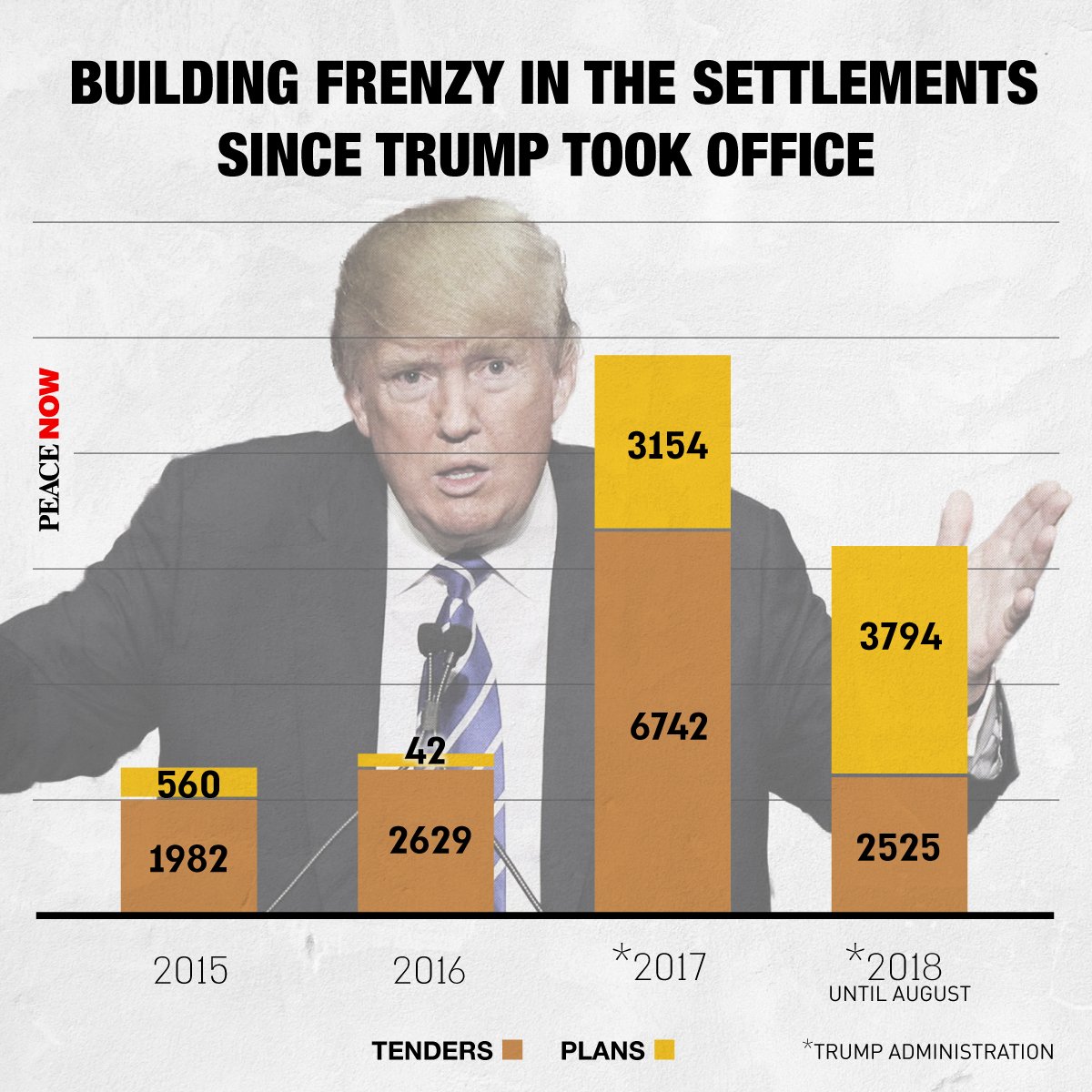
Image by Peace Now
When another settler organization – the Council of Jewish Communities in Judea and Samaria – published near identical data points in January 2019 (literally last month), the overwhelming response of the settler community was to blame former U.S. President Barack Obama for a slowdown in the population growth from the 2017 rate, which was at 3.4%. However, if Gordon is correct in his prediction of a settler surge to come, that surge will indeed by blamed on or credited to – depending on the source – U.S. President Donald Trump.
Peace Now has documented the sharp in increase in settlement advancements in 2018, which will eventually result in an increase in the population of settlers (by as many as 60,000 settlers) once those new units are built and sold.
Nabil Abu Rudeineh, spokesman for Palestinian President Mahmoud Abbas, told the AP:
“The American support for settlements through silence is doomed to failure because there is no peace and stability without an agreement with the Palestinian people and its legitimate leadership.”
New B’Tselem Report Slams High Court for Role in Dispossessing Palestinians, Validating Occupation
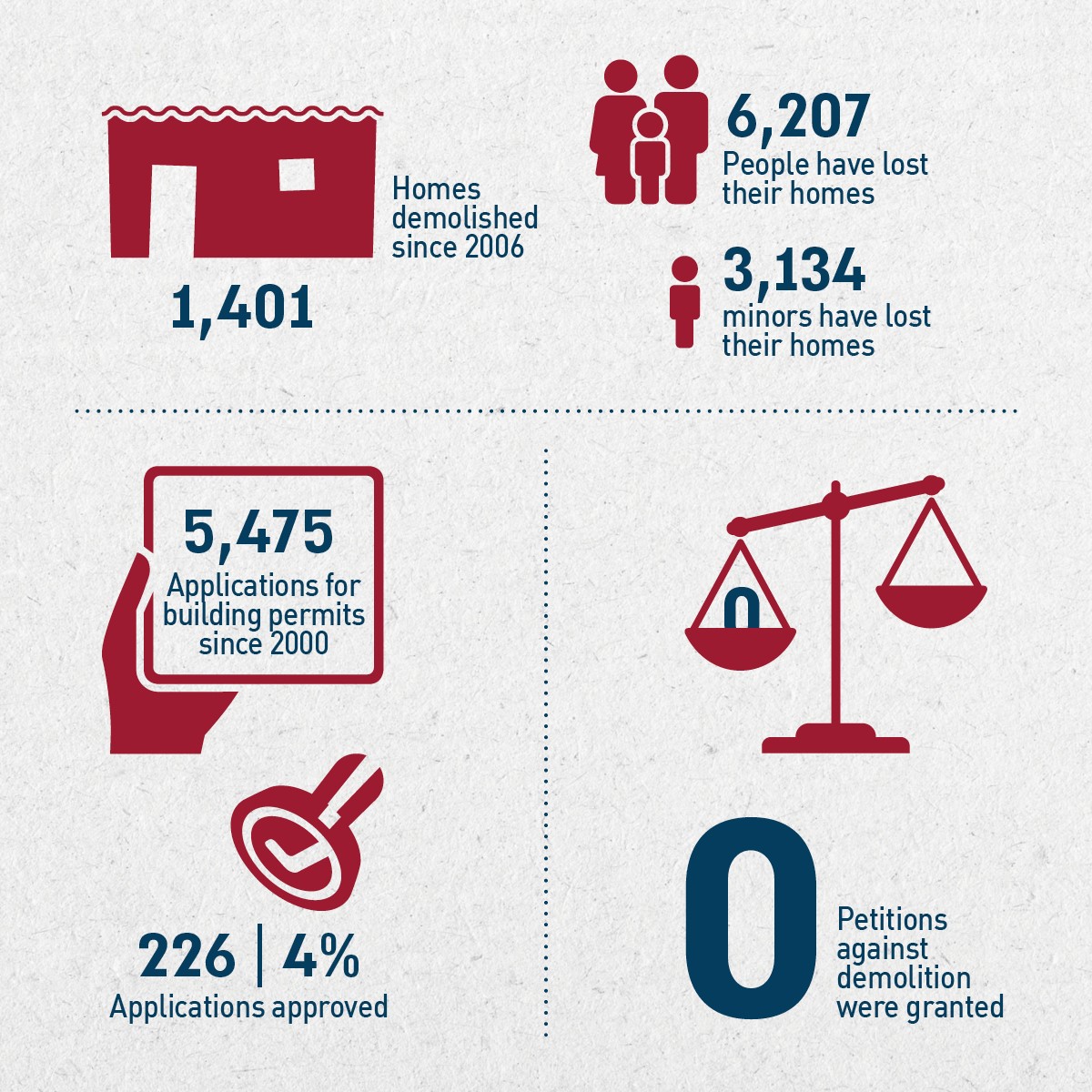
Image by B’Tselem
B’Tselem published an important new report entitled “Fake Justice: The Responsibility Israel’s High Court Justices Bear for the Demolition of Palestinian Homes and the Dispossession of Palestinians.” The report examines the role the highest court in Israel (and the only practicable avenue by which Palestinians can challenge Israeli policies and settler actions) has played in perpetuating the severe injustices inflicted upon Palestinians by the Israeli occupation and providing a guise of legality to for the Israeli policies behind them. Looking at its actions over the years as a whole, the report concludes that the court’s support of Israeli planning policy in the West Bank is tantamount to support for “forcible transfer” — a war crime.
The report’s executive summary explains:
“On the declarative level, Israeli authorities consider the demolition of Palestinian homes in the West Bank as no more than a matter of illegal construction, as if Israel does not have long-term goals in the West Bank and as if the matter does not have far-reaching implications for the human rights of hundreds of thousands of individuals, including their ability to subsist, make a living and manage their own routine. The Supreme Court has fully embraced this point of view. In hundreds of rulings and decisions handed down over the years on the demolition of Palestinian homes in the West Bank, the justices have regarded Israeli planning policy as lawful and legitimate, nearly always focusing only on the technical issue of whether the petitioners had building permits. Time and time again, the justices have ignored the intent underlying the Israeli policy and the fact that, in practice, this policy imposes a virtually blanket prohibition on Palestinian construction. They have also ignored the policy’s consequences for Palestinians: the barest – sometimes positively appalling – living conditions, being compelled to build homes without permits, and absolute uncertainty as to the future.”
The report is available to read and download here.
Video Compilation of Likud Candidates Touting Role of Tourism in Expanding Settlements
The Israeli archaeological group Emek Shaveh produced a video compilation of prominent Likud candidates touting their role in driving settlement tourism projects – in statements made in anticipation of the Likud primary elections (which were held on February 5th). Snippets in the video include:
- Former Mayor of Jerusalem Nir Barakat bragging about his work on behalf of settlement projects run by Elad in the Silwan neighborhood;
- Transportation Minister Yaariv Levin bragging on Facebook about the huge investments his ministry made into developing a settlement tourism industry, including doubling the amount of tourism to the West Bank in two years, funding two hotels in the Kiryat Arba settlement, and starting a grants program for tourist projects in settlements;
- Jerusalem Affairs Minister Zeev Elkin celebrating the opening of a “visitors center” in a settlement near the central West Bank city of Nablus.
Emek Shaveh writes:
“What was previously termed ‘hidden settlement’ has quietly transformed amid the Likud primaries into open policy. The extent of the Israeli government’s investments in the tourist settlement is now being exposed.”
There has been a growing awareness of – and opposition to – Israel’s overt investment in settlement tourism as means to expand and entrench Israeli settlements, most acutely in East Jerusalem. In February 2018, a leaked report by the European Union said explicitly that Israeli archaeological and tourism projects in East Jerusalem are “a political tool to modify the historical narrative and to support, legitimacy and expand settlements.”
Emek Shaveh issued a statement elaborating on leaked EU report, saying:
“Archaeological tourism projects are favored by the settlers as a means of winning the hearts of minds of the Israeli, Jewish and evangelical publics. The EU now recognizes how archaeological sites in East Jerusalem are being used as a political tool to ‘modify the historical narrative and to support, legitimise and expand settlements’. The City of David in Silwan, the new cable car project, the national parks in Palestinian neighborhoods compliment evictions and house demolitions in marginalising and disenfranchising the East Jerusalem Palestinian public. The difference between ‘cultural projects’ such as the national parks or the City of David and house demolitions is that in addition to the physical displacement, the former also expropriate the narrative, dispossessing the Palestinians from their historical and cultural contexts. When it comes to Jerusalem, narrative is not an abstract issue because in Jerusalem history and questions of present-day sovereignty are intertwined. And when it will come to determining the final status of the city, the question of who ‘owns’ the history of the city will be crucial.”
EU Settlement Report Details “Unprecedented” Level of Settlement Advancements 2018
On February 4th, the European Union issued its bi-annual report (pdf) documenting and analyzing trends in Israeli settlement activity from July through December 2018. It also provides a big picture summary of settlement activity in recent years, which found that there was a three-to-four-fold increase in settlement advancements in 2017/2018 (the era of U.S. President Donald Trump) compared to 2015/2016 (under Barack Obama).
The full report is available as a pdf here.
Bonus Reads
- “As West Bank Violence Surges, Israel is Silent on Attacks by Jews” (New York Times)
- “Digging Up Controversy” (US News)
- “US Blocks UN Statement on Israel Ending Hebron Monitors Mention” (Ynet)
- “CAF rejects tender for Jerusalem’s Railway as it Traverses ‘67 Borders” (Maan News)
Welcome to FMEP’s Weekly Settlement Report, covering everything you need to know about Israeli settlement activity this week.
To subscribe to this report, please click here.
November 15, 2018
- Knesset Advances Bill to Allow Settler Group to Build in Silwan
- Settler: Amichai Settlement Was Meant to Nullify Two-State Solution
- Want to Track Settlements? There’s an App for That
- Bonus Reads
Questions/comments? Email kmccarthy@fmep.org
Knesset Advances Bill to Allow Settler Group to Build in Silwan
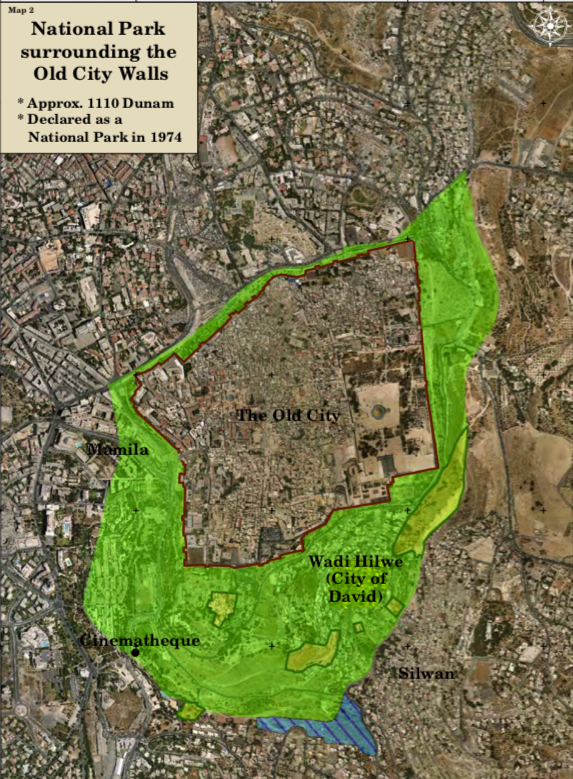
Map by Bimkom
Ir Amim reports that the Knesset has advanced an amendment to the National Parks, Natural Reserves and Memorial Sites Law – last considered in July 2018 – that will allow the Elad settler group to build settlement units in the Wadi Hilweh section of the Silwan neighborhood in East Jerusalem, in an area which Israel previously declared the “City of David National Park.” On November 15th, the proposed amendment (Amendment 17) entitled, “Planning for Housing in an Existing Neighborhood in a National Park,” was moved to the Knesset Interior Committee in preparation for a combined second and third reading, after which it will become law.
If passed into law, the amendment will create a custom made exception that exempts the City of David National Park from longstanding prohibitions against building inside of national parks. Elad has managed the “park” since 2001 on behalf of the Israel Nature and Parks Authority. In Haaretz, Ir Amim’s Director of International Relations & Advocacy, Betty Herschman, explains:
“Elad is not an environmental group or an archeological authority; it has no professional capacity to even compete for a bid to manage a national park (had there been a transparent tender process, which there was not). It is, though, a right-wing settler group. Elad is the only entity promoting this bill. Faced by objections from a spectrum of green groups, the group lobbied for a custom-made exemption to fit the City of David alone to push out Palestinians and permit building homes for settlers in a national park. That by itself should demonstrate Elad’s unfitness for running such a space. Amendment 17 is specifically designed to enable Elad to expand its foothold in Silwan where, backed by the state, it has seized roughly 75 Palestinian homes over the last several decades. The latest eviction took place last week.”
Ir Amim writes:
“Promotion of this [bill] lays bare the political drivers behind national park planning and development in East Jerusalem, an integral part of a larger settlement enterprise. National parks have become an effective tool for the state, working in cooperation with private bodies, to transfer administration and development powers for public, touristic, archaeological and educational projects into the hands of private right wing organizations; in so doing, enabling the Israelization of the Old City and surrounding band of Palestinian neighborhoods.”
For more information on the role on national parks around Jerusalem in advancing the Israeli settlement agenda in Palestinian neighborhoods, see Ir Amim’s reporting here; for a comprehensive survey and analysis of national parks in Jerusalem/East Jerusalem, see Bimkom’s report here.
Settler: Amichai Settlement Was Meant to Nullify Two-State Solution
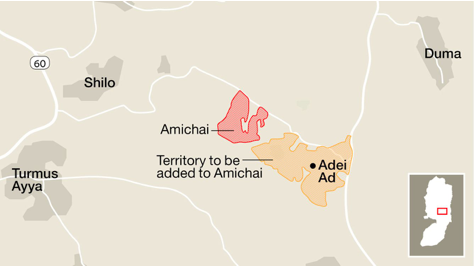
Map by Haaretz
A new Ynet report underscores the ideological significance of the Israeli government’s decision to approve plans for the first new government-backed settlement in 25 years, Amichai, which is currently under construction deep in the Shilo Valley.
As a reminder, Amichai is one of two new settlements the government promised as a pay-off to Israeli settlers who were forcibly removed from the unauthorized Amona outpost, following a High Court order (an order the government tried to avoid enforcing). The plans for the Amichai were originally approved in April 2017; in August 2018, the Israeli government approved another plan that massively expanded the municipal borders of the Amichai in order to annex several outposts – including the notorious and expansive Adei Ad outpost – to the settlement, expanding its footprint three-fold.
Recalling the Amona outpost settlers’ campaign to promote Amichai, a lead settler organizer told told Ynet:
“Some three years before the evacuation of [the unauthorized outpost of] Amona, a group of us residents were sitting in the office of the Defense Ministry’s legal advisor, Ahaz Ben Ari, in the Kirya IDF base in Tel Aviv. To our west was the Mediterranean Sea, to our east were the mountains of Judea and Samaria. Ben-Ari looked east and said, ‘You do realize you’re living there temporarily, right?’ We asked him what did he mean—’you’re talking about our homes, our lives.’ He answered, ‘The international community won’t let us stay there forever.’ I told him someone greater than us (Israel’s first prime minister David Ben-Gurion) once said, ‘What matters is not what the goyim say, but what the Jews do.’ And we said goodbye. This is the common view among the Israeli bureaucrats who decide and run things. This is the view that uses life in Judea and Samaria as a bargaining chip on the way to an arrangement with the Palestinians. Life in Judea and Samaria is put on hold. That is why the construction is only done within the confines of the separation barrier.
So the establishment of Amichai [beyond the separation barrier] is an internal statement to the bureaucrats as well as one to the international community that we’re done with just maintenance, and we’re moving forward by building a new community in the heart of the land. And not just a new community is being built, but this community is legalizing all of the smaller communities in the area. We’re leaving the confines of the separation barrier and building a community that completes the corridor of Jewish settlement from the beach in Tel Aviv to the Jordan Rift Valley. It nullifies the possibility of establishing an Arab state at the back of the mountain. And this isn’t my own personal statement, but a statement made by the prime minister and the entire Israeli government that voted unanimously to establish Amichai, a statement by the State of Israel.”
Want to Track Settlements? There’s an App for that
Americans for Peace Now has released a new and improved version of Facts on the Ground, APN’s smartphone app that gives users the ability to track, explore, and gain a comprehensive understanding of the settlements.
In announcing the updated app release, Americans for Peace Now says:
“Originally released in 2010, APN’s Facts on the Ground was the first-ever interactive online map of West Bank settlements. The new version features up-to-date statistics and data, including individual “snapshots” of every settlement and outpost in the West Bank. The app includes informational video, a comprehensive glossary, and a new, expansive statistics section from Peace Now. Facts on the Ground also marks the re-launch of APN’s Settlements in Focus publication. New issues, each profiling different West Bank settlements, will be featured on the app and available to all users.”
Bonus Reads
- “Occupation? What Occupation?” (Haaretz)
- “The Gatekeeper of Israeli Democracy & Rule of Law” (Al-Monitor)
- “How the tourism industry underpins illegal Israeli settlements” (Al Jazeera)
Welcome to FMEP’s Weekly Settlement Report, covering everything you need to know about Israeli settlement activity this week.
To subscribe to this report, please click here.
August 17, 2018
- U.S. Ambassador: There is “No Reason” to Evacuate Settlements from West Bank
- Israel Publishes Tenders for 603 new units in East Jerusalem Settlement of Ramat Shlomo
- Massive Jerusalem Development Deal for 20,000 New Apartments – Including Settlement Expansion Projects
- Israel Triples Size of New Settlement Industrial Zone In Hebron
- Knesset Sends Funds to New Settler Council in Hebron, Despite High Court Injunction
- Knesset Approves Past Due Payment for the Construction of Amichai Settlement & “Temporary” Outpost
- Delay in Opening of new Jerusalem “Park” That Confiscates Palestinian Spring
- Israel Evicts Palestinians from Bethlehem Home Despite Court Order
- Bonus Reads
Comments, questions, or suggestions? Email Kristin McCarthy at kmccarthy@fmep.org.
U.S. Ambassador: There is “No Reason” to Evacuate Settlements from West Bank
According to MK Yehuda Glick (Likud), U.S. Ambassador to Israel David Friedman – who is one of three lead authors of the supposedly forthcoming U.S. peace plan – told a group of settler leaders that he does not see any reason why settlements would need to be evacuated from the West Bank in a peace deal with the Palestinians. MK Glick said Friedman was “very explicit” about that point during the meeting, which was held at the U.S. Embassy in Jerusalem. Notably, the position attributed to Friedman is consistent with positions he has taken in the past, both in speaking and writing.
 The Embassy declined to comment on the headline-making statement or the meeting itself. Without an American statement, settler leaders are the only source for what transpired in the meeting. According to MK Glick, the small group of settler leaders pushed Ambassador Friedman to endorse an “economic peace plan” as a substitute for a political solution to the conflict. Glick said that an economic proposal would “make redundant the discourse of concessions” (under previous U.S. proposals, Israeli concessions would have included the evacuation of far flung settlements in the West Bank).
Along those lines, the group presented Ambassador Friedman with a plan for a new industrial zone and medical center in the southern West Bank that, according to Glick and Har Hevron Regional Council Chairman Yochai Damari, would employ and serve thousands of Palestinians. The plan was presented by Glick, Damari, and Palestinian businessman Muhammad Nasser, who also attended the meeting. According to Glick, the U.S. Ambassador was supportive of the plan and offered U.S. assistance once the initiative was up and running.
[UPDATED 9/28/18: More details on the joint Israeli-Palestinian industrial zone in the Har Hebron region was later fleshed out by Ynet in a report here. The plan calls for an industrial zone and commercial center to be built near the Tene-Omarim settlement. Israeli Finance Minister Moshe Kahlon briefed the details of the plan to U.S. Treasury Secretary Steven Mnuchin and Jason Greenblatt, U.S. Special Representative for International Negotiations. The U.S. is expected to present the plan to the World Economy Forum during its annual meeting in January 2019]
Israel Publishes Tenders for 603 new units in East Jerusalem Settlement of Ramat Shlomo

Map by Ir Amim
On August 15th, the Israel Land Authority published construction tenders for 603 new settlement units in the Ramat Shlomo settlement in East Jerusalem. The 603 units are part of a larger plan for 1,500 units in Ramat Shlomo (tenders for almost all of which have been published now) that was announced by Israel in 2010, during the visit of then-Vice President Joe Biden. The timing of that announcement, and the inflammatory nature of settlement approvals in East Jerusalem (which the Obama Administration pressured Israel to halt), sparked outrage and prompted Biden to issue harsh criticism of Israel while on the ground. The incident earned the 2010 Ramat Shlomo plan the nickname the “Biden Plan.”
Anti-settlement watchdog Ir Amim comments that the Ramat Shlomo tenders are a part of the Israeli endeavor to:
“expand the Israeli neighborhoods/settlements in such a way as to consume the remaining space between them and nearby Palestinian neighborhoods ( a critical geo-political link between Jerusalem and Ramallah) so as to inhibit their development and further complicate any future division of the city.”
There has been a significant uptick in East Jerusalem settlement advancements since President Trump assumed office in January 2017, reflecting the sea change in U.S. policy towards settlements (evidenced again this week by Ambassador Friedman’s remarks, detailed above). As Ir Amim details, Israel’s unrestrained advancement of settlement construction in East Jerusalem has been coupled with legislative schemes to change the borders of Jerusalem (annexing far flung settlements into Jerusalem and cutting Palestinian neighborhoods out of Jerusalem) in order to engineer a Jewish Israeli majority in Jerusalem.
Massive Jerusalem Development Deal for 20,000 New Apartments – Including Settlement Expansion Projects
On August 15th, the Jerusalem Municipality signed a $380 million deal with the Israel Land Authority to finance a plethora of projects across the city, including 20,000 new apartment units. While much of this development will be in West Jerusalem, some will reportedly be in the East Jerusalem settlements of Pisgat Ze’ev, French Hill, and Atarot. The Jerusalem City Council is expected to give final approval to the plan next week.
Israel Triples Size of New Settlement Industrial Zone In Hebron
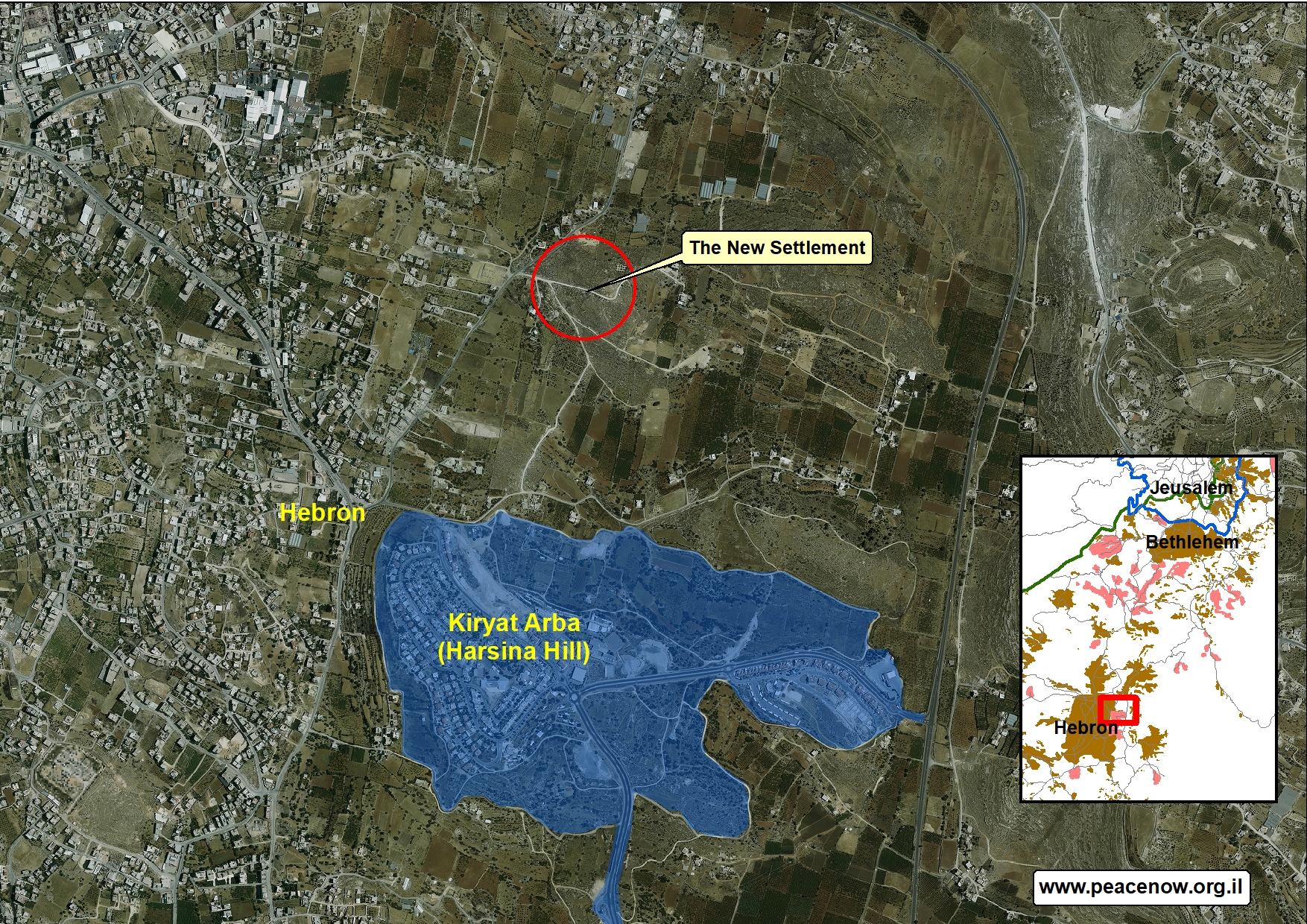
Map by Peace Now
According to The Jerusalem Post, on August 12th the Israeli government approved a plan that will triple the size of an industrial zone in the Kiryat Arba settlement in Hebron, approving 10 million shekels for the project. FMEP reported on the initial plans to build the Kiryat Arba industrial zone in March 2018, noting that the industrial zone is technically within the borders of the settlement but well outside of the developed lines of the settlement and beyond the fence that surrounds it – making it, in effect, a new Israeli settlement in Hebron. Now, the new settlement is set to significantly expand in one of the most volatile areas in the West Bank.
Knesset Sends Funds to New Settler Council in Hebron, Despite High Court Injunction
On August 12th, the Knesset Finance Committee approved 2 million shekels (about $550,000 USD) to fund the new local settler committee in Hebron. The Finance Committee requested that the money be disbursed to the Hebron settler committee “in accordance with an agreement in the past with MK Bezalel Smotrich,” (Habayit Hayehudi)…after the necessary professional and legal checks.”
The creation (via military order) of a new autonomous committee to represent and service a cluster of settlers living in enclaves in Hebron’s city center is being challenged by the Hebron Municipality. In response to the Palestinian petition, the High Court of Justice put a freeze on the plan, effective July 4, 2018, and gave the Israeli government 120 days to explain the legality of the plan. The petition argued that the military order creating the new body was intentionally vague in defining its legal and geographical jurisdiction, and pointed out that the new committee would be able to override decisions by the Hebron Municipality thereby stripping Palestinians of autonomy and representation in matters that directly affect them.
It is unclear from reporting if the Knesset Finance Committee’s decision to fund the new committee is related to the High Court’s ongoing consideration of the case. However, what is clear is that the Knesset is not concerned about undermining the High Court of Justice’s power over West Bank issues — indeed, the Knesset is actively pursuing that end with the recent passage of a new law stripping the Court of jurisdiction over land disputes and transferring it to a domestic Israeli Court, and with ongoing consideration of a bill that would allow the Knesset to reinstate laws that the High Court strikes down.
Knesset Approves Past Due Payment for the Construction of Amichai Settlement & “Temporary” Outpost
On August 12th, the Knesset Finance Committee approved the transfer of $9.5 million to pay contractors for their ongoing work on the first new settlement built with government approval in 25 years, Amichai, and a new “temporary” outpost for settlers whose homes were built on privately owned Palestinian land in the Netiv Ha’avot outpost and were recently demolished. Amichai is the new settlement approved as a pay-off to the settlers who were evacuated from the illegal Amona outpost. Construction on Amichai has begun, but has been interrupted several times due to lack of government cash, a problem ostensibly solved by this week’s cash transfer.
With respect to the new outpost for the Netiv Ha’avot outpost settlers, in February 2017 the Israeli government approved an unusual plan to place 15 mobile homes — connected to Israeli water, power, sewage, roads, and other infrastructure — at a site located near, but not within, the borders of the Alon Shvut settlement, in effect creating a new outpost for settlers evacuated from another outpost. When the High Planning Council initially approved the advancement of this plan in October 2017, it noted that “the plan is improper, but we will have to approve it as a temporary solution.” At the time, the Council ordered the government to go about expanding the borders of the Alon Shvut settlement to include the land. Under the approved plan, the new homes will be allowed to stay in that location for three years. However, based on past practice, it can be expected that within that time, or at the end of those three years, the site will “regulated” by Israel to become a permanent area of Israeli settlement.
In both cases – the Amichai plan and the Netiv Ha’avot plan – the Israeli government massively “compensating” citizens for the inconvenience of having been caught brazenly breaking Israeli law (i.e., for building without permits on privately owned Palestinian land). The two cases highlight the way in which the Israeli government not only encourages illegal settlement building, but generously incentivizes and rewards its. At this point, in addition to two new settlements, approximately 20 million shekels ($5.4 million) has been paid to the Amona evacuees and 15 million shekels ($4 million) to the Netiv Ha’avot evacuees.
Delay in Opening of new Jerusalem “Park” That Confiscates Palestinian Spring
A dispute between Israeli government agencies has led to a delay in the opening of a new Jerusalem tourist site – a park established for the express purpose of taking control over the Ein Al-Hanya spring, which was historically part of the al-Walajah Palestinian village. Originally slated to open April 1st, the delay centers around a battle over who will fund the operations of the site. For now, the site is closed and the grounds are not being maintained.
Regardless of the dispute, Israel has implemented policies that prevent Palestinians from accessing the spring and surrounding lands, including illegally moving a police checkpoint to further choke off al-Walajah from Jerusalem. As detailed in Haaretz, the plan for the park includes three pools filled by the spring – two for Israelis and tourists, and one for al-Walajah residents to water their crops and flocks. However, that third pool for Palestinians has not been built, and the water “merely spills into the nearby wadi.” The other pools, like the park, are currently empty and fenced off.
Israel Evicts Palestinians from Bethlehem Home Despite Court Order
Haaretz reports that settlers have forcibly evicted a Palestinian family from their home near Bethlehem, in defiance of an Israeli court order. The Palestinian Samara family reports that settlers tricked them into leaving the property, after which settlers locked them out, forcibly evicted them and their belongings, and then used a bulldozer to demolish their home. The family has filed an appeal to the High Court of Justice.
The Samara family – which since the early 1980s lived in 3 small units within a larger apartment building – has been targeted for eviction by settlers since 2012, when ownership of the building was transferred to an American organization controlled by Irving Moskowitz, a major funder of Jewish settlement in East Jerusalem. In 2016, the Gush Etzion Regional Council was given jurisdiction over the compound to move in Jewish Israeli settlers. Since that time, the building has been taken over by settlers, except for 2 units in which the Samara family lived as protected tenants (the third was welded shut), based on an Israeli court ruling under which the building’s owner promised not to restrict access to the building for four members of the Samara family (no other family members or visitors were allowed access). Regarding the arrangement, the judge wrote:
“This arrangement will remain in force unless a different judicial order is issued after a legal proceeding instituted by one of the parties.”
As Haaretz notes, there does not appear to be a different or new judicial order that would change the 2016 agreement.
In 2017, the Samaras reported that a new settler family had moved into the compound and began harassing the family members who remained – prompting them to file a complaint on July 26, 2018 with the Israeli police in the Beitar Illit settlement. Two weeks later on August 6th, the family was forcibly evicted and their units were demolished.
Despite the Samara’s harassment complaint and a real-time call to the police while the eviction was taking place, Israeli police took no action to prevent settlers from evicting the Samaras, reportedly stealing their cellphones, and bulldozing the properties. The Beitar Illit police station even refuse to allow the Samara family to enter the station and file a complaint until a lawyer for the family got involved many hours later.
Following intervention by UNRWA, the family was allowed to return to search the site for their ID cards and other important belongings. Now homeless, the Samara are taking their case to Israel’s the High Court of Justice.
Bonus Reads
- “A Palestinian Bedouin Village Braces for Forcible Transfer as Israel Seeks to Split the West Bank in Half” (The Intercept)
- “Between Garbage and Sewage: Israel’s Future Plans for Khan al-Ahmar” (+972 Mag)
- “Their Parents Settled the West Bank for Ideology, They’re Staying for the Vibes” (The Times of Israel)
Welcome to FMEP’s Weekly Settlement Report, covering everything you need to know about Israeli settlement activity this week.
To receive this report via email, please click here.
August 9, 2018
- Israel Plans to Use “Nation-State Law” to Defend Settlement “Regulation Law”
- Israel Moves to Approve a New Settlement…By Expanding An Existing One (An Old Trick)
- Israeli Govt is Funding a Settler School Squatting in a Palestinian Home
- Transferring Israeli Trash to the West Bank
- Settler Regional Council Funds Activities Aimed at Undermining Israeli Law
- Bonus Read
Comments, questions, or suggestions? Email Kristin McCarthy at kmccarthy@fmep.org.
Israel Plans to Use “Nation-State Law” to Defend Settlement “Regulation Law”
The Israel State’s private attorney tasked with defending the settlement “Regulation Law,” Harel Arnon, told reporters that the recent passage of the Nation-State law (declaring Israel the nation-state of the Jewish people alone) will strengthen his efforts to keeping the Regulation Law on the books (an effort which is widely expected to fail). The settlement “Regulation Law” was passed by the Knesset in February 2017, as a means to allow Israel to expropriate privately owned Palestinian land for the exclusive use/benefit of settlers. The High Court of Justice is currently weighing petitions against the settlement “Regulation Law,” which has been frozen since August 2017.
Arnon said:
“The nation-state law certainly impacts the Regulation Law. There is no question. If until now, the argument in defense of the Regulation Law was that it seeks to balance the individual rights of Israeli residents (in the West Bank) with those of the Arab residents… what the nation-state law does is raise the status of Jewish settlement to one of constitutional value.”
The Nation-State law was passed by the Knesset on July 19th, and has since sparked condemnation and protest for the way it demotes the standing of minority communities in Israel. The law says “the state views the development of Jewish settlement as a national value and will act to encourage and promote its establishment and consolidation.” Nothing in the text suggests a distinction between “Jewish settlement” within Israel’s sovereign borders, and settlement in the occupied territories.
Yossi Alpher – former senior Mossad official and IDF intelligence officer) predicted as much in his weekly explainer for Americans for Peace Now. Deconstructing recent quotes by Prime Minister Netanyahu (“Without the Nation State law it would be impossible to ensure Israel’s future as a Jewish state for the coming generations”) and Tourism Minister Yariv Levin (“The hysterics of the political left prove that this is an excellent law. Once the composition of the [High Court] judges is changed, we can get what we wanted”), Alpher deduced:
“…the ultra-nationalist right, currently Israel’s political mainstream, intends to continue absorbing the land of the West Bank into Israel. Simultaneously it seeks, in one form or another, to disenfranchise more than three million Palestinians living there lest they become Israeli citizens and tilt the demographic balance away from ‘Jewish’ and (with a combined population including 45 percent Arabs but still excluding Gaza) toward ‘bi-national’. A Jewish nation state in which only Jews determine the country’s constitutional nature is the perfect ‘legal’ legislative vehicle for taking the necessary apartheid-like measures to make this happen.”
Israel Moves to Approve a New Settlement…By Expanding An Existing One (An Old Trick)
On August 8th, the Israeli Civil Administration announced that it is planning to retroactively legalize the Adei Ad outpost by massively expanding the borders of the (brand new) Amichai settlement to turn Adei Ad into a (non-contiguous) neighborhood of Amichai. In effect, this is a stealth operation by Israel to turn the Adei Ad outpost into an entirely new official, legal settlement.
Map by Haaretz
The massive expansion of the Amichai settlement and the transformation of Adei Ad into a brand new settlement, if implemented, will be a significant step towards creating an uninterrupted corridor of settlements connecting sovereign Israel to the Ariel settlement, through the isolated Shiloh Valley settlements, all the way to the Jordan Valley. In so doing, It will completely bisect the northern part of the West Bank.
The plan takes into account a Civil Administration “Blue Line” survey in 2017, which found that the strip of land between the Amichai settlement and the Adei Ad outpost is privately owned Palestinian land. It seems that the Civil Administration is opting (for now) not to use its newly endowed tools for expropriating privately owned land for the use of settlements, and is instead moving forward with a plan that will effectively leave Adei Ad – ostensibly now a neighborhood of Amichai – physically disconnected from its new parent settlement. The strip of Palestinian land in between the two will almost certainly become inaccessible to its Palestinian owners, as is much of the Palestinian land near Adei Ad, a notoriously radical and violent outpost. It is highly likely that at a later date the land will be expropriated.
The Civil Administration unveiled the new plan in a letter addressed to Israeli NGO Yesh Din, in response to a 2014 petition against the Adei Ad outpost filed by the group on behalf of Palestinian landowners. The Civil Administration’s letter claimed the 2017 “Blue Line” land survey determined that Adei Ad is built on “state land” and is therefore eligible for retroactive legalization (despite having been built there entirely illegally). Yesh Din and its clients have formally appealed the findings of that survey, contending that Adei Ad is partially on private land.
After the Amichai borders are expanded to give cover for the legalization of Adei Ad, the Israeli Civil Administration is set to transfer administrative responsibilities over the expanded settlement (including the Adei Ad “neighborhood”) to the Binyamin Regional Council – the municipal body responsible for administering services and enforcing building laws in settlements within its jurisdiction (though it rarely moves to enforce laws against the illegal settler construction). As Haaretz notes:
“Except in the rarest cases, the council does not enforce the law against illegal construction in its jurisdiction…As a result of the transfer of administrative powers to municipal authorities at Amichai, the settlers will be able to build new structures illegally without effective enforcement.”
Yesh Din’s attorney, Shlomi Zecharia, told Haaretz:
“The inhabitants of the villages near the outpost have become hostages to the policy that abundantly rewards prizes and gifts to ideological criminals. Cutting off farmlands by means of a false [expansion of] jurisdiction is extreme, disproportionate and needless, and in fact is intended to perpetuate restrictions on and infringement of Palestinian property, this time under the official auspices of the government.”
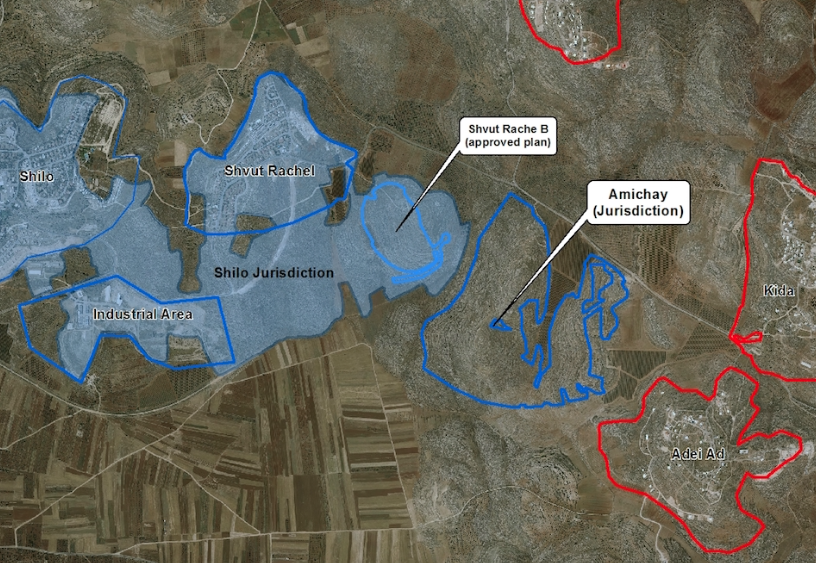
Map by Peace Now
Additionally worth noting, the Amichai expansion/Adei Ad legalization plan will represent yet another reward to settler law-breakers who evacuated from the unauthorized Amona outpost. Previously, the pay-off to settlers included the approval and construction of the Amichai settlement, which was the first new settlement to be built with government authorization in 25 years. It included, too, the approval of Shvut Rachel East, an outpost which – just like Adei Ad – became a non-contiguous “neighborhood” of an existing settlement (Shilo). The Amona pay-off package can now count a third settlement, Adei Ad. As FMEP documented at the time, the Trump Administration reportedly accepted the Amichai plan as an exception to its settlement policy which, at that time, was described in the media as President Trump asking Netanayahu “hold back on settlements for a little bit.”
Yesh Din comments on the Adei Ad scheme:
“Viewed in a broader context, this retroactive authorization is a major step towards fulfillment of Israel’s plan to annex Area C: retroactively authorizing unauthorized outposts at any price so as to ‘normalize’ them and render them permanent settlements; and creating continuous settler presence across the West Bank, from west to east, in order to facilitate the annexation, while dispossessing Palestinians of land that is their source of livelihood and in blatant disregard of international law and of the rights of Palestinian residents.”
Israeli Govt is Funding a Settler School Squatting in a Palestinian Home
The Times of Israel has a detailed report on a government-funded religious school that for years has been operating illegally in a privately owned Palestinian home near the Ofra settlement, in the center of the West Bank. The Mishpatei Eretz Institute, which is operating the school, receives around USD $55,000 annually from the Israeli Culture Ministry, and has received a total of USD $214,039 from government bodies over the past three years alone.
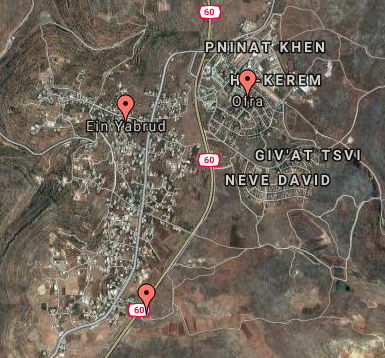
Map by Google, markers by The Times of Israel
In the mid 1990s the home was physically cut off from the Palestinian village to which it belongs when Israel paved Route 60, the major north-south highway in the West Bank. In 2003, Israeli settlers broke into the home while its owners, the Shehadeh family, were on a day trip to Ramallah. After invading the home, settlers produced forged documents claiming that the Al-Watan settler organization purchased the building, and then spent years trying to prove that the purchase was legitimate in order to have the building registered with the Civil Administration. The Shehadeh family also spent years trying to force the IDF to evict the squatters, but nothing was ever done. In the meantime, Al-Watan donated the building – even without having legally established ownership of it – to the Mishpatei Eretz Institute, which then began operating a religious school in the building with government funding.
In 2013, the Jerusalem District Court ruled against Al-Watan’s claim to the building (slamming the organization and its officers for engaging in rampant fraudulent activity), deciding that the documents had been forged and recognizing the original Palestinian owners’ rights. Ten days after the ruling, the IDF Central Command issued a military order seizing the plot of land the home sits on, claiming “security purposes.” The IDF also built a fence around the area. The military order seizing the land will remain in force until 2019.
When contacted about the story, the IDF acknowledged the 2013 Court ruling but did not offer an explanation for any of its actions dating to either before or after the court ruling. A lawyer representing the Palestinian owners told The Times of Israel that the family will soon petition the High Court of Justice to have the settlers, and their school, evicted.
The anti-settlement watchdog Kerem Navot told reporters:
“We see here another example that reveals the corrupt system that Israel maintains in the West Bank. Rather than enforce the law, and evict and punish the settlers who invaded the property, the IDF issued a corrupt military order based on security needs that de facto enables them to stay there. On top of that, we now discover that the government is generously funding criminal bodies like the Mishpatei Eretz Institute.”
Transferring Israeli Trash to the West Bank
Haaretz reports that the Israeli government is close to finalizing a new plan to transfer waste from Jerusalem to the West Bank. Under the scheme, Israel will build a waste treatment facility east of the Ma’ale Adumim settlement to handle waste from Jerusalem. The facility will recycle or burn as much of the waste as possible, and then transfer the resulting ash and any remaining waste back into Israel.
Since the West Bank is under a military occupation, environmental regulation standards are considerably lower than in sovereign Israeli territory, making the West Bank an ideal spot for Israel to dump/treat its waste on the cheap, a practice extensively documented in a 2017 report by B’Tselem. The report asserts:
“Waste treatment in the West Bank is simply one more facet of the exploitative policy Israel has practiced consistently for fifty years now, using Palestinian space and people to further its own interests. As part of this policy, Israel treats the West Bank – and particularly Area C, where it retained full control under the Oslo Accords – as an area meant to serve its needs exclusively, as if it were its sovereign territory.”
Echoing the B’Tselem report, MK Mossi Raz (Meretz) notes that the plan, though sold as an environmentally friendly solution, is part of Israel’s de facto annexation of the West Bank, saying:
“Although at first glance it looks as though the ministry wants to protect the environment, the government plans clearly demonstrate that the goal is to prepare the ground for annexation. The building of infrastructure in the occupied territories by the state, without cooperation from the PA, deepends Israeli control in the territories, and thereby in effect is bringing us even closer to the day when the Israeli government will annex the territories.”
The Israeli Defense Ministry is slowing down the implementation of the plan, which has broad support across other government ministries, for technical reasons — mainly having to do with a dispute about how the facility will be staffed.
Settler Regional Council Funds Activities Aimed at Undermining Israeli Law
In 2017 the Gush Etzion Regional Council contributed hundreds of thousands of shekels to illegal settlement and outpost construction in its jurisdiction, and heavily invested in projects connected to defending the unauthorized Netiv Ha’avot outpost against demolition. Data obtained by the Movement for Freedom of Information and analyzed by Peace Now show that the Gush Etzion Regional Council, which is supposed to be enforcing Israeli laws in areas under its jurisdiction, instead invested hundreds of thousands of shekels trying to help the illegal Netiv Ha’avot outpost skirt the law. The Council’s 2017 projects connected to Netiv Ha’avot included:
- The construction of a new, unauthorized observation tower (a memorial site) in the outpost. Construction of the tower moved forward after the High Court of Justice ruled that 17 buildings in Netiv Ha’avot were built partially on Palestinian land and must be demolished.
- A public campaign to save buildings in the Netiv Ha’avot outpost from demolition, including a payment to the radical Regavim settler organization in connection to the campaign (which is working to selectively enforce building laws against Palestinians in the West Bank). By the end of 2017, the council spent NIS 164,688 on the campaign – which, as Peace Now notes, became an even more active effort in 2018.
- Building a new (at that point unauthorized) outpost for those settlers facing evacuation from buildings in the Netiv Ha’avot outpost. The Council was able to recoup some of those expenses when the government later approved an NIS 60 million package to provide compensation for the settlers who were evacuated as well as funds for the Council.
In addition to the Netiv Ha’avot outpost expenditures, and other unauthorized settlement projects, the Gush Etzion Regional Council spent NIS 1,755 on an ATV tour for MK Yehuda Glick to conduct a “survey on the application of sovereignty over (i.e., annexation of) Gush Etzion.”
Peace Now says:
“It is time for official authorities that are obligated to act according to the law to stop funding illegal activities, attacking the High Court and evading enforcement of the law, especially when using public funds. The Interior Ministry must put an end to this sinister exploitation of the public coffers, and must get our taxpayers’ money back.”
Bonus Read
- “Fact and Fiction About the Amendment of the Israeli Supreme Court’s Jurisdiction Over West Bank Cases” (Lawfare Blog)
Welcome to FMEP’s Weekly Settlement Report, covering everything you need to know about Israeli settlement activity this week.
To receive this report via email, please click here.
July 12, 2018
- Continuing New Legal Strategy, Israel Argues “Market Regulation” Principle In Bid to Legalize Outpost
- Cabinet to Consider New Bill to Legalize 70 Outposts
- Cabinet to Consider Three Bills that Advance Annexation of Area C Settlements
- New Proof that the Israeli Government is Driving Unauthorized Settlement Activity
- High Court Freezes Plan for Settlement Committee in Hebron; IDF Seizes Private Land Near Kiryat Arba
- High Court Allows the Israel Land Authority to Remain Under the Influence of the Jewish National Fund
- New Bill Would Allow Settlers to Build on National Park Grounds in East Jerusalem
- Civil Administration Strike Will Delay Settlement Construction
- Amichai Settlement’s Makeshift Sewage Pit is Contaminating Nearby Palestinian Fields
- Israeli President Cautions Against Shaked’s Bill to Politicize Key Legal Appointments
- United Nations Envoy: Israel is Moving Towards Formal Annexation
- Bonus Reads
Comments, questions, or suggestions? Email Kristin McCarthy at kmccarthy@fmep.org.
Continuing New Legal Strategy, Israel Argues “Market Regulation” Principle In Bid to Legalize Outpost
On July 3rd the Israeli State Prosecutor’s Office told the Jerusalem District Court that it has the right to retroactively legalize the Mitzpe Kramim outpost based on the “market regulation” principle. This is the recently-invented legal principle according to which the government can seize privately owned Palestinian land to give to settlers if settlers can demonstrate (to the satisfaction of an Israeli government that is doing everything possible to help them) that they built on the land “in good faith,” based on government assurances, and if the rightful landowners are offered compensation. This is just the second time the government has used the “market regulation” principle to defend the seizure of privately owned Palestinian land in court, the first being in November 2017 when the State informed the High Court of Justice that it intended to expropriate private land near the Ofra settlement. Neither court ruled on either case.

Map by Haaretz
The government’s deployment of the “market regulation” principle in the Mitzpe Kramim case completely reverses the position the government has taken for the last 7 years on this specific outpost case. Since 2011, the Israeli government admitted that the land was privately owned, that it had been mistakenly given to the World Zionist Organization in the 1980s (the Mitzpe Kramim outpost was built without Israeli authorization in 1999), and that the situation should be corrected. In its argument on July 3, 2018, the government is expressing its newfound power to seize the land, asserting that the settlers built there “in good faith” and should not be punished for the government’s mistake, under the powers of the “market regulation.”
Peace Now said:
“The state’s announcement to the District Court is a new low in the moral and political deterioration led by the Netanyahu government. As the body that has assumed responsibility for the Occupied Territories for the last 51 years, the state should have protected the property rights of Palestinians, who have no civil rights nor the ability to defend their own land. The fact that the state failed to protect their land cannot be an excuse to steal the land and grant it to the settlers.”
As Peace Now also notes, in order to satisfy the 1967 Government Property Order (which is the law underlying the “market regulation” principle) all of the land owners must be invited to participate in the court case. However, the settlers who filed the petition regarding Mitzpe Kramim failed to include all of the registered land owners, meaning there is a long course of legal action ahead before the case. Should the Court decide the case in the settlers’ favor, it would set a potentially far-reaching precedent for implementing and upholding the “market regulation” principle.
Israeli Attorney General Avichai Mandelblit originally argued for the “market regulation” principle in late 2016 as an alternative legal basis to the Regulation Law, which he believes to be “a sweeping and injurious arrangement that does not meet the test of proportionality.” That law, passed by the Knesset in February 2017, is now in serious legal jeopardy. While the Israeli government continues to staunchly defend the broader legal basis for expropriating privately owned Palestinian land established under the “Regulation law,” its increased use of the “market regulation” principle makes clear that come what may, the Israeli government has the intention to do whatever it takes to “legally” seize Palestinian private land in order to legalize outposts (offering a stark illustration of the difference between “rule of law” and “rule by law.”)
For extensive reporting on and analysis of the “market regulation” principle and the “Regulation Law,” see FMEP’s tables documenting Israeli annexation policies.
Cabinet to Consider New Bill to Legalize 70 Outposts
MKs Bezalel Smotrich (Habayit Hayehudi) and Yoav Kisch (Likud) have submitted a bill for consideration by the Israeli Cabinet that seeks to retroactively legalize 70 unauthorized outposts across the West Bank. The Ministerial Committee for Legislation (a group of Cabinet members that decides whether or not to lend government backing to Knesset legislation before it is introduced) could vote on the July 15th, during its last weekly meeting before the Knesset recesses for its summer break. According to a Defense Ministry spokesperson, 50 of the 70 outposts can become part of existing official settlements — meaning that if passed into law, the bill would (a) significantly expand the borders/footprint of some 50 existing settlements (to include the outposts and land separately the outposts from the new parent settlement), and (b) create as many as 20 new settlements.
In addition, the bill would direct the government to treat the 70 unauthorized outposts as if they were legal settlements, which would include providing municipal services like water and electricity infrastructure at the expense of the relevant regional council (funded by Israeli tax-payers). The bill would also stop the potential of enforcement of the government’s own laws against the specified 70 outposts (reminder: the Israeli government rarely enforces building laws against Israeli settlers, actively funds outposts despite their illegality, and continues to invent new ways to legalize them). According to the bill, enforcement of building laws against the unauthorized outposts could only happen at the direction of the Defense Minister or the Prime Minister, with the backing of the Cabinet.
FMEP has repeatedly covered news regarding the government’s efforts to legalize outposts built on privately owned Palestinian land. The passage of the settlement “Regulation Law” gave the government new, sweeping authority to legalize outposts which it had been unable to address under existing Israeli law (because of the fact that they were built on privately owned Palestinian land, in effect turning these into cases of incontestable theft of private property. The 2005 Sasson Report admitted that there was no possible way to legalize outposts built on privately owned Palestinian land, and concluded that all such outposts should be evacuated). With the new law in place permitting Israel to launder this land theft, the Cabinet created a Defense Ministry task force – and appointed veteran settler leader Pinchas Wallerstein as its head – empowered to examine the individual legal situation of each outpost and devise plans to retroactively legalize as many outposts as possible. In January 2018, a leaked recording revealed that the task force had been working for six months to prescribe courses of action for the outposts. Despite this, settlers and Knesset members have complained that the task force has done nothing and has not been funded, using these as talking points in their push for the new Smotrich bill.
Developments related to these efforts are tracked in FMEP’s annexation policy tables.
Cabinet to Consider Three Bills that Advance Annexation of Area C Settlements
In addition to the outpost legalization bill (covered above), the Israeli Ministerial Committee on Legislation is slated at its next weekly meeting on July 15th to discuss three bills that seek to advance Israeli de facto annexation of Area C, after refraining from discussing them last week. Those bills are:
- A bill to recognize settlements in the South Hebron Hills as well as the Kiryat Arba settlement (which is, in effect, part of Hebron) as part of the Negev regional economy. Economically, the change would enable these settlements to benefit from government grants and programs for the Negev; politically, and far more importantly, the change would erase the Green Line, legally treating these settlements as part of sovereign Israeli territory (the Negev is an area located inside sovereign Israel).
- A bill to change a 1953 Jordanian law in order to allow Israelis to directly purchase property in the West Bank. Under the current law, private, non-Arab individuals cannot purchase land in the West Bank. In 1971, the law was amended to add a loophole allowing companies registered to operate in the West Bank (like the World Zionist Organization and the Jewish National Fund) to purchase property, and often do so only to give it to Israeli settlers. This additional change would open the door for private purchases across the West Bank by settlers and their backers, including in the heart of Palestinian cities. Notably, Israeli security officials have in the past objected to changing this law, based on their recognition of the fact that settlers implanting themselves wherever they want in the West Bank – including in acts intended to be deliberately provocative – will be a security nightmare for the IDF and will enable settlers and their financial patrons to further hijack the national security agenda of the state of Israel.
- A bill to rescind the 2005 Disengagement Law in order to allow four settlements in the northern West Bank to be rebuilt. The settlements – Sa-Nur, Homesh, Kadim and Ganim – were evacuated following the passage of the Disengagement Law. Notably, the head of the Samaria Regional Council, Yossi Dagan, is one of the settlers that was evacuated from Sa-Nur in 2005 and has championed the bill, which was submitted for Cabinet consideration by Bezalel Smotrich (Habayit Hayehudi).
New Proof that the Israeli Government is Driving Unauthorized Settlement Activity
The Israeli State Comptroller published a report that exposes how Israel government bodies have colluded with the Binyamin Regional Council (one of the main governing bodies over West Bank settlements) to bankroll the construction and ongoing support of unauthorized outposts, even as the Israeli Civil Administration acts to try to stop the illegal construction the government is funding.
The report reads:
“The [Binyamin Regional] council has been the driving force in the construction of unauthorized communities [outposts] and has financed them…In so doing, the council has dictated a negative standard of behavior, that has allowed for illegal construction in the Judea and Samaria and has even advanced such activity…Government offices were involved in financing the planning and construction of the unauthorized outposts.”
In one of several examples of how the collusion has worked, the Comptroller explained that the Esh Kodesh outpost – which is actually located outside of the Binyamin Regional Council’s jurisdiction – was built in 2000 without government permission. In 2014, the Interior Ministry financed the renovation of roads in the outpost. Meanwhile, the Civil Administration issued demolition orders against structures in the outpost in 2003, 2012, and 2013.
Sensing opportunity to promote their new bill to retroactively authorize outposts (see above), MKs Yoav Kisch (Likud) and MK Bezalel Smotrich (Bayit Yehudi) argued that the Comptroller’s report, by proving the the state has participated in building outposts, underlines the necessity of authorizing those outposts for the sake of the settlers who moved to the outposts at the encouragement of the state.
Adding to the Comptroller’s report (and echoing several of its key points), a freedom of information act filed by Peace Now revealed that the Binyamin Regional Council has been concealing massive and illegal annual contributions to the Amana organization, which leads wide scale illegal settlement construction. Amana received NIS 37 million over three years from the Council, which is 57% of the funds doled out to non-governmental groups over that period. The Comptroller’s report criticized the Council’s support for private organizations, which violates Israeli law restricting regional councils to supporting apolitical, public groups. The report said “the council serves as a conduit for transferring funds from the state to a private association.”
Peace Now writes:
“this data now reveals the depth of this robbing of public funds to finance political campaigns and illegal activity. It is time for the Interior Ministry to put an end to this abuse of Israelis’ taxpayer money and to demand that the authorities in the West Bank cease this illegal funding and give the money back.”
High Court Freezes Plan for Settlement Committee in Hebron; IDF Seizes Private Land Near Kiryat Arba
The Israel High Court has ordered a temporary freeze on a military order creating a new, autonomous settler committee to represent and service a cluster of Israeli settlement enclaves in Hebron’s city center, a plan announced by Defense Minister Avigdor Liberman in August 2017. The military order, if allowed to be implemented, would transfer responsibility for the settlers’ municipal services (roads, sewage, electricity, etc.) from the Hebron Municipality to the new settler committee, a plan which contradicts the 1997 Hebron Protocol.
The High Court gave the Israeli government 120 days to explain the legality of the plan, which was challenged on multiple fronts by the Hebron Municipality. The petition argued that the military order was intentionally vague in defining the legal and geographical jurisdiction of the proposed settler body, and pointed out that the new committee would be able to override decisions by the Hebron Municipality thereby stripping Palestinians of autonomy and representation in matters that directly affect them.
While the Court considers the matter, events on the ground continue to underscore the volatility of the situation in Hebron. Elor Azaria, the Israeli soldier who was caught on camera executing an incapacitated Palestinian on the streets of Hebron, victoriously returned to the city on July 3rd after serving only 9 months in jail. The festivities welcoming Azaria were planned by a group that included the extremist settler and politician, Baruch Marzel. Only two days after the Azaria lovefest, Marzel pitched a two-person tent on the sidewalk next to a Palestinian home in the Tel Rumeida neighborhood in the Old City of Hebron. According to the Palestinian news outlet Ma’an, Marzel was involved in attacks on Palestinians in Tel Rumeida the same day, in an incident that resulted in the arrest of one Palestinian. Israeli police removed Marzel’s encampment from the street.
Also in Hebron, Palestinian media reports that Israeli forces have confiscated a plot of privately owned Palestinian land near the Kiryat Arba settlement and the Ibrahimi Mosque/Cave of the Patriarchs. A Hebron activist reports that the Israeli Army set up a new camp across the street from the seized land about one month ago, and is now moving the camp to the new site with the intention of declaring it a “closed military zone” to prevent Palestinians from entering the area.
High Court Allows the Israel Land Authority to Remain Under the Influence of the Jewish National Fund
The High Court of Justice dismissed a petition filed by Adalah which alleged that the Jewish National Fund’s representation on the Israel Land Authority council infringes on the rights of Palestinian to equality and dignity. Under Israeli law, 6 of the 14 members on the Land Authority council are to be appointed by the Jewish National Fund, an organization the petitioners say (with good cause) “openly discriminates against non-Jews and sees itself as an entity that serves only one population.” The Israel Land Authority is responsible for deciding how (and to whom) to allocate or sell land in Israel, including the land owned by the Jewish National Fund (13% of all land in Israel).
Following the High Court’s dismissal of the petition, the Haaretz Editorial Board wrote:
“In a properly run country, people who declare that they’re committed to acting in a discriminatory way are immediately disqualified from a public role. One can only imagine what Israelis’ response would be if in a country where Jews were a minority, half of a group’s members stated their intention to discriminate against Jews.”
New Bill Would Allow Settlers to Build on National Park Grounds in East Jerusalem
The radical settler group Elad is lobbying for a bill that will allow the group to build settlement units on the grounds of one specific national park located in the East Jerusalem neighborhood of Silwan, where Elad is engaged in a variety of activities to displace Palestinians and replace them with Israeli settlers (as FMEP has reported on extensively). On July 10th, the bill was approved by the Knesset’s Interior and Environment Committee, despite objections submitted to the committee by the Justice Ministry and the Attorney General. The bill was sent to the Knesset plenum for its first of three votes.
The bill will allow Elad to build more homes for Israeli settlers on the grounds of the City of David national park, which is located immediately south of the Temple Mount, adjacent to the southern wall of the Old City of Jerusalem. Since 2001, Elad has managed the park grounds on behalf of the Israel Nature and Parks Authority, a scheme which gives the settler group authority over (but no legal responsibility towards) thousands of Palestinian homes and hundreds of settler homes – a demographic balance Elad is working hard to flip.
Ir Amim’s researcher Aviv Tatarsky told Haaretz:
“This isn’t the first time a monkey is being made of the law and common sense to advance the agenda of the Elad settlers. But even this law can’t change the fact that Silwan, like East Jerusalem, is entirely a Palestinian city. Israeli attempts to deny that simple truth impair the basic rights of 350,000 people in East Jerusalem. The residents of the Israeli city also pay a price for it.”
For more information on the role on national parks around Jerusalem in advancing the Israeli settlement agenda in Palestinian neighborhoods, see Ir Amim’s reporting here, and a key survey and analysis of national parks in Jerusalem/East Jerusalem by Bimkom here.
Civil Administration Strike Will Delay Settlement Construction
A recently released list of Civil Administration functions that will be brought to a halt during the impending union strike includes the High Planning Council’s work to advance settlement construction plans, though a Civil Administration spokesperson said that construction can be expected to climb next quarter.
Hananel Dorani, Chairman of the Yesha Council, the umbrella group representing settlements,wrote a letter to Prime Minister Netanyahu, Defense Minister Lieberman, and Finance Minister Kahlon. Dorani, highlighting the green light from the political echelon to promote settlements, criticized the Civil Administration while pushing for a resolution:
“Especially now, at a time when political approval was given to promote construction, it’s not only commonplace that the Civil Administration doesn’t meet the task properly, but the workers’ strike will exacerbate the situation and create a bottleneck that’ll be difficult to free from for years. Civil Administration employees’ demand to add additional positions and their requests to improve salary conditions so they can fill existing positions hasn’t been answered for a long time, leading to renewed sanctions. As is well known, this is not the first time Civil Administration employees have initiated sanctions, but this hasn’t yet been dealt with…this organization is routinely substandard, and for a long time important headquarters work wasn’t promoted, plans approved by the political echelon are halted and piled up on the table in the Civil Administration, budgets earmarked for infrastructure projects (transportation, cellular, etc.) aren’t realized, no work permits are issued, and more…We ask that you get involved with all relevant parties and act immediately and personally to restore the Civil Administration to full functioning.”
Samaria Regional Council chairman Yossi Dagan complained:
“As if it is not enough that every house in Judea and Samaria (West Bank) needs four different permits from the political echelon, now the residents have also become hostages in a conflict between Civil Administration employees and the Finance Ministry.”
The Civil Administration will also suspend the following operations: the flow of commercial goods between the West Bank (both settlements and Palestinian areas) and sovereign Israel; changes to the land and population registries, issuance of import licenses and business permits; and, significantly, all actions – including demolitions – against illegal construction, which might delay the demolition of the Khan al-Ahmar bedouin community.
Amichai Settlement’s Makeshift Sewage Pit is Contaminating Nearby Palestinian Fields
Raw sewage from the Amichai settlement (the first new government-backed settlement in 20 years, established in the Shiloh Valley as pay-off to the evacuees of the illegal Amona outpost) has been flowing into the agricultural lands of the nearby Palestinian village Turmus Ayya.
The settlers dug a temporary sewage site (a pit in the ground that is now overflowing) only a few meters from Palestinian farm lands. Settlers have been living in mobile homes on the site of the settlement (which has not been built yet) for less than four months, and Palestinians say the the sewage began overflowing two months ago. A permanent sewage site for the settlement has not yet been built, in part because the settlement plans were approved at a “dizzying speed,” as Haaretz explains it.
Israeli President Cautions Against Shaked’s Bill to Politicize Key Legal Appointments
At a swearing in ceremony for new judges, Israeli President Reuven Rivlin took the opportunity to pointedly criticize a bill promoted by Justice Minister Ayelet Shaked which would, by design, politicize the appointment of ministerial legal advisors (a bill FMEP reported on here).
Rivlin said:
“we need independent legal advisors whose commitment to the law and being gatekeepers flows in their veins and constitutes the essence of their professional ethic. I understand elected officials. I too served in one or two roles before I reached this house, and I didn’t always agree with the legal advisor’s position. However, I believe we must be careful not to weaken one of the important pillars of the executive branch in Israeli democracy. We all want a legal advisor who’ll serve all elected officials from anywhere in the political spectrum in exactly the same way. Faithfully, devotedly, professionally, committed to government policy and primarily responsibility to uphold the law.”
United Nations Envoy: Israel is Moving Towards Formal Annexation
Ahead of the United Nations Human Rights Council’s meeting on the Israeli-Palestinian conflict, legal expert Michael Lynk told press that:
“After years of creeping Israeli de facto annexation of the large swathes of the West Bank through settlement expansion, the creation of closed military zones and other measures, Israel appears to be getting closer to enacting legislation that will formally annex parts of the West Bank. This would amount to a profound violation of international law, and the impact of ongoing settlement expansion on human rights must not be ignored.”
The statement was later posted on the Human Rights Council’s website.
Bonus Reads
- “US administration silent on Israel’s occupation policy” (Al Monitor)
- “A Tango of Violence: Building Outposts on Palestinian Land” (Haaretz)
- “The Maps of Israeli Settlements that Shocked Barack Obama” (The New Yorker)
- “Israel slams ‘immoral’ Irish bill banning trade with settlements” (Times of Israel)
- “The demolition of Khan al-Ahmar is more than just a war crime” (+972 Mag)
Welcome to FMEP’s Weekly Settlement Report, covering everything you need to know about Israeli settlement activity this week.
To receive this report via email, please click here.
March 30, 2018
- 2017 – A Record Year in Settlement Expansion
- Hebron Settlers Leave One Disputed Property, Only to Enter Two More
- Settlers Celebrate Moving to Amichai, the First New Government-Backed Settlement in 25 Years
- Housing Minister on Annexation: Settlements are a Non-Negotiable Security Asset, Israel Must Keep Building
- Ambassador Friedman: U.S. Will Not Intervene To Stop Israeli Annexation
- After Annexing Settlement Universities, Israeli Education Ministry Moves to Censor Campus Criticism of Settlements/Occupation
- Terrestrial Jerusalem Report: “The Creation of a Settler Realm in and Around Jerusalem’s Old City”
- Al-Shabaka Policy Brief: Israel’s Annexation Crusade in Jerusalem
- Yesh Din/Emek Shaveh Report: “Appropriating the Past: Israel’s Archaeological Practices in the West Bank”
- Emek Shaveh Report: The Jerusalem Cable Car Undermines the History & Multiculturalism of the Historic Basin
- You Can’t Make This Stuff Up: Settler Lands Helicopter at Qalandiya Checkpoint (in Attempt to Seize It)
- Bonus Reads
Comments, questions, or suggestions? Email Kristin McCarthy at kmccarthy@fmep.org
2017 – A Record Year in Settlement Expansion
In its annual report on settlement activity, the settlement watchdog group Peace Now documents two significant facts about settlement growth in 2017 – the first year in the era of the Trump Administration era. Peace Now figures show that there was a large spike in new settlement starts compared to previous years; and second, most of these new construction starts are located in areas that are beyond the area that Israel can realistically expect to retain under any negotiated two-state agreement. 
Specifically, Peace Now reports that in 2017, construction began on 2,783 new settler housing units, an increase of around 17% over the yearly average rate since 2009. In terms of location of these new starts, Peace Now found that:
- More than three-quarters of the new housing starts are in settlements located deep inside the West Bank, beyond what would be a realistic border for a negotiated two-state agreement.
- Fewer than one-fifth of the new construction starts are located in areas west of the security barrier, as currently constructed (i.e., in settlements already de facto annexed to Israel by the barrier).
- At least one out of every ten of the new settlement starts is illegal according to Israeli laws (all settlements are illegal under international law), with most located in illegal outposts.
Director of the Peace Now Settlement Watch project, Shabtay Benet told i24News,
“If in the past, the government had focused on construction and housing within the blocs, it appears that the government is [today] openly working toward a reality of annexation.”
In addition, Peace Now documents in detail other major 2017 settlement-related developments, including:
- the establishment of three new illegal outposts in 2017: “Neve Achi” (near Ramallah ), “Kedem Arava” (near Jericho), and “Shabtai’s Farm” (south of Hebron).
- the establishment of the new “legal” settlement of “Amichai,” which is the first new settlement built with government approval in 25 years.
- Construction of a major new bypass road to link settlers more seamlessly to Jerusalem,
- The seizure by Israel of nearly 1,000 dunams of Palestinian land near Nablus in order to begin legalizing outposts in the area.
- The approval by the Israeli government of 31 new units for settlers in the heart of the Palestinian city of Hebron.
 The report also provides a timeline of data showing the fluctuation of Israeli government policy regarding outposts from 1996-2017. The data indicate that a 2006 pledge by Netanyahu to cease funding the construction of new outposts (a pledge that followed the publication of the government-mandated report on outposts known as the Sasson Report) expired in 2012, at which time the government began allowing (if not supporting) the construction of new outposts. Since 2012, 16 new outposts have been built and allowed to remain, some of which are now in the process of being retroactively legalized by the government.
The full report is available online here.
Hebron Settlers Leave One Disputed Property, Only to Enter Two More
After nearly eight months of illegally occupying a disputed property in Hebron, more than 100 settlers left the Beit Machpelah/Abu Rajab building. The High Court has ruled that the settlers must leave the residence while the Justices’ consider a case regarding rightful ownership of the property – a case that is not expected to wrap up in the near term.
In tandem with the departure of the settlers, the new head of the Israeli Army’s Central Command, Maj. Gen. Nadav Padan, signed an order declaring the area around the property – which is across the street from the the Tomb of the Patriarchs/Al-Ibrahimi Mosque – as a “closed military zone,” where civilian access is forbidden. Ostensibly intended to prevent the settlers from re-entering the property, the order will inevitably further restrict freedom of movement for Palestinians, who already face acute limitations resulting from segregated and closed-off streets, a maze of checkpoints, harassment by settlers living in the middle of the city, and the heavy IDF presence guarding a few hundred Israeli settlers living amidst ~150,000 Palestinians in Hebron.

Map by Peace Now
Undeterred (or emboldened) by their experience with the Beit Machpelah/Abu Rajab building, Hebron settlers subsequently broke into and occupied two additional properties in downtown Hebron (which settlers are calling “Beit Leah” and “Beit Rachel,” and which Palestinians call the “Zaatari Compound,” after the Palestinian family who owns the buildings). Like in the case of the Beit Machpelah/Abu Rajab building, ownership of these two properties is disputed, with settlers claiming to have purchased the properties lawfully from Palestinian owners, and the Palestinians denying having sold them. And like the past nearly eight months in the case of the Beit Machpelah/Abu Rajab building, the settlers are for now being allowed to stay in the two disputed properties, under the protection of the IDF, in violation of Israeli law.
Breaking the Silence – an Israeli NGO recently barred from giving tours in Hebron – told The Times of Israel that the removal of the settlers from the Beit Machpelah/Abu Rajab building was “appropriate” but:
“Still, this is just only a drop of water in the sea of illegal invasions that we guarded as soldiers… For 50 years, settlers have been establishing facts on the ground and we are being sent to guard them at the expense of the Palestinians.”
With respect to the two new properties occupied by the settlers, Peace Now said:
“The settlers’ recent break-in into the Zaatari compound constitutes just the latest in a slew of such unauthorized incidents in Hebron. Their strategy is clear. Since they have failed thus far to obtain the ownership rights legally, instead they must resort to illegal means to establish facts on the ground by squatting, knowing that the right-wing government will be reluctant to attract negative publicity from its base by evicting settlers, and will in turn attempt to delay the eviction or perhaps find a way to legalize the take-over. Fellow Israeli citizens must not give in to this emotional blackmail, and the authorities must evict these squatters without delay.”
Settlers Celebrate Moving to Amichai, the First New Government-Backed Settlement in 25 Years
Settlers who were removed from the unauthorized Amona outpost last year held a ceremony March 26, 2018, marking the day that they moved into Amichai, the new settlement that was promised to them as compensation. Amichai is the first new settlement built with government approval in 25 years. The leader of the law-breaking Amona settlers, Avichai Boaran, said at the ceremony:
“After a long wait and a stubborn struggle – tomorrow it happens. Amichai residents enter their new community! We are looking forward to entering our new homes, which we were able to establish with the blood of our hearts, with determination and faith, love for the land and for Zionism.”
The settlers will be housed in temporary mobile homes while construction continues in the settlement. The Master Plan approved for Amichai permits 102 units on a hilltop in the Shiloh Valley, a third of which face additional legal proceedings as a result of petitions filed by Palestinian landowners.
As FMEP has covered many times in the past, Amichai is the first of two new settlements approved by the Israeli government in early 2017 as pay-off to settlers who were forced to leave the Amona outpost by the High Court of Justice. That Amona outpost was established without authorization from the Israeli government and was located on private Palestinian land; the government of Israel fought for years to retroactively legalize it, but eventually was forced by the High Court to evacuate its residents (evacuation that some residents resisted violently). The establishment of Amichai clearly demonstrates that settler law-breaking not only goes unpunished, but is handsomely rewarded by the Israeli government, and that establishing illegal outposts is an effective route to establishing new settlements.
Housing Minister on Annexation: Settlements are a Non-Negotiable Security Asset, Israel Must Keep Building
Minister of Housing and Construction, Yoav Galant (Kulanu), told settler leaders that he believes Israel must bolster the settlements, calling them “non-negotiable [security] assets” that Israel must always maintain “full control” over. Galant’s remarks were made during a meeting with leaders of the Yesha Council (a settlement umbrella group) during which he also bragged about doubling the budget for settlement construction. He said:
“The Ministry of Construction and Housing, headed by me, has invested twice the budgets of the previous government in planning and development in Yehuda and Shomron.” [Note: “Yehuda and Shomron” means Judea and Samaria, the biblical names for the area in the West Bank]
Yesha Council Chairman Chananel Dorani thanked Minister Galant for his support, saying:
“Minister Galant leads the Housing Ministry to important goals and objectives for the development of the State of Israel, the area of Yehuda, Shomron and the Jordan Valley is a suitable space for massive construction and dispersal of the population of the country. I am thankful for your consistent support for the settlement, for the ideal, but also for the actions.”
Ambassador Friedman: U.S. Will Not Intervene To Stop Israeli Annexation
In an interview with an Israeli Orthodox newspaper this week, U.S. Ambassador David Friedman was quoted as suggesting that the U.S. was ready to replace President Abbas if he refused to play ball with U.S. efforts. Friedman subsequently claimed he was misquoted. He did not, however, suggest that he was misquoted on another subject that came up in that interview: possible annexation of part of the West Bank. Friedman was asked in the interview if the U.S. would support partial annexation of the West Bank. Friedman reportedly answered:
“On these issues, Israel ought to decide for itself, we will not intervene with the government in Jerusalem regarding its way of handling the conflict. We will definitely express our opinion when asked, but we’ll avoid unnecessary involvement in decision making.”
Friedman’s remark come amidst a growing wave of legislation and legal opinions pushing Israeli annexation schemes forward, none of which the U.S. has publically intervened to stop, or even criticize. To date, Israeli Prime Minister Netanyahu has held at bay the most forthright annexation legislation – like a bill to annex Ma’ale Adumim/E-1, the “Greater Jerusalem Bill,” a Jordan Valley annexation bill, and the Likud-inspired the “Annexation/Sovereignty Bill” – always citing concerns about coordinating with the United States. Friedman’s comments, which were neither clarified nor contradicted by anyone in Washington, suggest that the Trump Administration would not object to legislation of this kind moving forward.
Simultaneously, Netanyahu has allowed annexation to proceed on several more subtle fronts, including: giving government support to the “Ariel Bill” (now law) which effectively annexed settlement universities and colleges; giving government support to a bill that would transfer jurisdiction over West Bank land disputes from the High Court to the Jerusalem District Court (where a pro-settlement judge was recently installed by Justice Minister Shaked); defending the “Regulation Law” and, at least seemingly, beginning to implement it against the dictates of a court-ordered injunction; finding additional legal bases (1 and 2) to retroactively legalize outposts; installing radical settlers in government posts tasked with handling land disputes in the West Bank and East Jerusalem; and much more. These annexation policies are, of course, in addition to the day-to-day settlement construction on the ground that is gobbling up more and more West Bank land (documented in detail in Peace Now’s comprehensive report on settlement activity in 2017, discussed above).
Americans for Peace Now responded to Friedman’s latest pro-settlement, pro-annexation remarks, saying:
“Friedman is a loose cannon, whose statements on the Israeli-Palestinian conflict routinely upend longstanding US foreign policy. Given Friedman’s advocacy on their behalf, it is not difficult to see why settler leaders see President Trump and his Middle East team as sent by God.”
After Annexing Settlement Universities, Israeli Education Ministry Moves to Censor Campus Criticism of Settlements/Occupation
A month after bringing settlement universities under Israeli sovereign control (affectively annexing them), the Israeli Council of Higher Education advanced a new code of ethics that seeks to ban professors in all Israeli universities from criticising settlements or the occupation.
The new code has five principles, most having to do with preventing discrimination based on political views and affiliation. The principles include clauses prohibiting lecturers from calling for or engaging in activity that promotes an academic boycott of Israel or its academic institutions (some of which are now in the settlements), and another clause that prohibits faculty from promoting the idea of boycotting Israel.
Israel’s Association of University Heads (VERA) slammed the move as an attempt to politically censor academia, saying they will not “serve as political thought police for the government.” The statement from VERA, representing the heads of Israeli universities, goes on to say:
“We are already seeing a dangerous deterioration on the edge of the abyss with regards to freedom of expression and academic freedom, as is customary in dark countries and not in a country that claims to be a democracy. [We] do not accept the dictation from ‘the top’ and do not intend to serve as a tool for narrow political interests. We will continue to fight for academic freedom, free speech and freedom of expression in the democratic State of Israel.”
Education Minister Naftali Bennett, who requested the new code, called the statement from VERA “puzzling” and turned logic on its head to defend the new code from criticism, saying:
“We must keep the world of academic free of politics and foreign interests. Complete academic freedom – yes. Promoting political agendas and calling for a boycott – no. We are in fact limiting the freedom of condemnation and increasing the freedom of expression, so the academic discourse in Israel remains free of politics and discrimination. At the gates of academia, leave politics outside.”
Now that the new code has been adopted, the Council for Higher Education is seeking input from universities. After the input is collected, the Council will review and amend the code before bringing it up for a final vote. The Council said it aims to have the code adopted by universities by 2019, with required reporting on efforts to implement its provision due to the Council in 2020.
Terrestrial Jerusalem Report: “The Creation of a Settler Realm in and Around Jerusalem’s Old City”
Terrestrial Jerusalem published a comprehensive look at how Israel is creating a “settler realm” in Jerusalem. The report opens,
“taken as a whole, the array of ongoing projects and plans centered on the Old City and its immediate hinterlands represents an unprecedented move to fundamentally change the character and fabric of life in these areas, turning them into – as we’ve termed it in the past – a Disneyland-style area in which one historical and religious narrative, the Jewish one, predominates and marginalizes/erases all others.”

Map by Terrestrial Jerusalem
The report focuses on 12 recent and ongoing projects that are taking place largely in the context of a 2005 decision of the Sharon government – following its withdrawal from Gaza – to pursue, “a thinly veiled scheme to consolidate the settlers’ control over the public domain in the Old City and its environs.” At that point, an ad hoc, what had been an incremental settler campaign to establish Jewish hegemony over East Jerusalem became a multi-million-shekel per year government-backed endeavor to fortify a Jewish Israeli settler control over all areas of East Jerusalem and the Old City.
Commenting on the settler regime, Terrestrial Jerusalem founder Daniel Seidemann writes:
“While these are all recent developments, they reflect the culmination of a process that has been going on for many years. The data … further illustrate the predominant role played by Elad and the JDA [the Jerusalem Development Authority] in advancing settlers’ control over East Jerusalem, and the complicity of the State in doing so, as detailed in the Comptroller Report published on November 2016 (see our analysis here). Indeed, the settler “DNA” has been injected into virtually all of the governmental organs with any relevant authority in and around the Old City: the Israel Lands Authority, the Custodian General, the Absentee Property Custodian, the Israel Police, the Planning Committees, the Jerusalem Municipality, the Ministry of Finance and many more. Similarly, many of the authorities of these governmental agencies have been outsourced to the settlers. The governmental adoption of the settler ideology and the outsourcing of governmental authority create a situation in which the public interest and the settler interest have become virtually indistinguishable. No new master plan has been created, and none is necessary – the brakes that slowed these schemes have merely been removed. Israel remains a feisty, albeit increasingly challenged democracy: when it comes to the Old City and its visual basin, it morphs into something highly reminiscent of a regime.”
Al-Shabaka Policy Brief: Israel’s Annexation Crusade in Jerusalem
A new report from Al-Shabaka: The Palestinian Policy Network, titled “Israel’s Annexation Crusade in Jerusalem: The Role of Ma’ale Adumim and the E1 Corridor,” paints a picture of Israeli policies building towards the eventual annexation of the settlements bordering Jerusalem, paying particular attention to the history and centrality of the Ma’ale Adumim and E1 settlement areas. Though Netanyahu has delayed the outright annexation of these settlements by blocking the passage of the “Greater Jerusalem Bill,” Al-Shabaka’s brief examines several other bills, projects, resolutions, and regulations that effectively advance the annexation more subtly.
The report’s author, Zena Agha, concludes with key recommendations emphasizing the need to more stridently highlight and oppose the Israeli settlement enterprise and the creeping annexation inherent in recent policies. Agha writes,
“Since it is evident that the Trump administration will not be the restraining force on the right-wing coalition in the Knesset, nations other than the US as well as international bodies must apply pressure on the Israeli government to ensure any annexation bill is costly. Palestinian civil society and the Palestine solidarity movement must go further in raising awareness of how close the Israeli settlement project is to the point of no return in their current and planned campaigns with policymakers.”
Yesh Din/Emek Shaveh Report: “Appropriating the Past: Israel’s Archaeological Practices in the West Bank”
In a new joint report documenting a 4-year project, Emek Shaveh and Yesh Din reveal how Israeli organizations used a guise of archaeological preservation to dispossess Palestinians of privately owned land across the West Bank since 1967. The report, titled “Appropriating the Past: Israel’s Archaeological Practices in the West Bank,” introduces the topic by explaining:
“Israel continues to use its position as the administrator of archaeological sites in the West Bank as a means to deepen its control over West Bank land, to expand the settlement enterprise, and extend the policy of dispossession of Palestinians from their lands and cultural assets. Although the takeover of land through archaeology is not the main method of achieving Israeli control over land, it is significant because of its symbolic aspects and impact on public awareness.”
The report goes on to document several examples of how archaeology is used to advance settlements. Those include:
- Gerrymandering the jurisdiction of settlements to include antiquity sites, as in the case of the Anatot-Almon settlement and the Tel-Alamit antiquity site;
- Illegally invading of antiquity sites, as in the case of the Ain al Qaws spring near Nabi Saleh; and,
- Using archaeological excavations to retroactively justify the establishment of new settlements, as in the case of the Shiloh settlement and the now evacuated Amona outpost.
The report concludes:
“By controlling all aspects of archaeology – the excavations, management of the sites, the interpretation of the nds, and which knowledge is disclosed to (or concealed from) the public – Israel appropriates the archaeological treasures uncovered in the West Bank and exploits them in order to sustain a narrative of continued Israeli control over the OPT.”
The report is available online here.
Emek Shaveh Report: The Jerusalem Cable Car Undermines the History & Multiculturalism of the Historic Basin
In a recent paper, the Israeli NGO Emek Shaveh analyzes the detrimental impacts of the new Israeli cable car project, including the dispossession and tangible economic consequences facing Palestinian Jerusalemites.
The paper concludes:
“The cable car is an experimental project driven by political interests in the most important and sensitive site in our region – the Old City of Jerusalem. Although this project is presented to the public as a response to transportation and tourism needs, its goal is political – strengthening Israel’s hold on East Jerusalem with a national-religious narrative and by “establishing facts on the ground” that will erase the chances of a historic compromise in the Holy Basin and the rich cultural diversity of the city. The cable car will also seriously damage the historical nature of the Old City and corrupt its famous beauty, which attracts visitors from all over the world.”
FMEP has tracked the planning process for the cable car, a project promoted by the settler group Elad. Elad aggressively pursues the eviction of Palestinians and the growing presence of Jewish Israelis across East Jerusalem, but particularly in the Silwan neighborhood where the Kedem Center is being built to serve as the final stop of the cable car line. The project has been harshly critiqued by the international community.
You Can’t Make This Stuff Up: Settler Lands Helicopter at Qalandiya Checkpoint (in Attempt to Seize It)
This week, Yedidya Meshulami – a settler living in an illegal outpost near Nablus – attempted to usurp the Israeli Army and take control of the Qalandiya checkpoint by landing his personal helicopter nearby, declaring “I don’t care what they do to me, I’ll take it [the checkpoint] over.” Israeli security forces arrested Meshulami and seized his helicopter (shortly thereafter he was released to house arrest; it goes without saying that had he been a Palestinian seeking to take over the checkpoint by any means whatsoever, he would still be in custody). The Qalandiya checkpoint is the most heavily trafficked checkpoint in the West Bank, through which 26,000 Palestinians (who are lucky enough to have permits to enter Israel) pass en route to Jerusalem on a daily basis.
Meshulami landed his helicopter at the site of the defunct Atarot airport, situated on a strategic strip of land between Jerusalem and Ramallah near the Qalandiya checkpoint he hoped to take control over. Rumors concerning plans to build a settlement at the Atarot site have been rumbling for over a year, fed by the Knesset’s decision to allocate millions of shekels to the project last October. Developing the airport into an Israeli settlement would deprive a future Palestinian state of the only airport in the West Bank, would cut through many Palestinian neighborhoods, and would further sever East Jerusalem from a Palestinian state (acting like E-1 on Jerusalem’s northeast flank, and like Givat Hamatos on Jerusalem’s southern flank).
Meshulami, lives in an unauthorized outpost called “Alumot” near the settlement of Itamar, south of Nablus. Meshulami helped establish the outpost in 1996 after serving in the Israeli Air Force and, despite lacking permits, he personally built an airstrip in the outpost in 2013. According to reports this week, Israeli security forces had previously revoked Meshulami’s pilot license for flying over the West Bank without a permit. Two days after his arrest, the IDF raided the illegal airstip and seized a second helicopter. They also found an ultralight plane that will reportedly be seized in the coming days.
Bonus Reads
- VIDEO: Times of Israel Settlements Correspondent Jacob Magid discusses internal settler dynamis w/ Ron Kampeas (FMEP)
- “Settler Violence Against Palestinians Is on the Rise, but Goes Regularly Unpunished” (Haaretz)
- “Israel’s government and the settlers want terror.” (Haaretz+)
- “Israel’s Separation Barrier: Legitimate in theory, malicious in practice” (Times of Israel)